wheel TOYOTA FJ CRUISER 2012 1.G Owners Manual
[x] Cancel search | Manufacturer: TOYOTA, Model Year: 2012, Model line: FJ CRUISER, Model: TOYOTA FJ CRUISER 2012 1.GPages: 540, PDF Size: 10.32 MB
Page 460 of 540
460 5-2. Steps to take in an emergency
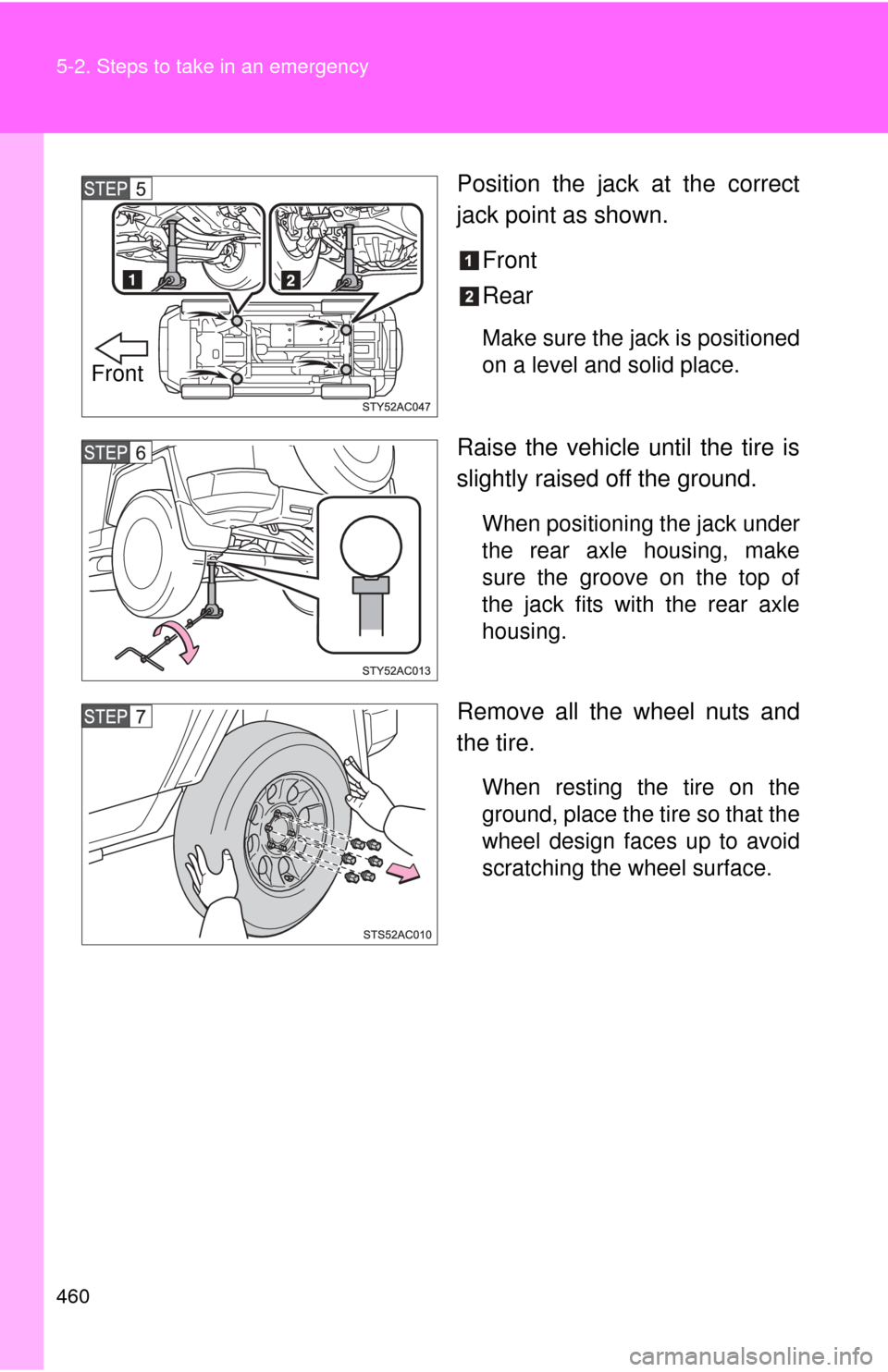
Position the jack at the correct
jack point as shown.Front
Rear
Make sure the jack is positioned
on a level and solid place.
Raise the vehicle until the tire is
slightly raised off the ground.
When positioning the jack under
the rear axle housing, make
sure the groove on the top of
the jack fits with the rear axle
housing.
Remove all the wheel nuts and
the tire.
When resting the tire on the
ground, place the tire so that the
wheel design faces up to avoid
scratching the wheel surface.
Front
Page 461 of 540
5
When trouble arises
461
5-2. Steps to take in an emergency
Installing the tire
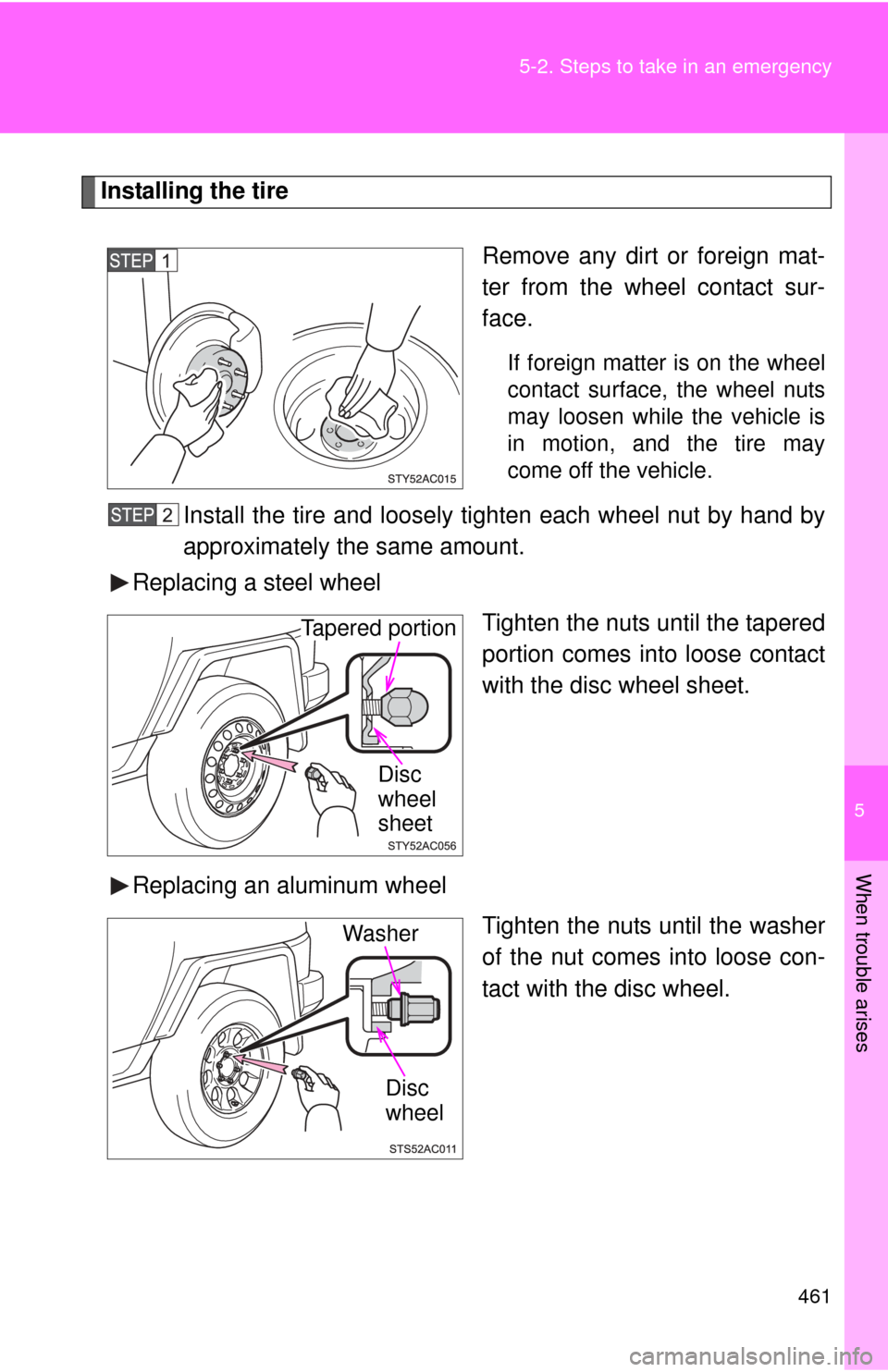
Remove any dirt or foreign mat-
ter from the wheel contact sur-
face.
If foreign matter is on the wheel
contact surface, the wheel nuts
may loosen while the vehicle is
in motion, and the tire may
come off the vehicle.
Install the tire and loosely tighten each wheel nut by hand by
approximately the same amount.
Replacing a steel wheel
Tighten the nuts until the tapered
portion comes into loose contact
with the disc wheel sheet.
Replacing an aluminum wheel Tighten the nuts until the washer
of the nut comes into loose con-
tact with the disc wheel.
Tapered portion
Disc
wheel
sheet
Disc
wheel
Washer
Page 462 of 540
462 5-2. Steps to take in an emergency
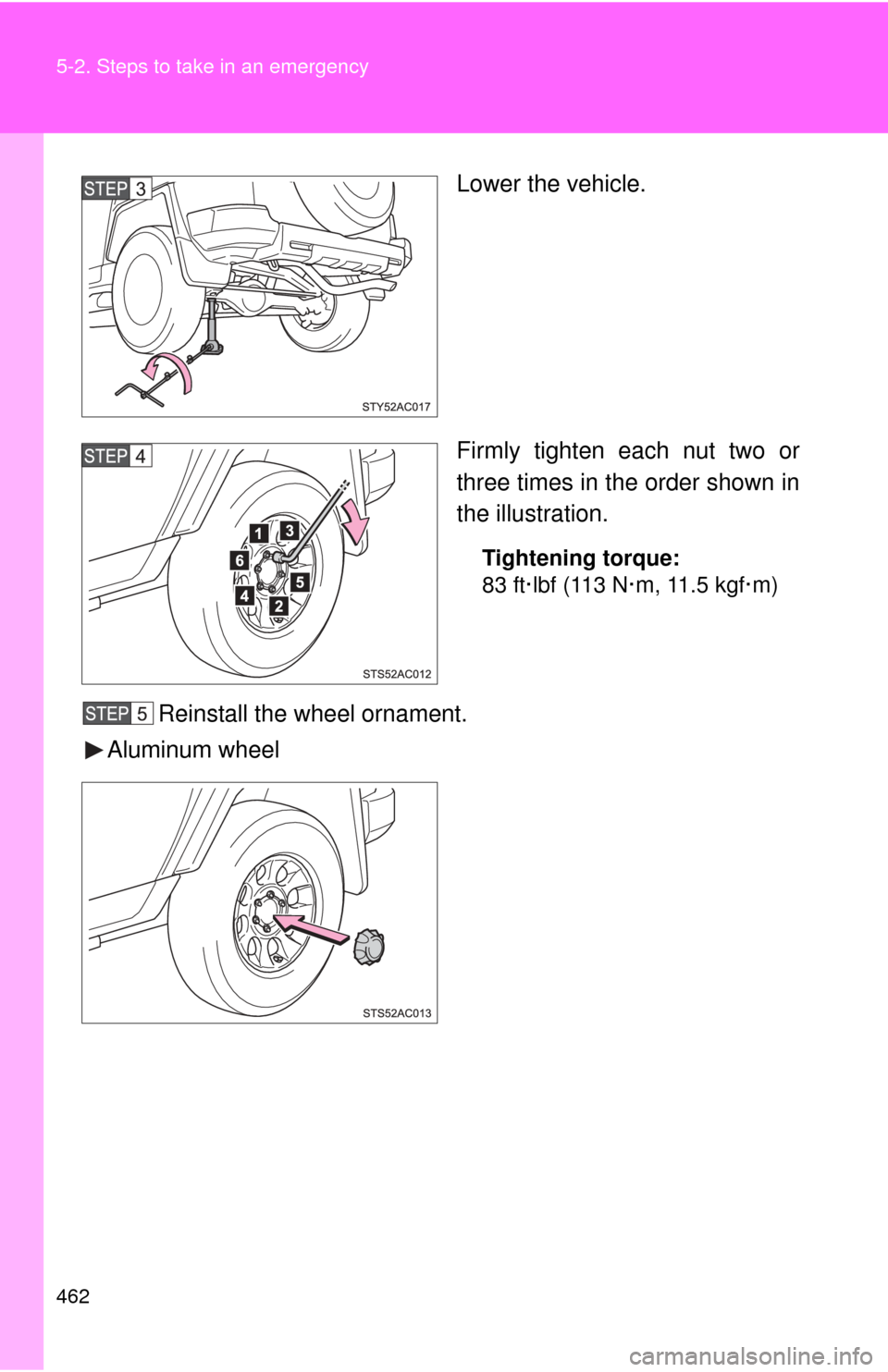
Lower the vehicle.
Firmly tighten each nut two or
three times in the order shown in
the illustration.
Tightening torque:
83 ft·lbf (113 N·m, 11.5 kgf·m)
Reinstall the wheel ornament.
Aluminum wheel
Page 463 of 540
5
When trouble arises
463
5-2. Steps to take in an emergency
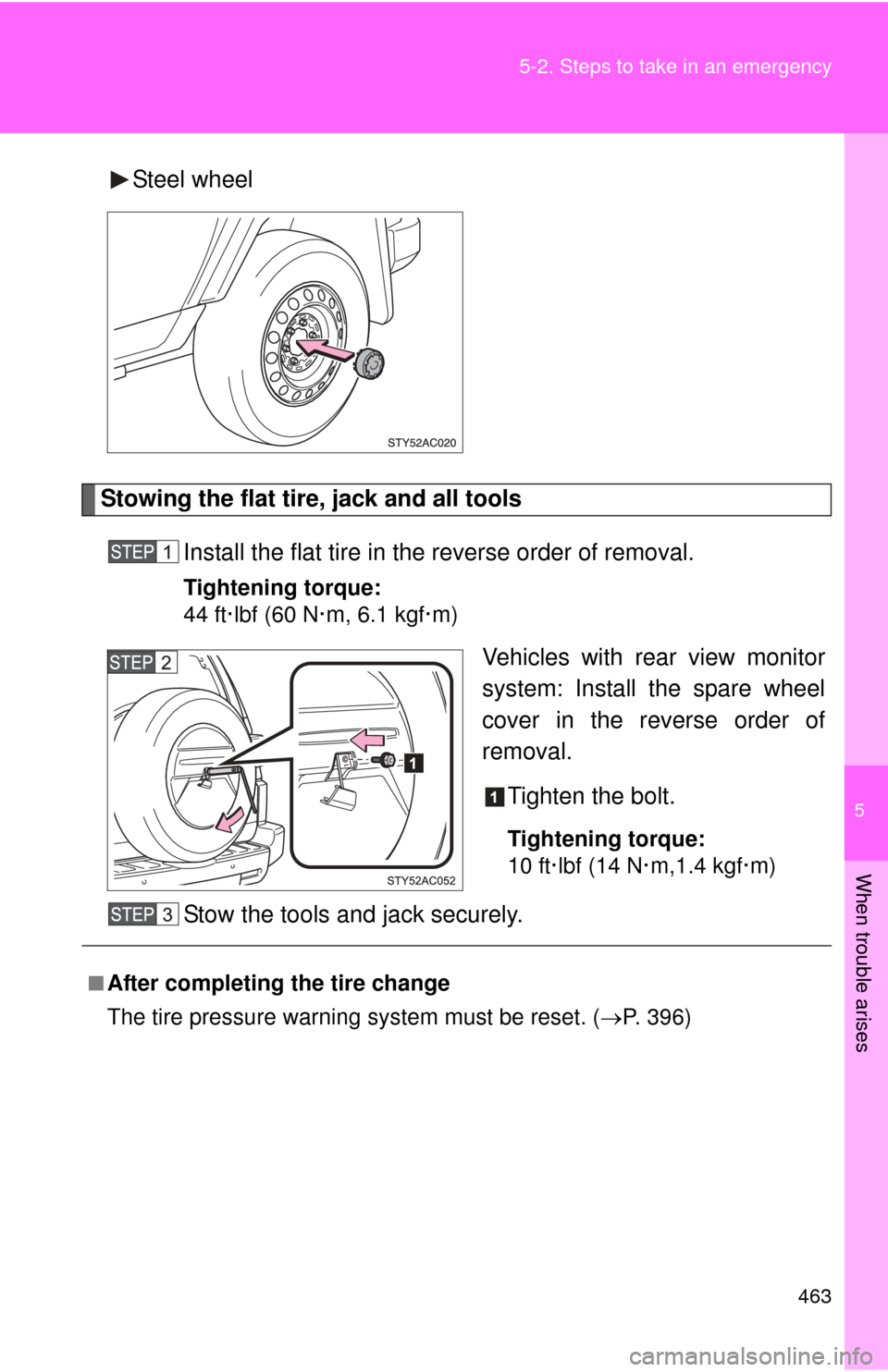
Steel wheel
Stowing the flat tire, jack and all tools
Install the flat tire in the reverse order of removal.
Tightening torque:
44 ft·lbf (60 N·m, 6.1 kgf·m)
Vehicles with rear view monitor
system: Install the spare wheel
cover in the reverse order of
removal.Tighten the bolt.
Tightening torque:
10 ft·lbf (14 N·m,1.4 kgf·m)
Stow the tools and jack securely.
■After completing the tire change
The tire pressure warning system must be reset. (P. 396)
Page 465 of 540

5
When trouble arises
465
5-2. Steps to take in an emergency
CAUTION
■Replacing a flat tire
●Observe the following precautions.
Failure to do so may resu
lt in serious injury:
• Do not try to remove the wheel ornament by hand. Take due care in handling the ornament to avoid unexpected personal injury.
• Do not touch the disc wheels or the area around the brakes imme- diately after the vehicle has been driven.
After the vehicle has been driven the disc wheels and the area
around the brakes will be extremely hot. Touching these areas with
hands, feet or other body parts while changing a tire, etc. may
result in burns.
●Failure to follow these precautions could cause the wheel nuts to
loosen and the tire to fall off, resulting in death or serious injury.
• Have the wheel nuts tightened with a torque wrench to 83 ft·lbf (113 N·m, 11.5 kgf·m) as soon as possible after changing wheels.
• When installing a tire, only use wheel nuts that have been specifi- cally designed for that wheel.
• If there are any cracks or deformations in the bolt screws, nut threads or bolt holes of the wh eel, have the vehicle inspected by
your Toyota dealer.
• When installing the wheel nuts, be sure to install them with the
tapered ends facing inward. ( P. 408)
Page 466 of 540

466 5-2. Steps to take in an emergency
NOTICE
■Do not drive the vehicle with a flat tire
Do not continue driving with a flat tire.
Driving even a short distance with a flat tire can damage the tire and the
wheel beyond repair.
■When replacing the tires
●When removing or fitting the wheels, tires or the tire pressure warning
valve and transmitter, contact your Toyota dealer as the tire pressure
warning valve and transmitter may be damaged if not handled cor-
rectly.
●Replace the grommets for the tire pressure warning valves and trans-
mitters as well.
■To avoid damage to the tire pressure warning valves and transmit-
ters
When a tire is repaired with liquid sealants, the tire pressure warning
valve and transmitter may not operate properly. If a liquid sealant is
used, contact your Toyota dealer or other qualified service shop as soon
as possible. Make sure to replace the tire pressure warning valve and
transmitter when replacing the tire. ( P. 396)
■To prevent damage to the wheel ornament
Vehicles with a steel wheel: Do not attach wheel ornament to the wheel
on the back door.
Vehicles with rear view monitor syst em: Do not install a wheel with the
ornament attached onto the back door.
■To prevent damage to the camera (vehicles with rear view monitor
system)
Be careful not to impact or damage the camera when installing or remov-
ing the spare tire.
Page 478 of 540

478 5-2. Steps to take in an emergency
CAUTION
■When attempting to free a stuck vehicle
If you choose to rock the vehicle back and forth to free it, make sure the sur-
rounding area is clear, to avoid striki ng other vehicles, objects or persons.
The vehicle may also lunge forward or lunge back suddenly as it becomes
free. Use extreme caution.
■ When shifting the shift lever
Vehicles with automatic transmission: Be careful not to shift the shift lever
with the accelerator pedal depressed.
This may lead to unexpected rapid acceleration of the vehicle that may
cause an accident and result in death or serious injury.
NOTICE
■To avoid damaging the transmission and other components
●Avoid spinning the wheels and do not rev the engine.
● If the vehicle remains stuck after trying these procedures, the vehicle may
require towing to be freed.
Page 480 of 540

480 5-2. Steps to take in an emergency
CAUTION
■If the engine has to be turned off while driving
●Power assist for the brakes and steering wheel will be lost, making the
brake pedal harder to depress and the steering wheel heavier to turn.
Decelerate as much as possible before turning off the engine.
● Never attempt to remove the key, as doing so will lock the steering wheel.
Page 482 of 540
482
6-1. Specifications
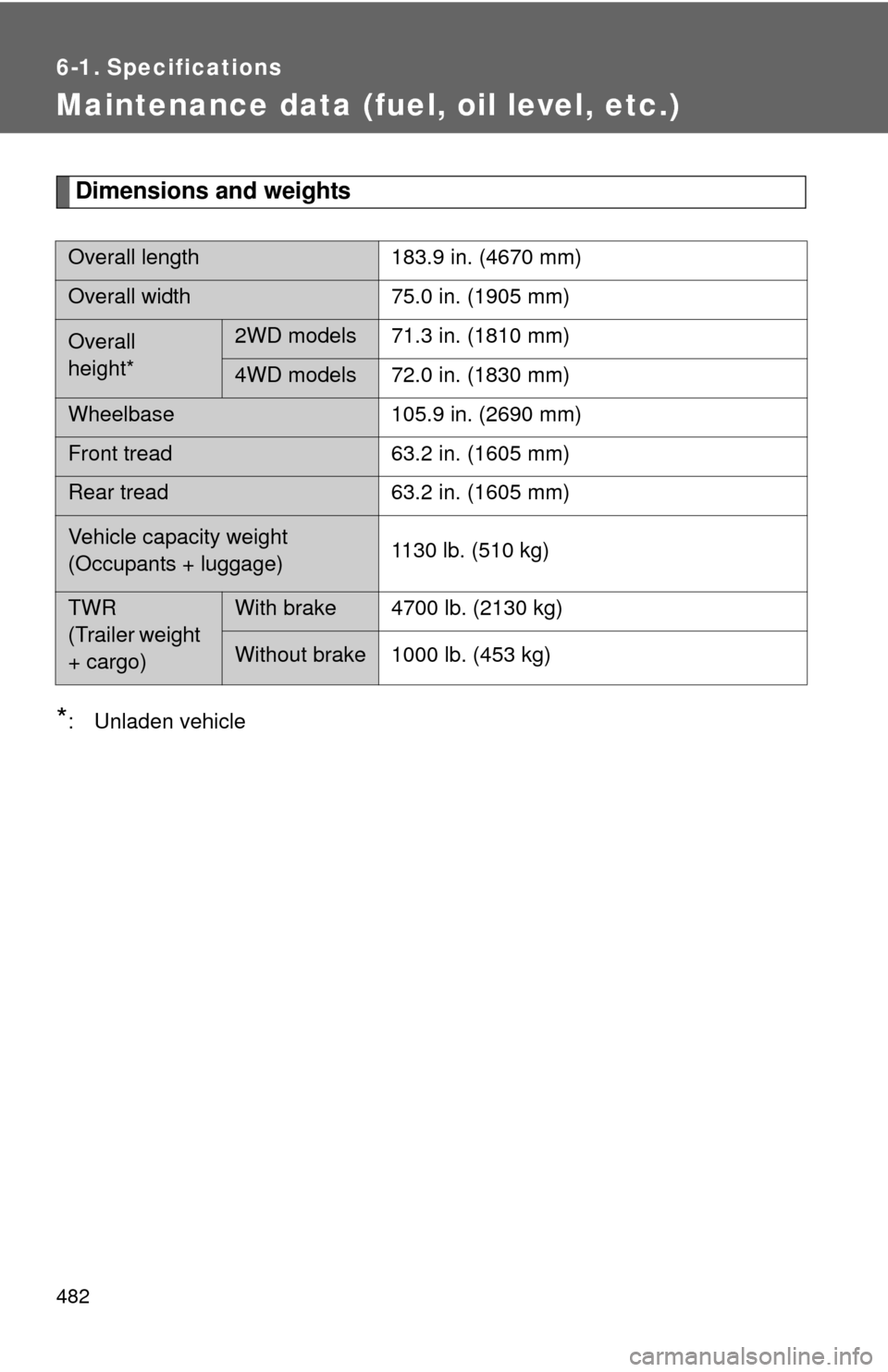
Maintenance data (fuel, oil level, etc.)
Dimensions and weights
*: Unladen vehicle
Overall length183.9 in. (4670 mm)
Overall width75.0 in. (1905 mm)
Overall
height*2WD models 71.3 in. (1810 mm)
4WD models 72.0 in. (1830 mm)
Wheelbase105.9 in. (2690 mm)
Front tread 63.2 in. (1605 mm)
Rear tread 63.2 in. (1605 mm)
Vehicle capacity weight
(Occupants + luggage)1130 lb. (510 kg)
TWR
(Trailer weight
+ cargo)With brake 4700 lb. (2130 kg)
Without brake 1000 lb. (453 kg)
Page 491 of 540
491
6-1. Specifications
6
Vehicle specifications
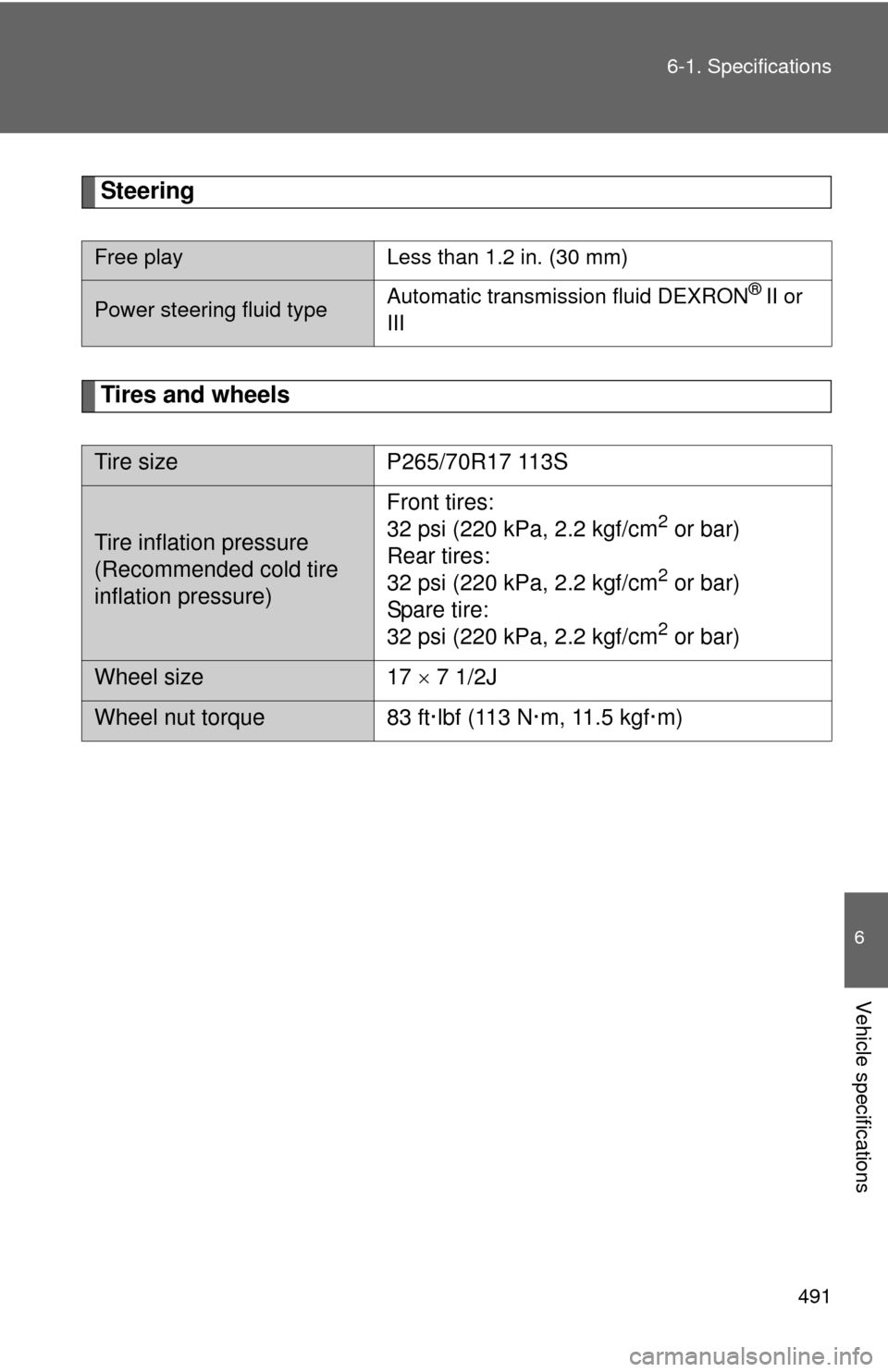
Steering
Tires and wheels
Free playLess than 1.2 in. (30 mm)
Power steering fluid type
Automatic transmission fluid DEXRON® II or
III
Tire size P265/70R17 113S
Tire inflation pressure
(Recommended cold tire
inflation pressure)Front tires:
32 psi (220 kPa, 2.2 kgf/cm2 or bar)
Rear tires:
32 psi (220 kPa, 2.2 kgf/cm
2 or bar)
Spare tire:
32 psi (220 kPa, 2.2 kgf/cm
2 or bar)
Wheel size 17 7 1/2J
Wheel nut torque 83 ft·lbf (113 N·m, 11.5 kgf·m)