brake light TOYOTA FJ CRUISER 2012 1.G User Guide
[x] Cancel search | Manufacturer: TOYOTA, Model Year: 2012, Model line: FJ CRUISER, Model: TOYOTA FJ CRUISER 2012 1.GPages: 540, PDF Size: 10.32 MB
Page 181 of 540

181
2-4. Using other
driving systems
2
When driving
■When the TRAC OFF (TRC OFF) indi cator light comes on even if the
VSC OFF switch has not been pressed
TRAC (TRC) system cannot be operated. Contact your Toyota dealer.
■ Automatic reactivation of TRAC (TRC) and VSC
Turning the engine switch off after turning off the TRAC (TRC) and VSC sys-
tems will automatically re-enable them.
■ Automatic VSC reactivation (2WD models)
If only the TRAC system is turned off, VSC OFF and AUTO LSD indicators
turn on. The VSC system will turn on when the vehicle speed increases.
■ Automatic TRAC (TRC) and VSC reactivation
If the TRAC (TRC) and VSC systems are turned off, the systems will not turn
on, even when vehicle speed increases.
■ Sounds and vibrations caused by the ABS, TRAC (TRC), VSC and
brake assist system
● A sound may be heard from the engine compartment when the engine is
started or just after the vehicle begins to move. This sound does not indi-
cate that a malfunction has occurred in any of these systems.
● Any of the following conditions may occur when the above systems are
operating. None of these indicates that a malfunction has occurred.
• Vibrations may be felt through the vehicle body and steering.
• A motor sound may be heard after the vehicle comes to a stop.
• The brake pedal may pulsate slightly after the ABS is activated.
• The brake pedal may move down slightly after the ABS is activated.
■ If the brake system overheats
TRAC (TRC) will cease operation and a buzzer will sound to alert the driver.
Stop the vehicle in a safe place. (Ther e is no problem with continuing normal
driving.)
Page 373 of 540
373
4-2. Maintenance
4
Maintenance and care
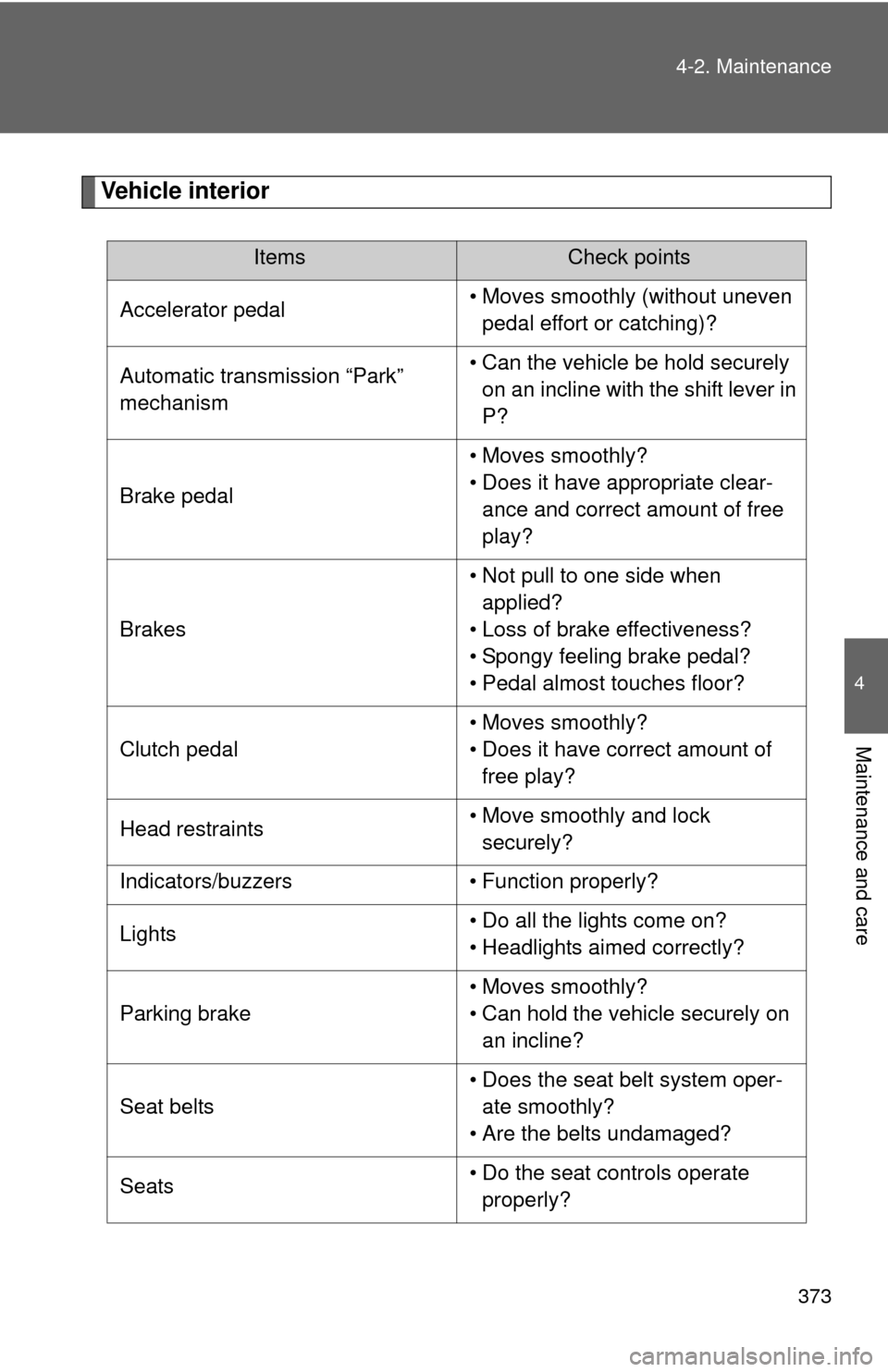
Vehicle interior
ItemsCheck points
Accelerator pedal • Moves smoothly (without uneven
pedal effort or catching)?
Automatic transmission “Park”
mechanism • Can the vehicle be hold securely
on an incline with the shift lever in
P?
Brake pedal • Moves smoothly?
• Does it have appropriate clear-
ance and correct amount of free
play?
Brakes • Not pull to one side when
applied?
• Loss of brake effectiveness?
• Spongy feeling brake pedal?
• Pedal almost touches floor?
Clutch pedal • Moves smoothly?
• Does it have correct amount of
free play?
Head restraints • Move smoothly and lock
securely?
Indicators/buzzers • Function properly?
Lights • Do all the lights come on?
• Headlights aimed correctly?
Parking brake • Moves smoothly?
• Can hold the vehicle securely on
an incline?
Seat belts • Does the seat belt system oper-
ate smoothly?
• Are the belts undamaged?
Seats • Do the seat controls operate
properly?
Page 379 of 540

379
4-3. Do-it-yourself maintenance
4
Maintenance and care
NOTICE
■
If you remove the air cleaner
Driving with the air cleaner removed may cause excessive engine wear due
to dirt in the air. Also a backfire could cause a fire in the engine compart-
ment.
■ If the fluid level is low or high
It is normal for the brake fluid level to go down slightly as the brake pads
wear or when the fluid level in the accumulator is high.
If the reservoir needs frequent refilling, it may indicate a serious pro\
blem.
Page 388 of 540
388 4-3. Do-it-yourself maintenance
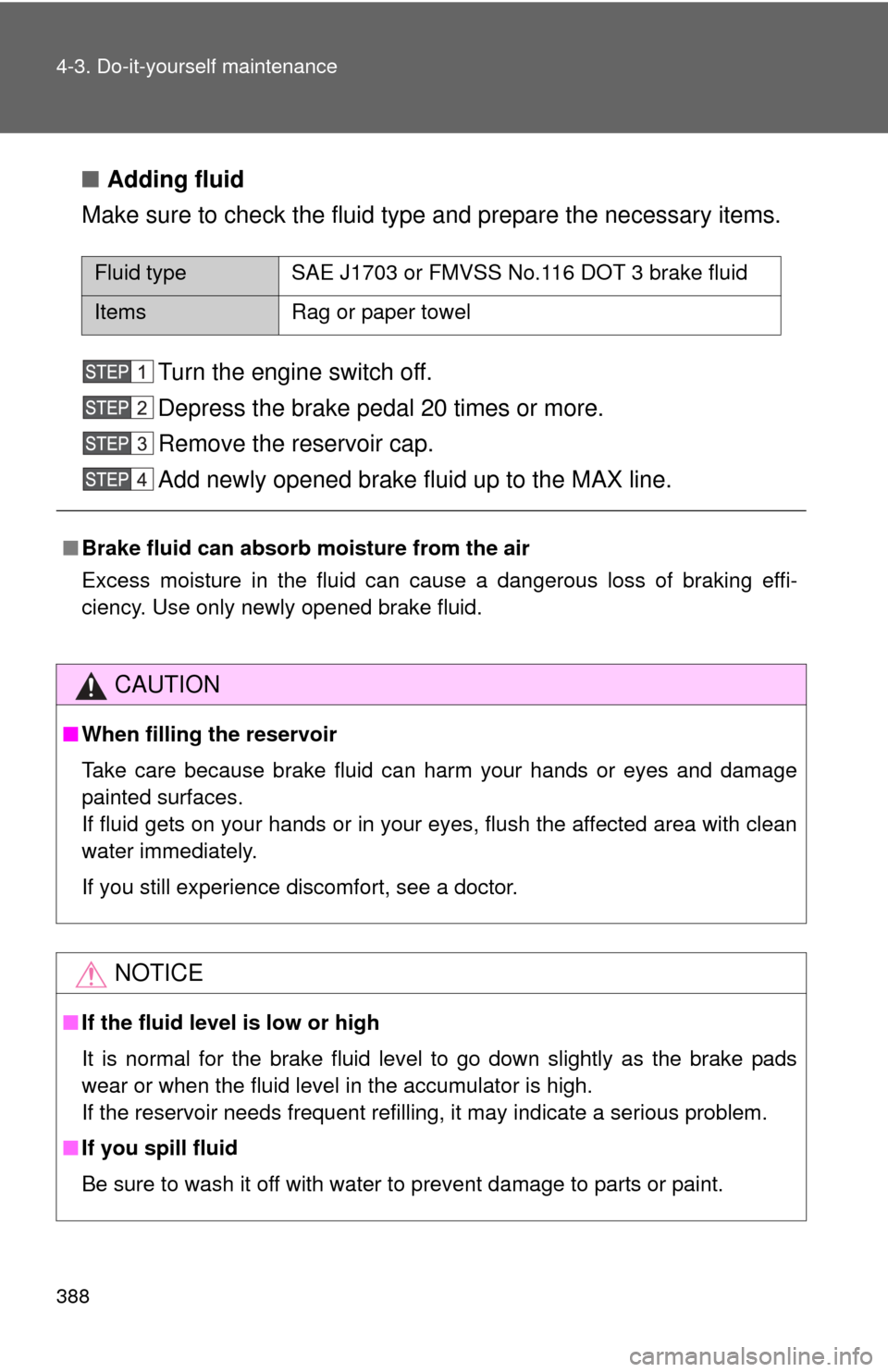
■Adding fluid
Make sure to check the fluid type and prepare the necessary items.
Turn the engine switch off.
Depress the brake pedal 20 times or more.
Remove the reservoir cap.
Add newly opened brake fluid up to the MAX line.
Fluid type SAE J1703 or FMVSS No.116 DOT 3 brake fluid
Items Rag or paper towel
■ Brake fluid can absorb moisture from the air
Excess moisture in the fluid can cause a dangerous loss of braking effi-
ciency. Use only newly opened brake fluid.
CAUTION
■When filling the reservoir
Take care because brake fluid can harm your hands or eyes and damage
painted surfaces.
If fluid gets on your hands or in your eyes, flush the affected area with clean
water immediately.
If you still experience discomfort, see a doctor.
NOTICE
■If the fluid level is low or high
It is normal for the brake fluid level to go down slightly as the brake pads
wear or when the fluid level in the accumulator is high.
If the reservoir needs frequent refilling, it may indicate a serious pro\
blem.
■ If you spill fluid
Be sure to wash it off with water to prevent damage to parts or paint.
Page 420 of 540
420 4-3. Do-it-yourself maintenance
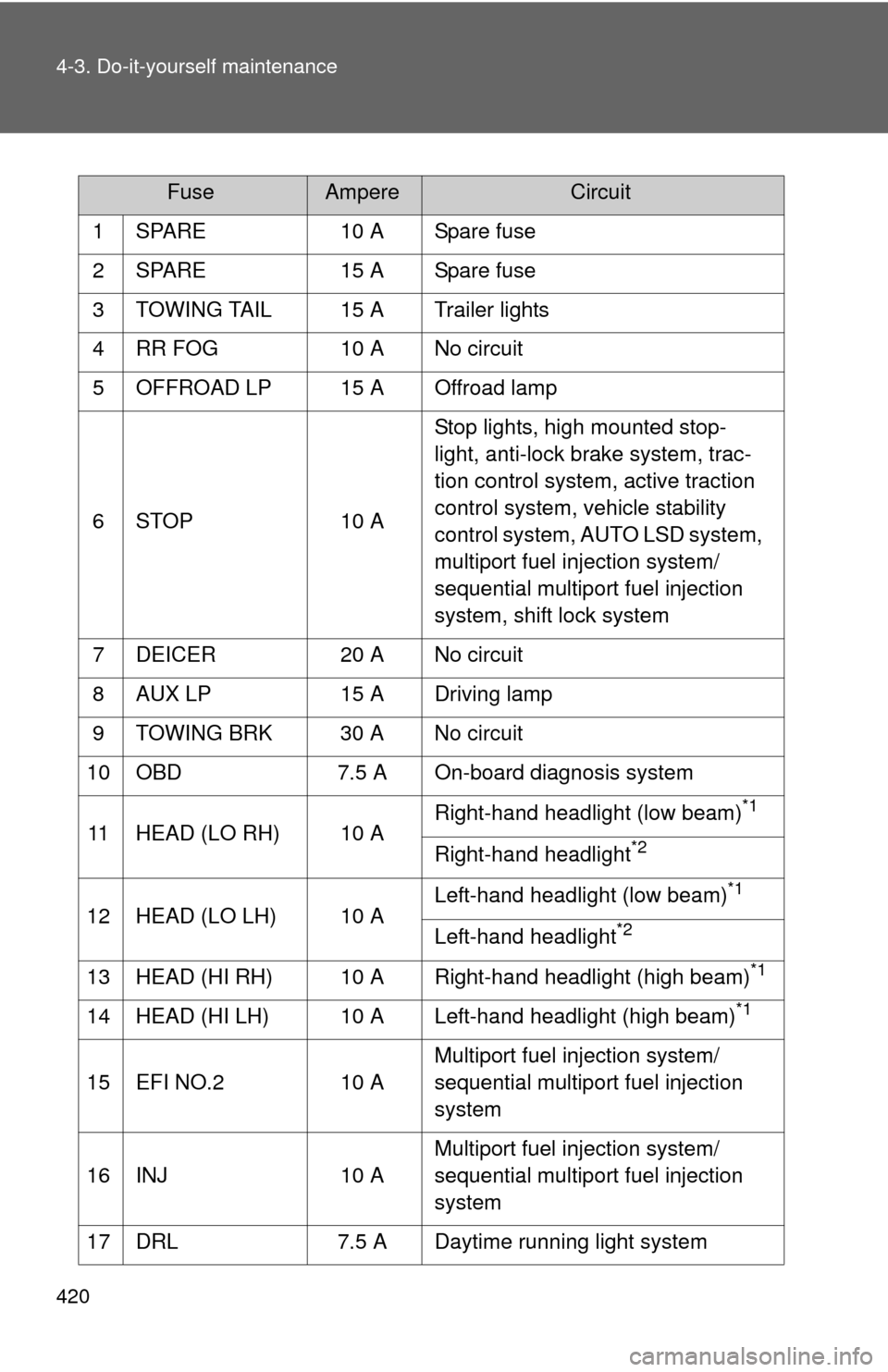
FuseAmpereCircuit
1 SPARE 10 A Spare fuse
2 SPARE 15 A Spare fuse
3 TOWING TAIL 15 A Trailer lights
4 RR FOG 10 A No circuit
5 OFFROAD LP 15 A Offroad lamp
6 STOP 10 A Stop lights, high mounted stop-
light, anti-lock brake system, trac-
tion control system, active traction
control system, vehicle stability
control system, AUTO LSD system,
multiport fuel injection system/
sequential multiport fuel injection
system, shift lock system
7 DEICER 20 A No circuit
8 AUX LP 15 A Driving lamp
9 TOWING BRK 30 A No circuit
10 OBD 7.5 A On-board diagnosis system
11 HEAD (LO RH) 10 A Right-hand headlight (low beam)
*1
Right-hand headlight*2
12 HEAD (LO LH) 10 A Left-hand headlight (low beam)
*1
Left-hand headlight*2
13 HEAD (HI RH) 10 A Right-hand headlight (high beam)*1
14 HEAD (HI LH) 10 A Left-hand headlight (high beam)*1
15 EFI NO.2
10 AMultiport fuel injection system/
sequential multiport fuel injection
system
16 INJ 10 AMultiport fuel injection system/
sequential multiport fuel injection
system
17 DRL 7.5 A Daytime running light system
Page 422 of 540
422 4-3. Do-it-yourself maintenance
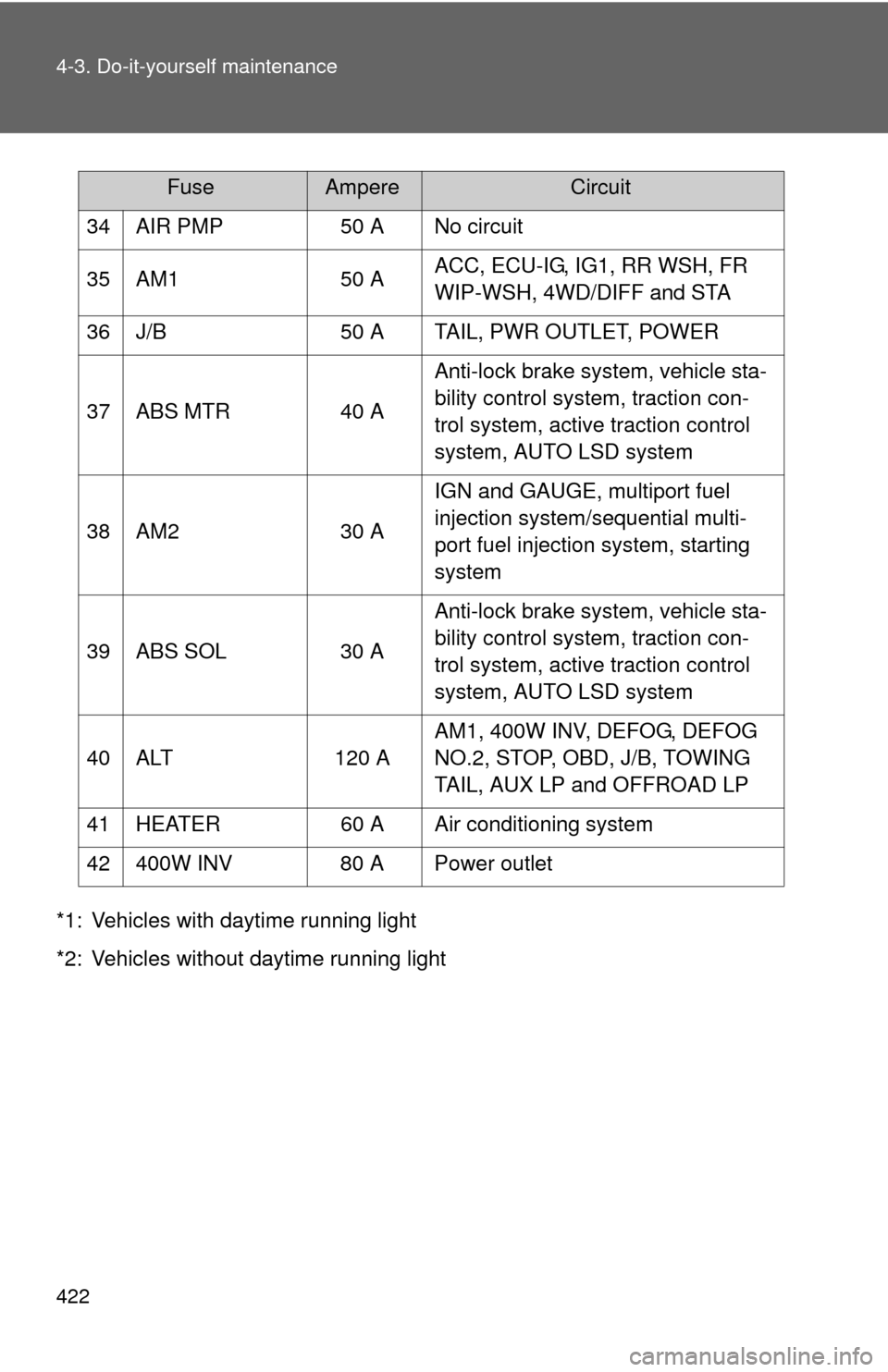
*1: Vehicles with daytime running light
*2: Vehicles without daytime running light34 AIR PMP
50 A No circuit
35 AM1 50 AACC, ECU-IG, IG1, RR WSH, FR
WIP-WSH, 4WD/DIFF and STA
36 J/B 50 A TAIL, PWR OUTLET, POWER
37 ABS MTR 40 AAnti-lock brake system, vehicle sta-
bility control system, traction con-
trol system, active traction control
system, AUTO LSD system
38 AM2 30 AIGN and GAUGE, multiport fuel
injection system/sequential multi-
port fuel injection system, starting
system
39 ABS SOL 30 AAnti-lock brake system, vehicle sta-
bility control system, traction con-
trol system, active traction control
system, AUTO LSD system
40 ALT 120 AAM1, 400W INV, DEFOG, DEFOG
NO.2, STOP, OBD, J/B, TOWING
TAIL, AUX LP and OFFROAD LP
41 HEATER 60 A Air conditioning system
42 400W INV 80 A Power outlet
FuseAmpereCircuit
Page 424 of 540
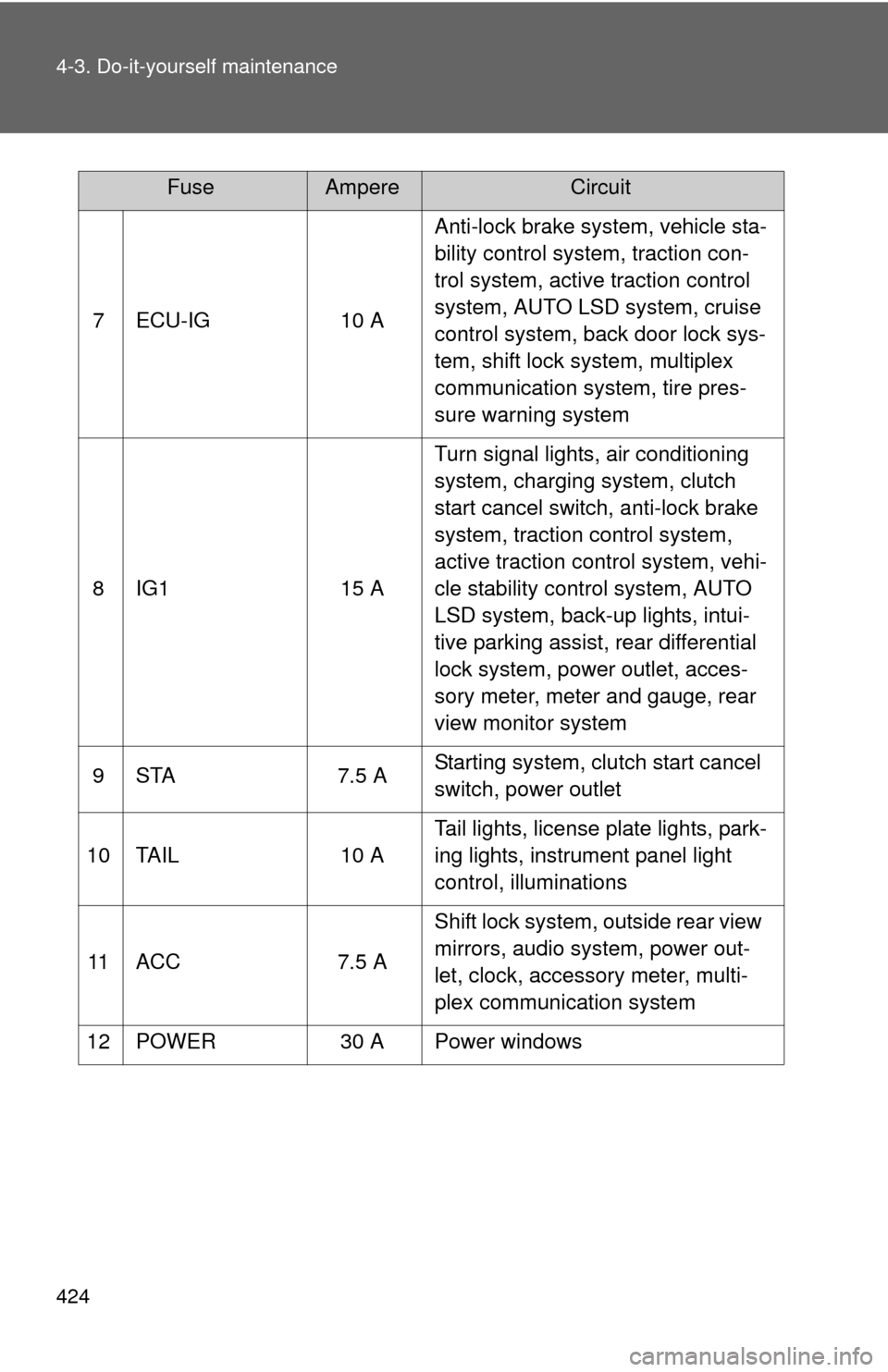
424 4-3. Do-it-yourself maintenance
7 ECU-IG10 AAnti-lock brake system, vehicle sta-
bility control system, traction con-
trol system, active traction control
system, AUTO LSD system, cruise
control system, back door lock sys-
tem, shift lock system, multiplex
communication system, tire pres-
sure warning system
8 IG1 15 ATurn signal lights, air conditioning
system, charging system, clutch
start cancel switch, anti-lock brake
system, traction control system,
active traction control system, vehi-
cle stability control system, AUTO
LSD system, back-up lights, intui-
tive parking assist, rear differential
lock system, power outlet, acces-
sory meter, meter and gauge, rear
view monitor system
9 STA 7.5 AStarting system, clutch start cancel
switch, power outlet
10 TAIL 10 ATail lights, license plate lights, park-
ing lights, instrument panel light
control, illuminations
11 A C C 7 . 5 AShift lock system, outside rear view
mirrors, audio system, power out-
let, clock, accessory meter, multi-
plex communication system
12 POWER 30 A Power windows
FuseAmpereCircuit
Page 444 of 540
444
5-2. Steps to take in an emergency
If a war ning light tur ns on or a war ning buzzer sounds...
Stop the vehicle immediately. Continuing to drive the vehicle may be dangerous.
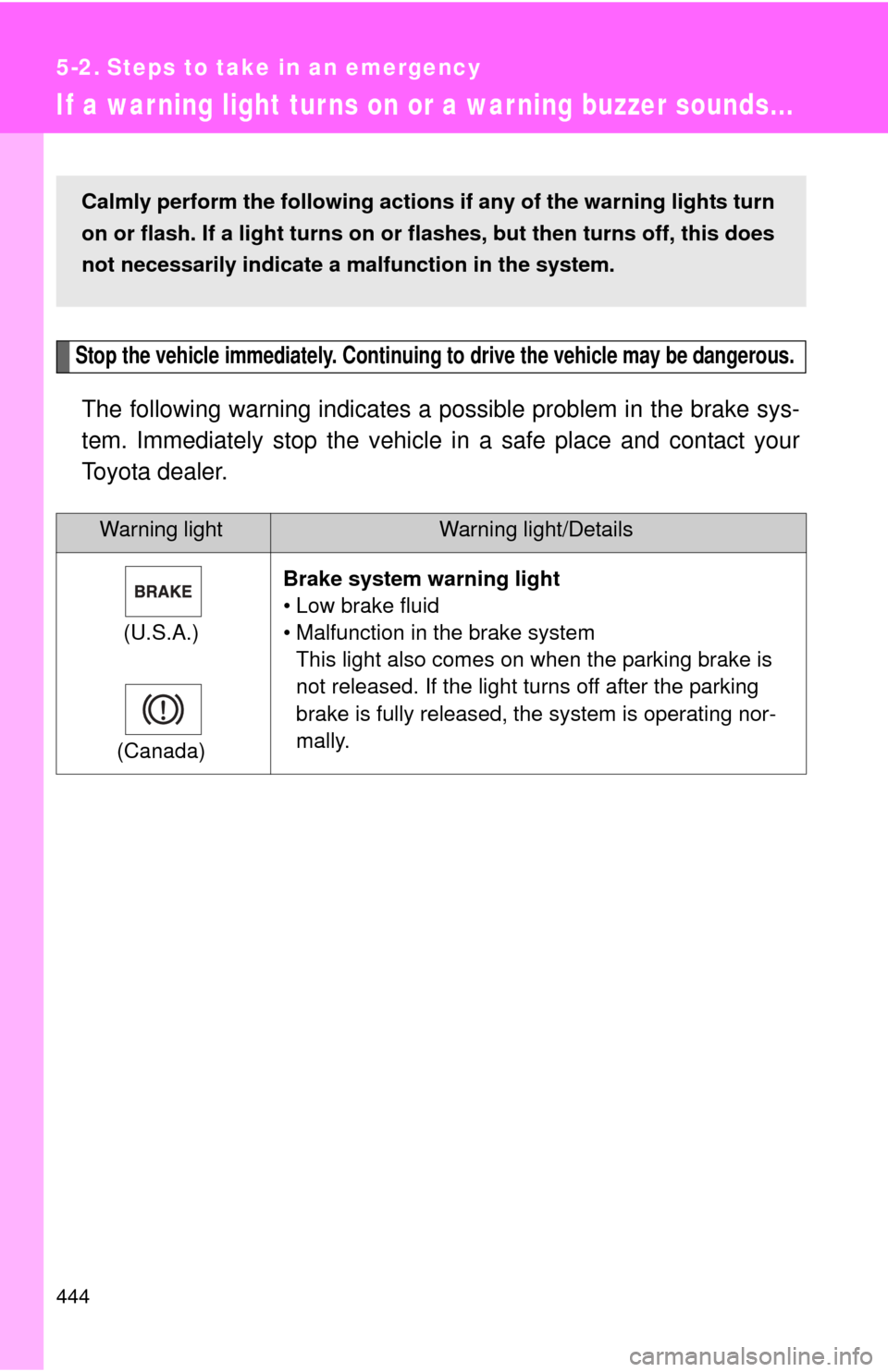
The following warning indicates a possible problem in the brake sys-
tem. Immediately stop the vehicle in a safe place and contact your
Toyota dealer.
Warning lightWarning light/Details
(U.S.A.)
(Canada) Brake system warning light
• Low brake fluid
• Malfunction in the brake system
This light also comes on when the parking brake is
not released. If the light turns off after the parking
brake is fully released, the system is operating nor-
mally.
Calmly perform the following actions if any of the warning lights turn
on or flash. If a light turns on or flashes, but then turns off, this does
not necessarily indicate a malfunction in the system.
Page 446 of 540
446 5-2. Steps to take in an emergency
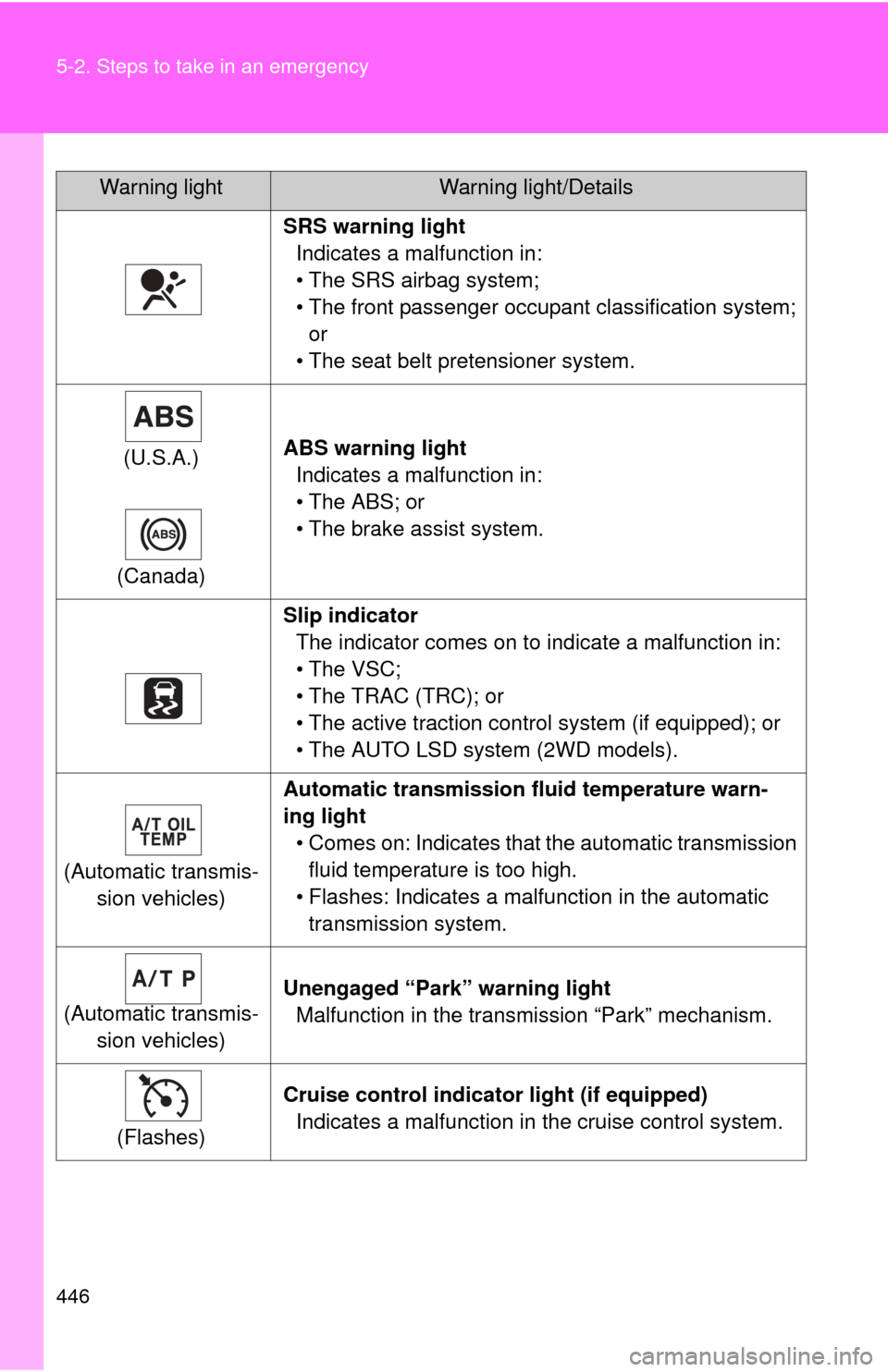
SRS warning lightIndicates a malfunction in:
• The SRS airbag system;
• The front passenger occupant classification system; or
• The seat belt pretensioner system.
(U.S.A.)
(Canada) ABS warning light
Indicates a malfunction in:
• The ABS; or
• The brake assist system.
Slip indicator The indicator comes on to indicate a malfunction in:
• The VSC;
• The TRAC (TRC); or
• The active traction control system (if equipped); or
• The AUTO LSD system (2WD models).
(Automatic transmis- sion vehicles) Automatic transmission fluid temperature warn-
ing light
• Comes on: Indicates that the automatic transmission fluid temperature is too high.
• Flashes: Indicates a malfunction in the automatic transmission system.
(Automatic transmis- sion vehicles) Unengaged “Park” warning light
Malfunction in the transmission “Park” mechanism.
(Flashes) Cruise control indicator light (if equipped)
Indicates a malfunction in the cruise control system.
Warning lightWarning light/Details
Page 452 of 540
452 5-2. Steps to take in an emergency
CAUTION
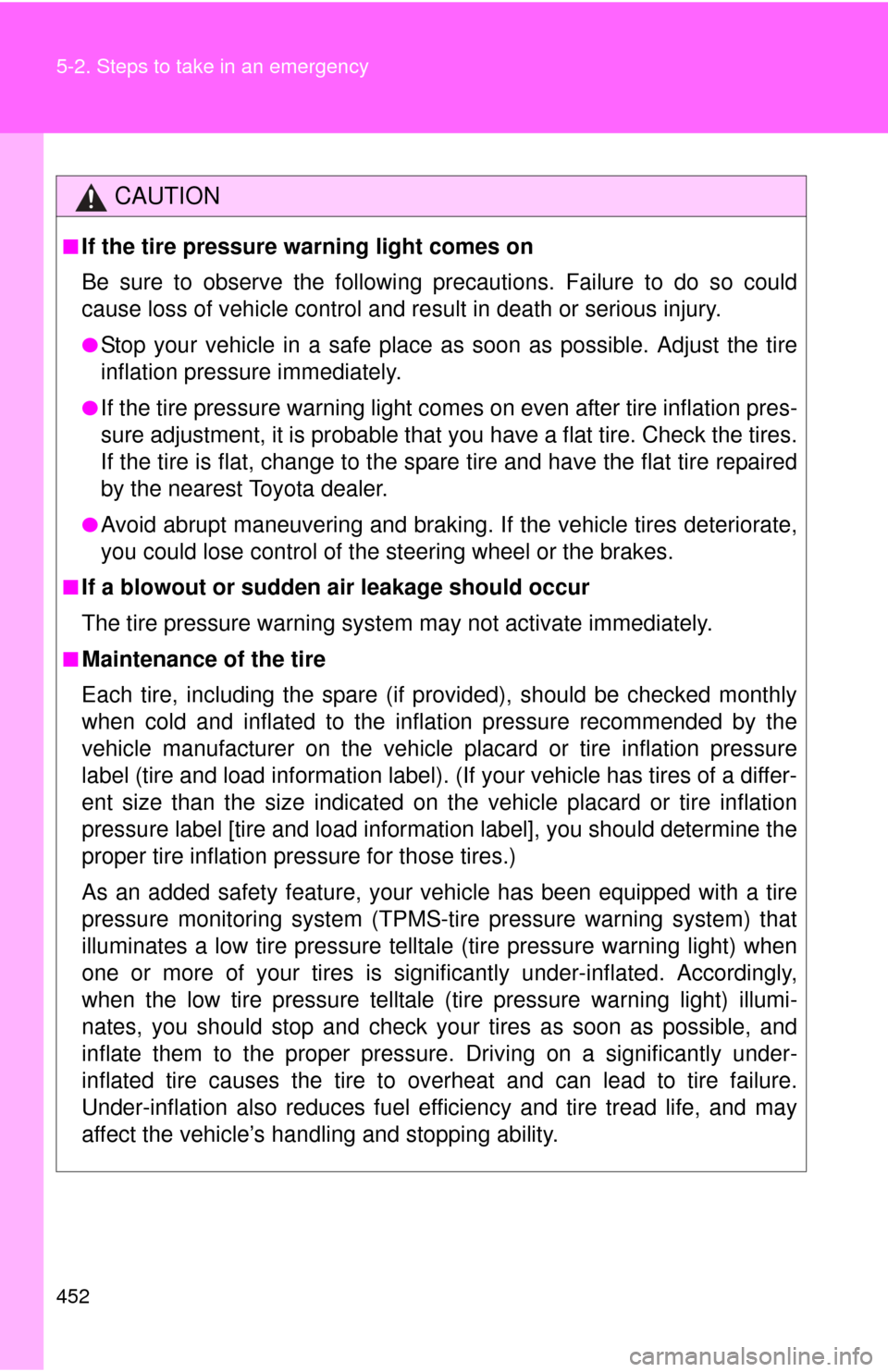
■If the tire pressure warning light comes on
Be sure to observe the following precautions. Failure to do so could
cause loss of vehicle control and re sult in death or serious injury.
●Stop your vehicle in a safe place as soon as possible. Adjust the tire
inflation pressure immediately.
●If the tire pressure warning light comes on even after tire inflation pres-
sure adjustment, it is pr obable that you have a flat tire. Check the tires.
If the tire is flat, change to the spare tire and have the flat tire repaired
by the nearest Toyota dealer.
●Avoid abrupt maneuvering and braking. If the vehicle tires deteriorate,
you could lose control of the steering wheel or the brakes.
■If a blowout or sudden air leakage should occur
The tire pressure warning syste m may not activate immediately.
■Maintenance of the tire
Each tire, including the spare (if provided), should be checked monthly
when cold and inflated to the inflation pressure recommended by the
vehicle manufacturer on the vehicle placard or tire inflation pressure
label (tire and load information label). (If your vehicle has tires of a differ-
ent size than the size indicated on the vehicle placard or tire inflation
pressure label [tire and load information label], you should determine the
proper tire inflation pr essure for those tires.)
As an added safety feature, your vehicle has been equipped with a tire
pressure monitoring system (TPMS-ti re pressure warning system) that
illuminates a low tire pressure telltal e (tire pressure warning light) when
one or more of your tires is significantly under-inflated. Accordingly,
when the low tire pressu re telltale (tire pressure warning light) illumi-
nates, you should stop and check your tires as soon as possible, and
inflate them to the proper pressure. Driving on a significantly under-
inflated tire causes the tire to overheat and can lead to tire failure.
Under-inflation also reduces fuel effi ciency and tire tread life, and may
affect the vehicle’s handling and stopping ability.