airbag TOYOTA FJ CRUISER 2012 1.G Owners Manual
[x] Cancel search | Manufacturer: TOYOTA, Model Year: 2012, Model line: FJ CRUISER, Model: TOYOTA FJ CRUISER 2012 1.GPages: 540, PDF Size: 10.32 MB
Page 1 of 540

TABLE OF CONTENTS
1
1Before drivingAdjusting and operating features such as door locks,
mirrors, and steering column.
2When drivingDriving, stopping and safe-driving information.
3Interior
featuresAir conditioning and audio systems, as well as other in-
terior features for a comfortable driving experience.
4Maintenance
and careCleaning and protecting your vehicle, performing do-it-
yourself maintenance, and maintenance information.
5When trouble
arisesWhat to do if the vehicle needs to be towed, gets a flat
tire, or is involved in an accident.
6Vehicle
specificationsDetailed vehicle information.
7For ownersReporting safety defects for U.S. owners, and seat belt
and SRS airbag instructions for Canadian owners
IndexAlphabetical listing of information contained in this
manual.
Page 2 of 540

TABLE OF CONTENTSIndex
2
1-1. Key informationKeys ..................................... 28
1-2. Opening, closing and locking the doors
Wireless remote control ....... 30
Side doors ............................ 33
Access doors........................ 36
Back door ............................. 38
Glass hatch .......................... 43
1-3. Adjustable components (seats, mirrors, steering
wheel)
Front seats ........................... 47
Rear seats ............................ 49
Head restraints ..................... 55
Seat belts ............................. 58
Steering wheel ..................... 64
Anti-glare inside rear view mirror .................................. 65
Outside rear view mirrors ..... 68
1-4. Opening and closing the windows
Power windows .................... 71
1-5. Refueling Opening the fuel tank cap .... 73 1-6. Theft deterrent system
Engine immobilizer system ................................ 76
Theft prevention labels (U.S.A.)............................... 78
1-7. Safety information Correct driving posture ......... 79
SRS airbags ......................... 81
Front passenger occupant classification system ........... 94
Child restraint systems ......... 99
Installing child restraints ..... 103
2-1. Driving procedures Driving the vehicle .............. 116
Engine (ignition) switch....... 127
Automatic Transmission ..... 130
Manual Transmission ......... 132
Turn signal lever ................. 134
Parking brake ..................... 135
Horn .................................... 137
2-2. Instrument cluster Gauges and meters ............ 138
Indicators and warning lights ................................. 141
Accessory meter ................. 144
1Before driving
2When driving
Page 5 of 540

1
2
3
4
5
6
7
5
5-1. Essential informationEmergency flashers ............ 436
If your vehicle needs to be towed ........................... 437
If you think something is wrong ................................ 442
Fuel pump shut off system .............................. 443
5-2. Steps to take in an emergency If a warning light turns on or a warning buzzer
sounds... ........................... 444
If you have a flat tire............ 454
If the engine will not start .... 467
If the shift lever cannot be shifted from P
(vehicles with an
automatic transmission) .... 468
If you lose your keys ........... 469
If the vehicle battery is discharged ........................ 470
If your vehicle overheats ..... 474
If the vehicle becomes stuck ................................. 477
If your vehicle has to be stopped in
an emergency ................... 479 6-1. Specifications
Maintenance data (fuel, oil level, etc.) ........... 482
Fuel information.................. 493
Tire information .................. 496
6-2. Customization Customizable features........ 507
Items to initialize ................. 509
Reporting safety defects for U.S. owners ................ 512
Seat belt instructions for Canadian owners
(in French) ........................ 513
SRS airbag instructions for Canadian owners
(in French) ........................ 515
Abbreviation list ........................ 526
Alphabetical index .................... 528
What to do if... ........................... 537
5When trouble arises6Vehicle specifications
7For owners
Index
Page 9 of 540
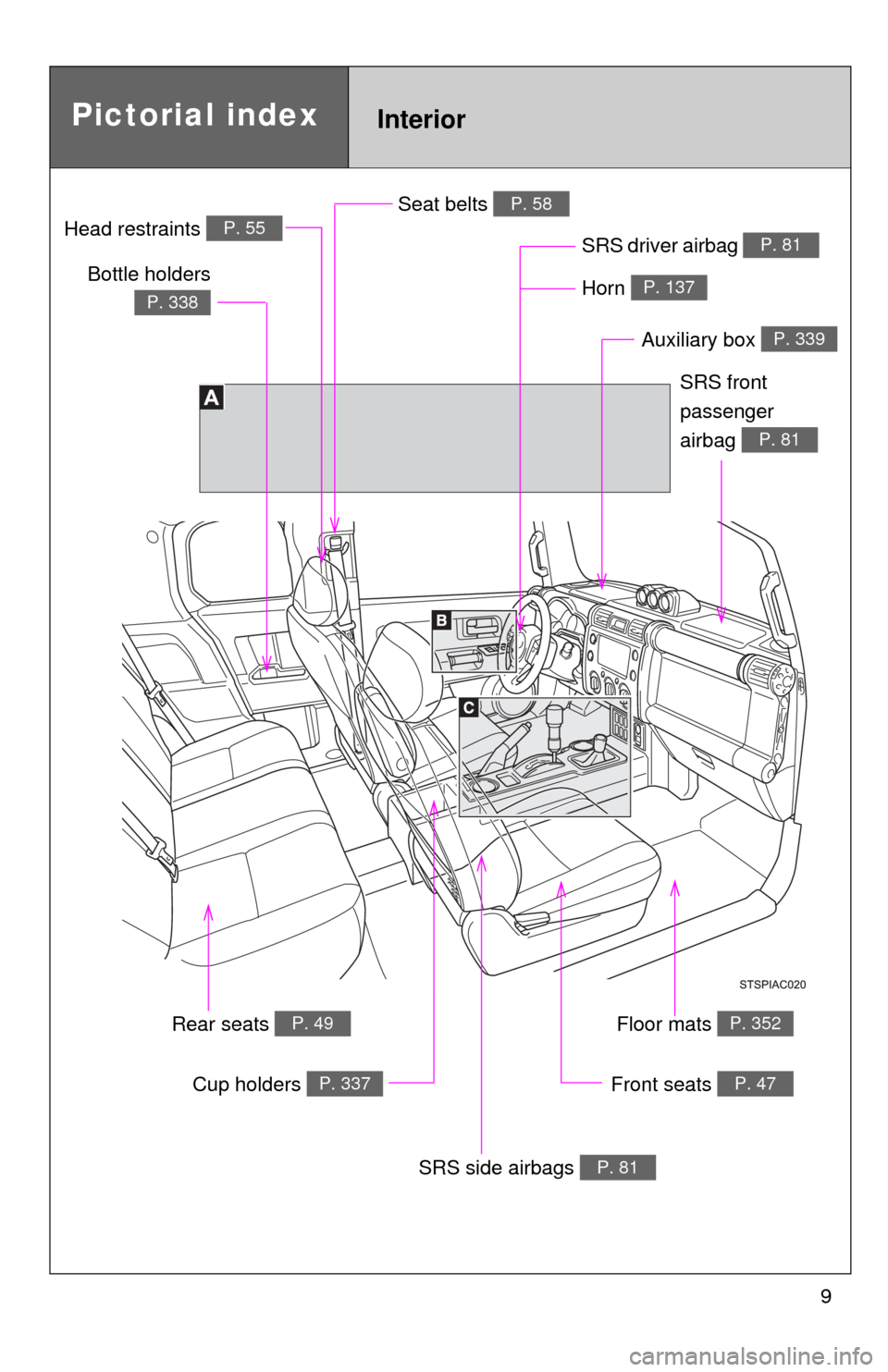
9
Pictorial indexInterior
Seat belts P. 58
SRS driver airbag P. 81Head restraints P. 55
Bottle holders
P. 338
Cup holders P. 337
SRS side airbags P. 81
Floor mats P. 352
SRS front
passenger
airbag
P. 81
Auxiliary box P. 339
Rear seats P. 49
Horn P. 137
Front seats P. 47
Page 10 of 540
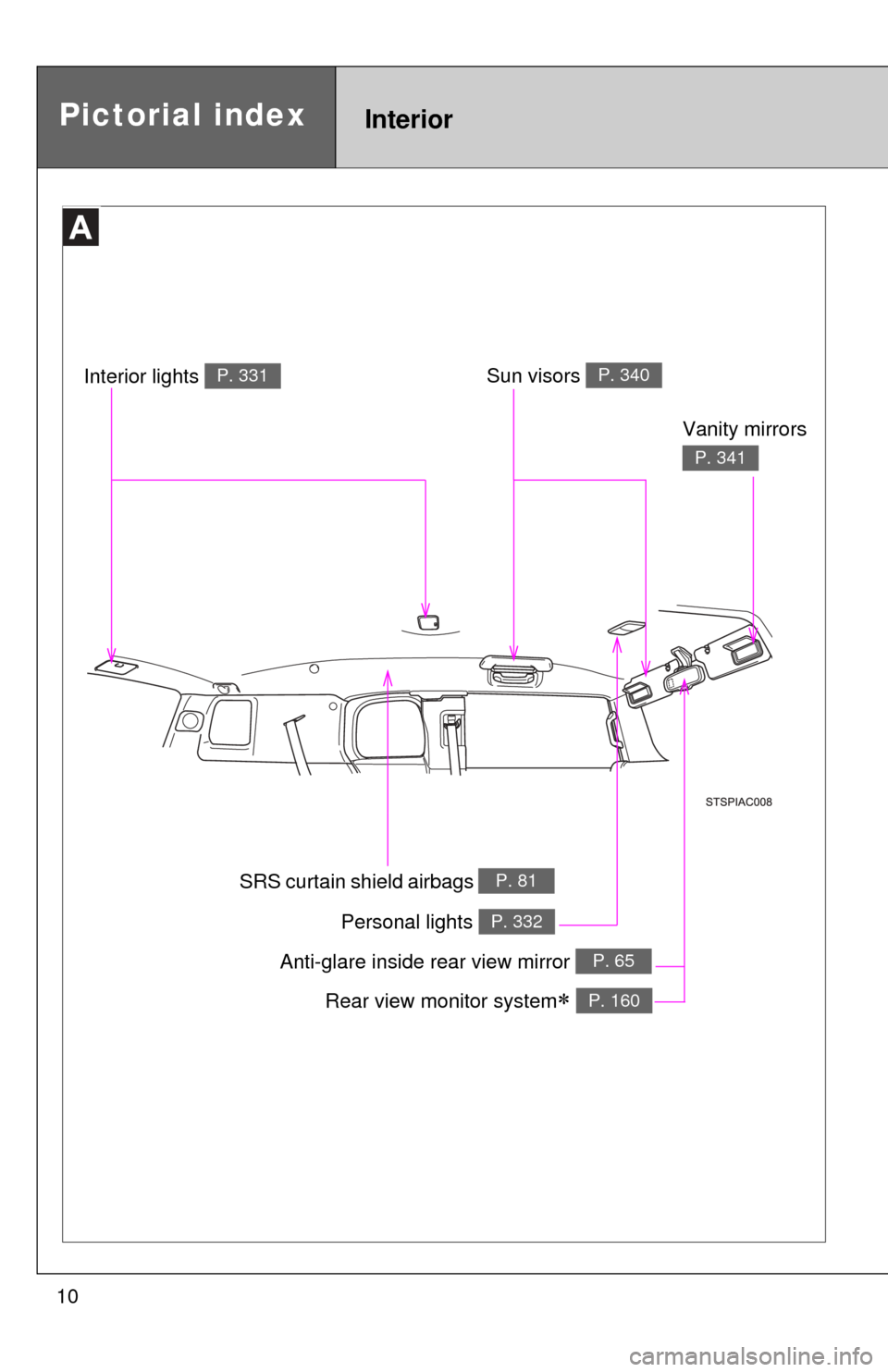
10
Anti-glare inside rear view mirror P. 65
Sun visors P. 340
SRS curtain shield airbags P. 81
Vanity mirrors
P. 341
Interior lights P. 331
Personal lights P. 332
Rear view monitor system P. 160
Pictorial indexInterior
Page 22 of 540

22
Installation of a mobile two-way radio system
The installation of a mobile two-way radio system in your vehicle could affect
electronic systems such as:
●Multiport fuel injection system/sequential multiport fuel injection system
● Cruise control system
● Anti-lock brake system
● SRS airbag system
● Seat belt pretensioner system
Be sure to check with your Toyota dealer for precautionary measures or spe-
cial instructions regarding installation of a mobile two-way radio system.
Scrapping your Toyota
The SRS airbag and seat belt pretensioner devices in your Toyota contain
explosive chemicals. If the vehicle is scrapped with the airbags and seat belt
pretensioners left as they are, this may cause an accident such as fire. Be
sure to have the systems of the SRS airbag and seat belt pretensioner
removed and disposed of by a qualified service shop or by your Toyota
dealer before you scrap your vehicle.
Perchlorate Material
Special handling may apply,
See www.dtsc.ca.gov/hazardouswaste/perchlorate.
Your vehicle has components that may contain perchlorate. These compo-
nents may include airbag, seat belt pretensioners, and wireless remote con-
trol batteries.
Page 24 of 540

24
●Event data recorder
Your vehicle has computers that monitor and control certain aspects of your
vehicle. These computers assist in driving and maintaining optimal vehicle
performance.
Besides storing data useful for troubleshooting, there is an event data
recorder (EDR) that records data in a crash or near crash event.
The SRS airbag sensor assembly contains the EDR. In a crash or near crash
event, this device may record the following information:
• Engine speed
• Whether the brake pedal was depressed or not
• Vehicle speed
• To what extent the accelerator pedal was depressed
• The transmission shift position (except manual transmission)
• Whether the driver and front passenger wore seat belts or not
• Driver’s seat position
• SRS airbag deployment data
• SRS airbag system diagnostic data
• Front passenger’s occupant classification
• Whether the “RSCA OFF” indicator was turned on or off
The information above is intended to be used for the purpose of improving
vehicle safety performance. Unlike general data recorders, the EDR does
not record sound data such as conversation between passengers.
● Disclosure of the EDR data
Toyota will not disclose the data recorded in an EDR to a third party except
when:
• An agreement from the vehicle’s owner (or the leasing company for a leased vehicle) is obtained
• Officially requested to by the police or other authorities
• Necessary, for use as a defense for Toyota in a lawsuit
• Ordered to by a court of law
However, if necessary, Toyota will:
• Use the data for research on Toyota vehicle safety performance
• Disclose the data to a third party for research purposes without disclosing details of the vehicle owner, and that only when deemed necessary
• Disclose summarized data cleared of vehicle identification information to a non-Toyota organization for research purposes
Page 27 of 540
Before driving1
27
1-1. Key informationKeys ................................... 28
1-2. Opening, closing and locking the doors
Wireless remote control ..... 30
Side doors .......................... 33
Access doors ..................... 36
Back door ........................... 38
Glass hatch ........................ 43
1-3. Adjustable components
(seats, mirrors, steering
wheel)
Front seats ......................... 47
Rear seats.......................... 49
Head restraints................... 55
Seat belts ........................... 58
Steering wheel ................... 64
Anti-glare inside rear view mirror ............................... 65
Outside rear view mirrors ... 68
1-4. Opening and clos ing
the windows
Pow er windows .................. 71
1-5. Refueling Opening the fuel tank cap ................................... 73 1-6. Theft deterrent system
Engine immobilizer system ............................. 76
Theft prevention labels (U.S.A.) ............................ 78
1-7. Safety information Correct driving posture....... 79
SRS airbags ....................... 81
Front passenger occupant classification system ........ 94
Child restraint systems....... 99
Installing child restraints... 103
Page 79 of 540
79
1
Before driving
1-7. Safety information
Correct driving posture
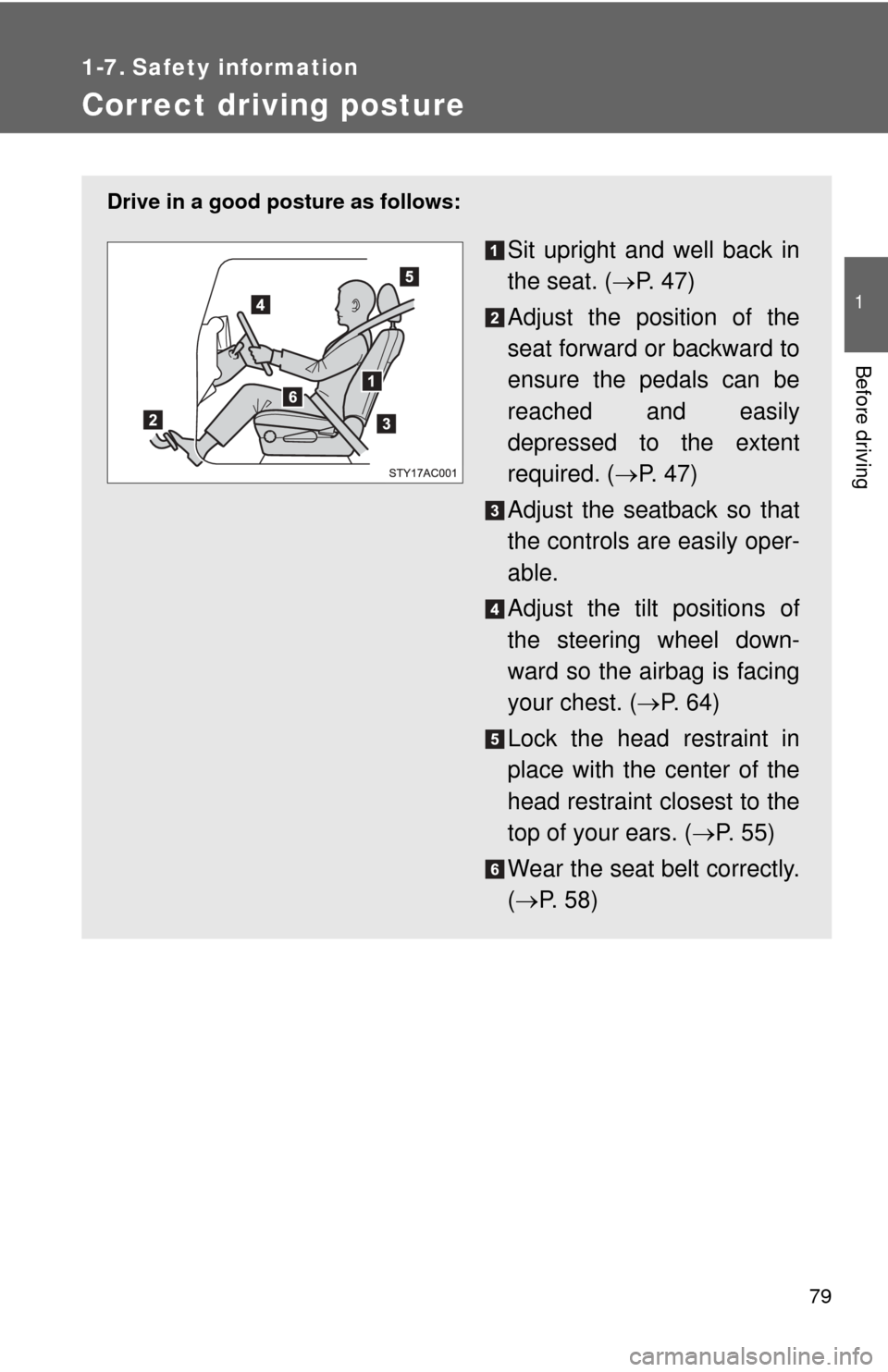
Drive in a good posture as follows:
Sit upright and well back in
the seat. (P. 4 7 )
Adjust the position of the
seat forward or backward to
ensure the pedals can be
reached and easily
depressed to the extent
required. ( P. 47)
Adjust the seatback so that
the controls are easily oper-
able.
Adjust the tilt positions of
the steering wheel down-
ward so the airbag is facing
your chest. ( P. 6 4 )
Lock the head restraint in
place with the center of the
head restraint closest to the
top of your ears. ( P. 55)
Wear the seat belt correctly.
( P. 58)
Page 81 of 540
81
1
1-7. Safety information
Before driving
SRS airbags
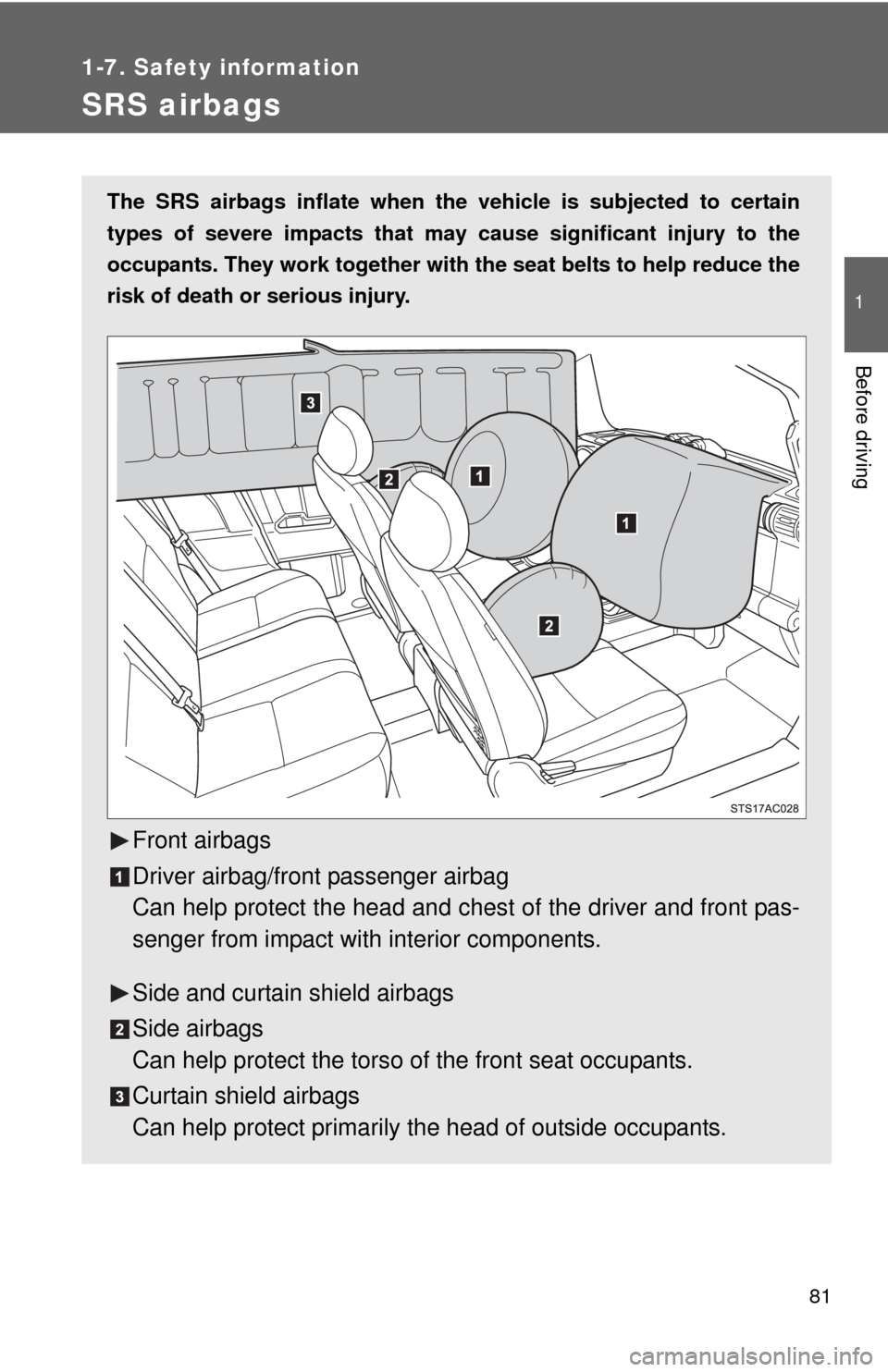
The SRS airbags inflate when the vehicle is subjected to certain
types of severe impacts that may cause significant injury to the
occupants. They work together with the seat belts to help reduce the
risk of death or serious injury.
Front airbags
Driver airbag/front passenger airbag
Can help protect the head and ches t of the driver and front pas-
senger from impact with interior components.
Side and curtain shield airbags
Side airbags
Can help protect the torso of the front seat occupants.
Curtain shield airbags
Can help protect primarily the head of outside occupants.