transmission TOYOTA FR-S 2014 Owners Manual (in English)
[x] Cancel search | Manufacturer: TOYOTA, Model Year: 2014, Model line: FR-S, Model: TOYOTA FR-S 2014Pages: 452, PDF Size: 5.61 MB
Page 2 of 452

TABLE OF CONTENTSIndex
2
1-1. Key informationKeys ..................................... 20
1-2. Opening, closing and locking the doors and
trunk
Smart key system................. 23
Wireless remote control ....... 37
Doors.................................... 40
Trunk .................................... 42
1-3. Adjustable components (seats, mirrors,
steering wheel)
Front seats ........................... 47
Rear seats ............................ 50
Head restraints ..................... 52
Seat belts ............................. 54
Steering wheel ..................... 61
Anti-glare inside rear view mirror.......................... 62
Outside rear view mirrors ..... 63
1-4. Opening and closing the windows
Power windows .................... 66
1-5. Refueling Opening the fuel tank cap .... 69 1-6. Theft deterrent system
Engine immobilizer system ................................ 73
Alarm .................................... 75
Theft prevention labels (U.S.A.)............................... 79
1-7. Safety information Correct driving posture ......... 80
SRS airbag (Supplemental Restraint System
airbag) ................................ 82
Front passenger occupant classification system ......... 117
Child restraint systems ....... 125
Installing child restraints ..... 129
2-1. Driving procedures Driving the vehicle .............. 140
Engine (ignition) switch....... 153
Automatic transmission ...... 162
Manual Transmission ......... 169
Turn signal lever ................. 172
Parking brake ..................... 173
Horn .................................... 174
2-2. Instrument cluster Gauges and meters ............ 175
Indicators and warning lights ................................. 179
Multi-information display ..... 183
1Before driving
2When driving
Page 28 of 452

28 1-2. Opening, closing and locking the doors and trunk
*: Vehicles with an automatic transmission only
AlarmSituationCorrection procedure
Interior alarm
pings once and
exterior alarm
sounds once for
5 seconds An attempt was made to
lock either door by opening
a door and putting the
inside lock button into the
lock position, then closing
the door by pulling on the
outside door handle with
the electronic key still
inside the vehicle.
Retrieve the elec-
tronic key from the
vehicle and lock the
doors again.
Exterior alarm
sounds once for
5 seconds An attempt was made to
lock the doors using the
smart key system while the
electronic key was still
inside the vehicle.
Retrieve the elec-
tronic key from the
vehicle and lock the
doors again.
An attempt was made to
lock the vehicle while a
door was open. Close all of the doors
and lock the doors
again.
Interior alarm
sounds continu-
ously The “ENGINE START
STOP” switch was turned
to ACCESSORY mode
while the driver’s door was
open (or the driver’s door
was opened while the
“ENGINE START STOP”
switch was in ACCES-
SORY mode). Turn the “ENGINE
START STOP” switch
off and close the
driver’s door.
Interior alarm
sounds continu-
ously* The driver’s door was
opened while any shift
position other than P was
selected without turning off
the “ENGINE START
STOP” switch.
Shift the shift lever to
P.
Page 51 of 452
51
1-3. Adjustable components (s
eats, mirrors, steering wheel)
1
Before driving
CAUTION
■When folding the rear seatbacks down
Observe the following precautions. Failure to do so may result in death or
serious injury.
●Do not fold the seatbacks down while driving.
● Stop the vehicle on level ground, set the parking brake and shift the shift
lever to P (automatic transmission) or N (manual transmission).
● Do not allow anyone to sit on a folded seatback or in the trunk while driv-
ing.
● Do not allow children to enter the trunk.
■ After returning the rear seatback to the upright position
Observe the following precautions. Failure to do so may result in death or
serious injury.
●Check that the seat belts are not twisted or caught in the seatback.
■ Before using the rear seat belts
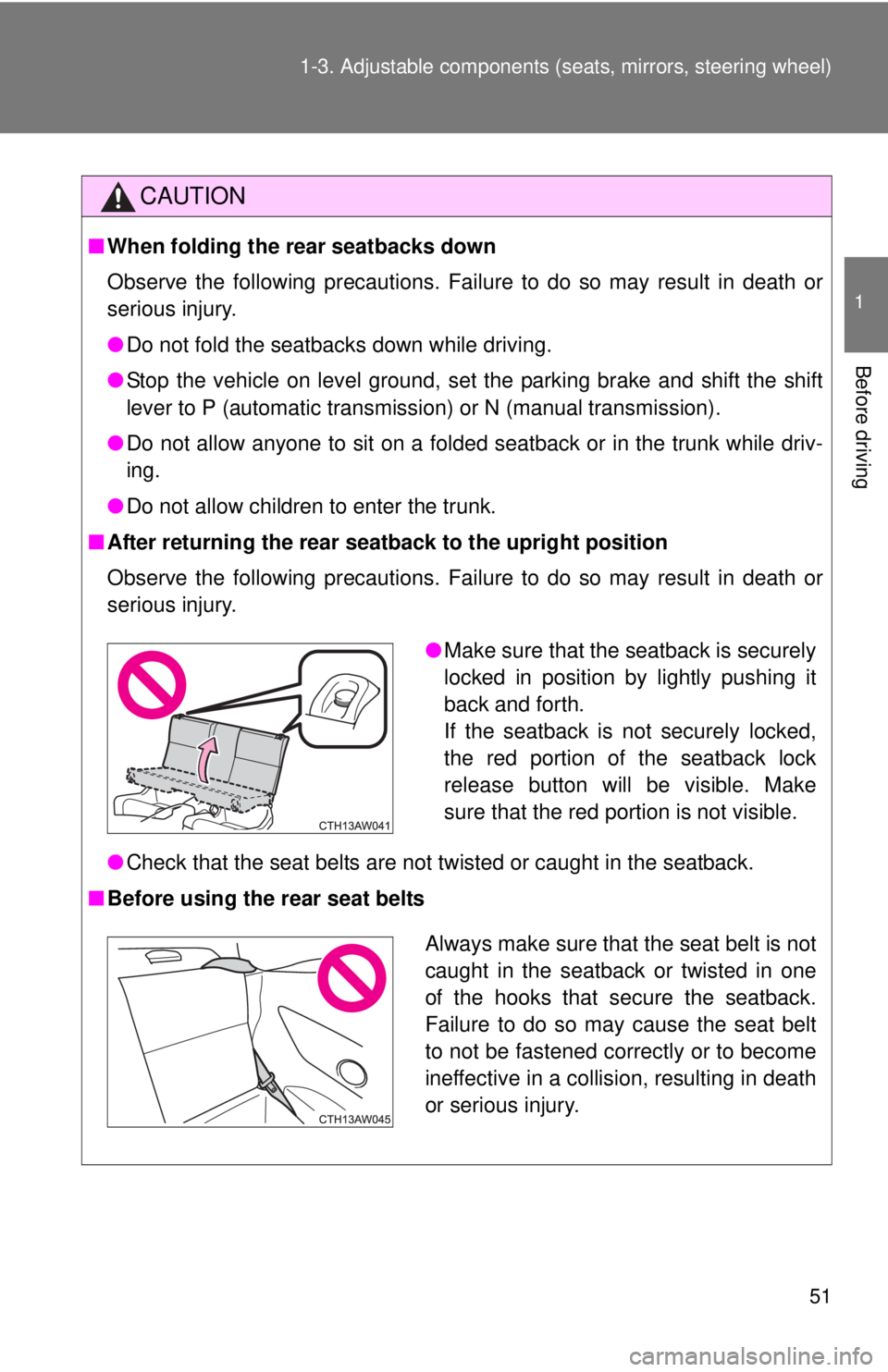
●Make sure that the seatback is securely
locked in position by lightly pushing it
back and forth.
If the seatback is not securely locked,
the red portion of the seatback lock
release button will be visible. Make
sure that the red portion is not visible.
Always make sure that the seat belt is not
caught in the seatback or twisted in one
of the hooks that secure the seatback.
Failure to do so may cause the seat belt
to not be fastened correctly or to become
ineffective in a collision, resulting in death
or serious injury.
Page 139 of 452
When driving2
139
2-1. Driving proceduresDriving the vehicle............ 140
Engine (ignition) switch ............................. 153
Automatic transmission................... 162
Manual Transmission ....... 169
Turn signal lever .............. 172
Parking brake ................... 173
Horn ................................. 174
2-2. Instrument cluster Gauges and meters ......... 175
Indicators and warning lights .............................. 179
Multi-information display............................ 183 2-3. Operating the lights and
windshield wipers
Headlight switch ............... 188
Windshield wipers and washer ........................... 193
2-4. Using other driving systems
Cruise control ................... 196
Driving assist systems ..... 201
2-5. Driving information Cargo and luggage .......... 207
Vehicle load limits ............ 211
Winter driving tips ............ 212
Trailer towing ................... 215
Dinghy towing .................. 216
Page 140 of 452
140
2-1. Driving procedures
Driving the vehicle
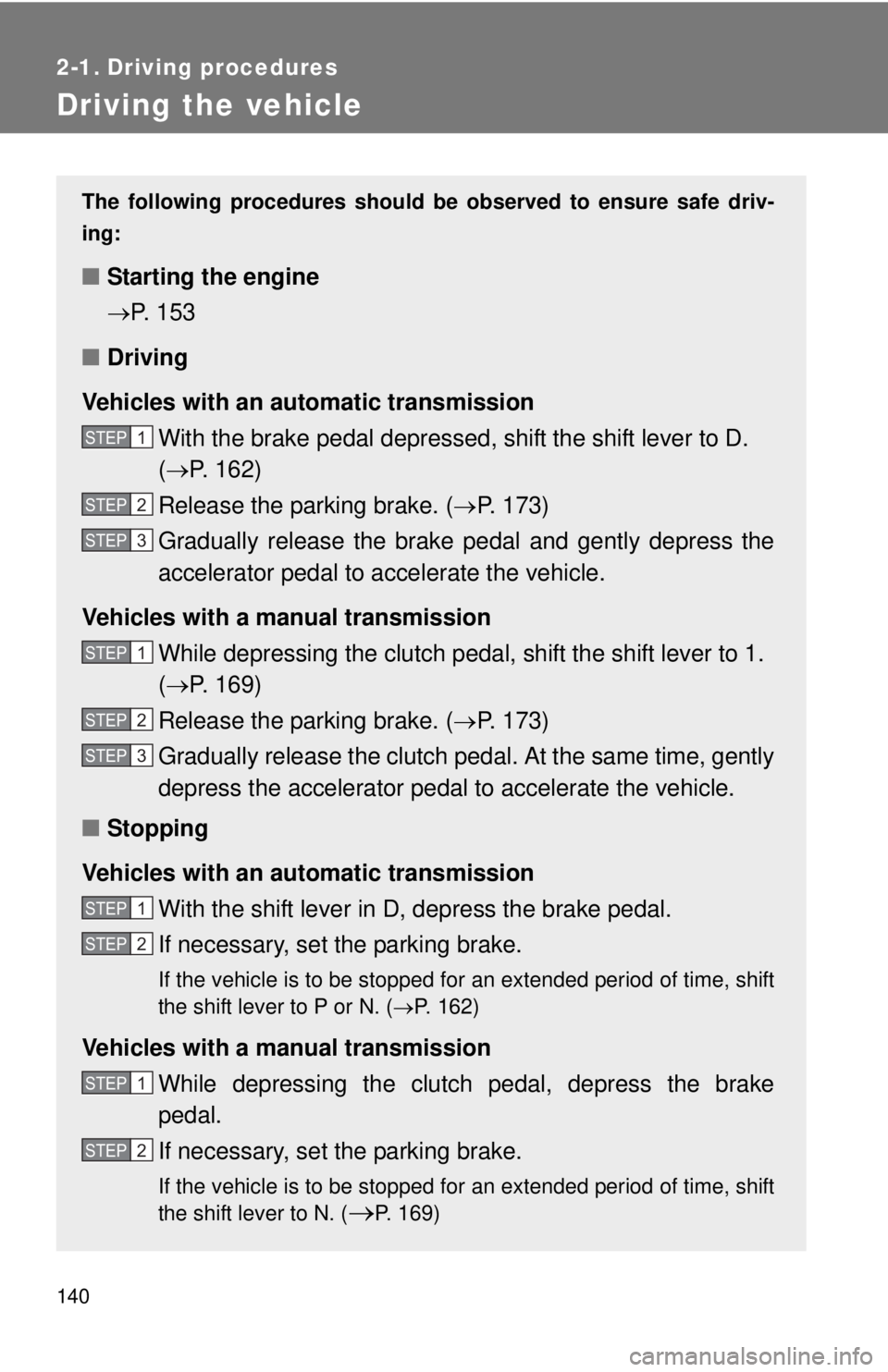
The following procedures should be observed to ensure safe driv-
ing:
■ Starting the engine
P. 153
■ Driving
Vehicles with an au tomatic transmission
With the brake pedal depressed, shift the shift lever to D.
( P. 162)
Release the parking brake. ( P. 173)
Gradually release the brake pedal and gently depress the
accelerator pedal to accelerate the vehicle.
Vehicles with a manual transmission While depressing the clutch pedal, shift the shift lever to 1.
( P. 169)
Release the parking brake. ( P. 173)
Gradually release the clutch pedal. At the same time, gently
depress the accelerator pedal to accelerate the vehicle.
■ Stopping
Vehicles with an au tomatic transmission
With the shift lever in D, depress the brake pedal.
If necessary, set the parking brake.
If the vehicle is to be stopped for an extended period of time, shift
the shift lever to P or N. ( P. 162)
Vehicles with a manual transmission
While depressing the clutch pedal, depress the brake
pedal.
If necessary, set the parking brake.
If the vehicle is to be stopped for an extended period of time, shift
the shift lever to N. (
P. 169)
STEP 1
STEP 2
STEP 3
STEP 1
STEP 2
STEP 3
STEP 1
STEP 2
STEP 1
STEP 2
Page 141 of 452
141
2-1. Driving procedures
2
When driving
■
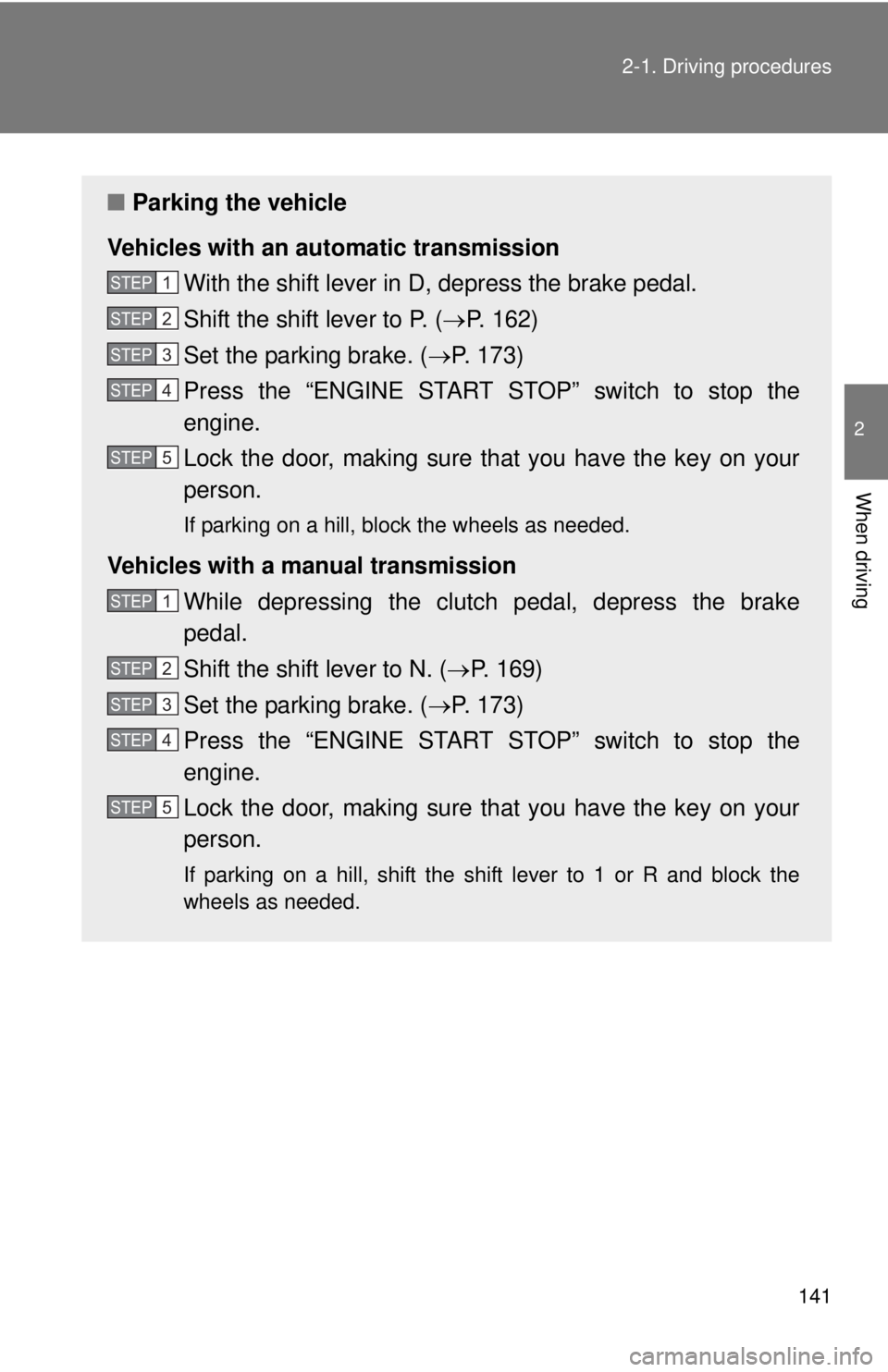
Parking the vehicle
Vehicles with an au tomatic transmission
With the shift lever in D, depress the brake pedal.
Shift the shift lever to P. ( P. 162)
Set the parking brake. ( P. 173)
Press the “ENGINE START STOP” switch to stop the
engine.
Lock the door, making sure that you have the key on your
person.
If parking on a hill, block the wheels as needed.
Vehicles with a manual transmission While depressing the clutch pedal, depress the brake
pedal.
Shift the shift lever to N. ( P. 169)
Set the parking brake. ( P. 173)
Press the “ENGINE START STOP” switch to stop the
engine.
Lock the door, making sure that you have the key on your
person.
If parking on a hill, shift the shift lever to 1 or R and block the
wheels as needed.
STEP 1
STEP 2
STEP 3
STEP 4
STEP 5
STEP 1
STEP 2
STEP 3
STEP 4
STEP 5
Page 142 of 452
142 2-1. Driving procedures
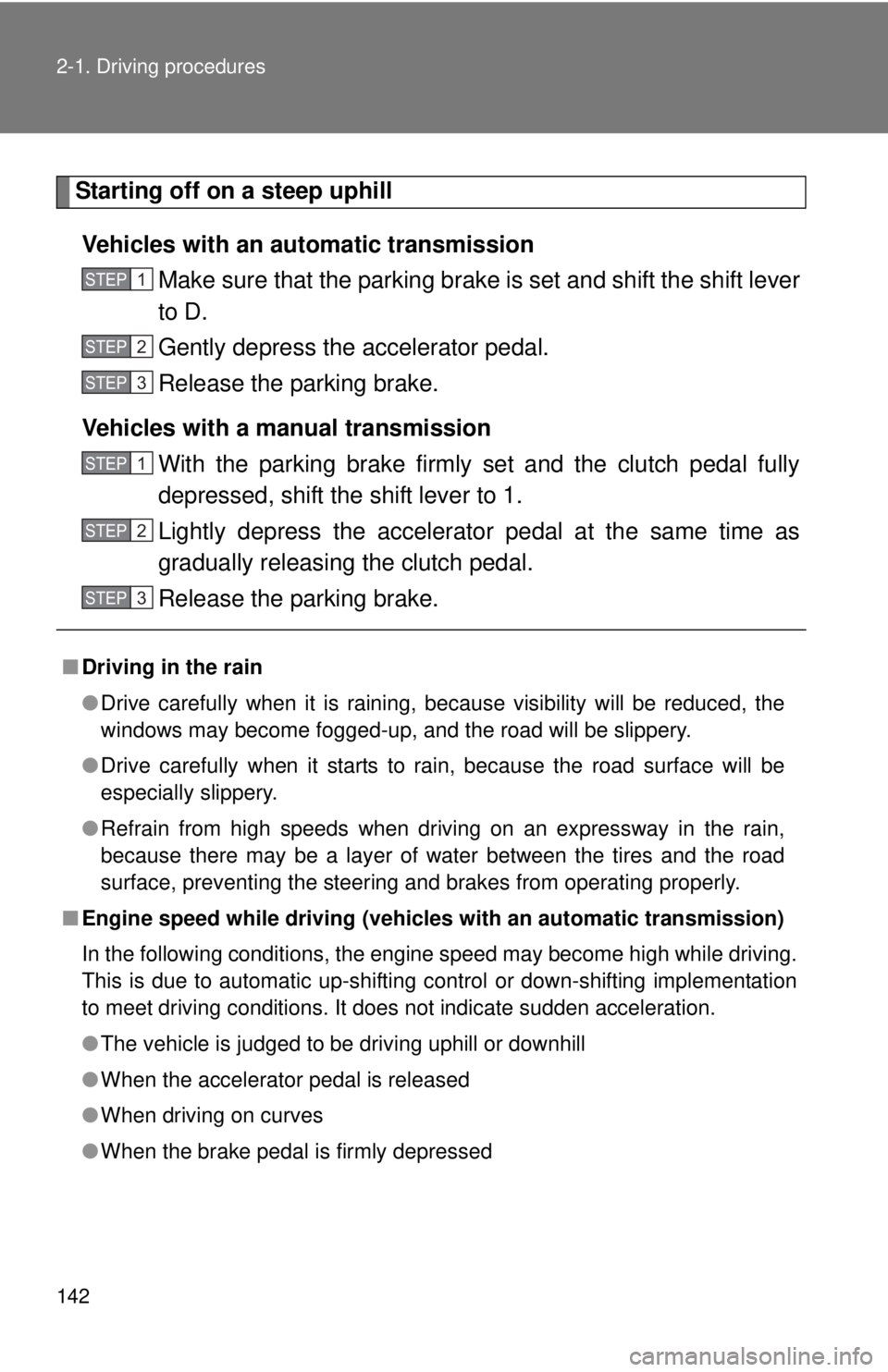
Starting off on a steep uphillVehicles with an au tomatic transmission
Make sure that the parking brake is set and shift the shift lever
to D.
Gently depress the accelerator pedal.
Release the parking brake.
Vehicles with a manual transmission With the parking brake firmly set and the clutch pedal fully
depressed, shift the shift lever to 1.
Lightly depress the accelerator pedal at the same time as
gradually releasing the clutch pedal.
Release the parking brake.
■Driving in the rain
●Drive carefully when it is raining, because visibility will be reduced, the
windows may become fogged-up, and the road will be slippery.
● Drive carefully when it starts to rain, because the road surface will be
especially slippery.
● Refrain from high speeds when driving on an expressway in the rain,
because there may be a layer of water between the tires and the road
surface, preventing the steering and brakes from operating properly.
■ Engine speed while driving (vehicl es with an automatic transmission)
In the following conditions, the engine speed may become high while driving.
This is due to automatic up-shifting control or down-shifting implementation
to meet driving conditions. It does not indicate sudden acceleration.
● The vehicle is judged to be driving uphill or downhill
● When the accelerator pedal is released
● When driving on curves
● When the brake pedal is firmly depressed
STEP 1
STEP 2
STEP 3
STEP 1
STEP 2
STEP 3
Page 144 of 452

144 2-1. Driving procedures
CAUTION
■When starting the vehicle (vehicl es with an automatic transmission)
● Always keep your foot on the brake pedal while stopped with the engine
running. This prevents the vehicle from creeping.
● Firmly depress the brake pedal because engine speed may increase
immediately after starting the engine, when the air conditioning system is
operating, when turning the steering wheel, etc., thereby causing creeping
to become stronger. Apply the parking brake as necessary.
■ When driving the vehicle
●Do not drive if you are unfamiliar with the location of the brake and accel-
erator pedals to avoid depressing the wrong pedal.
• Accidentally depressing the accelerator pedal instead of the brake
pedal will result in sudden acceleration that may lead to an accident
that could result in death or serious injury.
• When backing up, you may twist your body around, leading to a diffi- culty in operating the pedals. Make sure to operate the pedals properly.
• Make sure to keep a correct driving posture even when moving the vehicle only slightly. This allows you to depress the brake and acceler-
ator pedals properly.
• Depress the brake pedal using your right foot. Depressing the brake pedal using your left foot may delay response in an emergency, result-
ing in an accident.
● Do not drive the vehicle over or stop the vehicle near flammable materials.
The exhaust system and exhaust gases can be extremely hot. These hot
parts may cause a fire if there is any flammable material nearby.
● On vehicles with an automatic transmission, do not let the vehicle roll
backward while the shift lever is in a driving position, or roll forward while
the shift lever is in R.
Doing so may cause the engine to stall or lead to poor brake and steering
performance, resulting in an accident or damage to the vehicle.
● If the smell of exhaust is noticed inside the vehicle, open the windows and
check that the trunk is closed. Large amounts of exhaust in the vehicle can
cause driver drowsiness and an accident, resulting in death or a serious
health hazard. Have the vehicle inspected by your Scion dealer immedi-
ately.
Page 145 of 452

145
2-1. Driving procedures
2
When driving
CAUTION
●
On vehicles with a manual transmission, do not shift the shift lever to R
while the vehicle is moving forward.
Doing so can damage the transmission and may result in a loss of vehicle\
control.
● Do not shift the shift lever to D (vehicles with an automatic transmission) or
1 (vehicles with a manual transmission) while the vehicle is moving back-
ward.
Doing so can damage the transmission and may result in a loss of vehicle\
control.
● On vehicles with a manual transmission, do not release the clutch pedal
too quickly. Doing so may propel the vehicle forward, possibly causing an
accident.
● Moving the shift lever to N while the vehicle is moving will disengage the
engine from the transmission. Engine braking is not available when N is
selected.
● During normal driving, do not turn off the engine. Turning the engine off
while driving will not cause loss of steering or braking control, but the
power assist to these systems will be lost. This will make it more difficult to
steer and brake, so you should pull over and stop the vehicle as soon as it
is safe to do so.
However, in the event of an emergency, such as if it becomes impossible
to stop the vehicle in the normal way: P. 375
● Use engine braking (downshift) to maintain a safe speed when driving
down a steep hill.
Using the brakes continuously may cause the brakes to overheat and lose
effectiveness. ( P. 163, 169)
● Do not adjust the position of the steering wheel, the seat, or the inside or
outside rear view mirrors while driving.
Doing so may result in a loss of vehicle control that can cause accidents,
resulting in death or serious injury.
Page 146 of 452
146 2-1. Driving procedures
CAUTION
●Always check that all passengers' arms, heads or other parts of their body
are not outside the vehicle, as this may result in death or serious injury.
● Do not drive in excess of the speed limit. Even if the legal speed limit per-
mits it, do not drive over 85 mph (140 km/h) unless your vehicle has high-
speed capability tires. Driving over 85 mph (140 km/h) may result in tire
failure, loss of control and possible injury. Be sure to consult a tire dealer
to determine whether the tires on your vehicle are high-speed capability
tires or not before driving at such speeds.
■ When driving on slippery road surfaces
●Sudden braking, acceleration and steering may cause tire slippage and
reduce your ability to control the vehicle, resulting in an accident.
● Sudden acceleration, engine braking due to shift changing, or changes in
engine speed could cause the vehicle to skid, resulting in an accident.
● After driving through a puddle, lightly depress the brake pedal to make
sure that the brakes are functioning properly. Wet brake pads may prevent
the brakes from functioning properly. If the brakes on only one side are wet
and not functioning properly, steering control may be affected, resulting in
an accident.
■ When shifting the shift lever
●On vehicles with an automatic transmission, be careful not to shift the shift
lever with the accelerator pedal depressed. Shifting the shift lever to a
gear other than P or N may lead to unexpected rapid acceleration of the
vehicle that may cause an accident and result in death or serious injury.
● Do not place items in the shift lever's surrounding area. It may cause incor-
rect operation.
● If the shift boot is pulled out during cleaning, return it to its previous posi-
tion. If the shift boot is left pulled out, the shift lever may become difficult to
operate.