steering wheel TOYOTA FR-S 2015 (in English) Owner's Guide
[x] Cancel search | Manufacturer: TOYOTA, Model Year: 2015, Model line: FR-S, Model: TOYOTA FR-S 2015Pages: 452, PDF Size: 9.97 MB
Page 113 of 452
113 1-7. Safety information
1
Before driving
CAUTION
■SRS airbag precautions
●Do not use seat accessories which cover the parts where the SRS side
airbags inflate as they may interfere with inflation of the airbags. Such
accessories may prevent the side airbags from activating correctly, disable
the system or cause the side airbags to inflate accidentally, resulting in
death or serious injury.
●Do not strike or apply significant levels of force to the area of the SRS air-
bag components (P. 87).
Doing so can cause the SRS airbags to malfunction.
●Do not touch any of the component parts immediately after the SRS air-
bags have deployed (inflated) as they may be hot.
●If breathing becomes difficult after the SRS airbag has deployed, open a
door or window to allow fresh air in, or leave the vehicle if it is safe to do
so. Wash off any residue as soon as possible to prevent skin irritation.
●If the areas where the SRS airbags are stored, such as the steering wheel
pad and front and rear pillar garnishes, are damaged or cracked, have
them replaced by your Scion dealer.
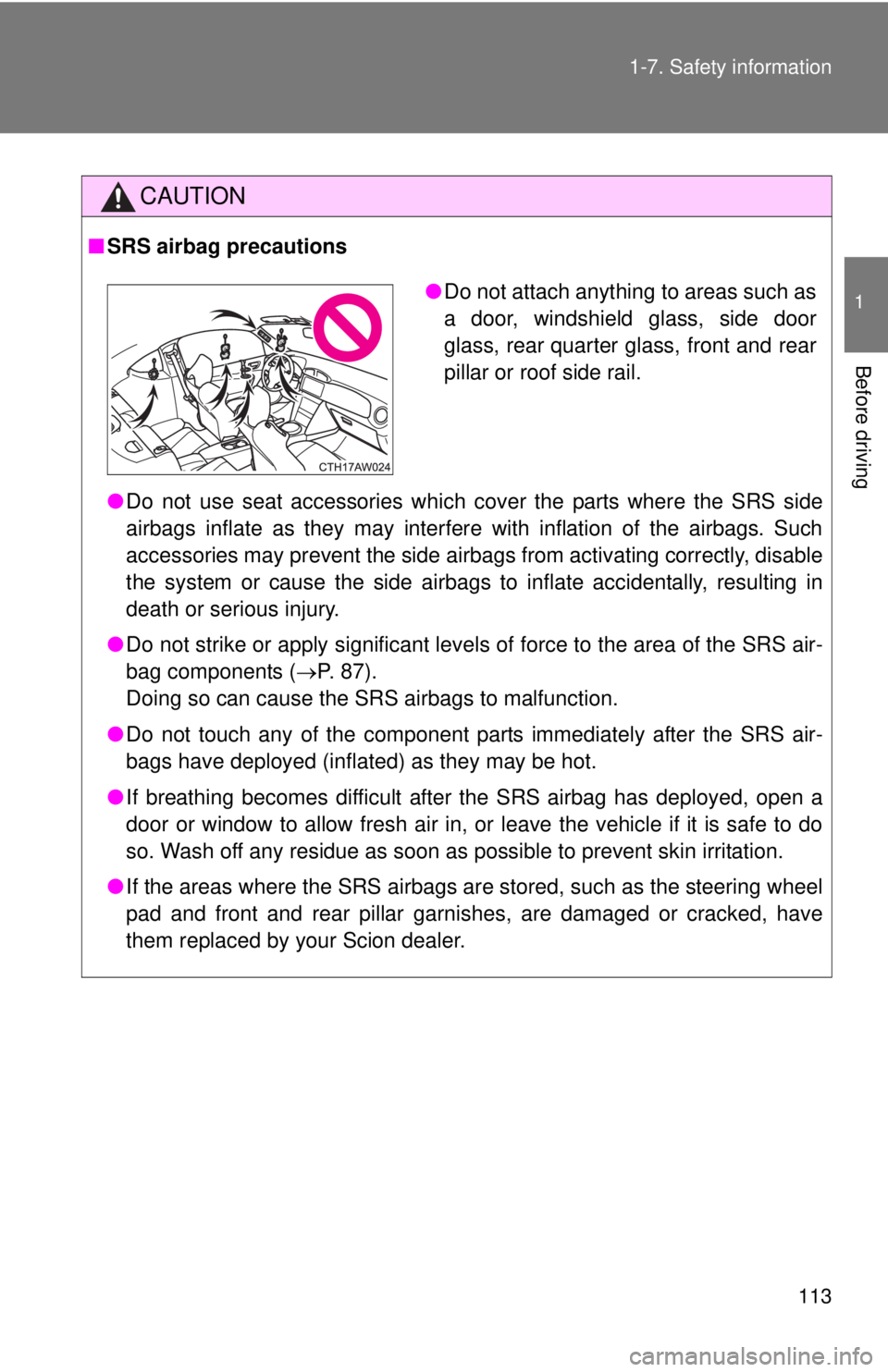
●Do not attach anything to areas such as
a door, windshield glass, side door
glass, rear quarter glass, front and rear
pillar or roof side rail.
Page 114 of 452

114 1-7. Safety information
CAUTION
■Modification and disposal of SRS airbag system components
Do not dispose of your vehicle or perform any of the following modifications
without consulting your Scion dealer.
The SRS airbags may malfunction or deploy (inflate) accidentally, causing
death or serious injury.
●Installation, removal, disassembly and repair of the SRS airbags.
●Repairs, modifications, removal or replacement of the steering wheel,
instrument panel, dashboard, seats or seat upholstery, front, side and rear
pillars or roof side rails.
●Repairs or modifications of the front fender, front bumper, or side of the
occupant compartment.
●Installation of a grille guard (bull bars, kangaroo bar, etc.), snow plows,
winches.
●Modifications to the vehicle's suspension system.
●Installation of electronic devices such as mobile two-way radios and CD
players.
●Modifications to your vehicle for a person with a physical disability.
Page 124 of 452

124 1-7. Safety information
CAUTION
■Front passenger occupant classification system precautions
●Never install a rearward facing child seat in the front passenger’s seat
even if the front passenger’s SRS frontal airbag is deactivated. Be sure to
install it in the rear seat in a correct manner. Also, it is strongly recom-
mended that any forward facing child seat or booster seat be installed in
the rear seat, and that even children who have outgrown a child restraint
system be also seated in the rear seat. This is because children sitting in
the front passenger’s seat may be killed or severely injured should the
front passenger’s SRS frontal airbag deploy. Scion believes that the rear
seats are the safest place for children
●If luggage or electronic devices are placed on the front passenger seat,
the OFF indicator may turn off and the ON indicator may illuminate. If this
occurs, the front passenger’s airbag may deploy during a collision. If this is
not desirable, remove the luggage or electronic devices from the front pas-
senger seat.
●Modifications for persons with disabilities that may affect the front passen-
ger occupant classification system. (U.S. only) Removing, replacing or
modifying any parts of the front seats, seat belts, front bumper, front side
frame, instrument panel, combination meter, steering wheel, steering col-
umn, tires, suspension or floor panel can affect the operation of the Scion
front passenger occupant classification system.
Page 144 of 452

144 2-1. Driving procedures
CAUTION
■When starting the vehicle (vehicles with an automatic transmission)
●Always keep your foot on the brake pedal while stopped with the engine
running. This prevents the vehicle from creeping.
●Firmly depress the brake pedal because engine speed may increase
immediately after starting the engine, when the air conditioning system is
operating, when turning the steering wheel, etc., thereby causing creeping
to become stronger. Apply the parking brake as necessary.
■When driving the vehicle
●Do not drive if you are unfamiliar with the location of the brake and accel-
erator pedals to avoid depressing the wrong pedal.
• Accidentally depressing the accelerator pedal instead of the brake
pedal will result in sudden acceleration that may lead to an accident
that could result in death or serious injury.
• When backing up, you may twist your body around, leading to a diffi-
culty in operating the pedals. Make sure to operate the pedals properly.
• Make sure to keep a correct driving posture even when moving the
vehicle only slightly. This allows you to depress the brake and acceler-
ator pedals properly.
• Depress the brake pedal using your right foot. Depressing the brake
pedal using your left foot may delay response in an emergency, result-
ing in an accident.
●Do not drive the vehicle over or stop the vehicle near flammable materials.
The exhaust system and exhaust gases can be extremely hot. These hot
parts may cause a fire if there is any flammable material nearby.
●On vehicles with an automatic transmission, do not let the vehicle roll
backward while the shift lever is in a driving position, or roll forward while
the shift lever is in R.
Doing so may cause the engine to stall or lead to poor brake and steering
performance, resulting in an accident or damage to the vehicle.
●If the smell of exhaust is noticed inside the vehicle, open the windows and
check that the trunk is closed. Large amounts of exhaust in the vehicle can
cause driver drowsiness and an accident, resulting in death or a serious
health hazard. Have the vehicle inspected by your Scion dealer immedi-
ately.
Page 145 of 452

145 2-1. Driving procedures
2
When driving
CAUTION
●On vehicles with a manual transmission, do not shift the shift lever to R
while the vehicle is moving forward.
Doing so can damage the transmission and may result in a loss of vehicle
control.
●Do not shift the shift lever to D (vehicles with an automatic transmission) or
1 (vehicles with a manual transmission) while the vehicle is moving back-
ward.
Doing so can damage the transmission and may result in a loss of vehicle
control.
●On vehicles with a manual transmission, do not release the clutch pedal
too quickly. Doing so may propel the vehicle forward, possibly causing an
accident.
●Moving the shift lever to N while the vehicle is moving will disengage the
engine from the transmission. Engine braking is not available when N is
selected.
●During normal driving, do not turn off the engine. Turning the engine off
while driving will not cause loss of steering or braking control, but the
power assist to these systems will be lost. This will make it more difficult to
steer and brake, so you should pull over and stop the vehicle as soon as it
is safe to do so.
However, in the event of an emergency, such as if it becomes impossible
to stop the vehicle in the normal way: P. 375
●Use engine braking (downshift) to maintain a safe speed when driving
down a steep hill.
Using the brakes continuously may cause the brakes to overheat and lose
effectiveness. (P. 163, 169)
●Do not adjust the position of the steering wheel, the seat, or the inside or
outside rear view mirrors while driving.
Doing so may result in a loss of vehicle control that can cause accidents,
resulting in death or serious injury.
Page 152 of 452

152 2-1. Driving procedures
NOTICE
■Avoiding damage to vehicle parts
●Do not turn the steering wheel fully in either direction and hold it there for
an extended period of time.
Doing so may damage the power steering motor.
●When driving over bumps in the road, drive as slowly as possible to avoid
damaging the wheels, underside of the vehicle, etc.
●On vehicles with an automatic transmission, do not race the engine for
more than 5 seconds in any position except the N or P position when the
brake is applied or when chocks are used in the wheels. This may cause
the transmission fluid to overheat.
■If you get a flat tire while driving
A flat or damaged tire may cause the following situations. Hold the steering
wheel firmly and gradually depress the brake pedal to slow down the vehicle.
●It may be difficult to control your vehicle.
●The vehicle will make abnormal sounds or vibrations.
●The vehicle will lean abnormally.
Information on what to do in case of a flat tire (P. 346)
■When encountering flooded roads
Do not drive on a road that has flooded after heavy rain etc. Doing so may
cause the following serious damage to the vehicle:
●Engine stalling
●Short in electrical components
●Engine damage caused by water immersion
In the event that you drive on a flooded road and the vehicle is flooded, be
sure to have your Scion dealer check the following:
●Brake function
●Changes in quantity and quality of oil and fluid used for the engine, trans-
mission, differential, etc.
●Lubricant condition for the propeller shaft, bearings and suspension joints
(where possible) and the function of all joints, bearings, etc.
Page 158 of 452
158 2-1. Driving procedures
■Operation of the “ENGINE START STOP” switch
When operating the “ENGINE START STOP” switch, one short, firm press is
enough. If the switch is pressed improperly, the engine may not start or the
“ENGINE START STOP” switch mode may not change. It is not necessary to
press and hold the switch.
■Electronic key battery depletion
P. 3 4
■Conditions affecting operation
P. 3 0
■Note for the entry function
P. 3 1
■If the engine does not start
The engine immobilizer system may not have been deactivated. (P. 73)
Contact your Scion dealer.
■Steering lock
After turning the “ENGINE START STOP” switch off and opening and closing
the doors, the steering wheel will be locked due to the steering lock function.
Operating the “ENGINE START STOP” switch again automatically cancels
the steering lock.
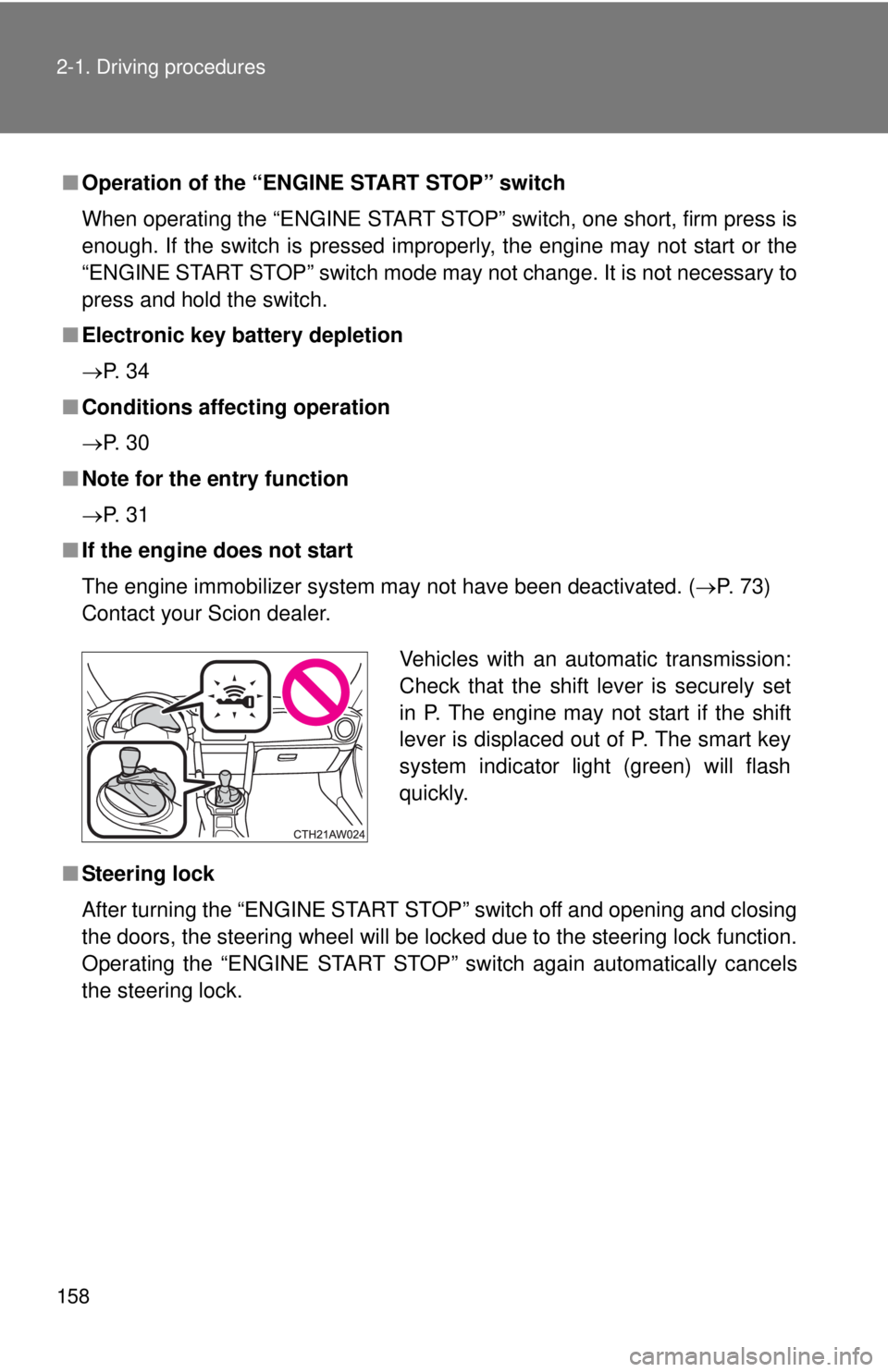
Vehicles with an automatic transmission:
Check that the shift lever is securely set
in P. The engine may not start if the shift
lever is displaced out of P. The smart key
system indicator light (green) will flash
quickly.
Page 159 of 452
159 2-1. Driving procedures
2
When driving
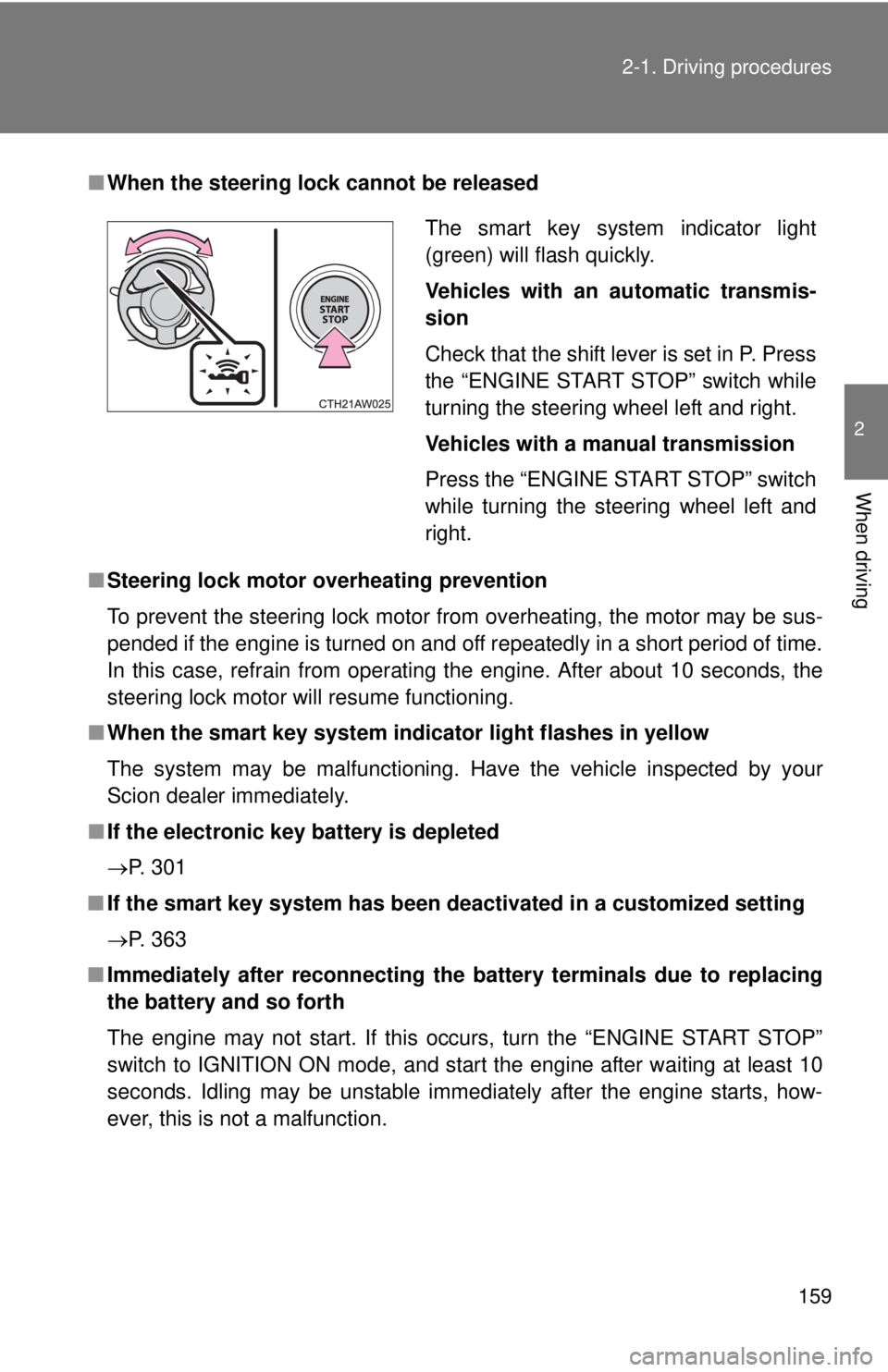
■When the steering lock cannot be released
■Steering lock motor overheating prevention
To prevent the steering lock motor from overheating, the motor may be sus-
pended if the engine is turned on and off repeatedly in a short period of time.
In this case, refrain from operating the engine. After about 10 seconds, the
steering lock motor will resume functioning.
■When the smart key system indicator light flashes in yellow
The system may be malfunctioning. Have the vehicle inspected by your
Scion dealer immediately.
■If the electronic key battery is depleted
P. 301
■If the smart key system has been deactivated in a customized setting
P. 363
■Immediately after reconnecting the battery terminals due to replacing
the battery and so forth
The engine may not start. If this occurs, turn the “ENGINE START STOP”
switch to IGNITION ON mode, and start the engine after waiting at least 10
seconds. Idling may be unstable immediately after the engine starts, how-
ever, this is not a malfunction.
The smart key system indicator light
(green) will flash quickly.
Vehicles with an automatic transmis-
sion
Check that the shift lever is set in P. Press
the “ENGINE START STOP” switch while
turning the steering wheel left and right.
Vehicles with a manual transmission
Press the “ENGINE START STOP” switch
while turning the steering wheel left and
right.
Page 160 of 452

160 2-1. Driving procedures
CAUTION
■When starting the engine
●Always start the engine while sitting in the driver’s seat. Do not depress
the accelerator pedal while starting the engine under any circumstances.
Doing so may cause an accident resulting in death or serious injury.
●If the smart key system indicator light flashes in green after the engine has
started, never drive the vehicle. The steering wheel is still locked, and it
may result in an accident.
■Caution while driving
If engine failure occurs while the vehicle is moving, do not lock or open the
doors until the vehicle reaches a safe and complete stop. Activation of the
steering lock in this circumstance may lead to an accident, resulting in death
or serious injury.
■Stopping the engine in an emergency
If you want to stop the engine in an emergency while driving the vehicle,
press and hold the “ENGINE START STOP” switch for more than 2 seconds,
or press it briefly 3 times or more in succession. (P. 375)
However, do not touch the “ENGINE START STOP” switch while driving
except in an emergency. Turning the engine off while driving will not cause
loss of steering or braking control, but the power assist to these systems will
be lost. This will make it more difficult to steer and brake, so you should pull
over and stop the vehicle as soon as it is safe to do so.
Page 174 of 452
174
2-1. Driving procedures
Hor n
■After adjusting the steering wheel
Make sure that the steering wheel is securely locked.
The horn may not sound if the steering wheel is not securely locked.
(P. 61)
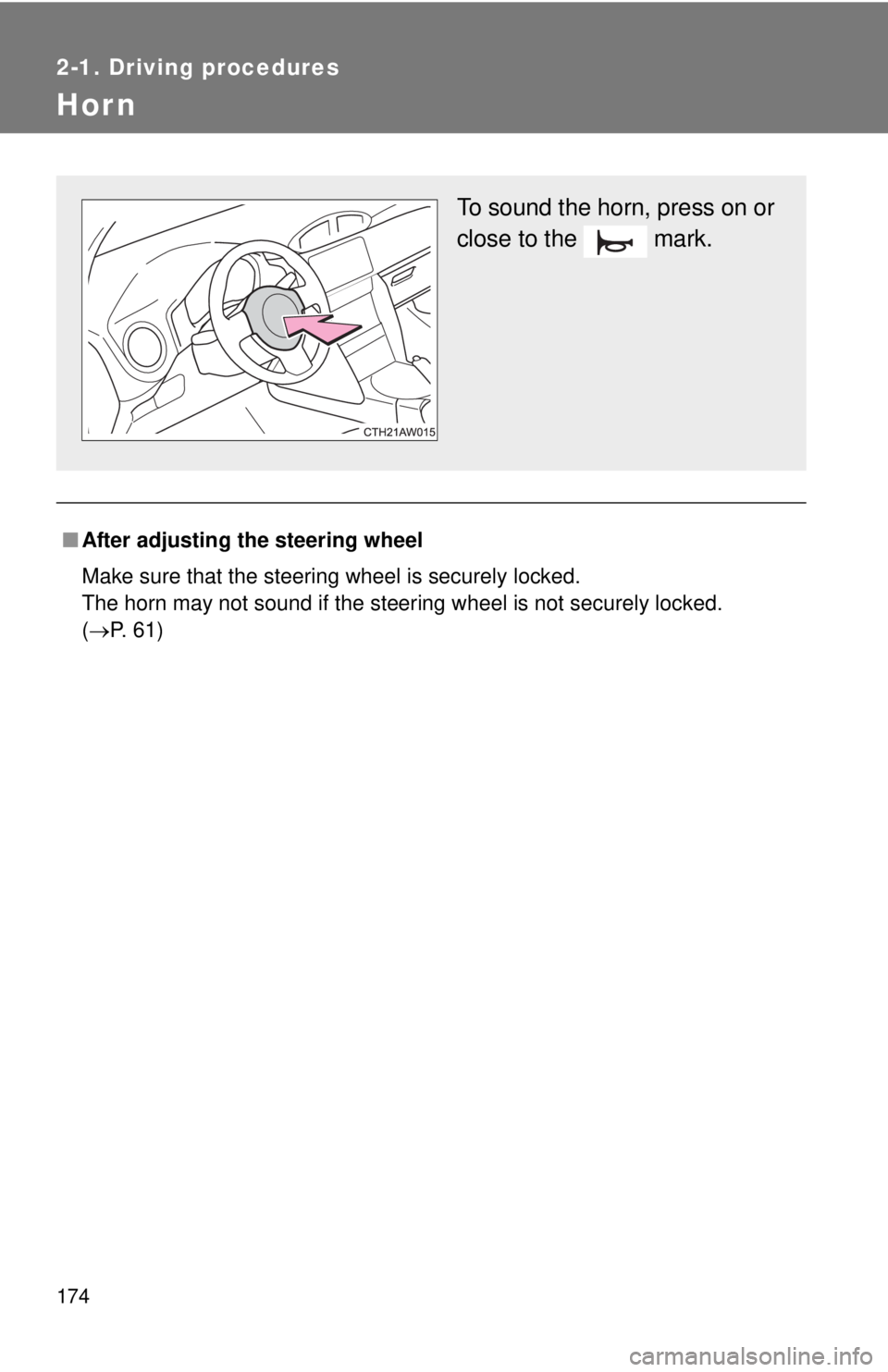
To sound the horn, press on or
close to the mark.