airbag off TOYOTA GR YARIS 2020 User Guide
[x] Cancel search | Manufacturer: TOYOTA, Model Year: 2020, Model line: GR YARIS, Model: TOYOTA GR YARIS 2020Pages: 458, PDF Size: 105.69 MB
Page 54 of 458
52
YARIS(GR) Owner's Manual_Europe_M52L09_en
1-2. Child safety
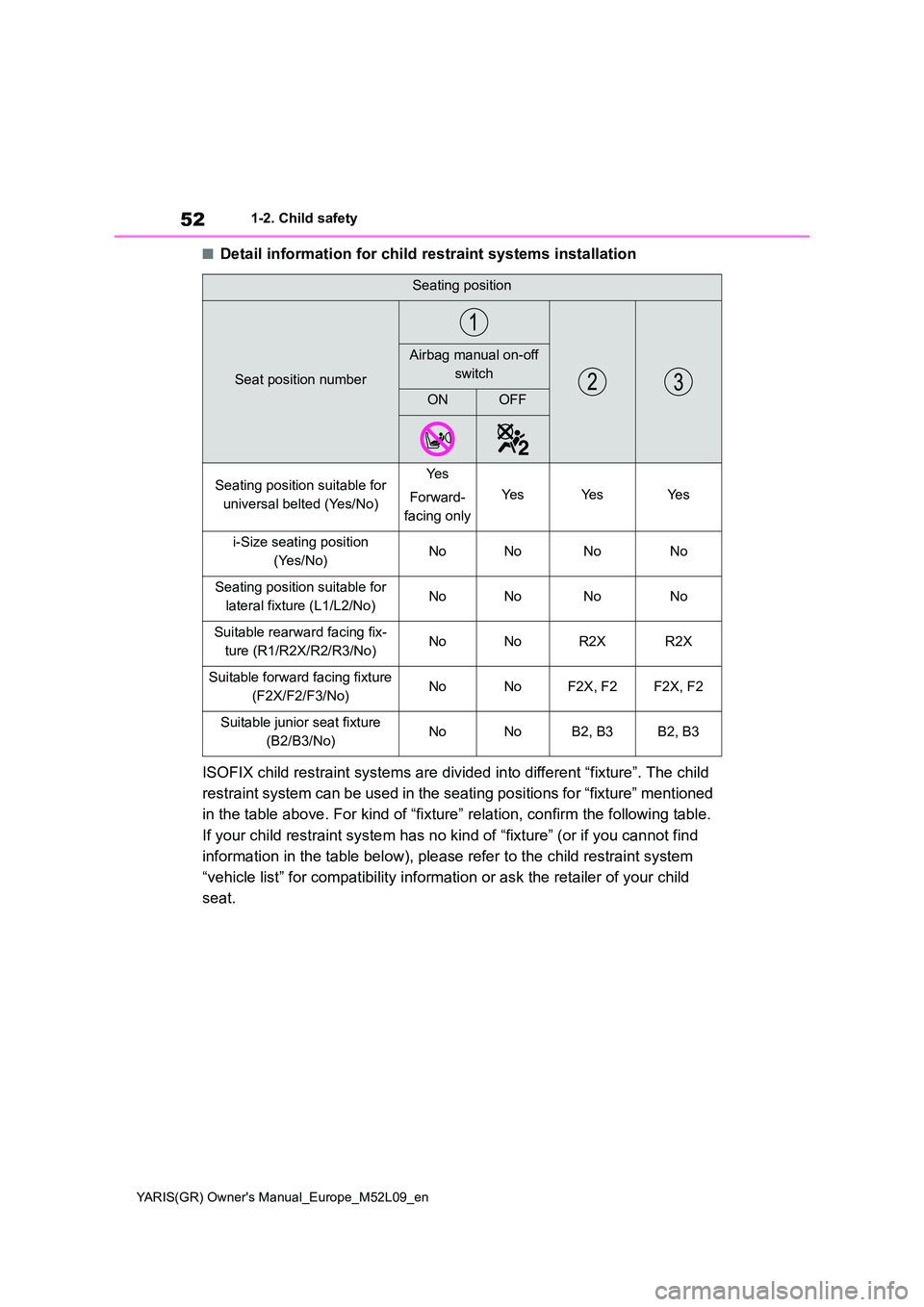
■Detail information for child restraint systems installation
ISOFIX child restraint systems are divided into different “fixture”. The child
restraint system can be used in the seating positions for “fixture” mentioned
in the table above. For kind of “fixture” relation, confirm the following table.
If your child restraint system has no kind of “fixture” (or if you cannot find
information in the table below), please refer to the child restraint system
“vehicle list” for compatibility information or ask the retailer of your child
seat.
Seating position
Seat position number
Airbag manual on-off
switch
ONOFF
Seating position suitable for
universal belted (Yes/No)
Ye s
Forward-
facing only
Ye sYe sYe s
i-Size seating position
(Yes/No)NoNoNoNo
Seating position suitable for
lateral fixture (L1/L2/No)NoNoNoNo
Suitable rearward facing fix-
ture (R1/R2X/R2/R3/No)NoNoR2XR2X
Suitable forward facing fixture
(F2X/F2/F3/No)NoNoF2X, F2F2X, F2
Suitable junior seat fixture
(B2/B3/No)NoNoB2, B3B2, B3
Page 56 of 458
54
YARIS(GR) Owner's Manual_Europe_M52L09_en
1-2. Child safety
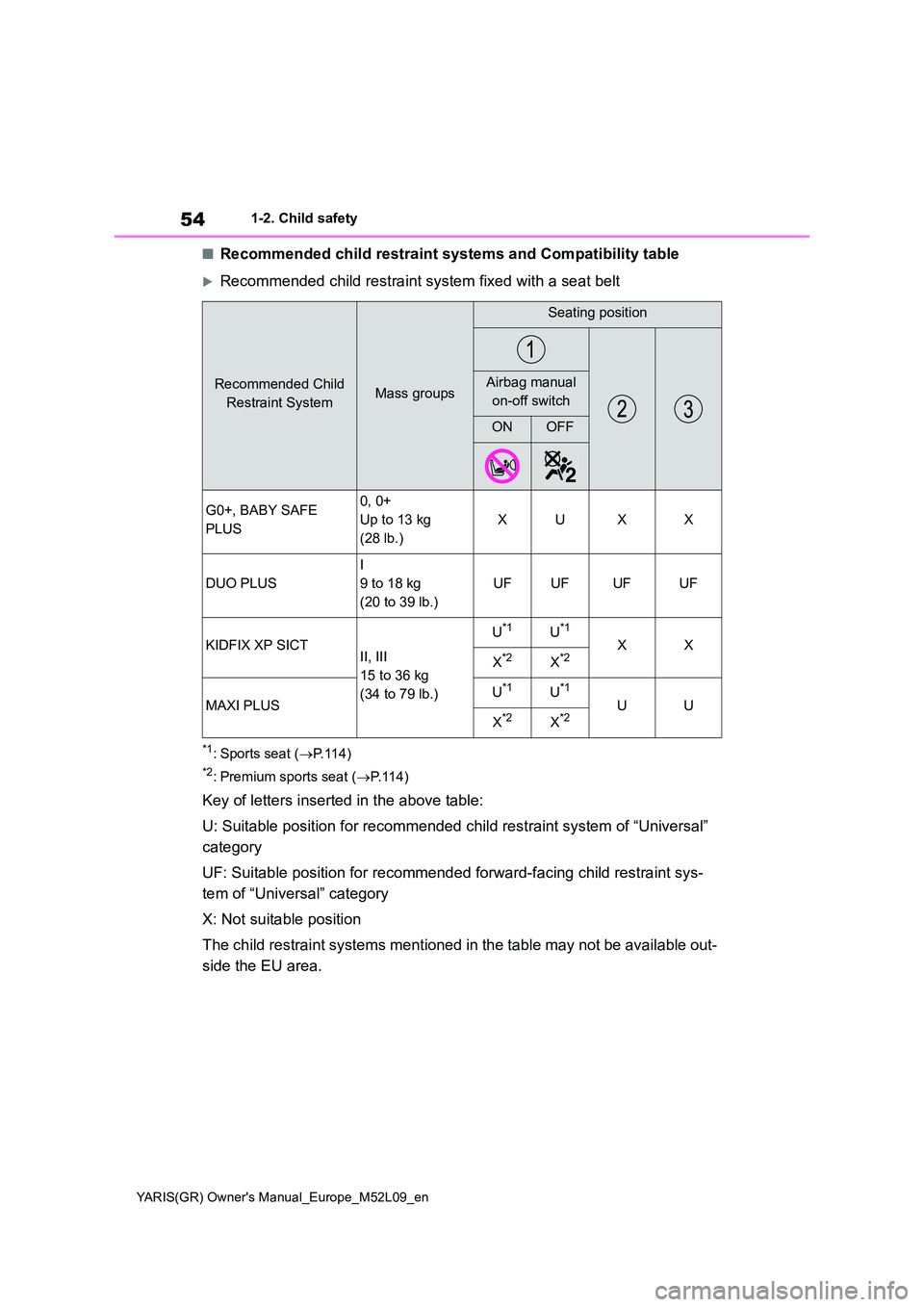
■Recommended child restraint systems and Compatibility table
Recommended child restraint system fixed with a seat belt
*1: Sports seat (→P.114)
*2: Premium sports seat (→P.114)
Key of letters inserted in the above table:
U: Suitable position for recommended child restraint system of “Universal”
category
UF: Suitable position for recommended forward-facing child restraint sys-
tem of “Universal” category
X: Not suitable position
The child restraint systems mentioned in the table may not be available out-
side the EU area.
Recommended Child
Restraint SystemMass groups
Seating position
Airbag manual
on-off switch
ONOFF
G0+, BABY SAFE
PLUS
0, 0+
Up to 13 kg
(28 lb.)
XUXX
DUO PLUS
I
9 to 18 kg
(20 to 39 lb.)
UFUFUFUF
KIDFIX XP SICTII, III
15 to 36 kg
(34 to 79 lb.)
U*1U*1
XX
X*2X*2
MAXI PLUSU*1U*1
UU
X*2X*2
Page 57 of 458
55
1
YARIS(GR) Owner's Manual_Europe_M52L09_en
1-2. Child safety
For safety and security
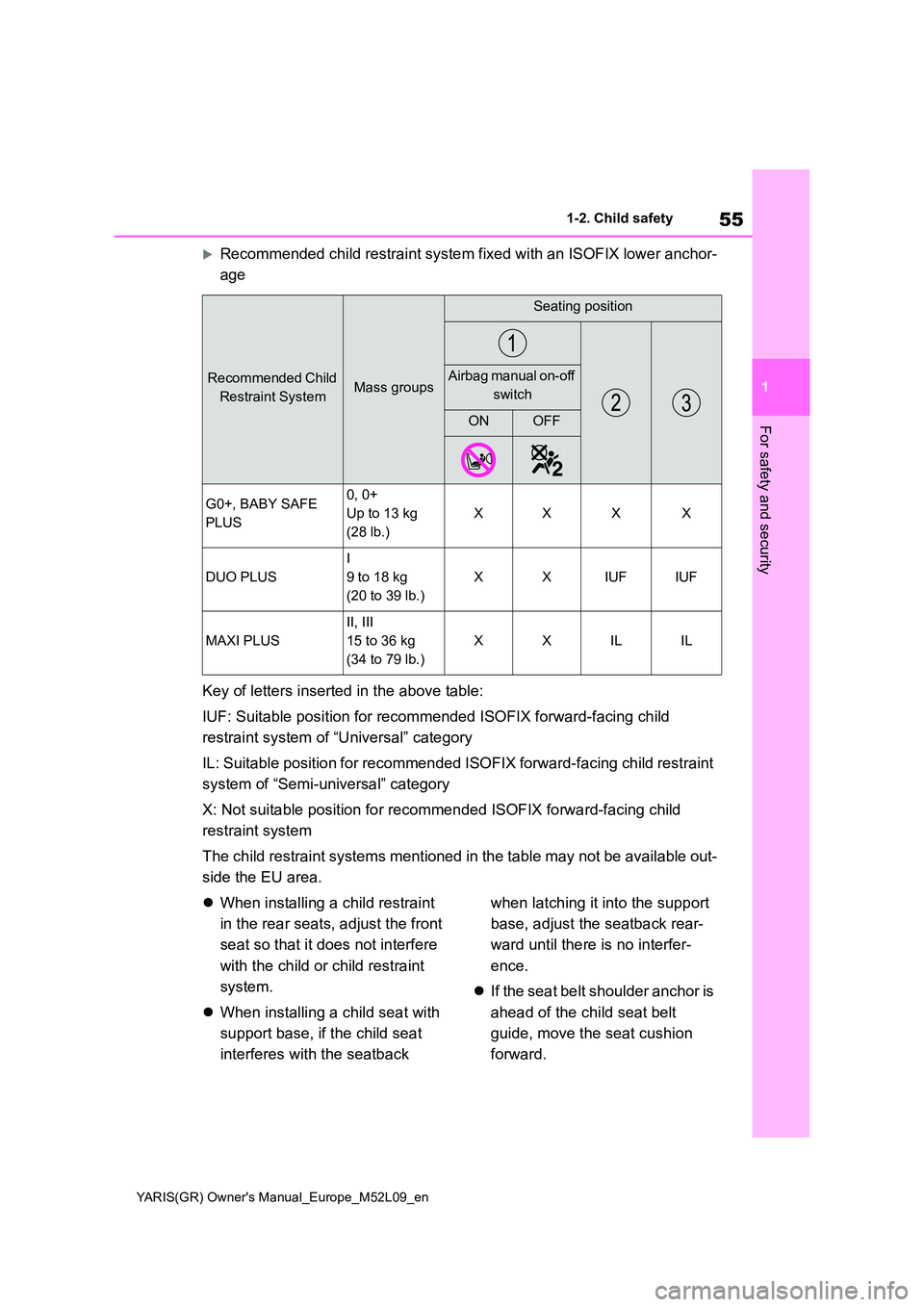
Recommended child restraint system fixed with an ISOFIX lower anchor-
age
Key of letters inserted in the above table:
IUF: Suitable position for recommended ISOFIX forward-facing child
restraint system of “Universal” category
IL: Suitable position for recommended ISOFIX forward-facing child restraint
system of “Semi-universal” category
X: Not suitable position for recommended ISOFIX forward-facing child
restraint system
The child restraint systems mentioned in the table may not be available out-
side the EU area.
z When installing a child restraint
in the rear seats, adjust the front
seat so that it does not interfere
with the child or child restraint
system.
z When installing a child seat with
support base, if the child seat
interferes with the seatback
when latching it into the support
base, adjust the seatback rear-
ward until there is no interfer-
ence.
z If the seat belt shoulder anchor is
ahead of the child seat belt
guide, move the seat cushion
forward.
Recommended Child
Restraint SystemMass groups
Seating position
Airbag manual on-off
switch
ONOFF
G0+, BABY SAFE
PLUS
0, 0+
Up to 13 kg
(28 lb.)
XXXX
DUO PLUS
I
9 to 18 kg
(20 to 39 lb.)
XXIUFIUF
MAXI PLUS
II, III
15 to 36 kg
(34 to 79 lb.)
XXILIL
Page 222 of 458
220
YARIS(GR) Owner's Manual_Europe_M52L09_en
4-5. Using the driving support systems
■TRC (Traction Control)
Helps to maintain drive power and
prevent the drive wheels from spin-
ning when starting the vehicle or
accelerating on slippery roads
■Hill-start assist control
Helps to reduce the backward
movement of the vehicle when
starting on an uphill
■EPS (Electric Power Steering)
Employs an electric motor to
reduce the amount of effort needed
to turn the steering wheel.
■Active Torque Split AWD sys-
tem
Automatically switches from front-
wheel drive to all-wheel drive
(AWD) according to the driving con-
ditions, helping to ensure reliable
handling and stability. Examples of
conditions where the system will
switch to AWD are when cornering,
going uphill, starting off or acceler-
ating, and when the road surface is
slippery due to snow, rain, etc.
■Emergency brake signal
When the brakes are applied sud-
denly, the emergency flashers auto-
matically flash to alert the vehicle
behind.
■The secondary Collision Brake
(if equipped)
When the SRS airbag sensor
detects a collision and the system
operates, the brakes and brake
lights are automatically controlled to reduce the vehicle speed and
help reduce the possibility of further
damage due to a secondary colli-
sion.
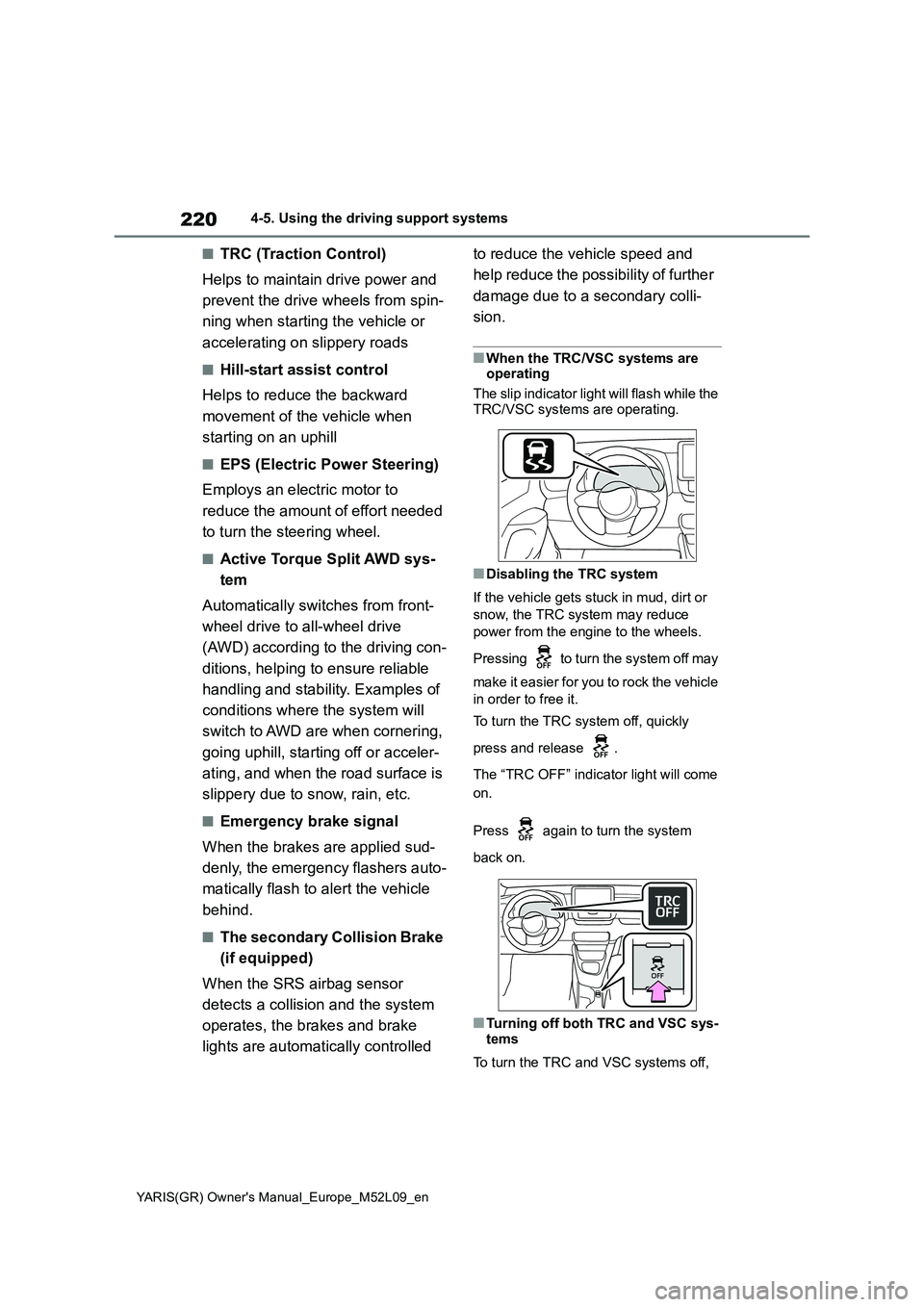
■When the TRC/VSC systems are
operating
The slip indicator light will flash while the
TRC/VSC systems are operating.
■Disabling the TRC system
If the vehicle gets stuck in mud, dirt or
snow, the TRC system may reduce
power from the engine to the wheels.
Pressing to turn the system off may
make it easier for you to rock the vehicle
in order to free it.
To turn the TRC system off, quickly
press and release .
The “TRC OFF” indicator light will come
on.
Press again to turn the system
back on.
■Turning off both TRC and VSC sys-
tems
To turn the TRC and VSC systems off,
Page 240 of 458
238
YARIS(GR) Owner's Manual_Europe_M52L09_en
5-2. Using the interior lights
2Turns the door position on
3 Turns the light on
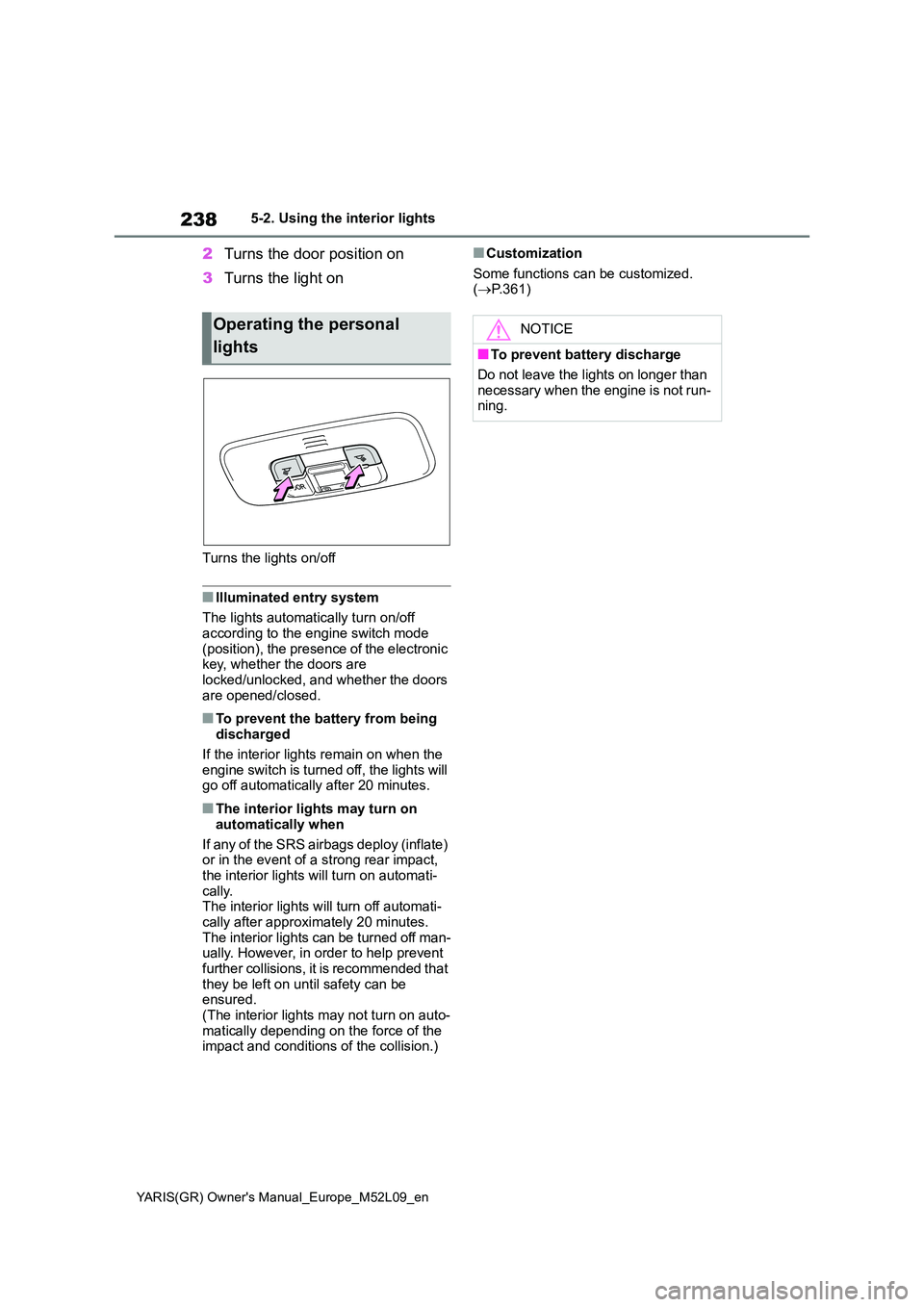
Turns the lights on/off
■Illuminated entry system
The lights automatically turn on/off
according to the engine switch mode (position), the presence of the electronic key, whether the doors are
locked/unlocked, and whether the doors are opened/closed.
■To prevent the battery from being discharged
If the interior lights remain on when the engine switch is turned off, the lights will go off automatically after 20 minutes.
■The interior lights may turn on
automatically when
If any of the SRS airbags deploy (inflate) or in the event of a strong rear impact,
the interior lights will turn on automati- cally.The interior lights will turn off automati-
cally after approximately 20 minutes. The interior lights can be turned off man-ually. However, in order to help prevent
further collisions, it is recommended that they be left on until safety can be ensured.
(The interior lights may not turn on auto- matically depending on the force of the impact and conditions of the collision.)
■Customization
Some functions can be customized. ( →P.361)
Operating the personal
lights
NOTICE
■To prevent battery discharge
Do not leave the lights on longer than necessary when the engine is not run-ning.
Page 254 of 458
252
YARIS(GR) Owner's Manual_Europe_M52L09_en
6-1. Maintenance and care
WARNING
■Water in the vehicle
●Do not splash or spill liquid in the
vehicle. Doing so may cause electrical com-ponents, etc. to malfunction or
catch fire.
●Do not get any of the SRS compo-
nents or wiring in the vehicle interior wet. ( →P. 3 4 ) An electrical malfunction may
cause the airbags to deploy or not function properly, resulting in death or serious injury.
■Cleaning the interior (especially instrument panel)
Do not use a polish wax or polish cleaner. The instrument panel may reflect off the windshield, obstructing
the driver’s view and leading to an accident, resulting in death or serious injury.
NOTICE
■Cleaning detergents
●Do not use the following types of detergent, as they may discolor the vehicle interior or cause streaks or
damage to painted surfaces:
• Non-seat portions: Organic sub- stances such as benzene or gaso-
line, alkaline or acidic solutions, dye, and bleach
• Seats: Alkaline or acidic solutions,
such as thinner, benzene, and alco- hol
●Do not use a polish wax or polish cleaner. The instrument panel’s or other interior part’s painted surface
may be damaged.
■Preventing damage to leather surfaces
Observe the following precautions to
avoid damage to and deterioration of leather surfaces:
●Remove any dust or dirt from
leather surfaces immediately.
●Do not expose the vehicle to direct
sunlight for extended periods of time. Park the vehicle in the shade, especially during summer.
●Do not place items made of vinyl, plastic, or containing wax on the
upholstery, as they may stick to the leather surface if the vehicle interior heats up significantly.
■Water on the floor
Do not wash the vehicle floor with
water. Vehicle systems such as the audio system may be damaged if water
comes into contact with electrical components such as the audio sys-tem above or under the floor of the
vehicle. Water may also cause the body to rust.
■When cleaning the inside of the windshield (vehicles with Toyota Safety Sense)
Do not allow glass cleaner to contact the lens. Also, do not touch the lens. ( →P.155)
●Be careful not to scratch or damage the heater wires or antenna.
■Cleaning the inside of the rear window
●Do not use glass cleaner to clean the rear window, as this may cause damage to the rear window defog-
ger heater wires or antenna. Use a cloth dampened with lukewarm water to gently wipe the window
clean. Wipe the window in strokes running parallel to the heater wires or antenna.
Page 308 of 458
306
YARIS(GR) Owner's Manual_Europe_M52L09_en
7-1. Essential information
7-1.Essential information
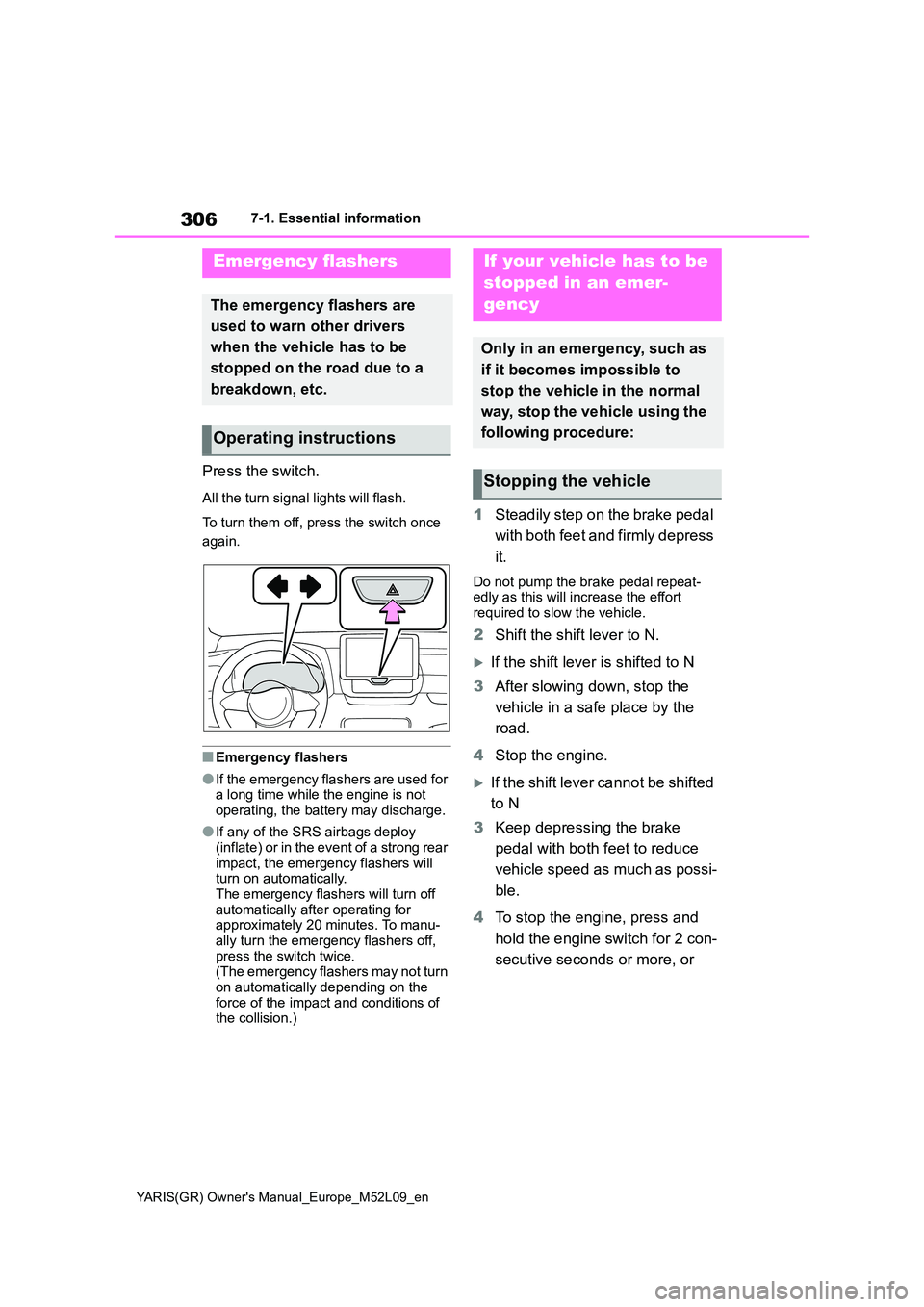
Press the switch.
All the turn signal lights will flash.
To turn them off, press the switch once
again.
■Emergency flashers
●If the emergency flashers are used for a long time while the engine is not
operating, the battery may discharge.
●If any of the SRS airbags deploy
(inflate) or in the event of a strong rear impact, the emergency flashers will turn on automatically.
The emergency flashers will turn off automatically after operating for approximately 20 minutes. To manu-
ally turn the emergency flashers off, press the switch twice.(The emergency flashers may not turn
on automatically depending on the force of the impact and conditions of the collision.)
1 Steadily step on the brake pedal
with both feet and firmly depress
it.
Do not pump the brake pedal repeat- edly as this will increase the effort required to slow the vehicle.
2 Shift the shift lever to N.
If the shift lever is shifted to N
3 After slowing down, stop the
vehicle in a safe place by the
road.
4 Stop the engine.
If the shift lever cannot be shifted
to N
3 Keep depressing the brake
pedal with both feet to reduce
vehicle speed as much as possi-
ble.
4 To stop the engine, press and
hold the engine switch for 2 con-
secutive seconds or more, or
Emergency flashers
The emergency flashers are
used to warn other drivers
when the vehicle has to be
stopped on the road due to a
breakdown, etc.
Operating instructions
If your vehicle has to be
stopped in an emer-
gency
Only in an emergency, such as
if it becomes impossible to
stop the vehicle in the normal
way, stop the vehicle using the
following procedure:
Stopping the vehicle
Page 316 of 458
314
YARIS(GR) Owner's Manual_Europe_M52L09_en
7-2. Steps to take in an emergency
Follow the procedure below to
restart the engine after the system
is activated.
1 Turn the engine switch to ACC
or OFF.
2 Restart the engine.
Fuel pump shut off sys-
tem
To minimize the risk of fuel
leakage when the engine stalls
or when an airbag inflates
upon collision, the fuel pump
shut off system stops the sup-
ply of fuel to the engine.
Restarting the engine
NOTICE
■Before starting the engine
Inspect the ground under the vehicle. If you find that fuel has leaked onto the ground, the fuel system has been
damaged and is in need of repair. Do not restart the engine.
Page 337 of 458
335
7
YARIS(GR) Owner's Manual_Europe_M52L09_en
7-2. Steps to take in an emergency
When trouble arises
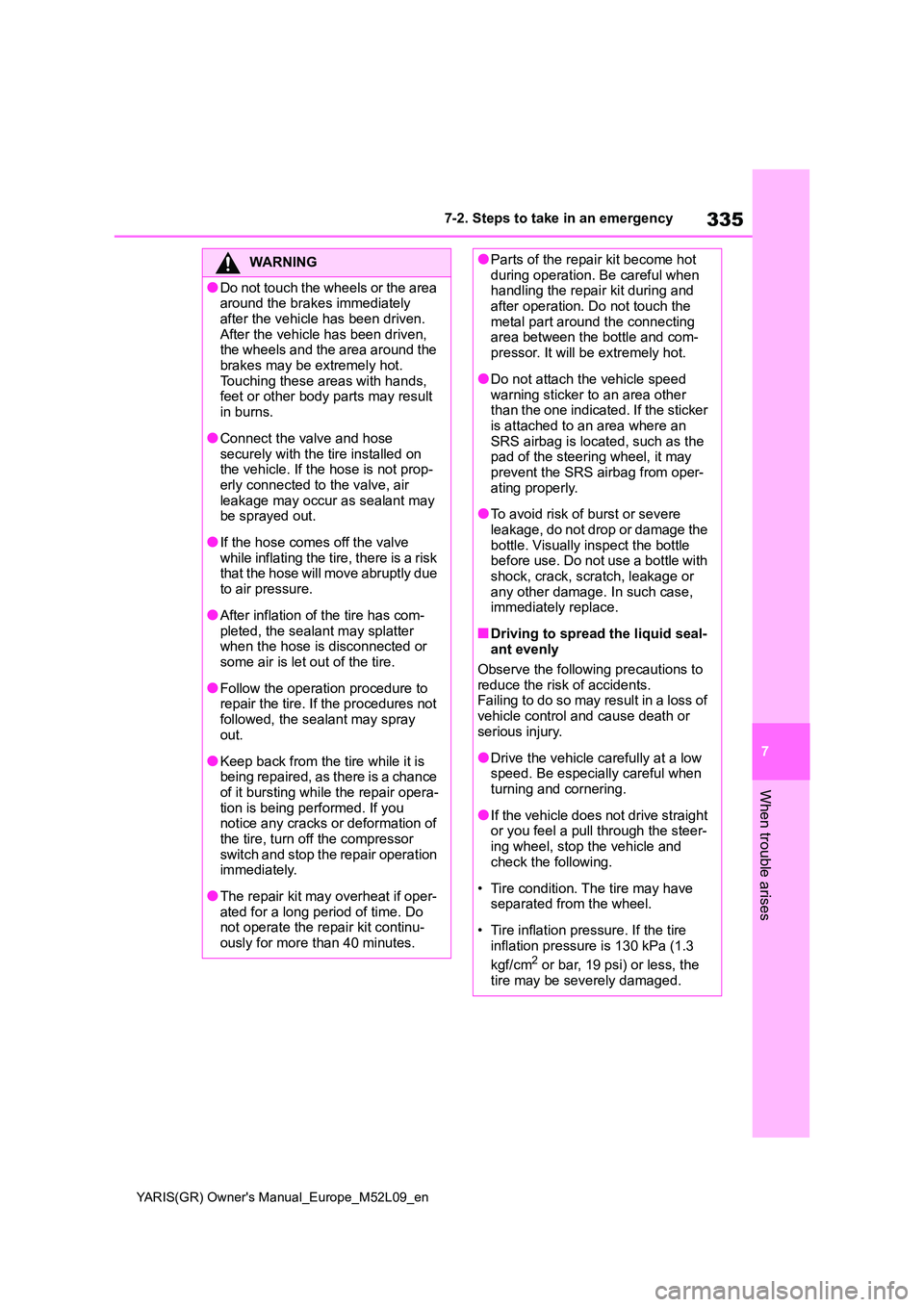
WARNING
●Do not touch the wheels or the area around the brakes immediately
after the vehicle has been driven. After the vehicle has been driven, the wheels and the area around the
brakes may be extremely hot. Touching these areas with hands, feet or other body parts may result
in burns.
●Connect the valve and hose
securely with the tire installed on the vehicle. If the hose is not prop-erly connected to the valve, air
leakage may occur as sealant may be sprayed out.
●If the hose comes off the valve while inflating the tire, there is a risk that the hose will move abruptly due
to air pressure.
●After inflation of the tire has com-
pleted, the sealant may splatter when the hose is disconnected or some air is let out of the tire.
●Follow the operation procedure to repair the tire. If the procedures not
followed, the sealant may spray out.
●Keep back from the tire while it is being repaired, as there is a chance of it bursting while the repair opera-
tion is being performed. If you notice any cracks or deformation of the tire, turn off the compressor
switch and stop the repair operation immediately.
●The repair kit may overheat if oper-ated for a long period of time. Do not operate the repair kit continu-
ously for more than 40 minutes.
●Parts of the repair kit become hot during operation. Be careful when handling the repair kit during and
after operation. Do not touch the metal part around the connecting area between the bottle and com-
pressor. It will be extremely hot.
●Do not attach the vehicle speed
warning sticker to an area other than the one indicated. If the sticker is attached to an area where an
SRS airbag is located, such as the pad of the steering wheel, it may prevent the SRS airbag from oper-
ating properly.
●To avoid risk of burst or severe
leakage, do not drop or damage the bottle. Visually inspect the bottle before use. Do not use a bottle with
shock, crack, scratch, leakage or any other damage. In such case, immediately replace.
■Driving to spread the liquid seal-ant evenly
Observe the following precautions to reduce the risk of accidents.Failing to do so may result in a loss of
vehicle control and cause death or serious injury.
●Drive the vehicle carefully at a low speed. Be especially careful when turning and cornering.
●If the vehicle does not drive straight or you feel a pull through the steer-
ing wheel, stop the vehicle and check the following.
• Tire condition. The tire may have separated from the wheel.
• Tire inflation pressure. If the tire inflation pressure is 130 kPa (1.3
kgf/cm2 or bar, 19 psi) or less, the
tire may be severely damaged.
Page 445 of 458
443
YARIS(GR) Owner's Manual_Europe_M52L09_en
Alphabetical Index
Alphabetical Index
A
A/C
Air conditioning filter................... 293
Automatic air conditioning system
................................................. 230
ABS (Anti-lock Brake System) .... 219
Warning light .............................. 316
Active Torque Split AWD system 220
Air conditioning filter ................... 293
Air conditioning system
Air conditioning filter................... 293
Automatic air conditioning system
................................................. 230
Airbag manual on-off system ........ 43
Airbags ............................................ 34
Airbag manual on-off system ....... 43
Airbag operating conditions ......... 36
Airbag precautions for your child . 38
Correct driving posture................. 29
Curtain shield airbag operating con-
ditions ........................................ 36
Curtain shield airbag precautions 38
General airbag precautions.......... 38
Locations of airbags ..................... 34
Modification and disposal of airbags
................................................... 41
Side airbag operating conditions.. 36
Side airbag precautions ............... 38
Side and curtain shield airbags oper-
ating conditions.......................... 36
Side and curtain shield airbags pre-
cautions ..................................... 38
SRS airbags ................................. 34
SRS warning light ...................... 316Alarm................................................74
Alarm ............................................ 74
Warning buzzer .......................... 315
Antennas (smart entry & start sys-
tem) ..............................................109
Anti-lock Brake System (ABS)..... 219
Warning light .............................. 316
Approach warning ........................ 187
Assist grips ...................................245
Audio remote control switches ... 245
Audio system-linked display ......... 89
Automatic air conditioning system
..................................................... 230
Automatic High Beam ..................147
Automatic light control system ... 144
Average fuel economy ................... 88
Average vehicle speed ................... 89
B
Back door ...................................... 106
Back-up light
Replacing light bulbs ..................301
Battery
Battery checking......................... 275
If the battery is discharged ......... 341
Preparing and checking before win-
ter ............................................. 226
Warning light .............................. 315
Blind Spot Monitor (BSM) ............201
Enabling/disabling the Blind Spot
Monitor ..................................... 203
Boost Meter .....................................90
Bottle holders................................ 240