brake light TOYOTA HIGHLANDER 2010 XU40 / 2.G User Guide
[x] Cancel search | Manufacturer: TOYOTA, Model Year: 2010, Model line: HIGHLANDER, Model: TOYOTA HIGHLANDER 2010 XU40 / 2.GPages: 608, PDF Size: 11.99 MB
Page 225 of 608
225
2-4. Using other driving systems
2
When driving
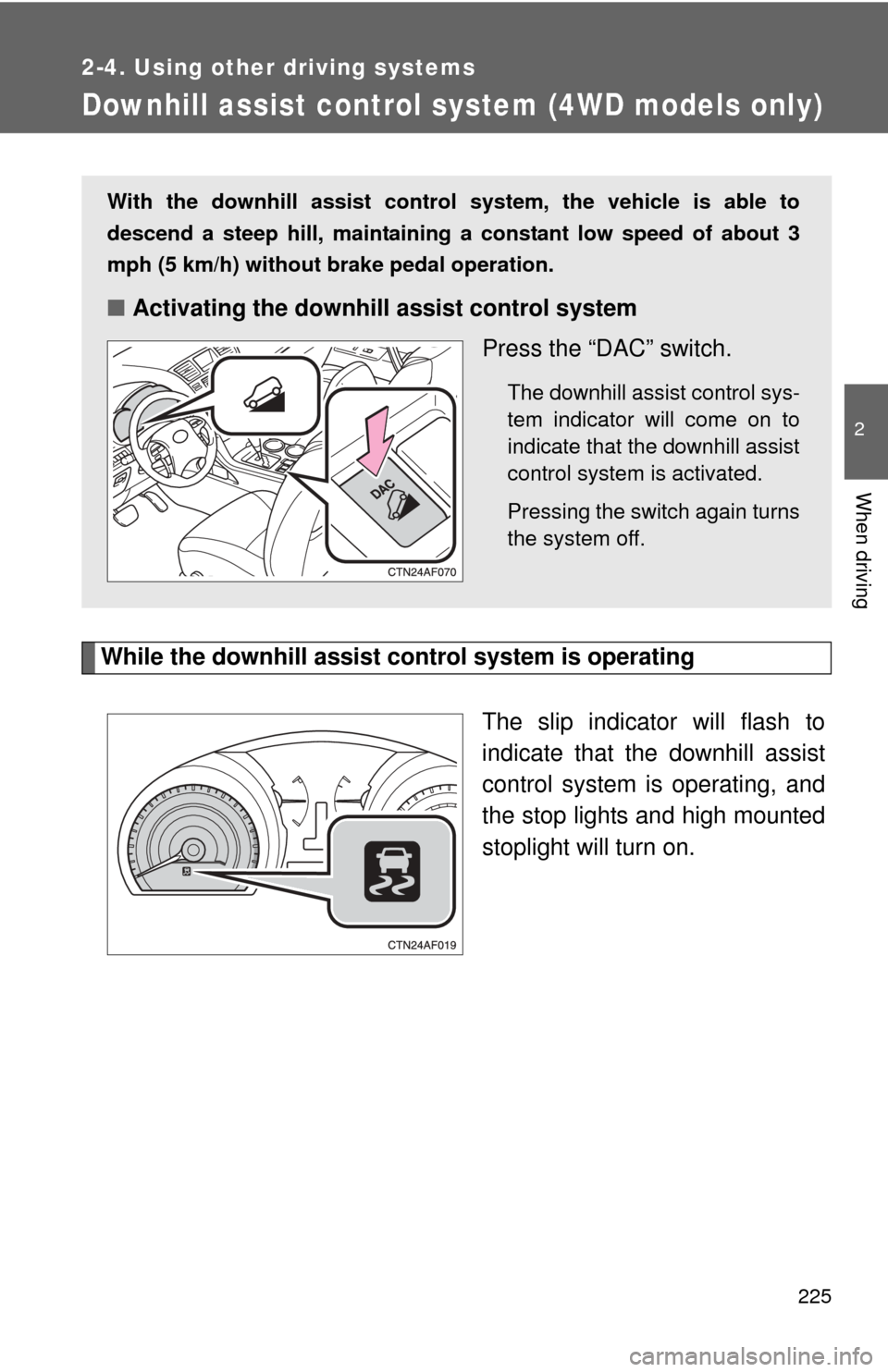
Downhill assist control system (4WD models only)
While the downhill assist control system is operatingThe slip indicator will flash to
indicate that the downhill assist
control system is operating, and
the stop lights and high mounted
stoplight will turn on.
With the downhill assist control system, the vehicle is able to
descend a steep hill, maintaining a constant low speed of about 3
mph (5 km/h) without brake pedal operation.
■Activating the downhill assist control system
Press the “DAC” switch.
The downhill assist control sys-
tem indicator will come on to
indicate that the downhill assist
control system is activated.
Pressing the switch again turns
the system off.
Page 251 of 608
251
2-5. Driving information
2
When driving
CAUTION
●
Lubricate the hitch ball with a light coat of grease.
● Remove the trailer hitch whenever you are not towing a trailer. After
removing the hitch, seal any mounting hole in the vehicle body to prevent
entry of any substances into the vehicle.
■ When towing a trailer
●If the gross trailer weight exceeds 1000 lb. (453 kg), trailer brakes are
required. Toyota recommends trailers wi th brakes that conform to all appli-
cable federal and state/provincial regulations.
● Never tap into your vehicle's hydraulic system, as this will lower the vehi-
cle's braking effectiveness.
● Never tow a trailer without using a safety chain securely attached to both
the trailer and the vehicle. If damage occurs to the coupling unit or hitch
ball, there is danger of the trailer wandering into another lane.
NOTICE
■When installing a trailer hitch
●Use only the position recommended by your Toyota dealer. Do not install
the trailer hitch on the bumper as this may cause body damage.
● Do not use axle-mounted hitches, as they can cause damage to the axle
housing, wheel bearings, wheels or tires.
■ Safety chain
A safety chain must always be used between the towing vehicle and the
trailer. Leave sufficient slack in the chain for turns. The chain should cross
under the trailer tongue to prevent the tongue from dropping to the ground in
the case that it becomes damaged or separated. For the correct safety chain
installation procedure, ask your Toyota dealer.
■ Do not directly splice trailer lights
Directly splicing trailer lights may damage your vehicle's electrical system
and cause a malfunction.
Page 425 of 608
425
4-2. Maintenance
4
Maintenance and care
Vehicle interior
ItemsCheck points
Accelerator pedal • Moves smoothly (without uneven
pedal effort or catching)?
Automatic transmission “Park”
mechanism • Can the vehicle be held securely
on an incline with the shift lever in
P?
Brake pedal • Moves smoothly?
• Does it have appropriate clear-
ance and correct amount of free
play?
Brakes • Not pull to one side when
applied?
• Loss of brake effectiveness?
• Spongy feeling brake pedal?
• Pedal almost touches floor?
Head restraints • Move smoothly and lock
securely?
Indicators/buzzers • Function properly?
Lights • Do all the lights come on?
• Headlights aimed correctly?
Parking brake • Moves smoothly?
• Can hold the vehicle securely on
an incline?
Seat belts • Does the seat belt system oper-
ate smoothly?
• Are the belts undamaged?
Seats • Do the seat controls operate
properly?
Steering wheel • Moves smoothly?
• Has correct free play?
• No strange noises?
Page 449 of 608
449
4-3. Do-it-yourself maintenance
4
Maintenance and care
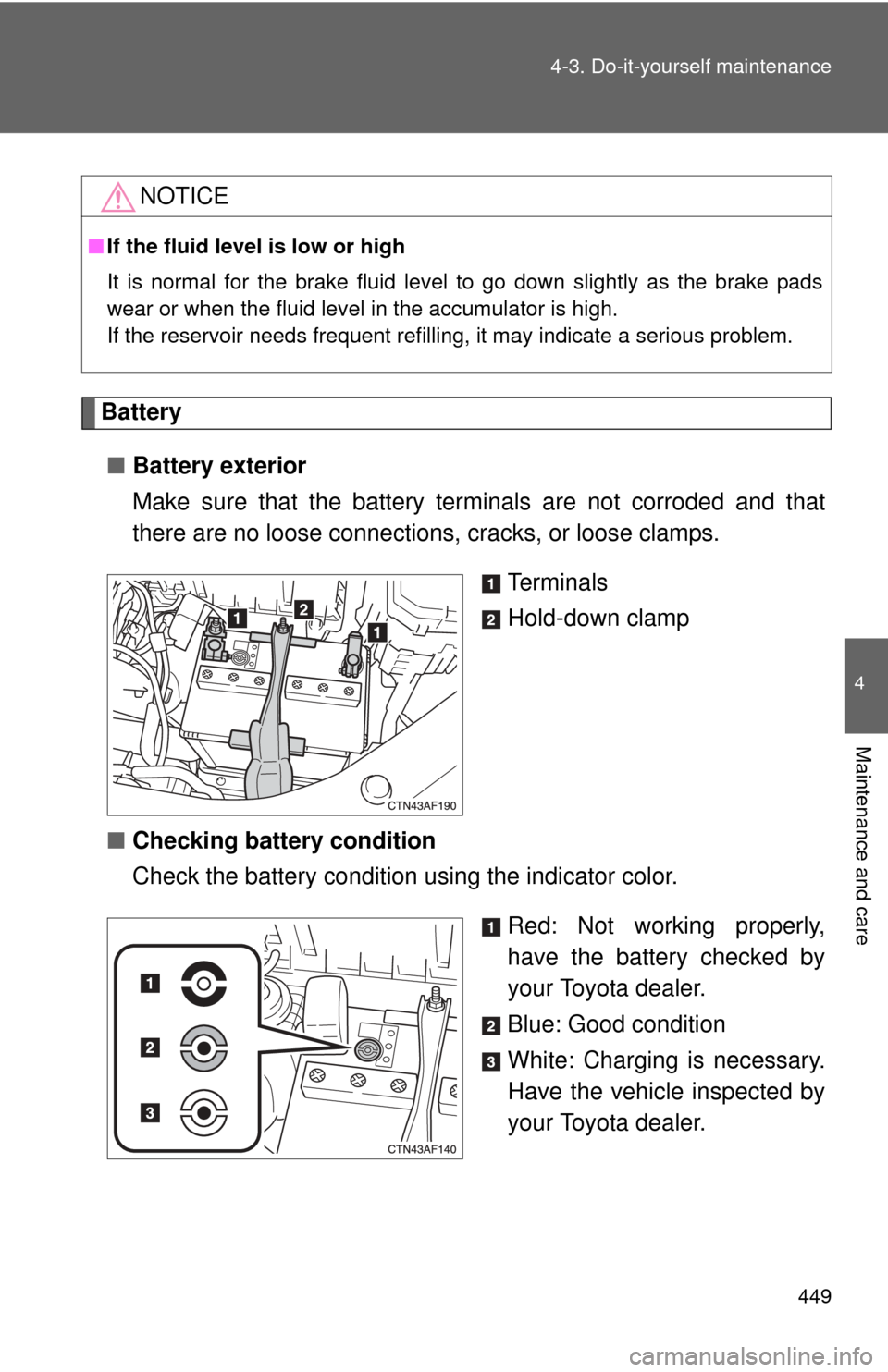
Battery
■ Battery exterior
Make sure that the battery terminals are not corroded and that
there are no loose connections, cracks, or loose clamps.
Te r m i n a l s
Hold-down clamp
■ Checking battery condition
Check the battery condition using the indicator color.
Red: Not working properly,
have the battery checked by
your Toyota dealer.
Blue: Good condition
White: Charging is necessary.
Have the vehicle inspected by
your Toyota dealer.
NOTICE
■If the fluid level is low or high
It is normal for the brake fluid level to go down slightly as the brake pads
wear or when the fluid level in the accumulator is high.
If the reservoir needs frequent refilling, it may indicate a serious pro\
blem.
Page 484 of 608

484 4-3. Do-it-yourself maintenance
22 GAUGE NO.1 10 AAudio system, outside rear view
mirror defoggers, back-up lights,
charging system, emergency flash-
ers, traction control system, instru-
ment panel light control dial,
windshield wiper deicer
23 FR WIP 30 A Windshield wipers and washer
24 RR WIP 15 A Rear window wiper and washer
25 IGN 10 A Multiport fuel injection system/
sequential multiport fuel injection
system, steering lock system, anti-
lock brake system, smart key sys-
tem, SRS airbag system
26 GAUGE NO.2 7.5 A Gauges and meters, rear view
monitor
27 ECU-ACC 7.5 A Auto anti-glare rear view mirrors,
shift lock system, smart key system
28 ACC SOCK
NO.1 10 A Power outlet
29 ACC SOCK
NO.2 20 A Power outlet
30 RADIO NO.2 7.5 A Audio system, clock, rear seat
entertainment system, charging
system, interior lights, personal
lights
31 MIR HTR 15 A Outside rear view mirror defoggers
FuseAmpereCircuit
Page 510 of 608
510
5-2. Steps to take in an emergency
If a war ning light tur ns on or a war ning buzzer sounds...
Stop the vehicle immediately. Continuing to drive the vehicle may be dangerous.
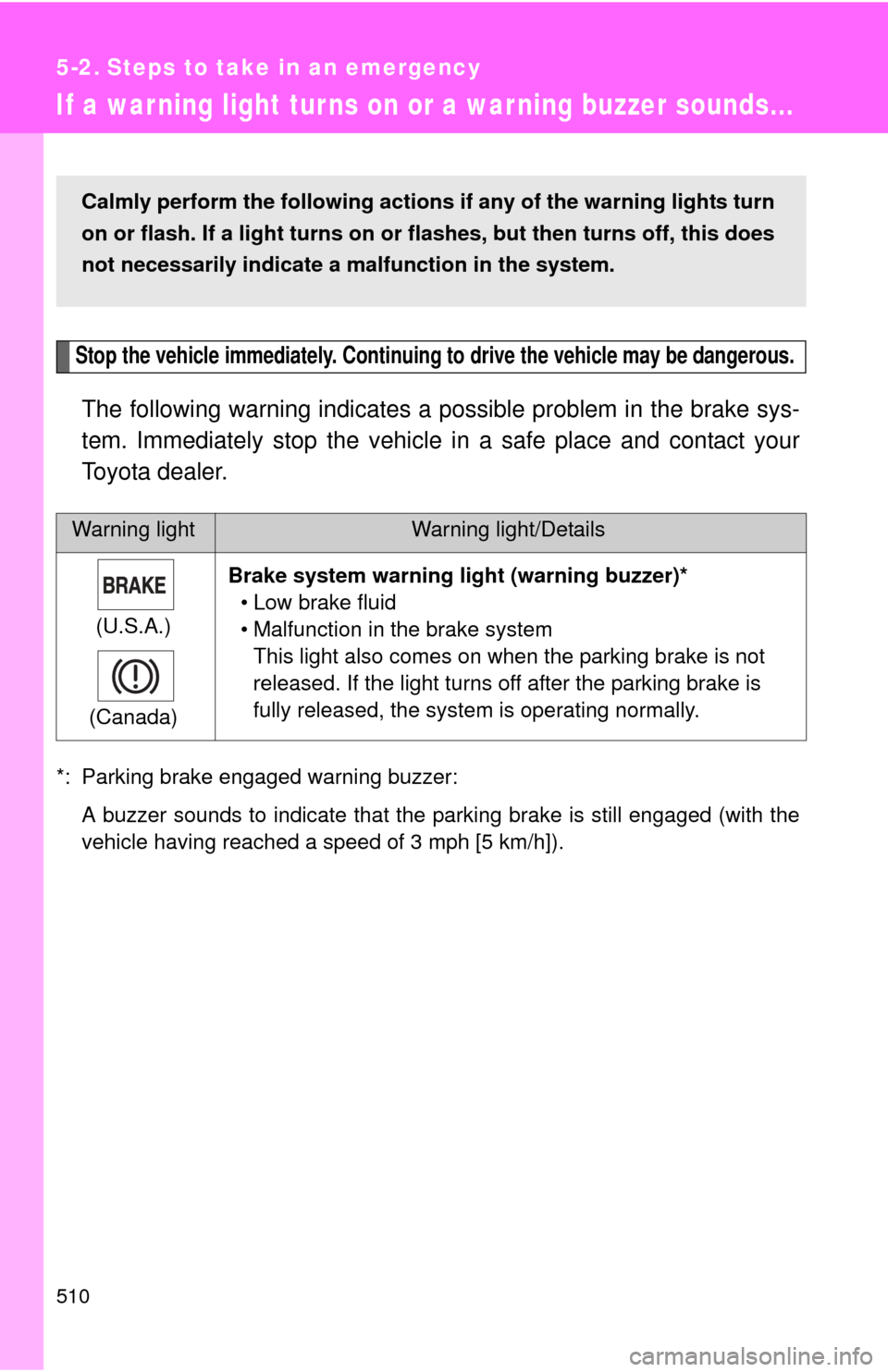
The following warning indicates a possible problem in the brake sys-
tem. Immediately stop the vehicle in a safe place and contact your
Toyota dealer.
*: Parking brake engaged warning buzzer:
A buzzer sounds to indicate that the parking brake is still engaged (with the
vehicle having reached a speed of 3 mph [5 km/h]).
Warning lightWarning light/Details
(U.S.A.)
(Canada) Brake system warning light (warning buzzer)*
• Low brake fluid
• Malfunction in the brake system This light also comes on when the parking brake is not
released. If the light turns off after the parking brake is
fully released, the system is operating normally.
Calmly perform the following actions if any of the warning lights turn
on or flash. If a light turns on or flashes, but then turns off, this does
not necessarily indicate a malfunction in the system.
Page 512 of 608
512 5-2. Steps to take in an emergency
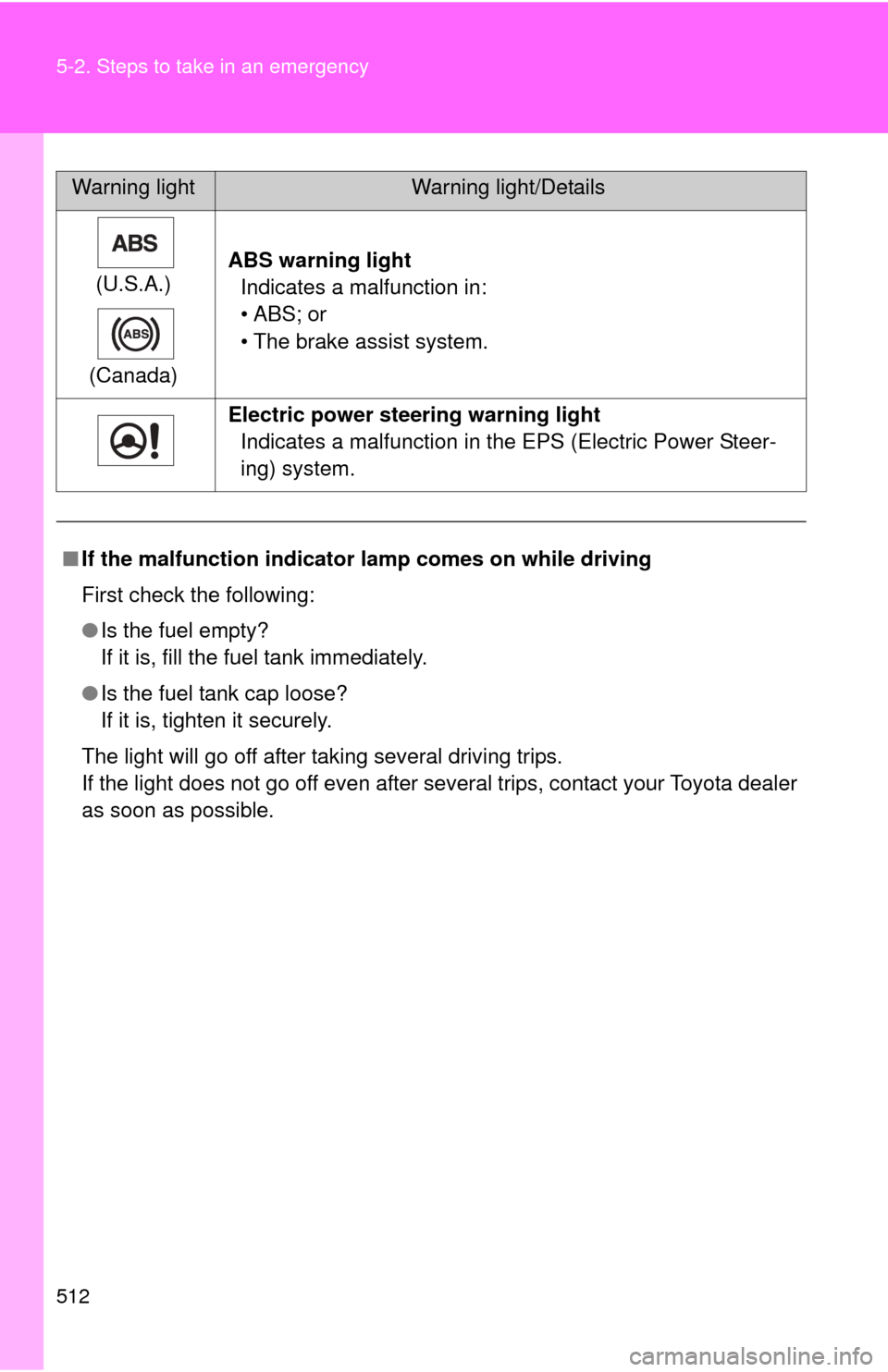
(U.S.A.)
(Canada) ABS warning light
Indicates a malfunction in:
•ABS; or
• The brake assist system.
Electric power steering warning light Indicates a malfunction in the EPS (Electric Power Steer-
ing) system.
■ If the malfunction indicator lamp comes on while driving
First check the following:
● Is the fuel empty?
If it is, fill the fuel tank immediately.
● Is the fuel tank cap loose?
If it is, tighten it securely.
The light will go off after taking several driving trips.
If the light does not go off even after several trips, contact your Toyota dealer
as soon as possible.
Warning lightWarning light/Details
Page 519 of 608
5
When trouble arises
519
5-2. Steps to take in an emergency
CAUTION
■If the tire pressure warning light comes on
Be sure to observe the following precautions. Failure to do so could
cause loss of vehicle control and result in death or serious injury.
●Stop your vehicle in a safe place as
soon as possible. Adjust the tire
inflation pressure immediately.
●If the tire pressure warning light comes on even after tire inflation pres-
sure adjustment, it is pr obable that you have a flat tire. Check the tires.
If the tire is flat, change to the spare tire and have the flat tire repaired
by the nearest Toyota dealer.
●Avoid abrupt maneuvering and braking. If the vehicle tires deteriorate,
you could lose control of the steering wheel or the brakes.
■If a blowout or sudden air leakage should occur
The tire pressure warning syste m may not activate immediately.
■Maintenance of the tires
Each tire, including the spare (if provided), should be checked monthly
when cold and inflated to the inflation pressure recommended by the
vehicle manufacturer on the vehicle placard or tire inflation pressure
label (tire and load information label). (If your vehicle has tires of a differ-
ent size than the size indicated on the vehicle placard or tire inflation
pressure label [tire and load information label], you should determine the
proper tire inflation pr essure for those tires.)
As an added safety feature, your vehicle has been equipped with a tire
pressure monitoring system (TPMS-ti re pressure warning system) that
illuminates a low tire pressure telltal e (tire pressure warning light) when
one or more of your tires is significantly under-inflated. Accordingly,
when the low tire pressure telltale (tire pre ssure warning light) illumi-
nates, you should stop and check your tires as soon as possible, and
inflate them to the proper pressure. Driving on a significantly under-
inflated tire causes the tire to overheat and can lead to tire failure.
Under-inflation also reduces fuel effi ciency and tire tread life, and may
affect the vehicle's hand ling and stopping ability.
Page 536 of 608
536 5-2. Steps to take in an emergency
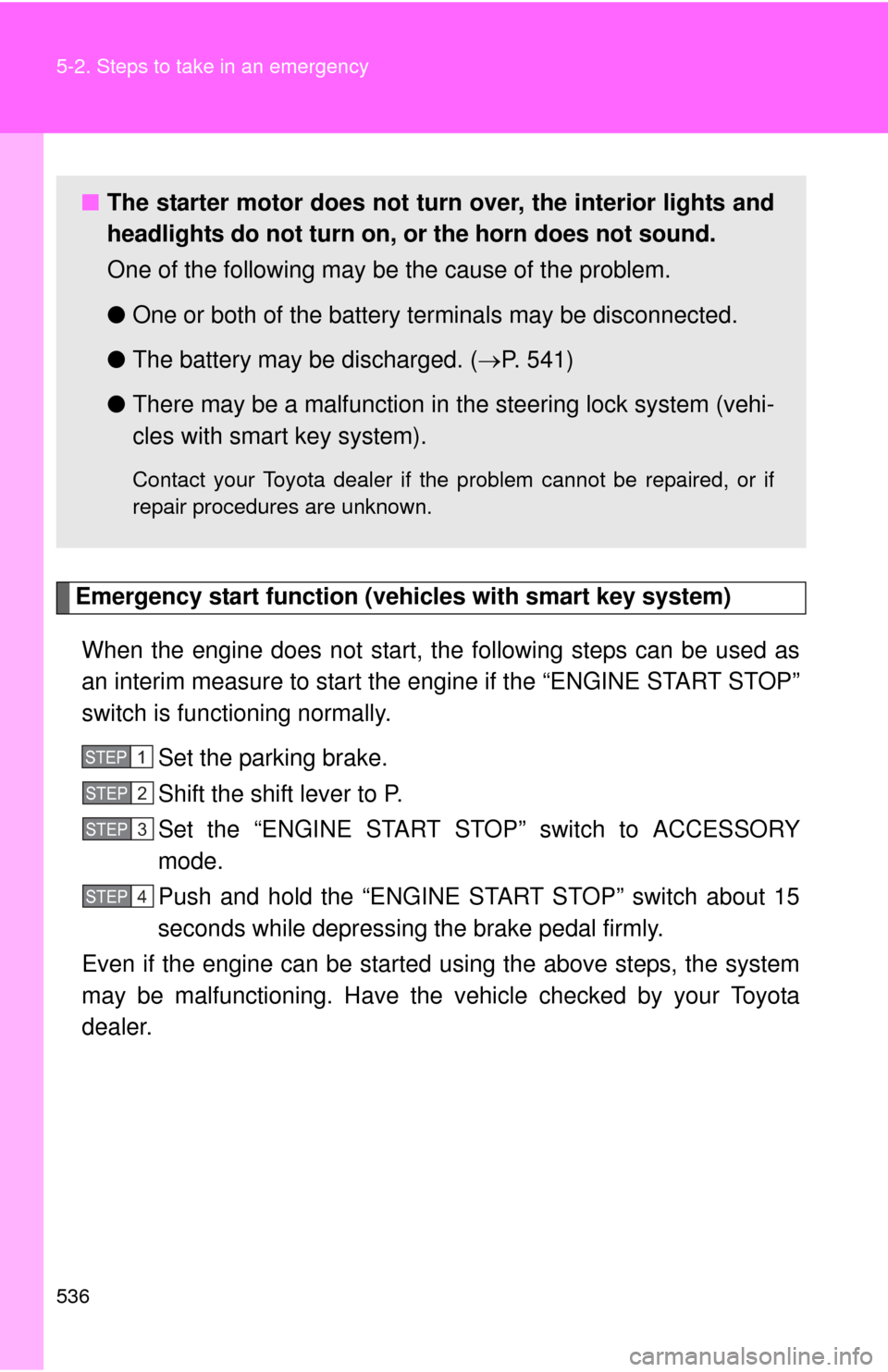
Emergency start function (vehicles with smart key system)When the engine does not start, the following steps can be used as
an interim measure to start the engine if the “ENGINE START STOP”
switch is functioning normally. Set the parking brake.
Shift the shift lever to P.
Set the “ENGINE START ST OP” switch to ACCESSORY
mode.
Push and hold the “ENGINE START STOP” switch about 15
seconds while depressing the brake pedal firmly.
Even if the engine can be start ed using the above steps, the system
may be malfunctioning. Have the vehicle checked by your Toyota
dealer.
■ The starter motor does not turn over, the interior lights and
headlights do not turn on, or the horn does not sound.
One of the following may be the cause of the problem.
● One or both of the battery terminals may be disconnected.
● The battery may be discharged. ( P. 541)
● There may be a malfunction in the steering lock system (vehi-
cles with smart key system).
Contact your Toyota dealer if the problem cannot be repaired, or if
repair procedures are unknown.
STEP1
STEP2
STEP3
STEP4
Page 592 of 608
592
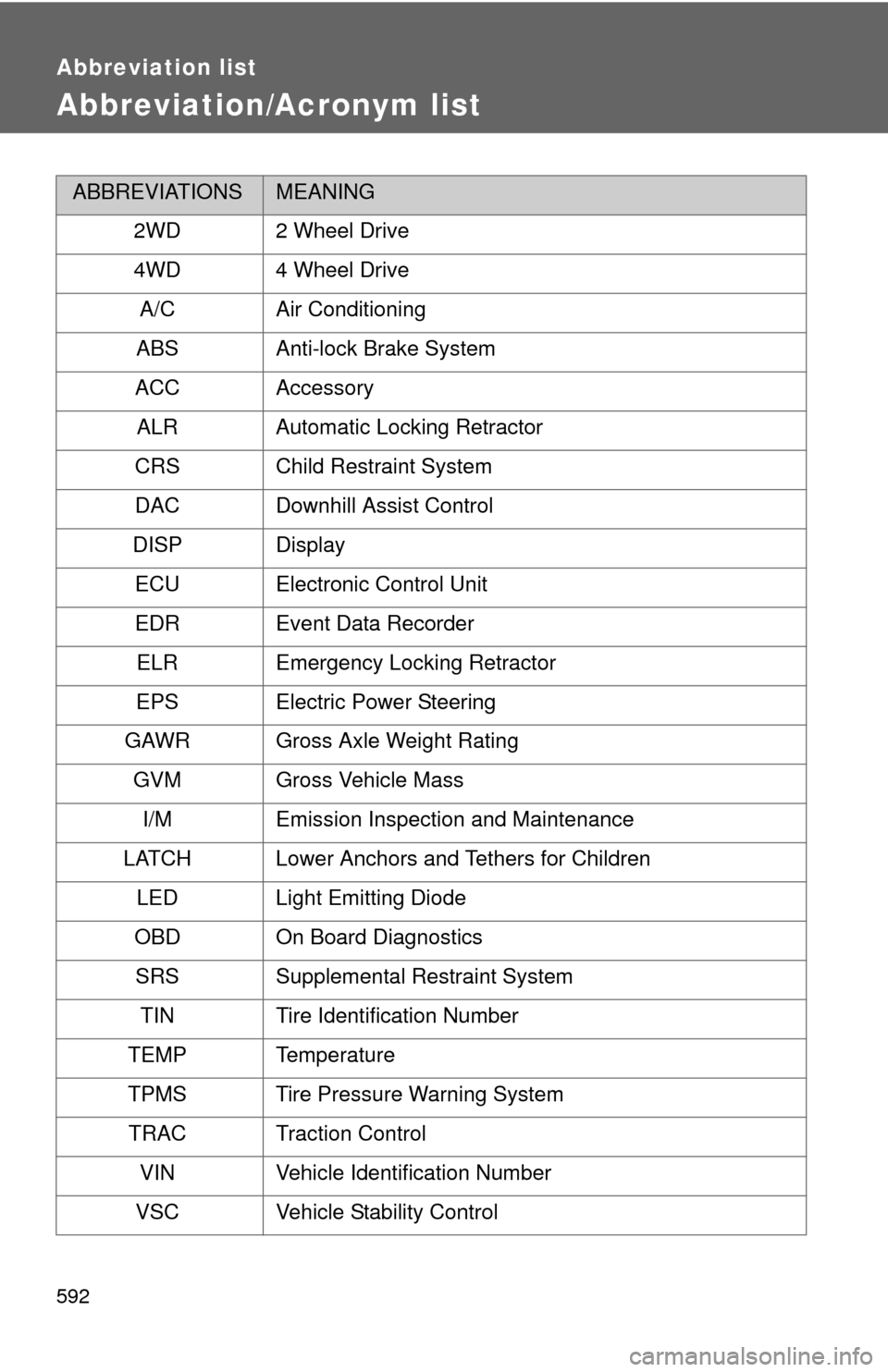
Abbreviation list
Abbreviation/Acronym list
ABBREVIATIONSMEANING
2WD 2 Wheel Drive
4WD 4 Wheel Drive A/C Air Conditioning
ABS Anti-lock Brake System
ACC Accessory ALR Automatic Locking Retractor
CRS Child Restraint System
DAC Downhill Assist Control
DISP Display
ECU Electronic Control Unit
EDR Event Data RecorderELR Emergency Locking Retractor
EPS Electric Power Steering
GAWR Gross Axle Weight Rating GVM Gross Vehicle Mass I/M Emission Inspection and Maintenance
LATCH Lower Anchors and Tethers for Children LED Light Emitting Diode
OBD On Board Diagnostics
SRS Supplemental Restraint System TIN Tire Identification Number
TEMP Temperature
TPMS Tire Pressure Warning System
TRAC Traction Control VIN Vehicle Identification Number
VSC Vehicle Stability Control