tire pressure TOYOTA HIGHLANDER 2010 XU40 / 2.G Owners Manual
[x] Cancel search | Manufacturer: TOYOTA, Model Year: 2010, Model line: HIGHLANDER, Model: TOYOTA HIGHLANDER 2010 XU40 / 2.GPages: 608, PDF Size: 11.99 MB
Page 5 of 608

1
2
3
4
5
6
7
5
4-1. Maintenance and careCleaning and protecting the vehicle exterior............ 416
Cleaning and protecting the vehicle interior............. 419
4-2. Maintenance Maintenance requirements ..................... 422
General maintenance.......... 424
Emission inspection and maintenance (I/M)
programs........................... 427
4-3. Do-it-yourself maintenance Do-it-yourself service precautions ....................... 428
Hood ................................... 432
Positioning a floor jack ........ 434
Engine compartment ........... 437
Tires .................................... 453
Tire inflation pressure ......... 463
Wheels ................................ 467
Air conditioning filter............ 469
Wireless remote control/electronic key
battery ............................... 472
Checking and replacing fuses ................................. 475
Light bulbs........................... 486 5-1. Essential information
Emergency flashers............ 498
If your vehicle needs to be towed........................... 499
If you think something is wrong ............................ 506
Fuel pump shut off system .............................. 507
Event data recorder ............ 508
5-2. Steps to take in an emergency If a warning light turns on or a warning buzzer
sounds... .......................... 510
If a warning message is displayed (vehicles with
multi-information
display) ............................. 521
If you have a flat tire ........... 522
If the engine will not start.... 535
If the shift lever cannot be shifted from P ................... 537
If you lose your keys/wireless remote
control transmitter ............ 538
If the electronic key does not operate properly
(vehicles with smart
key system) ...................... 539
If the battery is discharged........................ 541
If your vehicle overheats .... 545
If the vehicle becomes stuck ................................. 548
4Maintenance and care5When trouble arises
Page 9 of 608
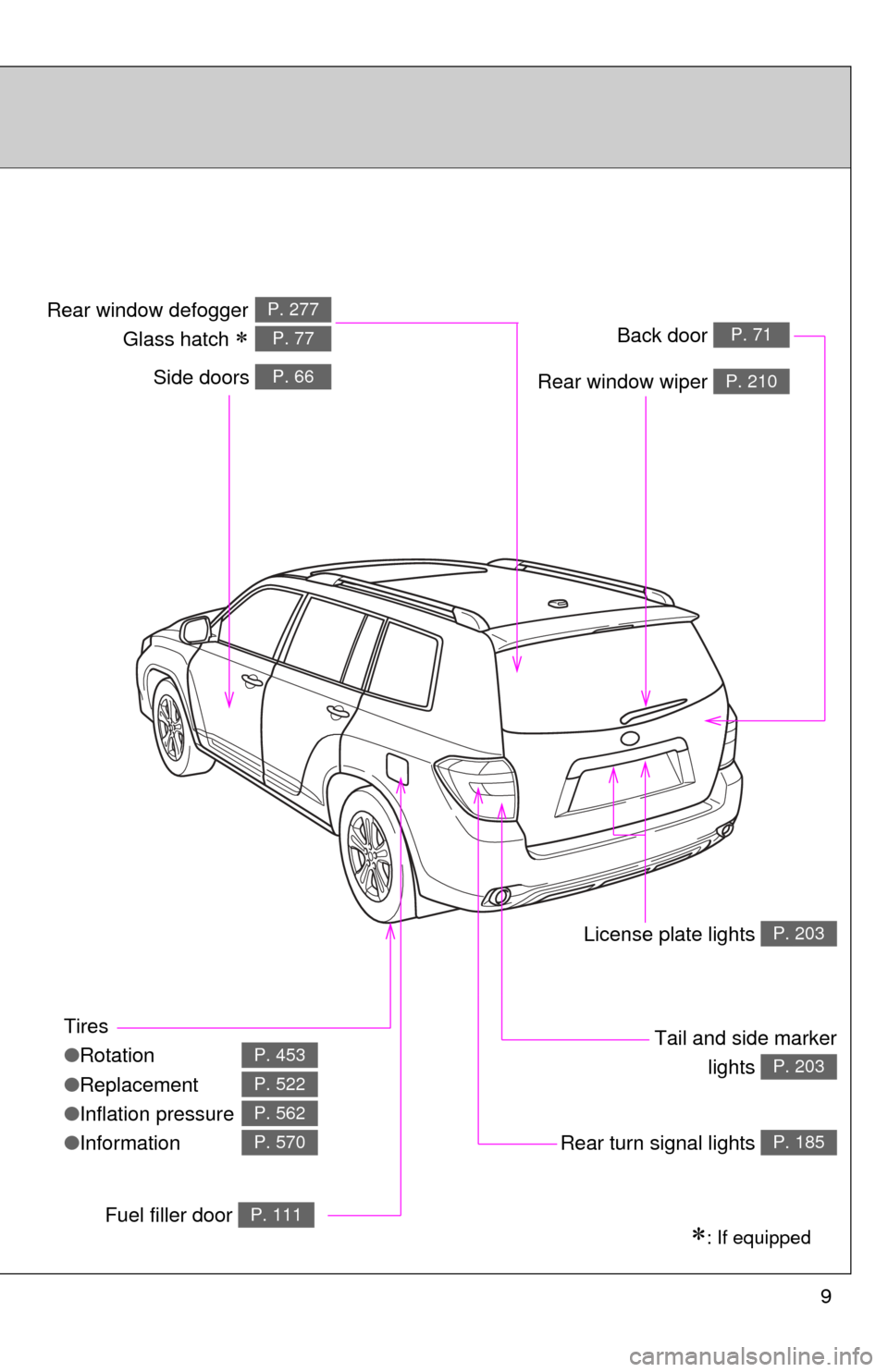
9
Tires
●Rotation
● Replacement
● Inflation pressure
● Information
P. 453
P. 522
P. 562
P. 570
: If equipped
Back door P. 71
Side doors P. 66
Tail and side marker
lights
P. 203
Rear window wiper P. 210
Rear window defogger
Glass hatch
P. 277
P. 77
License plate lights P. 203
Rear turn signal lights P. 185
Fuel filler door P. 111
Page 16 of 608
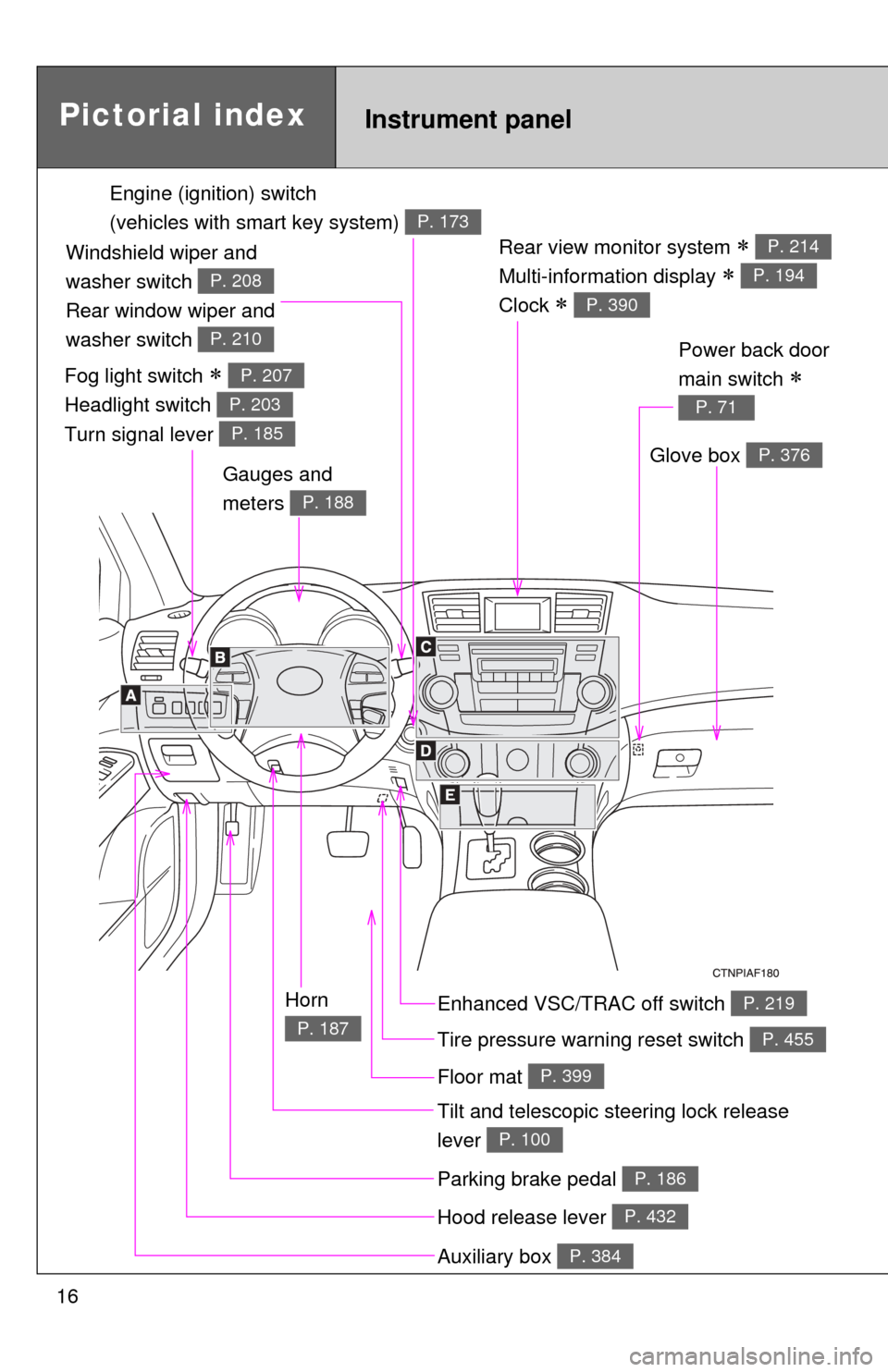
16
Rear view monitor system
Multi-information display
Clock
P. 214
P. 194
P. 390
Gauges and
meters
P. 188
Tilt and telescopic steering lock release
lever
P. 100
Glove box P. 376
Pictorial indexInstrument panel
Power back door
main switch
P. 71
Enhanced VSC/TRAC off switch P. 219
Tire pressure warning reset switch P. 455
Parking brake pedal P. 186
Hood release lever P. 432
Auxiliary box P. 384
Engine (ignition) switch
(vehicles with smart key system)
P. 173
Fog light switch
Headlight switch
Turn signal lever P. 207
P. 203
P. 185
Windshield wiper and
washer switch
Rear window wiper and
washer switch
P. 208
P. 210
Horn
P. 187
Floor mat P. 399
Page 222 of 608

222 2-4. Using other driving systems
CAUTION
■TRAC may not operate effectively when
Directional control and power may not be achievable while driving on slip-
pery road surfaces even if the TRAC system is operating.
Do not drive the vehicle in conditions where stability and power may be lost.
■ When the Enhanced VSC is activated
The slip indicator light flashes and a warning buzzer sounds. Always drive
carefully. Reckless driving may cause an accident. Exercise particular care
when the indicator light flashes and a buzzer sounds.
■ When TRAC and Enhanced VSC are off
Be especially careful and drive at a speed appropriate to the road condi-
tions. As these are systems to ensure vehicle stability and driving force, do
not turn off TRAC and Enhanced VSC unless necessary.
■ Replacing tires
Make sure that all tires are of the same size, brand, tread pattern and total
load capacity. In addition, make sure that the tires are inflated to the appro-
priate tire pressure level.
The ABS and Enhanced VSC systems will not function correctly if different
tires are fitted on the vehicle.
Contact your Toyota dealer for further information when replacing tires or
wheels.
■ Handling of tires and suspension
Using tires with any kind of problem or modifying the suspension will affect
the driving assist systems, and may cause the system to malfunction.
Page 240 of 608

240 2-5. Driving information
■Tire chains
Observe the following precautions when installing and removing chains.
●Install and remove tire chains in a safe location.
● Install tire chains on the front tires.
● Install tire chains following the instructions provided in the accompanying
manual.
CAUTION
■Driving with snow tires
Observe the following precautions to reduce the risk of accidents.
Failing to do so may result in a loss of vehicle control and cause death or
serious injury.
●Use tires of the specified size.
● Maintain the recommended level of air pressure.
● Do not drive in excess of 75 mph (120 km/h), regardless of the type of
snow tires being used.
● Snow tires should be installed on all wheels.
■ Driving with tire chains
Observe the following precautions to reduce the risk of accidents.
Failing to do so may result in the vehicle being unable to be driven safely,
and may cause death or serious injury.
●Do not drive in excess of the speed limit specified for the tire chains being
used or 30 mph (50 km/h), whichever is lower.
● Avoid driving on bumpy road surfaces or over potholes.
● Avoid sudden turns and braking.
● Slow down sufficiently before entering a curve to ensure that vehicle con-
trol is maintained.
Page 241 of 608

241
2-5. Driving information
2
When driving
NOTICE
■
Repairing or replacing snow tires
Request repairs of and obtain replacement snow tires from Toyota dealers or
legitimate tire retailers.
This is because the removal and attachment of snow tires affects the opera-
tion of the tire pressure warning valves and transmitters.
■ Fitting tire chains
The tire pressure warning valves and transmitters may not function correctly
when tire chains are fitted.
Page 415 of 608
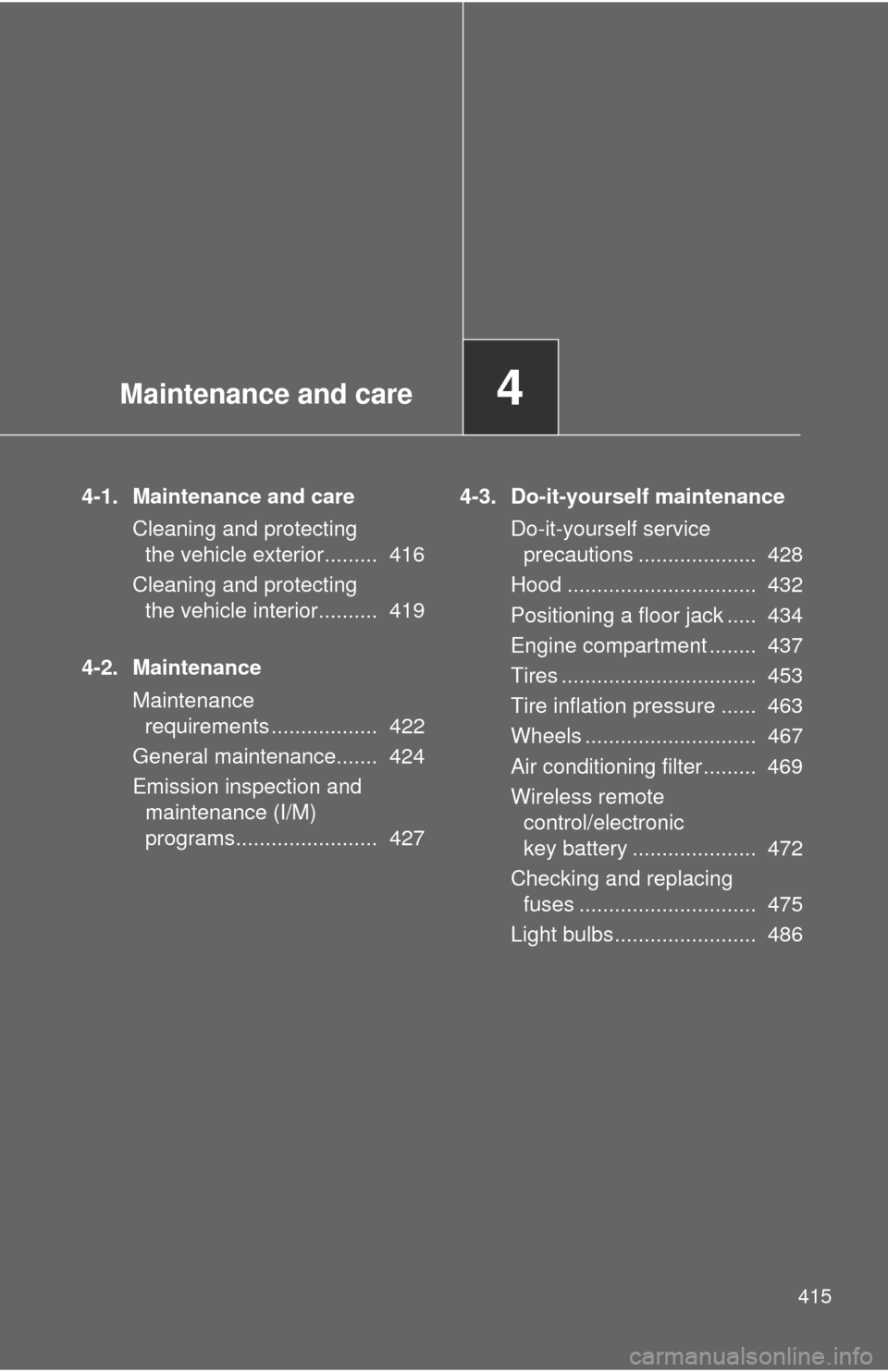
Maintenance and care4
415
4-1. Maintenance and careCleaning and protecting the vehicle exterior......... 416
Cleaning and protecting the vehicle interior.......... 419
4-2. Maintenance Maintenance requirements .................. 422
General maintenance....... 424
Emission inspection and maintenance (I/M)
programs........................ 427 4-3. Do-it-yourself maintenance
Do-it-yourself service precautions .................... 428
Hood ................................ 432
Positioning a floor jack ..... 434
Engine compartment ........ 437
Tires ................................. 453
Tire inflation pressure ...... 463
Wheels ............................. 467
Air conditioning filter......... 469
Wireless remote control/electronic
key battery ..................... 472
Checking and replacing fuses .............................. 475
Light bulbs........................ 486
Page 426 of 608

426 4-2. Maintenance
Vehicle exterior
ItemsCheck points
Door • Operate smoothly?
Engine hood • The lock system works properly?
Fluid leaks • Is there any leakage after park-
ing?
Tire • Inflation pressure is correct?
• Tire surfaces not worn or dam-
aged?
• Tires rotated according to the maintenance schedule?
• Wheel nuts are not loose?
CAUTION
■ If the engine is running
Turn the engine off and ensure that there is adequate ventilation before per-
forming maintenance checks.
Page 429 of 608
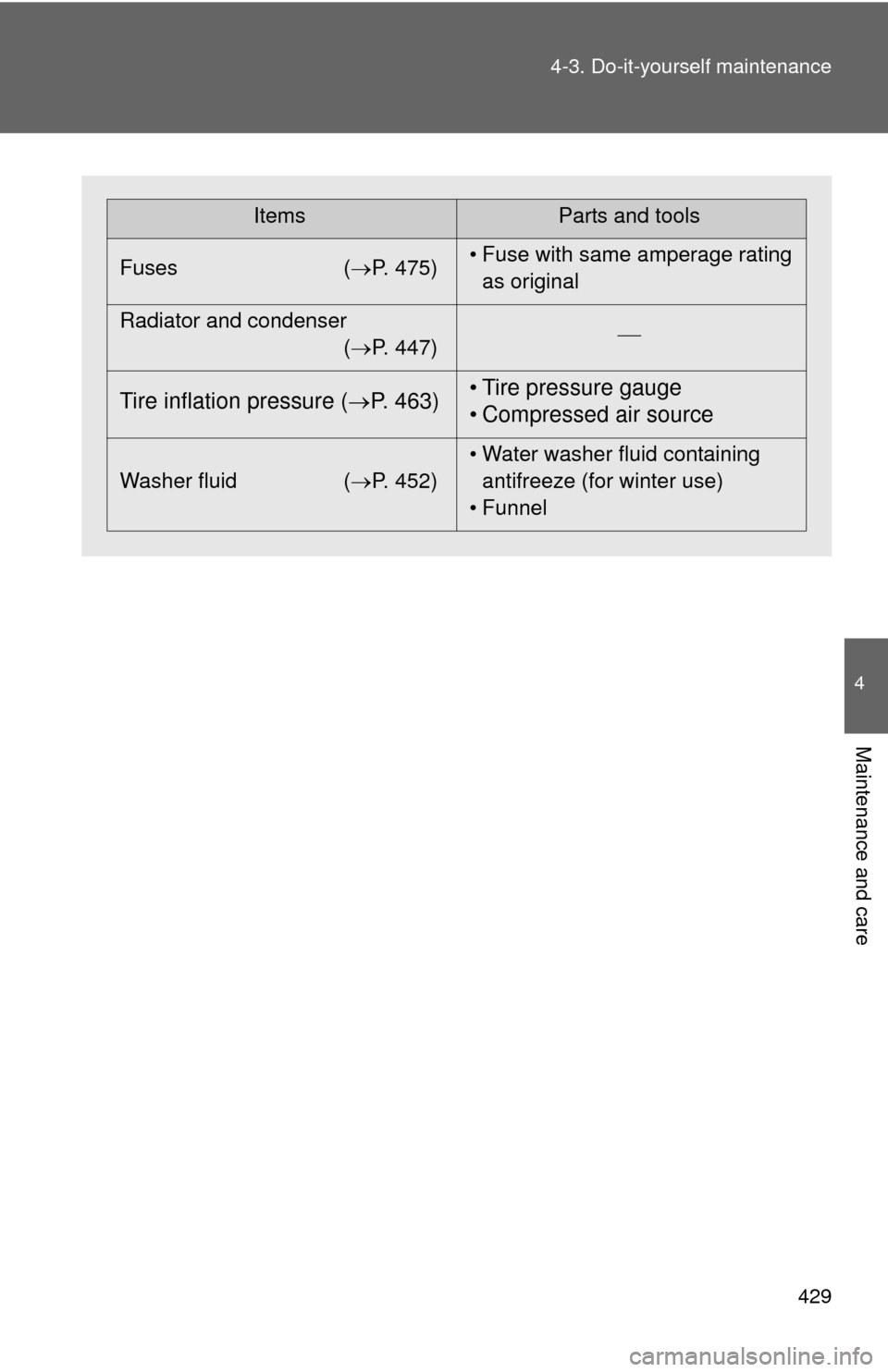
429
4-3. Do-it-yourself maintenance
4
Maintenance and care
ItemsParts and tools
Fuses ( P. 475)• Fuse with same amperage rating
as original
Radiator and condenser (P. 447)
Tire inflation pressure (
P. 463) • Tire pressure gauge
• Compressed air source
Washer fluid
(P. 452) • Water washer fluid containing
antifreeze (for winter use)
• Funnel
Page 453 of 608
453
4-3. Do-it-yourself maintenance
4
Maintenance and care
Tires
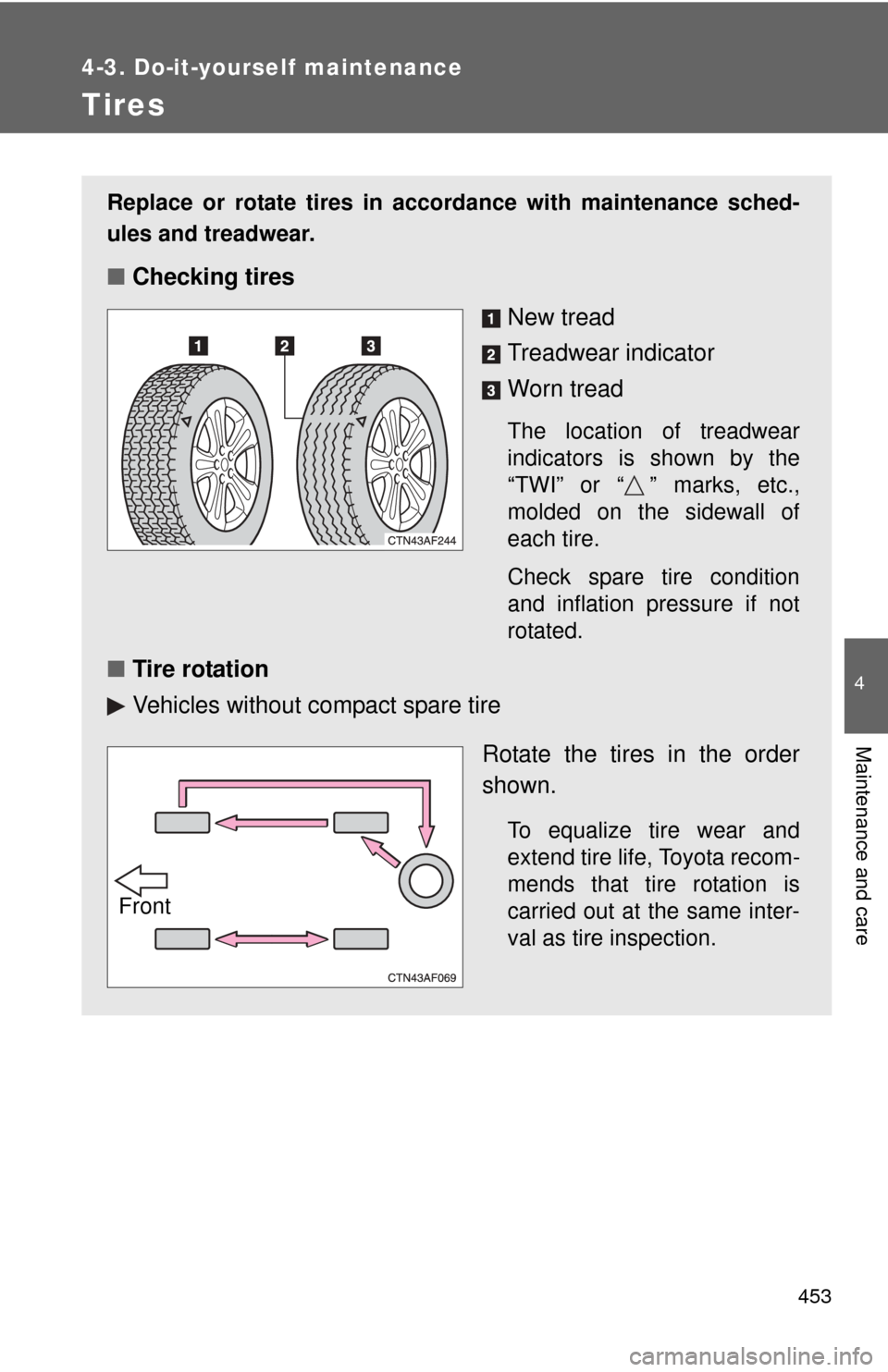
Replace or rotate tires in accordance with maintenance sched-
ules and treadwear.
■Checking tires
New tread
Treadwear indicator
Worn tread
The location of treadwear
indicators is shown by the
“TWI” or “ ” marks, etc.,
molded on the sidewall of
each tire.
Check spare tire condition
and inflation pressure if not
rotated.
■Tire rotation
Vehicles without compact spare tire
Rotate the tires in the order
shown.
To equalize tire wear and
extend tire life, Toyota recom-
mends that tire rotation is
carried out at the same inter-
val as tire inspection.
Front