Octane TOYOTA LAND CRUISER 2008 J200 Owners Manual
[x] Cancel search | Manufacturer: TOYOTA, Model Year: 2008, Model line: LAND CRUISER, Model: TOYOTA LAND CRUISER 2008 J200Pages: 531, PDF Size: 5.6 MB
Page 89 of 531
90 1−5. Refueling
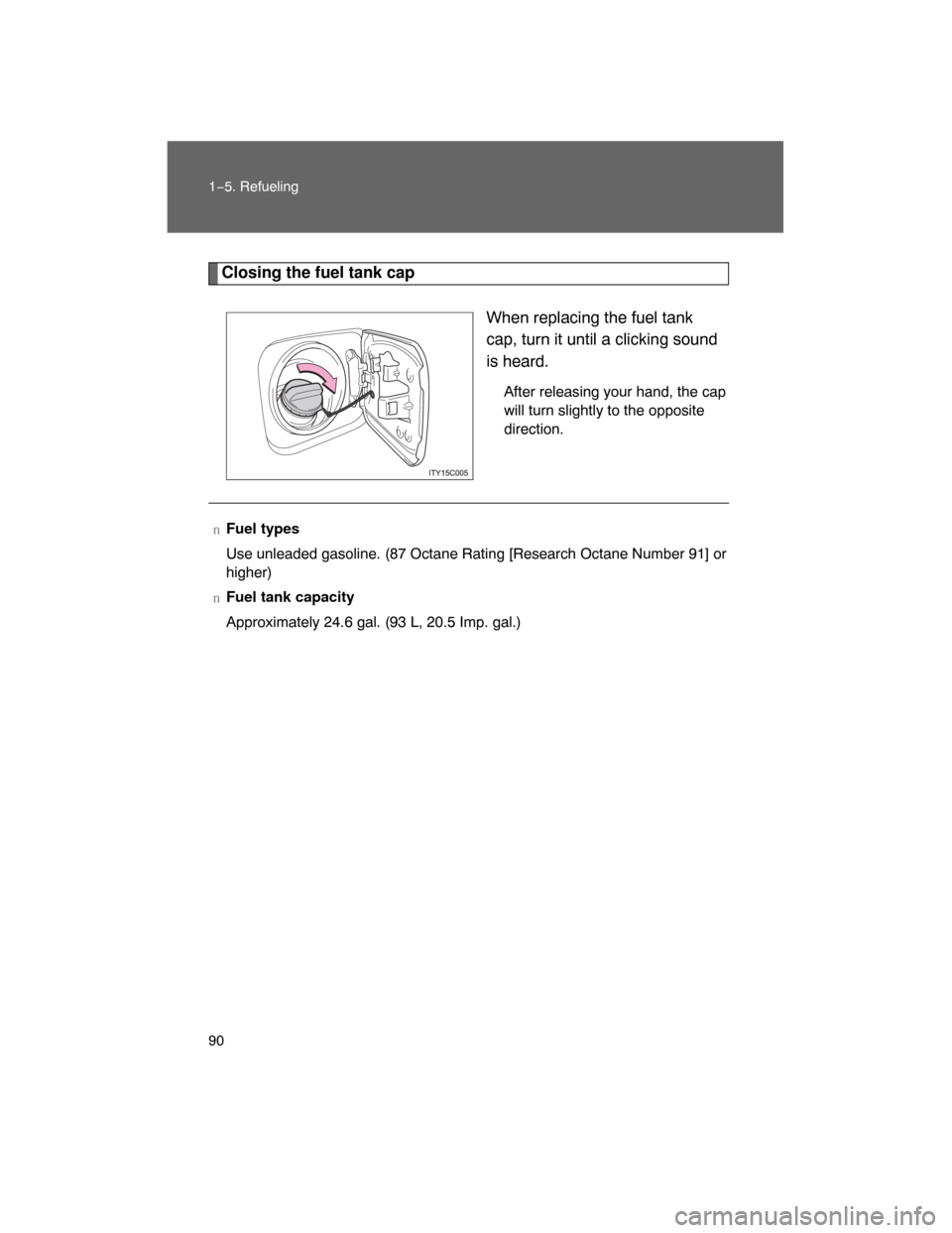
Closing the fuel tank cap
When replacing the fuel tank
cap, turn it until a clicking sound
is heard.
After releasing your hand, the cap
will turn slightly to the opposite
direction.
nFuel types
Use unleaded gasoline. (87 Octane Rating [Research Octane Number 91] or
higher)
nFuel tank capacity
Approximately 24.6 gal. (93 L, 20.5 Imp. gal.)
Page 489 of 531
496 6−1. Specifications
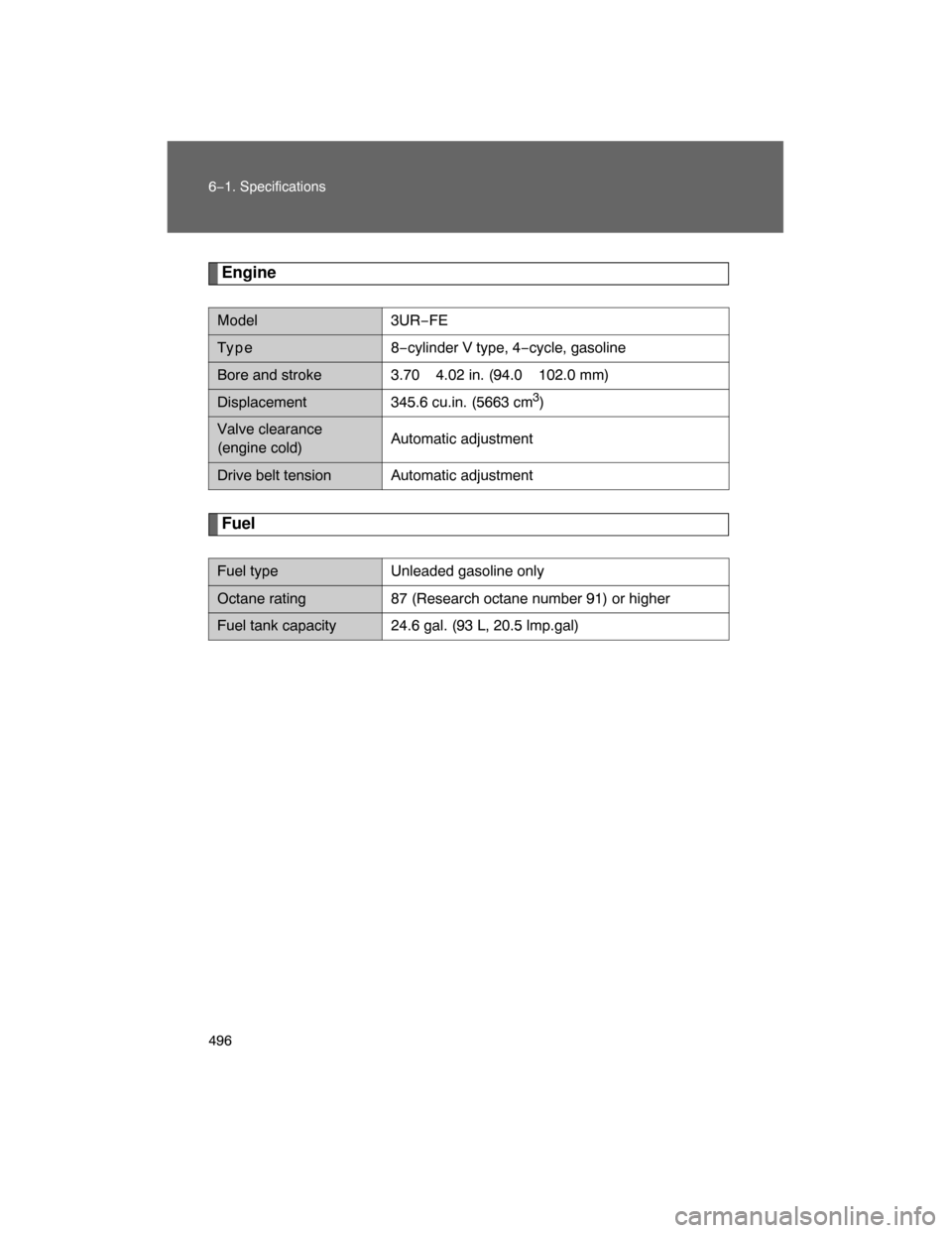
Engine
Fuel
Model3UR−FE
Ty p e
8−cylinder V type, 4−cycle, gasoline
Bore and stroke 3.70 4.02 in. (94.0
102.0 mm)
Displacement 345.6 cu.in. (5663 cm
3)
Valve clearance
(engine cold)
Automatic adjustment
Drive belt tension
Automatic adjustment
Fuel type
Unleaded gasoline only
Octane rating
87 (Research octane number 91) or higher
Fuel tank capacity
24.6 gal. (93 L, 20.5 lmp.gal)
Page 497 of 531
504
6−1. Specifications
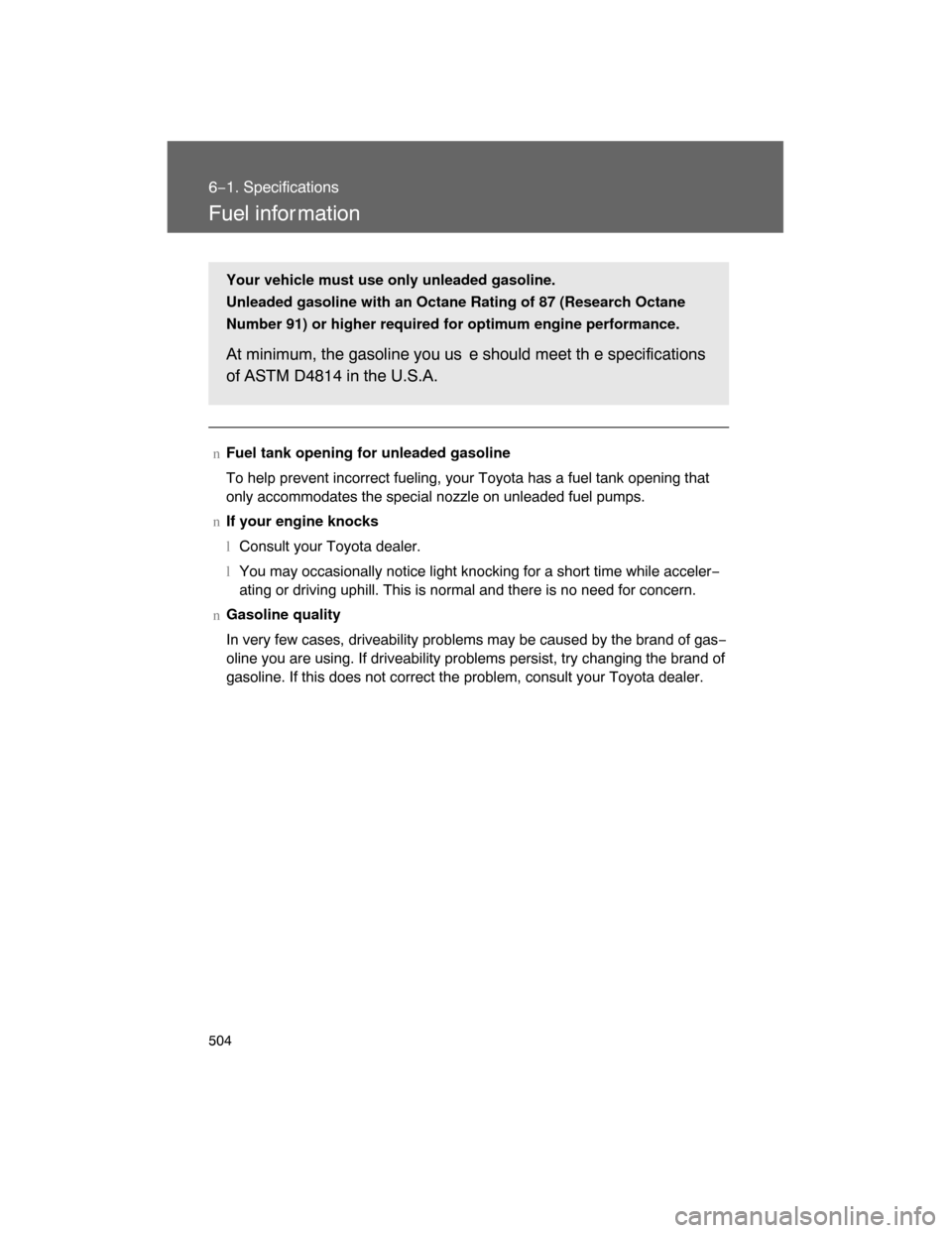
Fuel infor mation
nFuel tank opening for unleaded gasoline
To help prevent incorrect fueling, your Toyota has a fuel tank opening that
only accommodates the special nozzle on unleaded fuel pumps.
nIf your engine knocks
lConsult your Toyota dealer.
lYou may occasionally notice light knocking for a short time while acceler−
ating or driving uphill. This is normal and there is no need for concern.
nGasoline quality
In very few cases, driveability problems may be caused by the brand of gas−
oline you are using. If driveability problems persist, try changing the brand of
gasoline. If this does not correct the problem, consult your Toyota dealer. Your vehicle must use only unleaded gasoline.
Unleaded gasoline with an Octane Rating of 87 (Research Octane
Number 91) or higher required for optimum engine performance.
At minimum, the gasoline you us e should meet th e specifications
of ASTM D4814 in the U.S.A.
Page 498 of 531
505
6−1. Specifications
6
Vehicle specifications
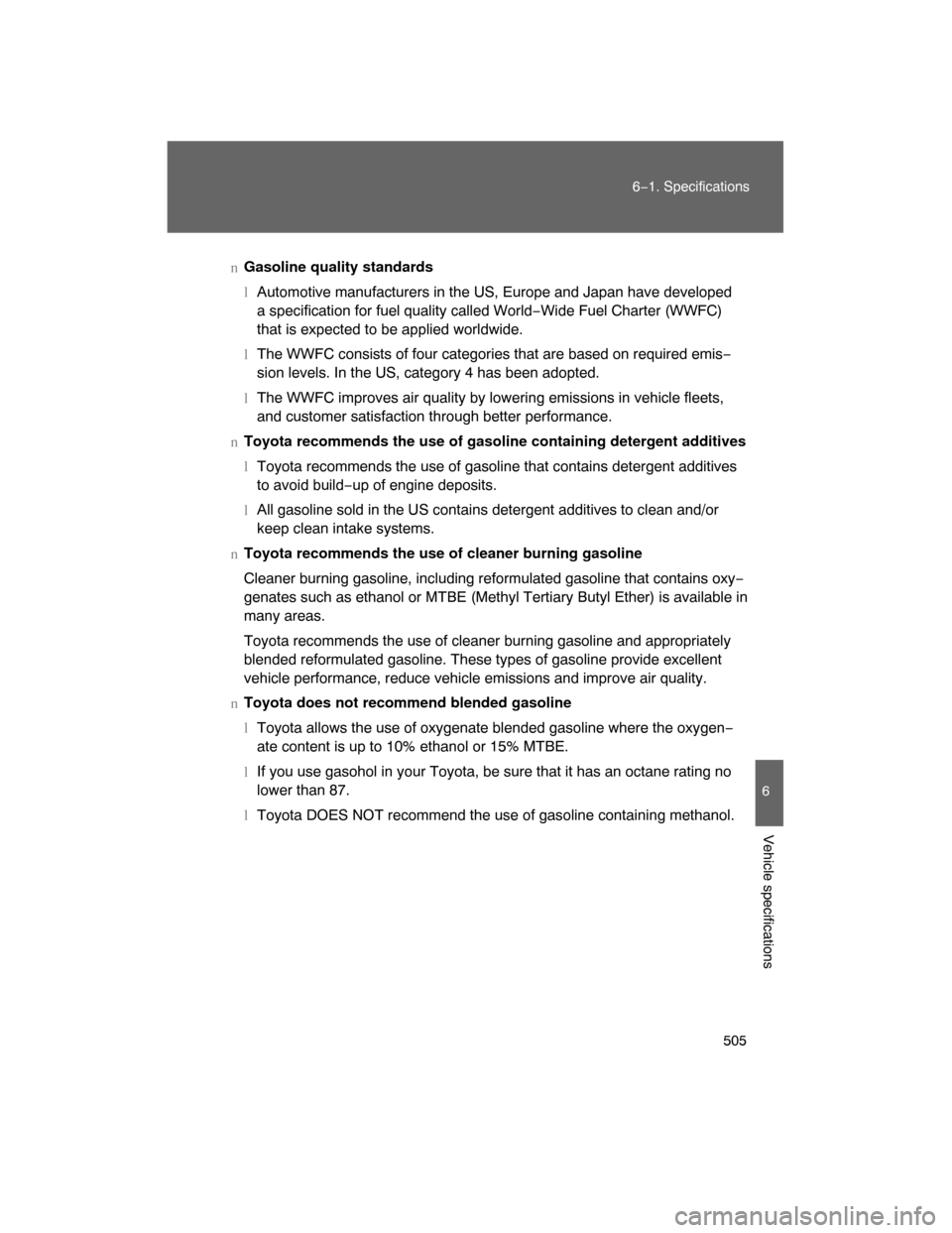
nGasoline quality standards
lAutomotive manufacturers in the US, Europe and Japan have developed
a specification for fuel quality called World−Wide Fuel Charter (WWFC)
that is expected to be applied worldwide.
lThe WWFC consists of four categories that are based on required emis−
sion levels. In the US, category 4 has been adopted.
lThe WWFC improves air quality by lowering emissions in vehicle fleets,
and customer satisfaction through better performance.
nToyota recommends the use of gasoline containing detergent additives
lToyota recommends the use of gasoline that contains detergent additives
to avoid build−up of engine deposits.
lAll gasoline sold in the US contains detergent additives to clean and/or
keep clean intake systems.
nToyota recommends the use of cleaner burning gasoline
Cleaner burning gasoline, including reformulated gasoline that contains oxy−
genates such as ethanol or MTBE (Methyl Tertiary Butyl Ether) is available in
many areas.
Toyota recommends the use of cleaner burning gasoline and appropriately
blended reformulated gasoline. These types of gasoline provide excellent
vehicle performance, reduce vehicle emissions and improve air quality.
nToyota does not recommend blended gasoline
lToyota allows the use of oxygenate blended gasoline where the oxygen−
ate content is up to 10% ethanol or 15% MTBE.
lIf you use gasohol in your Toyota, be sure that it has an octane rating no
lower than 87.
lToyota DOES NOT recommend the use of gasoline containing methanol.
Page 499 of 531
506 6−1. Specifications
nToyota does not recommend gasoline containing MMT
Some gasoline contains octane enhancing additive called MMT (Methylcy
clopentadienyl Manganese Tricarbonyl).
Toyota DOES NOT recommend the use of gasoline that contains MMT. If
fuel containing MMT is used, your emission control system may be
adversely affected.
The malfunction indicator lamp on the instrument cluster may come on. If
this happens, contact your Toyota dealer for service.
NOTICE
nNotice on gasoline quality
lDo not use leaded gasoline.
Leaded gasoline can cause damage to your vehicle’s three−way catalytic
converters causing the emission control system to malfunction.
lDo not use gasohol other than that stated here.
Other gasohol may cause fuel system damage or vehicle performance
problems.
lUsing unleaded gasoline with an octane number or rating lower than that
stated here will cause persistent heavy knocking.
At worst, this will lead to engine damage.
nFuelrelated poor driveability
If after using a different type of fuel, poor driveability is encountered (poor
hot starting, vaporization, engine knocking, etc.), discontinue the use of that
type of fuel.
n
When refueling with gasohole
Take care not to spill gasohol. It can damage your vehicle’s paint.