engine oil TOYOTA LAND CRUISER 2010 J200 User Guide
[x] Cancel search | Manufacturer: TOYOTA, Model Year: 2010, Model line: LAND CRUISER, Model: TOYOTA LAND CRUISER 2010 J200Pages: 592, PDF Size: 7.98 MB
Page 428 of 592
428
4-3. Do-it-yourself maintenance
L/C200_U
Engine compar tment
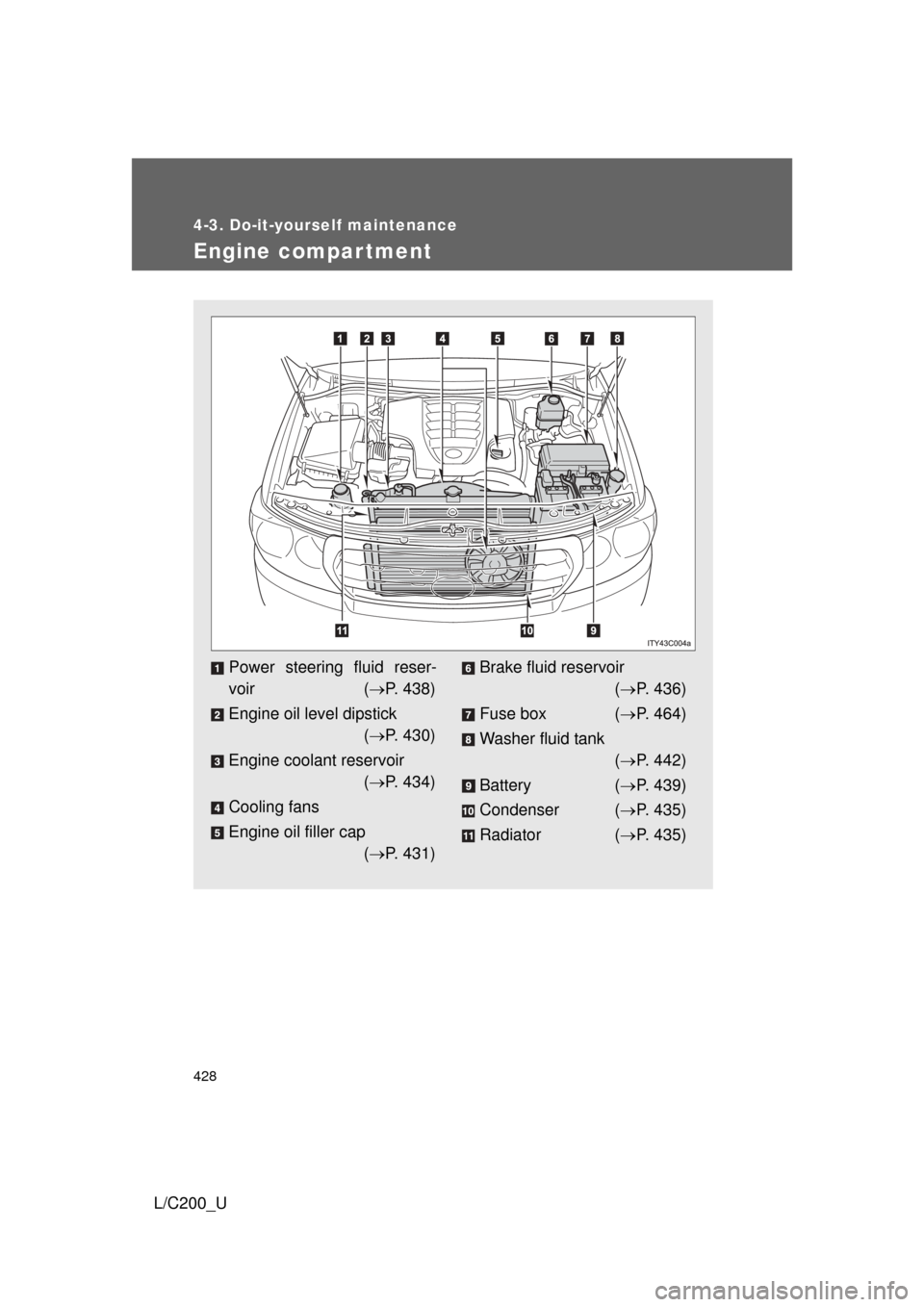
Power steering fluid reser-
voir (P. 438)
Engine oil level dipstick ( P. 430)
Engine coolant reservoir ( P. 434)
Cooling fans
Engine oil filler cap ( P. 431)Brake fluid reservoir
( P. 436)
Fuse box ( P. 464)
Washer fluid tank ( P. 442)
Battery ( P. 439)
Condenser ( P. 435)
Radiator ( P. 435)
Page 430 of 592
430 4-3. Do-it-yourself maintenance
L/C200_U
Engine oilWith the engine at operating temperature and turned off, check the oil
level on the dipstick.
■ Checking the engine oil
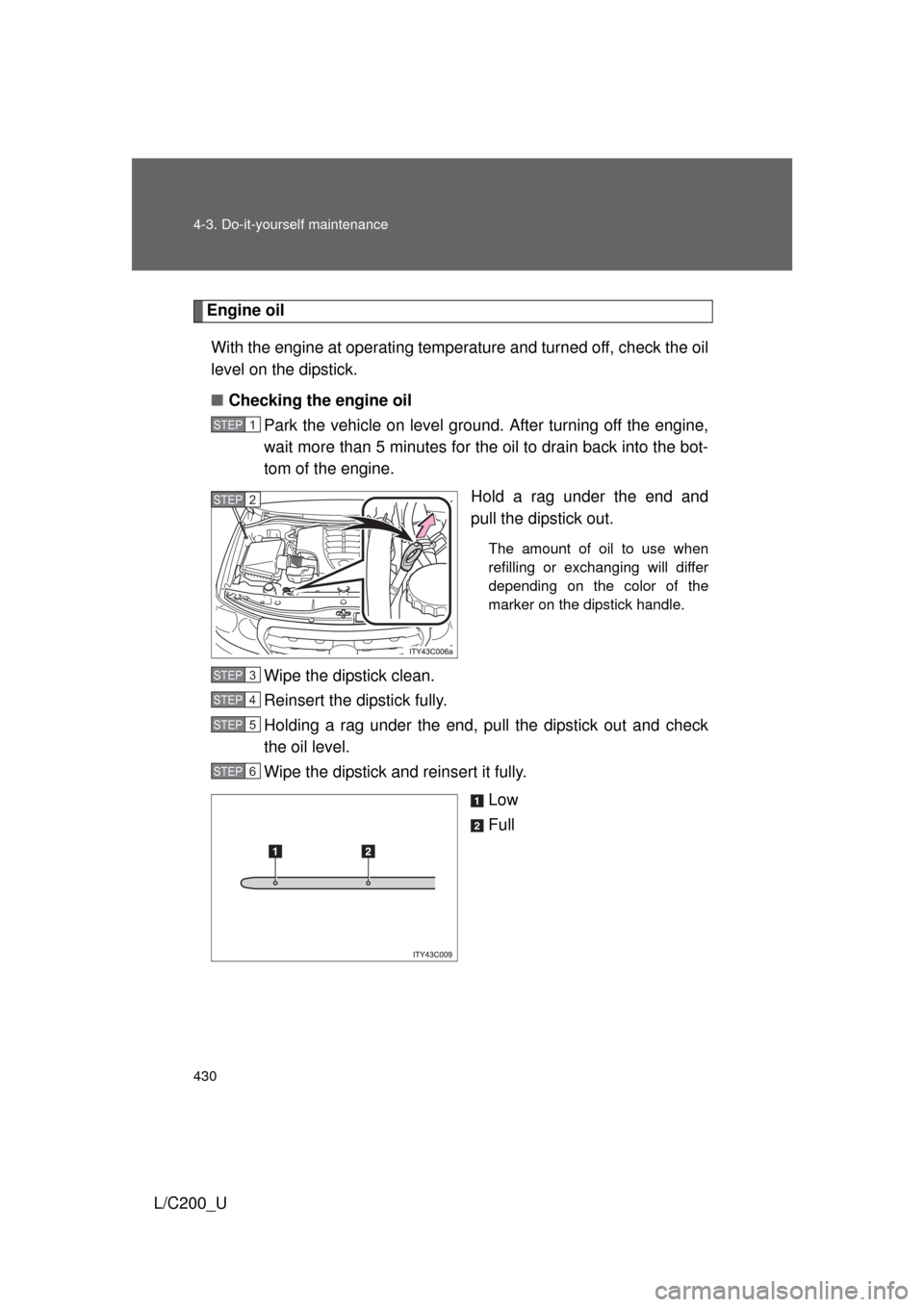
Park the vehicle on level gro und. After turning off the engine,
wait more than 5 minutes for the oil to drain back into the bot-
tom of the engine.
Hold a rag under the end and
pull the dipstick out.
The amount of oil to use when
refilling or exchanging will differ
depending on the color of the
marker on the dipstick handle.
Wipe the dipstick clean.
Reinsert the dipstick fully.
Holding a rag under the end, pull the dipstick out and check
the oil level.
Wipe the dipstick and reinsert it fully. Low
Full
STEP1
STEP2
STEP3
STEP4
STEP5
STEP6
Page 431 of 592
431
4-3. Do-it-yourself maintenance
4
Maintenance and care
L/C200_U
■
Adding engine oil
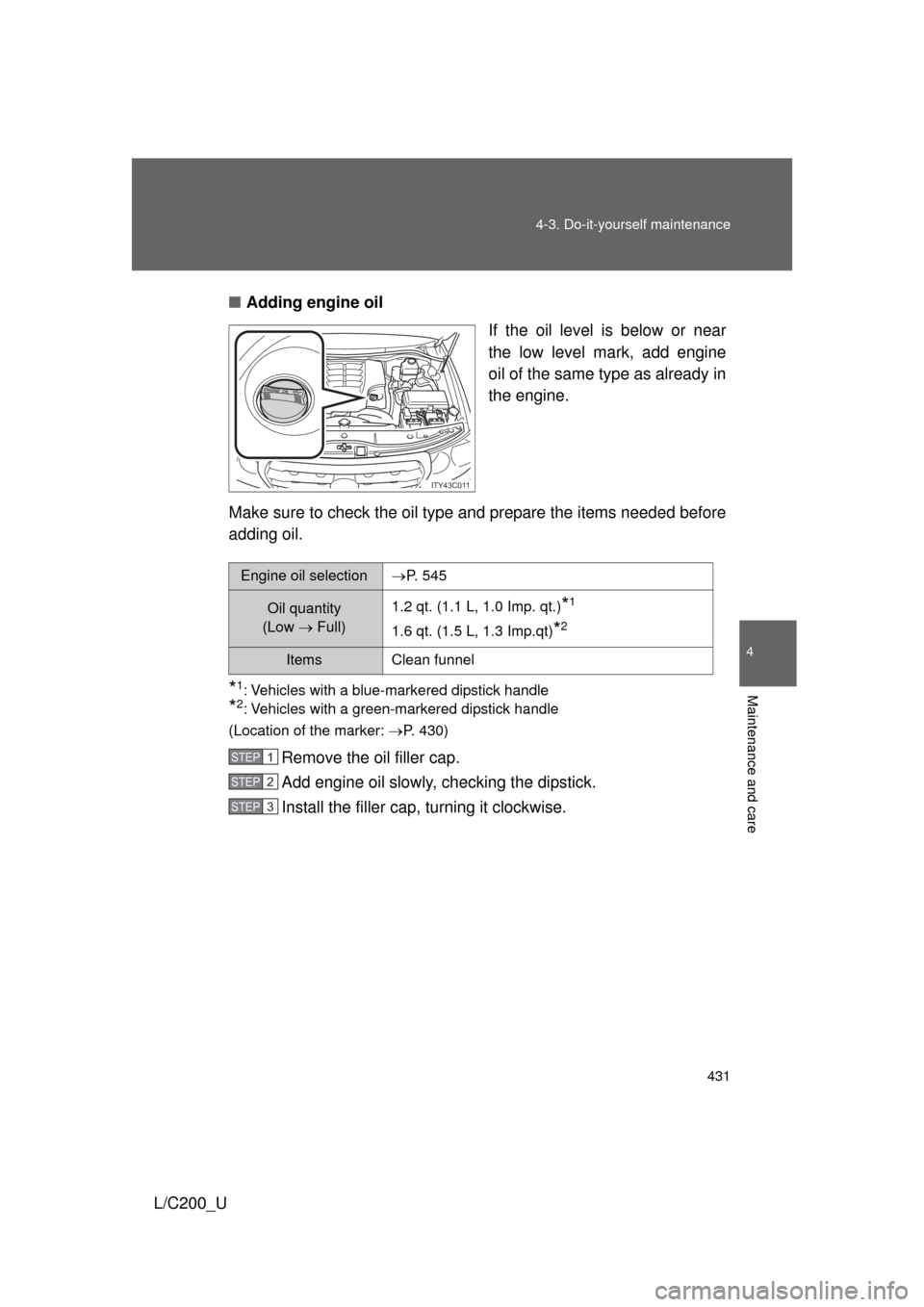
If the oil level is below or near
the low level mark, add engine
oil of the same type as already in
the engine.
Make sure to check the oil type and prepare the items needed before
adding oil.
*1: Vehicles with a blue-markered dipstick handle
*2: Vehicles with a green-markered dipstick handle
(Location of the marker: P. 430)
Remove the oil filler cap.
Add engine oil slowly, checking the dipstick.
Install the filler cap, turning it clockwise.
ITY43C011
Engine oil selectionP. 545
Oil quantity
(Low Full)1.2 qt. (1.1 L, 1.0 Imp. qt.)*1
1.6 qt. (1.5 L, 1.3 Imp.qt)*2
ItemsClean funnel
STEP1
STEP2
STEP3
Page 432 of 592
432 4-3. Do-it-yourself maintenance
L/C200_U
■Engine oil consumption
● The amount of engine oil consumed depends on the oil viscosity, the
quality of the oil and the way the vehicle is driven.
● More oil is consumed under driving conditions such as high speeds and
frequent acceleration and deceleration.
● A new engine consumes more oil.
● When judging the amount of oil consumption, keep in mind that the oil
may have become diluted, making it difficult to judge the true level accu-
rately.
● Oil consumption: Max. 1.1 qt./600 miles (0.9 lmp.qt./600 miles, 1.0 L p\
er
1000 km)
● If you consume more than 1.1 qt. (1.0 L, 0.9 lmp.qt.) every 600 miles
(1000 km), contact your Toyota dealer.
■ Resetting the engine oil maintenance data
The oil change system should be reset. Perform the following procedures:
Switch the display to the trip meter A when the engine is running.
( P. 165)
Turn the “ENGINE START STOP” switch OFF.
While pressing the trip meter reset button, set the “ENGINE START
STOP” switch to IGNITION ON mode (but do not start the engine
because otherwise the reset mode will be cancelled). Continue to
press and hold the button until the multi-information display indi-
cates that the reset is complete.
STEP1
STEP2
STEP3
Page 433 of 592
433
4-3. Do-it-yourself maintenance
4
Maintenance and care
L/C200_U
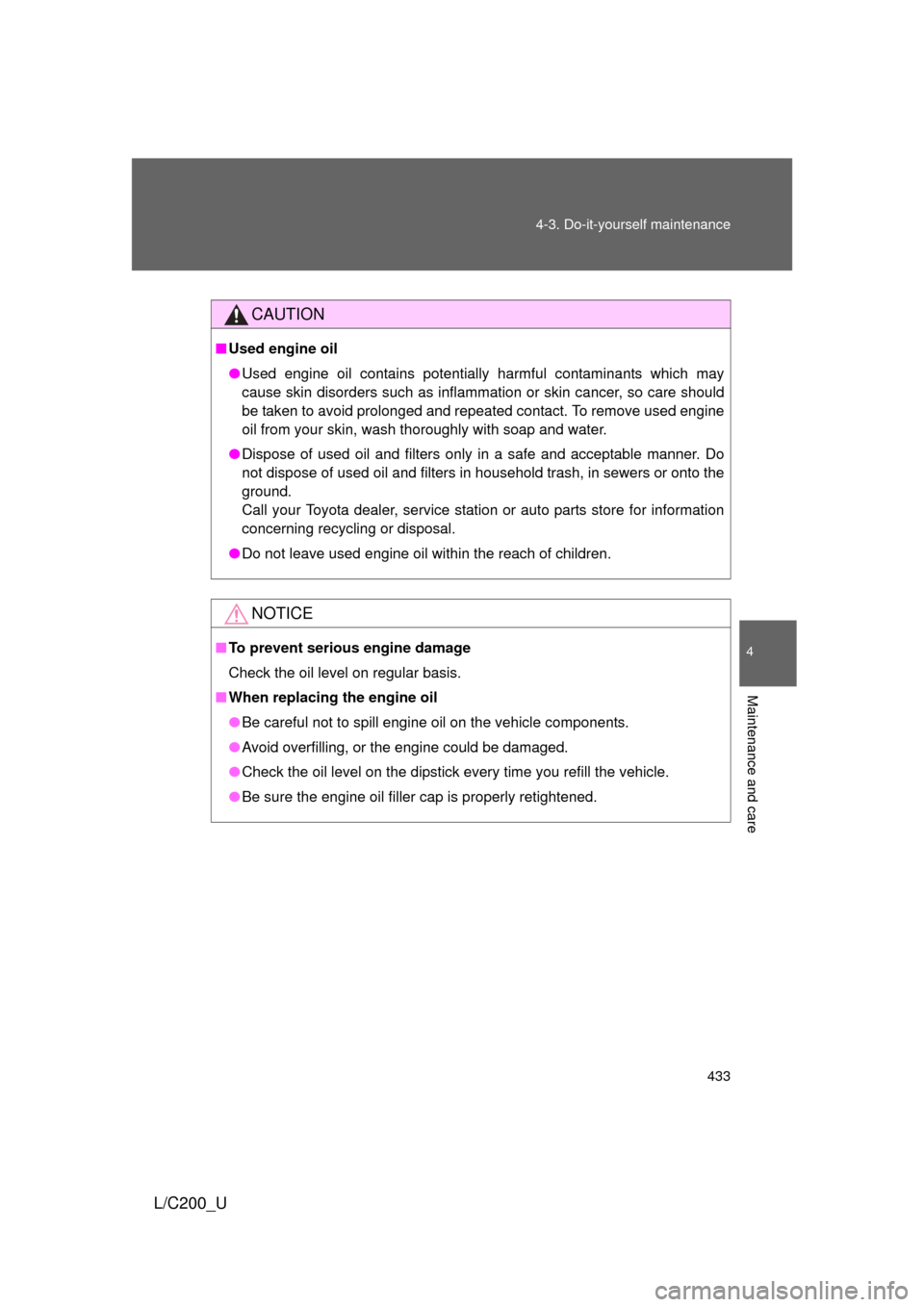
CAUTION
■
Used engine oil
● Used engine oil contains potentially harmful contaminants which may
cause skin disorders such as inflammation or skin cancer, so care should
be taken to avoid prolonged and repeated contact. To remove used engine
oil from your skin, wash thoroughly with soap and water.
● Dispose of used oil and filters only in a safe and acceptable manner. Do
not dispose of used oil and filters in household trash, in sewers or onto the
ground.
Call your Toyota dealer, service station or auto parts store for information
concerning recycling or disposal.
● Do not leave used engine oil within the reach of children.
NOTICE
■To prevent serious engine damage
Check the oil level on regular basis.
■ When replacing the engine oil
● Be careful not to spill engine oil on the vehicle components.
● Avoid overfilling, or the engine could be damaged.
● Check the oil level on the dipstick every time you refill the vehicle.
● Be sure the engine oil filler cap is properly retightened.
Page 496 of 592

496
5-1. Essential information
L/C200_U
If you think something is wrong
If you notice any of the following symptoms, your vehicle probably
needs adjustment or repair. Contact your Toyota dealer as soon as
possible.
■ Visible symptoms
●Fluid leaks under the vehicle
(Water dripping from the air cond itioning after use is normal.)
● Flat-looking tires or uneven tire wear
● Engine coolant temperature g auge needle continually points
higher than normal
● Engine oil pressure gauge continually points lower than nor-
mal
● Voltmeter continually points higher or lower than normal
■ Audible symptoms
●Changes in exhaust sound
● Excessive tire squeal when cornering
● Strange noises related to the suspension system
● Pinging or other noises related to the engine
■ Operational symptoms
●Engine missing, stumbling or running rough
● Appreciable loss of power
● Vehicle pulls heavily to one side when braking
● Vehicle pulls heavily to one side when driving on a level road
● Loss of brake effectiveness, s pongy feeling, pedal almost
touches the floor
Page 506 of 592

506 5-2. Steps to take in an emergency
L/C200_U
■SRS warning light
This warning light system monitors the following:
● The airbag sensor assembly
● Front airbag sensors
● The curtain shield airbag sensors
● The side and curtain shield airbag sensors
● The seat belt buckle switches
● The driver’s seat position sensor
● The belt tension sensor
● The inflators
● The interconnecting wiring and power sources
● The front passenger occupant classification ECU
● “AIR BAG ON” and “AIR BA G OFF” indicator lights
● The seat belt pretensioners
● The roll sensing of curtain shield airbags off indicator light
■ Changing the engine oil
Make sure to reset oil change system
■
When the tire pressure warning light comes on
Check the tire inflation pressure and adjust to the appropriate level.
Pushing the tire pressure warning reset switch does not turn off the tire
pressure warning light.
■The tire pressure warning light ma y turn on due to natural causes
The tire pressure warning light may turn on due to natural causes such
as natural air leaks or tire inflation pressure changes caused by temper-
ature. In this case, adjusting the ti re inflation pressure will turn off the
warning light (after a few minutes).
Page 513 of 592
5
When trouble arises
513
5-2. Steps to take in an emergency
L/C200_U
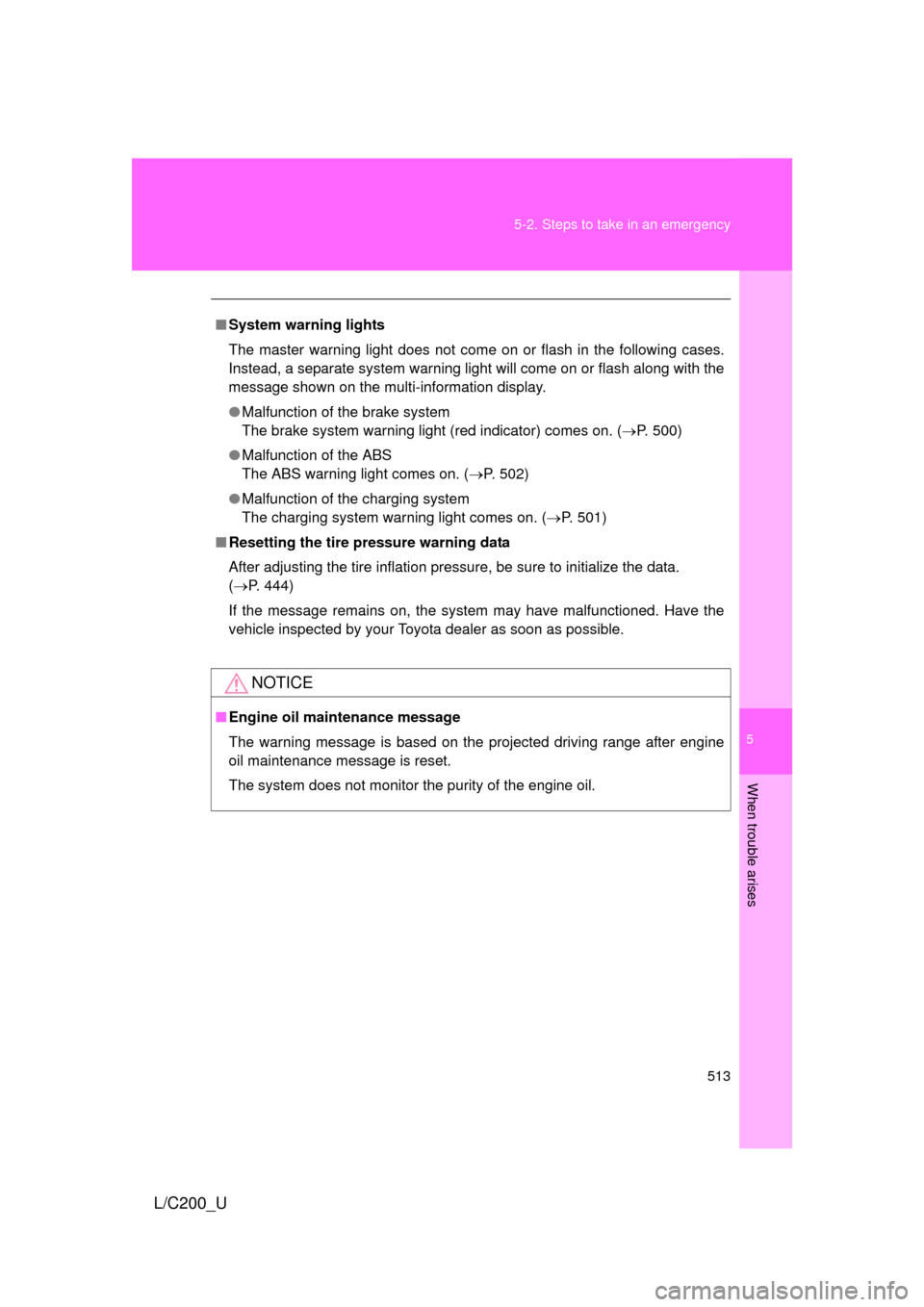
■
System warning lights
The master warning light does not come on or flash in the following cases.
Instead, a separate system warning light will come on or flash along with the
message shown on the multi-information display.
● Malfunction of the brake system
The brake system warning light (red indicator) comes on. ( P. 500)
● Malfunction of the ABS
The ABS warning light comes on. ( P. 502)
● Malfunction of the charging system
The charging system warning light comes on. ( P. 501)
■ Resetting the tire pressure warning data
After adjusting the tire inflation pressure, be sure to initialize the data.
(P. 444)
If the message remains on, the system may have malfunctioned. Have the
vehicle inspected by your Toyota dealer as soon as possible.
NOTICE
■ Engine oil maintenance message
The warning message is based on the projected driving range after engine
oil maintenance message is reset.
The system does not monitor the purity of the engine oil.
Page 545 of 592
545
6-1. Specifications
6
Vehicle specifications
L/C200_U
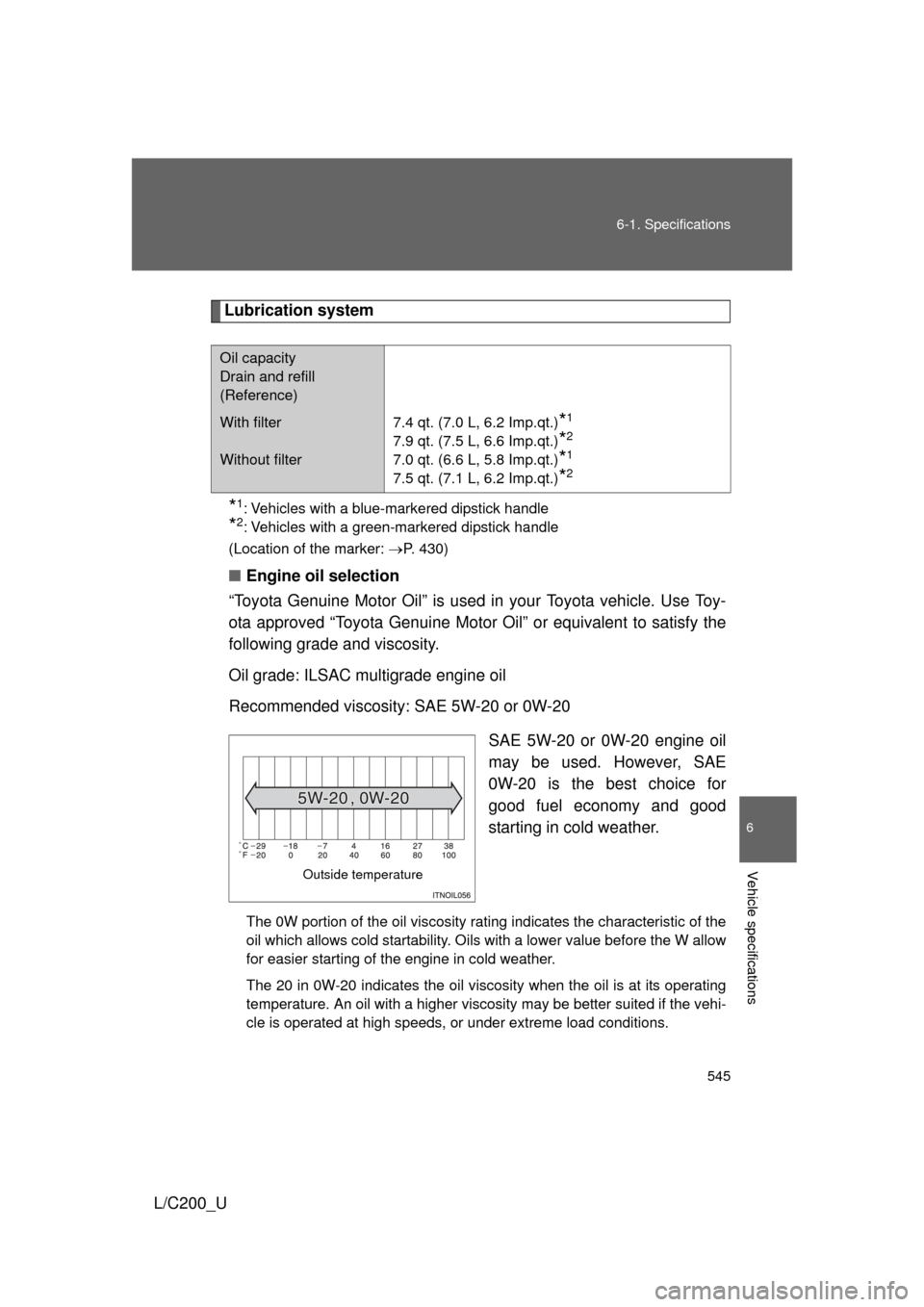
Lubrication system
*1: Vehicles with a blue-markered dipstick handle
*2: Vehicles with a green-markered dipstick handle
(Location of the marker: P. 430)
■Engine oil selection
“Toyota Genuine Motor Oil” is used in your Toyota vehicle. Use Toy-
ota approved “Toyota Genuine Motor Oil” or equivalent to satisfy the
following grade and viscosity.
Oil grade: ILSAC multigrade engine oil
Recommended viscosity: SAE 5W-20 or 0W-20
SAE 5W-20 or 0W-20 engine oil
may be used. However, SAE
0W-20 is the best choice for
good fuel economy and good
starting in cold weather.
The 0W portion of the oil viscosity rating indicates the characteristic of the
oil which allows cold startability. Oils with a lower value before the W allow
for easier starting of the engine in cold weather.
The 20 in 0W-20 indicates the oil viscosity when the oil is at its operating
temperature. An oil with a higher viscosity may be better suited if the vehi-
cle is operated at high speeds, or under extreme load conditions.
Oil capacity
Drain and refill
(Reference)
With filter
Without filter7.4 qt. (7.0 L, 6.2 Imp.qt.)*1
7.9 qt. (7.5 L, 6.6 Imp.qt.)*2
7.0 qt. (6.6 L, 5.8 Imp.qt.)*1
7.5 qt. (7.1 L, 6.2 Imp.qt.)*2
Outside temperature
Page 549 of 592
549
6-1. Specifications
6
Vehicle specifications
L/C200_U
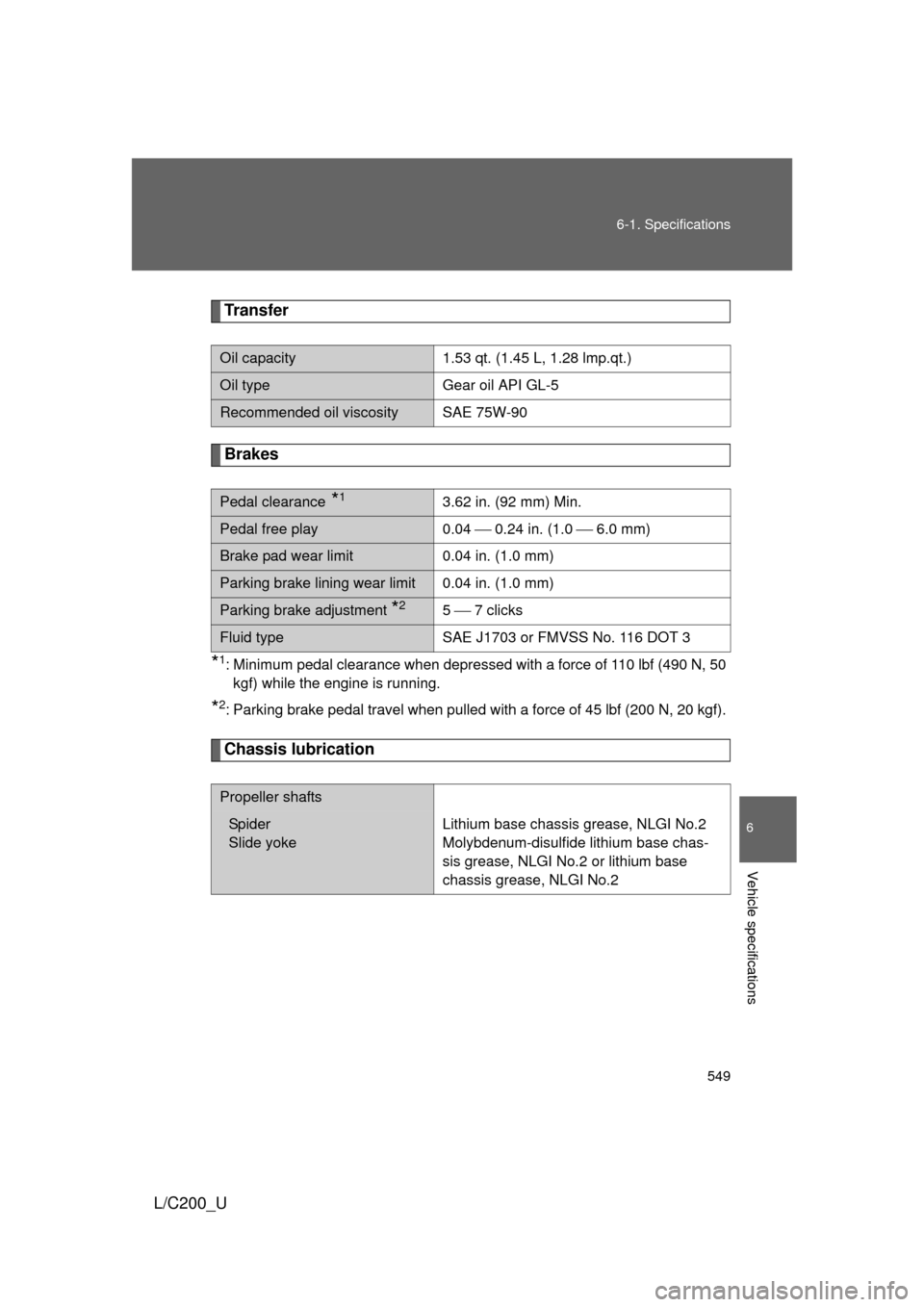
Transfer
Brakes
*1: Minimum pedal clearance when depressed with a force of 110 lbf (490 N, 50
kgf) while the engine is running.
*2: Parking brake pedal travel when pulled with a force of 45 lbf (200 N, 20 kgf).
Chassis lubrication
Oil capacity1.53 qt. (1.45 L, 1.28 lmp.qt.)
Oil typeGear oil API GL-5
Recommended oil viscositySAE 75W-90
Pedal clearance *13.62 in. (92 mm) Min.
Pedal free play0.04 0.24 in. (1.0 6.0 mm)
Brake pad wear limit0.04 in. (1.0 mm)
Parking brake lining wear limit0.04 in. (1.0 mm)
Parking brake adjustment *25 7 clicks
Fluid typeSAE J1703 or FMVSS No. 116 DOT 3
Propeller shafts
Spider
Slide yokeLithium base chassis grease, NLGI No.2
Molybdenum-disulfide lithium base chas-
sis grease, NLGI No.2 or lithium base
chassis grease, NLGI No.2