flat tire TOYOTA LAND CRUISER 2010 J200 Owner's Manual
[x] Cancel search | Manufacturer: TOYOTA, Model Year: 2010, Model line: LAND CRUISER, Model: TOYOTA LAND CRUISER 2010 J200Pages: 592, PDF Size: 7.98 MB
Page 450 of 592

450 4-3. Do-it-yourself maintenance
L/C200_U
CAUTION
■Tire pressure warning system operation
The tire pressure warning system may not provide warning immediately
if a tire bursts or if sudden air leakage occurs.
■When inspecting or replacing tires
Observe the following precautions to prevent accidents. Failure to do so
may cause damage to parts of the drive train, as well as dangerous han-
dling characteristics, which may lead to an accident resulting in death or
serious injury.
●Do not mix tires of different makes, models or tread patterns.
Also, do not mix tires of remarkably different treadwear.
●Do not use tire sizes other than those recommended by Toyota.
●Do not mix differently constructed ti res (radial, bias-belted or bias-ply
tires).
●Do not mix summer, all season and winter tires.
●Do not use tire that have been used on another vehicle.
Do not use tires if you do not know they were used previously.
■When initializing the tire pressure warning system
Do not push the tire pressure warnin g reset switch without first adjusting
the tire inflation pressure to the spec ified level. Otherwise, the tire pres-
sure warning light may not come on ev en if the tire inflation pressure is
low, or it may come on when the tire inflation pressure is actually normal.
NOTICE
■Repairing or replacing tires, wheels and tire pressure warning
valves and transmitters
When removing or fitting the wheels, tires or the tire pressure warning
valve and transmitter, contact your Toyota dealer as the tire pressure
warning valve and transmitter may be damaged if not handled correctly.
■To avoid damaging the tire pressure warning valves and transmit-
ters
Do not use liquid sealants on flat tires.
Page 451 of 592

451
4-3. Do-it-yourself maintenance
4
Maintenance and care
L/C200_U
NOTICE
■Driving on rough roads
Take particular care when driving
on roads with loose surfaces or pot-
holes.
These conditions may cause losses in tire inflation pressure, reducing
the cushioning ability of the tires. In addition driving on rough roads may
cause damage to the tires themselves, as well as the vehicle’s wheels
and body.
■If tire inflation pressures become low while driving
Do not continue driving, or your tires and/or wheels may be ruined.
Page 452 of 592
452
4-3. Do-it-yourself maintenance
L/C200_U
Tire inflation pressure
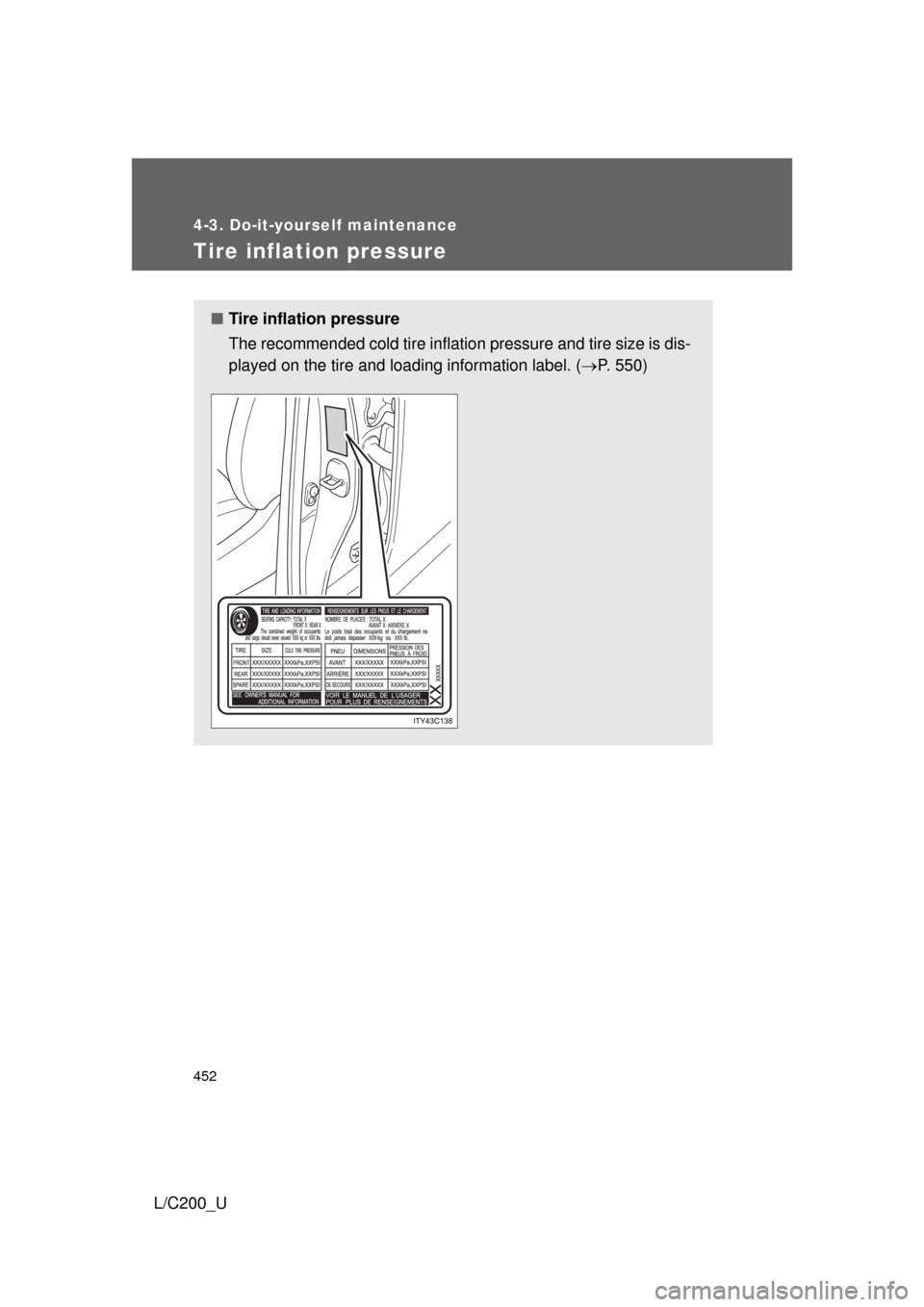
■Tire inflation pressure
The recommended cold tire inflation pressure and tire size is dis-
played on the tire and loadi ng information label. (P. 550)
Page 453 of 592
453
4-3. Do-it-yourself maintenance
4
Maintenance and care
L/C200_U
.
■Tire inflation pressure check interval
You should check tire inflation pressu
re every 2 weeks, or at least once a
month.
Do not forget to check the spare.
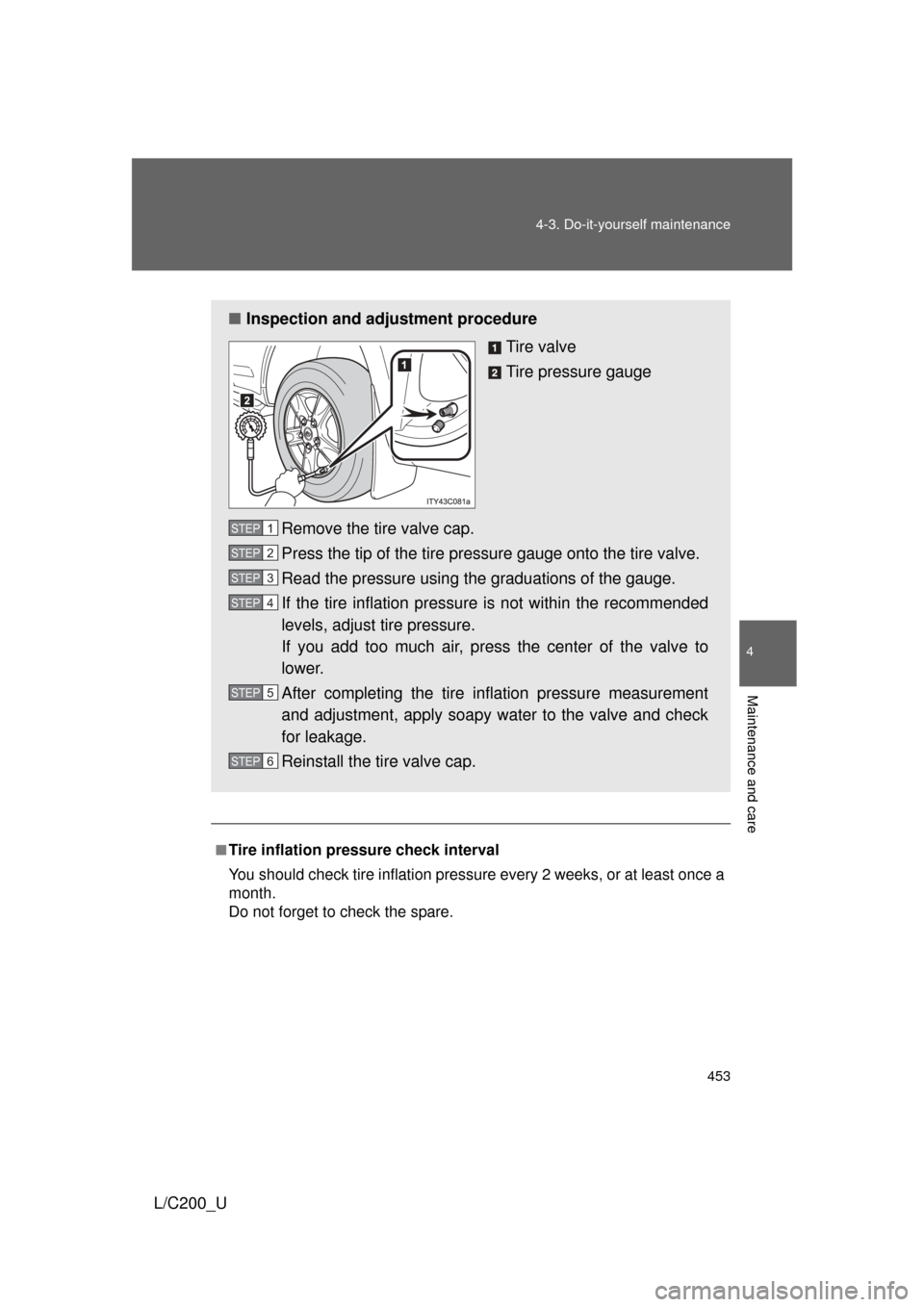
■ Inspection and adjustment procedure
Tire valve
Tire pressure gauge
Remove the tire valve cap.
Press the tip of the tire pressure gauge onto the tire valve.
Read the pressure using the graduations of the gauge.
If the tire inflation pressure is not within the recommended
levels, adjust tire pressure.
If you add too much air, pres s the center of the valve to
lower.
After completing the tire inflation pressure measurement
and adjustment, apply soapy water to the valve and check
for leakage.
Reinstall the tire valve cap.
STEP1
STEP2
STEP3
STEP4
STEP5
STEP6
Page 454 of 592

454 4-3. Do-it-yourself maintenance
L/C200_U
■Effects of incorrect tire inflation pressure
Driving with incorrect tire inflation pressure ma y result in the following:
●Reduced fuel efficiency
●Reduced driving comfort and tire life
●Reduced safety
●Damage to the drive train
If a tire needs frequent re filling, have it checked by your Toyota dealer.
■Instructions for checking tire inflation pressure
When checking tire inflation pressure, observe the following:
●Check only when the tires are cold.
If your vehicle has been parked for at least 3 hours and has not been
driven for more than 1 mile or 1.5 km, you will get an accurate cold
tire inflation pressure reading.
●Always use a tire pressure gauge.
The appearance of the tire can be mi sleading. In addition, tire infla-
tion pressures that are even just a few pounds off can degrade ride
and handling.
●Do not bleed or reduce tire inflation pressure after driving. It is normal
for the tire inflation pressure to be higher after driving.
●Never exceed the vehicle capacity weight.
Passengers and luggage weight should be placed so that the vehicle
is balanced.
Page 455 of 592

455
4-3. Do-it-yourself maintenance
4
Maintenance and care
L/C200_U
CAUTION
■Proper inflation is critical
to save tire performance
Keep your tires properly inflated. Otherwise, the following conditions
may occur and result in an accident causing death or serious injury.
●Excessive wear
●Uneven wear
●Poor handling
●Possibility of blowouts resu lting from overheated tires
●Poor sealing of the tire bead
●Wheel deformation and/or tire separation
●A greater possibility of tire damage from road hazards
NOTICE
■When inspecting and adjusting tire inflation pressure
Be sure to reinstall the tire valve caps.
Without the valve caps, dirt or mo isture could get into the valve and
cause air leakage, which could result in an accident. If the caps have
been lost, replace them as soon as possible.
Page 457 of 592
457
4-3. Do-it-yourself maintenance
4
Maintenance and care
L/C200_U
■
When replacing wheels
The wheels of your Toyota are equipped with tire pressure warning valves
and transmitters that allow the tire pressure warning system to provide
advanced warning in the event of a loss in tire inflation pressure. Whenever
wheels are replaced, the tire pressure warning valves and transmitters must
be installed. ( P. 444)
CAUTION
■When replacing wheels
● Do not use wheels that are a different size from those recommended in the
Owner’s Manual, as this may result in loss of handling control.
● Never use an inner tube in a leaking wheel which is designed for a tube-
less tire. Doing so may result in an accident, causing death or serious
injury.
NOTICE
■Replacing tire pressure warning valves and transmitters
● Because tire repair or replacement may affect the tire pressure warning
valves and transmitters, make sure to have tires serviced by your Toyota
dealer or other qualified service shop. In addition, make sure to purchase
your tire pressure warning valves and transmitters at your Toyota dealer.
● Ensure that only genuine Toyota wheels are used on your vehicle.
Tire pressure warning valves and transmitters may not work properly with
non-genuine wheels.
Page 489 of 592
When trouble arises5
489
L/C200_U
5-1. Essential informationEmergency flashers ......... 490
If your vehicle needs to be towed ............................. 491
If you think something is wrong ............................. 496
Fuel pump shut off system ........................... 497
Event data recorder ......... 498 5-2. Steps to take in an
emergency
If a warning light turns on or a warning
sounds... ....................... 500
If a warning message is displayed ........................ 511
If you have a flat tire......... 514
If the engine will not start ................................ 526
If the shift lever cannot be shifted from P ................. 528
If you lose your keys ........ 529
If you cannot operate back door opener ........... 530
If the electronic key does not operate properly....... 531
If the battery is discharged ..................... 534
If your vehicle overheats ....................... 537
If the vehicle becomes stuck .............................. 540
Page 496 of 592

496
5-1. Essential information
L/C200_U
If you think something is wrong
If you notice any of the following symptoms, your vehicle probably
needs adjustment or repair. Contact your Toyota dealer as soon as
possible.
■ Visible symptoms
●Fluid leaks under the vehicle
(Water dripping from the air cond itioning after use is normal.)
● Flat-looking tires or uneven tire wear
● Engine coolant temperature g auge needle continually points
higher than normal
● Engine oil pressure gauge continually points lower than nor-
mal
● Voltmeter continually points higher or lower than normal
■ Audible symptoms
●Changes in exhaust sound
● Excessive tire squeal when cornering
● Strange noises related to the suspension system
● Pinging or other noises related to the engine
■ Operational symptoms
●Engine missing, stumbling or running rough
● Appreciable loss of power
● Vehicle pulls heavily to one side when braking
● Vehicle pulls heavily to one side when driving on a level road
● Loss of brake effectiveness, s pongy feeling, pedal almost
touches the floor
Page 503 of 592
5
When trouble arises
503
5-2. Steps to take in an emergency
L/C200_U
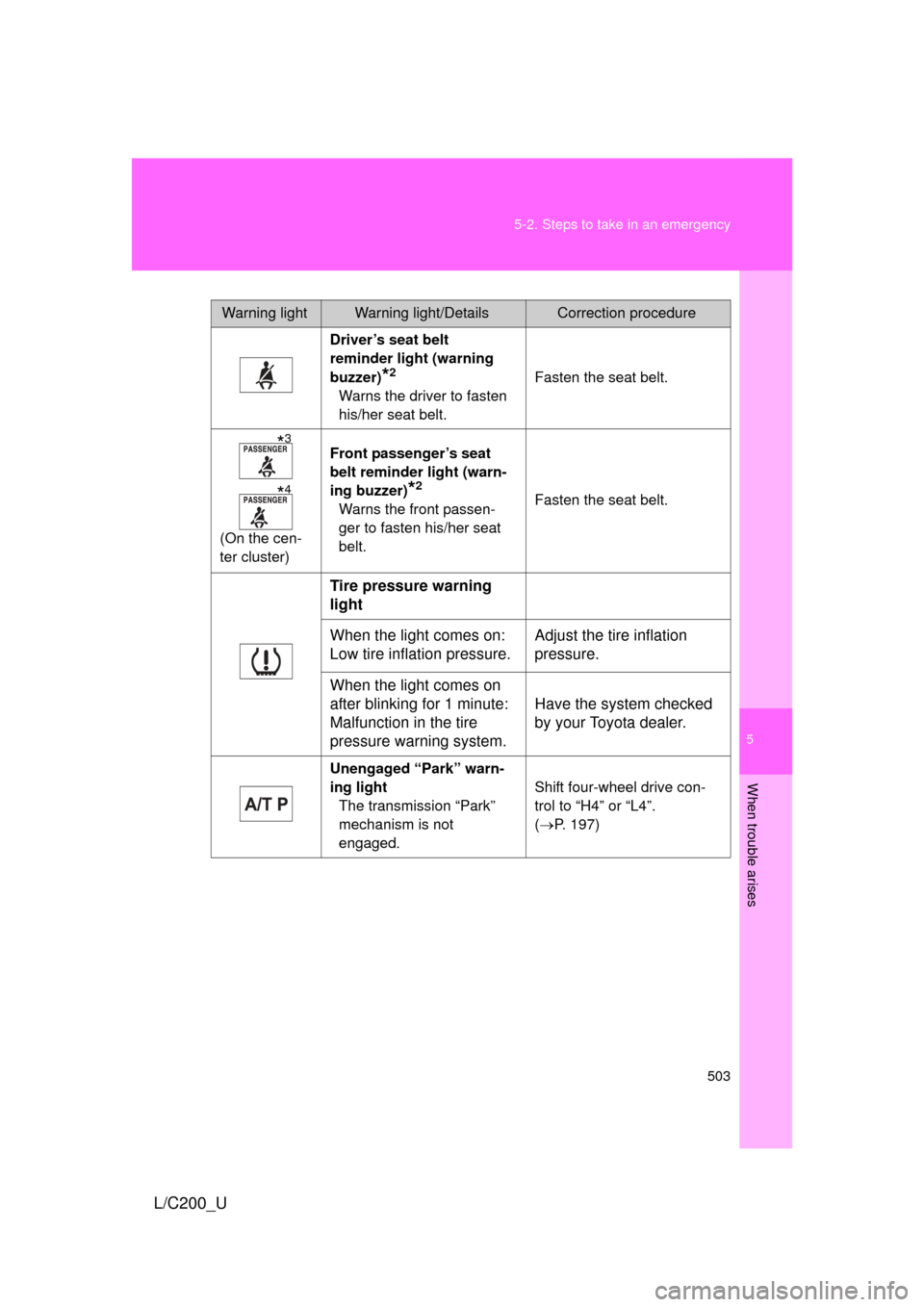
Warning lightWarning light/DetailsCorrection procedure
Driver’s seat belt
reminder light (warning
buzzer)
*2
Warns the driver to fasten
his/her seat belt. Fasten the seat belt.
(On the cen-
ter cluster) Front passenger’s seat
belt reminder light (warn-
ing buzzer)
*2
Warns the front passen-
ger to fasten his/her seat
belt.
Fasten the seat belt.
Tire pressure warning
light
When the light comes on:
Low tire inflation pressure.
Adjust the tire inflation
pressure.
When the light comes on
after blinking for 1 minute:
Malfunction in the tire
pressure warning system. Have the system checked
by your Toyota dealer.
Unengaged “Park” warn-
ing light
The transmission “Park”
mechanism is not
engaged. Shift four-wheel drive con-
trol to “H4” or “L4”.
(
P. 197)
*3
*4