window TOYOTA LAND CRUISER 2010 J200 Owner's Manual
[x] Cancel search | Manufacturer: TOYOTA, Model Year: 2010, Model line: LAND CRUISER, Model: TOYOTA LAND CRUISER 2010 J200Pages: 592, PDF Size: 7.98 MB
Page 92 of 592
92
L/C200_U
1-5. Refueling
Opening the fuel tank cap
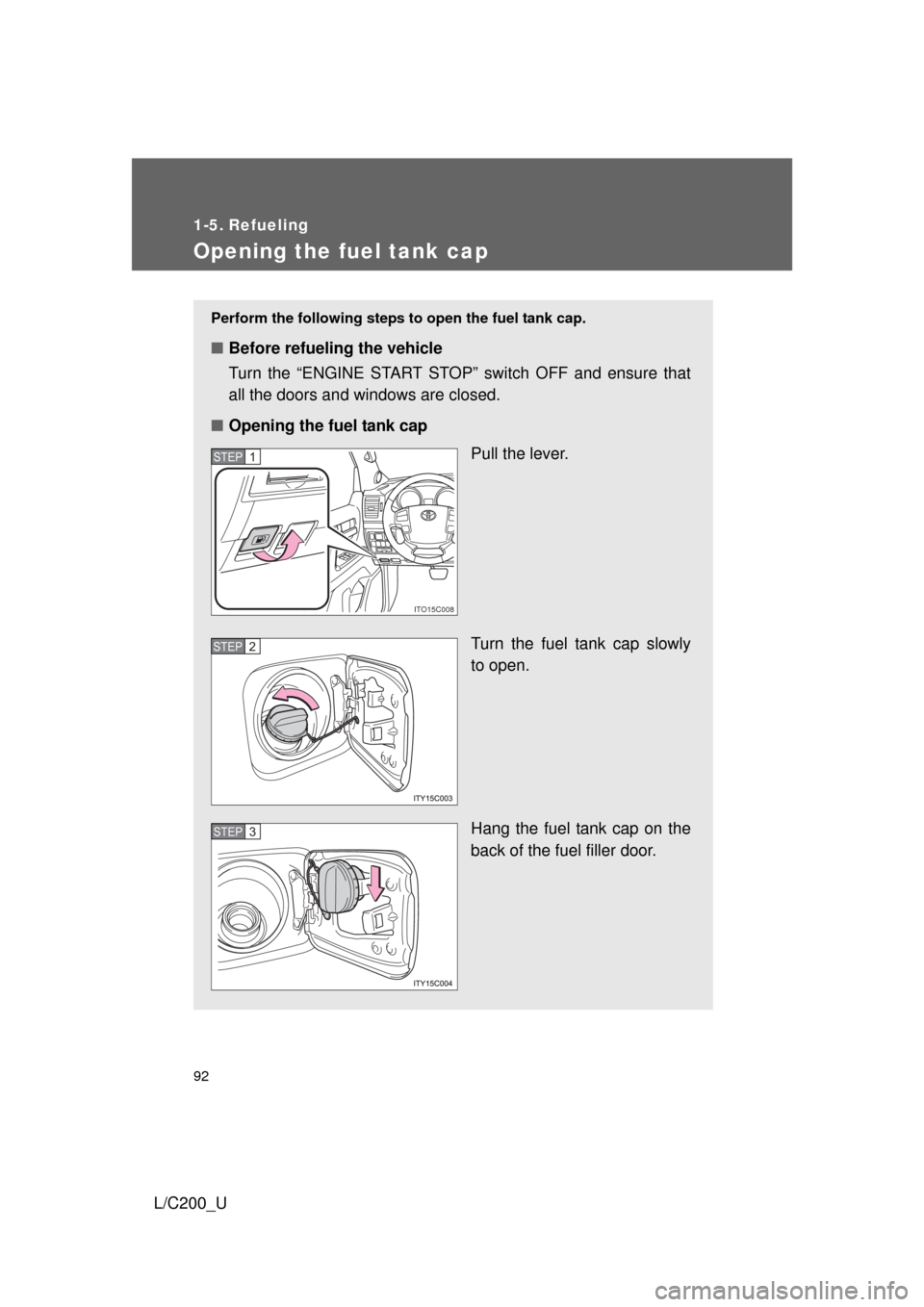
Perform the following steps to open the fuel tank cap.
■Before refueling the vehicle
Turn the “ENGINE START STOP” switch OFF and ensure that
all the doors and windows are closed.
■ Opening the fuel tank cap
Pull the lever.
Turn the fuel tank cap slowly
to open.
Hang the fuel tank cap on the
back of the fuel filler door.
ITO15C008
STEP1
STEP2
STEP3
Page 99 of 592
99
1-6. Theft deterrent system
1
Before driving
L/C200_U
■
Items to check before locking the vehicle
To prevent unexpected triggering of the alarm and vehicle theft, make sure
of the following.
● Nobody is in the vehicle.
● The windows and moon roof are closed before the alarm is set.
● No valuables or other personal items are left in the vehicle.
■ Deactivating or stopping the alarm
Do one of the following to deactivate or stop the alarm.
●Unlock the doors using the smart key system or the wireless
remote control.
● Start the engine. (The alarm will be deactivated or stopped
after a few seconds.)
Page 115 of 592

115
1-7. Safety information
1
Before driving
L/C200_U
CAUTION
■
SRS airbag precautions
● If the vinyl cover is put on the area where the SRS knee airbag will deploy,
be sure to remove it.
● Do not use seat accessories which cover the parts where the SRS side
airbags inflate as they may interf ere with inflation of the airbags.
● Do not strike or apply significant levels of force to the area of the SRS air-
bag components shown on P. 105. Doing so can cause the SRS airbags to
malfunction.
● Do not touch any of the component parts immediately after the SRS air-
bags have deployed (inflated) as they may be hot.
● If breathing becomes difficult after the SRS airbag has deployed, open a
door or window to allow fresh air in, or leave the vehicle if it is safe to do
so. Wash off any residue as soon as possible to prevent skin irritation.
● If the areas where the SRS airbags are stored, such as the steering wheel
pad and front, center and rear pillar garnishes, are damaged or cracked,
have them replaced by your Toyota dealer.
Page 141 of 592
When driving2
141
L/C200_U
2-1. Driving proceduresDriving the vehicle............ 142
Engine (ignition) switch .... 152
Automatic transmission .... 156
Turn signal lever .............. 161
Parking brake ................... 162
Horn ................................. 163
2-2. Instrument cluster Gauges and meters ......... 164
Indicators and warning lights .............................. 167
Multi-information display............................ 170 2-3. Operating the lights and
wipers
Headlight switch ............... 174
Fog light switch ................ 176
Windshield wipers and washer ........................... 177
Rear window wiper and washer ........................... 182
Headlight cleaner switch ............................. 183
2-4. Using other driving systems Cruise control ................... 184
Intuitive parking assist...... 188
Four-wheel drive system ........................... 197
Crawl Control ................... 202
Driving assist systems ..... 206
Pre-Collision System........ 212
2-5. Driving information Off-road precautions ........ 213
Cargo and luggage .......... 218
Vehicle load limits ............ 225
Winter driving tips ............ 226
Trailer towing ................... 231
Dinghy towing .................. 243
Page 143 of 592

143
2-1. Driving procedures
2
When driving
L/C200_U
■
Driving in the rain
● Drive carefully when it is raining, because visibility will be reduced, the
windows may become fogged-up, and the road will be slippery.
● Drive carefully when it starts to rain, because the road surface will be
especially slippery.
● Refrain from high speeds when driving on an expressway in the rain,
because there may be a layer of water between the tires and the road
surface, preventing the steering and brakes from operating properly.
■ Breaking in your new Toyota
To extend the life of the vehicle, the following precautions are recommended
to observe:
● For the first 200 miles (300 km):
Avoid sudden stops.
● For the first 500 miles (800 km):
Do not tow a trailer.
● For the first 1000 miles (1600 km):
• Do not drive at extremely high speeds.
• Avoid sudden acceleration.
• Do not drive continuously in the low gears.
• Do not drive at a constant speed for extended periods.
■ Drum-in-disc type parking brake system
Your vehicle has a drum-in-disc type parking brake system.
This type of brake system needs bedding-down of the brake shoes periodi-
cally or whenever the parking brake shoes and/or drums are replaced.
Have your Toyota dealer perform the bedding-down.
■ Operating your vehicle in a foreign country
Comply with the relevant vehicle registration laws and confirm the availability
of the correct fuel. ( P. 544)
Page 144 of 592

144 2-1. Driving procedures
L/C200_U
CAUTION
■When starting the vehicle
Always keep your foot on the brake pedal while stopped with the engine run-
ning. This prevents the vehicle from creeping.
■ When driving the vehicle
● Do not drive if you are unfamiliar with the location of the brake and accel-
erator pedals to avoid depressing the wrong pedal.
• Accidentally depressing the accelerator pedal instead of the brake
pedal will result in sudden acceleration that may lead to an accident
that could result in death or serious injury.
• When backing up, you may twist your body around, leading to a diffi- culty in operating the pedals. Make sure to operate the pedals properly.
• Make sure to keep a correct driving posture even when moving the vehicle only slightly, allowing you to depress the brake and accelerator
pedals properly.
• Depress the brake pedal using your right foot. Depressing the brake pedal using your left foot may delay response in an emergency, result-
ing in an accident.
● Do not drive the vehicle over or st op the vehicle near flammable materials.
The exhaust system and exhaust gases can be extremely hot. This may
cause a fire if there is any flammable material nearby.
● Do not let the vehicle roll backwards while the shift lever is in a driving
position, or roll forward while the shift lever is in “R”.
Doing so may cause the engine to stall and lead to poor steering perfor-
mance, resulting in an accident or damage to the vehicle.
● If the smell of exhaust is noticed inside the vehicle, open the windows and
check that the back door is closed. Large amounts of exhaust in the vehi-
cle can cause driver drowsiness and an accident, resulting in death or a
serious health hazard. Have the vehicle inspected by your Toyota dealer
immediately.
● Do not shift the shift lever to "P" while the vehicle is moving.
Doing so can damage the transmission and may result in a loss of vehicle\
control.
Page 181 of 592
![TOYOTA LAND CRUISER 2010 J200 Owners Manual 181
2-3. Operating the lights and wipers
2
When driving
L/C200_U
■
In extremely hot or cold weather
The system will turn off if the windshield gets extremely hot (at more than
176 F [80 C]) or](/img/14/6488/w960_6488-180.png "TOYOTA LAND CRUISER 2010 J200 Owners Manual 181
2-3. Operating the lights and wipers
2
When driving
L/C200_U
■
In extremely hot or cold weather
The system will turn off if the windshield gets extremely hot (at more than
176 F [80 C]) or")
181
2-3. Operating the lights and wipers
2
When driving
L/C200_U
■
In extremely hot or cold weather
The system will turn off if the windshield gets extremely hot (at more than
176 F [80 C]) or cold (at less than -14 F [-10 C]).
■ Windshield wiper features
The rear window and outside rear view mirror defoggers automatically turn
on when you operate the wipers.
CAUTION
■Caution regarding the use of windshield wipers in “AUTO” mode
The windshield wipers may operate unexpec tedly if the sensor is touched or
the windshield is subject to vibration in “AUTO” mode. Take care that your
fingers or anything else do not become caught in the windshield wipers.
NOTICE
■ When the windshield is dry
Do not use the wipers, as they may damage the windshield.
■ When there is no washer fluid spray from the nozzle
Damage to the washer fluid pump may be caused if the lever is pulled
toward you and held continually.
■ When a nozzle becomes blocked
Do not try to clear it with a pin or other object. The nozzle will be damaged.
Page 182 of 592
182
2-3. Operating the lights and wipers
L/C200_U
Rear window wiper and washer
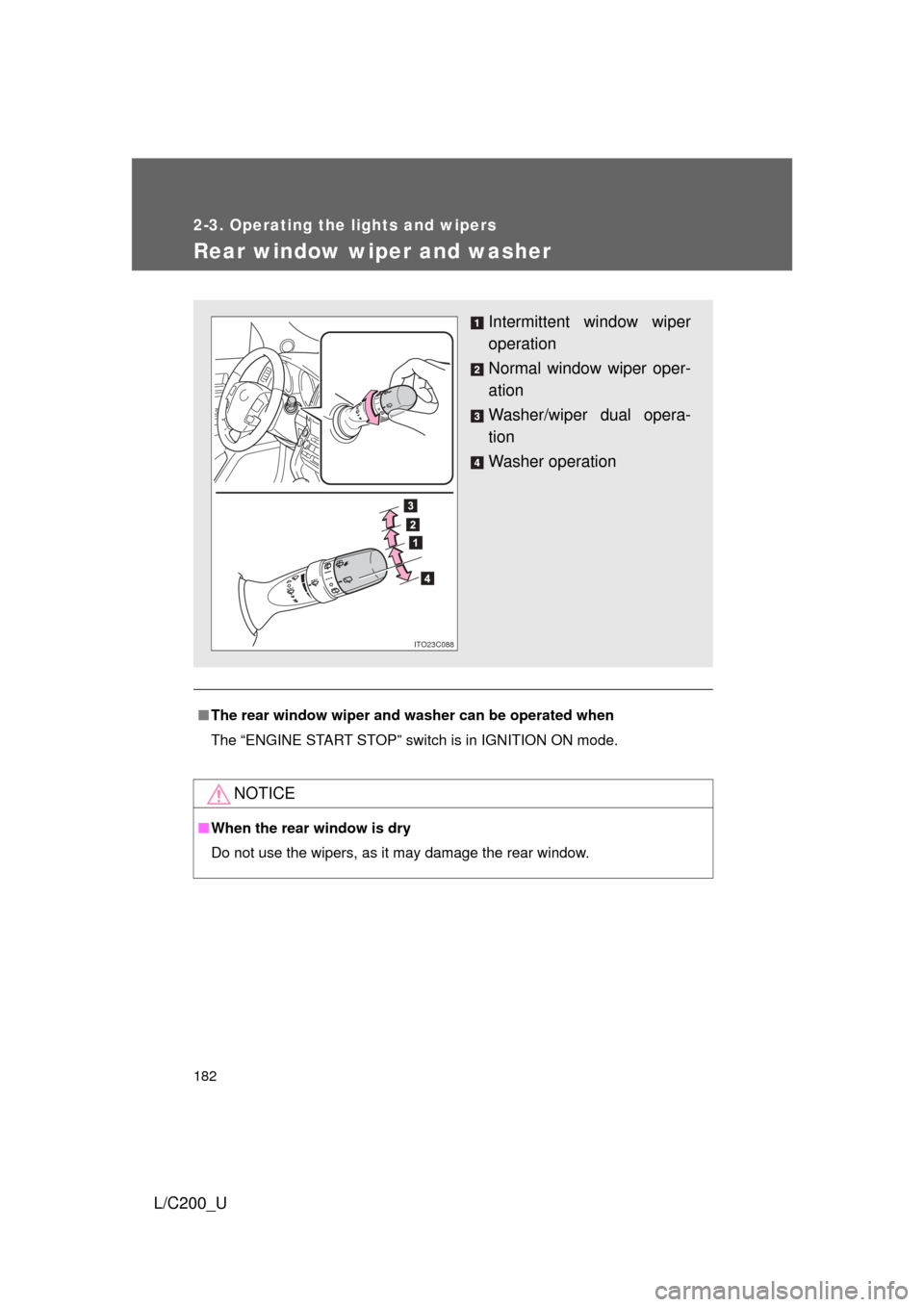
■The rear window wiper and w asher can be operated when
The “ENGINE START STOP” switch is in IGNITION ON mode.
NOTICE
■ When the rear window is dry
Do not use the wipers, as it may damage the rear window.
Intermittent window wiper
operation
Normal window wiper oper-
ation
Washer/wiper dual opera-
tion
Washer operation
ITO23C088
Page 227 of 592
227
2-5. Driving information
2
When driving
L/C200_U
■
Before driving the vehicle
Perform the following according to the driving conditions.
●Do not try to forcibly open a window or move a wiper that is
frozen. Pour warm water over the frozen area to melt the ice.
Wipe away the water immediately to prevent it from freezing.
● To ensure proper operation of th e climate control system fan,
remove any snow that has accumulated on the air inlet vents
in front of the windshield.
● Remove any ice that has accumu lated on the vehicle chassis.
● Periodically check for and remove any excess ice or snow
that may have accumulated in the wheel well or on the
brakes.
■ When driving the vehicle
Accelerate the vehicle slowly and drive at a reduced speed suit-
able to road conditions.
■ When parking the vehicle
Park the vehicle and move the shift lever to “P” without setting
the parking brake. The parking brake may freeze up, preventing
it from being released.
Page 244 of 592
244
L/C200_U
3-1. Using the air conditioning system and defogger
Front air conditioning system ........................... 246
Rear air conditioning system ........................... 256
Rear window and outside rear view mirror
defoggers ....................... 260
Windshield wiper de-icer ............................ 261
3-2. Using the audio system Audio system type............ 262
Using the radio ................. 265
Using the CD player ......... 274
Playing back MP3 and WMA discs ..................... 282
Operating an iPod
®.......... 289
Operating a USB memory .......................... 296
Optimal use of the audio system ........................... 304
Using the AUX adapter .... 306
Using the steering switches ......................... 307
Interior features3