flat tire TOYOTA LAND CRUISER 2010 J200 Owner's Guide
[x] Cancel search | Manufacturer: TOYOTA, Model Year: 2010, Model line: LAND CRUISER, Model: TOYOTA LAND CRUISER 2010 J200Pages: 592, PDF Size: 7.98 MB
Page 506 of 592

506 5-2. Steps to take in an emergency
L/C200_U
■SRS warning light
This warning light system monitors the following:
● The airbag sensor assembly
● Front airbag sensors
● The curtain shield airbag sensors
● The side and curtain shield airbag sensors
● The seat belt buckle switches
● The driver’s seat position sensor
● The belt tension sensor
● The inflators
● The interconnecting wiring and power sources
● The front passenger occupant classification ECU
● “AIR BAG ON” and “AIR BA G OFF” indicator lights
● The seat belt pretensioners
● The roll sensing of curtain shield airbags off indicator light
■ Changing the engine oil
Make sure to reset oil change system
■
When the tire pressure warning light comes on
Check the tire inflation pressure and adjust to the appropriate level.
Pushing the tire pressure warning reset switch does not turn off the tire
pressure warning light.
■The tire pressure warning light ma y turn on due to natural causes
The tire pressure warning light may turn on due to natural causes such
as natural air leaks or tire inflation pressure changes caused by temper-
ature. In this case, adjusting the ti re inflation pressure will turn off the
warning light (after a few minutes).
Page 507 of 592

5
When trouble arises
507
5-2. Steps to take in an emergency
L/C200_U
■When a tire is replaced with a spare tire
The spare tire is also equipped with the tire pressure warning valve and
transmitter. The tire pressure warning li
ght will turn on if the tire inflation
pressure of the spare tire is low. If a tire goes flat, even though the flat
tire is replaced with the spare tire, the tire pressure warning light does
not turn off. Replace the spare tire with the repaired tire and adjust the
proper tire inflation pressure. The ti re pressure warning light will turn off
after a few minutes.
■If the tire pressure warning system is inoperative
The tire pressure warning system will be disabled in the following condi-
tions:
(When the condition be comes normal, the system will work properly.)
●If tires not equipped with tire pressure warning valves and transmit-
ters are used.
●If the ID code on the tire pressure warning valves and transmitters is
not registered in the tire pressure warning computer.
●If the tire inflation pressure is 73 psi (500 kPa, 5.1 kgf/cm2 or bar) or
higher.
The tire pressure warning system may be disabled in the following condi-
tions:
(When the condition be comes normal, the system will work properly.)
●If electronic devices or facilities using similar radio wave frequencies
are nearby.
●If a radio set at similar frequencies is in use in the vehicle.
●If a window tint that affects the radio wave signals is installed.
●If there is a lot of snow or ice on the vehicle, in particular around the
wheels or wheel housings.
●If non-genuine Toyota wheels are used. (Even if you use Toyota
wheels, the tire pressu re warning system may not work properly with
some types of tires.)
●If tire chains are used.
●If the spare tire is in a location subject to poor radio wave signal
reception.
●If a large metallic object which can interfere with signal reception is
put in the luggage compartment.
Page 508 of 592

508 5-2. Steps to take in an emergency
L/C200_U
■If the tire pressure warning light comes on after blinking for 1
minute frequently
If the tire pressure warning light comes on after blinking for 1 minute fre-
quently when the “ENGINE START STOP” switch is turned to IGNITION
ON mode, have it checked by Toyota dealer.
CAUTION
■If the tire pressure warning light comes on
Be sure to observe the following precautions. Failure to do so could
cause loss of vehicle control and re sult in death or serious injury.
●Stop your vehicle in a safe place as soon as possible. Adjust the tire
inflation pressure immediately.
●If the tire pressure warning light comes on even after tire inflation pres-
sure adjustment, it is pr obable that you have a flat tire. Check the tires.
If the tire is flat, change to the spare tire and have the flat tire repaired
by the nearest Toyota dealer.
●Avoid abrupt maneuvering and braking. If the vehicle tires deteriorate,
you could lose control of the steering wheel or the brakes.
■If a blowout or sudden air leakage should occur
The tire pressure warning syste m may not activate immediately.
Page 509 of 592

5
When trouble arises
509
5-2. Steps to take in an emergency
L/C200_U
CAUTION
■Maintenance of the tires
Each tire, including the spare (if provided), should be checked monthly
when cold and inflated to the inflation pressure recommended by the
vehicle manufacturer on the vehicle
placard or tire inflation pressure
label (tire and load information label). (If your vehicle has tires of a differ-
ent size than the size indicated on the vehicle placard or tire inflation
pressure label [tire and load information label], you should determine the
proper tire inflation pr essure for those tires.)
As an added safety feature, your vehicle has been equipped with a tire
pressure monitoring system (TPMS-ti re pressure warning system) that
illuminates a low tire pressure telltal e (tire pressure warning light) when
one or more of your tires is significantly under-inflated. Accordingly,
when the low tire pressure telltale (tire pre ssure warning light) illumi-
nates, you should stop and check your tires as soon as possible, and
inflate them to the proper pressure. Driving on a significantly under-
inflated tire causes the tire to overheat and can lead to tire failure.
Under-inflation also reduces fuel effi ciency and tire tread life, and may
affect the vehicle’s handling and stopping ability.
Please note that the TPMS (tire pressure warning system) is not a sub-
stitute for proper tire ma intenance, and it is the driver’s responsibility to
maintain correct tire pressure, even if under-inflation has not reached the
level to trigger illu mination of the TPMS low ti re pressure telltale (tire
pressure warning light).
Page 513 of 592

5
When trouble arises
513
5-2. Steps to take in an emergency
L/C200_U
■
System warning lights
The master warning light does not come on or flash in the following cases.
Instead, a separate system warning light will come on or flash along with the
message shown on the multi-information display.
● Malfunction of the brake system
The brake system warning light (red indicator) comes on. ( P. 500)
● Malfunction of the ABS
The ABS warning light comes on. ( P. 502)
● Malfunction of the charging system
The charging system warning light comes on. ( P. 501)
■ Resetting the tire pressure warning data
After adjusting the tire inflation pressure, be sure to initialize the data.
(P. 444)
If the message remains on, the system may have malfunctioned. Have the
vehicle inspected by your Toyota dealer as soon as possible.
NOTICE
■ Engine oil maintenance message
The warning message is based on the projected driving range after engine
oil maintenance message is reset.
The system does not monitor the purity of the engine oil.
Page 514 of 592
514
5-2. Steps to take in an emergency
L/C200_U
If you have a flat tire
Remove the flat tire and replace it with the spare provided.
■Before jacking up the vehicle
●Stop the vehicle on a hard, flat surface.
● Set the parking brake.
● Shift the shift lever to “P”.
● Stop the engine.
● Turn on the emergency flashers.
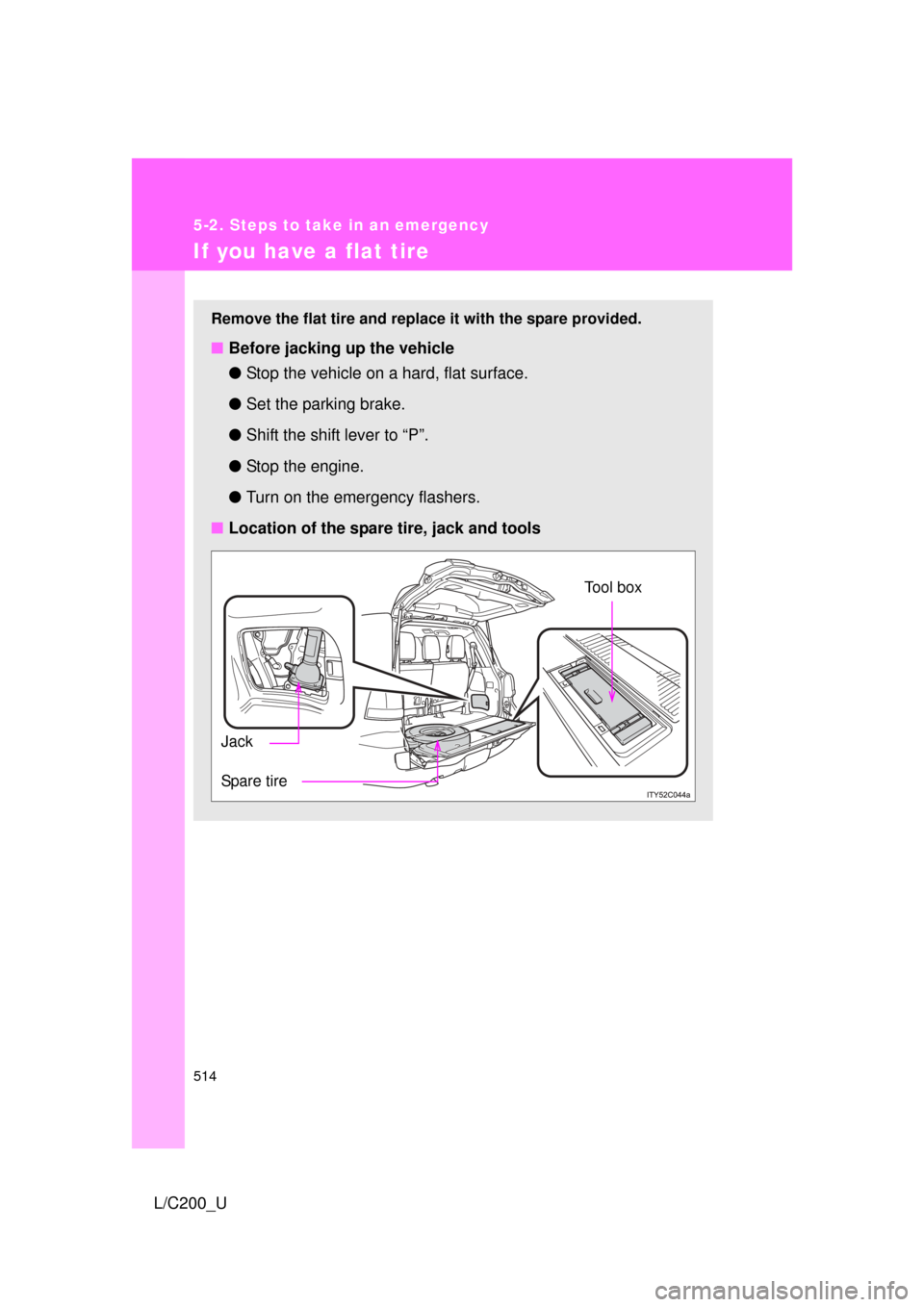
■ Location of the spare tire, jack and tools
Tool box
Spare tire Jack
Page 518 of 592
518 5-2. Steps to take in an emergency
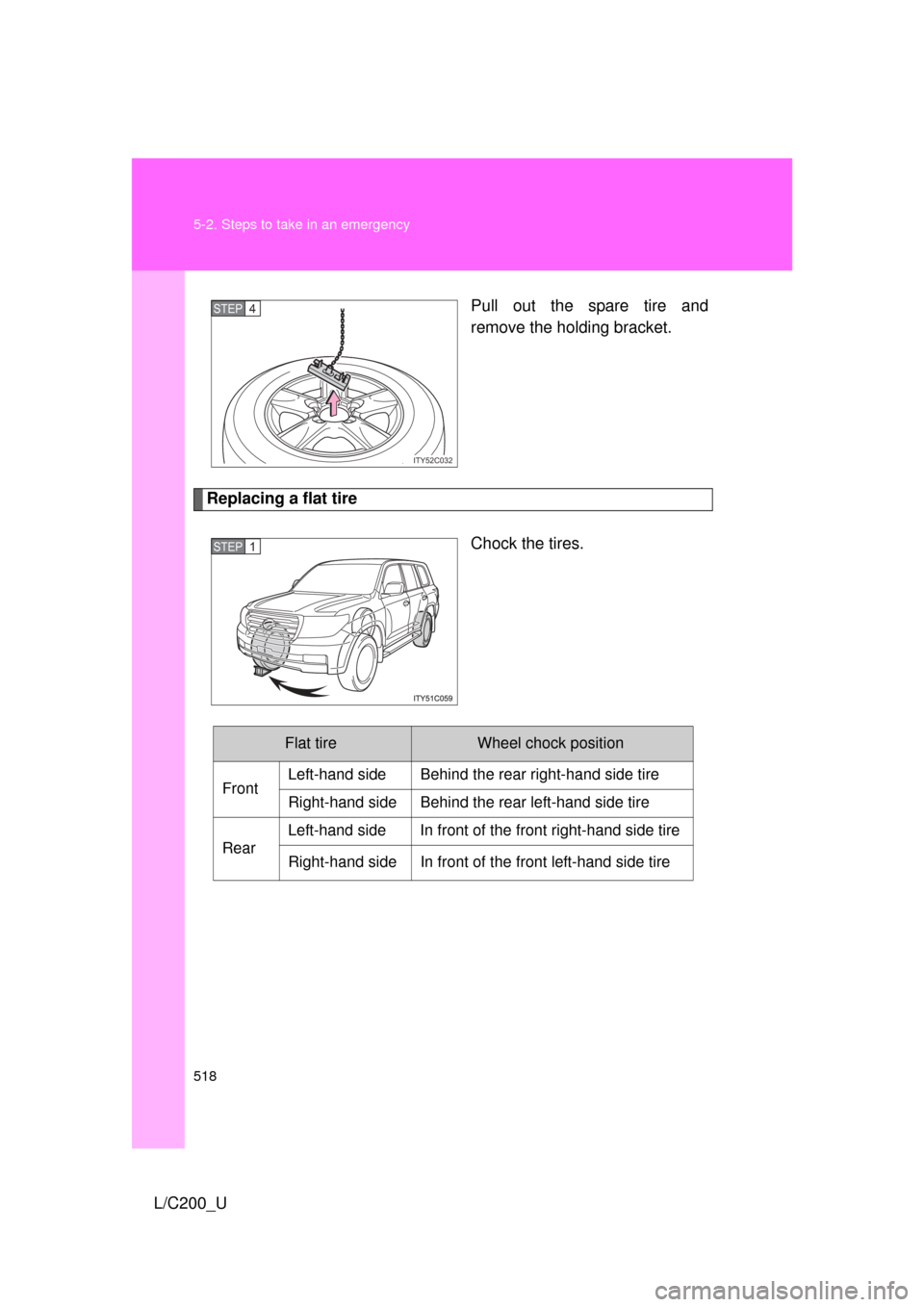
L/C200_UPull out the spare tire and
remove the holding bracket.
Replacing a flat tire
Chock the tires.
ITY52C032
STEP4
STEP1
Flat tireWheel chock position
Front Left-hand side Behind the rear right-hand side tire
Right-hand side Behind the rear left-hand side tire
Rear Left-hand side In front of the front right-hand side tire
Right-hand side In front of the front left-hand side tire
Page 522 of 592
522 5-2. Steps to take in an emergency
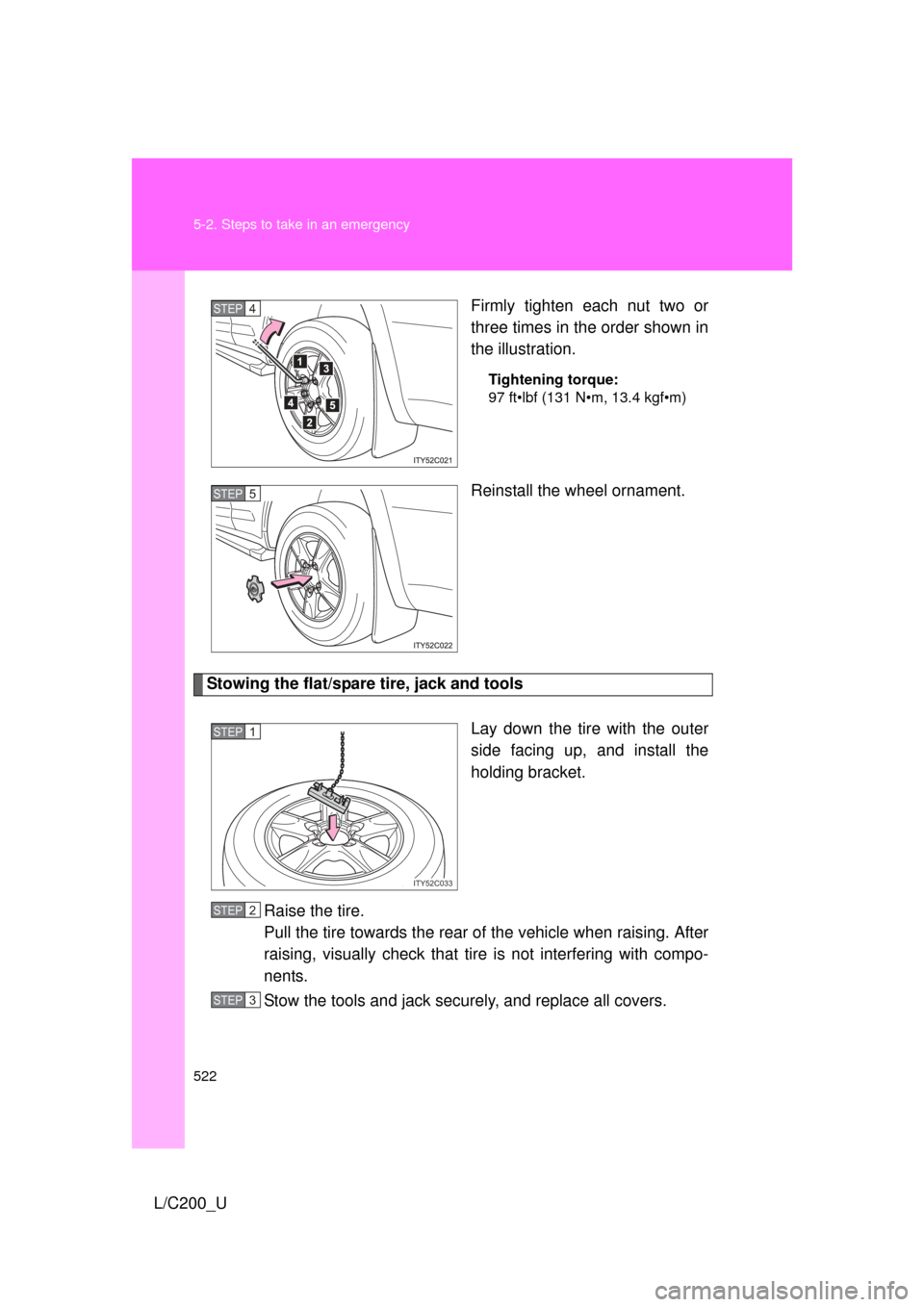
L/C200_UFirmly tighten each nut two or
three times in the order shown in
the illustration.
Tightening torque:
97 ft•lbf (131 N•m, 13.4 kgf•m)
Reinstall the wheel ornament.
Stowing the flat/spare tire, jack and tools
Lay down the tire with the outer
side facing up, and install the
holding bracket.
Raise the tire.
Pull the tire towards the rear of the vehicle when raising. After
raising, visually check that tire is not interfering with compo-
nents.
Stow the tools and jack securely, and replace all covers.
STEP4
STEP5
ITY52C033
STEP1
STEP2
STEP3
Page 523 of 592
5
When trouble arises
523
5-2. Steps to take in an emergency
L/C200_U
■After completing the tire change
The tire pressure warning
system must be reset. (P. 444)
CAUTION
■Using the tire jack
Improper use of the tire jack may lead to death or serious injuries due to
the vehicle suddenly falling off the jack.
●Do not use the tire jack for any pu rpose other than replacing tires or
installing and removing tire chains.
●Only use the tire jack that comes wi th this vehicle for replacing a flat
tire.
Do not use it on other vehicles, and do not use other tire jacks for
replacing tires on this vehicle.
●Always check that the tire jack is securely set to the jack point.
●Do not raise the vehicle while someone is in it.
●When raising the vehicle, do not put an object on or under the jack.
●Do not raise the vehicle to a hei ght greater than that required to
replace the tire.
●Use a jack stand if it is necessary to get under the vehicle.
●Do not put any part of your body under the vehicle supported by a jack.
●Do not start or run the engine while your vehicle is supported by the
jack.
Take particular care when lowering the vehicle to ensure that no one
working on or near the vehicle may be injured.
■Using the jack handle
Tighten all the jack handle bolts securely using a Phillips-head screw-
driver, to prevent the extension parts from coming apart unexpectedly.
Page 524 of 592

524 5-2. Steps to take in an emergency
L/C200_U
CAUTION
■Replacing a flat tire
Observe the following precautions to reduce the risk of death or serious
injury.
●Lower the spare tire completely to the ground before removing it from
under the vehicle.
●Do not try to remove the wheel ornament by hand. Take due care in
handling the ornament to avoid unexpected personal injury.
●Never use oil or grease on the wheel bolts or wheel nuts.
Oil and grease may cause the wheel nuts to be excessively tightened,
leading to bolt or disc wheel damage. In addition, the oil or grease can
cause the wheel nuts to loosen and the wheel may fall off, causing a
serious accident. Remove any oil or grease from the wheel bolts or
wheel nuts.
●Have the wheel nuts tightened with a torque wrench to 97 ft•lbf (131
N•m, 13.4 kgf•m) as soon as possible after changing wheels.
Failure to follow these precautions could cause the nuts to loosen and
the wheels may fall off, which could lead to an accident causing death
or serious injury.
●Do not attach a heavily damaged wheel ornament, as it may fly off the
wheel while the vehicle is moving.