brake TOYOTA LAND CRUISER 2010 J200 Service Manual
[x] Cancel search | Manufacturer: TOYOTA, Model Year: 2010, Model line: LAND CRUISER, Model: TOYOTA LAND CRUISER 2010 J200Pages: 592, PDF Size: 7.98 MB
Page 428 of 592
428
4-3. Do-it-yourself maintenance
L/C200_U
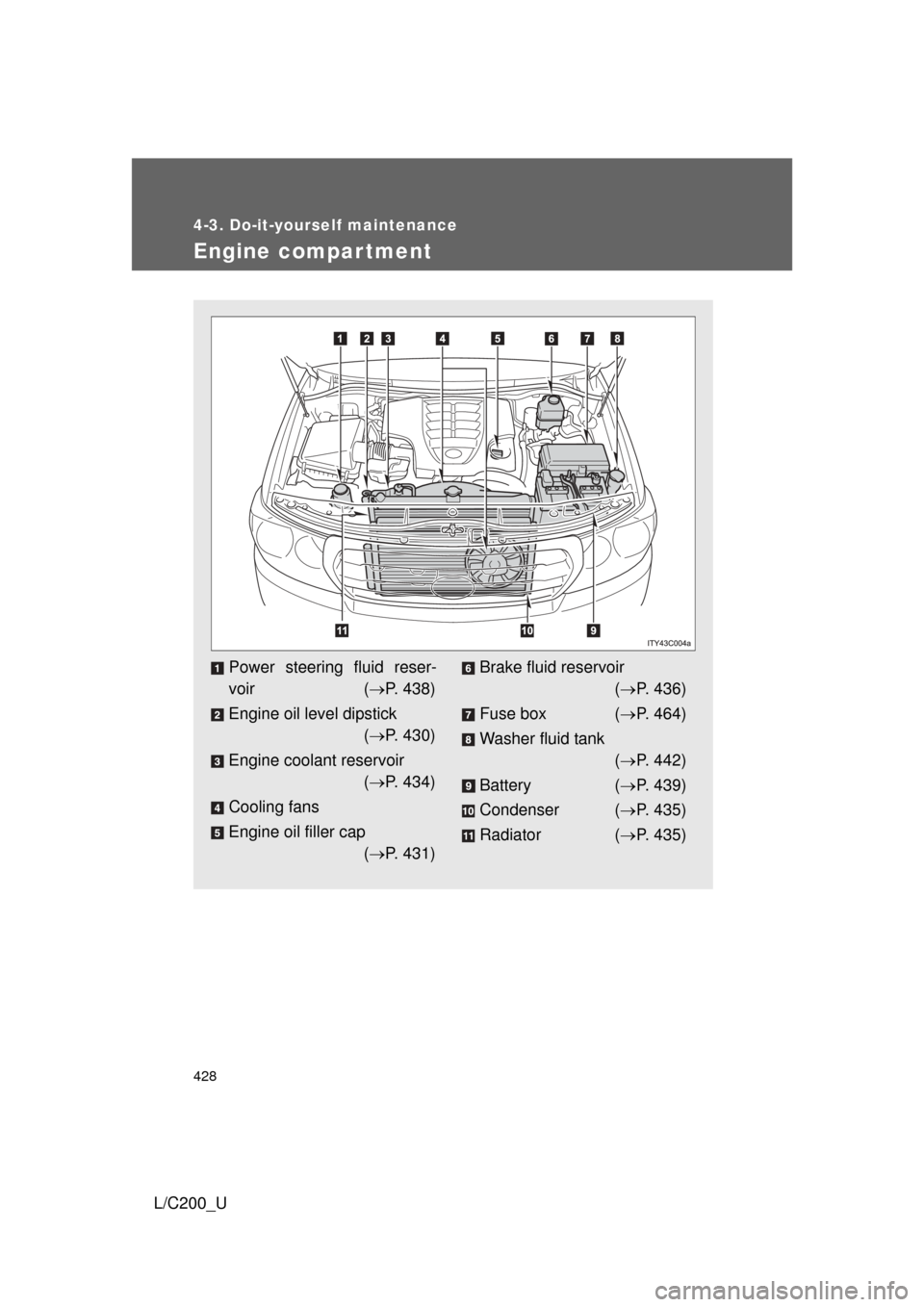
Engine compar tment
Power steering fluid reser-
voir (P. 438)
Engine oil level dipstick ( P. 430)
Engine coolant reservoir ( P. 434)
Cooling fans
Engine oil filler cap ( P. 431)Brake fluid reservoir
( P. 436)
Fuse box ( P. 464)
Washer fluid tank ( P. 442)
Battery ( P. 439)
Condenser ( P. 435)
Radiator ( P. 435)
Page 436 of 592
436 4-3. Do-it-yourself maintenance
L/C200_U
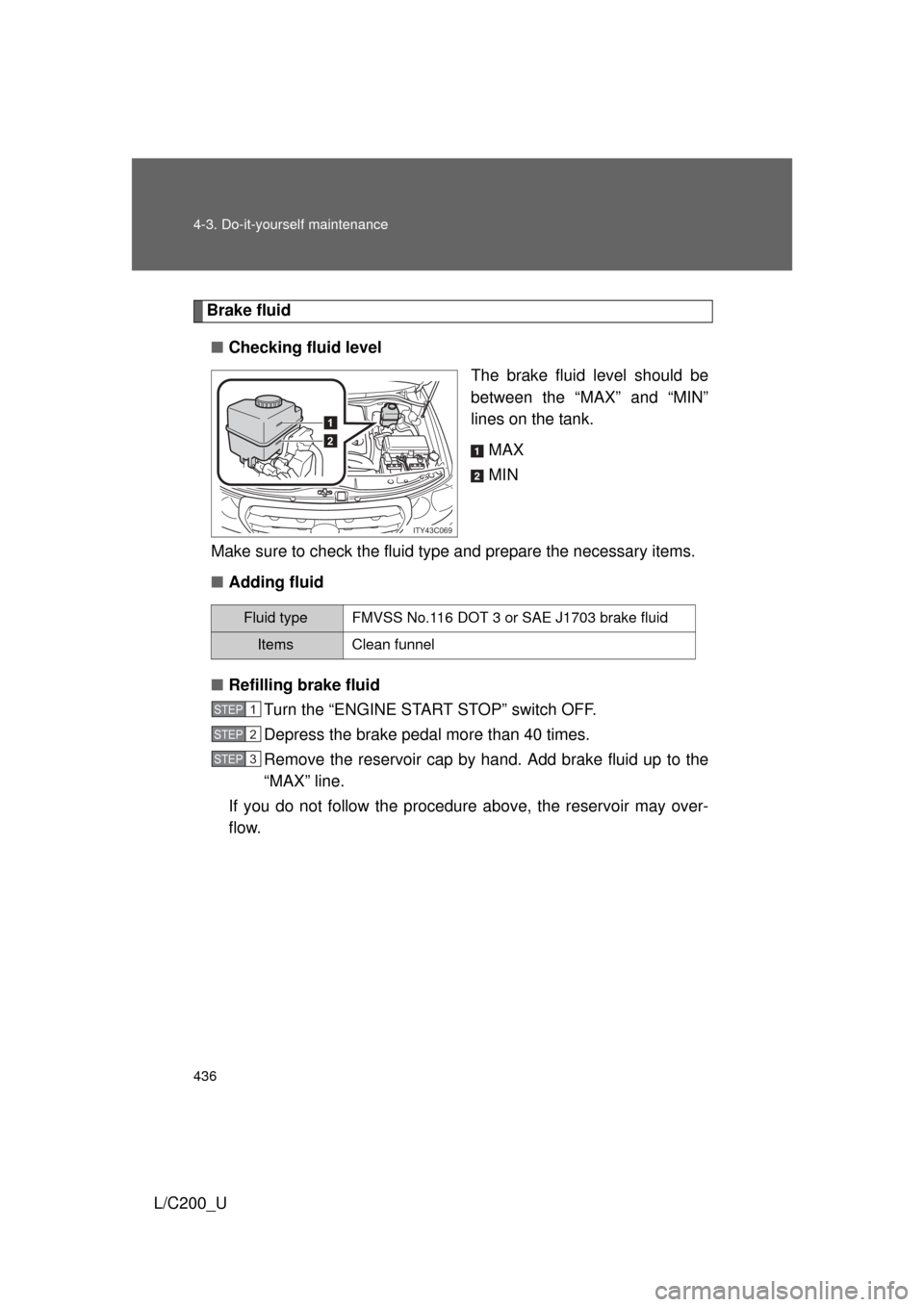
Brake fluid■ Checking fluid level
The brake fluid level should be
between the “MAX” and “MIN”
lines on the tank.
MAX
MIN
Make sure to check the fluid type and prepare the necessary items.
■ Adding fluid
■ Refilling brake fluid
Turn the “ENGINE START STOP” switch OFF.
Depress the brake pedal more than 40 times.
Remove the reservoir cap by ha nd. Add brake fluid up to the
“MAX” line.
If you do not follow the procedure above, the reservoir may over-
flow.
1
2
ITY43C069
Fluid typeFMVSS No.116 DOT 3 or SAE J1703 brake fluid
ItemsClean funnel
STEP1
STEP2
STEP3
Page 437 of 592
437
4-3. Do-it-yourself maintenance
4
Maintenance and care
L/C200_U
■
Brake fluid can absorb moisture from the air
Excess moisture in the fluid can cause a dangerous loss of braking effi-
ciency. Use only newly opened brake fluid.
CAUTION
■When filling the reservoir
Take care because brake fluid can harm your hands or eyes and damage
painted surfaces.
If fluid gets in your eyes, flush your eyes with clean water immediately.
If you still experience discomfort, see a doctor.
NOTICE
■If the fluid level is low or high
It is normal for the brake fluid level to go down slightly as the brake pads
wear or when the fluid level in the accumulator is high.
If the reservoir needs frequent refilling, it may indicate a serious pro\
blem.
Page 440 of 592
440 4-3. Do-it-yourself maintenance
L/C200_U■
Checking battery condition
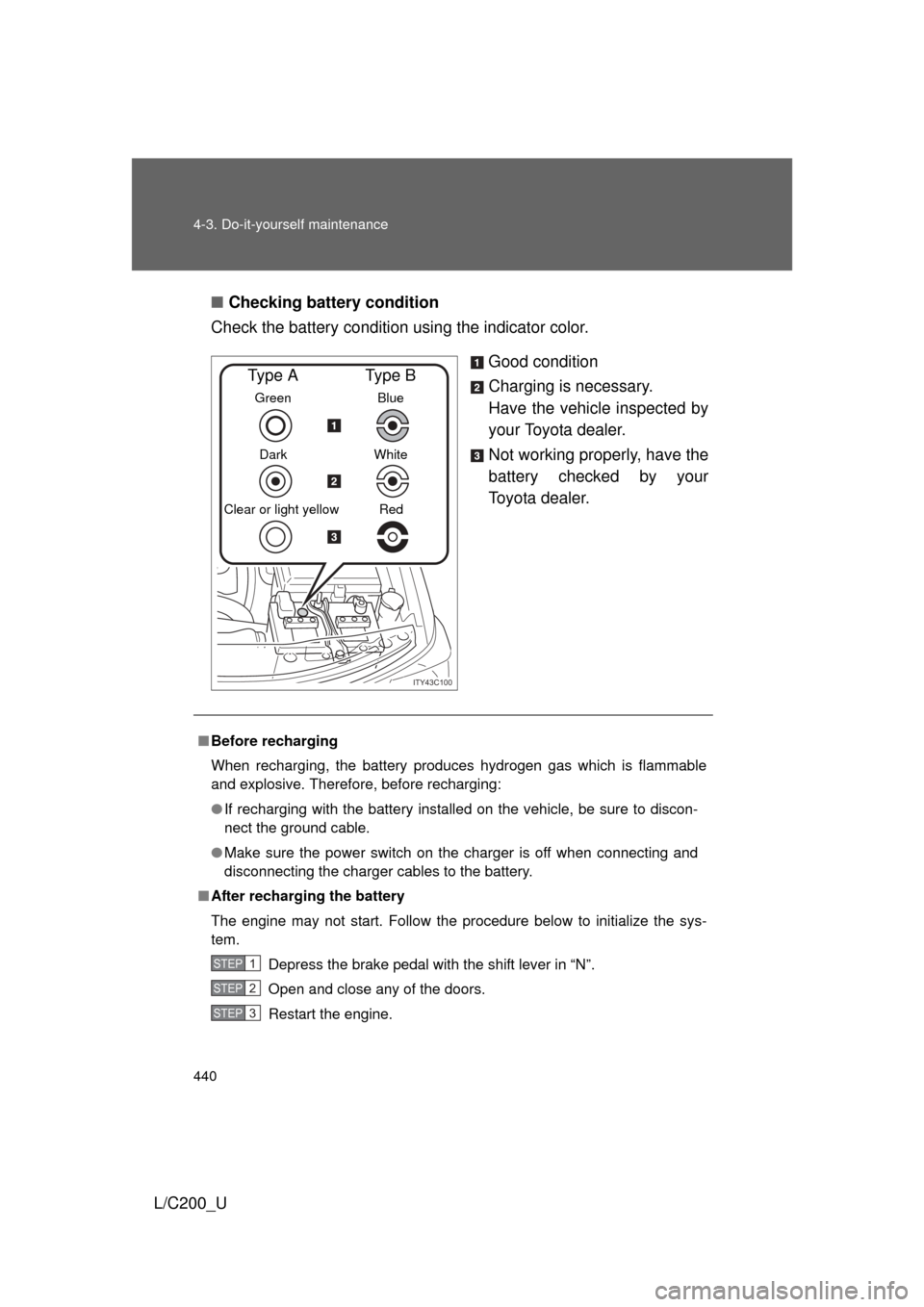
Check the battery condition using the indicator color.
Good condition
Charging is necessary.
Have the vehicle inspected by
your Toyota dealer.
Not working properly, have the
battery checked by your
Toyota dealer.
ITY43C100
Green
Dark
Clear or light yellow
Type A
Blue
White Red
Type B
■ Before recharging
When recharging, the battery produces hydrogen gas which is flammable
and explosive. Therefore, before recharging:
● If recharging with the battery installed on the vehicle, be sure to discon-
nect the ground cable.
● Make sure the power switch on the charger is off when connecting and
disconnecting the charger cables to the battery.
■ After recharging the battery
The engine may not start. Follow the procedure below to initialize the sys-
tem.
Depress the brake pedal with the shift lever in “N”.
Open and close any of the doors.
Restart the engine.
STEP1
STEP2
STEP3
Page 469 of 592
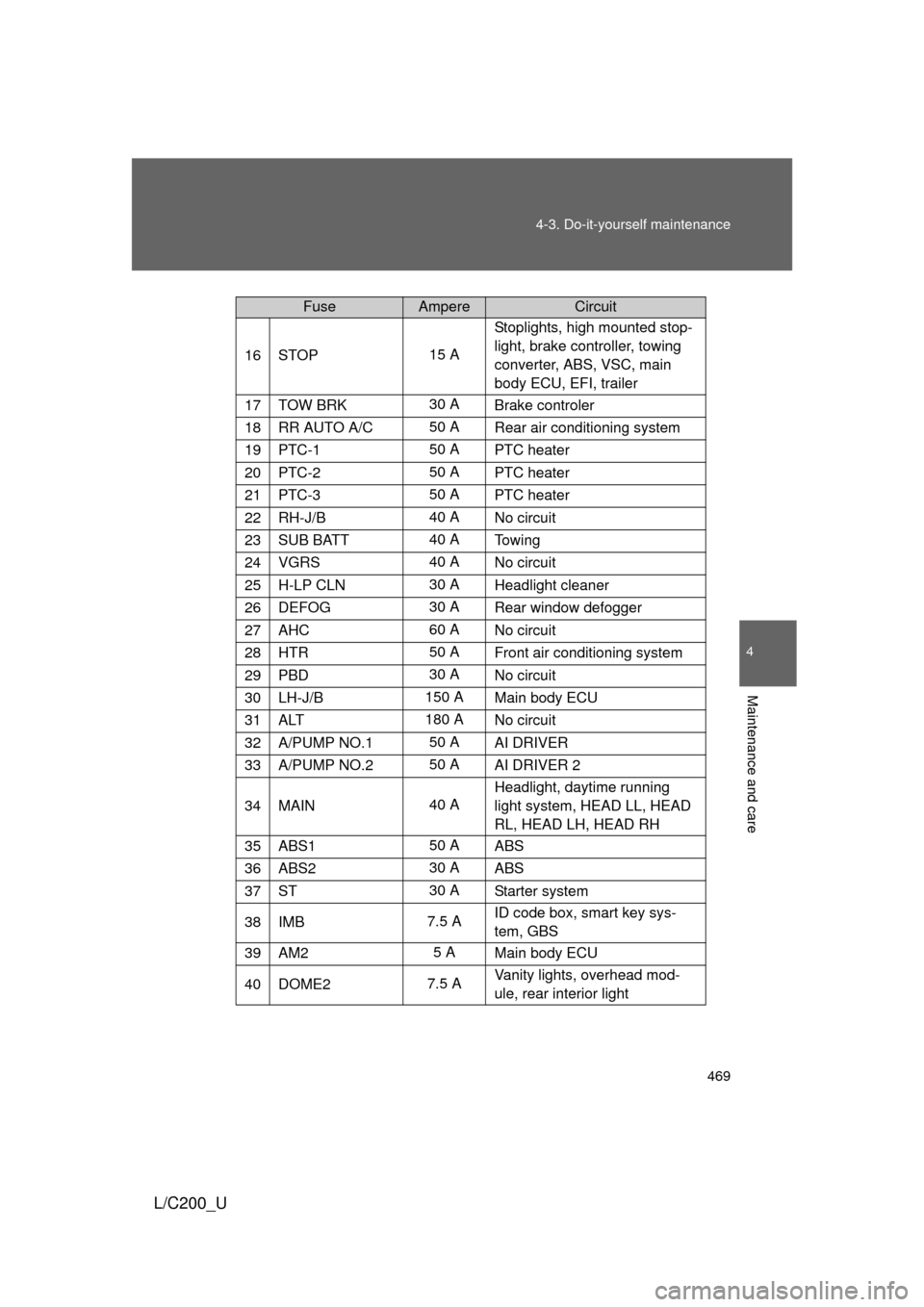
469
4-3. Do-it-yourself maintenance
4
Maintenance and care
L/C200_U
16STOP15 A
Stoplights, high mounted stop-
light, brake controller, towing
converter, ABS, VSC, main
body ECU, EFI, trailer
17TOW BRK30 A
Brake controler
18RR AUTO A/C50 ARear air conditioning system
19PTC-150 APTC heater
20PTC-250 A
PTC heater
21PTC-350 APTC heater
22RH-J/B40 ANo circuit
23SUB BATT40 A
To w i n g
24VGRS40 ANo circuit
25H-LP CLN30 AHeadlight cleaner
26DEFOG30 A
Rear window defogger
27AHC60 ANo circuit
28HTR50 AFront air conditioning system
29PBD30 A
No circuit
30LH-J/B150 A Main body ECU
31ALT180 ANo circuit
32A/PUMP NO.150 A
AI DRIVER
33A/PUMP NO.250 AAI DRIVER 2
34MAIN40 AHeadlight, daytime running
light system, HEAD LL, HEAD
RL, HEAD LH, HEAD RH
35ABS150 A
ABS
36ABS230 A
ABS
37ST30 AStarter system
38IMB7.5 A ID code box, smart key sys-
tem, GBS
39AM25 A
Main body ECU
40DOME27.5 A Vanity lights, overhead mod-
ule, rear interior light
FuseAmpereCircuit
Page 472 of 592
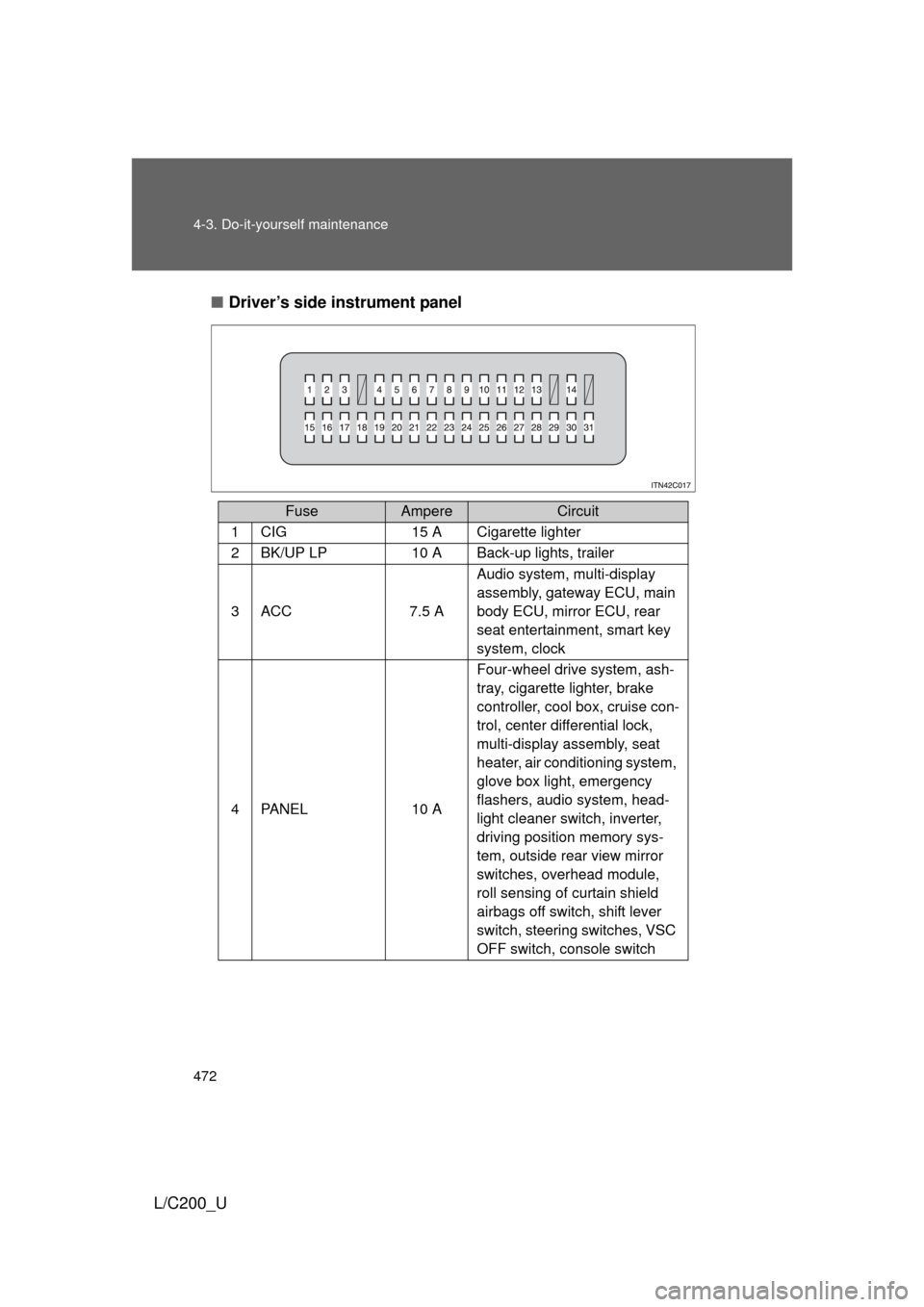
472 4-3. Do-it-yourself maintenance
L/C200_U■
Driver’s side instrument panel
FuseAmpereCircuit
1CIG15 A Cigarette lighter
2BK/UP LP10 A Back-up lights, trailer
3ACC7.5 A Audio system, multi-display
assembly, gateway ECU, main
body ECU, mirror ECU, rear
seat entertainment, smart key
system, clock
4PA N E L10 AFour-wheel drive system, ash-
tray, cigarette lighter, brake
controller, cool box, cruise con-
trol, center differential lock,
multi-display assembly, seat
heater, air conditioning system,
glove box light, emergency
flashers, audio system, head-
light cleaner switch, inverter,
driving position memory sys-
tem, outside rear view mirror
switches, overhead module,
roll sensing of curtain shield
airbags off switch, shift lever
switch, steering switches, VSC
OFF switch, console switch
Page 491 of 592

5
When trouble arises
491
5-1. Essential information
L/C200_U
If your vehicle needs to be towed
Before towingThe following may indicate a problem with your transmission. Contact
your Toyota dealer before towing.
● The engine is running, but the vehicle will not move.
● The vehicle makes an abnormal sound.
Emergency towing
If a tow truck is not available in an emergency, your vehicle may be
temporarily towed using a cable or chain secured to the following
part. This should only be attempt ed on hard, surfaced roads for short
distances at low speeds.
A driver must be in the vehicle to steer and operate the brakes. The
vehicle’s wheels, drive train, axles, steering and brakes must be in
good condition.
Towing hook
If towing is necessary, we recommend having your vehicle towed by
your Toyota dealer or a commerci al towing service, using a lift-type
truck or a flat bed truck.
Use a safety chain system for all to wing, and abide by all state/pro-
vincial and local laws.
Use a towing dolly or flat bed truck.
Page 492 of 592
492 5-1. Essential information
L/C200_U
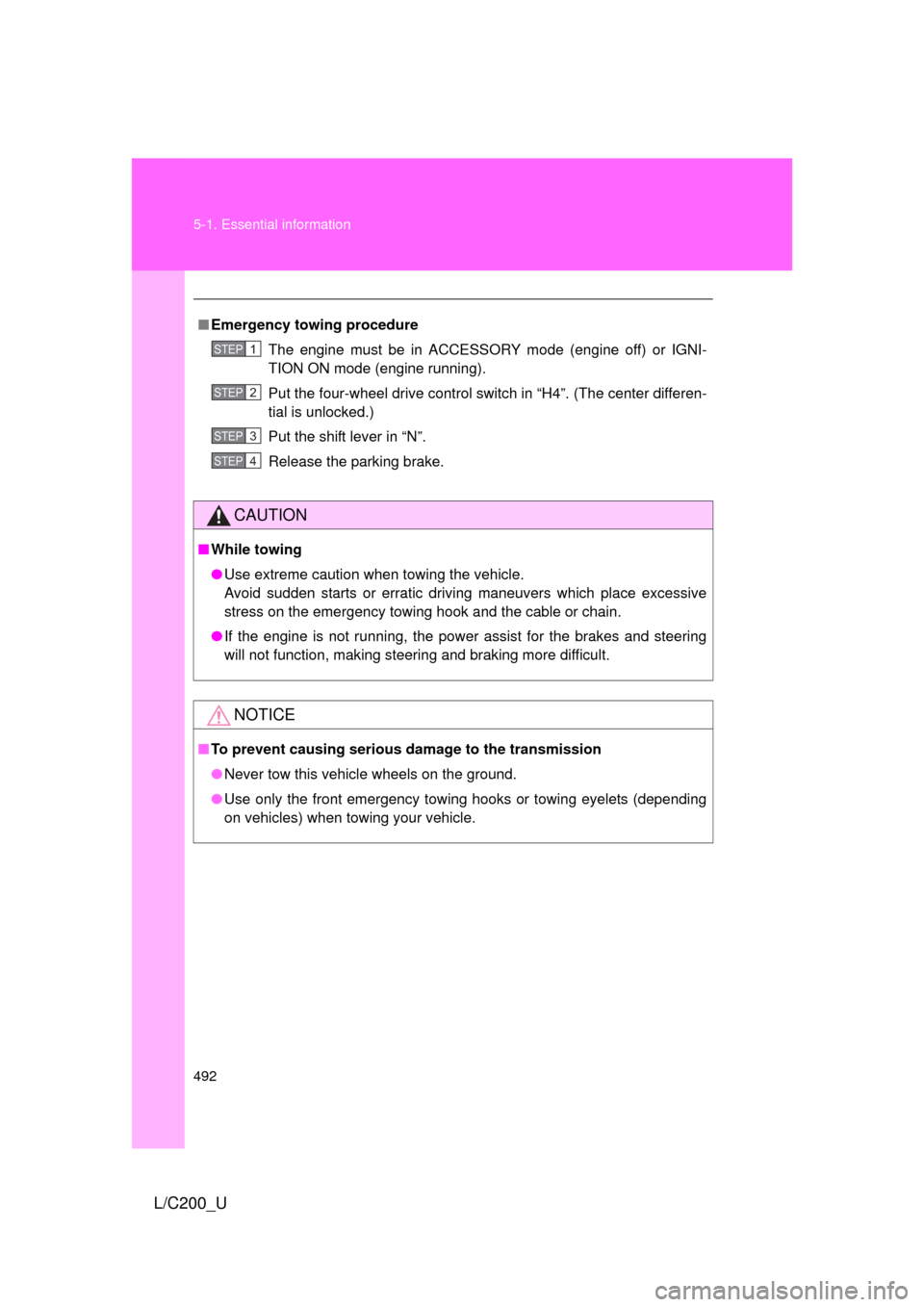
■Emergency towing procedure
The engine must be in ACCESSORY mode (engine off) or IGNI-
TION ON mode (engine running).
Put the four-wheel drive control swit ch in “H4”. (The center differen-
tial is unlocked.)
Put the shift lever in “N”.
Release the parking brake.
CAUTION
■ While towing
● Use extreme caution when towing the vehicle.
Avoid sudden starts or erratic driving maneuvers which place excessive
stress on the emergency towing hook and the cable or chain.
● If the engine is not running, the power assist for the brakes and steering
will not function, making steering and braking more difficult.
NOTICE
■To prevent causing serious dama ge to the transmission
● Never tow this vehicle wheels on the ground.
● Use only the front emergency towing hooks or towing eyelets (depending
on vehicles) when towing your vehicle.
STEP1
STEP2
STEP3
STEP4
Page 496 of 592

496
5-1. Essential information
L/C200_U
If you think something is wrong
If you notice any of the following symptoms, your vehicle probably
needs adjustment or repair. Contact your Toyota dealer as soon as
possible.
■ Visible symptoms
●Fluid leaks under the vehicle
(Water dripping from the air cond itioning after use is normal.)
● Flat-looking tires or uneven tire wear
● Engine coolant temperature g auge needle continually points
higher than normal
● Engine oil pressure gauge continually points lower than nor-
mal
● Voltmeter continually points higher or lower than normal
■ Audible symptoms
●Changes in exhaust sound
● Excessive tire squeal when cornering
● Strange noises related to the suspension system
● Pinging or other noises related to the engine
■ Operational symptoms
●Engine missing, stumbling or running rough
● Appreciable loss of power
● Vehicle pulls heavily to one side when braking
● Vehicle pulls heavily to one side when driving on a level road
● Loss of brake effectiveness, s pongy feeling, pedal almost
touches the floor
Page 498 of 592

498
5-1. Essential information
L/C200_U
Event data recorder
In a crash or a near car crash eventThe SRS airbag sensor assembly contains the EDR. In a crash or a
near car crash event, this device may record some or all of the follow-
ing information:
● Engine speed
● Whether the brake pedal was applied or not
● Vehicle speed
● To what extent the accelerator pedal was depressed
● Position of the transmission shift lever
● Whether the driver and front passenger wore seat belts or not
● Driver’s seat position
● Front passenger’s occupant classification
● SRS airbag deployment data
● SRS airbag system diagnostic data
The information above is intended to be used for the purpose of
improving vehicle safety performan ce. Unlike general data recorders,
the EDR does not record sound data such as conversation between
passengers.
Your vehicle has computers that monitor and control certain aspects
of your vehicle. These computers assi st in driving and maintaining
optimal vehicle performance.
Besides storing data useful for tr oubleshooting, there is a system to
record data in a crash or a near car crash event. This is called an
Event Data Recorder (EDR).