trailer TOYOTA LAND CRUISER 2010 J200 Owners Manual
[x] Cancel search | Manufacturer: TOYOTA, Model Year: 2010, Model line: LAND CRUISER, Model: TOYOTA LAND CRUISER 2010 J200Pages: 592, PDF Size: 7.98 MB
Page 3 of 592

1
2
3
4
5
6
7
3
L/C200_U
Windshield wipers and washer .............................. 177
Rear window wiper and washer .............................. 182
Headlight cleaner switch ..... 183
2-4. Using other driving systems Cruise control ...................... 184
Intuitive parking assist......... 188
Four-wheel drive system ..... 197
Crawl Control ...................... 202
Driving assist systems ........ 206
Pre-Collision System........... 212
2-5. Driving information Off-road precautions ........... 213
Cargo and luggage ............. 218
Vehicle load limits ............... 225
Winter driving tips ............... 226
Trailer towing ...................... 231
Dinghy towing ..................... 243
3-1. Using the air conditioning system and defogger
Front air conditioning system .............................. 246
Rear air conditioning system .............................. 256
Rear window and outside rear view mirror
defoggers .......................... 260
Windshield wiper de-icer ..... 261 3-2. Using the audio system
Audio system type .............. 262
Using the radio ................... 265
Using the CD player ........... 274
Playing back MP3 and WMA discs ....................... 282
Operating an iPod
®............ 289
Operating a USB memory ............................ 296
Optimal use of the audio system .............................. 304
Using the AUX adapter....... 306
Using the steering switches ........................... 307
3-3. Using the Bluetooth
® audio
system
Bluetooth
® audio system .... 311
Using the Bluetooth
® audio
system .............................. 314
Operating a Bluetooth
®
enabled portable player.... 320
Setting up a Bluetooth
®
enabled portable player.... 323
Bluetooth
® audio system
setup ................................ 330
3-4. Using the hands-free system (for cellular phone)
Hands-free system (for cellular phone) ........... 331
Using the hands-free system .............................. 335
Making a phone call ........... 343
Setting a cellular phone ...... 348
Security and system setup ................................ 354
Using the phone book ........ 3603Interior features
Page 141 of 592
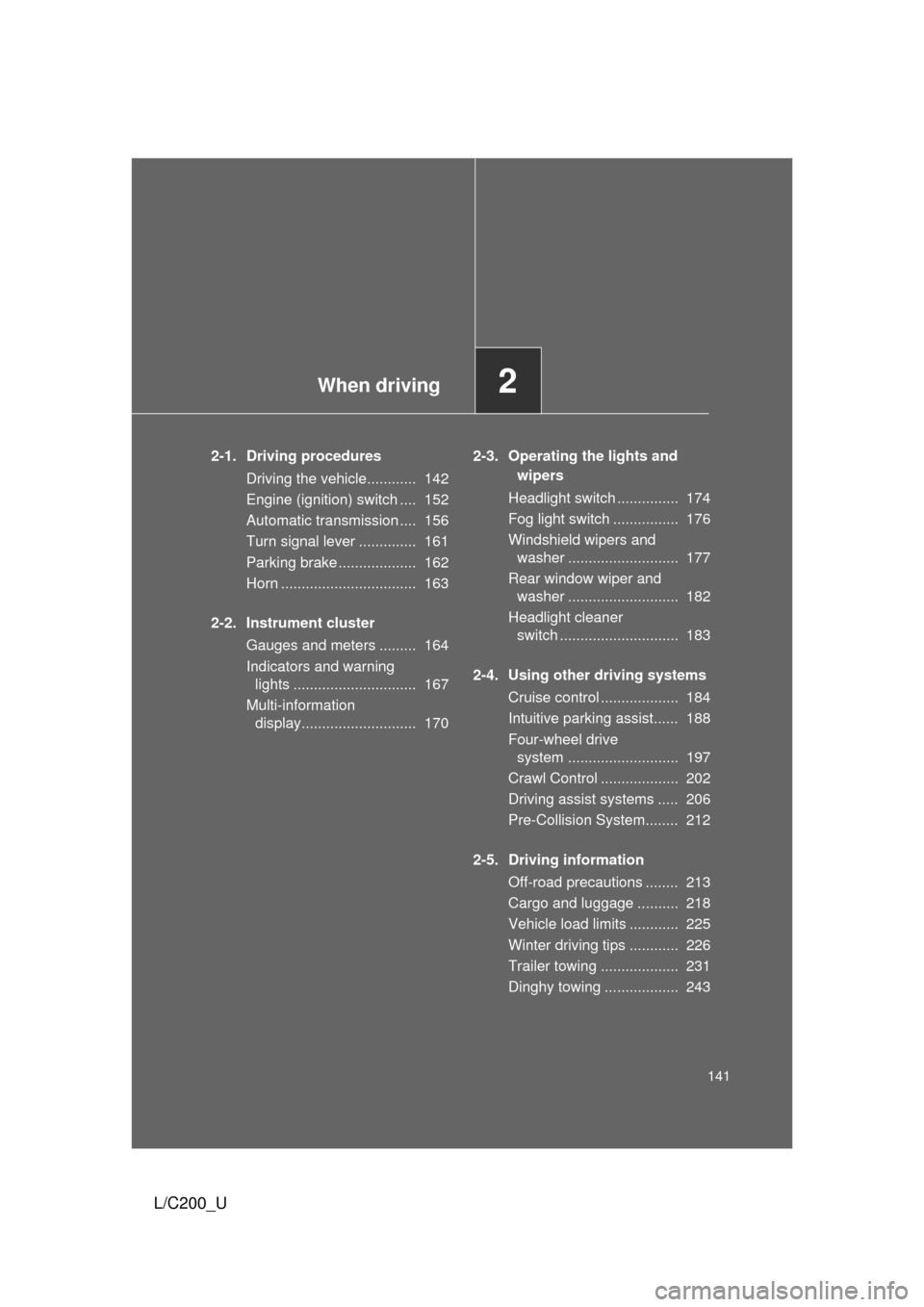
When driving2
141
L/C200_U
2-1. Driving proceduresDriving the vehicle............ 142
Engine (ignition) switch .... 152
Automatic transmission .... 156
Turn signal lever .............. 161
Parking brake ................... 162
Horn ................................. 163
2-2. Instrument cluster Gauges and meters ......... 164
Indicators and warning lights .............................. 167
Multi-information display............................ 170 2-3. Operating the lights and
wipers
Headlight switch ............... 174
Fog light switch ................ 176
Windshield wipers and washer ........................... 177
Rear window wiper and washer ........................... 182
Headlight cleaner switch ............................. 183
2-4. Using other driving systems Cruise control ................... 184
Intuitive parking assist...... 188
Four-wheel drive system ........................... 197
Crawl Control ................... 202
Driving assist systems ..... 206
Pre-Collision System........ 212
2-5. Driving information Off-road precautions ........ 213
Cargo and luggage .......... 218
Vehicle load limits ............ 225
Winter driving tips ............ 226
Trailer towing ................... 231
Dinghy towing .................. 243
Page 143 of 592
143
2-1. Driving procedures
2
When driving
L/C200_U
■
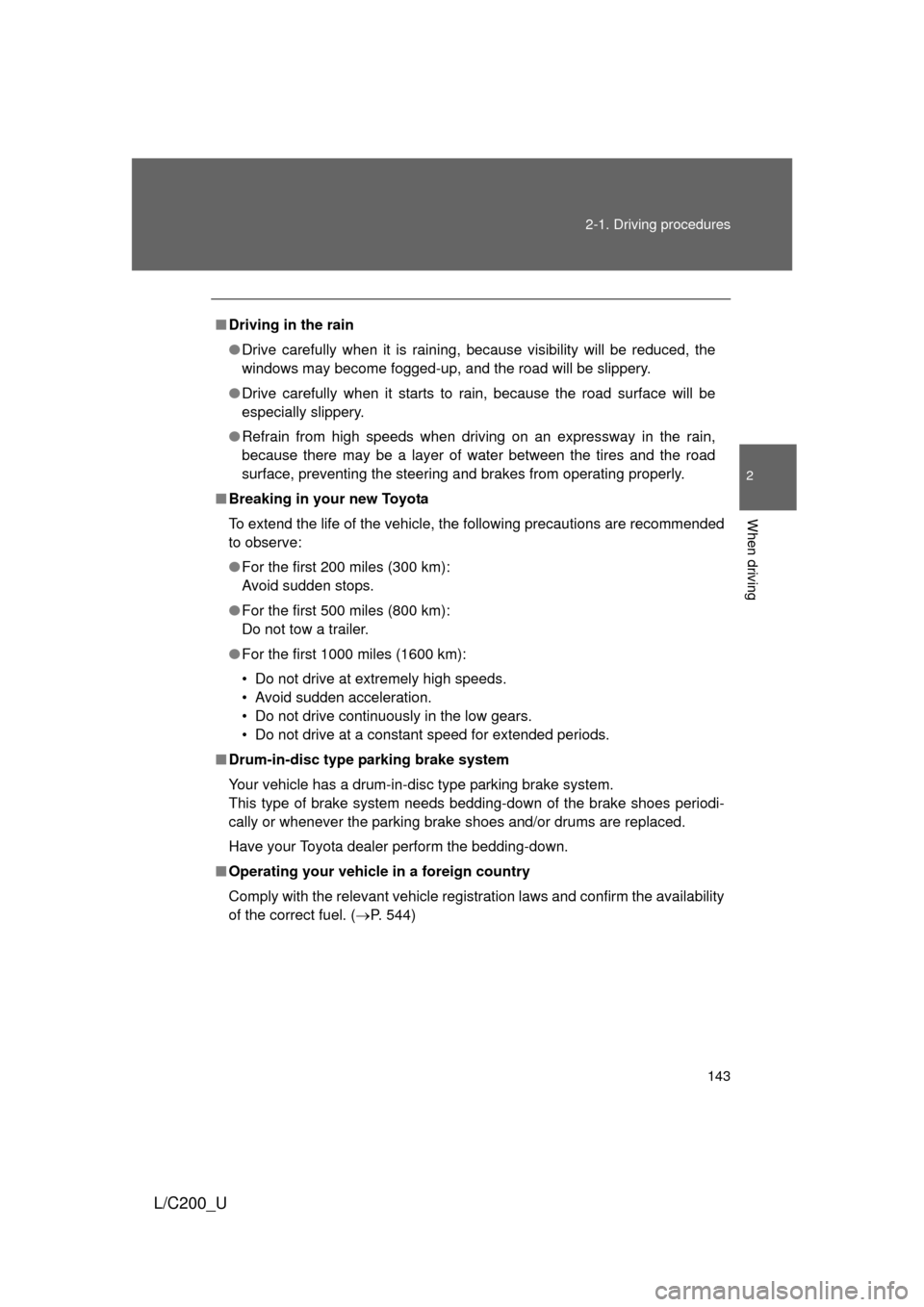
Driving in the rain
● Drive carefully when it is raining, because visibility will be reduced, the
windows may become fogged-up, and the road will be slippery.
● Drive carefully when it starts to rain, because the road surface will be
especially slippery.
● Refrain from high speeds when driving on an expressway in the rain,
because there may be a layer of water between the tires and the road
surface, preventing the steering and brakes from operating properly.
■ Breaking in your new Toyota
To extend the life of the vehicle, the following precautions are recommended
to observe:
● For the first 200 miles (300 km):
Avoid sudden stops.
● For the first 500 miles (800 km):
Do not tow a trailer.
● For the first 1000 miles (1600 km):
• Do not drive at extremely high speeds.
• Avoid sudden acceleration.
• Do not drive continuously in the low gears.
• Do not drive at a constant speed for extended periods.
■ Drum-in-disc type parking brake system
Your vehicle has a drum-in-disc type parking brake system.
This type of brake system needs bedding-down of the brake shoes periodi-
cally or whenever the parking brake shoes and/or drums are replaced.
Have your Toyota dealer perform the bedding-down.
■ Operating your vehicle in a foreign country
Comply with the relevant vehicle registration laws and confirm the availability
of the correct fuel. ( P. 544)
Page 187 of 592
187
2-4. Using other
driving systems
2
When driving
L/C200_U
CAUTION
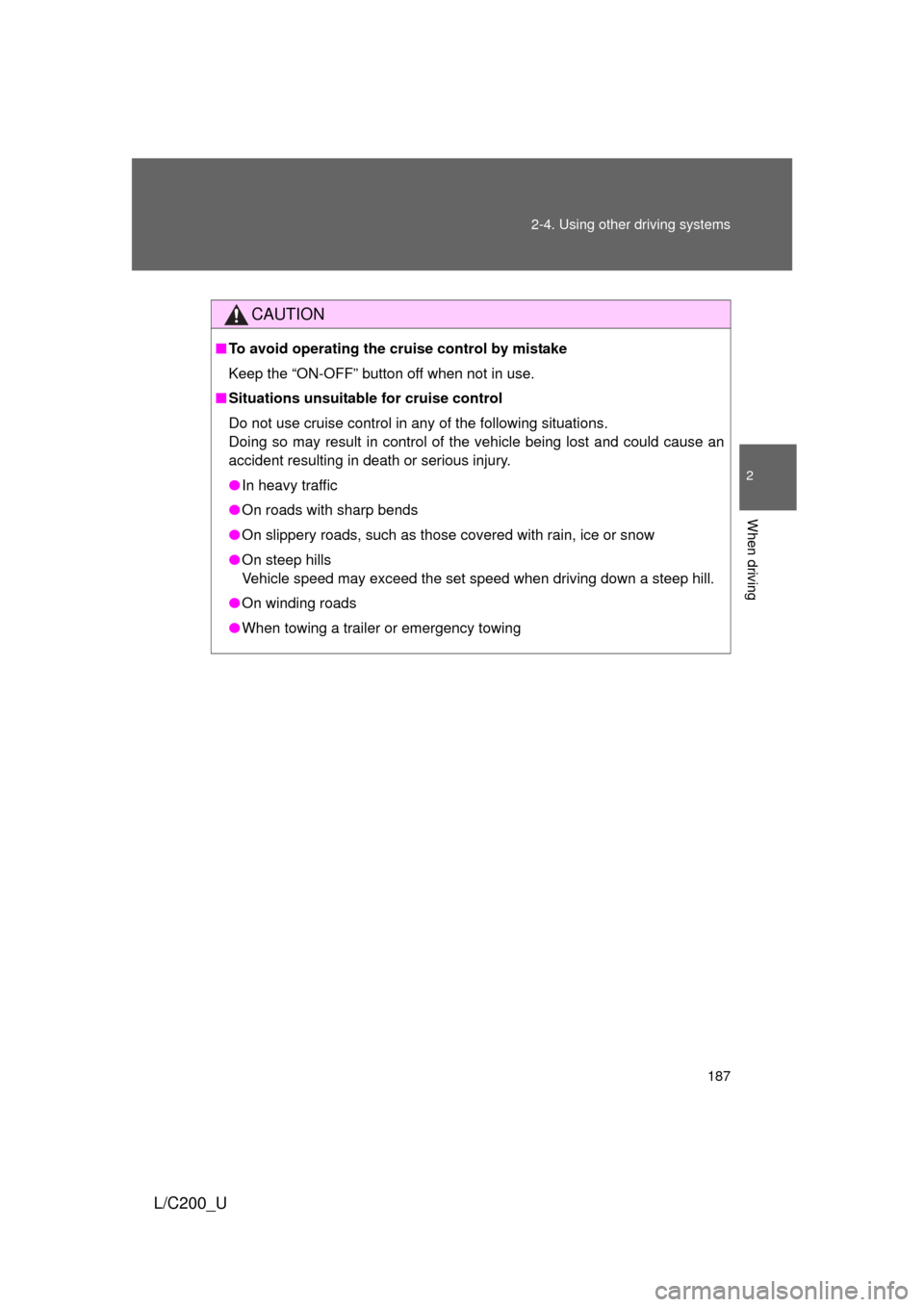
■To avoid operating the cruise control by mistake
Keep the “ON-OFF” button off when not in use.
■ Situations unsuitable for cruise control
Do not use cruise control in any of the following situations.
Doing so may result in control of the vehicle being lost and could cause an
accident resulting in death or serious injury.
● In heavy traffic
● On roads with sharp bends
● On slippery roads, such as those covered with rain, ice or snow
● On steep hills
Vehicle speed may exceed the set speed when driving down a steep hill.
● On winding roads
● When towing a trailer or emergency towing
Page 220 of 592

220 2-5. Driving information
L/C200_U
Capacity and distributionCargo capacity depends on the total weight of the occupants.
(Cargo capacity) = (Total load capa city) — (Total weight of occupants)
Steps for Determining Correct Load Limit—
(1) Locate the statement “The co mbined weight of occupants and
cargo should never exceed XXX kg or XXX lbs.” on your vehi-
cle’s placard.
(2) Determine the combined weight of the driver and passengers that will be riding in your vehicle.
(3) Subtract the combined weight of the driver and passengers from
XXX kg or XXX lbs.
(4) The resulting figure equals the available amount of cargo and luggage load capacity.
For example, if the “XXX” amount equals 1400 lbs. and there will
be five 150 lb passengers in your vehicle, the amount of avail-
able cargo and luggage load capacity is 650 lbs. (1400 - 750 (5
150) = 650 lbs.)
(5) Determine the combined weight of luggage and cargo being loaded on the vehicle.
That weight may not safely ex ceed the available cargo and lug-
gage load capacity calculated in Step 4.
(6) If your vehicle will be towing a trailer, load from your trailer will be transferred to your vehicle. Consult this manual to determine
how this reduces the available cargo and luggage load capacity
of your vehicle. ( P. 225)
Page 225 of 592
225
2-5. Driving information
2
When driving
L/C200_U
Vehicle load limits
■Total load capacity and seating capacity
These details are also described on the tire and loading information
label. (P. 452)
CAUTION
■Overloading the vehicle
Do not overload the vehicle.
It may not only cause damage to the ti res, but also degrade steering and
braking ability, resulting in an accident.
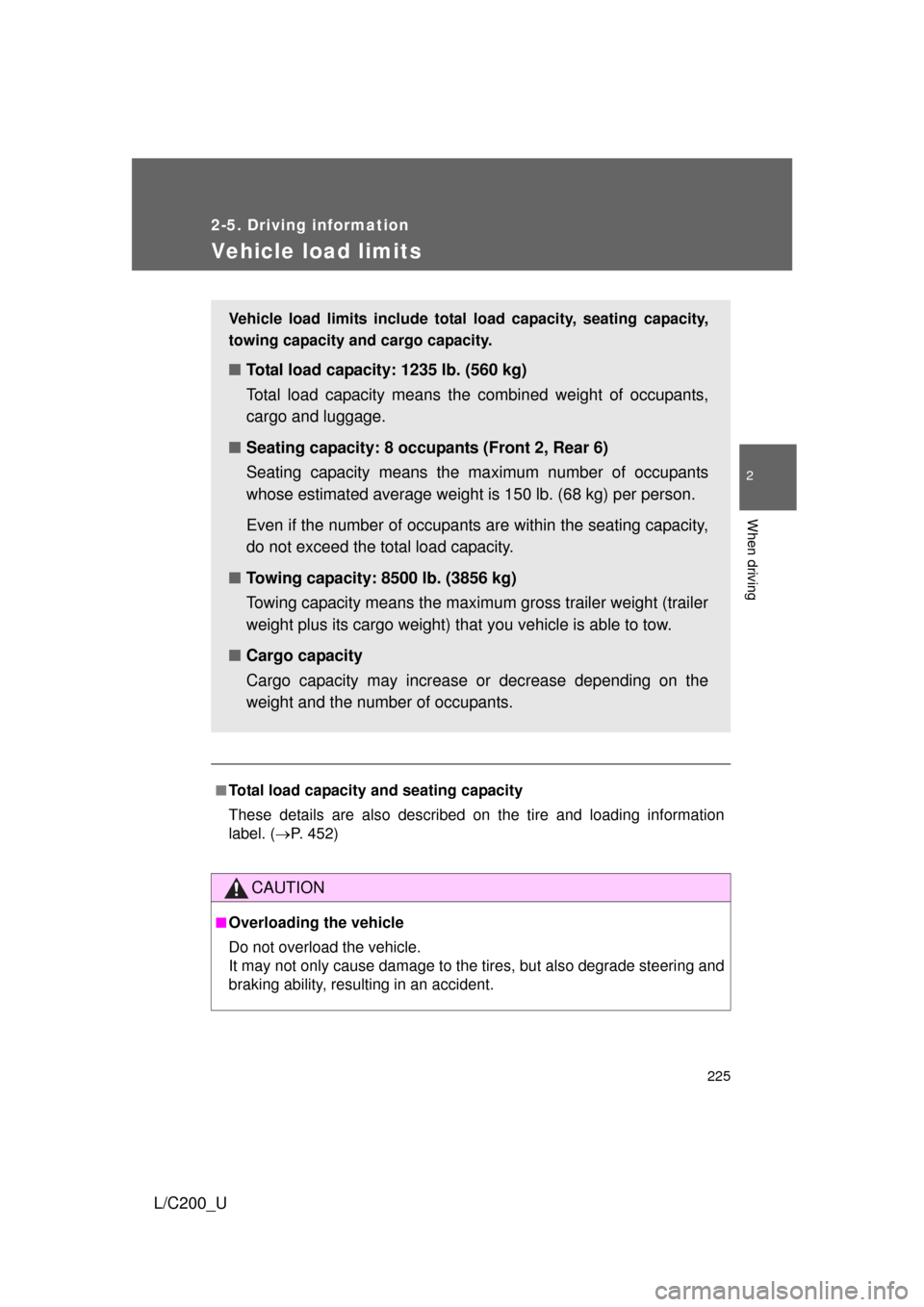
Vehicle load limits include total load capacity, seating capacity,
towing capacity and cargo capacity.
■ Total load capacity: 1235 lb. (560 kg)
Total load capacity means the combined weight of occupants,
cargo and luggage.
■ Seating capacity: 8 occupants (Front 2, Rear 6)
Seating capacity means the ma ximum number of occupants
whose estimated average weight is 150 lb. (68 kg) per person.
Even if the number of occupants are within the seating capacity,
do not exceed the total load capacity.
■ Towing capacity: 8500 lb. (3856 kg)
Towing capacity means the maximum gross trailer weight (trailer
weight plus its cargo weight) that you vehicle is able to tow.
■ Cargo capacity
Cargo capacity may increase or decrease depending on the
weight and the number of occupants.
Page 231 of 592
231
2-5. Driving information
2
When driving
L/C200_U
Trailer towing
Your vehicle is designed primarily as a passenger-and-load car-
rying vehicle. Towing a trailer will have an adverse effect on han-
dling, performance, braking, durability, and fuel consumption.
For your safety and the safety of others, do not overload the vehi-
cle or trailer.
To tow a trailer safely, use extreme care and drive the vehicle in
accordance with the trailer’s characteristics and operating condi-
tions.
The vehicle stability and braking performance are affected by
trailer stability, brake setting and performance, and the hitch.
Toyota warranties do not apply to damage or malfunction caused
by towing a trailer for commercial purposes.
Contact your Toyota dealer for further information about additional
requirements such as a towing kits, etc.
Page 232 of 592
232 2-5. Driving information
L/C200_U
Weight limitsConfirm that the gross trailer weight, gross combined weight, gross
vehicle weight, gross axle weight and trailer tongue load are all within
the limits.
● The gross trailer weight must never exceed 8500 lb. (3856 kg).
● The gross combined weight must never exceed 14550 lb. (6600
kg).
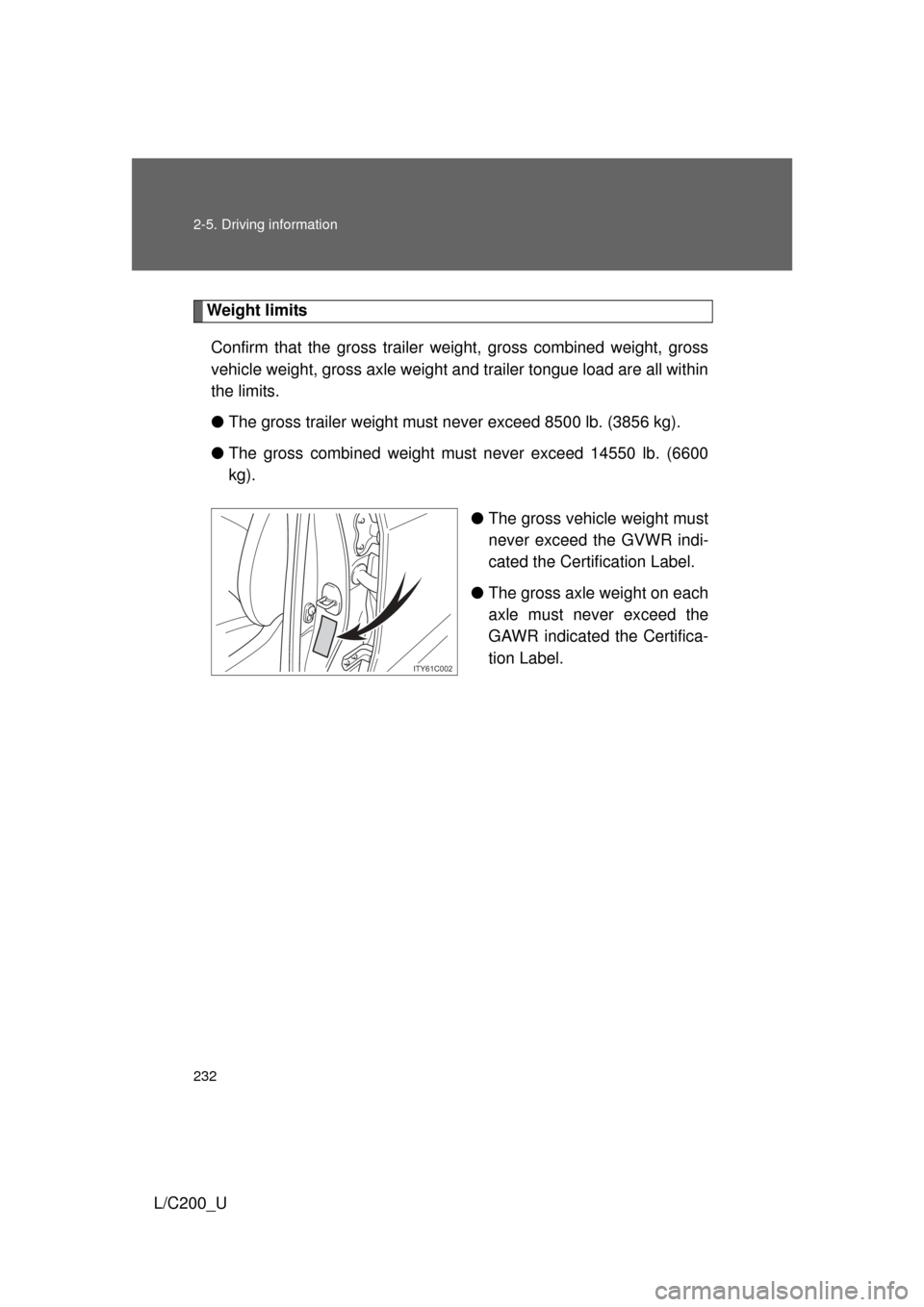
●The gross vehicle weight must
never exceed the GVWR indi-
cated the Certification Label.
● The gross axle weight on each
axle must never exceed the
GAWR indicated the Certifica-
tion Label.
ITY61C002
Page 233 of 592

233
2-5. Driving information
2
When driving
L/C200_U
Towing related term
Towing related termMeaning
GVWR (Gross Vehicle Weight
Rating) The maximum allowable gross vehicle
weight. The gross vehicle weight is the
total weight of the vehicle. When towing
a trailer, it is the sum of the vehicle
weight (including the occupants, cargo
and any optional equipment installed on
the vehicle) and the tongue load.
GAWR (Gross Axle Weight
Rating) The maximum allowable gross axle
weight.
The gross axle weight is the load placed
on each axle (front and rear).
GCWR (Gross Combination
Weight Rating) The maximum allowable gross combi-
nation weight. The gross combination
weight is the sum of the total vehicle
weight (including the occupants, cargo
and any optional equipment installed on
the vehicle) and the weight of the trailer
being towed (including the cargo in the
trailer).
Gross trailer weight The sum of the trailer weight and the
weight of the cargo in the trailer.
Towing capacity The maximum allowable gross trailer
weight. Towing capacity is calculated
considering base vehicle with neces-
sary vehicle equipment and occupants.
Additional optional equipment, passen-
gers and cargo in the vehicle will reduce
the towing capacity, gross trailer weight
includes the trailer, cargo and neces-
sary equipment for towing.
Tongue load The load placed on the trailer hitch ball.
Page 234 of 592
234 2-5. Driving information
L/C200_U
Trailer tongue load● A recommended tongue load varies in accordance with the types
of trailers or towing as described below.
● In order to ensure the recommended values shown below, the
trailer must be loaded by referring to the following instructions.
The trailer cargo load should be distributed so that the tongue load
is 9 to 11 %.
(Tongue load / Gross trailer weight 100 = 9 to 11 %)
If the gross trailer weight is over 2000 lbs. (900 kg), it is necessary
to use a sway control device with sufficient capacity.
If the gross trailer weight is over 5000 lbs. (2268 kg), it is neces-
sary to use a weight distributing hitch with sufficient capacity.
If using a weight distributing hitc h when towing, keep your vehicle
level with the ground.
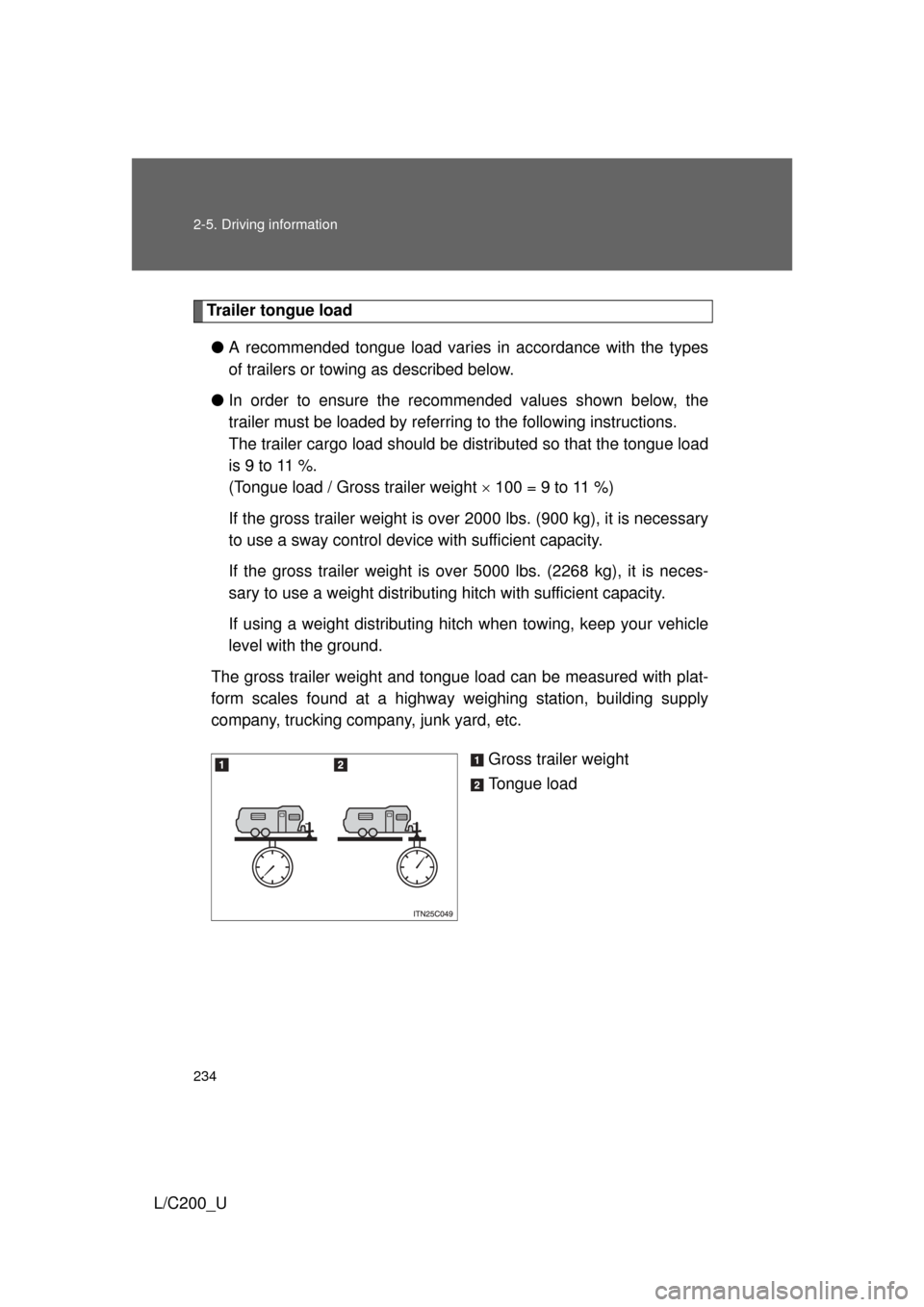
The gross trailer weight and tongue l oad can be measured with plat-
form scales found at a highway we ighing station, building supply
company, trucking company, junk yard, etc.
Gross trailer weight
Tongue load