air condition TOYOTA LAND CRUISER 2013 J200 User Guide
[x] Cancel search | Manufacturer: TOYOTA, Model Year: 2013, Model line: LAND CRUISER, Model: TOYOTA LAND CRUISER 2013 J200Pages: 720, PDF Size: 21.46 MB
Page 128 of 720
128 1-7. Safety information
LC200_OM_OM60F57U_(U)
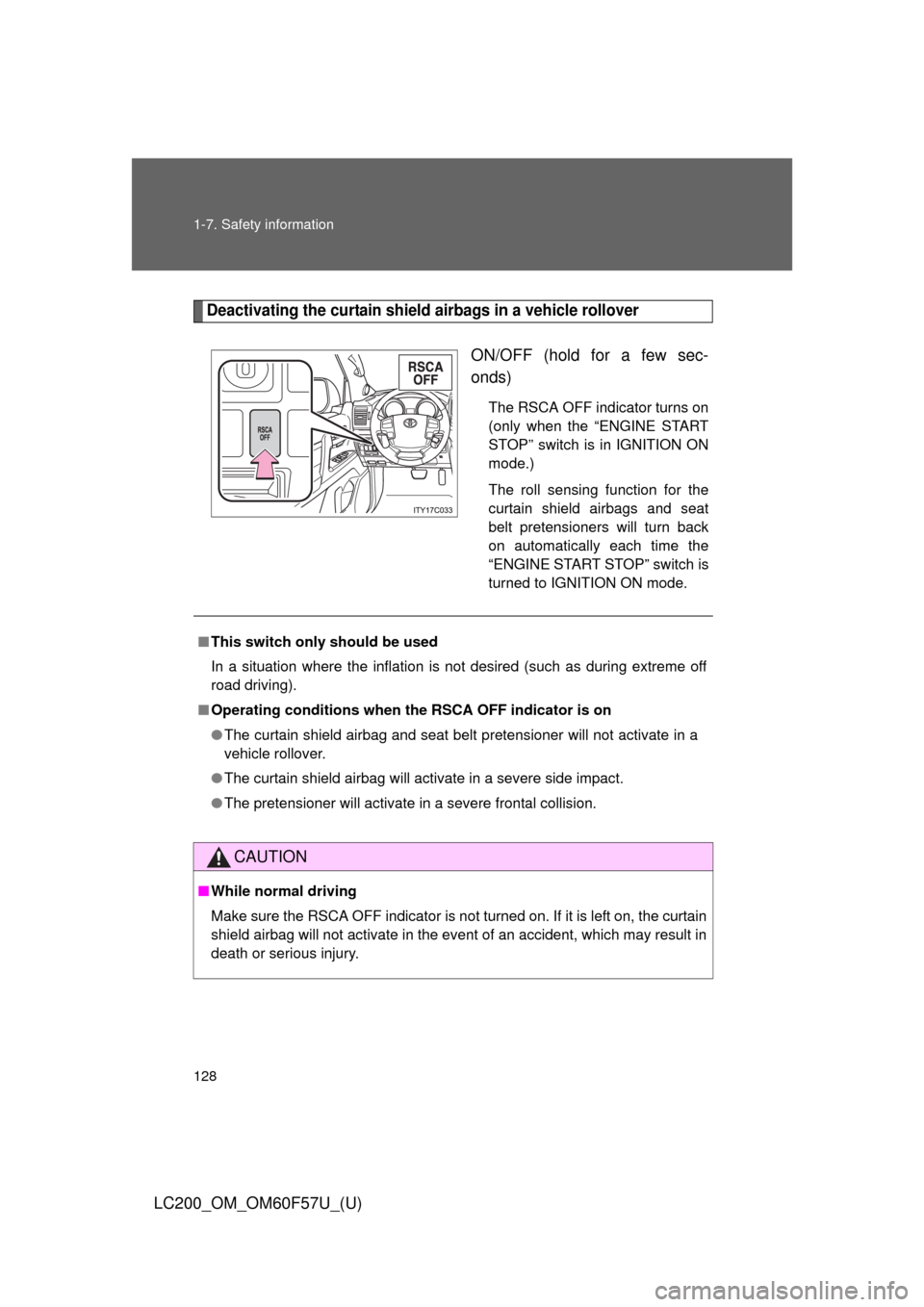
Deactivating the curtain shield airbags in a vehicle rollover
ON/OFF (hold for a few sec-
onds)
The RSCA OFF indicator turns on
(only when the “ENGINE START
STOP” switch is in IGNITION ON
mode.)
The roll sensing function for the
curtain shield airbags and seat
belt pretensioners will turn back
on automatically each time the
“ENGINE START STOP” switch is
turned to IGNITION ON mode.
■This switch only should be used
In a situation where the inflation is not desired (such as during extreme off
road driving).
■Operating conditions when the RSCA OFF indicator is on
●The curtain shield airbag and seat belt pretensioner will not activate in a
vehicle rollover.
●The curtain shield airbag will activate in a severe side impact.
●The pretensioner will activate in a severe frontal collision.
CAUTION
■While normal driving
Make sure the RSCA OFF indicator is not turned on. If it is left on, the curtain
shield airbag will not activate in the event of an accident, which may result in
death or serious injury.
Page 129 of 720
129
1
1-7. Safety information
Before driving
LC200_OM_OM60F57U_(U)
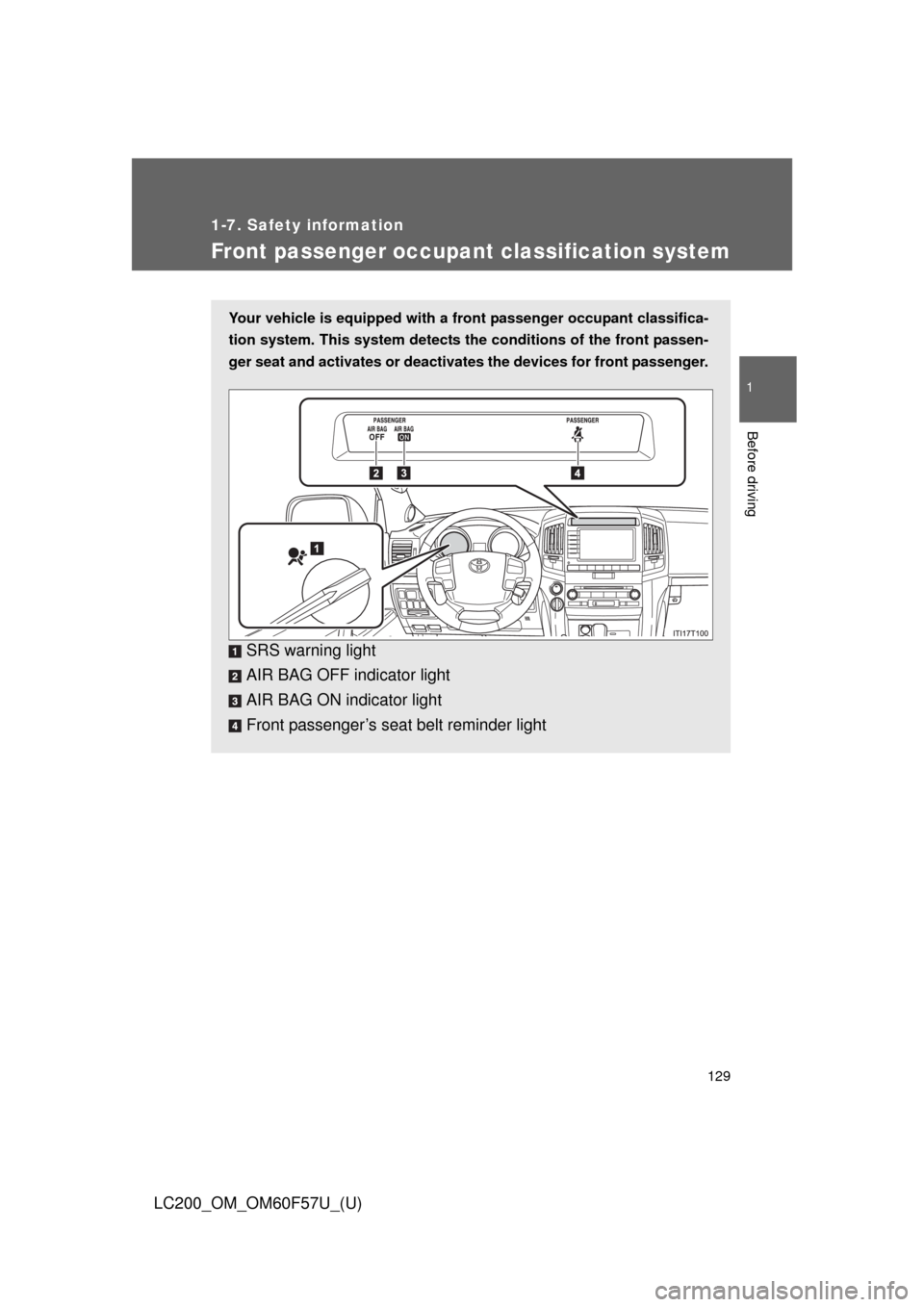
Front passenger occupant classification system
Your vehicle is equipped with a front passenger occupant classifica-
tion system. This system detects the conditions of the front passen-
ger seat and activates or deactivates the devices for front passenger.
SRS warning light
AIR BAG OFF indicator light
AIR BAG ON indicator light
Front passenger’s seat belt reminder light
Page 130 of 720

130 1-7. Safety information
LC200_OM_OM60F57U_(U)
Condition and operation in the front passenger occupant classi-
fication system
■Adult
*1
■Child*3 or child restraint system*4
Indicator/
warning lightAIR BAG ON and AIR BAG OFF
indicator lights“AIR BAG
ON”
SRS warning light Off
Front passenger’s seat belt reminder light Flashing
*2
DevicesFront passenger airbag and knee airbag
Activated Side airbag in the front passenger seat
Curtain shield airbag
on the front passenger side
Front passenger’s seat belt pretensioner
Indicator/
warning lightAIR BAG ON and AIR BAG OFF
indicator lights“AIR BAG
OFF”*5
SRS warning light Off
Front passenger’s seat belt reminder light Flashing
*2
DevicesFront passenger airbag and knee airbag Deactivated
Side airbag in the front passenger seat
Activated Curtain shield airbag
on the front passenger side
Front passenger’s seat belt pretensioner
Page 237 of 720

237 2-4. Using other driving systems
2
When driving
LC200_OM_OM60F57U_(U)
■Sensor detection information
●The sensor’s detection areas are limited to the areas around the vehi-
cle’s front corner and rear bumpers.
●Certain vehicle conditions and the surrounding environment may affect
the ability of the sensor to correctly detect obstacles. Particular instances
where this may occur are listed below.
• There is dirt, snow or ice on the sensor. (Wiping the sensors will
resolve this problem.)
• The sensor is frozen. (Thawing the area will resolve this problem.)
In especially cold weather, if a sensor is frozen the screen may show
an abnormal display, or obstacles may not be detected.
• The sensor is covered in any way.
• The vehicle is leaning considerably to one side.
• On an extremely bumpy road, on an incline, on gravel, or on grass
• The vicinity of the vehicle is noisy due to vehicle horns, motorcycle
engines, air brakes of large vehicles, or other loud noises producing
ultrasonic waves.
• There is another vehicle equipped with parking assist sensors in the
vicinity.
• The sensor is coated with a sheet of spray or heavy rain.
• The vehicle is equipped with a fender pole or wireless antenna.
• Towing eyelets are installed.
• The bumper or sensor receives a strong impact.
• The vehicle is approaching a tall or curved curb.
• In harsh sunlight or intense cold weather
• The area directly under the bumpers is not detected.
• If obstacles draw too close to the sensor.
• A non-genuine Toyota suspension (lowered suspension etc.) is
installed.
• People may not be detected if they are wearing certain types of cloth-
ing.
In addition to the examples above, there are instances in which, because
of their shape, signs and other objects may be judged by the sensor to be
closer than they are.
Page 238 of 720

238 2-4. Using other driving systems
LC200_OM_OM60F57U_(U)
●The shape of the obstacle may prevent the sensor from detecting it. Pay
particular attention to the following obstacles:
• Wires, fences, ropes, etc.
• Cotton, snow and other materials that absorb sound waves
• Sharply-angled objects
• Low obstacles
• Tall obstacles with upper sections projecting outwards in the direction
of your vehicle
●The following situations may occur during use.
• Depending on the shape of the obstacle and other factors, the detec-
tion distance may shorten, or detection may be impossible.
• Obstacles may not be detected if they are too close to the sensor
• There will be a short delay between obstacle detection and display.
Even at slow speeds, there is a possibility that the obstacle will come
within the sensor’s detection areas before the display is shown and the
warning beep sounds.
• Thin posts or objects lower than the sensor may not be detected for
collision when approached, even if they have been detected once.
• It might be difficult to hear beeps due to the volume of audio system or
air flow noise of air conditioning system.
■If a message is displayed on the multi-information display
P. 617
Page 311 of 720
311 2-5. Driving information
2
When driving
LC200_OM_OM60F57U_(U)
■Before driving the vehicle
Perform the following according to the driving conditions.
●Do not try to forcibly open a window or move a wiper that is
frozen. Pour warm water over the frozen area to melt the ice.
Wipe away the water immediately to prevent it from freezing.
●To ensure proper operation of the climate control system fan,
remove any snow that has accumulated on the air inlet vents
in front of the windshield.
●Check for and remove any excess ice or snow that may have
accumulated on the exterior lights, vehicle’s roof, chassis,
around the tires or on the brakes.
●Remove any snow or mud from the bottom of your shoes
before getting in the vehicle.
■When driving the vehicle
Accelerate the vehicle slowly, keep a safe distance between you
and the vehicle ahead, and drive at a reduced speed suitable to
road conditions.
■When parking the vehicle
Park the vehicle and move the shift lever to “P” without setting
the parking brake. The parking brake may freeze up, preventing
it from being released. If necessary, block the wheels to prevent
inadvertent sliding or creeping.
Page 326 of 720

326 2-5. Driving information
LC200_OM_OM60F57U_(U)●Avoid jerky starts or sudden acceleration.
●Avoid jerky steering and sharp turns, and slow down before mak-
ing a turn.
●Note that when making a turn, the trailer wheels will be closer than
the vehicle wheels to the inside of the turn. Compensate by making
a wider than normal turning radius.
●Slow down before making a turn, in crosswinds, on wet or slippery
surfaces, etc.
Increasing vehicle speed can destabilize the trailer.
●Take care when passing other vehicles. Passing requires consider-
able distance. After passing a vehicle, do not forget the length of
your trailer, and be sure you have plenty of room before changing
lanes.
●To maintain engine braking efficiency and charging system perfor-
mance, when using engine braking, do not put the transmission in
“D”.
Transmission shift range position must be in “5” in the “S” mode.
●Instability happens more frequently when descending steep or long
downhill grades. Before descending, slow down and downshift. Do
not make sudden downshifts while descending steep or long down-
hill grades.
●Avoid holding the brake pedal down too long or applying the
brakes too frequently. This could cause the brakes to overheat and
result in reduced braking efficiency.
●Due to the added load of the trailer, your vehicle’s engine may
overheat on hot days (at temperatures over 85°F [30°C]) when
driving up a long or steep grade. If the engine coolant temperature
gauge indicates overheating, immediately turn off the air condition-
ing (if in use), pull your vehicle off the road and stop in a safe spot.
(P. 658)
Page 334 of 720
334
LC200_OM_OM60F57U_(U)
3-1. Using the air conditioning
system and defogger
Front air conditioning
system ........................... 336
Rear air conditioning
system ........................... 347
Rear window and
outside rear view
mirror defoggers ............ 351
Windshield wiper
de-icer ............................ 352
3-2. Using the audio system
Audio system type............ 353
Using the radio ................. 356
Using the CD player ......... 365
Playing back MP3 and
WMA discs ..................... 373
Operating an iPod ............ 380
Operating a
USB memory ................. 387
Optimal use of the
audio system .................. 395
Using the AUX port .......... 397
Using the steering
switches ......................... 398
Page 336 of 720
336
LC200_OM_OM60F57U_(U)
3-1. Using the air conditioning system and defogger
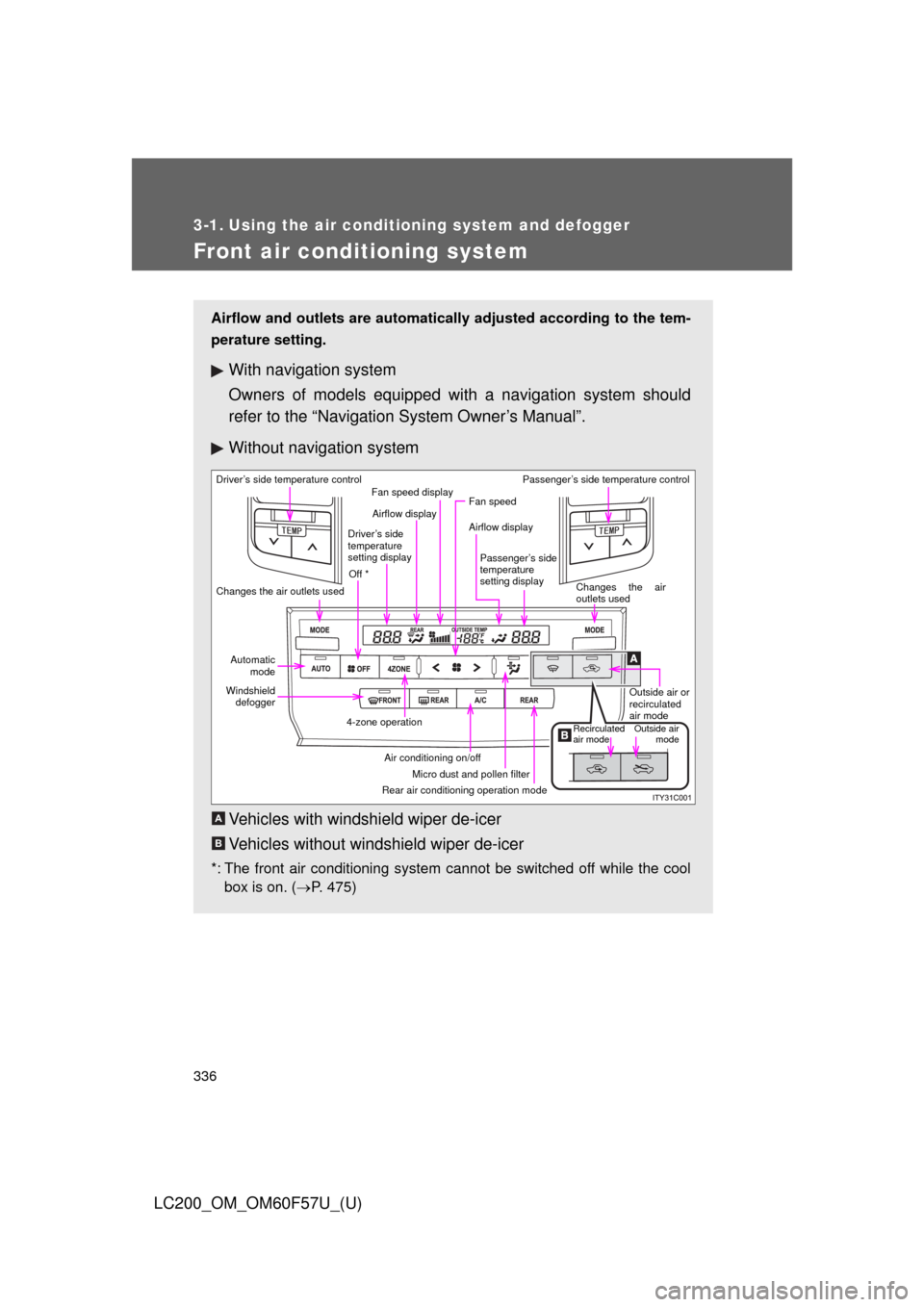
Front air conditioning system
Airflow and outlets are automatically adjusted according to the tem-
perature setting.
With navigation system
Owners of models equipped with a navigation system should
refer to the “Navigation System Owner’s Manual”.
Without navigation system
Vehicles with windshield wiper de-icer
Vehicles without windshield wiper de-icer
*: The front air conditioning system cannot be switched off while the cool
box is on. (P. 475)
Driver’s side temperature control
Changes the air outlets usedOff *Airflow display Fan speed display
Fan speed
Airflow display
Passenger’s side
temperature
setting displayPassenger’s side temperature control
Changes the air
outlets used
Outside air or
recirculated
air mode
Outside air
mode Recirculated
air mode
Rear air conditioning operation modeMicro dust and pollen filter Air conditioning on/off 4-zone operation Windshield
defogger Automatic
mode
Driver’s side
temperature
setting display
A
B
Page 337 of 720

337 3-1. Using the air conditioning system and defogger
3
Interior features
LC200_OM_OM60F57U_(U)
Using the automatic mode
Press .
The air conditioning system will begin to operate. Air outlets and fan
speed are automatically adjusted according to the temperature set-
ting.
Press “” to increase the temperature and “” to decrease the
temperature on .
The temperature for the driver’s and front passenger’s seats can be
set separately.
STEP1
STEP2
6'/2