engine oil TOYOTA MATRIX 2010 E140 / 2.G User Guide
[x] Cancel search | Manufacturer: TOYOTA, Model Year: 2010, Model line: MATRIX, Model: TOYOTA MATRIX 2010 E140 / 2.GPages: 448, PDF Size: 9.74 MB
Page 298 of 448
298 4-3. Do-it-yourself maintenance
■Engine oil consumption
●The amount of engine oil consumed depends on the oil viscosity, the
quality of the oil and the way the vehicle is driven.
●More oil is consumed under driving conditions such as high speeds and
frequent acceleration and deceleration.
●A new engine consumes more oil.
●When judging the amount of oil consumption, keep in mind that the oil
may have become diluted, making it difficult to judge the true level accu-
rately.
●Oil consumption: Max. 1.1 qt./600 miles, 0.9 Imp. qt./600 miles (1.0 L per
1000 km)
●If you consume more than 1.1 qt. (1.0 L, 0.9 Imp. qt.) every 600 miles
(1000 km), contact your Toyota dealer.
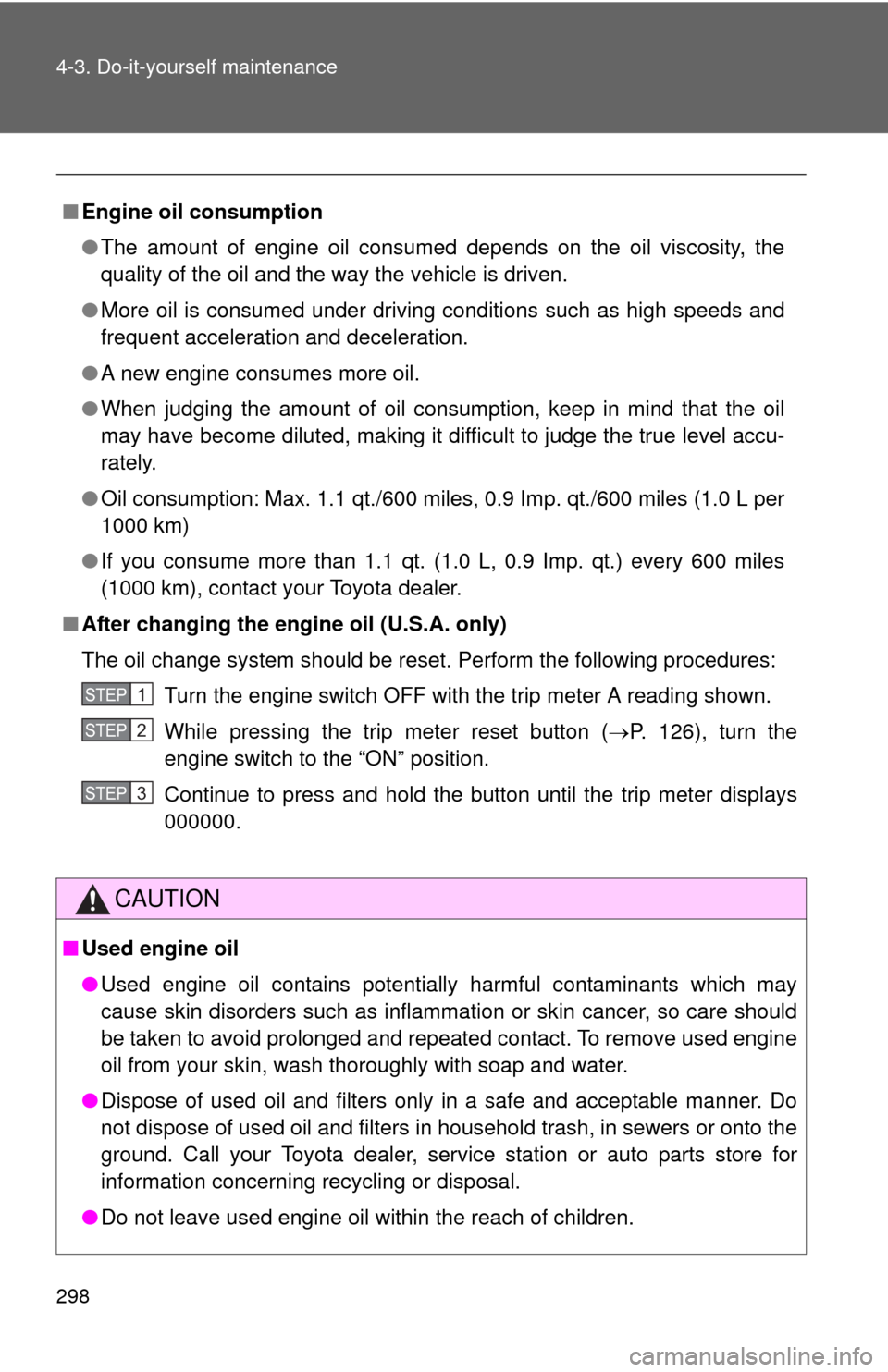
■After changing the engine oil (U.S.A. only)
The oil change system should be reset. Perform the following procedures:
Turn the engine switch OFF with the trip meter A reading shown.
While pressing the trip meter reset button (P. 126), turn the
engine switch to the “ON” position.
Continue to press and hold the button until the trip meter displays
000000.
CAUTION
■Used engine oil
●Used engine oil contains potentially harmful contaminants which may
cause skin disorders such as inflammation or skin cancer, so care should
be taken to avoid prolonged and repeated contact. To remove used engine
oil from your skin, wash thoroughly with soap and water.
●Dispose of used oil and filters only in a safe and acceptable manner. Do
not dispose of used oil and filters in household trash, in sewers or onto the
ground. Call your Toyota dealer, service station or auto parts store for
information concerning recycling or disposal.
●Do not leave used engine oil within the reach of children.
STEP1
STEP2
STEP3
Page 299 of 448

299 4-3. Do-it-yourself maintenance
4
Maintenance and care
NOTICE
■To prevent serious engine damage
Check the oil level on a regular basis.
■When replacing the engine oil
●Be careful not to spill engine oil on the vehicle components.
●Avoid overfilling, as the engine could be damaged.
●Check the oil level on the dipstick every time you refill the vehicle.
●Be sure the engine oil filler cap is properly tightened.
Page 360 of 448
360 5-2. Steps to take in an emergency
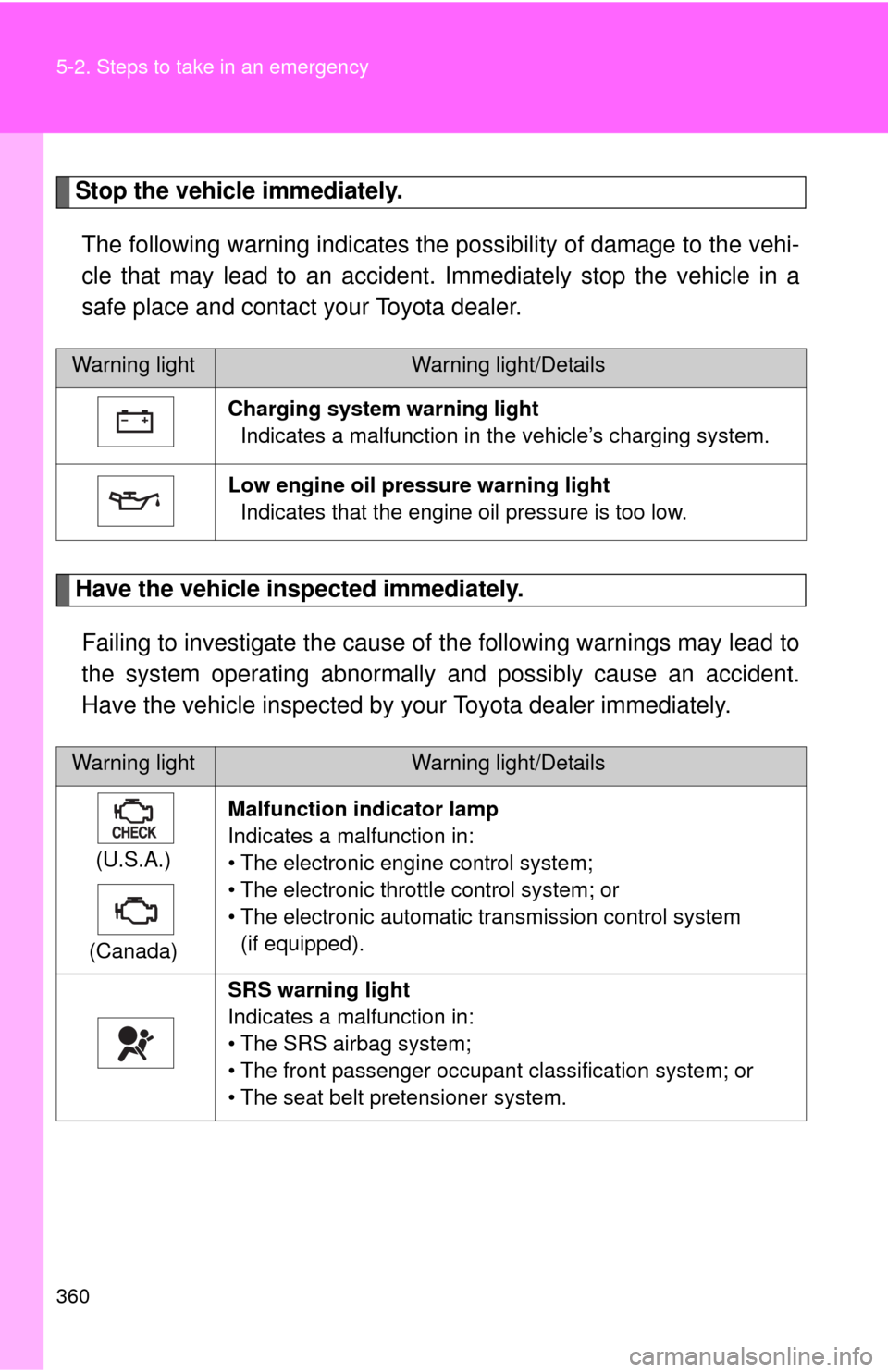
Stop the vehicle immediately.
The following warning indicates the possibility of damage to the vehi-
cle that may lead to an accident. Immediately stop the vehicle in a
safe place and contact your Toyota dealer.
Have the vehicle inspected immediately.
Failing to investigate the cause of the following warnings may lead to
the system operating abnormally and possibly cause an accident.
Have the vehicle inspected by your Toyota dealer immediately.
Warning lightWarning light/Details
Charging system warning light
Indicates a malfunction in the vehicle’s charging system.
Low engine oil pressure warning light
Indicates that the engine oil pressure is too low.
Warning lightWarning light/Details
(U.S.A.)
(Canada)Malfunction indicator lamp
Indicates a malfunction in:
• The electronic engine control system;
• The electronic throttle control system; or
• The electronic automatic transmission control system
(if equipped).
SRS warning light
Indicates a malfunction in:
• The SRS airbag system;
• The front passenger occupant classification system; or
• The seat belt pretensioner system.
Page 363 of 448
5
When trouble arises
363 5-2. Steps to take in an emergency
*: Driver's and front passenger’s seat belt warning buzzers:
The driver’s and front passenger’s seat belts warning buzzers sound to alert
the driver and front passenger that his or her seat belt is not fastened. The
buzzer sounds intermittently for 10 seconds after the vehicle has reached a
speed of 12 mph (20 km/h). Then, if the seat belt is still unfastened, the
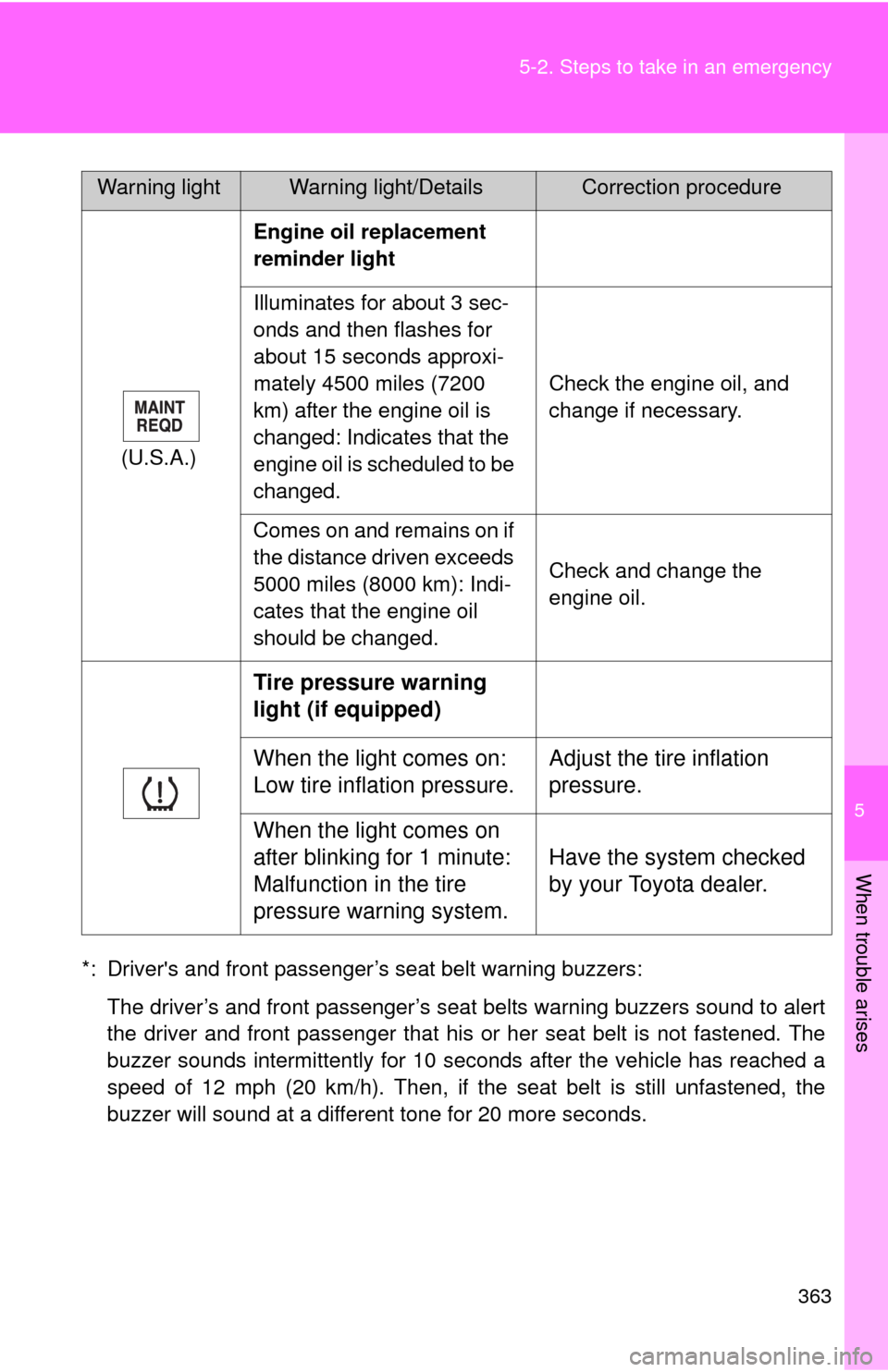
buzzer will sound at a different tone for 20 more seconds.(U.S.A.)Engine oil replacement
reminder light
Illuminates for about 3 sec-
onds and then flashes for
about 15 seconds approxi-
mately 4500 miles (7200
km) after the engine oil is
changed: Indicates that the
engine oil is scheduled to be
changed.Check the engine oil, and
change if necessary.
Comes on and remains on if
the distance driven exceeds
5000 miles (8000 km): Indi-
cates that the engine oil
should be changed.Check and change the
engine oil.
Tire pressure warning
light (if equipped)
When the light comes on:
Low tire inflation pressure.Adjust the tire inflation
pressure.
When the light comes on
after blinking for 1 minute:
Malfunction in the tire
pressure warning system.Have the system checked
by your Toyota dealer.
Warning lightWarning light/DetailsCorrection procedure
Page 364 of 448

364 5-2. Steps to take in an emergency
■Front passenger detection sensor and passenger seat belt reminder
●If luggage is placed on the front passenger seat, the front passenger
detection sensor may cause the warning light to flash, even if a passen-
ger is not sitting in the seat.
●If a cushion is placed on the seat, the sensor may not detect a passen-
ger, and the warning light may not operate properly.
■Changing the engine oil (U.S.A. only)
Make sure to reset the oil change system. (P. 298)
■
When the tire pressure warning light comes on
Check the tire inflation pressure and adjust to the appropriate level.
Pushing the tire pressure warning reset switch does not turn off the tire
pressure warning light.
■The tire pressure warning light may turn on due to natural causes
The tire pressure warning light may turn on due to natural causes such
as natural air leaks or tire inflation pressure changes caused by temper-
ature. In this case, adjusting the tire inflation pressure will turn off the
warning light (after a few minutes).
Page 401 of 448
401 6-1. Specifications
6
Vehicle specifications
Lubrication system
■Engine oil selection
“Toyota Genuine Motor Oil” is used in your Toyota vehicle. Use
Toyota approved “Toyota Genuine Motor Oil” or equivalent to satisfy
the following grade and viscosity.
Oil grade: ILSAC multigrade engine oil
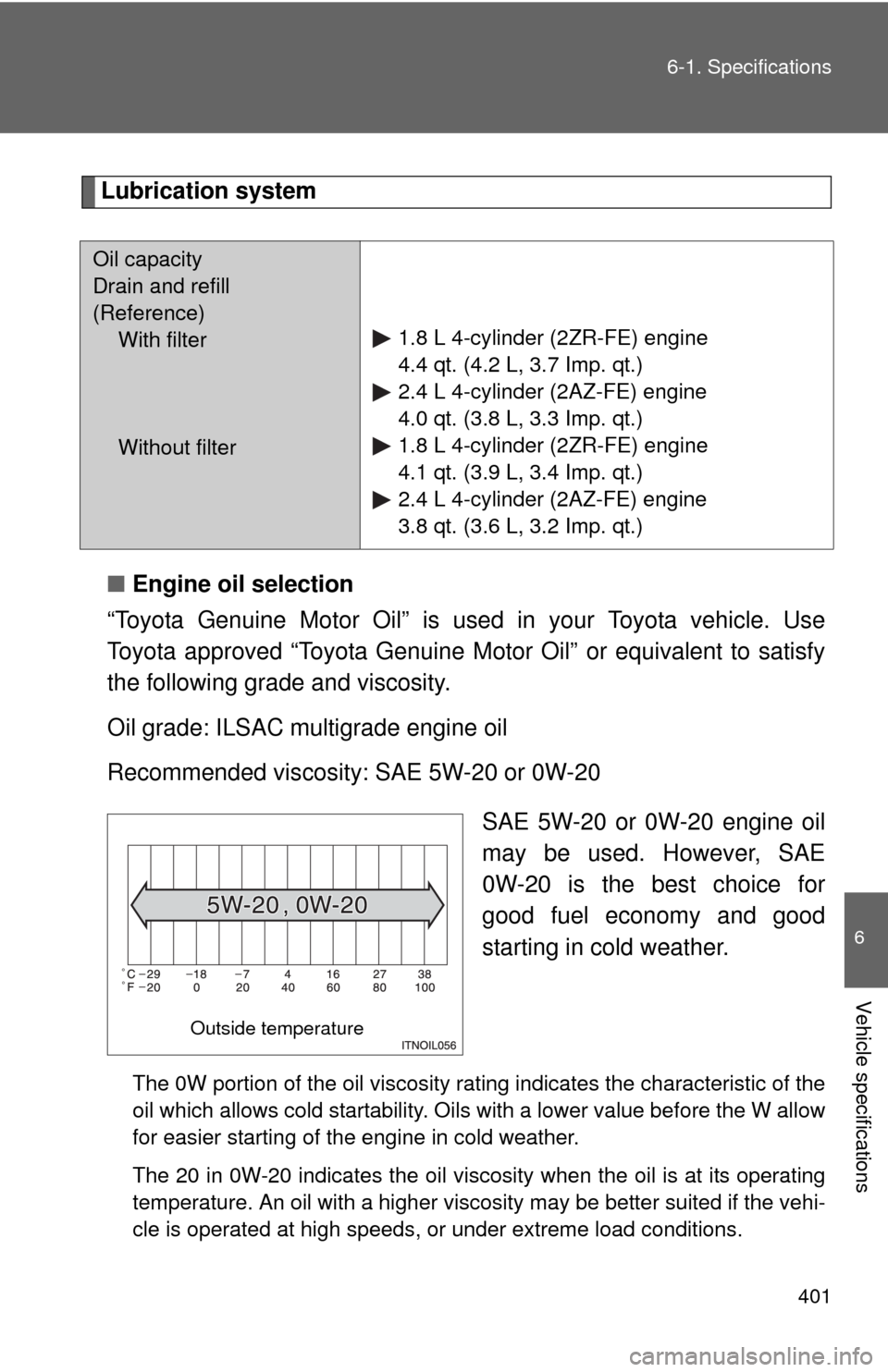
Recommended viscosity: SAE 5W-20 or 0W-20
SAE 5W-20 or 0W-20 engine oil
may be used. However, SAE
0W-20 is the best choice for
good fuel economy and good
starting in cold weather.
The 0W portion of the oil viscosity rating indicates the characteristic of the
oil which allows cold startability. Oils with a lower value before the W allow
for easier starting of the engine in cold weather.
The 20 in 0W-20 indicates the oil viscosity when the oil is at its operating
temperature. An oil with a higher viscosity may be better suited if the vehi-
cle is operated at high speeds, or under extreme load conditions.
Oil capacity
Drain and refill
(Reference)
With filter
Without filter1.8 L 4-cylinder (2ZR-FE) engine
4.4 qt. (4.2 L, 3.7 Imp. qt.)
2.4 L 4-cylinder (2AZ-FE) engine
4.0 qt. (3.8 L, 3.3 Imp. qt.)
1.8 L 4-cylinder (2ZR-FE) engine
4.1 qt. (3.9 L, 3.4 Imp. qt.)
2.4 L 4-cylinder (2AZ-FE) engine
3.8 qt. (3.6 L, 3.2 Imp. qt.)
Outside temperature
Page 404 of 448
404 6-1. Specifications
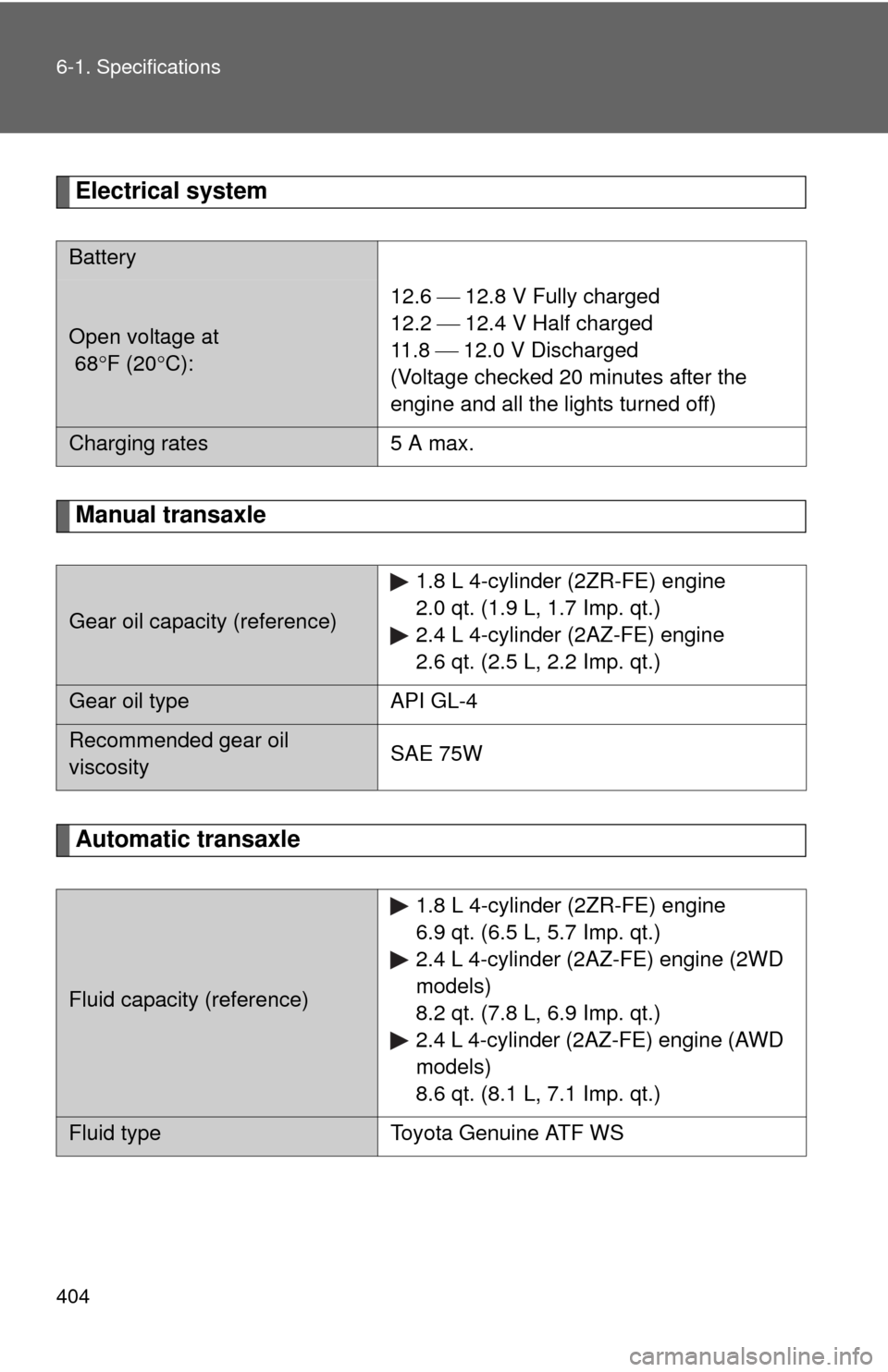
Electrical system
Manual transaxle
Automatic transaxle
Battery
Open voltage at
68F (20C):12.6 12.8 V Fully charged
12.2 12.4 V Half charged
11 . 8 12.0 V Discharged
(Voltage checked 20 minutes after the
engine and all the lights turned off)
Charging rates 5 A max.
Gear oil capacity (reference)1.8 L 4-cylinder (2ZR-FE) engine
2.0 qt. (1.9 L, 1.7 Imp. qt.)
2.4 L 4-cylinder (2AZ-FE) engine
2.6 qt. (2.5 L, 2.2 Imp. qt.)
Gear oil type API GL-4
Recommended gear oil
viscositySAE 75W
Fluid capacity (reference)1.8 L 4-cylinder (2ZR-FE) engine
6.9 qt. (6.5 L, 5.7 Imp. qt.)
2.4 L 4-cylinder (2AZ-FE) engine (2WD
models)
8.2 qt. (7.8 L, 6.9 Imp. qt.)
2.4 L 4-cylinder (2AZ-FE) engine (AWD
models)
8.6 qt. (8.1 L, 7.1 Imp. qt.)
Fluid type Toyota Genuine ATF WS
Page 421 of 448
421 6-1. Specifications
6
Vehicle specifications
Warning: The temperature grades for this tire are established for a
tire that is properly inflated and not overloaded.
Excessive speed, underinflation, or excessive loading, either sepa-
rately or in combination, can cause heat buildup and possible tire fail-
ure.
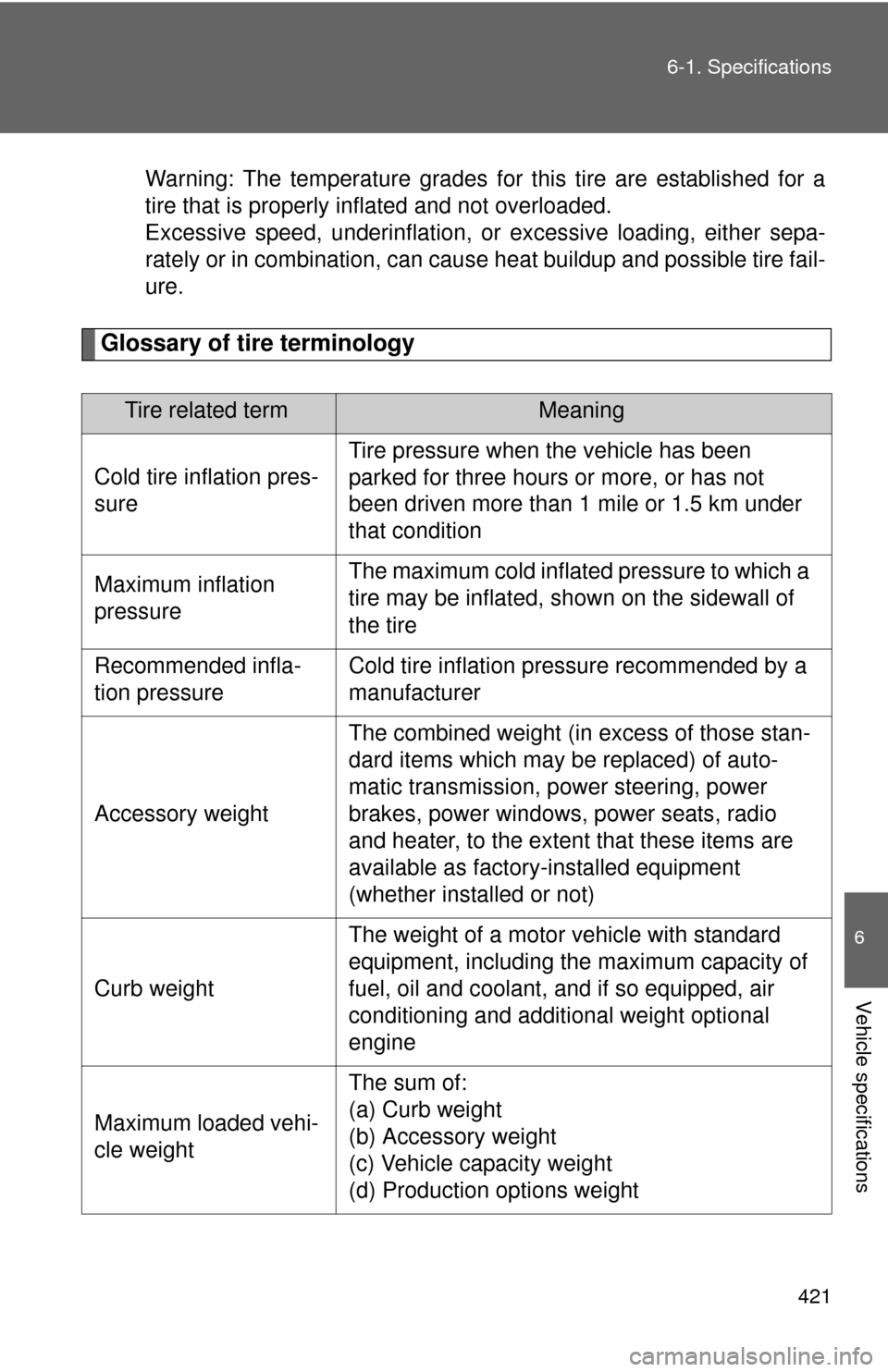
Glossary of tire terminology
Tire related termMeaning
Cold tire inflation pres-
sureTire pressure when the vehicle has been
parked for three hours or more, or has not
been driven more than 1 mile or 1.5 km under
that condition
Maximum inflation
pressureThe maximum cold inflated pressure to which a
tire may be inflated, shown on the sidewall of
the tire
Recommended infla-
tion pressureCold tire inflation pressure recommended by a
manufacturer
Accessory weightThe combined weight (in excess of those stan-
dard items which may be replaced) of auto-
matic transmission, power steering, power
brakes, power windows, power seats, radio
and heater, to the extent that these items are
available as factory-installed equipment
(whether installed or not)
Curb weightThe weight of a motor vehicle with standard
equipment, including the maximum capacity of
fuel, oil and coolant, and if so equipped, air
conditioning and additional weight optional
engine
Maximum loaded vehi-
cle weightThe sum of:
(a) Curb weight
(b) Accessory weight
(c) Vehicle capacity weight
(d) Production options weight
Page 429 of 448
429
6
Vehicle specifications
6-3. Initialization
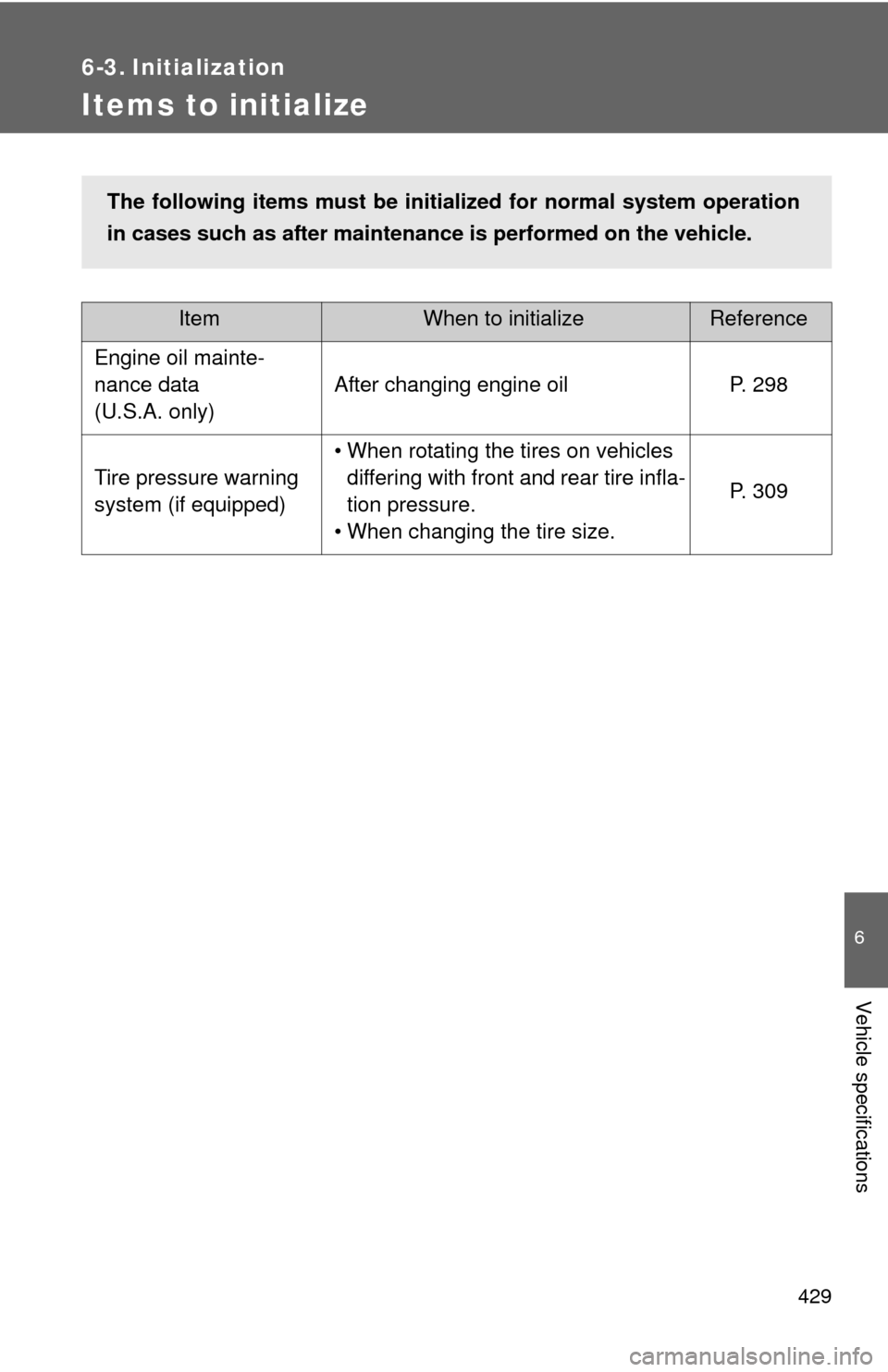
Items to initialize
ItemWhen to initializeReference
Engine oil mainte-
nance data
(U.S.A. only)After changing engine oil P. 298
Tire pressure warning
system (if equipped)• When rotating the tires on vehicles
differing with front and rear tire infla-
tion pressure.
• When changing the tire size.P. 309
The following items must be initialized for normal system operation
in cases such as after maintenance is performed on the vehicle.
Page 439 of 448

439 Alphabetical index
Daytime running light
system ................................... 133
Defogger
Rear window......................... 174
Side mirror ............................ 174
Dimension ................................ 396
Dinghy towing .................. 163,164
Display
Trip meter ............................. 126
Do-it-yourself maintenance .... 285
Doors
Door glasses .......................... 56
Door lock .......................... 26, 29
Side mirrors ............................ 54
Driver's seat belt reminder
light ........................................ 362
Driving
Break-in tips ......................... 104
Correct posture....................... 68
Procedures ........................... 102
Winter driving tips ................. 151
Electric power steering........... 142
Emergency flashers
Switch ................................... 348
Emergency, in case of
If a warning light turns on ..... 359
If the engine will not start...... 383
If the shift lever cannot be
shifted from P ..................... 384
If the vehicle has a
discharged battery ............. 386
If the warning buzzer
sounds ............................... 359If you have a flat tire .............369
If you lose your keys .............385
If you think something is
wrong ..................................355
If your vehicle becomes
stuck ...................................394
If your vehicle needs to be
towed ..................................349
If your vehicle overheats .......391
Engine
Compartment ........................294
Engine switch ........................112
Hood......................................289
How to start the
engine .................................112
Identification number .............397
If the engine will not start ......383
Ignition switch........................112
Overheating...........................391
Engine coolant
Capacity ................................403
Checking ...............................300
Preparing and checking before
winter ..................................151
Engine coolant temperature
gauge ......................................126
Engine immobilizer system.......65
Engine oil
Capacity ................................401
Checking ...............................296
Preparing and checking before
winter ..................................151
Engine oil maintenance
data .........................................298
EPS ............................................142
Event data recorder .................357D
E