oil TOYOTA MATRIX 2010 E140 / 2.G User Guide
[x] Cancel search | Manufacturer: TOYOTA, Model Year: 2010, Model line: MATRIX, Model: TOYOTA MATRIX 2010 E140 / 2.GPages: 448, PDF Size: 9.74 MB
Page 295 of 448
295 4-3. Do-it-yourself maintenance
4
Maintenance and care
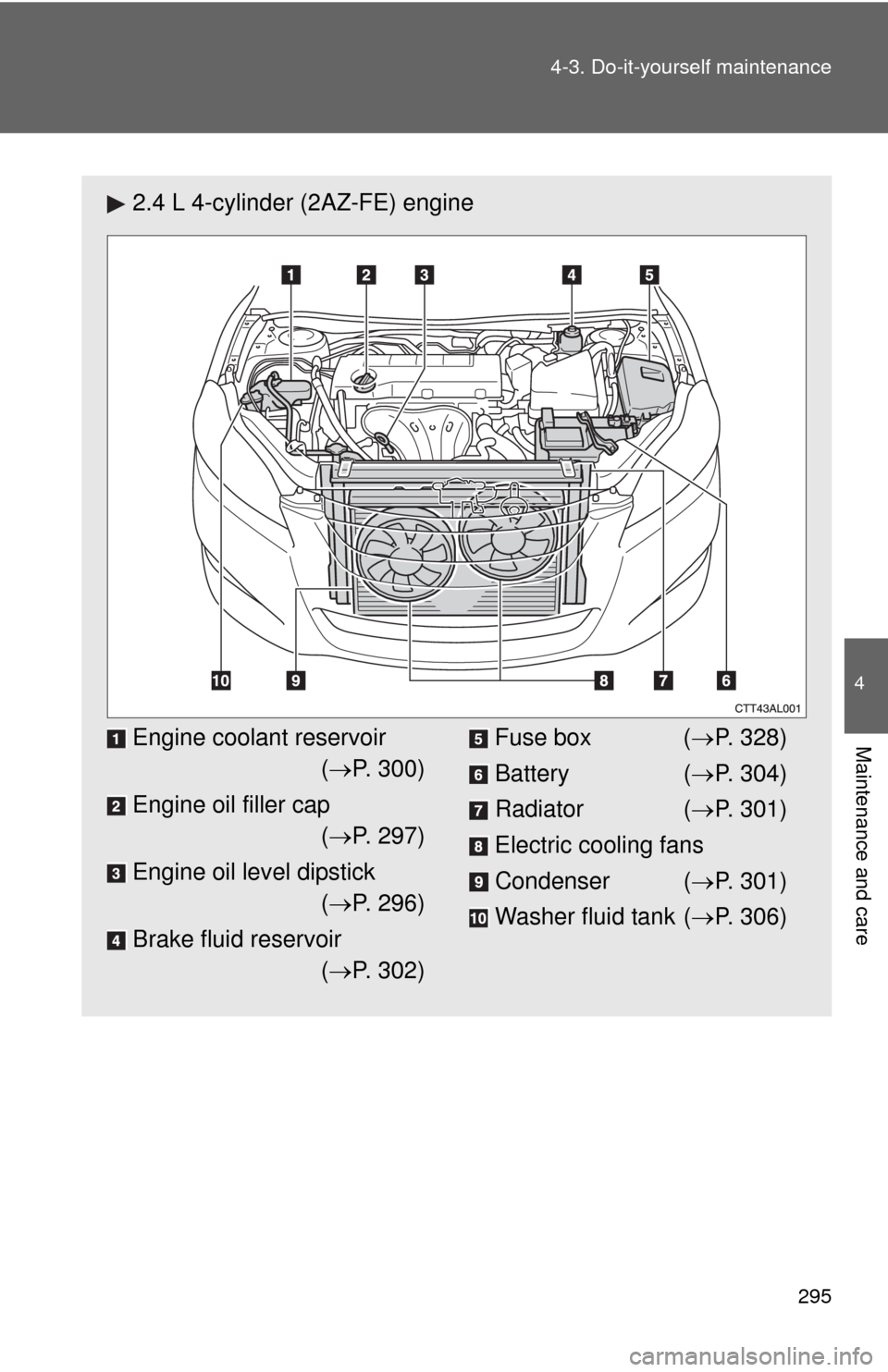
2.4 L 4-cylinder (2AZ-FE) engine
Engine coolant reservoir
(P. 300)
Engine oil filler cap
(P. 297)
Engine oil level dipstick
(P. 296)
Brake fluid reservoir
(P. 302)Fuse box (P. 328)
Battery (P. 304)
Radiator (P. 301)
Electric cooling fans
Condenser (P. 301)
Washer fluid tank (P. 306)
Page 296 of 448
296 4-3. Do-it-yourself maintenance
Engine oil
With the engine at operating temperature and turned off, check the oil
level on the dipstick.
■Checking the engine oil
Park the vehicle on level ground. After turning off the engine,
wait more than five minutes for the oil to drain back into the
bottom of the engine.
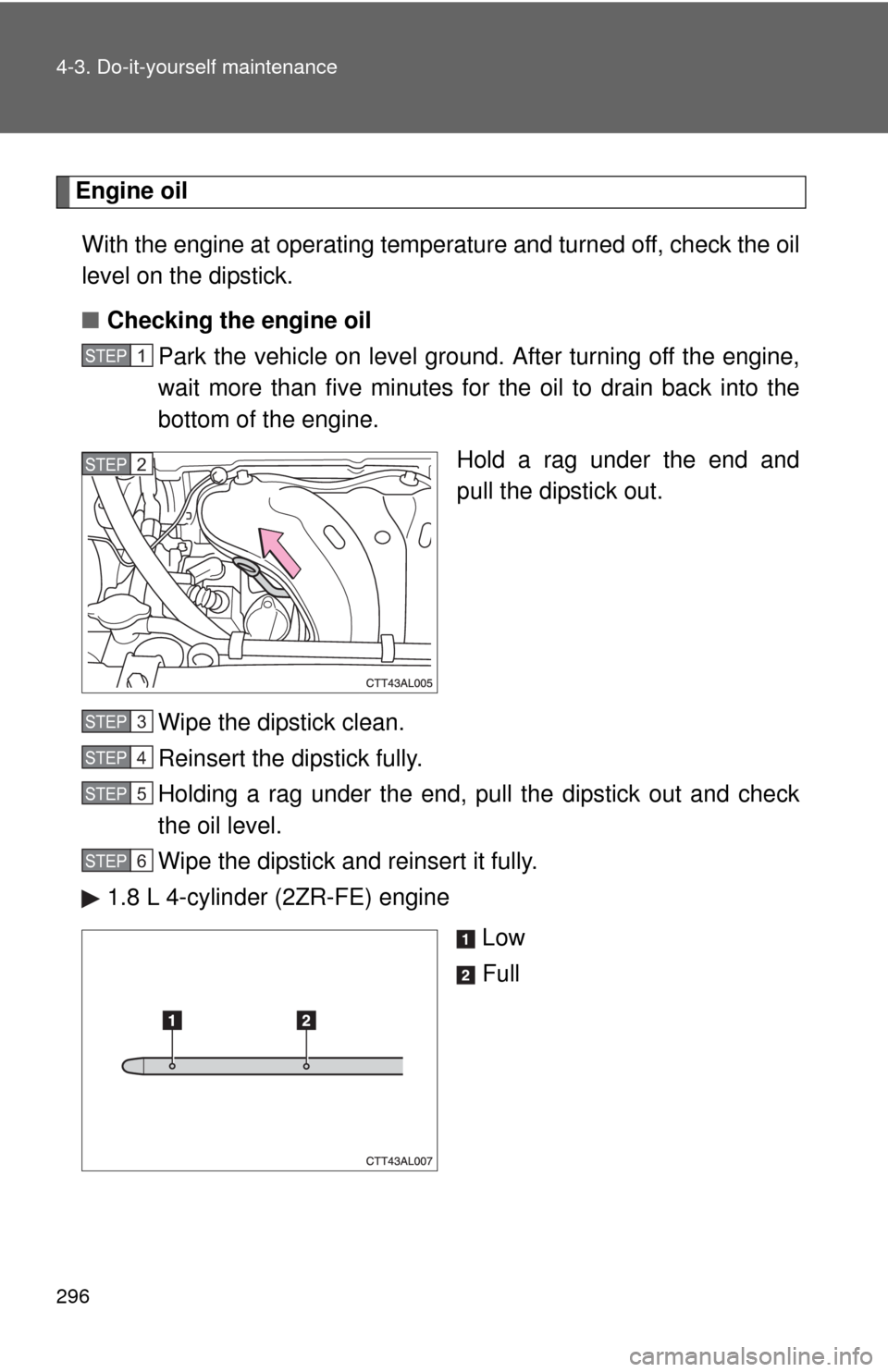
Hold a rag under the end and
pull the dipstick out.
Wipe the dipstick clean.
Reinsert the dipstick fully.
Holding a rag under the end, pull the dipstick out and check
the oil level.
Wipe the dipstick and reinsert it fully.
1.8 L 4-cylinder (2ZR-FE) engine
Low
Full
STEP1
STEP2
STEP3
STEP4
STEP5
STEP6
Page 297 of 448
297 4-3. Do-it-yourself maintenance
4
Maintenance and care
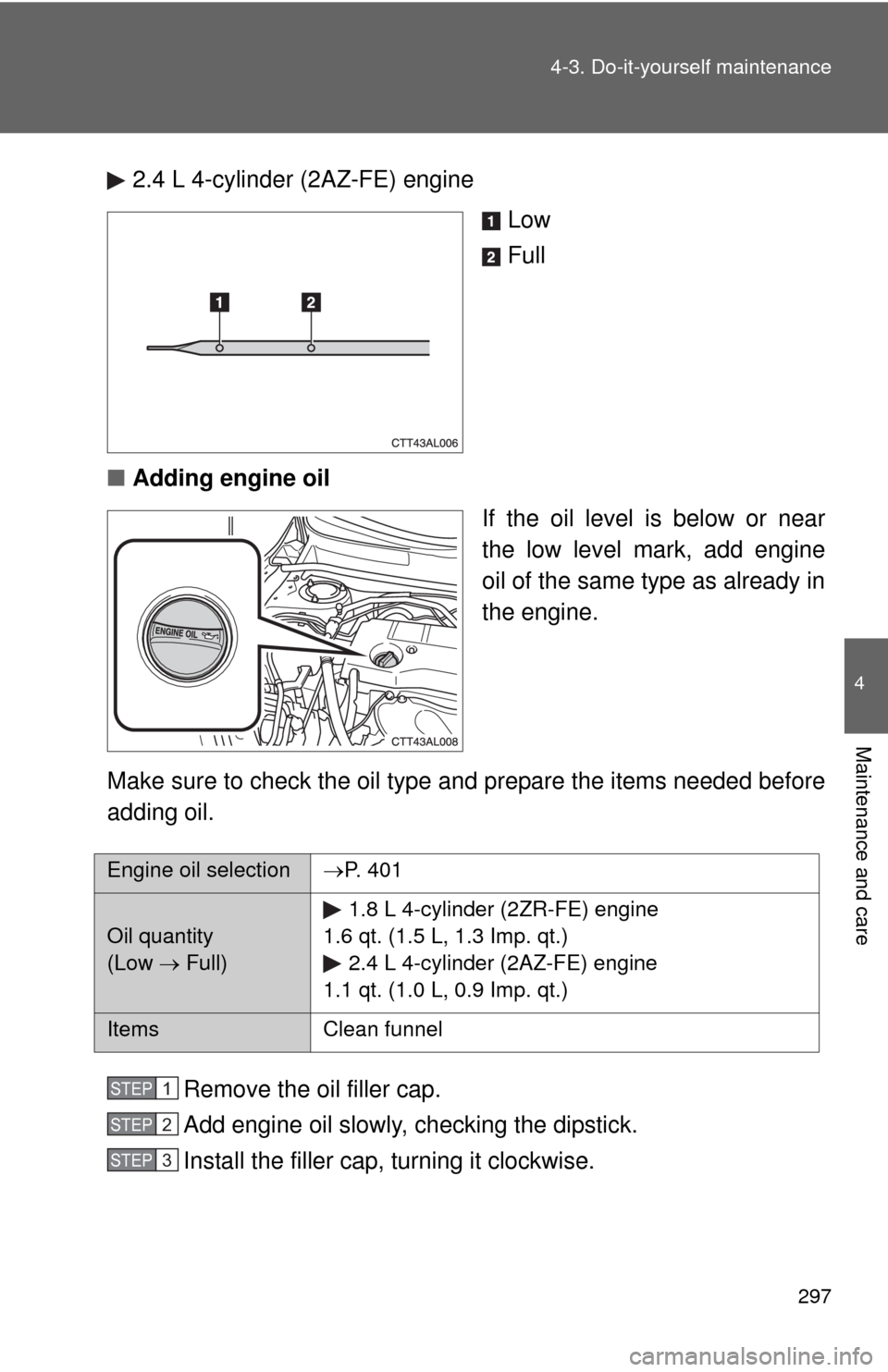
2.4 L 4-cylinder (2AZ-FE) engine
Low
Full
■Adding engine oil
If the oil level is below or near
the low level mark, add engine
oil of the same type as already in
the engine.
Make sure to check the oil type and prepare the items needed before
adding oil.
Remove the oil filler cap.
Add engine oil slowly, checking the dipstick.
Install the filler cap, turning it clockwise.
Engine oil selectionP. 401
Oil quantity
(Low Full)1.8 L 4-cylinder (2ZR-FE) engine
1.6 qt. (1.5 L, 1.3 Imp. qt.)
2.4 L 4-cylinder (2AZ-FE) engine
1.1 qt. (1.0 L, 0.9 Imp. qt.)
Items Clean funnel
STEP1
STEP2
STEP3
Page 298 of 448
298 4-3. Do-it-yourself maintenance
■Engine oil consumption
●The amount of engine oil consumed depends on the oil viscosity, the
quality of the oil and the way the vehicle is driven.
●More oil is consumed under driving conditions such as high speeds and
frequent acceleration and deceleration.
●A new engine consumes more oil.
●When judging the amount of oil consumption, keep in mind that the oil
may have become diluted, making it difficult to judge the true level accu-
rately.
●Oil consumption: Max. 1.1 qt./600 miles, 0.9 Imp. qt./600 miles (1.0 L per
1000 km)
●If you consume more than 1.1 qt. (1.0 L, 0.9 Imp. qt.) every 600 miles
(1000 km), contact your Toyota dealer.
■After changing the engine oil (U.S.A. only)
The oil change system should be reset. Perform the following procedures:
Turn the engine switch OFF with the trip meter A reading shown.
While pressing the trip meter reset button (P. 126), turn the
engine switch to the “ON” position.
Continue to press and hold the button until the trip meter displays
000000.
CAUTION
■Used engine oil
●Used engine oil contains potentially harmful contaminants which may
cause skin disorders such as inflammation or skin cancer, so care should
be taken to avoid prolonged and repeated contact. To remove used engine
oil from your skin, wash thoroughly with soap and water.
●Dispose of used oil and filters only in a safe and acceptable manner. Do
not dispose of used oil and filters in household trash, in sewers or onto the
ground. Call your Toyota dealer, service station or auto parts store for
information concerning recycling or disposal.
●Do not leave used engine oil within the reach of children.
STEP1
STEP2
STEP3
Page 299 of 448
299 4-3. Do-it-yourself maintenance
4
Maintenance and care
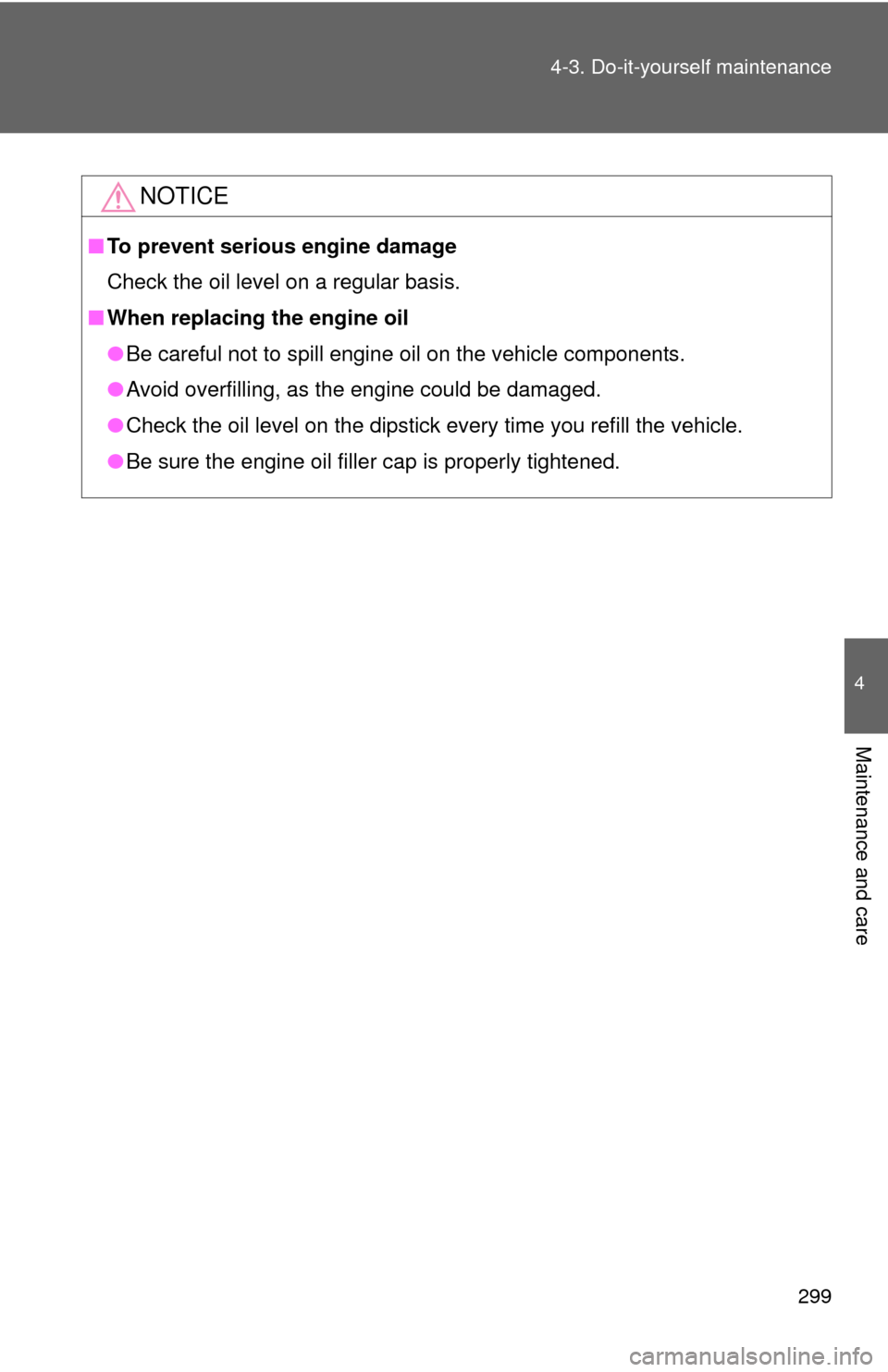
NOTICE
■To prevent serious engine damage
Check the oil level on a regular basis.
■When replacing the engine oil
●Be careful not to spill engine oil on the vehicle components.
●Avoid overfilling, as the engine could be damaged.
●Check the oil level on the dipstick every time you refill the vehicle.
●Be sure the engine oil filler cap is properly tightened.
Page 360 of 448
360 5-2. Steps to take in an emergency
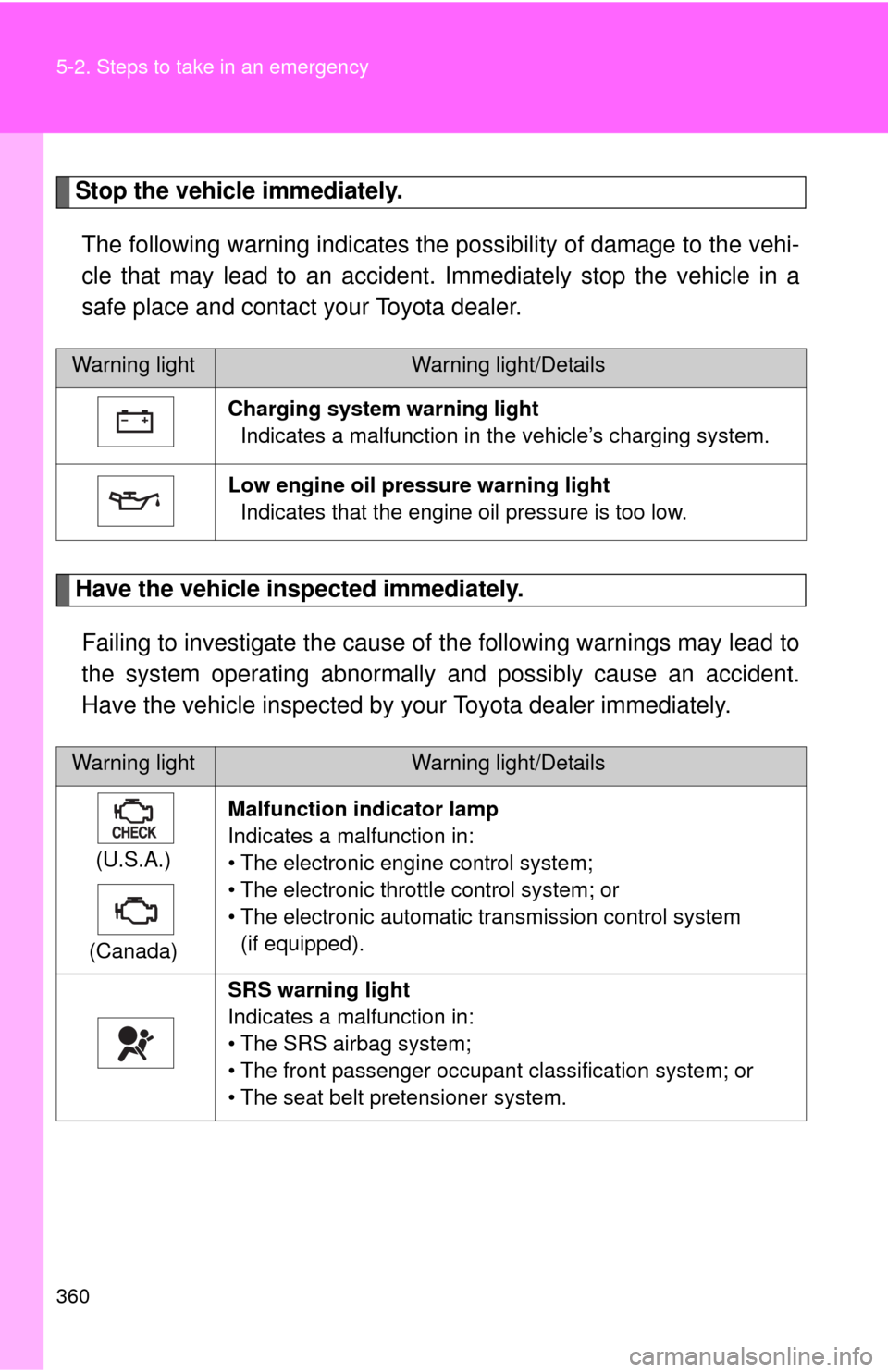
Stop the vehicle immediately.
The following warning indicates the possibility of damage to the vehi-
cle that may lead to an accident. Immediately stop the vehicle in a
safe place and contact your Toyota dealer.
Have the vehicle inspected immediately.
Failing to investigate the cause of the following warnings may lead to
the system operating abnormally and possibly cause an accident.
Have the vehicle inspected by your Toyota dealer immediately.
Warning lightWarning light/Details
Charging system warning light
Indicates a malfunction in the vehicle’s charging system.
Low engine oil pressure warning light
Indicates that the engine oil pressure is too low.
Warning lightWarning light/Details
(U.S.A.)
(Canada)Malfunction indicator lamp
Indicates a malfunction in:
• The electronic engine control system;
• The electronic throttle control system; or
• The electronic automatic transmission control system
(if equipped).
SRS warning light
Indicates a malfunction in:
• The SRS airbag system;
• The front passenger occupant classification system; or
• The seat belt pretensioner system.
Page 363 of 448
5
When trouble arises
363 5-2. Steps to take in an emergency
*: Driver's and front passenger’s seat belt warning buzzers:
The driver’s and front passenger’s seat belts warning buzzers sound to alert
the driver and front passenger that his or her seat belt is not fastened. The
buzzer sounds intermittently for 10 seconds after the vehicle has reached a
speed of 12 mph (20 km/h). Then, if the seat belt is still unfastened, the
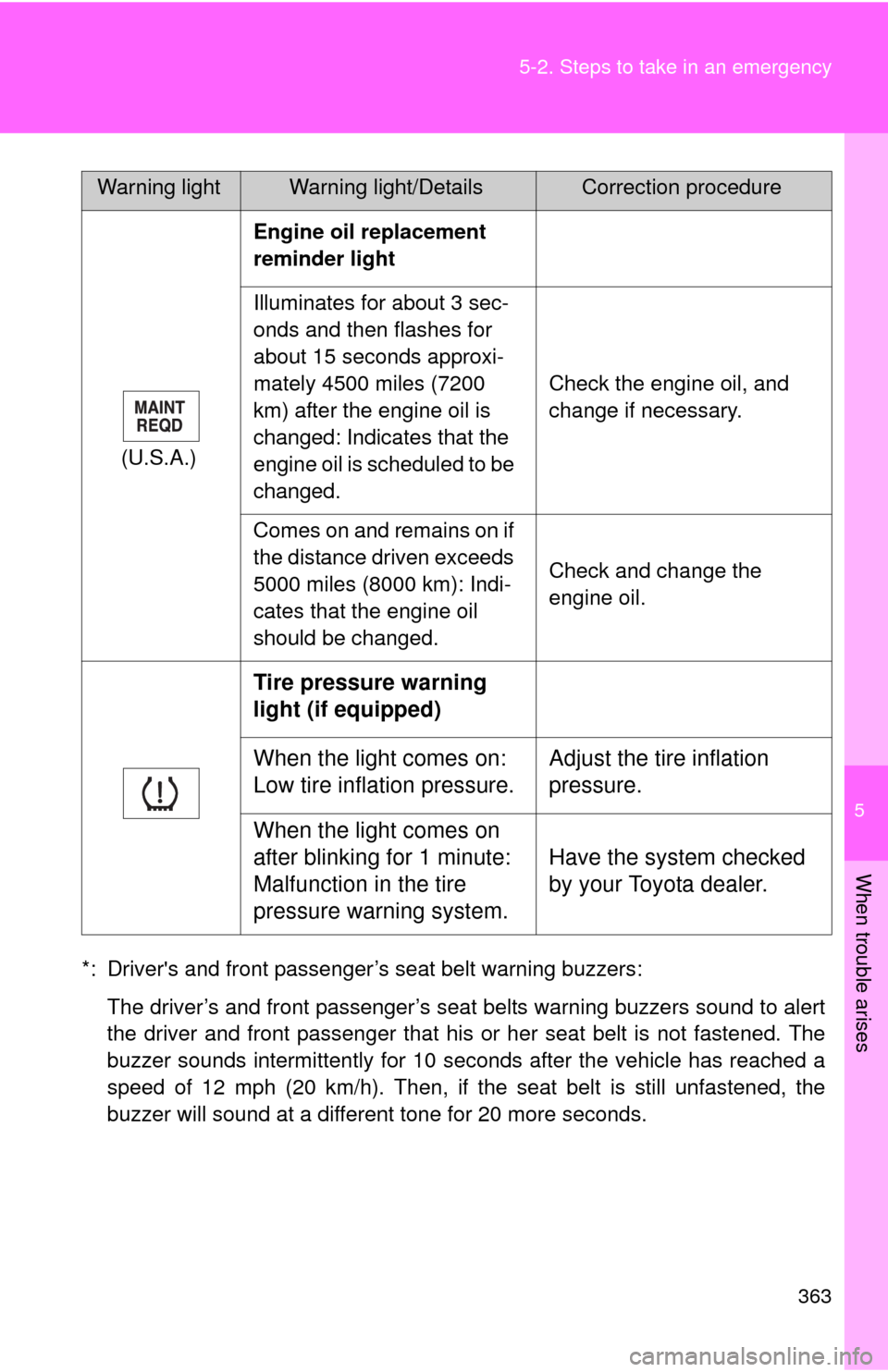
buzzer will sound at a different tone for 20 more seconds.(U.S.A.)Engine oil replacement
reminder light
Illuminates for about 3 sec-
onds and then flashes for
about 15 seconds approxi-
mately 4500 miles (7200
km) after the engine oil is
changed: Indicates that the
engine oil is scheduled to be
changed.Check the engine oil, and
change if necessary.
Comes on and remains on if
the distance driven exceeds
5000 miles (8000 km): Indi-
cates that the engine oil
should be changed.Check and change the
engine oil.
Tire pressure warning
light (if equipped)
When the light comes on:
Low tire inflation pressure.Adjust the tire inflation
pressure.
When the light comes on
after blinking for 1 minute:
Malfunction in the tire
pressure warning system.Have the system checked
by your Toyota dealer.
Warning lightWarning light/DetailsCorrection procedure
Page 364 of 448

364 5-2. Steps to take in an emergency
■Front passenger detection sensor and passenger seat belt reminder
●If luggage is placed on the front passenger seat, the front passenger
detection sensor may cause the warning light to flash, even if a passen-
ger is not sitting in the seat.
●If a cushion is placed on the seat, the sensor may not detect a passen-
ger, and the warning light may not operate properly.
■Changing the engine oil (U.S.A. only)
Make sure to reset the oil change system. (P. 298)
■
When the tire pressure warning light comes on
Check the tire inflation pressure and adjust to the appropriate level.
Pushing the tire pressure warning reset switch does not turn off the tire
pressure warning light.
■The tire pressure warning light may turn on due to natural causes
The tire pressure warning light may turn on due to natural causes such
as natural air leaks or tire inflation pressure changes caused by temper-
ature. In this case, adjusting the tire inflation pressure will turn off the
warning light (after a few minutes).
Page 380 of 448

380 5-2. Steps to take in an emergency
CAUTION
■Replacing a flat tire
Observe the following precautions to reduce the risk of death or serious
injury:
●Never use oil or grease on the wheel bolts or wheel nuts.
Oil and grease may cause the wheel nuts to be excessively tightened,
leading to bolt or disc wheel damage. In addition, the oil or grease can
cause the wheel nuts to loosen and the wheel may fall off, causing a
serious accident. Remove any oil or grease from the wheel bolts or
wheel nuts.
●Have the wheel nuts tightened with a torque wrench to 76 ft•lbf (103
N
•m, 10.5 kgf•m) as soon as possible after changing wheels.
Failure to follow these precautions could cause the nuts to loosen and
the wheel may fall off, which could lead to an accident causing death
or serious injury.
■When using the compact spare tire
●Remember that your compact spare tire is specifically designed for
use with your vehicle. Do not use your compact spare tire on another
vehicle.
●Do not use two compact spare tires simultaneously.
●Replace the compact spare tire with a standard tire as soon as possi-
ble.
●Avoid sudden acceleration, deceleration and braking, as well as sharp
cornering.
■Speed limit when using the compact spare tire
Do not drive at speeds in excess of 50 mph (80 km/h) when a compact
spare tire is installed on the vehicle.
The compact spare tire is not designed for driving at high speeds. Failing
to observe this precaution may lead to an accident causing death or seri-
ous injury.
Page 395 of 448
Vehicle specifications6
395
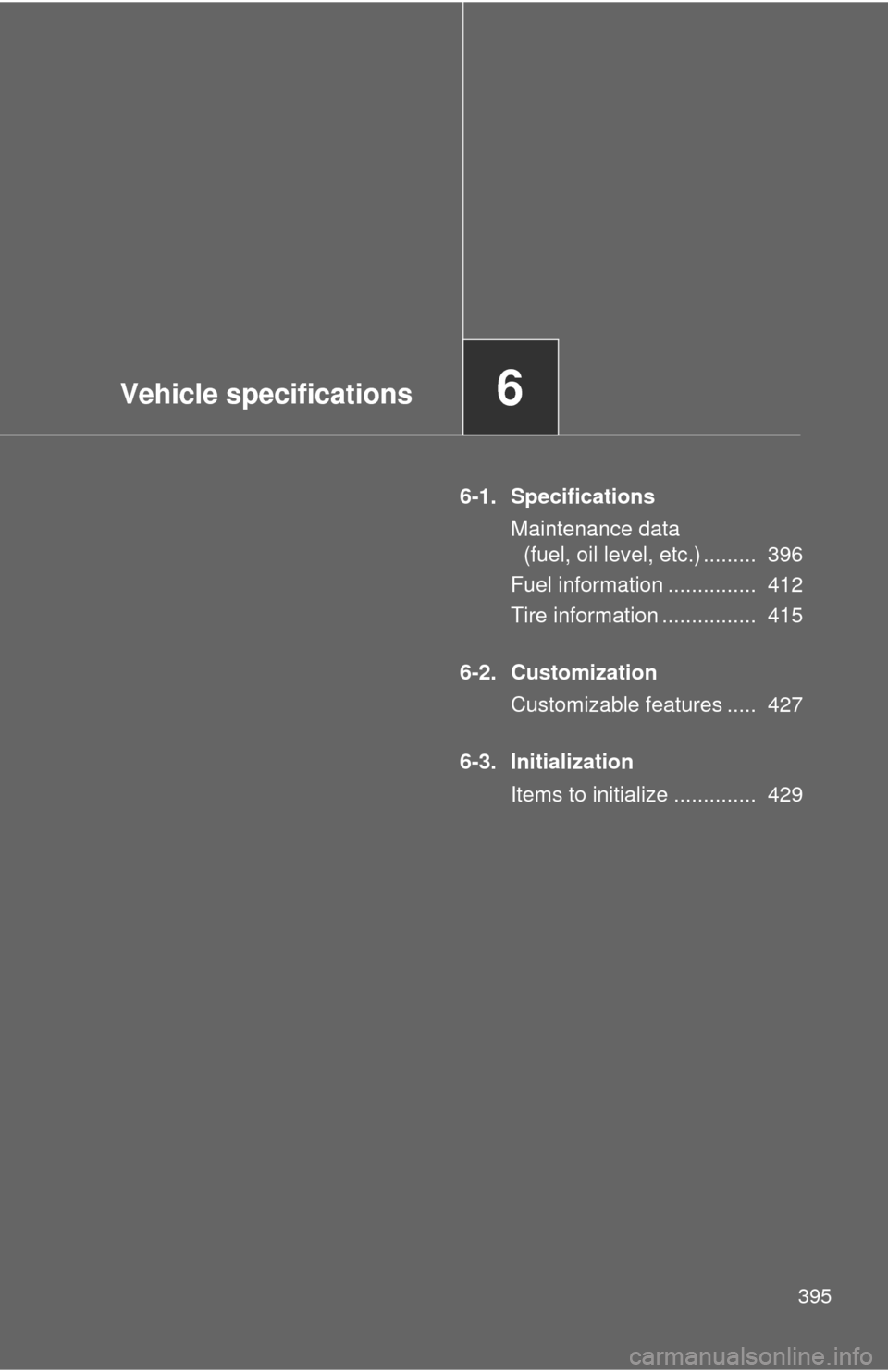
6-1. Specifications
Maintenance data
(fuel, oil level, etc.) ......... 396
Fuel information ............... 412
Tire information ................ 415
6-2. Customization
Customizable features ..... 427
6-3. Initialization
Items to initialize .............. 429