tow TOYOTA MIRAI 2019 (in English) User Guide
[x] Cancel search | Manufacturer: TOYOTA, Model Year: 2019, Model line: MIRAI, Model: TOYOTA MIRAI 2019Pages: 528, PDF Size: 11.84 MB
Page 160 of 528
1604-4. Adjusting the steering wheel and mirrors
MIRAI_OM_USA_OM62054U(18MY)_O
M62048U(19MY)
Steering wheel
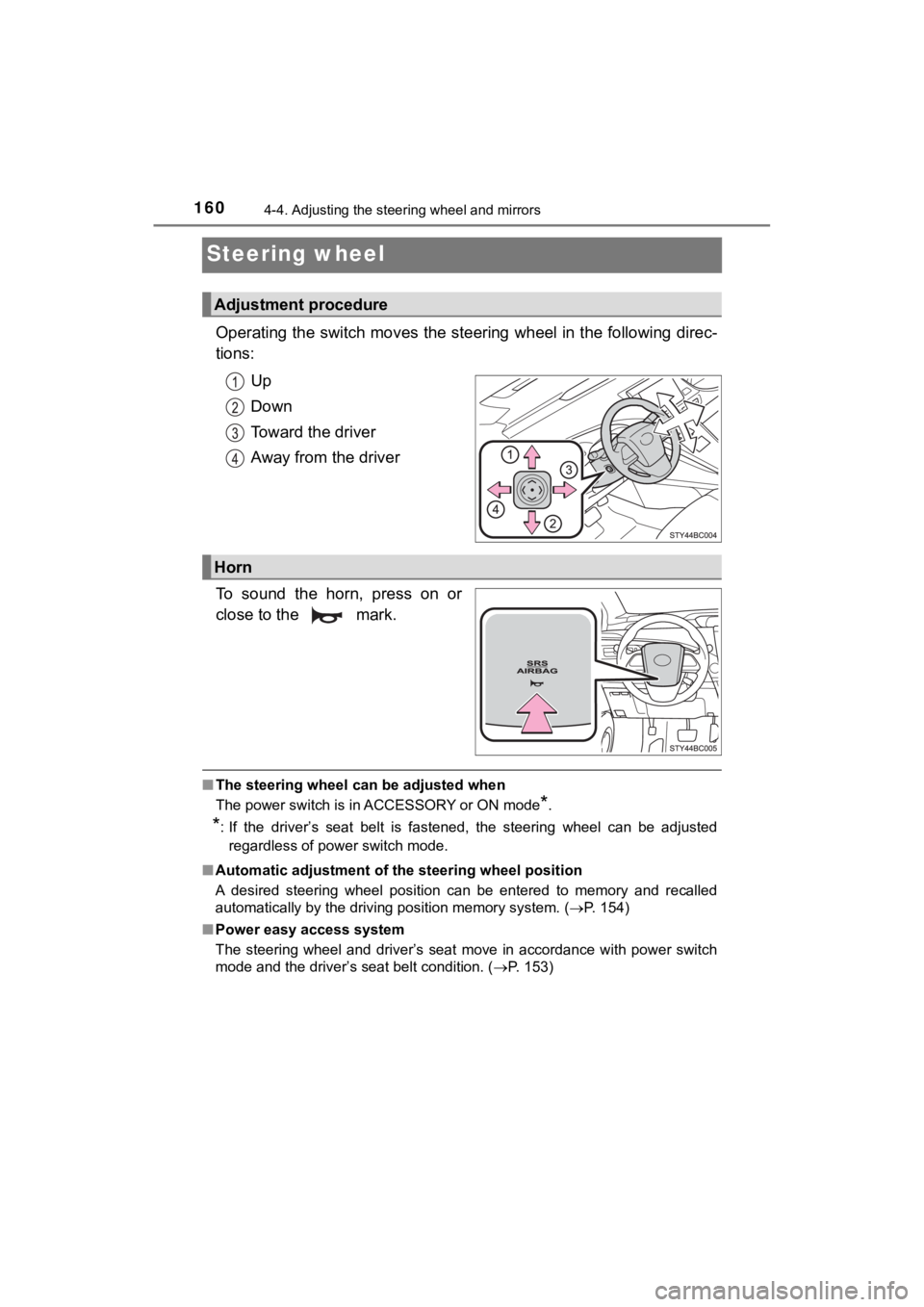
Operating the switch moves the steering wheel in the following direc-
tions:
Up
Down
Toward the driver
Away from the driver
To sound the horn, press on or
close to the mark.
■ The steering wheel can be adjusted when
The power switch is in ACCESSORY or ON mode
*.
*: If the driver’s seat belt is fastened, the steering wheel can be adjusted
regardless of power switch mode.
■ Automatic adjustment of th e steering wheel position
A desired steering wheel position can be entered to memory and recalled
automatically by the driving position memory system. ( P. 154)
■ Power easy access system
The steering wheel and driver’s seat move in accordance with po wer switch
mode and the driver’s seat belt condition. ( P. 153)
Adjustment procedure
Horn
Page 166 of 528

1664-4. Adjusting the steering wheel and mirrors
MIRAI_OM_USA_OM62054U(18MY)_O
M62048U(19MY)■
Using automatic mode in cold weather
When automatic mode is used in cold weather, the door mirror co uld freeze
up and automatic stowing and return may not be possible. In thi s event,
remove any ice and snow from the door mirror, then either opera te the mirror
using manual mode or move the mirror by hand.
■ Customization
The automatic mirror folding and extending operation can be cha nged.
(Customizable features: P. 488)
WARNING
■Important points while driving
Observe the following precautions while driving.
Failure to do so may result in loss of control of the vehicle and cause an
accident, resulting in death or serious injury.
● Do not adjust the mirrors while driving.
● Do not drive with the mirrors folded.
● Both the driver and passenger side mirrors must be extended and properly
adjusted before driving.
■ When a mirror is moving
To avoid personal injury and mirror malfunction, be careful not to get your
hand caught by the moving mirror.
■ When the mirror defoggers are operating
Do not touch the rear view mirror surfaces, as they can become very hot
and burn you.
NOTICE
■ Handling the rain clearing mirror
The rain clearing effect is finite. Observe the following precautions in order
to retain the rain-clearing properties of the mirrors:
● When using water repellent, oil film remover, wax, or any other car mainte-
nance product that contains silicone, pay full attention not to adhere it to
the mirror surface.
● Do not wipe the mirror surface by using any cloth smeared with sand, oil
film remover, abrasive agent, or any other thing that may scrat ch the mir-
ror surface.
● When the mirrors become iced up, remove the ice by applying war m
water, or operating the outside rear view mirror defoggers.
But, do not attempt to scrape the ice off by using the plastic plate, etc.
● When washing your vehicle using car shampoo with water repellen t effect,
rinse the mirror surface with a lot of water, and remove the wa ter drops by
using a clean and soft cloth.
Page 171 of 528
171
5Driving
MIRAI_OM_USA_OM62054U(18MY)_O
M62048U(19MY)5-1. Before driving
Driving the vehicle ............. 172
Cargo and luggage ........... 180
Vehicle load limits ............. 183
Trailer towing..................... 184
Dinghy towing ................... 185
5-2. Driving procedures Power switch ..................... 186
Transmission ..................... 193
Turn signal lever................ 199
Parking brake .................... 200 5-3. Operating the lights
and wipers
Headlight switch ................ 201
Automatic High Beam ....... 205
Windshield wipers and washer ............................ 210
5-4. Refueling Opening the fuel door ....... 213
5-5. Using the driving support systems
Toyota Safety Sense 2.0... 218
PCS (Pre-Collision System) ... 226
LDA (Lane Departure Alert with steering control) ....... 238
RSA (Road Sign Assist) .... 248
Dynamic radar cruise control ............................. 253
Intuitive parking assist....... 265
Parking Support Brake function
(for static objects) ........... 274
BSM (Blind Spot Monitor) ........ 286
• The Blind Spot Monitor function ......................... 289
• The Rear Cross Traffic Alert function ................. 292
Driving assist systems ...... 295
5-6. Driving tips Winter driving tips ............. 301
Page 179 of 528
1795-1. Before driving
5
Driving
MIRAI_OM_USA_OM62054U(18MY)_O
M62048U(19MY)
NOTICE
■Avoiding damage to vehicle parts
● Do not turn the steering wheel fully in either direction and ho ld it there for
an extended period of time.
Doing so may damage the power steering motor.
● When driving over bumps in the road, drive as slowly as possibl e to avoid
damaging the wheels, underside of the vehicle, etc.
■ If you get a flat tire while driving
A flat or damaged tire may cause the following situations. Hold the steering
wheel firmly and gradually depress the brake pedal to slow down the vehi-
cle.
● It may be difficult to control your vehicle.
● The vehicle will make abnormal sounds or vibrations.
● The vehicle will lean abnormally.
Information on what to do in case of a flat tire ( P. 432)
■ When encountering flooded roads
Do not drive on a road that has flooded after heavy rain, etc. Doing so may
cause the following serious damage to the vehicle:
● Fuel cell system stalling
● Short in electrical components
● Fuel cell system damage caused by water immersion
In the event that you drive on a flooded road and the vehicle i s flooded, be
sure to have your Toyota dealer check the following:
● Fuel cell system
● Brake function
● Changes in quantity and quality of transmission fluid, etc.
● Lubricant condition for the bearings and suspension joints (whe re possi-
ble), and the function of all joints, bearings, etc.
If the shift control system is damaged by flooding, it may not be possible to
shift the shift position to P, or from P to other positions. Wh en the shift posi-
tion cannot be changed from P to any other position, the front wheels will
lock, and you will be unable to tow the vehicle with the front wheels on the
ground, as the front wheels may be locked. In this case, transp ort the vehi-
cle with both front wheels or all four wheels lifted.
■ If the vehicle will not shift out of the P position
There is a possibility that the 12-volt battery is discharged. Check the
12-volt battery in this situation.
Page 180 of 528
1805-1. Before driving
MIRAI_OM_USA_OM62054U(18MY)_O
M62048U(19MY)
Cargo and luggage
Cargo capacity depends on the total weight of the occupants.
(Cargo capacity) = (Total load capacity) — (Total weight of occ upants)
Steps for Determining Correct Load Limit —
(1) Locate the statement “The co mbined weight of occupants and
cargo should never exceed XXX kg or XXX lbs.” on your vehicle’s
placard.
(2) Determine the combined weight of the driver and passengers t hat
will be riding in your vehicle.
(3) Subtract the combined weight of the driver and passengers fr om
XXX kg or XXX lbs.
(4) The resulting figure equals the available amount of cargo an d lug-
gage load capacity.
For example, if the “XXX” amount equals 1400 lbs. and there wil l be
five 150 lb passengers in your vehicle, the amount of available
cargo and luggage load capacity is 650 lbs. (1400 750 (5150) =
650 lbs.)
(5) Determine the combined weight of luggage and cargo being loa ded
on the vehicle. That weight may n ot safely exceed the available
cargo and luggage load capac ity calculated in Step 4.
(6) If your vehicle will be towing a trailer, load from your tra iler will be
transferred to your vehicle. Consult this manual to determine h ow
this reduces the available cargo and luggage load capacity of y our
vehicle.
( P. 1 8 3 )
Toyota does not recommend towing a trailer with your vehicle. Y our
vehicle is not desig ned for trailer towing.
Take notice of the following information about storage precau-
tions, cargo capacity and load.
Capacity and distribution
Page 182 of 528

1825-1. Before driving
MIRAI_OM_USA_OM62054U(18MY)_O
M62048U(19MY)
WARNING
■Things that must not be carried in the trunk
The following things may cause a fire if loaded in the trunk:
●Vehicle receptacle containing gasoline
●Aerosol cans
■Storage precautions
Observe the following precautions.
Failure to do so may prevent the pedals from being depressed pr operly,
may block the driver’s vision, or may result in items hitting t he driver or
passengers, possibly causing an accident.
●Stow cargo and luggage in the trunk whenever possible.
●Do not place cargo or luggage in or on the following locations.
• At the feet of the driver
• On the front passenger or rea r seats (when stacking items)
• On the package tray
• On the instrument panel
• On the dashboard
●Secure all items in the occupant compartment.
■Capacity and distribution
●Do not exceed the maximum axle weight rating or the total vehic le
weight rating.
●Even if the total load of occupant’s weight and the cargo load is less
than the total load capacity, d o not apply the load unevenly. I mproper
loading may cause deterioration of steering or braking control which
may cause death or serious injury.
Page 183 of 528
1835-1. Before driving
5
Driving
MIRAI_OM_USA_OM62054U(18MY)_O
M62048U(19MY)
Vehicle load limits
◆Total load capacity (vehicle capacity weight): (P. 4 6 6 )
Total load capacity means the co mbined weight of occupants, cargo
and luggage.
◆Seating capacity: 4 occupants (Front 2, Rear 2)
Seating capacity means the max imum number of occupants whose
estimated average weight is 1 50 lb. (68 kg) per person.
◆Towing capacity
Toyota does not recommend towing a trailer with your vehicle.
◆Cargo capacity
Cargo capacity may increase or decrease depending on the weight
and the number of occupants.
■Total load capacity and seating capacity
These details are also described on the tire and loading inform ation label.
( P. 393)
Vehicle load limits include total load capacity, seating capaci ty,
towing capacity and cargo capacity.
WARNING
■Overloading the vehicle
Do not overload the vehicle.
It may not only cause damage to the tires, but also degrade steering
and braking ability, res ulting in an accident.
Page 184 of 528
1845-1. Before driving
MIRAI_OM_USA_OM62054U(18MY)_O
M62048U(19MY)
Trailer towing
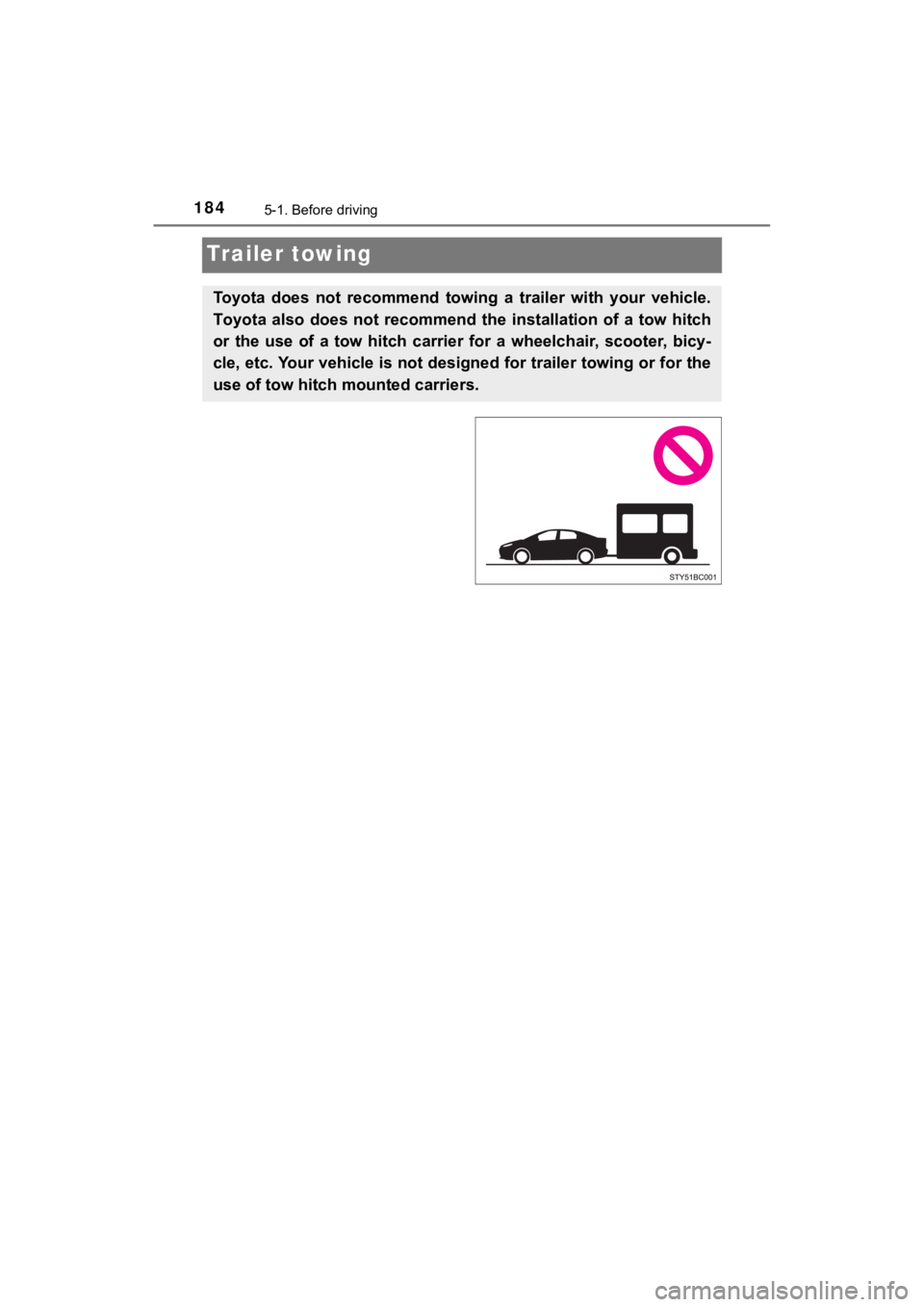
Toyota does not recommend towing a trailer with your vehicle.
Toyota also does not recommend the installation of a tow hitch
or the use of a tow hitch carrier for a wheelchair, scooter, bi cy-
cle, etc. Your vehicle is not des igned for trailer towing or for the
use of tow hitch mounted carriers.
Page 185 of 528
1855-1. Before driving
5
Driving
MIRAI_OM_USA_OM62054U(18MY)_O
M62048U(19MY)
Dinghy towing
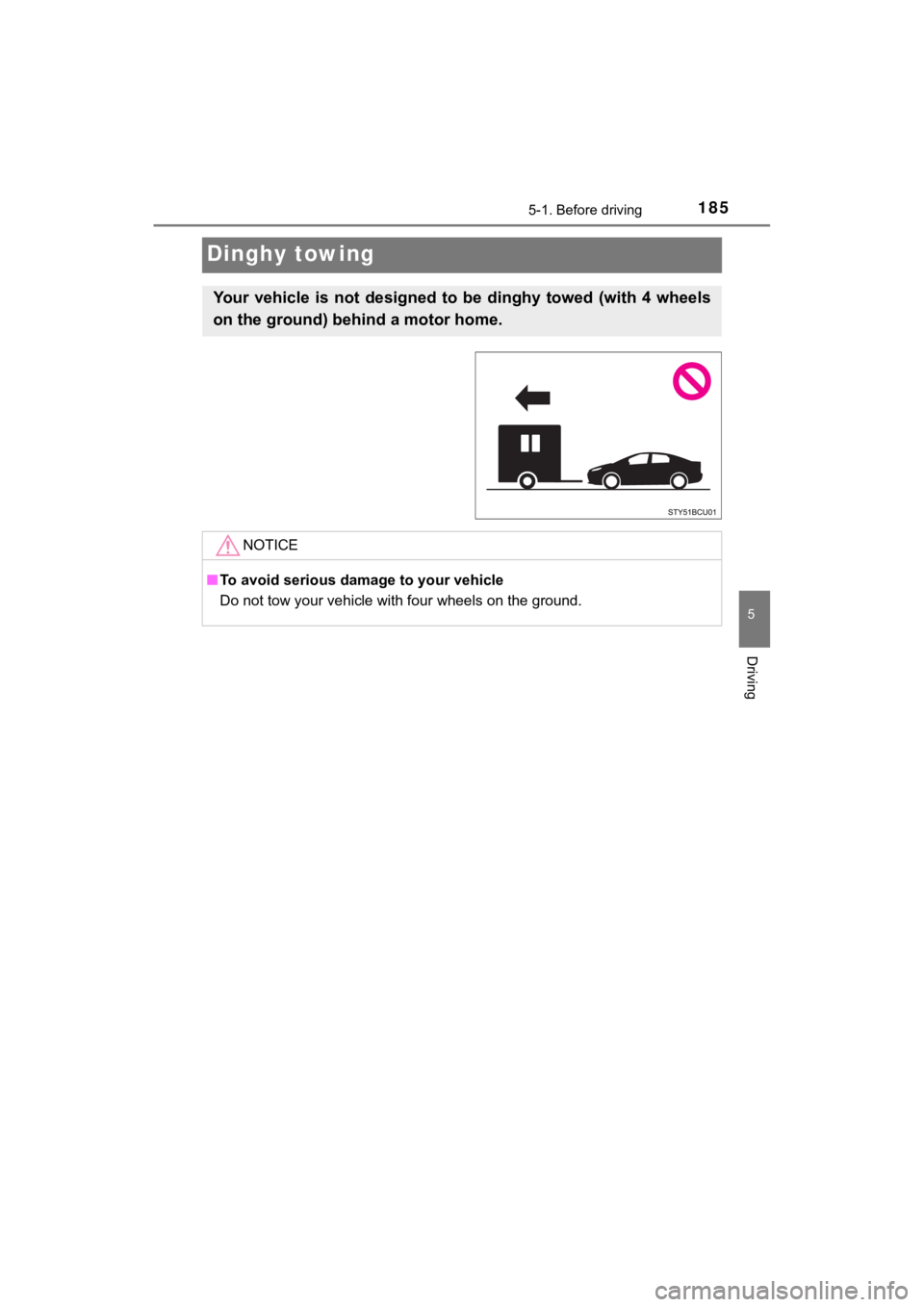
Your vehicle is not designed to be dinghy towed (with 4 wheels
on the ground) behind a motor home.
NOTICE
■To avoid serious damage to your vehicle
Do not tow your vehicle with four wheels on the ground.
Page 190 of 528

1905-2. Driving procedures
MIRAI_OM_USA_OM62054U(18MY)_O
M62048U(19MY)■
Parking the vehicle during cold weather
●Water may automatically purge from the tailpipe, even when the fuel cell
system is off, in order to prevent liquid in the fuel cell stac k, hydrogen pipe-
lines, etc., from freezing.
● It is normal to hear hissing and other sounds during purge. ( P. 88)
● The H
2O indicator on the meter will illuminate during purge.
■ Water release function during cold weather
In the following cases, the fuel cell system automatic drainage may not oper-
ate. It may not be possible to start the fuel cell system due t o the fuel cell
stack, hydrogen pipes, etc, being frozen.
• When transporting or towing the vehicle in frozen areas
• When the 12-volt battery terminals are disconnected and remain as such
in frozen areas
Operate the water release function with the following procedure beforehand
to prevent water from freezing in the system.
Turn the power switch to ON mode and press the H
2O switch.
Check that the H
2O indicator on the meter turns on.
While depressing the brake, press the power switch to start the fuel cell
system.
Check that the “READY” indicator turns on.
Press the power switch to stop the fuel cell system.
The water release is automatically performed. During water purg e, the
H
2O indicator turns on. (Longer than normal water purge)
■ Conditions affecting operation
P. 146
■ Notes for the entry function
P. 147
■ If the fuel cell system does not start
●The immobilizer system may not have been deactivated. ( P. 78)
Contact your Toyota dealer.
● Check that the shift position is P. ( P. 193)
The fuel cell system cannot be started when the shift position is N.
If P position is not selected, “Shift to P position to start” w ill be displayed on
the multi-information display.
● Check that the fuel door is closed.
When the fuel door is open, the fuel cell system cannot be star ted.
Close the fuel door before starting the system. ( P. 216)
1
2
3