inflation pressure TOYOTA MIRAI 2019 (in English) Owner's Manual
[x] Cancel search | Manufacturer: TOYOTA, Model Year: 2019, Model line: MIRAI, Model: TOYOTA MIRAI 2019Pages: 528, PDF Size: 11.84 MB
Page 443 of 528
4438-2. Steps to take in an emergency
MIRAI_OM_USA_OM62054U(18MY)_O
M62048U(19MY)
8
When trouble arises
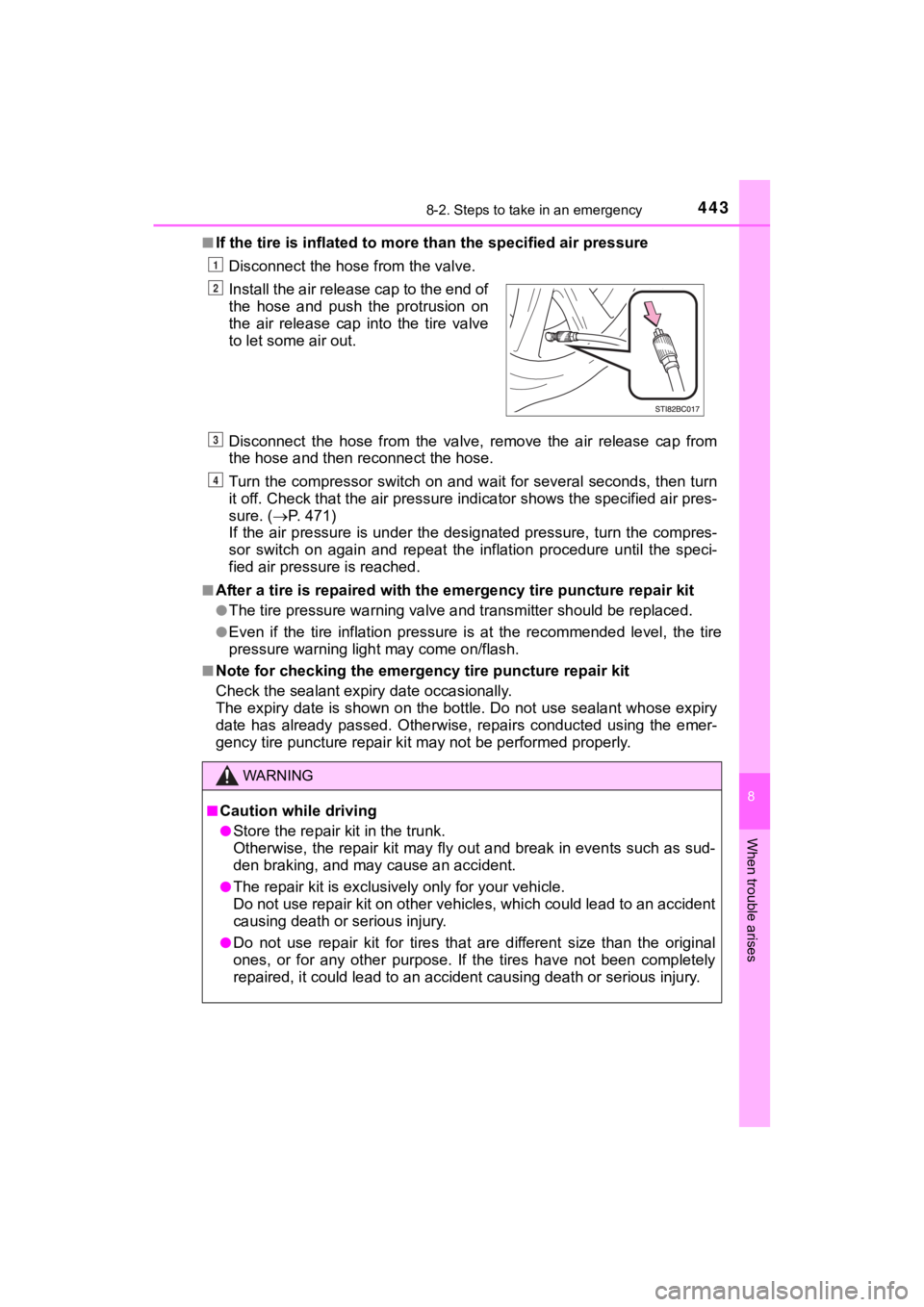
■If the tire is inflated to more than the specified air pressure
Disconnect the hose from the valve.
Disconnect the hose from the valv e, remove the air release cap from
the hose and then reconnect the hose.
Turn the compressor switch on and wait for several seconds, then turn
it off. Check that the air pressu re indicator shows the specified air pres-
sure. ( P. 471)
If the air pressure is under the designated pressure, turn the compres-
sor switch on again and repeat the inflation procedure until th e speci-
fied air pressure is reached.
■After a tire is repaired with the emergency tire puncture repai r kit
●The tire pressure warning valve and transmitter should be replaced.
●Even if the tire inflation pressure is at the recommended level, the tire
pressure warning light may come on/flash.
■Note for checking the emergency tire puncture repair kit
Check the sealant expiry date occasionally.
The expiry date is shown on the bottle. Do not use sealant whos e expiry
date has already passed. Otherwise, repairs conducted using the emer-
gency tire puncture repair kit may not be performed properly. Install the air release cap to the end of
the hose and push the protrusion on
the air release cap into the tire valve
to let some air out.
WARNING
■Caution while driving
●Store the repair kit in the trunk.
Otherwise, the repair kit may fl
y out and break in events such as sud-
den braking, and may cause an accident.
●The repair kit is exclusively only for your vehicle.
Do not use repair kit on other vehicles, which could lead to an accident
causing death or serious injury.
●Do not use repair kit for tires that are different size than th e original
ones, or for any other purpose. If the tires have not been comp letely
repaired, it could le ad to an accident causing death or serious injury.
1
2
3
4
Page 444 of 528

4448-2. Steps to take in an emergency
MIRAI_OM_USA_OM62054U(18MY)_O
M62048U(19MY)
WARNING
■Precautions for use of the sealant
●Ingesting the sealant is hazardous to your health. If you ingest sealant,
consume as much water as possibl e, and then immediately consult a
doctor.
●If sealant gets in eyes or adheres to skin, immediately wash it off with
water. If discomfort persi sts, consult a doctor.
■When fixing the flat tire
●Stop your vehicle in a safe and flat area.
●Do not touch the wheels or the area around the brakes immediate ly
after the vehicle has been driven.
After the vehicle has been driven, the wheels and the area arou nd the
brakes may be extremely hot. Touching these areas with hands, f eet or
other body parts may result in burns.
●Connect the valve and hose securely with the tire installed on the vehi-
cle.
●If the hose is not properly connected to the valve, air leakage may
occur or sealant may be sprayed out.
●Follow the operation procedure to repair the tire. If the proce dures are
not followed, the sealant may spray out.
●If the hose comes off the valve while inflating the tire, there is a risk
that the hose will mo ve abruptly due to air pressure.
●After inflation of the tire has completed, the sealant may spla tter when
the hose is disconnec ted or some air is let out of the tire.
●Keep back from the tire while it is being repaired, as there is a chance
of it bursting while the repair operation is being performed. I f you
notice any cracks or deformation of the tire, turn off the comp ressor
switch and stop the repair operation immediately.
●The repair kit may overheat if operated for a long period of ti me. Do not
operate the repair kit continuous ly for more than 40 minutes.
●Parts of the repair kit become hot during operation. Be careful handling
the repair kit during and after operation. Do not touch the met al part
connecting the bottle and the compressor. I t will be extremely hot.
●Do not attach the vehicle speed warning sticker to an area other than
the one indicated. If the sticker is attached to an area where an SRS
airbag is located, such as the pad of the steering wheel, it ma y prevent
the SRS airbag from operating properly.
Page 445 of 528

4458-2. Steps to take in an emergency
MIRAI_OM_USA_OM62054U(18MY)_O
M62048U(19MY)
8
When trouble arises
WARNING
■Driving to spread the liquid sealant evenly
Observe the following precautions to reduce the risk of accidents.
Failure to do so may result in a loss of vehicle control and ca use death
or serious injury.
●Drive the vehicle carefully at a low speed. Be especially caref ul when
turning and cornering.
●If the vehicle does not drive straight or you feel a pull throu gh the
steering wheel, stop the vehi cle and check the following:
• Tire condition. The tire may have separated f rom the wheel.
• Tire inflation pressure. If tire inflation pressure is 19 psi (130 kPa,
1.3 kgf/cm
2 or bar) or less, this may i ndicate severe tire damage.
Page 471 of 528
4719-1. Specifications
MIRAI_OM_USA_OM62054U(18MY)_O
M62048U(19MY)
9
Vehicle specifications
*: Light bulbs not listed in this table are LED bulbs.
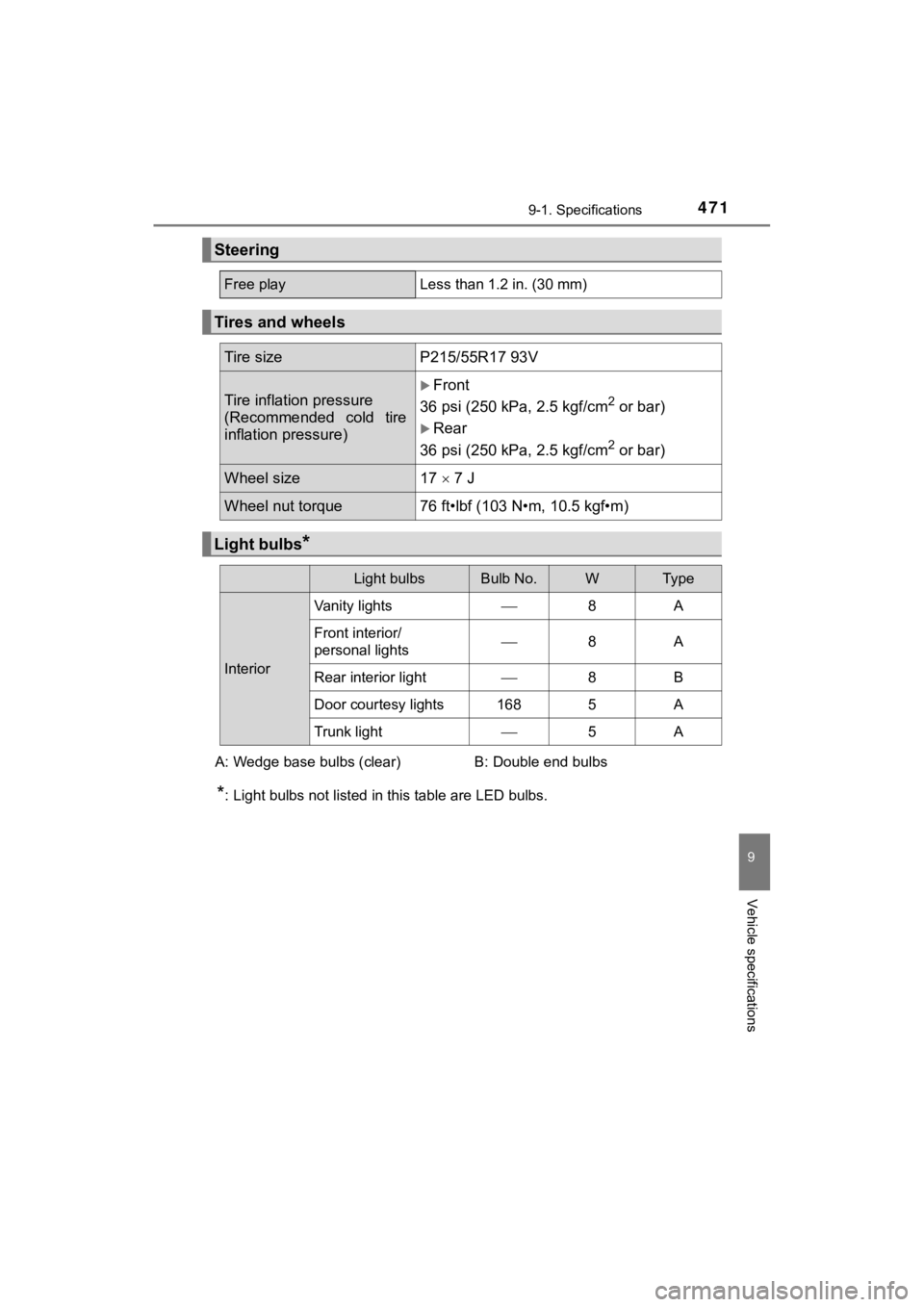
Steering
Free playLess than 1.2 in. (30 mm)
Tires and wheels
Tire sizeP215/55R17 93V
Tire inflation pressure
(Recommended cold tire
inflation pressure)
Front
36 psi (250 kPa, 2.5 kgf/cm
2 or bar)
Rear
36 psi (250 kPa, 2.5 kgf/cm2 or bar)
Wheel size 17 7 J
Wheel nut torque76 ft•lbf (103 N•m, 10.5 kgf•m)
Light bulbs*
Light bulbsBulb No.WTy p e
Interior Vanity lights
8A
Front interior/
personal lights
8A
Rear interior light 8B
Door courtesy lights 168 5 A
Trunk light 5A
A: Wedge base bulbs (clear) B: Double end bulbs
Page 472 of 528
4729-1. Specifications
MIRAI_OM_USA_OM62054U(18MY)_O
M62048U(19MY)
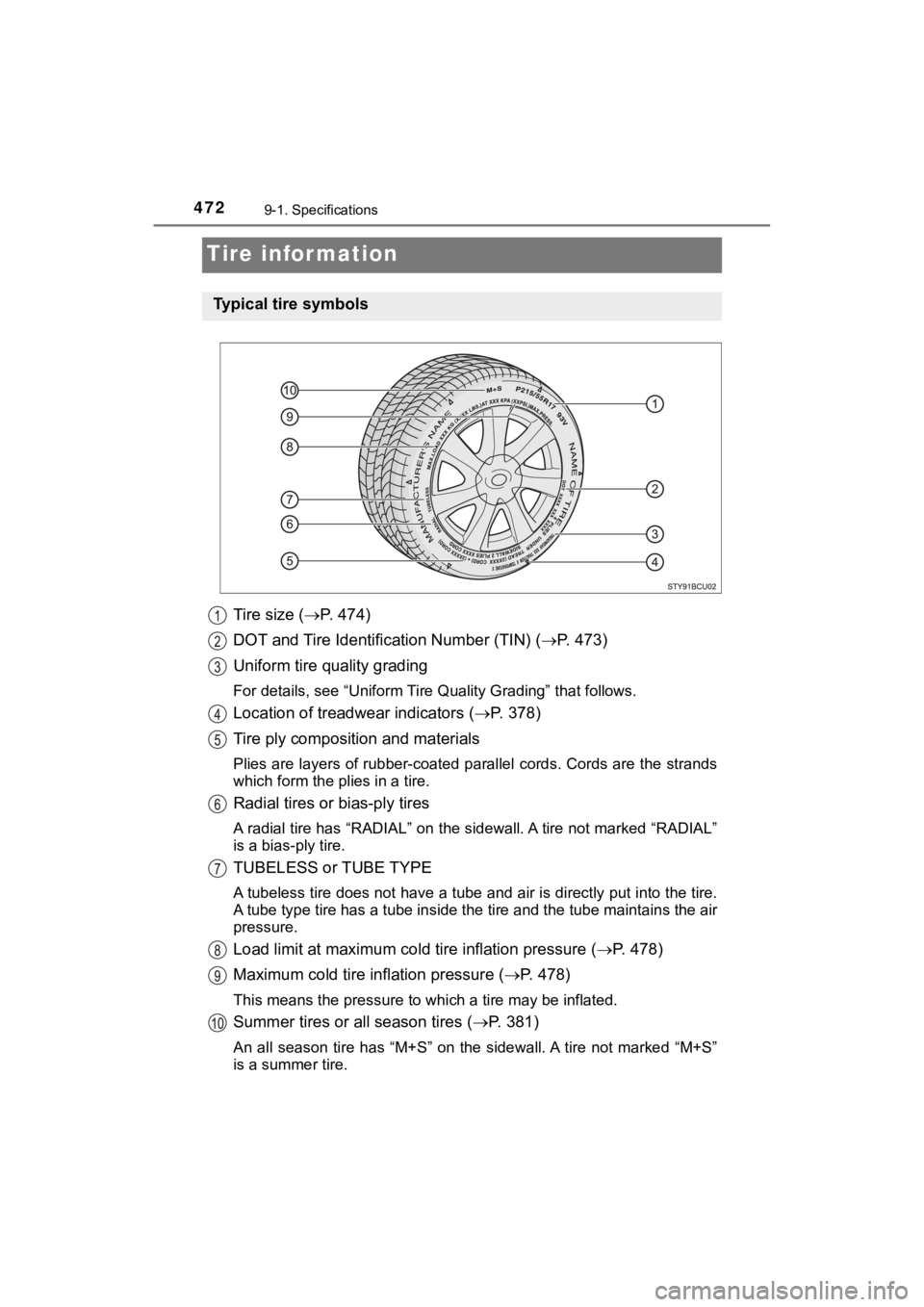
Tire information
Tire size (P. 474)
DOT and Tire Identification Number (TIN) ( P. 4 7 3 )
Uniform tire quality grading
For details, see “Uniform Tire Q uality Grading” that follows.
Location of treadwear indicators ( P. 3 7 8 )
Tire ply composition and materials
Plies are layers of rubber-coated parallel cords. Cords are the strands
which form the p lies in a tire.
Radial tires or bias-ply tires
A radial tire has “RADIAL” on the sidewall. A tire not marked “ RADIAL”
is a bias-ply tire.
TUBELESS or TUBE TYPE
A tubeless tire does not have a tube and air is directly put into the tire.
A tube type tire has a tube insi de the tire and the tube mainta ins the air
pressure.
Load limit at maximum cold tire inflation pressure ( P. 478)
Maximum cold tire in flation pressure (P. 478)
This means the press ure to which a tire may be inflated.
Summer tires or all season tires ( P. 3 8 1 )
An all season tire has “M+S” on the sidewall. A tire not marked “M+S”
is a summer tire.
Typical tire symbols
Page 478 of 528
4789-1. Specifications
MIRAI_OM_USA_OM62054U(18MY)_O
M62048U(19MY)
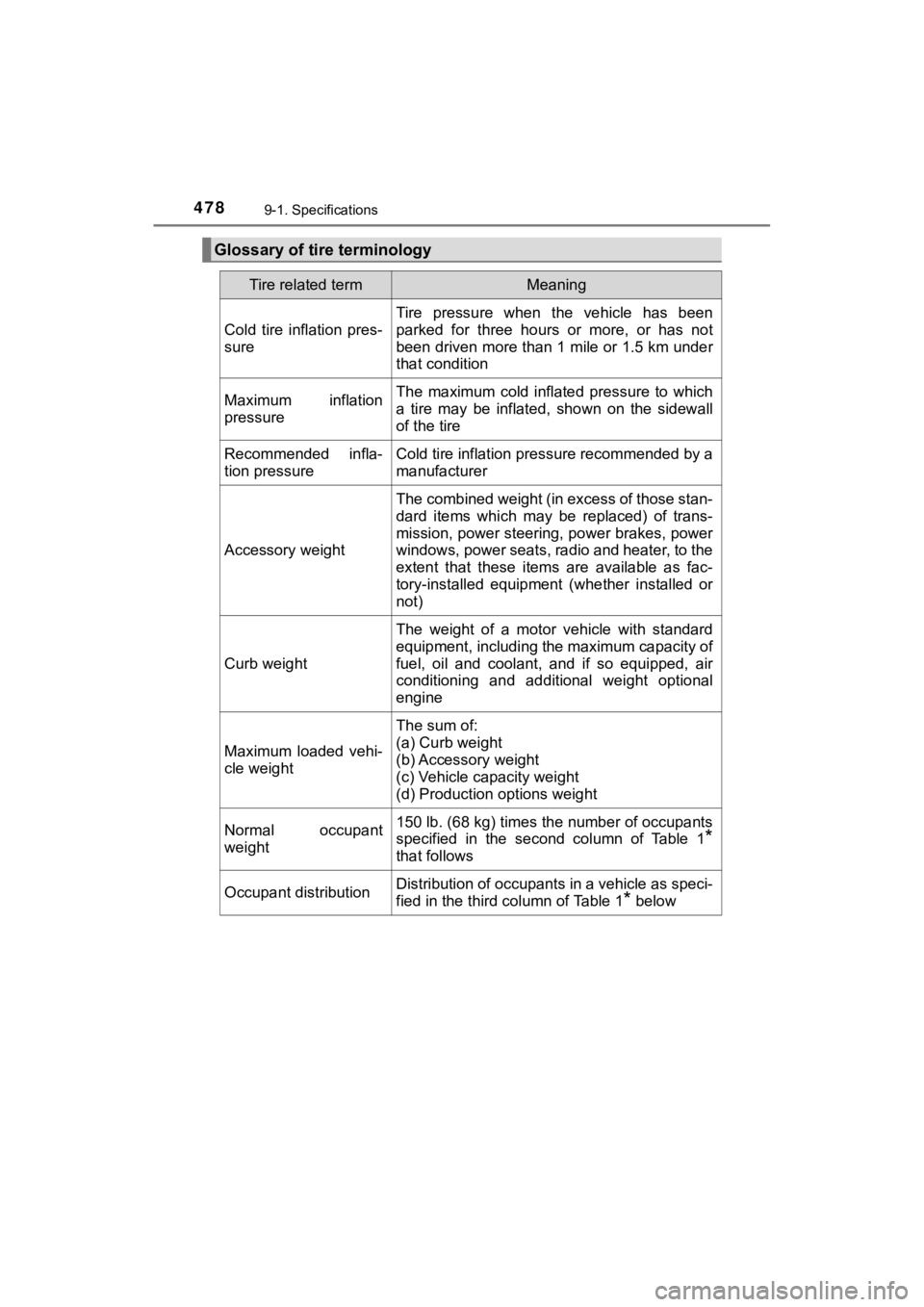
Glossary of tire terminology
Tire related termMeaning
Cold tire inflation pres-
sure
Tire pressure when the vehicle has been
parked for three hours or more, or has not
been driven more than 1 mile or 1.5 km under
that condition
Maximum inflation
pressureThe maximum cold inflated pressure to which
a tire may be inflated, shown on the sidewall
of the tire
Recommended infla-
tion pressureCold tire inflation pressure recommended by a
manufacturer
Accessory weight
The combined weight (in excess of those stan-
dard items which may be replaced) of trans-
mission, power steering, power brakes, power
windows, power seats, radio and heater, to the
extent that these items are available as fac-
tory-installed equipment (whether installed or
not)
Curb weight
The weight of a motor vehicle with standard
equipment, including the maximum capacity of
fuel, oil and coolant, and if so equipped, air
conditioning and additional weight optional
engine
Maximum loaded vehi-
cle weight
The sum of:
(a) Curb weight
(b) Accessory weight
(c) Vehicle capacity weight
(d) Production options weight
Normal occupant
weight150 lb. (68 kg) times the number of occupants
specified in the second column of Table 1
*
that follows
Occupant distributionDistribution of occupants in a vehicle as speci-
fied in the third column of Table 1
* below
Page 480 of 528
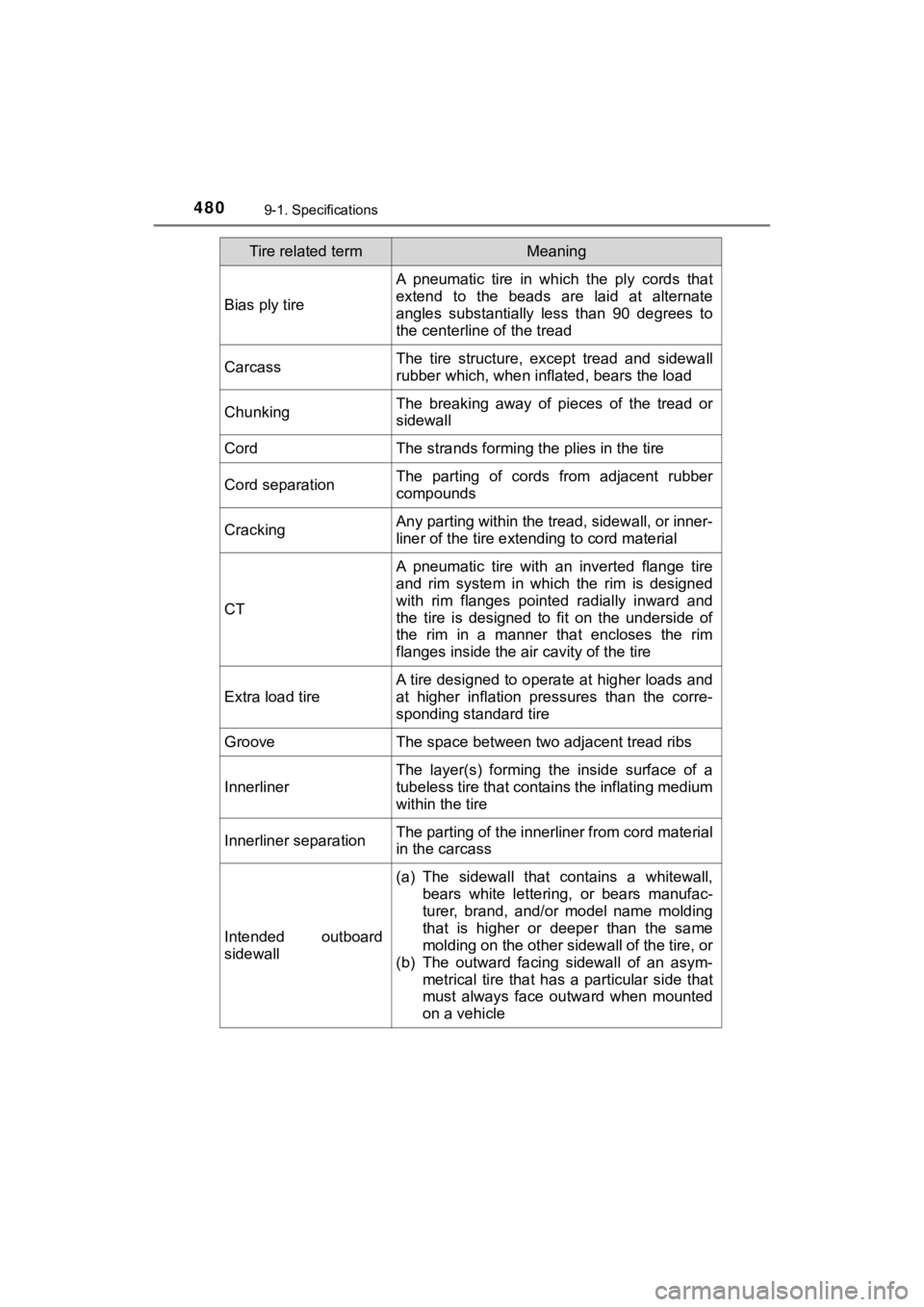
4809-1. Specifications
MIRAI_OM_USA_OM62054U(18MY)_O
M62048U(19MY)
Bias ply tire
A pneumatic tire in which the ply cords that
extend to the beads are laid at alternate
angles substantially less than 90 degrees to
the centerline of the tread
CarcassThe tire structure, except tread and sidewall
rubber which, when inflated, bears the load
ChunkingThe breaking away of pieces of the tread or
sidewall
CordThe strands forming the plies in the tire
Cord separationThe parting of cords from adjacent rubber
compounds
CrackingAny parting within the tread, sidewall, or inner-
liner of the tire extending to cord material
CT
A pneumatic tire with an inverted flange tire
and rim system in which the rim is designed
with rim flanges pointed radially inward and
the tire is designed to fit on the underside of
the rim in a manner that encloses the rim
flanges inside the air cavity of the tire
Extra load tire
A tire designed to operate at higher loads and
at higher inflation pressures than the corre-
sponding standard tire
GrooveThe space between two adjacent tread ribs
Innerliner
The layer(s) forming the inside surface of a
tubeless tire that contains the inflating medium
within the tire
Innerliner separationThe parting of the innerliner from cord material
in the carcass
Intended outboard
sidewall
(a) The sidewall that contains a whitewall,
bears white lettering, or bears manufac-
turer, brand, and/or model name molding
that is higher or deeper than the same
molding on the other sidewall of the tire, or
(b) The outward facing sidewall of an asym-
metrical tire that has a particular side that
must always face outward when mounted
on a vehicle
Tire related termMeaning
Page 481 of 528
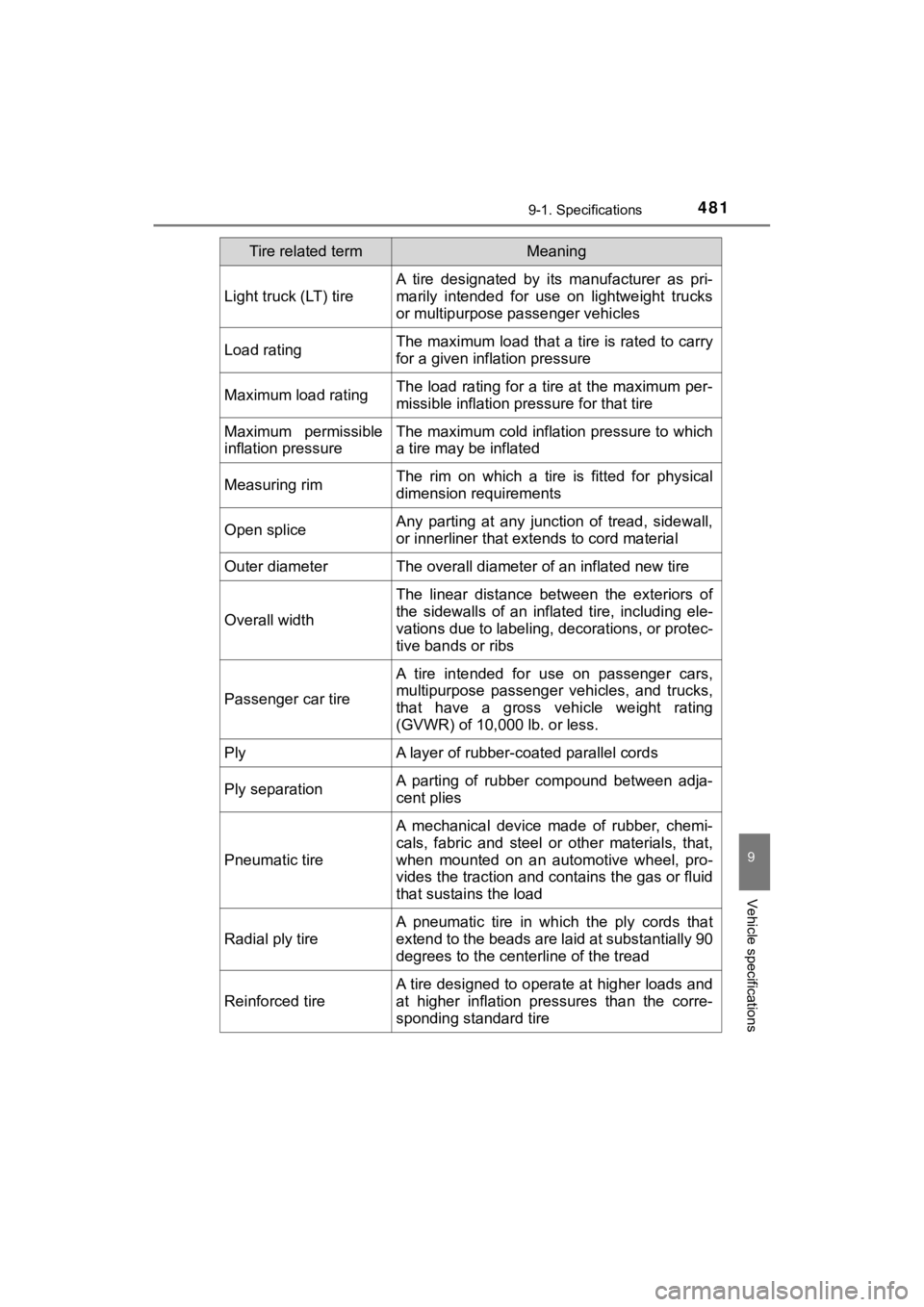
4819-1. Specifications
MIRAI_OM_USA_OM62054U(18MY)_O
M62048U(19MY)
9
Vehicle specifications
Light truck (LT) tire
A tire designated by its manufacturer as pri-
marily intended for use on lightweight trucks
or multipurpose passenger vehicles
Load ratingThe maximum load that a tire is rated to carry
for a given inflation pressure
Maximum load ratingThe load rating for a tire at the maximum per-
missible inflation pressure for that tire
Maximum permissible
inflation pressureThe maximum cold inflation pressure to which
a tire may be inflated
Measuring rimThe rim on which a tire is fitted for physical
dimension requirements
Open spliceAny parting at any junction of tread, sidewall,
or innerliner that extends to cord material
Outer diameterThe overall diameter of an inflated new tire
Overall width
The linear distance between the exteriors of
the sidewalls of an inflated tire, including ele-
vations due to labeling, decorations, or protec-
tive bands or ribs
Passenger car tire
A tire intended for use on passenger cars,
multipurpose passenger vehicles, and trucks,
that have a gross vehicle weight rating
(GVWR) of 10,000 lb. or less.
PlyA layer of rubber-coated parallel cords
Ply separationA parting of rubber compound between adja-
cent plies
Pneumatic tire
A mechanical device made of rubber, chemi-
cals, fabric and steel or other materials, that,
when mounted on an automotive wheel, pro-
vides the traction and co ntains the gas or fluid
that sustains the load
Radial ply tire
A pneumatic tire in which the ply cords that
extend to the beads are laid at substantially 90
degrees to the centerline of the tread
Reinforced tire
A tire designed to operate at higher loads and
at higher inflation pressures than the corre-
sponding standard tire
Tire related termMeaning
Page 525 of 528

525Alphabetical index
MIRAI_OM_USA_OM62054U(18MY)_O
M62048U(19MY)
Tail lights .................................. 201Light switch ........................... 201
Replacing light bulbs............. 405
Tailpipe ....................................... 95
Talk switch
*
Telephone switches*
Theft deterrent system Alarm ...................................... 81
Immobilizer system ................. 78
Tire inflation pressure ............. 393 Maintenance data ................. 471
Warning light ......................... 421
Tire information ....................... 472 Glossary................................ 478
Size ....................................... 474
Tire identification number ..... 473
Uniform Tire Quality
Grading............................... 476
Tire pressure warning system Function ................................ 379
Installing tire pressure
warning valves
and transmitters.................. 379
Registering ID codes ............ 379
Warning light ......................... 421 Tires .......................................... 378
Chains .................................. 302
Checking............................... 378
Emergency tire puncture repair kit ............................ 434
If you have a flat tire ............. 432
Inflation pressure .......... 393, 471
Information............................ 472
Replacing.............................. 386
Rotating tires ........................ 378
Size....................................... 471
Snow tires ............................. 301
Tire pressure warning system .......... ...................... 379
Warning light......................... 421
Tools ................................. 386, 434
Top tether strap ......................... 69
Total load capacity .................. 183
Towing Dinghy towing ....................... 185
Emergency towing ................ 411
Trailer towing ........................ 184
TRAC (Traction Control) ......... 295
Traction battery ......................... 91
Air intake vent ......................... 93
Charging ................................. 89
Location ............................ 86, 91
Warning message................. 426
Traction battery air intake vent........................................... 93
Traction Control (TRAC) ......... 295
T
*: Refer to the “NAVIGATION SYSTEM OWNER’S MANUAL”.
Page 528 of 528
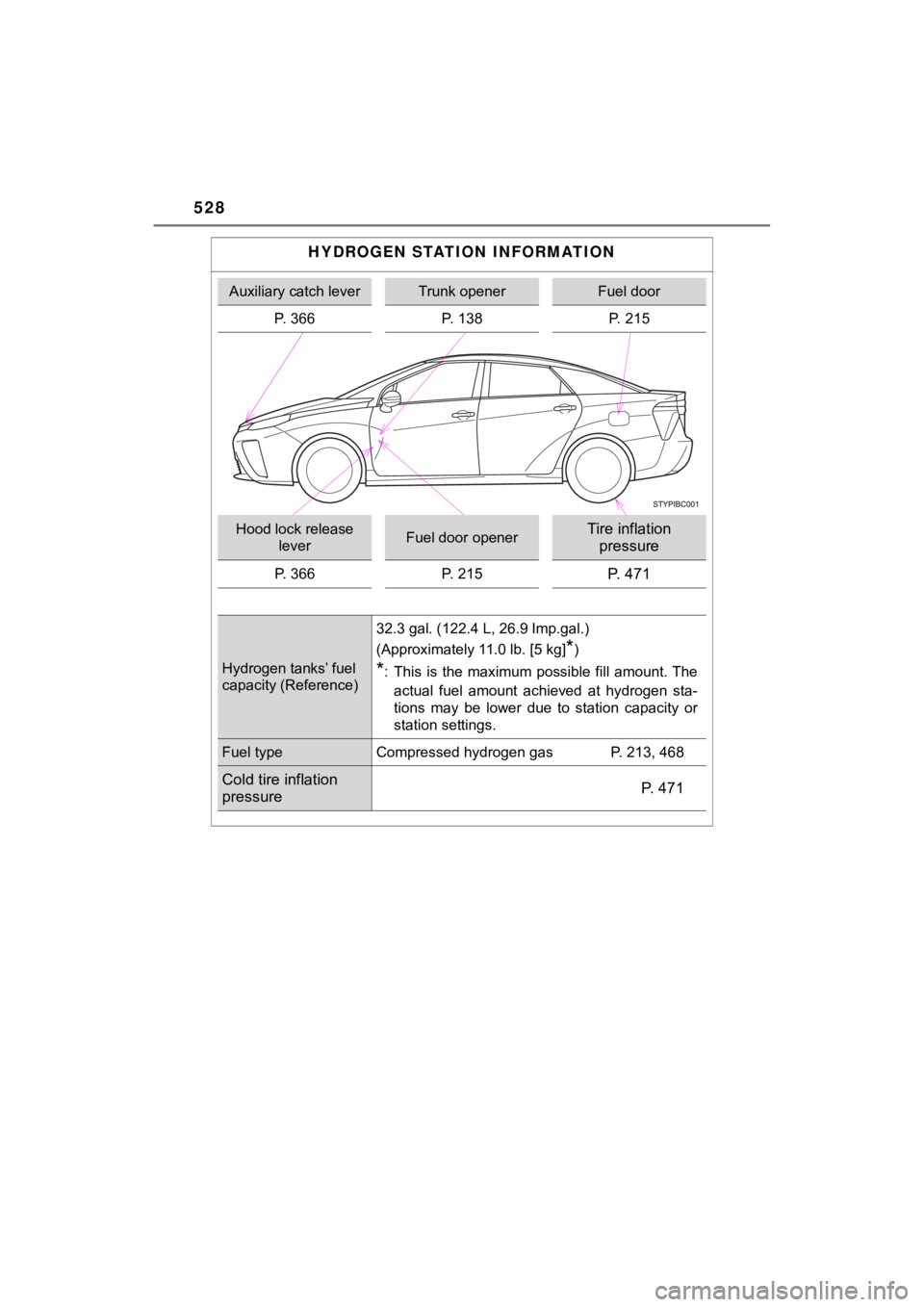
528
MIRAI_OM_USA_OM62054U(18MY)_O
M62048U(19MY)
HYDROGEN STATION INFORMATION
Auxiliary catch leverTrunk openerFuel door
P. 366 P. 138P. 215
Hood lock release
leverFuel door openerTire inflation pressure
P. 366 P. 215P. 471
Hydrogen tanks’ fuel
capacity (Reference)32.3 gal. (122.4 L, 26.9 Imp.gal.)
(Approximately 11.0 lb. [5 kg]
*)
*: This is the maximum possible fill amount. The
actual fuel amount achieved at hydrogen sta-
tions may be lower due to station capacity or
station settings.
Fuel type Compressed hydrogen gas P. 213, 468
Cold tire inflation
pressure P. 4 7 1