fuel cap TOYOTA MIRAI 2019 Owners Manual (in English)
[x] Cancel search | Manufacturer: TOYOTA, Model Year: 2019, Model line: MIRAI, Model: TOYOTA MIRAI 2019Pages: 528, PDF Size: 11.84 MB
Page 15 of 528
15Pictorial index
MIRAI_OM_USA_OM62054U(18MY)_O
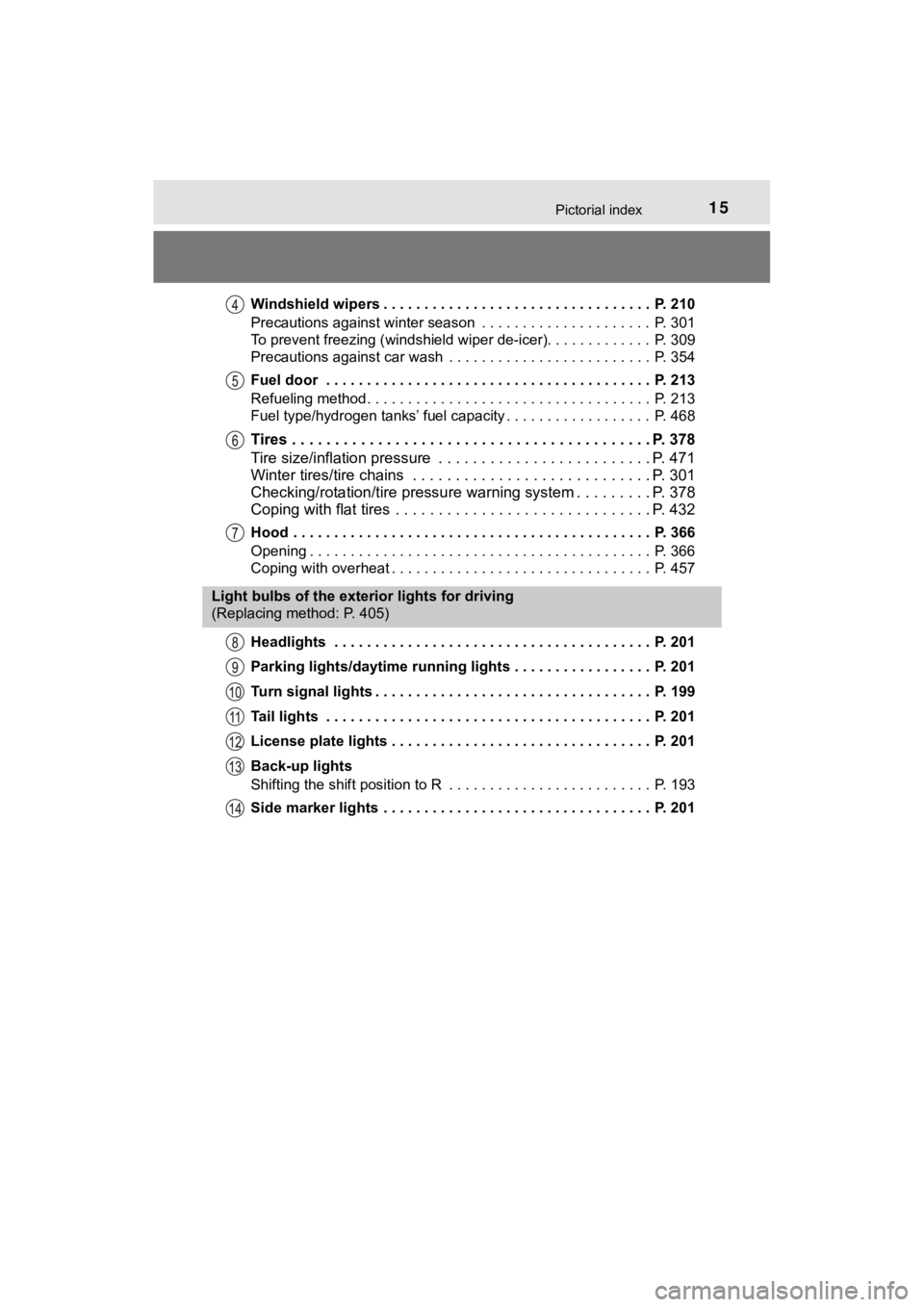
M62048U(19MY)Windshield wipers . . . . . . . . . . . . . . . . . . . . . . . . . . . . . . . . . P. 210
Precautions against winter season . . . . . . . . . . . . . . . . . . . . . P. 301
To prevent freezing (windshield wiper de-icer). . . . . . . . . . . . . P. 309
Precautions against car wash . . . . . . . . . . . . . . . . . . . . . . . . . P. 354
Fuel door . . . . . . . . . . . . . . . . . . . . . . . . . . . . . . . . . . . . . . . . P. 213
Refueling method . . . . . . . . . . . . . . . . . . . . . . . . . . . . . . . . . . . P. 213
Fuel type/hydrogen tanks’ fuel capacity . . . . . . . . . . . . . . . . . . P. 468
Tires . . . . . . . . . . . . . . . . . . . . . . . . . . . . .
. . . . . . . . . . . . . P. 378
Tire size/inflation pressure . . . . . . . . . . . . . . . . . . . . . . . . . P. 471
Winter tires/tire chains . . . . . . . . . . . . . . . . . . . . . . . . . . . . P. 301
Checking/rotation/tire pressur e warning system . . . . . . . . .P. 378
Coping with flat tires . . . . . . . . . . . . . . . . . . . . . . . . . . . . . . P. 432
Hood . . . . . . . . . . . . . . . . . . . . . . . . . . . . . . . . . . . . . . . . . . . . P. 366
Opening . . . . . . . . . . . . . . . . . . . . . . . . . . . . . . . . . . . . . . . . . . P. 366
Coping with overheat . . . . . . . . . . . . . . . . . . . . . . . . . . . . . . . . P. 457
Headlights . . . . . . . . . . . . . . . . . . . . . . . . . . . . . . . . . . . . . . . P. 201
Parking lights/daytime running lights . . . . . . . . . . . . . . . . . P. 201
Turn signal lights . . . . . . . . . . . . . . . . . . . . . . . . . . . . . . . . . . P. 199
Tail lights . . . . . . . . . . . . . . . . . . . . . . . . . . . . . . . . . . . . . . . . P. 201
License plate lights . . . . . . . . . . . . . . . . . . . . . . . . . . . . . . . . P. 201
Back-up lights
Shifting the shift position to R . . . . . . . . . . . . . . . . . . . . . . . . . P. 193
Side marker lights . . . . . . . . . . . . . . . . . . . . . . . . . . . . . . . . . P. 201
Light bulbs of the exterior lights for driving
(Replacing method: P. 405)
Page 98 of 528

982. Fuel cell vehicle
MIRAI_OM_USA_OM62054U(18MY)_O
M62048U(19MY)■
Basic concepts of hydrogen safety
●Prevent leakage
The pipe joints of the hydrogen pipelines are designed to preve nt leaks.
The joints are checked for gas leakage at every official vehicle inspection.
● Detect to stop leakage
• The vehicle is equipped with hydrogen detectors. If the hydrog en detec-
tors detect a leak, the hydrogen tank valves automatically clos e to pre-
vent more hydrogen from escaping.
• The vehicle is equipped with a collision sensor. If the collis ion sensor
detects a collision, the hydrogen tank valves automatically clo se to pre-
vent hydrogen gas from leaking from any damaged components.
● Disperse the leaked hydrogen gas
The hydrogen tanks and pipelines are located outside of the passenger
compartment, so any leaked gas will disperse into the atmospher e by
design.
● Eliminate sources of fire
No source of fire is located near the hydrogen pipelines by des ign.
WARNING
■Hydrogen-related components
● Never alter, customize, or disassemble any hydrogen-related par ts.
● The hydrogen tanks, fuel cell stack, hydrogen pipelines, and co nnecting
components are filled with hydrogen gas. Do not remove or disassemble
these parts. Doing so can cause a hydrogen gas leak, resulting in fire or
explosion of the vehicle, which may result in death or serious injury.
■ When hydrogen gas leak or other malfunction is detected
● If a large amount of hydrogen gas leaking is noticed, turn off the power
switch, exit the vehicle, and stay far away from it. Display wa rning signs
and keep sources of fire away from the vehicle. If possible, get assistance.
When the above is done, immediately contact your Toyota dealer.
● If you notice gas leaking or any other malfunction, immediately stop the
vehicle in a safe and well-ventilated place, exit the vehicle, and stay far
away from it.
● If a warning message is shown on the multi-information display, immedi-
ately stop the vehicle in a safe, well-ventilated place.
Page 173 of 528

1735-1. Before driving
5
Driving
MIRAI_OM_USA_OM62054U(18MY)_O
M62048U(19MY)
■When starting off on an uphill
The hill-start assist control will activate. ( P. 295)
■ For fuel-efficient driving
Keep in mind that fuel cell vehicles are similar to conventiona l vehicles, and it
is necessary to refrain from activities such as sudden accelera tion. (P. 102)
■ Driving in the rain
●Drive carefully when it is raining, because visibility will be reduced, the win-
dows may become fogged-up, and the road will be slippery.
● Drive carefully when it starts to rain, because the road surface will be espe-
cially slippery.
● Refrain from high speeds when driving on an expressway in the r ain,
because there may be a layer of water between the tires and the road sur-
face, preventing the steering and brakes from operating properl y.
■ Restraining the fuel cell system output (Brake Override System)
● When the accelerator and brake pedals are depressed at the same time, the
fuel cell system output may be restrained.
● A warning message is displayed on the multi-information display while the
system is operating. If a warning message is shown on the multi -information
display, read the message and follow the instructions.
■ Restraining sudden start (Drive-Start Control)
● When the following unusual operation is performed, the fuel cel l system out-
put may be restrained.
• When the shift lever is shifted from R to D, D to R, N to R, P to D, or P to
R with the accelerator pedal depressed, a warning message appears on
the multi-information display. If a warning message is shown on the multi-
information display, read the message and follow the instructio ns.
• When the accelerator pedal is depressed too while the vehicle is in
reverse.
● While Drive-Start Control is being activated, your vehicle may have trou-
ble escaping from the mud or fresh snow. In such case, deactiva te TRAC
( P. 296) to cancel Drive-Start Control so that the vehicle may b ecome
able to escape from the mud or fresh snow.
Page 176 of 528

1765-1. Before driving
MIRAI_OM_USA_OM62054U(18MY)_O
M62048U(19MY)
WARNING
Observe the following precautions.
Failure to do so may result in death or serious injury.
■When driving the vehicle
● Do not drive in excess of the speed limit. Even if the legal sp eed limit per-
mits it, do not drive over 85 mph (140 km/h) unless your vehicl e has high-
speed capability tires. Driving over 85 mph (140 km/h) may resu lt in tire
failure, loss of control and possible injury. Be sure to consult a tire dealer
to determine whether the tires on your vehicle are high-speed c apability
tires or not before driving at such speeds.
■ When driving on slippery road surfaces
● Sudden braking, acceleration and steering may cause tire slippa ge and
reduce your ability to control the vehicle.
● Sudden acceleration or regenerative braking due to shifting cou ld cause
the vehicle to skid.
● After driving through a puddle, lightly depress the brake pedal to make
sure that the brakes are functioning properly. Wet brake pads m ay prevent
the brakes from functioning properly. If the brakes on only one side are wet
and not functioning properly, steering control may be affected.
■ When changing the shift position
● Do not let the vehicle roll backward while a forward driving position is
selected, or roll forward while the shift position is in R.
Doing so may result in an accident or damage to the vehicle.
● Do not shift the shift position to P while the vehicle is movin g.
Doing so can damage the transmission and may result in a loss o f vehicle
control.
● Do not shift the shift position to R while the vehicle is movin g forward.
Doing so can damage the transmission and may result in a loss o f vehicle
control.
● Do not shift the shift position to a driving position while the vehicle is mov-
ing backward.
Doing so can damage the transmission and may result in a loss o f vehicle
control.
● Shifting the shift position to N while the vehicle is moving wi ll disengage
the fuel cell system. Regenerative braking is not available with the fuel cell
system disengaged.
● Be careful not to shift the shift position with the accelerator pedal
depressed. Shifting the shift position to any position other th an P or N may
lead to unexpected rapid acceleration of the vehicle that may c ause an
accident and result in death or serious injury.
After shifting the shift position, make sure to check the current shift posi-
tion using the shift position indicator. ( P. 193)
Page 214 of 528

2145-4. Refueling
MIRAI_OM_USA_OM62054U(18MY)_O
M62048U(19MY)
WARNING
■When filling
Observe the following precautions while fueling the vehicle.
Failure to do so may result in death or serious injury.
● Turn the power switch off before fueling.
● Ensure the hydrogen gas nozzle is locked onto the vehicle recep tacle
before filling. This can be done by pulling on the hydrogen gas nozzle to
check that it cannot be pulled off.
Failure to do so may result in injury or damage to the hydrogen gas nozzle
or vehicle.
● Do not smoke while fueling.
● Because the fuel is cold, the hydrogen gas nozzle and vehicle r eceptacle
surface will become cold, and frost may develop. After fueling is com-
pleted, remove the hydrogen gas nozzle by the plastic handle on ly. Do not
touch any other parts of the hydrogen gas nozzle or vehicle rec eptacle
with bare hands immediately after fueling, as frostbite may occ ur.
NOTICE
■When filling
● Fuel only with compressed hydrogen gas at stations compliant with the
Society of Automotive Engineers (SAE) J2601 fueling protocol or laws that
may supersede such SAE protocols.
If improper fuels are used, the fuel cell stack will be damaged .
● Do not swing or drop the hydrogen gas nozzle, or subject it to a large
amount of force. Doing so may cause damage.
● If the hydrogen gas nozzle cannot be removed after fueling, it may be fro-
zen to the vehicle receptacle. Wait for the hydrogen gas nozzle to thaw
before attempting to remove. Do not pull or rotate the hydrogen gas nozzle
forcibly. Failure to follow these precautions may cause damage.
● Be sure to replace the cap after filling. If foreign material g ets in the vehicle
receptacle, it may cause damage.
● Do not put anything sharp, such as a screwdriver, blade, or any foreign
object into the mouth of the vehicle receptacle. If the vehicle receptacle is
damaged, hydrogen gas may leak during fueling.
● If you notice anything unusual about the vehicle receptacle, pl ease notify
your Toyota dealer.
● If you notice anything unusual with the hydrogen dispenser or h ydrogen
gas nozzle, please notify the hydrogen station operator. Contac t informa-
tion is usually displayed on the dispenser.
Page 215 of 528
2155-4. Refueling
5
Driving
MIRAI_OM_USA_OM62054U(18MY)_O
M62048U(19MY)
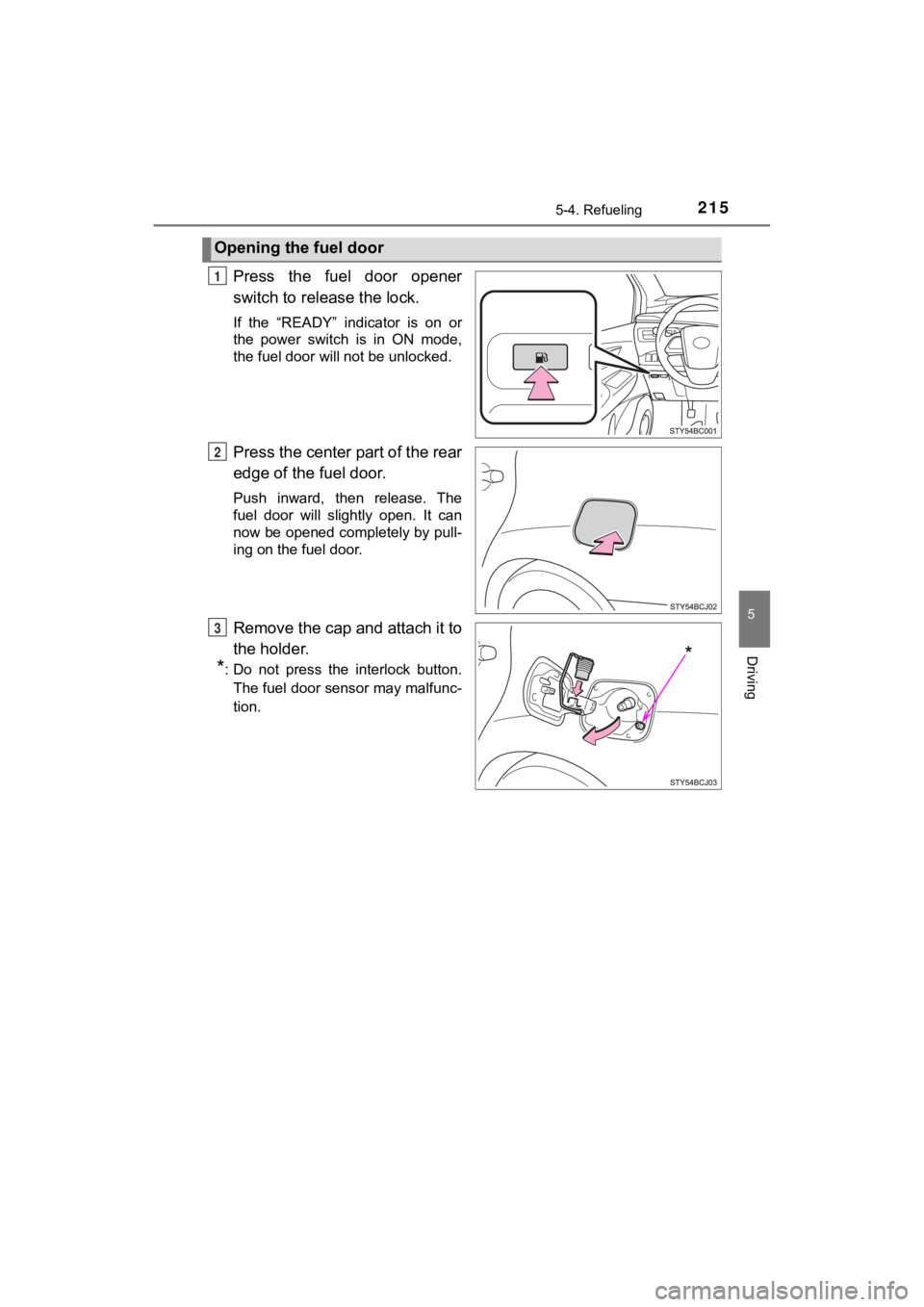
Press the fuel door opener
switch to release the lock.
If the “READY” indicator is on or
the power switch is in ON mode,
the fuel door will not be unlocked.
Press the center part of the rear
edge of the fuel door.
Push inward, then release. The
fuel door will slightly open. It can
now be opened completely by pull-
ing on the fuel door.
Remove the cap and attach it to
the holder.
*: Do not press the interlock button.The fuel door sensor may malfunc-
tion.
Opening the fuel door
1
2
*
P
Page 216 of 528
2165-4. Refueling
MIRAI_OM_USA_OM62054U(18MY)_O
M62048U(19MY)
■If “Open H2 Filler Door in a Safe Place when Vehicle is Powered OFF” is
displayed on the multi-information display
Stop the vehicle in a safe place and press the fuel door opener switch once
more with the following procedure:
Shift the shift position to P.
Turn the power switch off.
Press the fuel door opener switch.
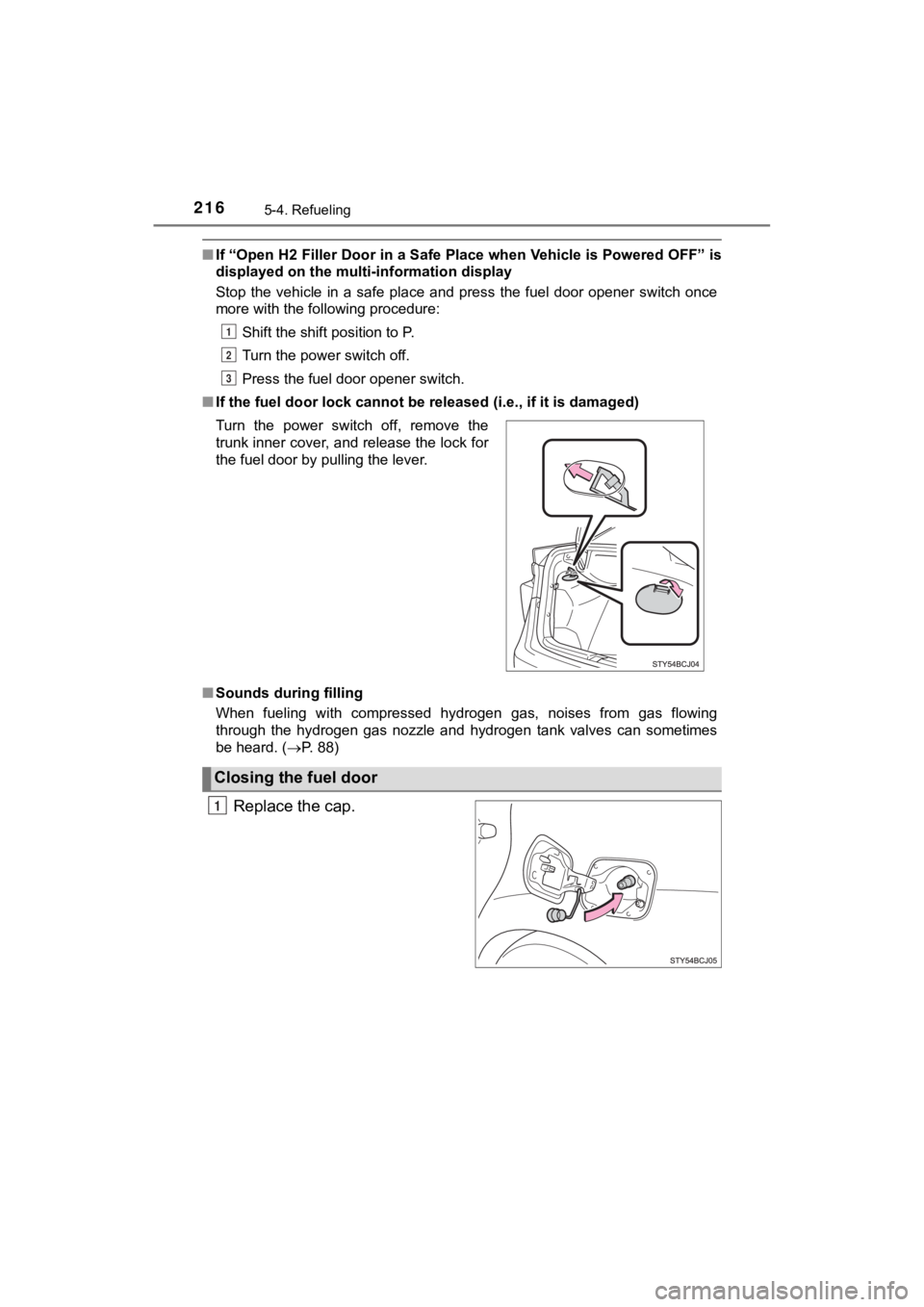
■ If the fuel door lock cannot be released (i.e., if it is damaged)
■ Sounds during filling
When fueling with compressed hydrogen gas, noises from gas flow ing
through the hydrogen gas nozzle and hydrogen tank valves can so metimes
be heard. ( P. 88)
Replace the cap.
Turn the power switch off, remove the
trunk inner cover, and release the lock for
the fuel door by pulling the lever.
Closing the fuel door
1
2
3
1
Page 217 of 528
2175-4. Refueling
5
Driving
MIRAI_OM_USA_OM62054U(18MY)_O
M62048U(19MY)
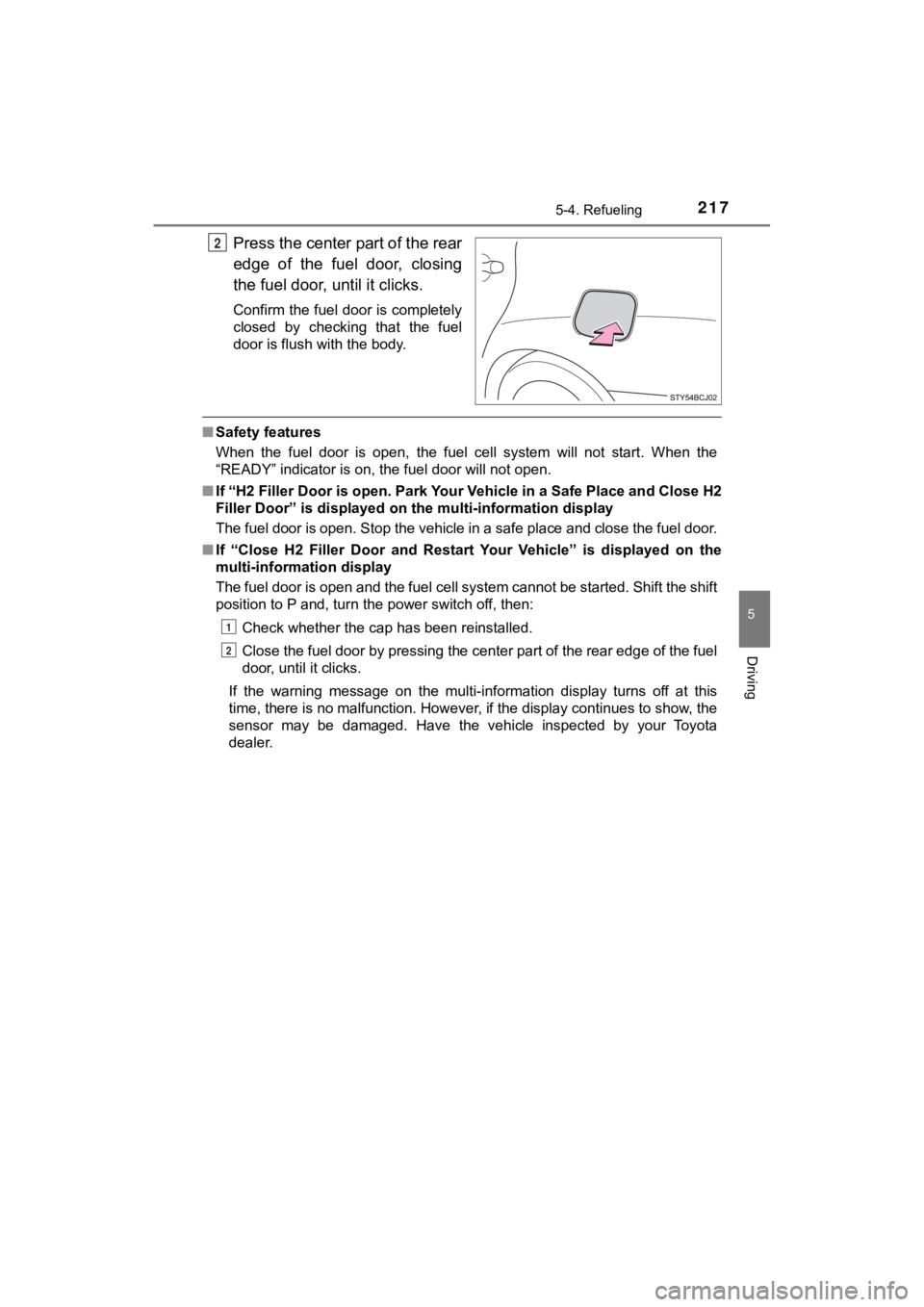
Press the center part of the rear
edge of the fuel door, closing
the fuel door, until it clicks.
Confirm the fuel door is completely
closed by checking that the fuel
door is flush with the body.
■Safety features
When the fuel door is open, the fuel cell system will not start . When the
“READY” indicator is on, the fuel door will not open.
■ If “H2 Filler Door is open. Park Your Vehicle in a Safe Place a nd Close H2
Filler Door” is displayed on th e multi-information display
The fuel door is open. Stop the vehicle in a safe place and close the fuel door.
■ If “Close H2 Filler Door and Restart Your Vehicle” is displayed on the
multi-information display
The fuel door is open and the fuel cell system cannot be starte d. Shift the shift
position to P and, turn the power switch off, then:
Check whether the cap has been reinstalled.
Close the fuel door by pressing the center part of the rear edg e of the fuel
door, until it clicks.
If the warning message on the multi-information display turns o ff at this
time, there is no malfunction. However, if the display continues to show, the
sensor may be damaged. Have the vehicle inspected by your Toyot a
dealer.
2
1
2
Page 311 of 528
3116-1. Using the air conditioning system and defogger
6
Interior features
MIRAI_OM_USA_OM62054U(18MY)_O
M62048U(19MY)■
Fogging up of the windows
●The windows will easily fog up when the humidity in the vehicle is high.
Turning on will dehumidify the air from the outlets and defog the wind-
shield effectively.
● If you turn off, the windows may fog up more easily.
● The windows may fog up if the recirculated air mode is used.
■ Windshield fog detection function
When automatic mode is set, the humidity sensor (P. 314) detects fog on
the windshield and controls the air conditioning system to prev ent fog.
■ Outside/recirculated air mode
●When driving on dusty roads such as tunnels or in heavy traffic, set the out-
side/recirculated air mode button to recirculated air mode. Thi s is effective in
preventing outside air from entering the vehicle interior. Duri ng cooling oper-
ation, setting the recirculated air mode will also cool the vehicle interior
effectively.
● Outside/recirculated air mode may automatically switch dependin g on the
temperature setting or the inside temperature.
■ Operation of the air conditioni ng system in ECO HEAT/COOL mode
● In ECO HEAT/COOL mode, the air conditioning system is controlle d as fol-
lows to prioritize fuel efficiency:
• Fluid (heating) heater and compressor operation controlled to restrict
heating/cooling capacity
• Fan speed restricted when automatic mode is selected
● To improve air conditioning performance, perform the following operations:
• Adjust the temperature settings and fan speed
• Touch while in , and is set
• Touch while in , and ECO HEAT/COOL mode is canceled
■ Operation of the air conditioning system in Eco drive mode
When “ECO MODE” switch is pressed, operations switch over to EC O HEAT/
COOL mode. ( P. 197)
■ When the outside temperature exceeds 75°F (24°C) and the air co ndition-
ing system is on
● In order to reduce the air conditioning power consumption, the air condition-
ing system may switch to recirculated air mode automatically. This may also
reduce fuel consumption.
● Recirculated air mode is selected as a default mode when the power switch
is turned to ON mode.
● It is possible to switch to outside air mode at any time by pre ssing .
Page 355 of 528
3557-1. Maintenance and care
MIRAI_OM_USA_OM62054U(18MY)_O
M62048U(19MY)
7
Maintenance and care
NOTICE
■Cleaning the exterior lights
● Wash carefully. Do not use organic substances or scrub with a h ard brush.
This may damage the surfaces of the lights.
● Do not apply wax to the surfaces of the lights.
Wax may cause damage to the lenses.
■ When washing the car
Do not remove the vehicle receptacle cap and directly pour wate r over the
vehicle receptacle. If water enters the vehicle receptacle, dam age may
occur.
■ When using an automatic car wash
Set the wiper switch to the off position. ( P. 210)
If the wiper switch is in “AUTO” the wipers may operate and the wiper
blades may be damaged.
■ When using a high pressure car wash
● When washing the vehicle, do not let water of the high pressure washer hit
directly or the vicinity of the camera. Due to the shock from t he high pres-
sure water, it is possible the device may not operate as normal .
● Do not bring the nozzle tip close to boots (rubber or resin man ufactured
cover), connectors or the following parts. The parts may be dam aged if
they come into contact with high-pressure water.
• Fuel cell stack
• Traction related parts
• Steering parts
• Suspension parts
• Brake parts
● Keep the cleaning nozzle at least 11.9 in. (30 cm) away from th e vehicle
body. Otherwise resin section, such as moldings and bumpers, ma y be
deformed and damaged. Also, do not continuously hold the nozzle in the
same place.
● Do not spray the lower part of the windshield continuously. If water enters
the air conditioning system intake located near the lower part of the wind-
shield, the air conditioning system may not operate correctly.
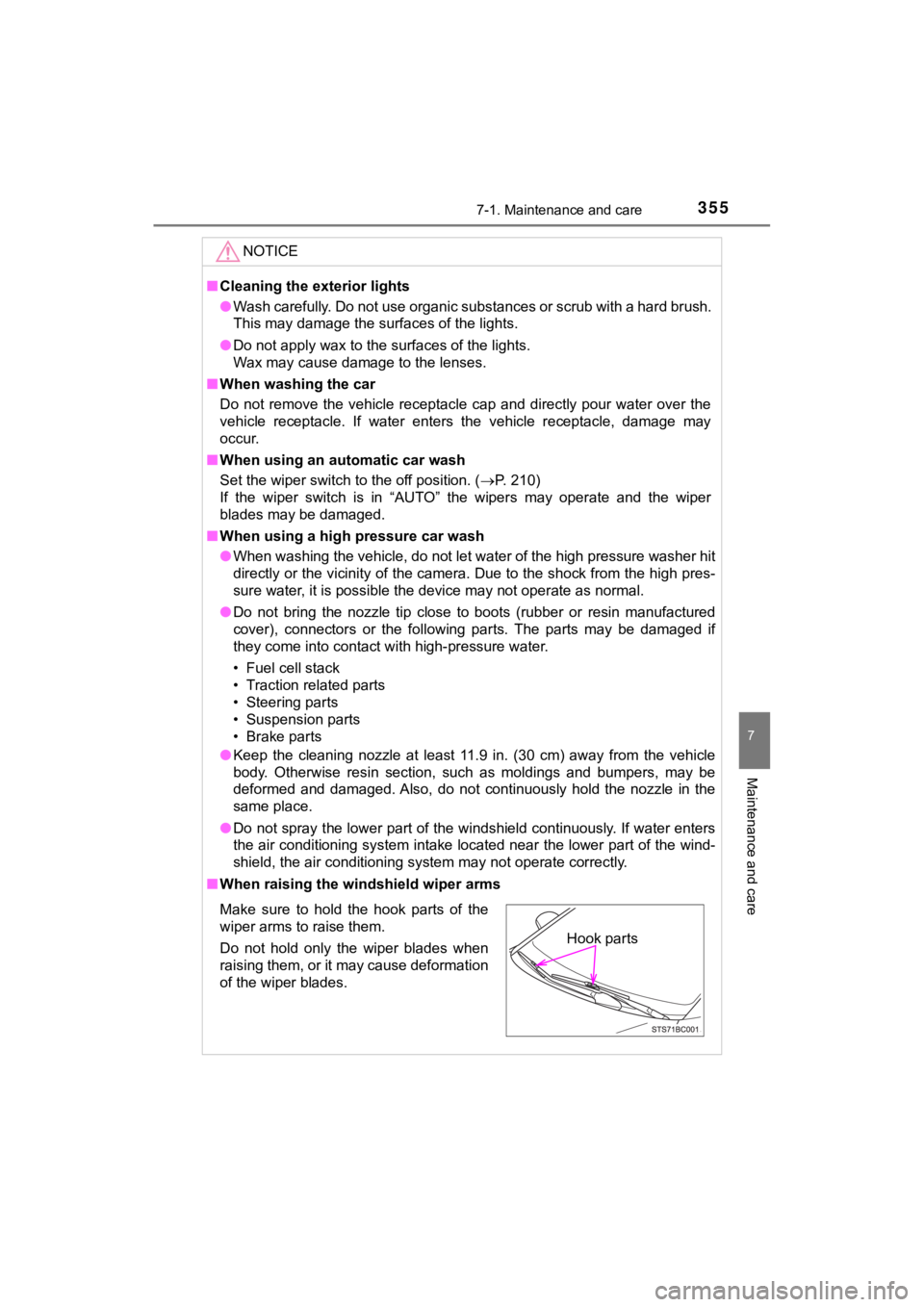
■ When raising the windshield wiper arms
Make sure to hold the hook parts of the
wiper arms to raise them.
Do not hold only the wiper blades when
raising them, or it may cause deformation
of the wiper blades.
Hook parts