inflation pressure TOYOTA MIRAI 2019 Owners Manual (in English)
[x] Cancel search | Manufacturer: TOYOTA, Model Year: 2019, Model line: MIRAI, Model: TOYOTA MIRAI 2019Pages: 528, PDF Size: 11.84 MB
Page 4 of 528

TABLE OF CONTENTS4
MIRAI_OM_USA_OM62054U(18MY)_O
M62048U(19MY)6-1. Using the air conditioning
system and defogger
Automatic air conditioning system............................. 306
Heated steering wheel/ seat heaters .................... 315
6-2. Using the interior lights Interior lights list ................ 317• Interior lights ................. 318
• Personal lights .............. 318
6-3. Using the storage features List of storage features...... 320• Glove box...................... 321
• Console box .................. 321
• Cup holders .................. 322
• Bottle holders ................ 324
• Auxiliary box ................. 324
Trunk features ................... 325
6-4. Other interior features Other interior features ....... 327• Sun visors ..................... 327
• Vanity mirrors................ 327
• Clock ............................. 328
• Armrest ......................... 329
• Coat hooks.................... 329
• Assist grips ................... 330
• Power outlet .................. 331
• USB charging ports....... 332
• Wireless charger ........... 334
Garage door opener .......... 343 7-1. Maintenance and care
Cleaning and protecting the vehicle exterior .......... 352
Cleaning and protecting the vehicle interior ........... 356
7-2. Maintenance Maintenance requirements ................... 359
General maintenance ........ 361
7-3. Do-it-yourself maintenance
Do-it-yourself service precautions ...................... 364
Hood .................................. 366
Positioning a floor jack....... 367
Motor compartment ........... 369
12-volt battery .................... 374
Tires................................... 378
Replacing the tire............... 386
Tire inflation pressure ........ 393
Wheels............................... 396
Air conditioning filter .......... 398
Electronic key battery ........ 400
Checking and replacing fuses ................................ 402
Light bulbs ......................... 405
6Interior features7Maintenance and care
Page 15 of 528
15Pictorial index
MIRAI_OM_USA_OM62054U(18MY)_O
M62048U(19MY)Windshield wipers . . . . . . . . . . . . . . . . . . . . . . . . . . . . . . . . . P. 210
Precautions against winter season . . . . . . . . . . . . . . . . . . . . . P. 301
To prevent freezing (windshield wiper de-icer). . . . . . . . . . . . . P. 309
Precautions against car wash . . . . . . . . . . . . . . . . . . . . . . . . . P. 354
Fuel door . . . . . . . . . . . . . . . . . . . . . . . . . . . . . . . . . . . . . . . . P. 213
Refueling method . . . . . . . . . . . . . . . . . . . . . . . . . . . . . . . . . . . P. 213
Fuel type/hydrogen tanks’ fuel capacity . . . . . . . . . . . . . . . . . . P. 468
Tires . . . . . . . . . . . . . . . . . . . . . . . . . . . . .
. . . . . . . . . . . . . P. 378
Tire size/inflation pressure . . . . . . . . . . . . . . . . . . . . . . . . . P. 471
Winter tires/tire chains . . . . . . . . . . . . . . . . . . . . . . . . . . . . P. 301
Checking/rotation/tire pressur e warning system . . . . . . . . .P. 378
Coping with flat tires . . . . . . . . . . . . . . . . . . . . . . . . . . . . . . P. 432
Hood . . . . . . . . . . . . . . . . . . . . . . . . . . . . . . . . . . . . . . . . . . . . P. 366
Opening . . . . . . . . . . . . . . . . . . . . . . . . . . . . . . . . . . . . . . . . . . P. 366
Coping with overheat . . . . . . . . . . . . . . . . . . . . . . . . . . . . . . . . P. 457
Headlights . . . . . . . . . . . . . . . . . . . . . . . . . . . . . . . . . . . . . . . P. 201
Parking lights/daytime running lights . . . . . . . . . . . . . . . . . P. 201
Turn signal lights . . . . . . . . . . . . . . . . . . . . . . . . . . . . . . . . . . P. 199
Tail lights . . . . . . . . . . . . . . . . . . . . . . . . . . . . . . . . . . . . . . . . P. 201
License plate lights . . . . . . . . . . . . . . . . . . . . . . . . . . . . . . . . P. 201
Back-up lights
Shifting the shift position to R . . . . . . . . . . . . . . . . . . . . . . . . . P. 193
Side marker lights . . . . . . . . . . . . . . . . . . . . . . . . . . . . . . . . . P. 201
Light bulbs of the exterior lights for driving
(Replacing method: P. 405)
Page 103 of 528
1032. Fuel cell vehicle
2
Fuel cell system
MIRAI_OM_USA_OM62054U(18MY)_O
M62048U(19MY)
◆Using Eco drive mode
Using Eco drive mode (P. 195) makes torque generation less
aggressive than normal when stepping on the accelerator pedal,
leading to improvement in fuel economy.
Also, is displayed on the air conditioning screen, indicating
the switch to ECO HEAT/COOL mode ( P. 3 0 8 ) .
◆Air conditioning system on/off
● Turn off the air conditioning system operation switch except
when necessary to help curb fuel consumption.
In summer: When the ambient temperature is high, use the recircu -
lated air mode. This decreases the load on the air con-
ditioning system.
In winter: Avoid excess heating. Use the seat heater to minimize the need for cabin heating ( P. 316).
● By pushing , ECO HEAT/COOL mode is turned on. This
helps curb fuel consumption even with the air conditioning syst em
turned on.
◆Checking tire inflation pressure
Make sure to check the tire inflation pressure frequently. Impr oper
tire inflation pressure can cause poor fuel economy.
Additionally, snow tires have mo re rolling friction and their use on
dry roads lead to poor fuel economy. Use tires that are appropr iate
for the season.
◆Luggage
Avoid carrying unnecessary luggage and unload excess weight in
order avoid poor fuel economy. Installing a large roof rack wil l also
reduce fuel economy.
Page 237 of 528
2375-5. Using the driving support systems
5
Driving
MIRAI_OM_USA_OM62054U(18MY)_O
M62048U(19MY)• When driving through steam or smoke
• When the surrounding area is dim, such as at dawn or dusk, or
while at
night or in a tunnel, making a detectable object appear to be n early the
same color as its surroundings
• When driving in a place where the surrounding brightness changes sud- denly, such as at the entrance or exit of a tunnel
• After the fuel cell system has started the vehicle has not bee n driven for a
certain amount of time
• While making a left/right turn and for a few seconds after mak ing a left/
right turn
• While driving on a curve and for a few seconds after driving o n a curve
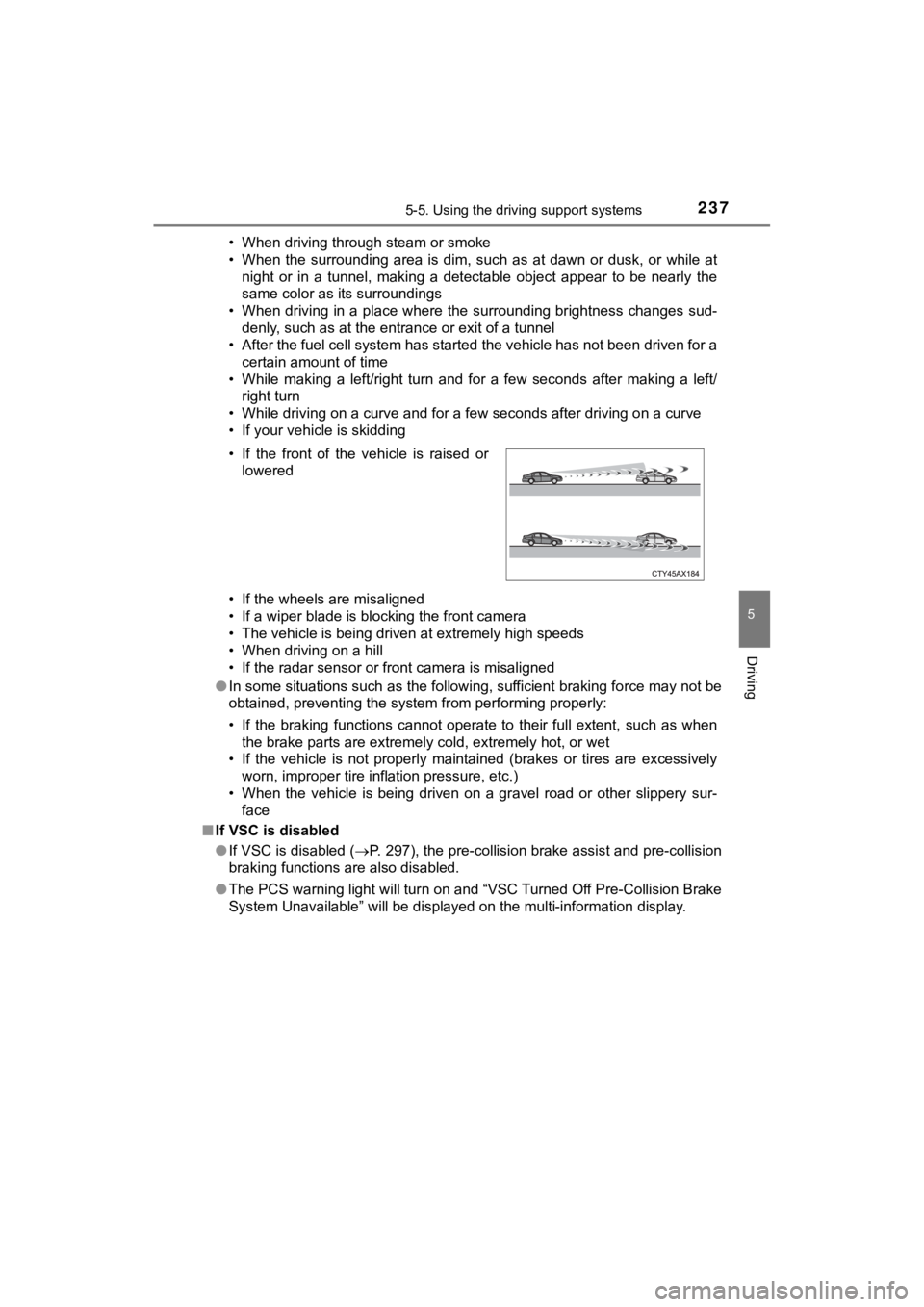
• If your vehicle is skidding
• If the wheels are misaligned
• If a wiper blade is blocking the front camera
• The vehicle is being driven at extremely high speeds
• When driving on a hill
• If the radar sensor or front camera is misaligned
● In some situations such as the following, sufficient braking fo rce may not be
obtained, preventing the system from performing properly:
• If the braking functions cannot operate to their full extent, such as when
the brake parts are extremely cold, extremely hot, or wet
• If the vehicle is not properly maintained (brakes or tires are excessively
worn, improper tire inflation pressure, etc.)
• When the vehicle is being driven on a gravel road or other sli ppery sur-
face
■ If VSC is disabled
●If VSC is disabled ( P. 297), the pre-collision brake assist and pre-collision
braking functions are also disabled.
● The PCS warning light will turn on and “VSC Turned Off Pre-Coll ision Brake
System Unavailable” will be displayed on the multi-information display.
• If the front of the vehicle is raised or
lowered
Page 300 of 528

3005-5. Using the driving support systems
MIRAI_OM_USA_OM62054U(18MY)_O
M62048U(19MY)
WARNING
■Replacing tires
Make sure that all tires are of the specified size, brand, trea d pattern and
total load capacity. In addition, make sure that the tires are inflated to the
recommended tire inflation pressure level.
The ABS, TRAC and VSC systems will not function correctly if di fferent tires
are installed on the vehicle.
Contact your Toyota dealer for further information when replaci ng tires or
wheels.
■ Handling of tires and the suspension
Using tires with any kind of problem or modifying the suspensio n will affect
the driving assist systems, and may cause a system to malfuncti on.
Page 351 of 528

351
7Maintenance and care
MIRAI_OM_USA_OM62054U(18MY)_O
M62048U(19MY)7-1. Maintenance and care
Cleaning and protecting the vehicle exterior .......... 352
Cleaning and protecting the vehicle interior ........... 356
7-2. Maintenance Maintenance requirements ................... 359
General maintenance........ 361
7-3. Do-it-yourself maintenance
Do-it-yourself service precautions ..................... 364
Hood ................................. 366
Positioning a floor jack ...... 367
Motor compartment ........... 369
12-volt battery ................... 374
Tires .................................. 378
Replacing the tire .............. 386
Tire inflation pressure ....... 393
Wheels .............................. 396
Air conditioning filter.......... 398
Electronic key battery........ 400
Checking and replacing fuses ............................... 402
Light bulbs......................... 405
Page 363 of 528
3637-2. Maintenance
MIRAI_OM_USA_OM62054U(18MY)_O
M62048U(19MY)
7
Maintenance and care
Seat belts
• Do the seat belts operatesmoothly?
• The seat belts should not be dam-
aged.
Seats• Do the seat controls operate prop-erly?
Steering wheel
• Does the steering wheel rotatesmoothly?
• Does the steering wheel have the correct amount of free play?
• There should not be any strange sounds coming from the steering
wheel.
Vehicle exterior
ItemsCheck points
ItemsCheck points
Doors/trunk• Do the doors/trunk operatesmoothly?
Hood• Does the hood lock system workproperly?
Fluid leaks
• There should not be any signs of
fluid leakage after the vehicle has
been parked.
Tires
• Is the tire inflation pressure cor-rect?
• The tires should not be dam- aged or excessively worn.
• Have the tires been rotated
according to the maintenance
schedule?
• The wheel nuts should not be
loose.
Windshield wipers
• The wiper blades should not show
any signs of cracking, splitting,
wear, contamination or deforma-
tion.
• The wiper blades should clear the windshield without streaking or
skipping.
Page 364 of 528
3647-3. Do-it-yourself maintenance
MIRAI_OM_USA_OM62054U(18MY)_O
M62048U(19MY)
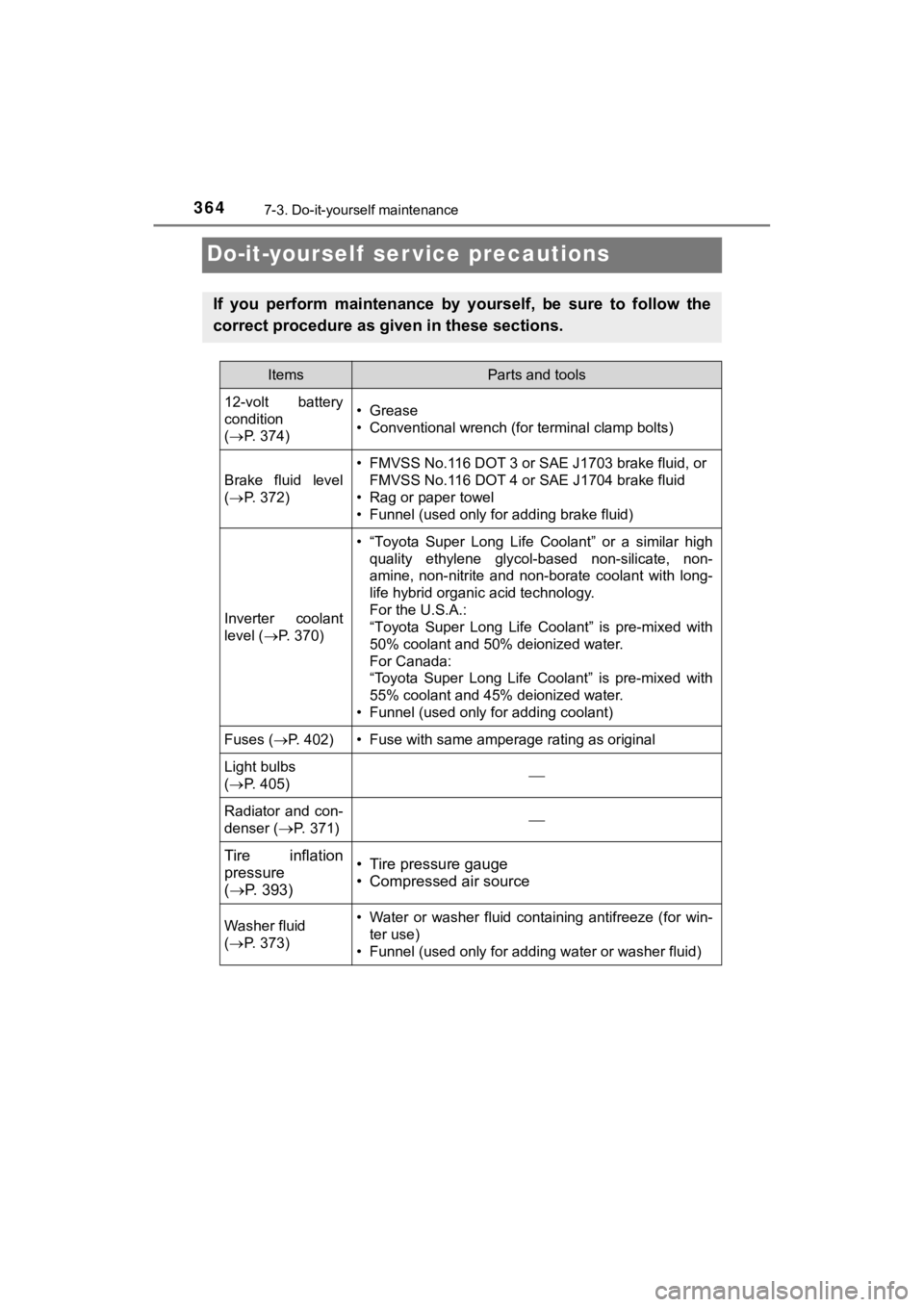
Do-it-yourself ser vice precautions
If you perform maintenance by yourself, be sure to follow the
correct procedure as given in these sections.
ItemsParts and tools
12-volt battery
condition
( P. 3 7 4 )•Grease
• Conventional wrench (for terminal clamp bolts)
Brake fluid level
( P. 3 7 2 )
• FMVSS No.116 DOT 3 or SAE J1703 brake fluid, or
FMVSS No.116 DOT 4 or SAE J1704 brake fluid
• Rag or paper towel
• Funnel (used only for adding brake fluid)
Inverter coolant
level ( P. 370)
• “Toyota Super Long Life Coolant” or a similar high
quality ethylene glycol-based non-silicate, non-
amine, non-nitrite and non-borate coolant with long-
life hybrid organic acid technology.
For the U.S.A.:
“Toyota Super Long Life Coolant” is pre-mixed with
50% coolant and 50% deionized water.
For Canada:
“Toyota Super Long Life Coolant” is pre-mixed with
55% coolant and 45% deionized water.
• Funnel (used only for adding coolant)
Fuses ( P. 402)• Fuse with same amperage rating as original
Light bulbs
( P. 4 0 5 )
Radiator and con-
denser (
P. 371)
Tire inflation
pressure
( P. 393)• Tire pressure gauge
• Compressed air source
Washer fluid
( P. 3 7 3 )• Water or washer fluid containing antifreeze (for win-
ter use)
• Funnel (used only for adding water or washer fluid)
Page 380 of 528
3807-3. Do-it-yourself maintenance
MIRAI_OM_USA_OM62054U(18MY)_O
M62048U(19MY)
■When to replace your vehicle’s tires
Tires should be replaced if:
●The treadwear indicators are showing on a tire.
●You have tire damage such as cuts, splits, cracks deep enough t o
expose the fabric, and bulges indicating internal damage
●A tire goes flat repeatedly or c annot be properly repaired due to the size
or location of a cut or other damage
If you are not sure, consult with your Toyota dealer.
■Replacing tires and wheels
If the ID code of the tire press ure warning valve and transmitt er is not reg-
istered, the tire pressure warni ng system will not work properly. A f t e r d r i v -
ing for about 20 minutes, the tire pressure warning light blink s for 1
minute and stays on to indi cate a system malfunction.
■Tire life
Any tire over 6 years old must be checked by a qualified techni cian even
if it has seldom or never been u sed or damage is not obvious.
■Routine tire inflation pressure checks
The tire pressure warning system does not replace routine tire inflation
pressure checks. Make sure to chec k tire inflation pressure as part of
your routine of daily vehicle checks.
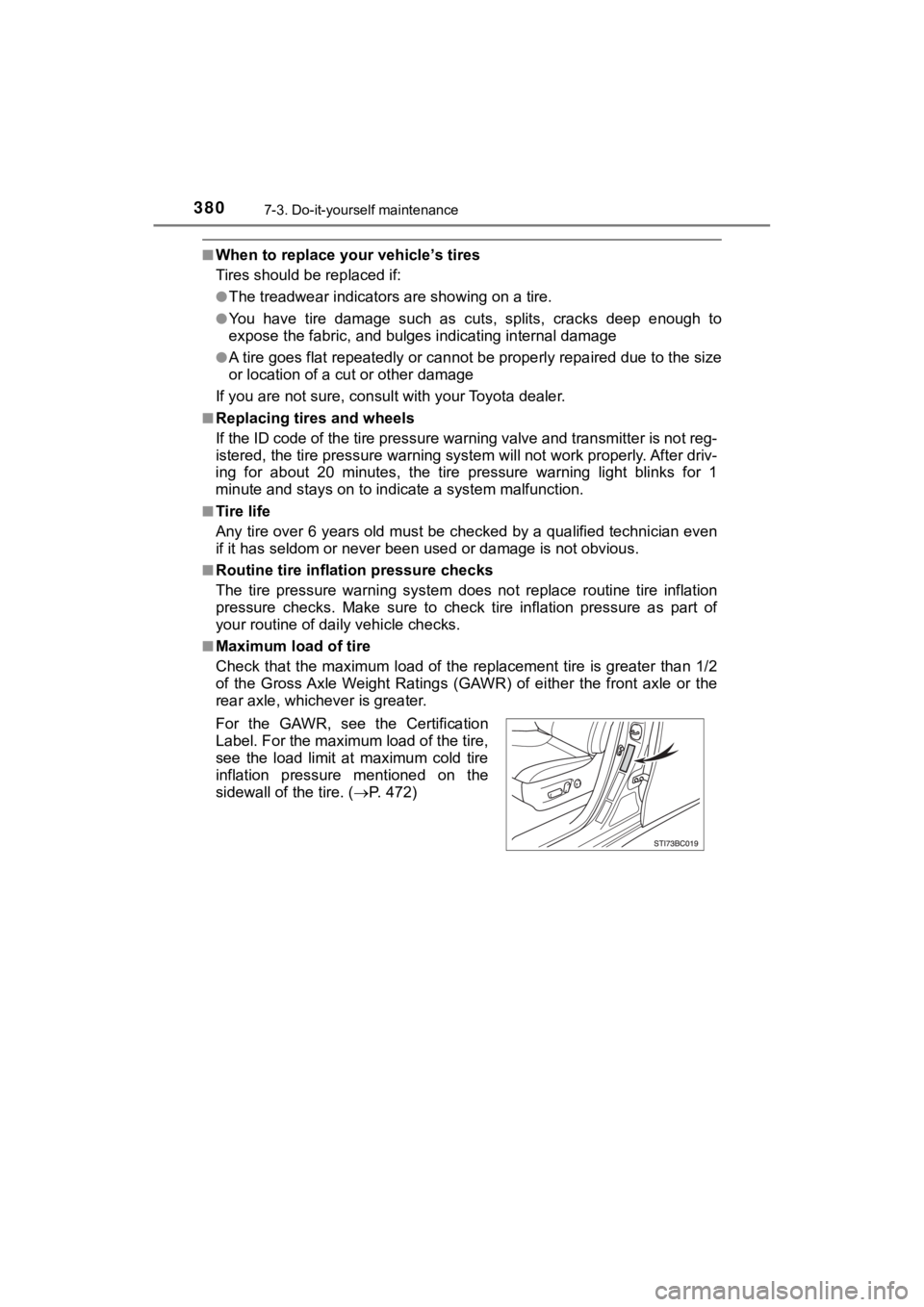
■Maximum load of tire
Check that the maximum load of t he replacement tire is greater than 1/2
of the Gross Axle Weight Ratings (GAWR) of either the front axl e or the
rear axle, whichever is greater.
For the GAWR, see the Certification
Label. For the maximum load of the tire,
see the load limit at maximum cold tire
inflation pressure mentioned on the
sidewall of the tire. ( P. 4 7 2 )
Page 382 of 528

3827-3. Do-it-yourself maintenance
MIRAI_OM_USA_OM62054U(18MY)_O
M62048U(19MY)■
Situations in which the tire pressure warning system may not op
er-
ate properly
●In the following cases, the tire pressure warning system may no t operate
properly.
• If non-genuine Toyota wheels are used.
• A tire has been replaced with a tire that is not an OE (Original Equip-
ment) tire.
• A tire has been replac ed with a tire that is not of the specif ied size.
• Tire chains, etc., are equipped.
• An auxiliary-supported ru n-flat tire is equipped.
• If a window tint that affects the radio wave signals is instal led.
• If there is a lot of snow or ice on the vehicle, particularly around the
wheels or wheel housings.
• If the tire inflation pressure is extremely higher than the sp ecified
level.
• If wheels without the tire pressure warning valves and transmi tters
are used.
• If the ID code on the tire pressure warning valves and transmi tters is
not registered in the tire pressure warning computer.
●Performance may be affected in the following situations.
• Near a TV tower, electric power plant, gas station, radio stat ion, large
display, airport or other facilit y that generates strong radio waves or
electrical noise
• When carrying a portable radio, cellular phone, cordless phone or
other wireless communication device
●When the vehicle is parked, the time taken for the warning to s tart or go
off could be extended.
●When tire inflation pressure declines rapidly for example when a tire has
burst, the warning may not function.