ECO mode TOYOTA RAV4 1996 Service User Guide
[x] Cancel search | Manufacturer: TOYOTA, Model Year: 1996, Model line: RAV4, Model: TOYOTA RAV4 1996Pages: 1632, PDF Size: 41.64 MB
Page 263 of 1632
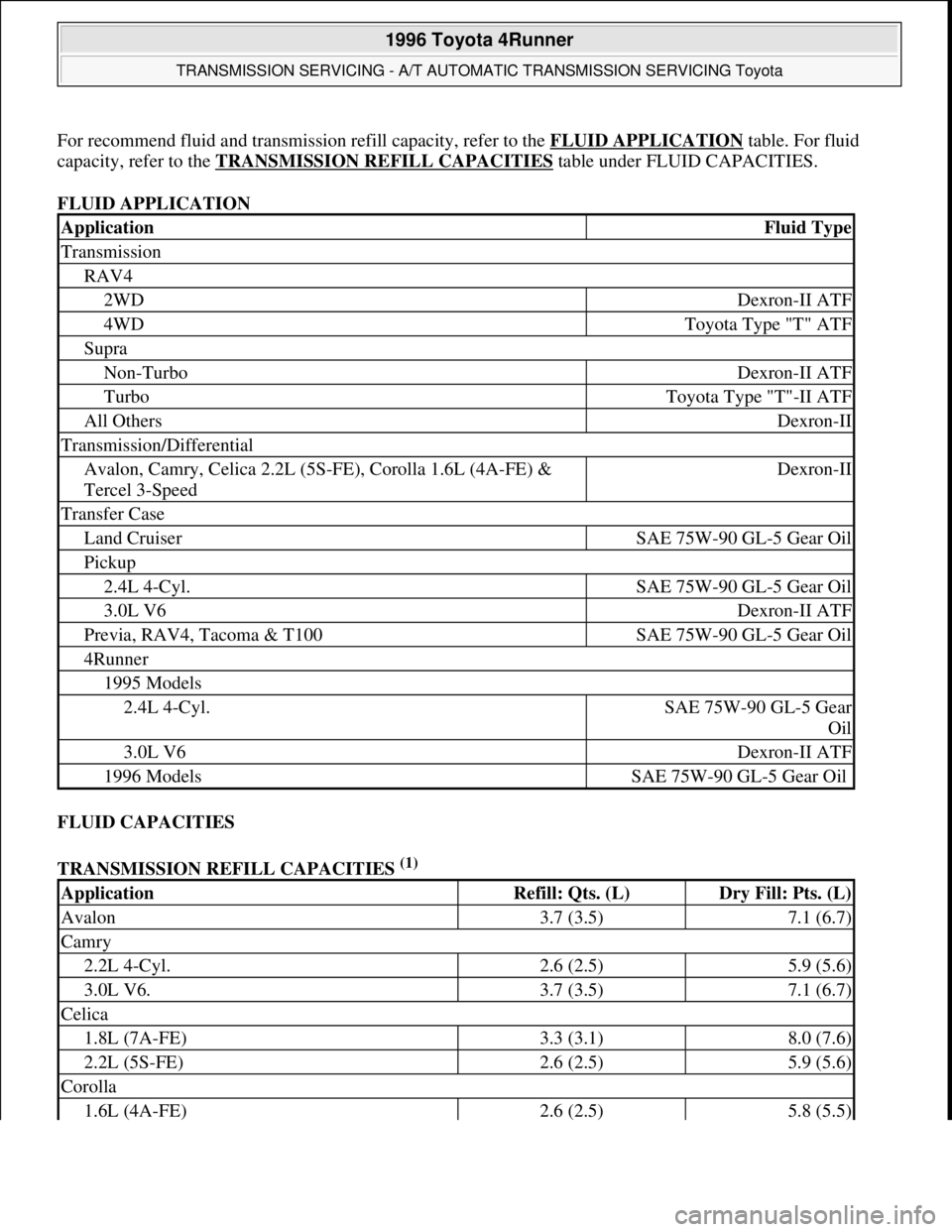
For recommend fluid and transmission refill capacity, refer to the FLUID APPLICATION table. For fluid
capacity, refer to the TRANSMISSION REFILL CAPACITIES
table under FLUID CAPACITIES.
FLUID APPLICATION
FLUID CAPACITIES
TRANSMISSION REFILL CAPACITIES
(1)
ApplicationFluid Type
Transmission
RAV4
2WDDexron-II ATF
4WDToyota Type "T" ATF
Supra
Non-TurboDexron-II ATF
TurboToyota Type "T"-II ATF
All OthersDexron-II
Transmission/Differential
Avalon, Camry, Celica 2.2L (5S-FE), Corolla 1.6L (4A-FE) &
Tercel 3-SpeedDexron-II
Transfer Case
Land CruiserSAE 75W-90 GL-5 Gear Oil
Pickup
2.4L 4-Cyl.SAE 75W-90 GL-5 Gear Oil
3.0L V6Dexron-II ATF
Previa, RAV4, Tacoma & T100SAE 75W-90 GL-5 Gear Oil
4Runner
1995 Models
2.4L 4-Cyl.SAE 75W-90 GL-5 Gear
Oil
3.0L V6Dexron-II ATF
1996 ModelsSAE 75W-90 GL-5 Gear Oil
ApplicationRefill: Qts. (L)Dry Fill: Pts. (L)
Avalon3.7 (3.5)7.1 (6.7)
Camry
2.2L 4-Cyl.2.6 (2.5)5.9 (5.6)
3.0L V6.3.7 (3.5)7.1 (6.7)
Celica
1.8L (7A-FE)3.3 (3.1)8.0 (7.6)
2.2L (5S-FE)2.6 (2.5)5.9 (5.6)
Corolla
1.6L (4A-FE)2.6 (2.5)5.8 (5.5)
1996 Toyota 4Runner
TRANSMISSION SERVICING - A/T AUTOMATIC TRANSMISSION SERVICING Toyota
Microsoft
Tuesday, August 18, 2009 7:18:46 PMPage 7 © 2005 Mitchell Repair Information Company, LLC.
Page 328 of 1632
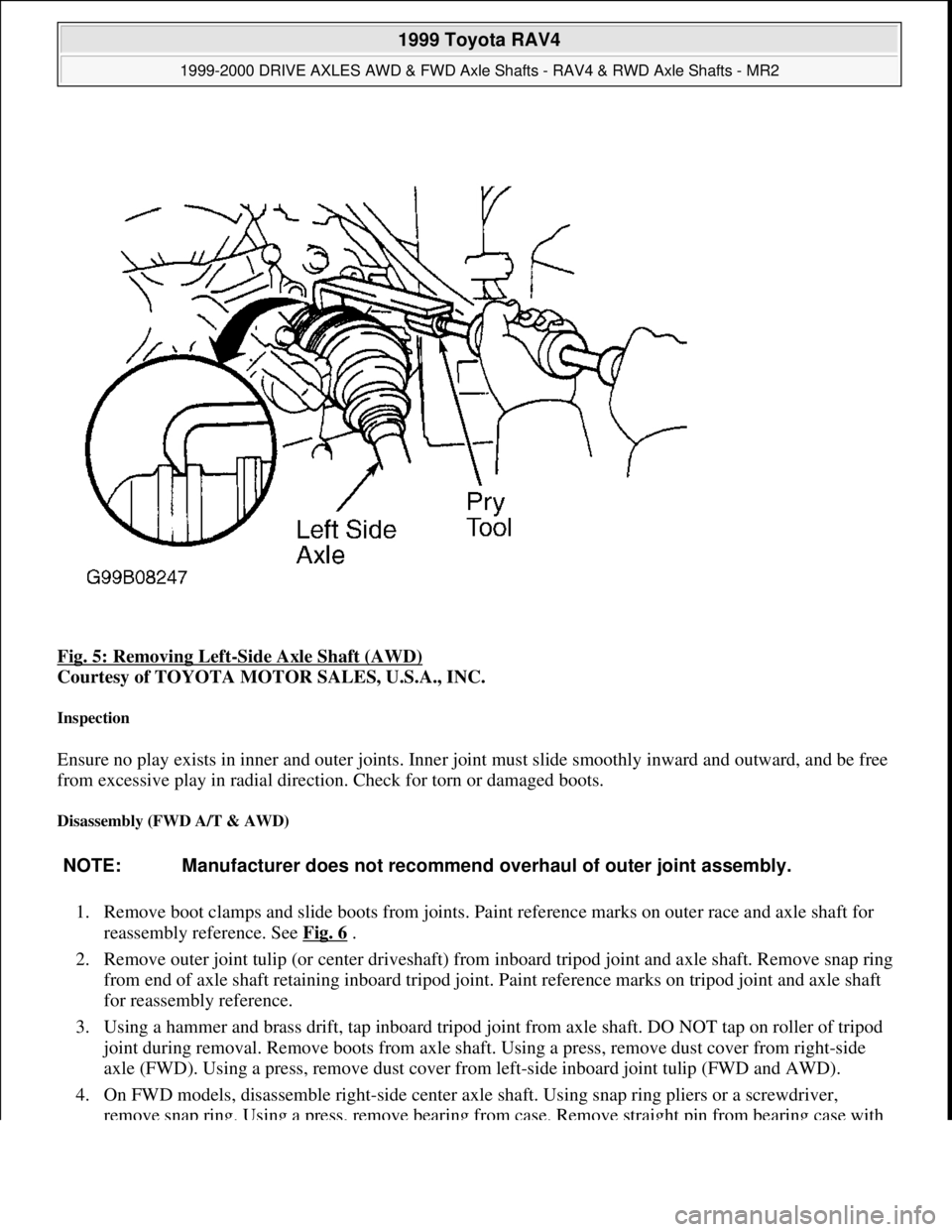
Fig. 5: Removing Left-Side Axle Shaft (AWD)
Courtesy of TOYOTA MOTOR SALES, U.S.A., INC.
Inspection
Ensure no play exists in inner and outer joints. Inner joint must slide smoothly inward and outward, and be free
from excessive play in radial direction. Check for torn or damaged boots.
Disassembly (FWD A/T & AWD)
1. Remove boot clamps and slide boots from joints. Paint reference marks on outer race and axle shaft for
reassembly reference. See Fig. 6
.
2. Remove outer joint tulip (or center driveshaft) from inboard tripod joint and axle shaft. Remove snap ring
from end of axle shaft retaining inboard tripod joint. Paint reference marks on tripod joint and axle shaft
for reassembly reference.
3. Using a hammer and brass drift, tap inboard tripod joint from axle shaft. DO NOT tap on roller of tripod
joint during removal. Remove boots from axle shaft. Using a press, remove dust cover from right-side
axle (FWD). Using a press, remove dust cover from left-side inboard joint tulip (FWD and AWD).
4. On FWD models, disassemble right-side center axle shaft. Using snap ring pliers or a screwdriver,
remove snap ring. Using a press, remove bearing from case. Remove straight pin from bearing case with
NOTE: Manufacturer does not recommend overhaul of outer joint assembly.
1999 Toyota RAV4
1999-2000 DRIVE AXLES AWD & FWD Axle Shafts - RAV4 & RWD Axle Shafts - MR2
Microsoft
Sunday, November 22, 2009 10:08:21 AMPage 7 © 2005 Mitchell Repair Information Company, LLC.
Page 331 of 1632
and sliding surfaces with Dexron-II. Position snap ring on end of axle shaft, with opening facing
downward.
2. Install axle shaft by lightly tapping axle shaft into transaxle. Ensure axle shaft will move inward and
outward approximately .079-.120" (2.00-3.00 mm), and cannot be pulled from transaxle.
3. To install remaining components, reverse removal procedure. Tighten remaining bolts/nuts to
specification. See TORQUE SPECIFICATIONS
. Fill transaxle with Dexron-II (A/T models), or 75W-
90 gear oil with API GL-3, GL-4 or GL-5 rating (M/T models).
Disassembly (FWD M/T)
1. Remove boot clamps, and slide boots from joints. Paint reference marks on outer race and axle shaft for
reassembly reference. See Fig. 6
.
2. Using a screwdriver, remove snap ring from outer tulip race. Remove outer tulip race from inner joint and
axle shaft. Remove snap ring from end of axle shaft retaining inner joint. Paint reference marks on inner
joint, outer cage and axle shaft for reassembly reference.
3. Remove 6 balls and cage. Using a hammer and brass drift, tap inner joint from axle shaft. Remove inner
snap ring. Remove boots from axle shaft. Using a press, remove dust cover from right-side axle shaft.
Using a press and bearing splitter, remove dust cover from left-side inner joint tulip.
4. Disassemble right-side center axle shaft. Using snap ring pliers or a screwdriver, remove snap ring. Using
a press, remove bearing from axle. Using a screwdriver and hammer, remove outer dust deflector from
axle shaft.
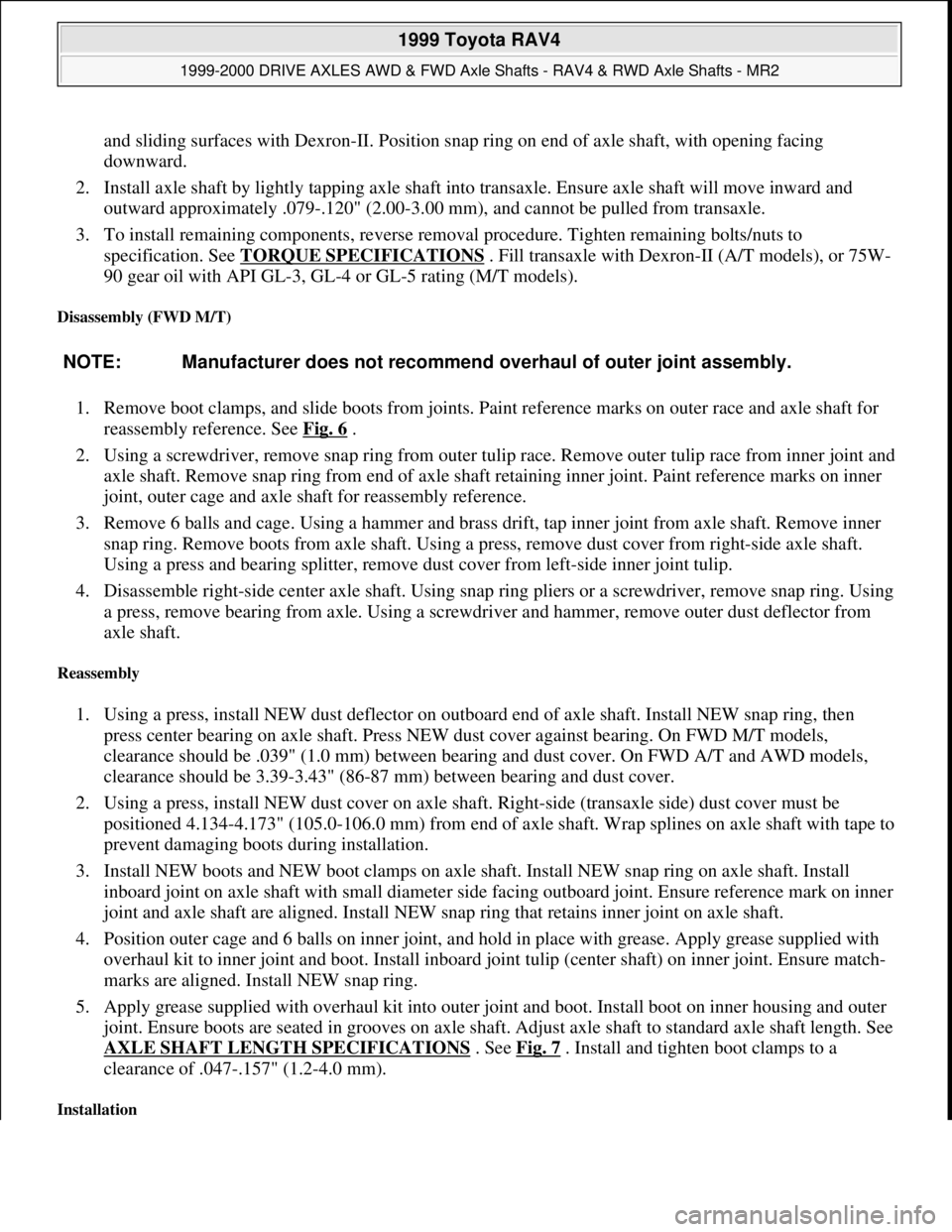
Reassembly
1. Using a press, install NEW dust deflector on outboard end of axle shaft. Install NEW snap ring, then
press center bearing on axle shaft. Press NEW dust cover against bearing. On FWD M/T models,
clearance should be .039" (1.0 mm) between bearing and dust cover. On FWD A/T and AWD models,
clearance should be 3.39-3.43" (86-87 mm) between bearing and dust cover.
2. Using a press, install NEW dust cover on axle shaft. Right-side (transaxle side) dust cover must be
positioned 4.134-4.173" (105.0-106.0 mm) from end of axle shaft. Wrap splines on axle shaft with tape to
prevent damaging boots during installation.
3. Install NEW boots and NEW boot clamps on axle shaft. Install NEW snap ring on axle shaft. Install
inboard joint on axle shaft with small diameter side facing outboard joint. Ensure reference mark on inner
joint and axle shaft are aligned. Install NEW snap ring that retains inner joint on axle shaft.
4. Position outer cage and 6 balls on inner joint, and hold in place with grease. Apply grease supplied with
overhaul kit to inner joint and boot. Install inboard joint tulip (center shaft) on inner joint. Ensure match-
marks are aligned. Install NEW snap ring.
5. Apply grease supplied with overhaul kit into outer joint and boot. Install boot on inner housing and outer
joint. Ensure boots are seated in grooves on axle shaft. Adjust axle shaft to standard axle shaft length. See
AXLE SHAFT LENGTH SPECIFICATIONS
. See Fig. 7 . Install and tighten boot clamps to a
clearance of .047-.157" (1.2-4.0 mm).
Installation
NOTE: Manufacturer does not recommend overhaul of outer joint assembly.
1999 Toyota RAV4
1999-2000 DRIVE AXLES AWD & FWD Axle Shafts - RAV4 & RWD Axle Shafts - MR2
Microsoft
Sunday, November 22, 2009 10:08:21 AMPage 10 © 2005 Mitchell Repair Information Company, LLC.
Page 407 of 1632
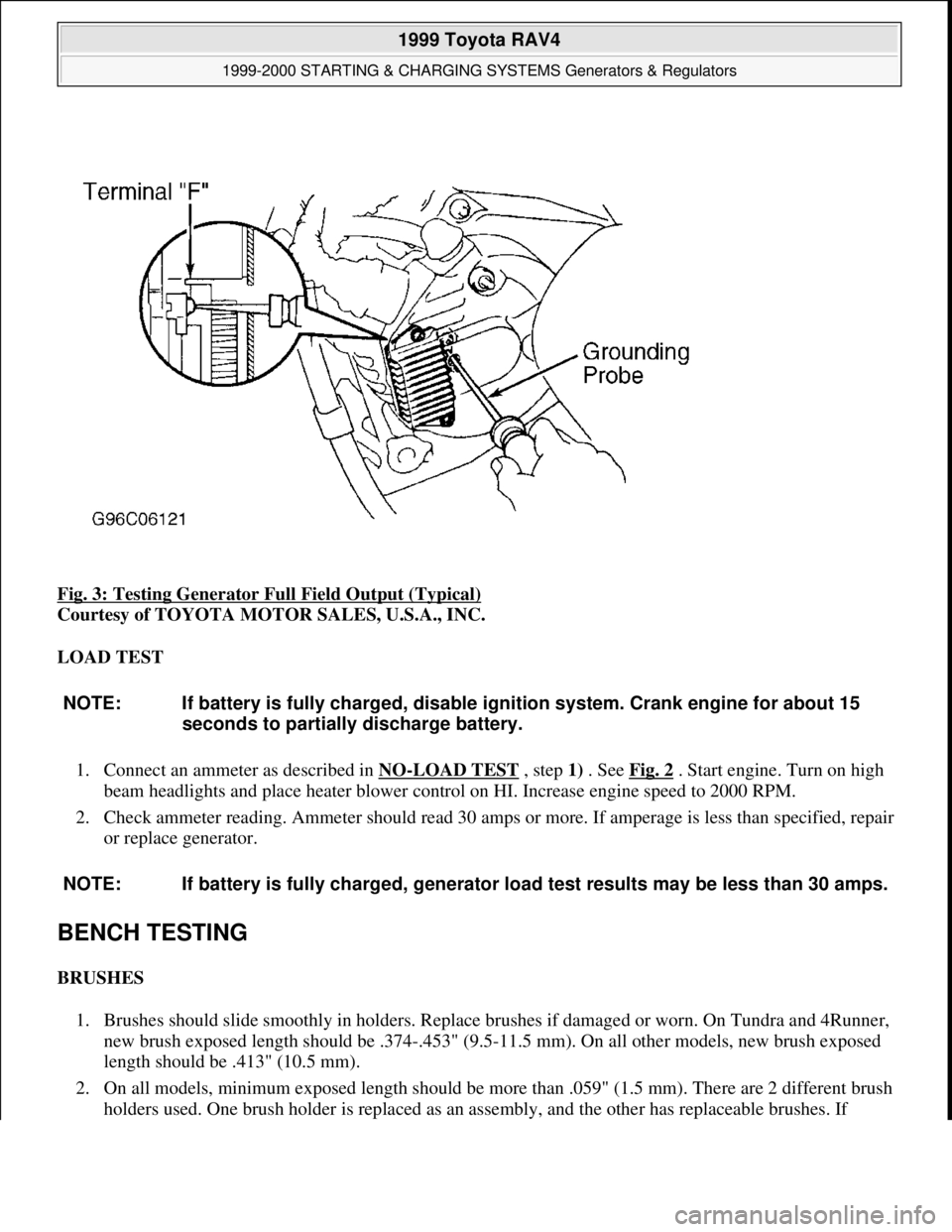
Fig. 3: Testing Generator Full Field Output (Typical)
Courtesy of TOYOTA MOTOR SALES, U.S.A., INC.
LOAD TEST
1. Connect an ammeter as described in NO
-LOAD TEST , step 1) . See Fig. 2 . Start engine. Turn on high
beam headlights and place heater blower control on HI. Increase engine speed to 2000 RPM.
2. Check ammeter reading. Ammeter should read 30 amps or more. If amperage is less than specified, repair
or replace generator.
BENCH TESTING
BRUSHES
1. Brushes should slide smoothly in holders. Replace brushes if damaged or worn. On Tundra and 4Runner,
new brush exposed length should be .374-.453" (9.5-11.5 mm). On all other models, new brush exposed
length should be .413" (10.5 mm).
2. On all models, minimum exposed length should be more than .059" (1.5 mm). There are 2 different brush
holders used. One brush holder is replaced as an assembl
y, and the other has replaceable brushes. If
NOTE: If battery is fully charged, disable ignition system. Crank engine for about 15
seconds to partially discharge battery.
NOTE: If battery is fully charged, generator load test results may be less than 30 amps.
1999 Toyota RAV4
1999-2000 STARTING & CHARGING SYSTEMS Generators & Regulators
Microsoft
Sunday, November 22, 2009 10:13:07 AMPage 6 © 2005 Mitchell Repair Information Company, LLC.
Page 466 of 1632
2. Install compressor housing "O" ring to compressor housing. Align compressor front head with
compressor housing and install. Tighten front head bolts "A" first and then front head bolts "B" in a
crisscross pattern. See Fig. 14
. Tighten bolts "A" to 10 ft. lbs. (13 N.m) and bolts "B" to 17 ft. lbs. (23
N.m). Remove shaft seal protector. To complete installation, reverse removal procedure.
ZEXEL ROTARY VANE
CLUTCH COIL & BEARING
Removal (Honda, Isuzu & Kia)
1. Using clutch disc/plate holder, remove clutch disc/plate bolt. Using puller and forcing screw, remove
clutch disc/plate. See Fig. 15
or Fig. 16 .
2. Remove shim(s) and snap ring. On DKV-14D compressor, use pulley puller pilot to protect compressor
shaft. On all models, use a puller to remove pulley. Remove screw for clutch coil lead. Remove 3 clutch
coil screws and clutch coil.
Installation
1. To install, reverse removal procedure. Align clutch coil pin with hole in front head of compressor and
install clutch coil. Tighten clutch coil screws to 44 INCH lbs. (5 N.m). Using pulley installer and drive
handle, tap pulley onto compressor. On all models, install new snap ring.
2. On DKV-14D compressor, tighten clutch plate bolt to 113 INCH lbs. (13 N.m) Using feeler gauge, ensure
air gap between clutch plate and pulley is 0.012-0.024" (0.30-0.60 mm). If air gap is incorrect, add or
remove shim(s) as necessary.
Removal (Nissan)
1. Hold clutch disc using clutch disc holder and remove center bolt. Using Clutch Disc Puller (J-38874),
remove clutch disc and adjustment shim(s).
2. Remove snap ring. Remove pulley using Pilot (J-39023) and universal 2-jaw puller. Position puller jaws
onto edge of pulley to prevent pulley groove from being deformed. Remove clutch coil lead, 3 clutch coil
retaining screws, and clutch coil. See Fig. 15
or Fig. 16 .
Installation
1. Ensure clutch disc and pulley contact surfaces are clean and free of excessive grooving and/or excessive
heat damage. Check clutch coil for loose connection or cracked insulation. Replace components as
necessary. Replace clutch disc and pulley assembly as a set.
2. Align pin in clutch coil with hole in front head of compressor. Ensure coil lead is installed in original NOTE: Subaru recommends replacing compressor as an assembly if there is a clutch
or compressor shaft seal failure.
NOTE: On Kia, shaft seal servicing procedure is not available from manufacturer.
1999 Toyota RAV4
1999 GENERAL SERVICING Compressor Servicing
Microsoft
Sunday, November 22, 2009 10:31:50 AMPage 29 © 2005 Mitchell Repair Information Company, LLC.
Page 471 of 1632
1999-2000 ENGINE COOLING
Electric Cooling Fans
IDENTIFICATION
ELECTRIC COOLING FAN IDENTIFICATION
DESCRIPTION & OPERATION
Land Cruiser, Tacoma, Tundra and 4Runner use a belt-driven cooling fan attached to the water pump. All other
models use 2 electric cooling fans located directly behind the radiator. Fans are controlled via Engine Coolant
Temperature (ECT) switches/sensors, and turn on when engine coolant temperature is above 208°F (98°C) on
Avalon, Camry with 3.0L, Camry Solara with 3.0L and Sienna. On Camry with 2.2L, Camry Solara with 2.2L,
Celica, Corolla, ECHO, MR2 and RAV4, ECT turns cooling fans on above 199°F (93°C). On Avalon, Camry
with 3.0L, Camry Solara with 3.0L and Sienna, fans will turn off when engine coolant temperature falls below
190°F (88°C). On Camry with 2.2L, Camry Solara with 2.2L, Celica, Corolla and RAV4, fans will turn off
below 181°F (83°C).
SYSTEM TESTS
ELECTRIC COOLING FAN
Avalon (1999), Camry 3.0L, Camry Solara 3.0L & Sienna
1. With engine coolant temperature below 190°F (88°C), turn ignition switch to ON position (engine off).
Ensure fans stop.
2. If fan do not stop, test cooling fan relay and ECT switch. See COOLING FAN RELAYS
and ECT
SWITCH . Check for loose or broken connector or wiring between relay and ECT switch. Repair as
necessary.
3. Disconnect No. 1 ECT switch connector. See ECT SWITCH LOCATIONS
table. With ignition still in
ON position, ensure cooling fan turns on. If not, check fuses, engine main relay, cooling fan relay and
cooling fan motor. Check for short between cooling fan relay and ECT switch.
4. Start engine and raise temperature above 208°F (98°C). Ensure cooling fan turns. If not, replace No. 1
ECT switch.
5. Stop engine and disconnect cooling fan 2-pin connector. With battery connected to ammeter (positive
battery terminal to positive ammeter terminal and negative battery and negative ammeter terminals to
each connector pin), test amperage readings. See Fig. 1
. If readings are not as specified, replace cooling
fan. See COOLING FAN AMPERAGE READINGS
table. Reconnect fan connector.
Avalon (2000)
ApplicationCooling Fan Location
All Models
Condenser Cooling FanPassenger's Side, Rear Of Radiator
Radiator Cooling FanDriver's Side, Rear Of Radiator
1999 Toyota RAV4
1999-2000 ENGINE COOLING Electric Cooling Fans
1999 Toyota RAV4
1999-2000 ENGINE COOLING Electric Cooling Fans
Microsoft
Sunday, November 22, 2009 10:21:41 AMPage 1 © 2005 Mitchell Repair Information Company, LLC.
Microsoft
Sunday, November 22, 2009 10:21:45 AMPage 1 © 2005 Mitchell Repair Information Company, LLC.
Page 474 of 1632
Fig. 1: Testing Amperage At Fan Connectors (Corolla Shown; Other Models Similar)
Courtesy of TOYOTA MOTOR SALES, U.S.A., INC.
Camry 2.2L, Camry Solara 2.2L, Celica, Corolla, ECHO, MR2 & RAV4
1. With engine coolant temperature below 181°F (83°C), turn ignition switch to ON position (engine off).
Ensure fan stops.
2. If fan does not stop, test cooling fan relay and ECT switch/sensor. See COOLING FAN RELAYS
and
ECT SWITCH
or ECT SENSOR . Check for loose or broken connector or wiring between relay and
ECT switch. Repair as necessary.
3. Disconnect ECT switch/sensor connector. See ECT SWITCH LOCATIONS
table. With ignition still in
ON position, ensure cooling fan turns on. If not, check fuses, engine main relay (if equipped), cooling fan
relay, and cooling fan motor. On MR2, check ECM. On all models, check for short between cooling fan
relay and ECT switch.
4. Start engine and raise temperature above 199°F (93°C). Ensure cooling fan turns. If not, replace ECT
switch/sensor.
5. Stop engine and disconnect cooling fan 2-pin connector. With battery connected to ammeter (positive
battery terminal to positive ammeter terminal and negative battery and negative ammeter terminals to
each connector pin), test amperage readings. See Fig. 1
. If readings are not as specified, replace cooling
fan. See COOLING FAN AMPERAGE READINGS
table. Reconnect fan connector.
ECT SWITCH LOCATIONS
COOLING FAN AMPERAGE READINGS
ApplicationECT Switch Location
All Models
Condenser Cooling FanPassenger's Side, Rear Of Radiator
Radiator Cooling FanDriver's Side, Rear Of Radiator
ApplicationAmps @ 68°F (20°C)
Avalon
19999.2-11.0
20008.5-11.5
Camry & Camry Solara
5S-FE4.9-8.5
1MZ-FE8.3-11.3
Celica
19996.4-7.4
20005.2-8.2
Corolla5.2-8.2
ECHO (1) 7.8-11.8
MR25.7-7.7
RAV49.1-11.1
Sienna
1999 Toyota RAV4
1999-2000 ENGINE COOLING Electric Cooling Fans
Microsoft
Sunday, November 22, 2009 10:21:41 AMPage 4 © 2005 Mitchell Repair Information Company, LLC.
Page 529 of 1632
ADJUSTMENTS
ACTUATOR CONTROL CABLE
Ensure actuator, control cable and throttle linkage are installed properly. Ensure actuator and bell crank operate
smoothly. Ensure cable is not too loose or tight. Cable free play should be less than .39" (10 mm). If control
cable is too loose, vehicle will lose speed while driving uphill. If control cable is too tight, idle RPM will
increase.
TROUBLE SHOOTING
CRUISE CONTROL FUNCTION TEST
Cruise control function test is used to help determine if cruise control circuits are functioning properly when no
trouble codes are present. To activate function test, turn ignition on. Push cruise control switch to SET/COAST
position and hold. Set cruise ON-OFF (main) switch to ON position. Ensure CRUISE indicator light comes on
and flashes after 3 seconds. Release cruise control switch from SET/COAST position. Activate each switch
circuit in order given. Normal function code will be displayed by CRUISE indicator light, as each circuit is
activated as follows:
SET/COAST Switch
Set cruise control switch to SET/COAST position and hold. If CRUISE control indicator light flashes 2 times
(repeating), indicating a normal Function Code 2, set/coast circuit is okay. Go to next step. If CRUISE control
indicator light does not flash 2 times (repeating), see SYMPTOM DIAGNOSIS
and perform appropriate test
(s).
RES/ACC Switch
Set cruise control switch to RES/ACC position and hold. If CRUISE control indicator light flashes 3 times
(repeating), indicating a normal Function Code 3, RES/ACCEL circuit is okay. Go to next step. If CRUISE
control indicator light does not flash 3 times (repeating), see SYMPTOM DIAGNOSIS
and perform
appropriate test(s).
CANCEL Switches
Observe CRUISE control indicator light and activate each cancel switch. Press CANCEL switch to ON and
OFF positions. Depress and release brake pedal. On A/T models, move shift lever from "D" to "N" position. On of testing. However, a corresponding trouble code may be stored in cruise
control ECU memory. See DIAGNOSTIC PROCEDURE
under SELF-DIAGNOSTIC
SYSTEM.
NOTE: Before performing CRUISE CONTROL FUNCTION TEST, perform DIAGNOSTIC
PROCEDURE under SELF-DIAGNOSTIC SYSTEM. Cruise control function test
should only be performed if no self-diagnostic trouble codes are present.
1999 Toyota RAV4
1999 ACCESSORIES & EQUIPMENT Cruise Control Systems - RAV4
Microsoft
Sunday, November 22, 2009 10:52:01 AMPage 5 © 2005 Mitchell Repair Information Company, LLC.
Page 530 of 1632
M/T models, depress and release clutch pedal. On all models, if CRUISE control indicator light comes on when
switch is in OFF position and goes off when switch is in ON position, circuit for that switch being activated is
okay. Go to next step. If CRUISE control indicator does not function as indicated, see SYMPTOM
DIAGNOSIS and perform appropriate test(s).
Vehicle Speed Sensor
1. Raise vehicle and support vehicle with drive wheels off ground. Start engine and slowly depress
accelerator pedal until vehicle speed is 25 MPH or more. Turn cruise ON-OFF switch to ON position. If
CRUISE control indicator light flashes on and off every .25 second, go to next step. If CRUISE control
indicator light does not flash on and off every .25 second, see SYMPTOM DIAGNOSIS
and perform
appropriate test(s).
2. Slow vehicle speed to 25 MPH or less. If CRUISE control indicator light comes on and stays on, vehicle
speed sensor circuit is okay. Go to next step. If CRUISE control indicator light does not come on, see
SYMPTOM DIAGNOSIS
and perform appropriate test(s).
3. Cruise control function test is now complete. No problems are indicated at this time. If cruise control
system still does not function properly and no trouble codes are present, see SYMPTOM DIAGNOSIS
and perform appropriate test(s). Problem may also be intermittent.
SYMPTOM DIAGNOSIS
Symptom diagnosis should only be performed if no Diagnostic Trouble Codes (DTCs) are present. If symptom
is unknown, perform CRUISE CONTROL FUNCTION TEST
to identify problem area. Identify symptom
and perform appropriate test. Perform tests in order listed.
SET Not Occurring Or CANCEL Occurring (No DTCs Present)
Check the following components and/or circuits:
Perform CRUISE CONTROL SWITCH CIRCUIT test under SYSTEM TESTS.
Perform DTC 21: VEHICLE SPEED SENSOR CIRCUIT test under DIAGNOSTIC TESTS.
Perform STOPLIGHT SWITCH CIRCUIT test under SYSTEM TESTS.
Perform PARK/NEUTRAL POSITION SWITCH CIRCUIT test under SYSTEM TESTS.
Perform CLUTCH SWITCH CIRCUIT test under SYSTEM TESTS.
Perform DTC 11 OR DTC 15: ACTUATOR MOTOR CIRCUIT test under DIAGNOSTIC TESTS.
Check actuator control cable adjustment. See ADJUSTMENTS .
Replace cruise control ECU with a known-good ECU and retest. If symptom is no longer present, replace
ECU.
SET Not Occurring Or CANCEL Occurring (DTC Is Not Output)
Check the following components and/or circuits:
Perform CRUISE CONTROL ECU POWER SOURCE CIRCUIT test under SYSTEM TESTS.
Replace cruise control ECU with a known-good ECU and retest. If symptom is no longer present, replace
1999 Toyota RAV4
1999 ACCESSORIES & EQUIPMENT Cruise Control Systems - RAV4
Microsoft
Sunday, November 22, 2009 10:52:01 AMPage 6 © 2005 Mitchell Repair Information Company, LLC.
Page 618 of 1632
10. Place reference marks on differential carrier and bearing caps. Remove both bearing caps. See Fig. 8 .
11. Using side bearing replacer and a hammer, remove 2 side bearing plate washers. Measure and record
thickness of plate washers. Remove differential case. Mark location of side bearing outer races for
reassembly reference. Remove side bearing outer races from carrier.
12. Remove drive pinion from differential carrier. Press front bearing from drive pinion (if necessary). Using
hammer and brass drift, remove bearing races from differential carrier.
13. Place reference marks on ring gear and differential case. Unstake and remove ring gear bolts. Using soft-
face hammer, tap ring gear from differential case. Using puller, remove side bearings from differential
case (if necessary).
14. If disassembling differential case on models equipped with conventional rear differential, drive straight
pin from ring gear bolt side of differential case. Remove pinion shaft, side gears, pinion gears and thrust
washers. On all models, remove dust cover from side gear shafts (if necessary).
Reassembly
1. Press NEW dust cover on side gear shafts (if removed). Install side gears and thrust washers. Install
pinion gears, thrust washers and pinion shaft in differential case. Ensure hole in pinion shaft aligns with
hole for straight pin in differential case.
2. Check side gear backlash with dial indicator. See Fig. 7
. Ensure side gear backlash is within .0020-
.0079" (.050-.201 mm).
3. If side gear backlash is not within specification, install different thickness thrust washers on side gears
and recheck side gear backlash.
4. Once correct side gear backlash is obtained, install straight pin in differential case. Using hammer and
punch, stake differential case at straight pin area.
5. On all models, heat ring gear in boiling water. Remove ring gear from water and allow moisture to
evaporate. Install ring gear on differential case with reference marks aligned. Temporarily install ring
gear bolts to ensure correct alignment of ring gear. Allow ring gear to cool.
6. Once ring gear has cooled, install and tighten ring gear bolts in a crisscross pattern to specification. See
TORQUE SPECIFICATIONS
. Stake ring gear bolt plates.
7. Using press, press side bearings on differential case (if removed). Install differential case into carrier.
Install 2 plate washers to remove all play in bearings. Install bearing caps. Using a dial indicator, measure
ring gear runout. runout should be .0028" (.071 mm).
8. Remove bearing caps, plate washers and differential carrier. Press outer races into front and rear of NOTE: On models with Limited Slip Differential (LSD), manufacturer does not
recommend disassembly of differential case.
NOTE: Steps 1-4 only apply to conventional rear differential models.
CAUTION: Ring gear bolts MUST NOT be tightened to specification until ring
gear has cooled.
1999 Toyota RAV4
1999-2000 DRIVE AXLES Differentials, Axle Shafts & Drive Shafts -- Rear Integral Housing -- RAV4
Microsoft
Sunday, November 22, 2009 10:09:38 AMPage 13 © 2005 Mitchell Repair Information Company, LLC.