steering TOYOTA RAV4 1996 Service User Guide
[x] Cancel search | Manufacturer: TOYOTA, Model Year: 1996, Model line: RAV4, Model: TOYOTA RAV4 1996Pages: 1632, PDF Size: 41.64 MB
Page 43 of 1632
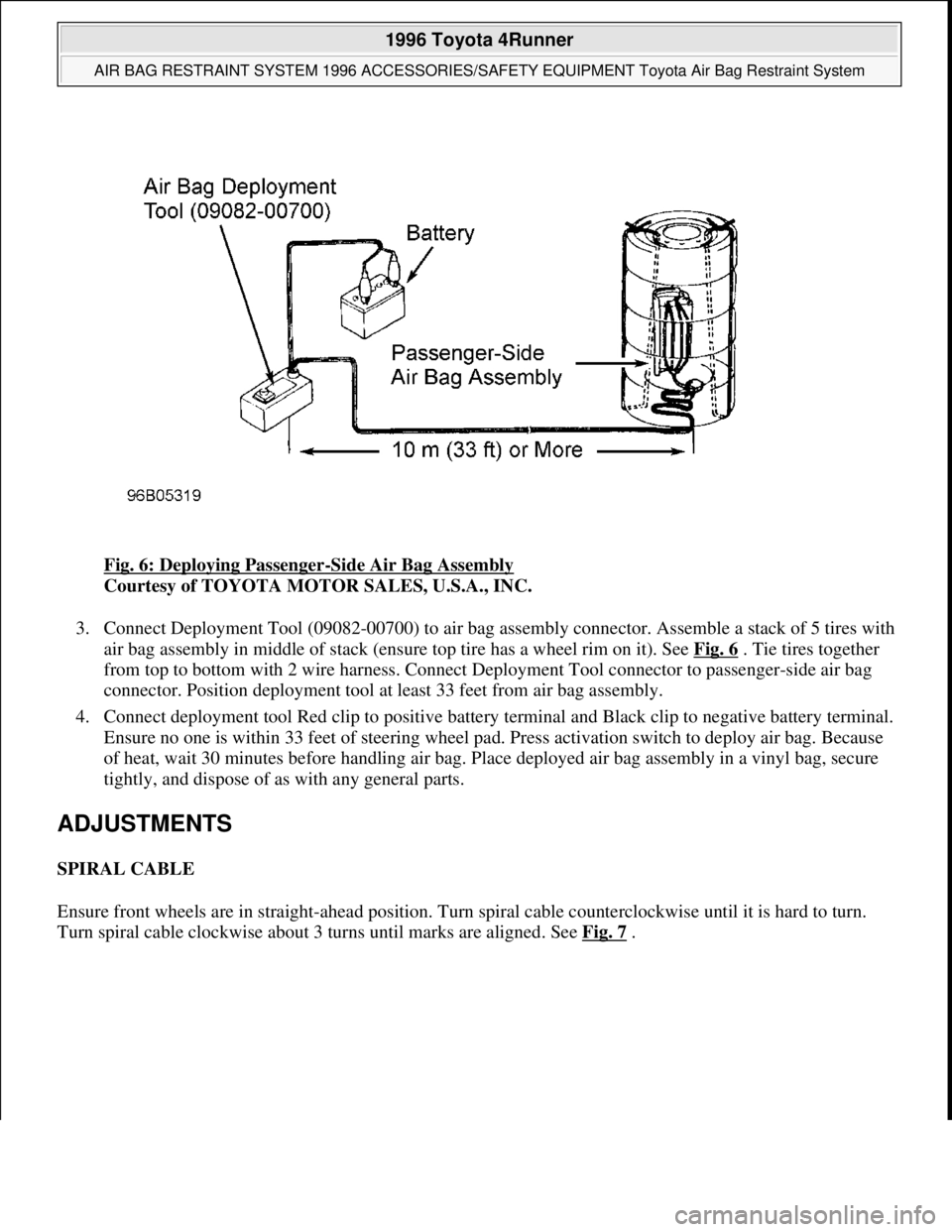
Fig. 6: Deploying Passenger-Side Air Bag Assembly
Courtesy of TOYOTA MOTOR SALES, U.S.A., INC.
3. Connect Deployment Tool (09082-00700) to air bag assembly connector. Assemble a stack of 5 tires with
air bag assembly in middle of stack (ensure top tire has a wheel rim on it). See Fig. 6
. Tie tires together
from top to bottom with 2 wire harness. Connect Deployment Tool connector to passenger-side air bag
connector. Position deployment tool at least 33 feet from air bag assembly.
4. Connect deployment tool Red clip to positive battery terminal and Black clip to negative battery terminal.
Ensure no one is within 33 feet of steering wheel pad. Press activation switch to deploy air bag. Because
of heat, wait 30 minutes before handling air bag. Place deployed air bag assembly in a vinyl bag, secure
tightly, and dispose of as with any general parts.
ADJUSTMENTS
SPIRAL CABLE
Ensure front wheels are in straight-ahead position. Turn spiral cable counterclockwise until it is hard to turn.
Turn spiral cable clockwise about 3 turns until marks are ali
gned. See Fig. 7.
1996 Toyota 4Runner
AIR BAG RESTRAINT SYSTEM 1996 ACCESSORIES/SAFETY EQUIPMENT Toyota Air Bag Restraint System
Microsoft
Tuesday, August 18, 2009 7:33:32 PMPage 9 © 2005 Mitchell Repair Information Company, LLC.
Page 45 of 1632
1. Before proceeding, see SERVICE PRECAUTIONS . Disable SRS. See DISABLING &
ACTIVATING AIR BAG SYSTEM .
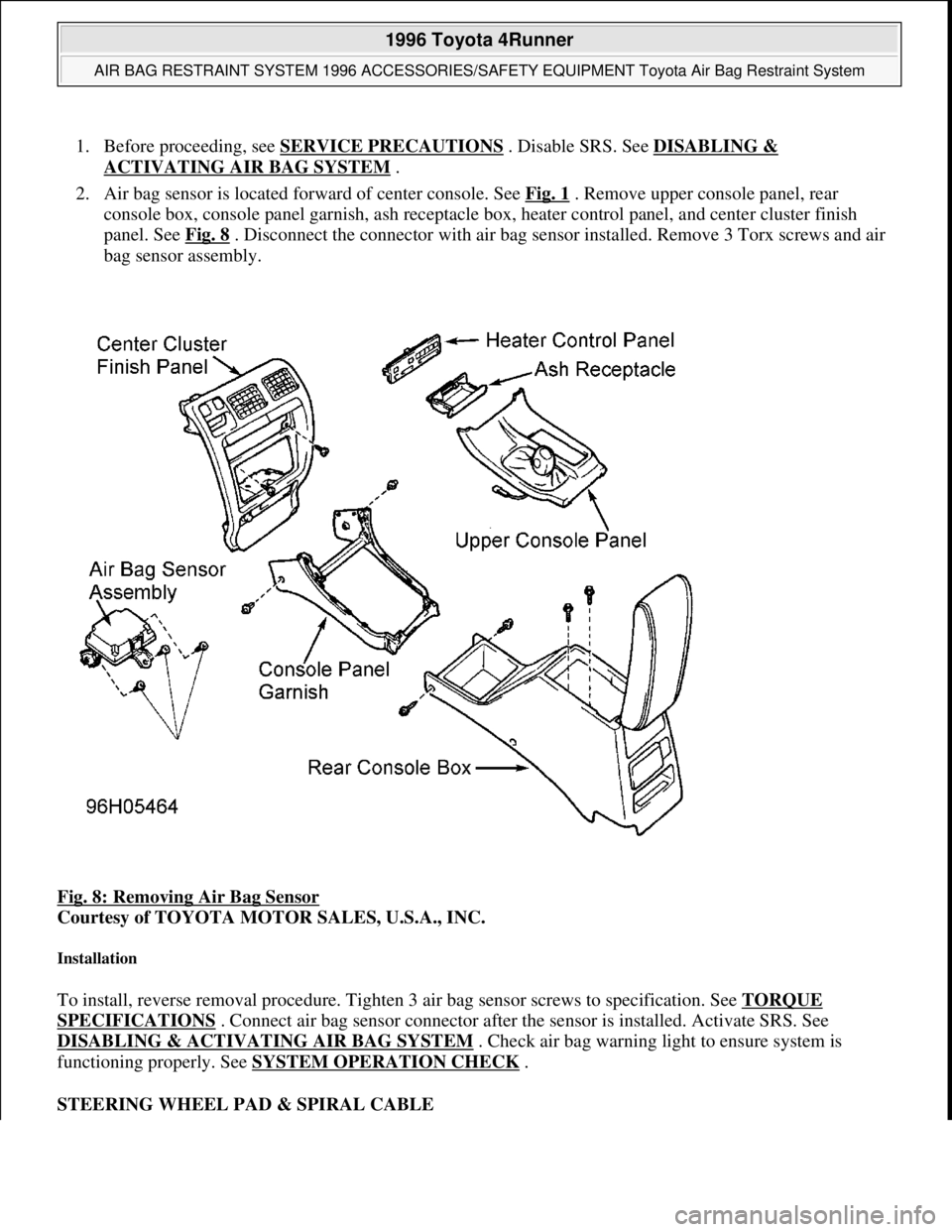
2. Air bag sensor is located forward of center console. See Fig. 1
. Remove upper console panel, rear
console box, console panel garnish, ash receptacle box, heater control panel, and center cluster finish
panel. See Fig. 8
. Disconnect the connector with air bag sensor installed. Remove 3 Torx screws and air
bag sensor assembly.
Fig. 8: Removing Air Bag Sensor
Courtesy of TOYOTA MOTOR SALES, U.S.A., INC.
Installation
To install, reverse removal procedure. Tighten 3 air bag sensor screws to specification. See TORQUE
SPECIFICATIONS . Connect air bag sensor connector after the sensor is installed. Activate SRS. See
DISABLING & ACTIVATING AIR BAG SYSTEM
. Check air bag warning light to ensure system is
functioning properly. See SYSTEM OPERATION CHECK
.
STEERING WHEEL PAD & SPIRAL CABLE
1996 Toyota 4Runner
AIR BAG RESTRAINT SYSTEM 1996 ACCESSORIES/SAFETY EQUIPMENT Toyota Air Bag Restraint System
Microsoft
Tuesday, August 18, 2009 7:33:32 PMPage 11 © 2005 Mitchell Repair Information Company, LLC.
Page 46 of 1632
Removal
1. Before proceeding, follow air bag service precautions. See SERVICE PRECAUTIONS . Ensure front
wheels are in a straight-ahead position. Turn ignition switch to LOCK position. Disconnect and shield
negative battery cable. Wait at least 90 seconds before working on system.
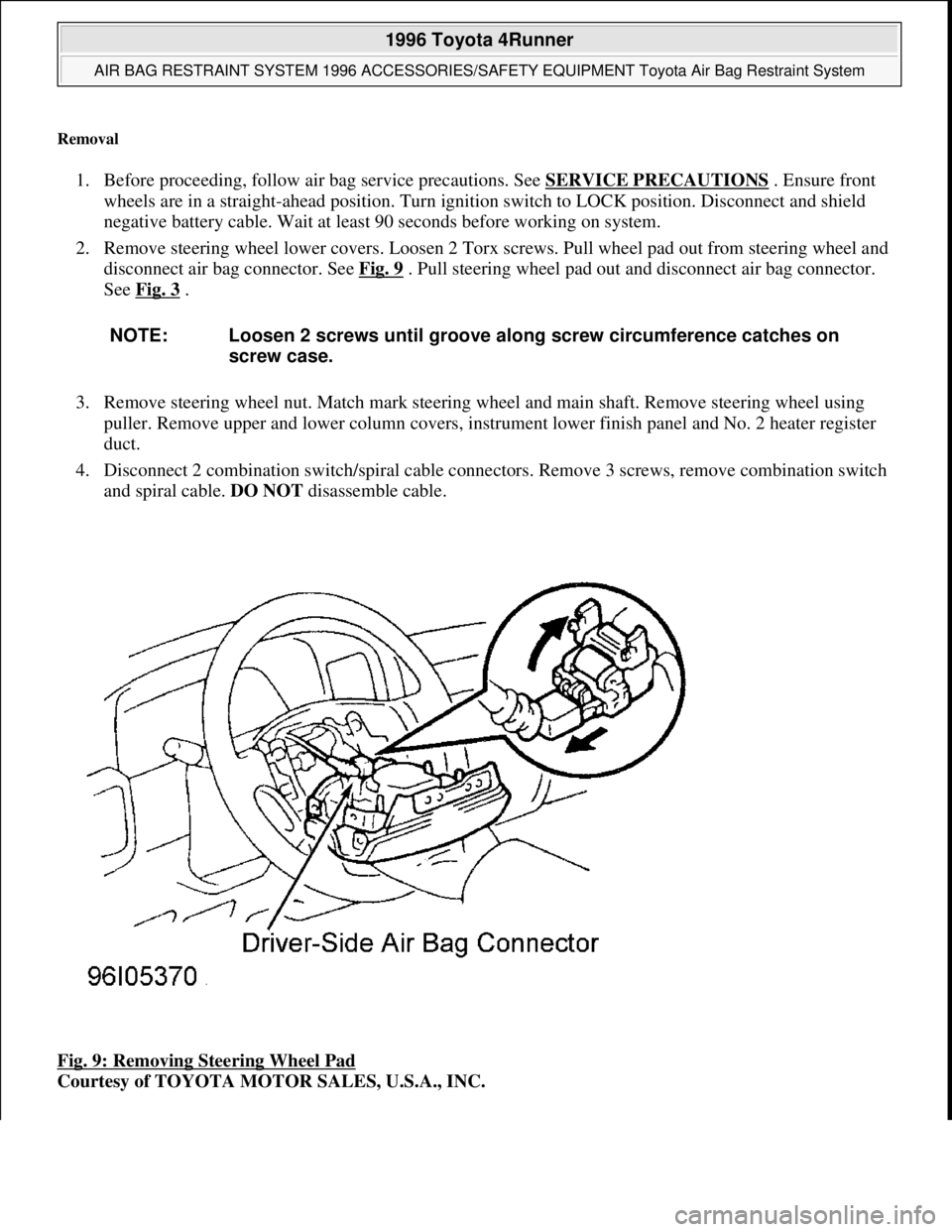
2. Remove steering wheel lower covers. Loosen 2 Torx screws. Pull wheel pad out from steering wheel and
disconnect air bag connector. See Fig. 9
. Pull steering wheel pad out and disconnect air bag connector.
See Fig. 3
.
3. Remove steering wheel nut. Match mark steering wheel and main shaft. Remove steering wheel using
puller. Remove upper and lower column covers, instrument lower finish panel and No. 2 heater register
duct.
4. Disconnect 2 combination switch/spiral cable connectors. Remove 3 screws, remove combination switch
and spiral cable. DO NOT disassemble cable.
Fig. 9: Removing Steering Wheel Pad
Courtesy of TOYOTA MOTOR SALES, U.S.A., INC. NOTE: Loosen 2 screws until groove along screw circumference catches on
screw case.
1996 Toyota 4Runner
AIR BAG RESTRAINT SYSTEM 1996 ACCESSORIES/SAFETY EQUIPMENT Toyota Air Bag Restraint System
Microsoft
Tuesday, August 18, 2009 7:33:32 PMPage 12 © 2005 Mitchell Repair Information Company, LLC.
Page 47 of 1632
Installation
To install, reverse removal procedure. Ensure spiral cable is properly aligned. See SPIRAL CABLE under
ADJUSTMENTS. Connect air bag connector. Tighten 2 Torx screws to specification. See TORQUE
SPECIFICATIONS . Install steering wheel side covers. Perform SYSTEM OPERATION CHECK .
PASSENGER-SIDE AIR BAG
Removal & Installation
1. Before proceeding, follow air bag service precautions. See SERVICE PRECAUTIONS . Turn ignition
switch to LOCK position. Disconnect and shield negative battery cable. Wait at least 90 seconds before
working on system.
2. Disable SRS. See DISABLING & ACTIVATING AIR BAG SYSTEM
. Remove instrument panel.
Remove the 2 bolts securing passenger-side air bag. See Fig. 10
. Remove air bag. Remove 3 bolts and
pry up the 5 air bag door clips and remove the air bag door. See Fig. 11
.
3. To install, reverse removal procedure. Tighten passenger-side air bag bolts to specification. See
TORQUE SPECIFICATIONS
. Activate SRS. See DISABLING & ACTIVATING AIR BAG
SYSTEM . Check air bag warning light to ensure system is functioning properly. See SYSTEM
OPERATION CHECK . WARNING:During installation, if spiral cable mating mark is not properly aligned,
steering wheel may not turn completely, or flat cable inside spiral cable
may be severed, disabling SRS system.
1996 Toyota 4Runner
AIR BAG RESTRAINT SYSTEM 1996 ACCESSORIES/SAFETY EQUIPMENT Toyota Air Bag Restraint System
Microsoft
Tuesday, August 18, 2009 7:33:32 PMPage 13 © 2005 Mitchell Repair Information Company, LLC.
Page 52 of 1632
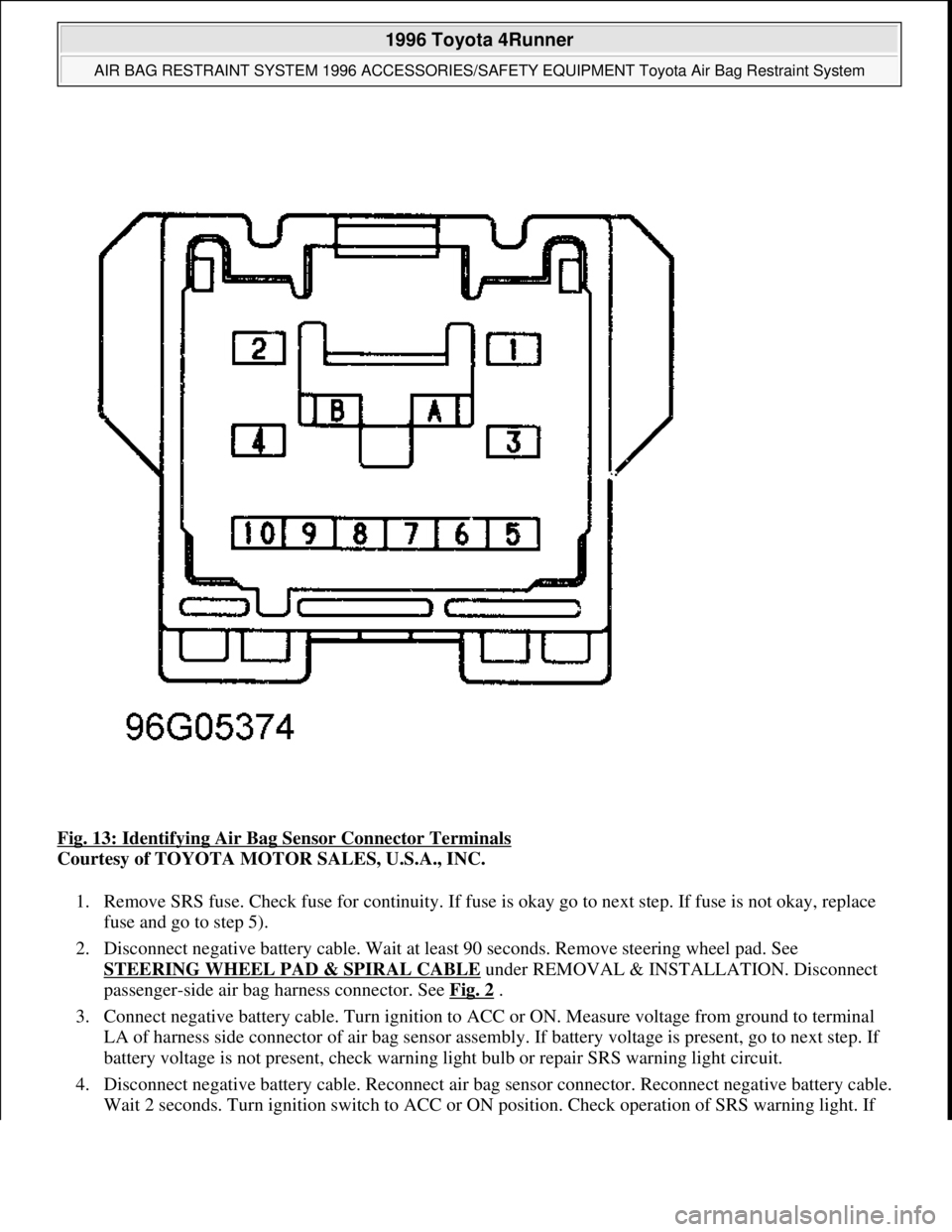
Fig. 13: Identifying Air Bag Sensor Connector Terminals
Courtesy of TOYOTA MOTOR SALES, U.S.A., INC.
1. Remove SRS fuse. Check fuse for continuity. If fuse is okay go to next step. If fuse is not okay, replace
fuse and go to step 5).
2. Disconnect negative battery cable. Wait at least 90 seconds. Remove steering wheel pad. See
STEERING WHEEL PAD & SPIRAL CABLE
under REMOVAL & INSTALLATION. Disconnect
passenger-side air bag harness connector. See Fig. 2
.
3. Connect negative battery cable. Turn ignition to ACC or ON. Measure voltage from ground to terminal
LA of harness side connector of air bag sensor assembly. If battery voltage is present, go to next step. If
battery voltage is not present, check warning light bulb or repair SRS warning light circuit.
4. Disconnect negative battery cable. Reconnect air bag sensor connector. Reconnect negative battery cable.
Wait 2 seconds. Turn i
gnition switch to ACC or ON position. Check operation of SRS warning light. If
1996 Toyota 4Runner
AIR BAG RESTRAINT SYSTEM 1996 ACCESSORIES/SAFETY EQUIPMENT Toyota Air Bag Restraint System
Microsoft
Tuesday, August 18, 2009 7:33:32 PMPage 18 © 2005 Mitchell Repair Information Company, LLC.
Page 56 of 1632
3. With squib circuit connector disconnected, insert paper into female terminal, sliding it under shorting bar
spring. This lifts the spring, breaking the circuit and allowing the test procedure to be performed as
specified.
TESTING - DIAGNOSTIC
NO CODES - SOURCE VOLTAGE DROP
1. Disconnect negative battery cable. Wait at least 90 seconds. Remove steering wheel pad. See
STEERING WHEEL PAD & SPIRAL CABLE
under REMOVAL & INSTALLATION. Disconnect
passenger-side air bag harness connector, accessible through finish plate in glove box. See Fig. 2
.
Disconnect air bag sensor assembly connector.
2. Reconnect negative battery cable. Turn ignition switch to ON position. Measure voltage between ground
and terminals IG2 and ACC of air bag sensor connector. See Fig. 13
. Operate electrical components
(defogger, wiper, headlights, heater blower, etc.). If voltage is 8-14 volts, go to next step. If voltage is not
8-14 volts, check harness between battery and air bag sensor assembly and check battery and charging
system.
3. Turn ignition switch to LOCK position. Connect steering wheel pad connector. Connect passenger-side
air bag connector. Turn ignition switch to ON position. Operate electrical components as in step 2) and
check that SRS warning light goes off. If light does not go off, check diagnostic trouble code and go to
appropriate CODE under TESTING - DIAGNOSTIC. If a normal code is output, replace air bag sensor
assembly. If warning light goes off, no problem detected at this time.
CODE 11
1. Disconnect negative battery cable. Wait at least 90 seconds. Remove steering wheel pad. See
STEERING WHEEL PAD & SPIRAL CABLE
under REMOVAL & INSTALLATION. Disconnect
passenger-side air bag harness connector, accessible through finish plate in glove box. See Fig. 2
.
Disconnect air bag sensor assembly connector.
2. Measure resistance on spiral cable side of connector between spiral cable and steering wheel pad between
D+, D- and ground. If resistance is 1000 ohms or more, go to next step. If resistance is less than 1000
ohms, go to step 7).
3. Measure resistance on air ba
g sensor assembly side of connector between air bag sensor and passenger- WARNING:Paper must not be thicker than male terminal. If paper is thicker,
connector terminal may be damaged, possible resulting in system
fault.
NOTE: Use Diagnosis Check Wiring (09843-18020) when connecting jumper wire
between terminals of DLC. Spiral cable upper connector is same as steering
wheel pad (squib) connector. Spiral cable lower connector (located under
steering column) connects the harness between spiral cable and center air bag
sensor.
NOTE: During testing, if codes other than Code 11 are displayed, disregard them.
1996 Toyota 4Runner
AIR BAG RESTRAINT SYSTEM 1996 ACCESSORIES/SAFETY EQUIPMENT Toyota Air Bag Restraint System
Microsoft
Tuesday, August 18, 2009 7:33:32 PMPage 22 © 2005 Mitchell Repair Information Company, LLC.
Page 57 of 1632
side air bag assembly between P+, P- and ground. If resistance is 1000 ohms or more, go to next step. If
resistance is less than 1000 ohms, replace harness or connector between air bag sensor assembly and
passenger-side air bag assembly.
4. Connect connector to air bag sensor assembly. Use a jumper wire to connect D+ and D- on spiral cable
side of connector between spiral cable and steering wheel pad. Use a jumper to connect P+ and P- on air
bag sensor assembly side of connector between air bag sensor assembly and passenger-side air bag
assembly. Connect negative battery cable and wait 2 seconds. Turn ignition switch to ACC or ON
position and wait at least 20 seconds. Clear malfunction codes. Turn ignition switch to LOCK position.
Wait 20 seconds. Turn ignition switch to ACC or ON position and wait at least 20 seconds. Using
Diagnosis Wire (09843-18020), connect terminals Tc and E1 of DLC1. If DTC 11 is output, go to next
step. If DTC 11 is not output, Replace air bag sensor assembly.
5. Turn ignition switch to LOCK position. Disconnect negative battery cable. Wait 90 seconds. Connect
steering wheel pad connector. Connect negative battery cable. Wait 2 seconds. Turn ignition switch to
ACC or ON position. Wait 20 seconds. Clear malfunction codes. Turn ignition switch to LOCK position.
Wait at least 20 seconds. Turn ignition switch to ACC or ON position. Wait at least 20 seconds. Use
Diagnosis Wire (09843-18020), connect terminals Tc and E1 of DLC1. If DTC 11 is output, replace
steering wheel pad. If DTC 11 is output, go to next step.
6. Turn ignition switch to LOCK position. Disconnect negative battery cable. Wait at least 90 seconds.
Connect passenger-side air bag assembly connector. Connect negative battery cable. Wait at least 2
seconds. Turn ignition switch to ACC or ON position. Wait at least 20 seconds. Clear malfunction codes.
Turn ignition switch to LOCK position. Wait at least 20 seconds. Turn ignition switch to ACC or ON
position. Wait at least 20 seconds. Use Diagnosis Wire (09843-18020) to connect terminals Tc and E1 of
DLC1. If DTC 11 is output, replace passenger-side air bag assembly. If DTC 11 is not output, go to next
step.
7. Disconnect connector between air bag sensor assembly and spiral cable. Measure resistance between D+
on spiral cable side of connector between spiral cable and steering wheel pad and body ground. If
resistance is 1000 ohms or more, replace harness or connector between air bag sensor assembly and spiral
cable. If resistance is less than 1000 ohms, replace spiral cable.
CODE 12
1. Disconnect negative battery cable. Wait at least 90 seconds. Remove steering wheel pad. See
STEERING WHEEL PAD & SPIRAL CABLE
under REMOVAL & INSTALLATION. Disconnect
passenger-side air bag connector, accessible through finish plate inside glove box. See Fig. 2
. Disconnect
air bag sensor assembly connector
2. Check voltage between ground, D+ and D- of connector (spiral cable side) between spiral cable and
steering wheel pad. If voltage is zero volts, go to next step. If voltage is not zero volts, go to step 7).
3. Check voltage between P+, P- and ground of connector (air bag sensor assembly side) between air bag
sensor assembly and passenger-side air bag assembly. If voltage is zero volts, go to next step. If voltage is
not zero volts, replace harness or connector between air bag sensor assembly and passenger-side air bag
assembly.
4. Connect connector to air bag sensor assembly. Use jumper wire to connect D+ and D- on spiral cable side
of connector between spiral cable and steering wheel pad. Use a jumper wire to connect P+ and P- on air NOTE: During testing, if codes other than Code 12 are displayed, disregard them.
1996 Toyota 4Runner
AIR BAG RESTRAINT SYSTEM 1996 ACCESSORIES/SAFETY EQUIPMENT Toyota Air Bag Restraint System
Microsoft
Tuesday, August 18, 2009 7:33:32 PMPage 23 © 2005 Mitchell Repair Information Company, LLC.
Page 58 of 1632
bag sensor assembly side of connector between airbag sensor assembly and passenger-side air bag
assembly. Connect negative battery cable. Wait 2 seconds. Turn ignition switch to ACC or ON position.
Wait at least 20 seconds. Clear malfunction codes. Turn ignition switch to LOCK position. Wait at least
20 seconds. Turn ignition switch to ACC or ON position. Wait at least 20 seconds. Using Diagnosis Wire
(09843-18020) connect terminals Tc and E1 of DLC1. If DTC 12 is output, replace air bag sensor
assembly. If DTC 12 is output, go to next step.
5. Turn ignition switch to LOCK position. Disconnect negative battery cable. Wait 90 seconds. Connect
steering wheel pad connector. Connect negative battery cable. Wait 2 seconds. Turn ignition to ACC or
On. Wait at least 20 seconds. Clear malfunction codes. Turn ignition switch to LOCK position. Wait at
least 20 seconds. Turn ignition to ACC or On. Wait at least 20 seconds. Using Diagnosis Wire (09843-
18020) connect terminals Tc and E1 of DLC1. If DTC 12 is output, replace passenger-side air bag. If
DTC 12 is not output, go to next step.
6. Turn ignition switch to LOCK position. Disconnect connector between air bag sensor assembly and spiral
cable. Turn ignition ON. Measure voltage between D+ terminal on spiral cable side of connector between
spiral cable and steering wheel pad. If voltage is zero volts, replace harness or connector between air bag
sensor assembly and spiral cable. If voltage is not zero volts, replace spiral cable.
CODE 14
1. Disconnect negative battery cable. Wait at least 90 seconds. Remove steering wheel pad. See
STEERING WHEEL PAD & SPIRAL CABLE
under REMOVAL & INSTALLATION. Disconnect
passenger-side air bag connector, accessible through finish plate inside glove box. See Fig. 2
. Disconnect
air bag sensor assembly connector.
2. Use a jumper wire to connect D+ and D- on air bag sensor assembly connector. Measure resistance
between D+ and D-. If resistance is less than one ohm, go to next step. If resistance is more than one ohm,
go to step 5).
3. Connect connector to air bag sensor assembly. Using a jumper wire, connect D+ and D- on spiral cable
side of connector between spiral cable and steering wheel pad. Connect negative battery cable. Wait 2
seconds. Turn ignition switch to ACC or ON position. Wait at least 20 seconds. Clear malfunction codes.
Turn ignition switch to LOCK position. Wait at least 20 seconds. Using Diagnosis Wire (09843-18020),
connect terminals Tc and E1 of DLC1. If DTC 14 is output, replace air bag sensor assembly. If DTC 14 is
not output, go to next step.
4. Turn ignition switch to LOCK position. Disconnect negative battery cable. Wait at least 90 seconds.
Connect steering wheel pad (squib) connector. Connect negative battery cable. Wait 2 seconds. Turn
ignition switch to ACC or ON position. Wait at least 20 seconds. Clear malfunction codes. Turn ignition
switch to LOCK position. Wait at least 20 seconds. Turn ignition switch to ACC or ON position. Wait at
least 20 seconds. Using Diagnosis Wire (09843-18020), connect terminals Tc and E1 of DLC1. If DTC
14 is output, replace steering wheel pad. If DTC 14 is not output, no problem is detected at this time..
5. Disconnect connector between air bag sensor assembly and spiral cable. Measure resistance between
terminals D+ and D- on spiral cable side of connector between spiral cable and steering wheel pad. If
resistance is less than one ohm, go to next step. If resistance is more than one ohm, replace spiral cable.
6. Use a jumper wire to connect D+ and D- on air bag sensor assembly connector. Measure resistance
between D+ and D- on air bag side of connector between air bag sensor assembly and spiral cable. If NOTE: During testing, if codes other than Code 14 are displayed, disregard them.
1996 Toyota 4Runner
AIR BAG RESTRAINT SYSTEM 1996 ACCESSORIES/SAFETY EQUIPMENT Toyota Air Bag Restraint System
Microsoft
Tuesday, August 18, 2009 7:33:32 PMPage 24 © 2005 Mitchell Repair Information Company, LLC.
Page 59 of 1632
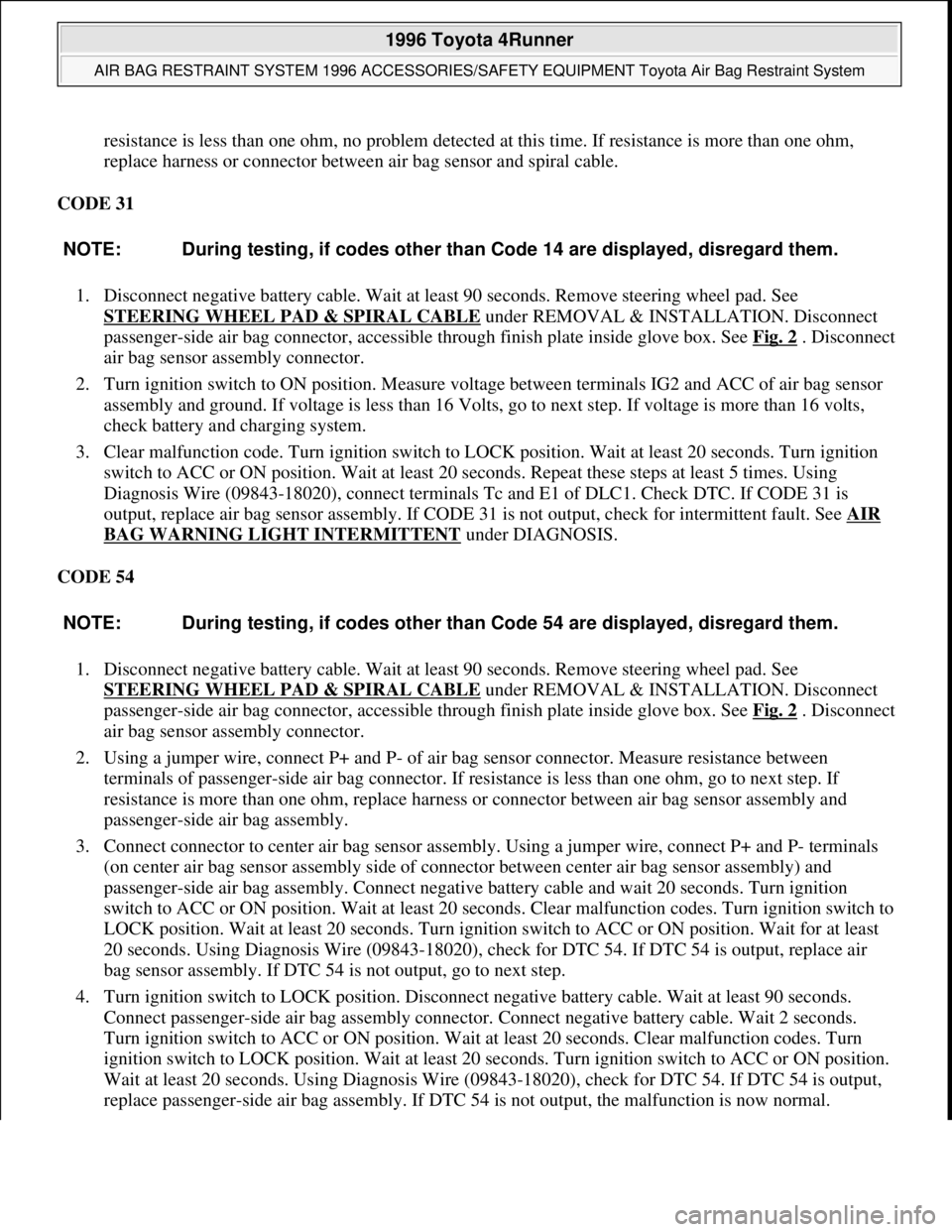
resistance is less than one ohm, no problem detected at this time. If resistance is more than one ohm,
replace harness or connector between air bag sensor and spiral cable.
CODE 31
1. Disconnect negative battery cable. Wait at least 90 seconds. Remove steering wheel pad. See
STEERING WHEEL PAD & SPIRAL CABLE
under REMOVAL & INSTALLATION. Disconnect
passenger-side air bag connector, accessible through finish plate inside glove box. See Fig. 2
. Disconnect
air bag sensor assembly connector.
2. Turn ignition switch to ON position. Measure voltage between terminals IG2 and ACC of air bag sensor
assembly and ground. If voltage is less than 16 Volts, go to next step. If voltage is more than 16 volts,
check battery and charging system.
3. Clear malfunction code. Turn ignition switch to LOCK position. Wait at least 20 seconds. Turn ignition
switch to ACC or ON position. Wait at least 20 seconds. Repeat these steps at least 5 times. Using
Diagnosis Wire (09843-18020), connect terminals Tc and E1 of DLC1. Check DTC. If CODE 31 is
output, replace air bag sensor assembly. If CODE 31 is not output, check for intermittent fault. See AIR
BAG WARNING LIGHT INTERMITTENT under DIAGNOSIS.
CODE 54
1. Disconnect negative battery cable. Wait at least 90 seconds. Remove steering wheel pad. See
STEERING WHEEL PAD & SPIRAL CABLE
under REMOVAL & INSTALLATION. Disconnect
passenger-side air bag connector, accessible through finish plate inside glove box. See Fig. 2
. Disconnect
air bag sensor assembly connector.
2. Using a jumper wire, connect P+ and P- of air bag sensor connector. Measure resistance between
terminals of passenger-side air bag connector. If resistance is less than one ohm, go to next step. If
resistance is more than one ohm, replace harness or connector between air bag sensor assembly and
passenger-side air bag assembly.
3. Connect connector to center air bag sensor assembly. Using a jumper wire, connect P+ and P- terminals
(on center air bag sensor assembly side of connector between center air bag sensor assembly) and
passenger-side air bag assembly. Connect negative battery cable and wait 20 seconds. Turn ignition
switch to ACC or ON position. Wait at least 20 seconds. Clear malfunction codes. Turn ignition switch to
LOCK position. Wait at least 20 seconds. Turn ignition switch to ACC or ON position. Wait for at least
20 seconds. Using Diagnosis Wire (09843-18020), check for DTC 54. If DTC 54 is output, replace air
bag sensor assembly. If DTC 54 is not output, go to next step.
4. Turn ignition switch to LOCK position. Disconnect negative battery cable. Wait at least 90 seconds.
Connect passenger-side air bag assembly connector. Connect negative battery cable. Wait 2 seconds.
Turn ignition switch to ACC or ON position. Wait at least 20 seconds. Clear malfunction codes. Turn
ignition switch to LOCK position. Wait at least 20 seconds. Turn ignition switch to ACC or ON position.
Wait at least 20 seconds. Using Diagnosis Wire (09843-18020), check for DTC 54. If DTC 54 is output,
replace passen
ger-side air bag assembly. If DTC 54 is not output, the malfunction is now normal. NOTE: During testing, if codes other than Code 14 are displayed, disregard them.
NOTE: During testing, if codes other than Code 54 are displayed, disregard them.
1996 Toyota 4Runner
AIR BAG RESTRAINT SYSTEM 1996 ACCESSORIES/SAFETY EQUIPMENT Toyota Air Bag Restraint System
Microsoft
Tuesday, August 18, 2009 7:33:32 PMPage 25 © 2005 Mitchell Repair Information Company, LLC.
Page 60 of 1632
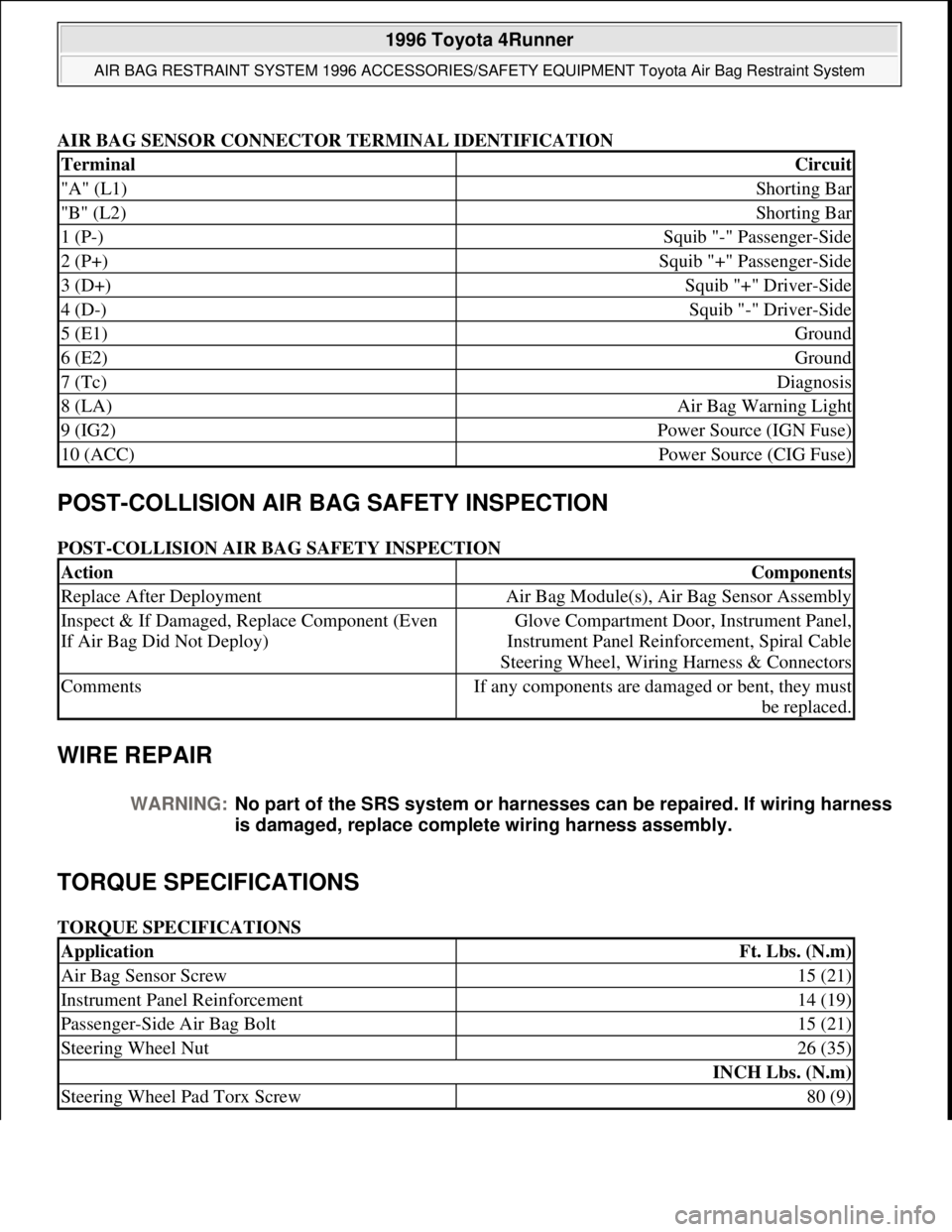
AIR BAG SENSOR CONNECTOR TERMINAL IDENTIFICATION
POST-COLLISION AIR BAG SAFETY INSPECTION
POST-COLLISION AIR BAG SAFETY INSPECTION
WIRE REPAIR
TORQUE SPECIFICATIONS
TORQUE SPECIFICATIONS
TerminalCircuit
"A" (L1)Shorting Bar
"B" (L2)Shorting Bar
1 (P-)Squib "-" Passenger-Side
2 (P+)Squib "+" Passenger-Side
3 (D+)Squib "+" Driver-Side
4 (D-)Squib "-" Driver-Side
5 (E1)Ground
6 (E2)Ground
7 (Tc)Diagnosis
8 (LA)Air Bag Warning Light
9 (IG2)Power Source (IGN Fuse)
10 (ACC)Power Source (CIG Fuse)
ActionComponents
Replace After DeploymentAir Bag Module(s), Air Bag Sensor Assembly
Inspect & If Damaged, Replace Component (Even
If Air Bag Did Not Deploy)Glove Compartment Door, Instrument Panel,
Instrument Panel Reinforcement, Spiral Cable
Steering Wheel, Wiring Harness & Connectors
CommentsIf any components are damaged or bent, they must
be replaced.
WARNING:No part of the SRS system or harnesses can be repaired. If wiring harness
is damaged, replace complete wiring harness assembly.
ApplicationFt. Lbs. (N.m)
Air Bag Sensor Screw15 (21)
Instrument Panel Reinforcement14 (19)
Passenger-Side Air Bag Bolt15 (21)
Steering Wheel Nut26 (35)
INCH Lbs. (N.m)
Steering Wheel Pad Torx Screw80 (9)
1996 Toyota 4Runner
AIR BAG RESTRAINT SYSTEM 1996 ACCESSORIES/SAFETY EQUIPMENT Toyota Air Bag Restraint System
Microsoft
Tuesday, August 18, 2009 7:33:32 PMPage 26 © 2005 Mitchell Repair Information Company, LLC.