ECO mode TOYOTA RAV4 1996 Service Owner's Manual
[x] Cancel search | Manufacturer: TOYOTA, Model Year: 1996, Model line: RAV4, Model: TOYOTA RAV4 1996Pages: 1632, PDF Size: 41.64 MB
Page 700 of 1632
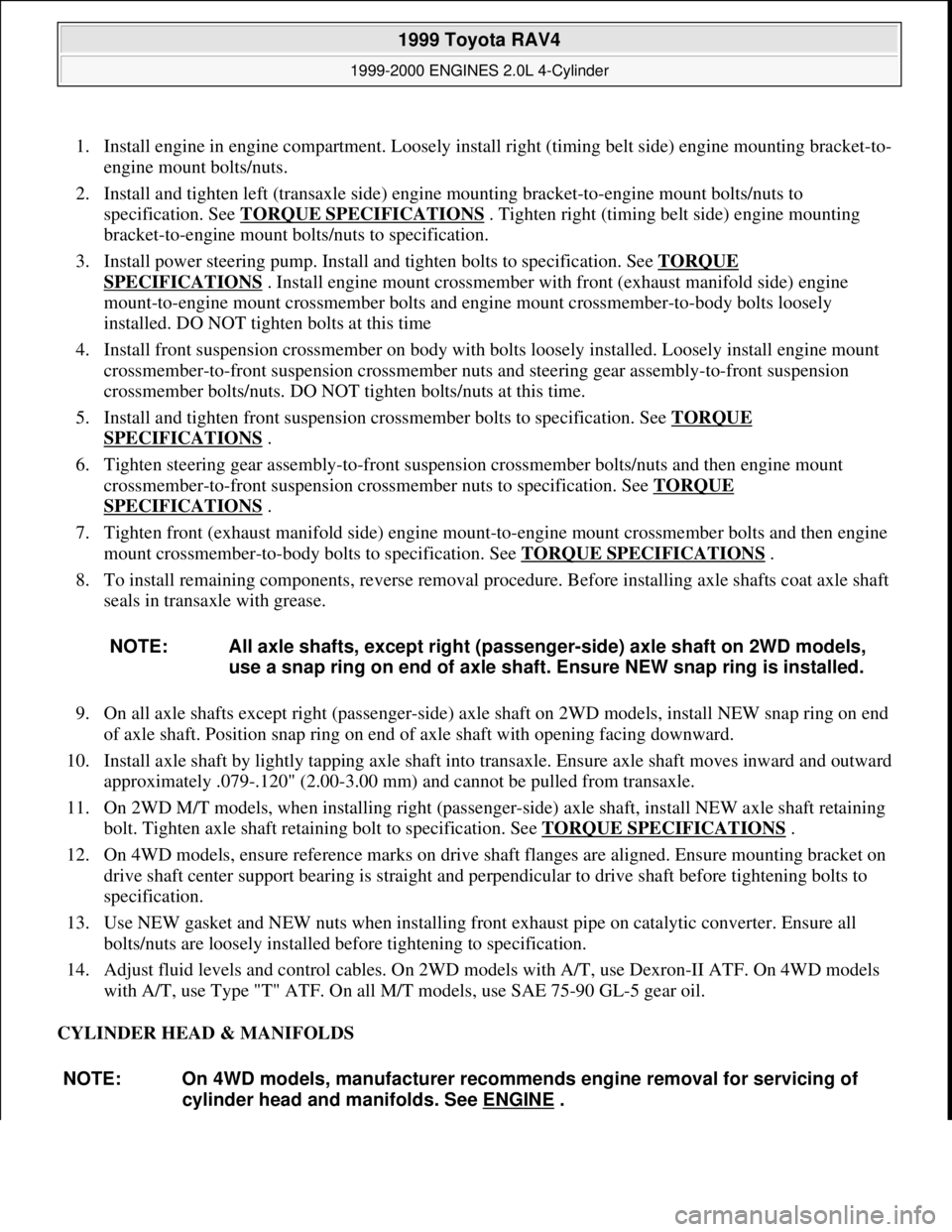
1. Install engine in engine compartment. Loosely install right (timing belt side) engine mounting bracket-to-
engine mount bolts/nuts.
2. Install and tighten left (transaxle side) engine mounting bracket-to-engine mount bolts/nuts to
specification. See TORQUE SPECIFICATIONS
. Tighten right (timing belt side) engine mounting
bracket-to-engine mount bolts/nuts to specification.
3. Install power steering pump. Install and tighten bolts to specification. See TORQUE
SPECIFICATIONS . Install engine mount crossmember with front (exhaust manifold side) engine
mount-to-engine mount crossmember bolts and engine mount crossmember-to-body bolts loosely
installed. DO NOT tighten bolts at this time
4. Install front suspension crossmember on body with bolts loosely installed. Loosely install engine mount
crossmember-to-front suspension crossmember nuts and steering gear assembly-to-front suspension
crossmember bolts/nuts. DO NOT tighten bolts/nuts at this time.
5. Install and tighten front suspension crossmember bolts to specification. See TORQUE
SPECIFICATIONS .
6. Tighten steering gear assembly-to-front suspension crossmember bolts/nuts and then engine mount
crossmember-to-front suspension crossmember nuts to specification. See TORQUE
SPECIFICATIONS .
7. Tighten front (exhaust manifold side) engine mount-to-engine mount crossmember bolts and then engine
mount crossmember-to-body bolts to specification. See TORQUE SPECIFICATIONS
.
8. To install remaining components, reverse removal procedure. Before installing axle shafts coat axle shaft
seals in transaxle with grease.
9. On all axle shafts except right (passenger-side) axle shaft on 2WD models, install NEW snap ring on end
of axle shaft. Position snap ring on end of axle shaft with opening facing downward.
10. Install axle shaft by lightly tapping axle shaft into transaxle. Ensure axle shaft moves inward and outward
approximately .079-.120" (2.00-3.00 mm) and cannot be pulled from transaxle.
11. On 2WD M/T models, when installing right (passenger-side) axle shaft, install NEW axle shaft retaining
bolt. Tighten axle shaft retaining bolt to specification. See TORQUE SPECIFICATIONS
.
12. On 4WD models, ensure reference marks on drive shaft flanges are aligned. Ensure mounting bracket on
drive shaft center support bearing is straight and perpendicular to drive shaft before tightening bolts to
specification.
13. Use NEW gasket and NEW nuts when installing front exhaust pipe on catalytic converter. Ensure all
bolts/nuts are loosely installed before tightening to specification.
14. Adjust fluid levels and control cables. On 2WD models with A/T, use Dexron-II ATF. On 4WD models
with A/T, use Type "T" ATF. On all M/T models, use SAE 75-90 GL-5 gear oil.
CYLINDER HEAD & MANIFOLDS NOTE: All axle shafts, except right (passenger-side) axle shaft on 2WD models,
use a snap ring on end of axle shaft. Ensure NEW snap ring is installed.
NOTE: On 4WD models, manufacturer recommends engine removal for servicing of
cylinder head and manifolds. See ENGINE
.
1999 Toyota RAV4
1999-2000 ENGINES 2.0L 4-Cylinder
Microsoft
Sunday, November 22, 2009 10:22:26 AMPage 17 © 2005 Mitchell Repair Information Company, LLC.
Page 722 of 1632
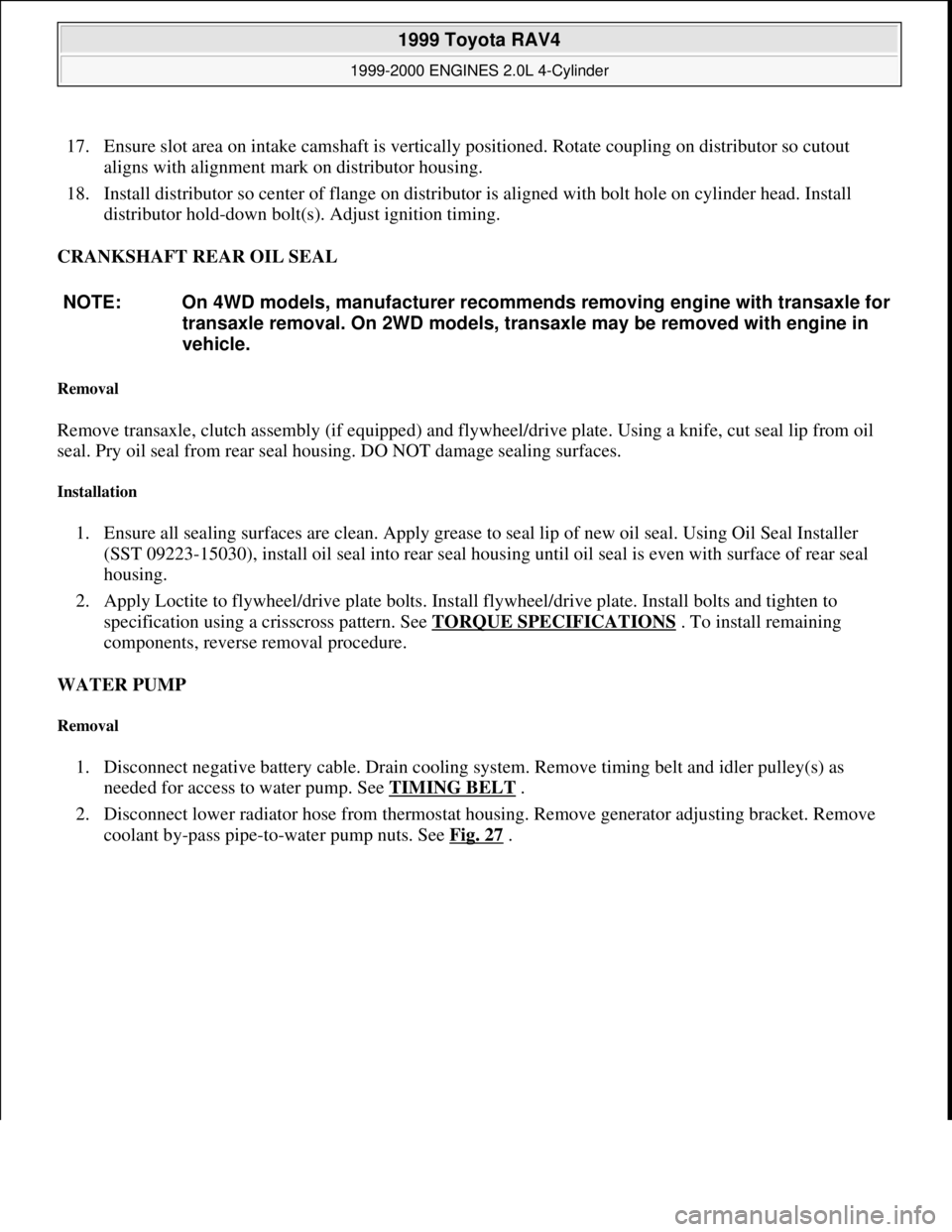
17. Ensure slot area on intake camshaft is vertically positioned. Rotate coupling on distributor so cutout
aligns with alignment mark on distributor housing.
18. Install distributor so center of flange on distributor is aligned with bolt hole on cylinder head. Install
distributor hold-down bolt(s). Adjust ignition timing.
CRANKSHAFT REAR OIL SEAL
Removal
Remove transaxle, clutch assembly (if equipped) and flywheel/drive plate. Using a knife, cut seal lip from oil
seal. Pry oil seal from rear seal housing. DO NOT damage sealing surfaces.
Installation
1. Ensure all sealing surfaces are clean. Apply grease to seal lip of new oil seal. Using Oil Seal Installer
(SST 09223-15030), install oil seal into rear seal housing until oil seal is even with surface of rear seal
housing.
2. Apply Loctite to flywheel/drive plate bolts. Install flywheel/drive plate. Install bolts and tighten to
specification using a crisscross pattern. See TORQUE SPECIFICATIONS
. To install remaining
components, reverse removal procedure.
WATER PUMP
Removal
1. Disconnect negative battery cable. Drain cooling system. Remove timing belt and idler pulley(s) as
needed for access to water pump. See TIMING BELT
.
2. Disconnect lower radiator hose from thermostat housing. Remove generator adjusting bracket. Remove
coolant b
y-pass pipe-to-water pump nuts. See Fig. 27. NOTE: On 4WD models, manufacturer recommends removing engine with transaxle for
transaxle removal. On 2WD models, transaxle may be removed with engine in
vehicle.
1999 Toyota RAV4
1999-2000 ENGINES 2.0L 4-Cylinder
Microsoft
Sunday, November 22, 2009 10:22:26 AMPage 39 © 2005 Mitchell Repair Information Company, LLC.
Page 765 of 1632
Removal
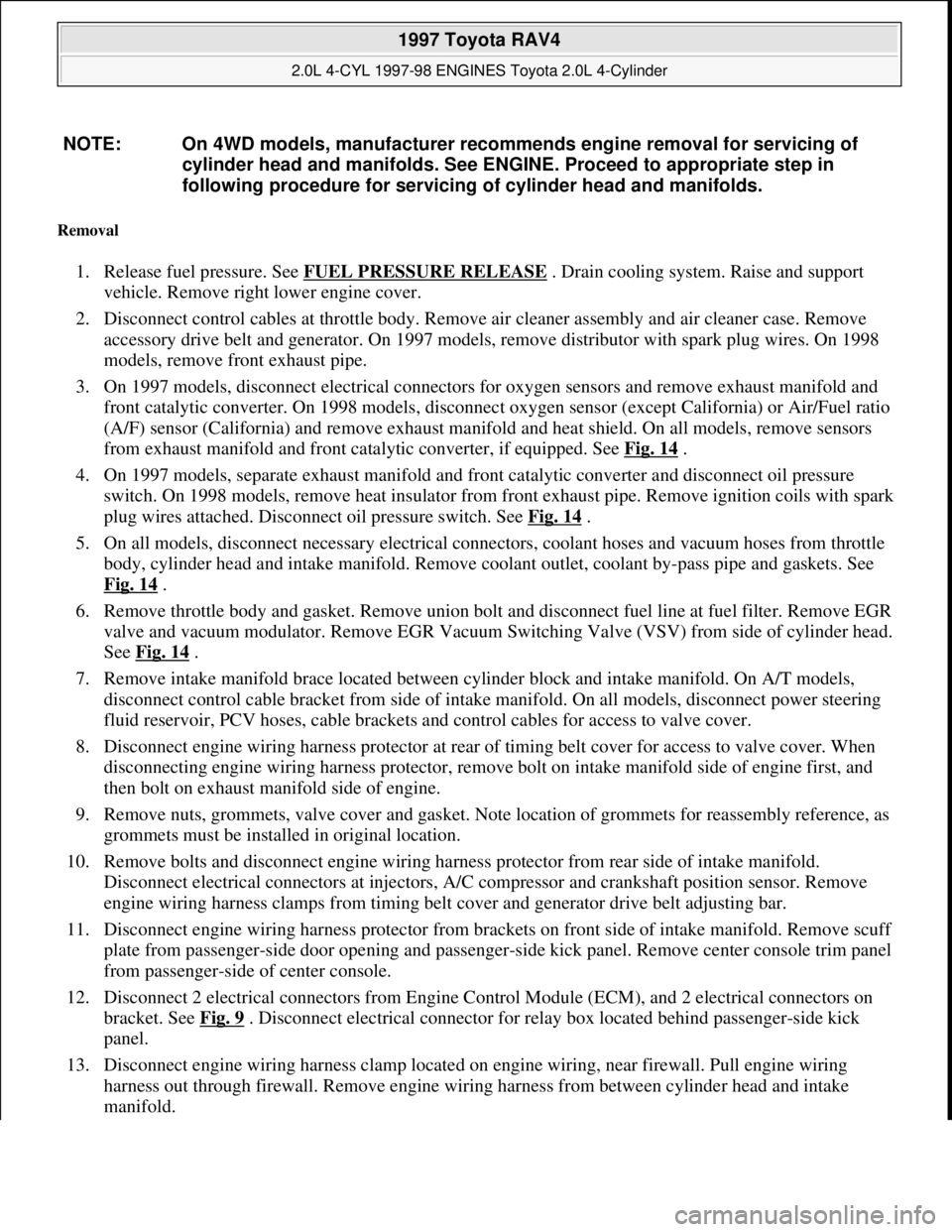
1. Release fuel pressure. See FUEL PRESSURE RELEASE . Drain cooling system. Raise and support
vehicle. Remove right lower engine cover.
2. Disconnect control cables at throttle body. Remove air cleaner assembly and air cleaner case. Remove
accessory drive belt and generator. On 1997 models, remove distributor with spark plug wires. On 1998
models, remove front exhaust pipe.
3. On 1997 models, disconnect electrical connectors for oxygen sensors and remove exhaust manifold and
front catalytic converter. On 1998 models, disconnect oxygen sensor (except California) or Air/Fuel ratio
(A/F) sensor (California) and remove exhaust manifold and heat shield. On all models, remove sensors
from exhaust manifold and front catalytic converter, if equipped. See Fig. 14
.
4. On 1997 models, separate exhaust manifold and front catalytic converter and disconnect oil pressure
switch. On 1998 models, remove heat insulator from front exhaust pipe. Remove ignition coils with spark
plug wires attached. Disconnect oil pressure switch. See Fig. 14
.
5. On all models, disconnect necessary electrical connectors, coolant hoses and vacuum hoses from throttle
body, cylinder head and intake manifold. Remove coolant outlet, coolant by-pass pipe and gaskets. See
Fig. 14
.
6. Remove throttle body and gasket. Remove union bolt and disconnect fuel line at fuel filter. Remove EGR
valve and vacuum modulator. Remove EGR Vacuum Switching Valve (VSV) from side of cylinder head.
See Fig. 14
.
7. Remove intake manifold brace located between cylinder block and intake manifold. On A/T models,
disconnect control cable bracket from side of intake manifold. On all models, disconnect power steering
fluid reservoir, PCV hoses, cable brackets and control cables for access to valve cover.
8. Disconnect engine wiring harness protector at rear of timing belt cover for access to valve cover. When
disconnecting engine wiring harness protector, remove bolt on intake manifold side of engine first, and
then bolt on exhaust manifold side of engine.
9. Remove nuts, grommets, valve cover and gasket. Note location of grommets for reassembly reference, as
grommets must be installed in original location.
10. Remove bolts and disconnect engine wiring harness protector from rear side of intake manifold.
Disconnect electrical connectors at injectors, A/C compressor and crankshaft position sensor. Remove
engine wiring harness clamps from timing belt cover and generator drive belt adjusting bar.
11. Disconnect engine wiring harness protector from brackets on front side of intake manifold. Remove scuff
plate from passenger-side door opening and passenger-side kick panel. Remove center console trim panel
from passenger-side of center console.
12. Disconnect 2 electrical connectors from Engine Control Module (ECM), and 2 electrical connectors on
bracket. See Fig. 9
. Disconnect electrical connector for relay box located behind passenger-side kick
panel.
13. Disconnect engine wiring harness clamp located on engine wiring, near firewall. Pull engine wiring
harness out through firewall. Remove engine wiring harness from between cylinder head and intake
manifold. NOTE: On 4WD models, manufacturer recommends engine removal for servicing of
cylinder head and manifolds. See ENGINE. Proceed to appropriate step in
following procedure for servicing of cylinder head and manifolds.
1997 Toyota RAV4
2.0L 4-CYL 1997-98 ENGINES Toyota 2.0L 4-Cylinder
Microsoft
Sunday, November 22, 2009 10:23:31 AMPage 17 © 2005 Mitchell Repair Information Company, LLC.
Page 787 of 1632
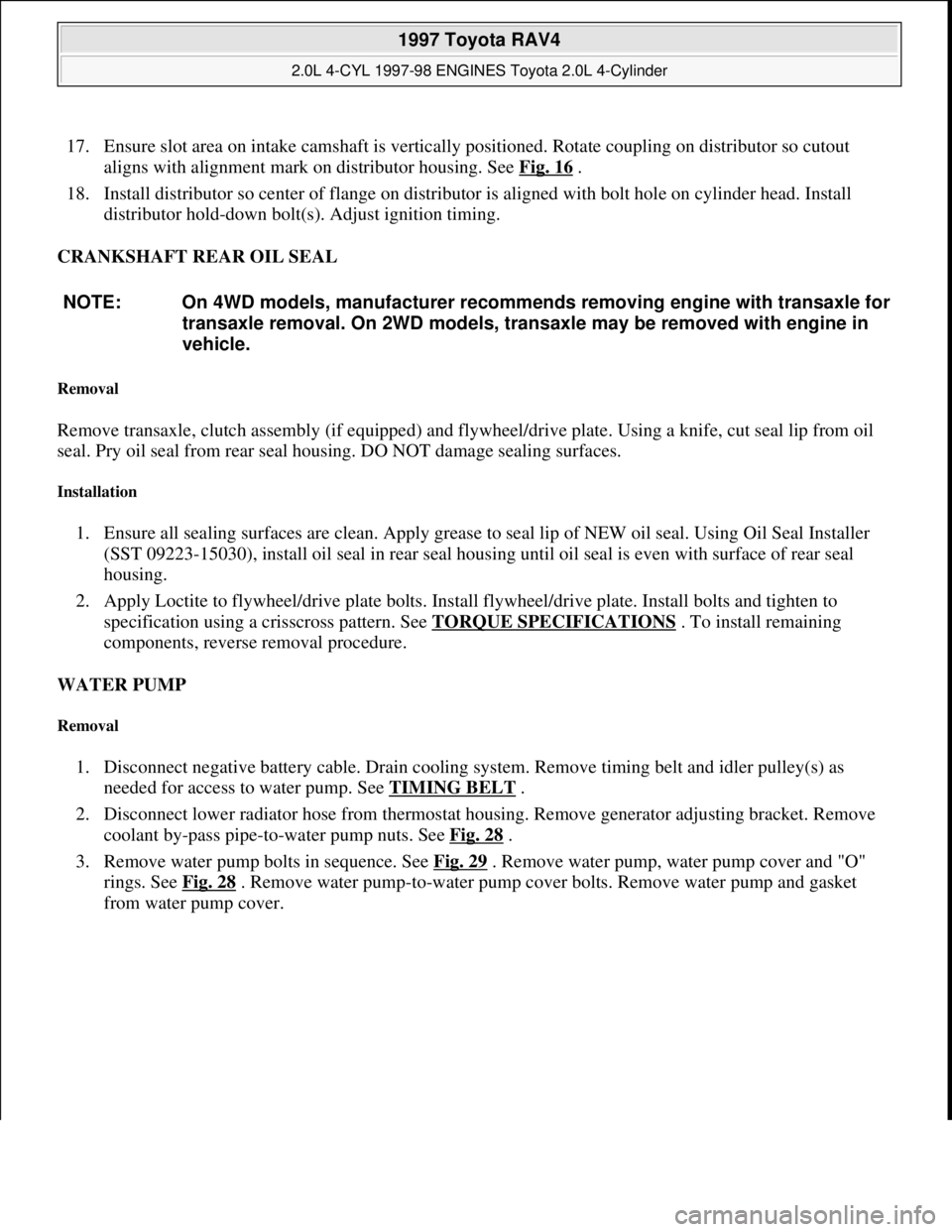
17. Ensure slot area on intake camshaft is vertically positioned. Rotate coupling on distributor so cutout
aligns with alignment mark on distributor housing. See Fig. 16
.
18. Install distributor so center of flange on distributor is aligned with bolt hole on cylinder head. Install
distributor hold-down bolt(s). Adjust ignition timing.
CRANKSHAFT REAR OIL SEAL
Removal
Remove transaxle, clutch assembly (if equipped) and flywheel/drive plate. Using a knife, cut seal lip from oil
seal. Pry oil seal from rear seal housing. DO NOT damage sealing surfaces.
Installation
1. Ensure all sealing surfaces are clean. Apply grease to seal lip of NEW oil seal. Using Oil Seal Installer
(SST 09223-15030), install oil seal in rear seal housing until oil seal is even with surface of rear seal
housing.
2. Apply Loctite to flywheel/drive plate bolts. Install flywheel/drive plate. Install bolts and tighten to
specification using a crisscross pattern. See TORQUE SPECIFICATIONS
. To install remaining
components, reverse removal procedure.
WATER PUMP
Removal
1. Disconnect negative battery cable. Drain cooling system. Remove timing belt and idler pulley(s) as
needed for access to water pump. See TIMING BELT
.
2. Disconnect lower radiator hose from thermostat housing. Remove generator adjusting bracket. Remove
coolant by-pass pipe-to-water pump nuts. See Fig. 28
.
3. Remove water pump bolts in sequence. See Fig. 29
. Remove water pump, water pump cover and "O"
rings. See Fig. 28
. Remove water pump-to-water pump cover bolts. Remove water pump and gasket
from water pump cover. NOTE: On 4WD models, manufacturer recommends removing engine with transaxle for
transaxle removal. On 2WD models, transaxle may be removed with engine in
vehicle.
1997 Toyota RAV4
2.0L 4-CYL 1997-98 ENGINES Toyota 2.0L 4-Cylinder
Microsoft
Sunday, November 22, 2009 10:23:31 AMPage 39 © 2005 Mitchell Repair Information Company, LLC.
Page 819 of 1632
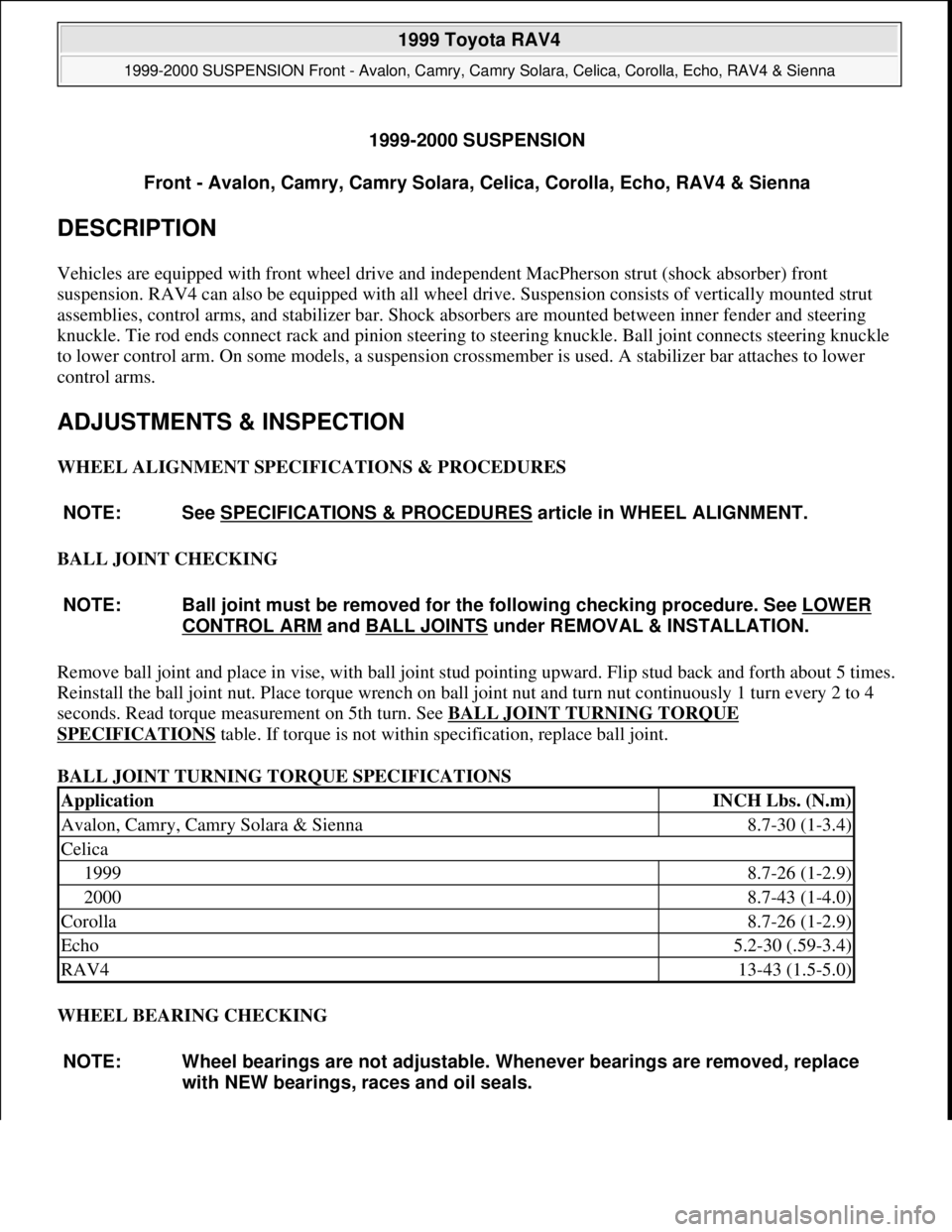
1999-2000 SUSPENSION
Front - Avalon, Camry, Camry Solara, Celica, Corolla, Echo, RAV4 & Sienna
DESCRIPTION
Vehicles are equipped with front wheel drive and independent MacPherson strut (shock absorber) front
suspension. RAV4 can also be equipped with all wheel drive. Suspension consists of vertically mounted strut
assemblies, control arms, and stabilizer bar. Shock absorbers are mounted between inner fender and steering
knuckle. Tie rod ends connect rack and pinion steering to steering knuckle. Ball joint connects steering knuckle
to lower control arm. On some models, a suspension crossmember is used. A stabilizer bar attaches to lower
control arms.
ADJUSTMENTS & INSPECTION
WHEEL ALIGNMENT SPECIFICATIONS & PROCEDURES
BALL JOINT CHECKING
Remove ball joint and place in vise, with ball joint stud pointing upward. Flip stud back and forth about 5 times.
Reinstall the ball joint nut. Place torque wrench on ball joint nut and turn nut continuously 1 turn every 2 to 4
seconds. Read torque measurement on 5th turn. See BALL JOINT TURNING TORQUE
SPECIFICATIONS table. If torque is not within specification, replace ball joint.
BALL JOINT TURNING TORQUE SPECIFICATIONS
WHEEL BEARING CHECKING NOTE: See SPECIFICATIONS & PROCEDURES
article in WHEEL ALIGNMENT.
NOTE: Ball joint must be removed for the following checking procedure. See LOWER
CONTROL ARM and BALL JOINTS under REMOVAL & INSTALLATION.
ApplicationINCH Lbs. (N.m)
Avalon, Camry, Camry Solara & Sienna8.7-30 (1-3.4)
Celica
19998.7-26 (1-2.9)
20008.7-43 (1-4.0)
Corolla8.7-26 (1-2.9)
Echo5.2-30 (.59-3.4)
RAV413-43 (1.5-5.0)
NOTE: Wheel bearings are not adjustable. Whenever bearings are removed, replace
with NEW bearings, races and oil seals.
1999 Toyota RAV4
1999-2000 SUSPENSION Front - Avalon, Camry, Camry Solara, Celica, Corolla, Echo, RAV4 & Sienna
1999 Toyota RAV4
1999-2000 SUSPENSION Front - Avalon, Camry, Camry Solara, Celica, Corolla, Echo, RAV4 & Sienna
Microsoft
Sunday, November 22, 2009 10:36:34 AMPage 1 © 2005 Mitchell Repair Information Company, LLC.
Microsoft
Sunday, November 22, 2009 10:36:38 AMPage 1 © 2005 Mitchell Repair Information Company, LLC.
Page 904 of 1632
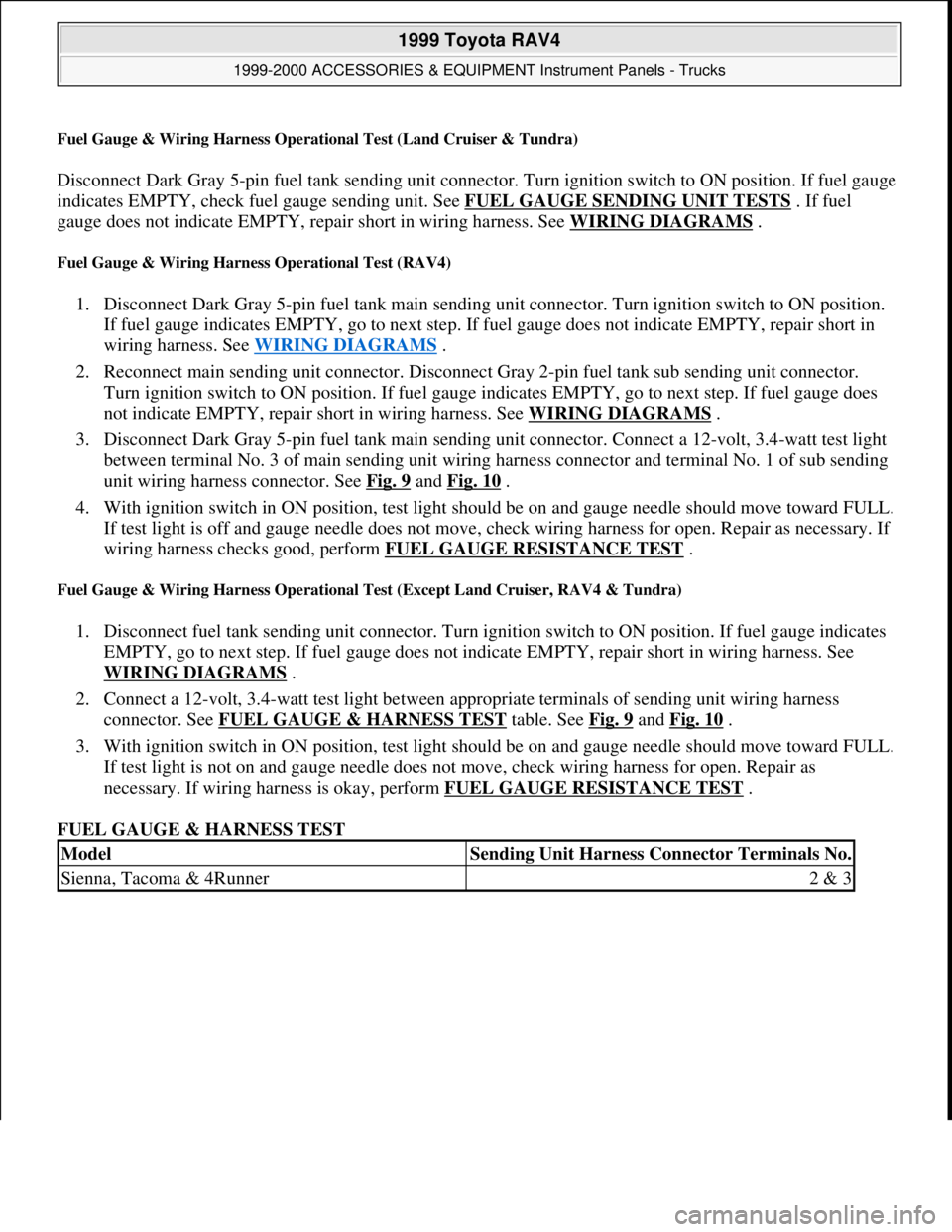
Fuel Gauge & Wiring Harness Operational Test (Land Cruiser & Tundra)
Disconnect Dark Gray 5-pin fuel tank sending unit connector. Turn ignition switch to ON position. If fuel gauge
indicates EMPTY, check fuel gauge sending unit. See FUEL GAUGE SENDING UNIT TESTS
. If fuel
gauge does not indicate EMPTY, repair short in wiring harness. See WIRING DIAGRAMS
.
Fuel Gauge & Wiring Harness Operational Test (RAV4)
1. Disconnect Dark Gray 5-pin fuel tank main sending unit connector. Turn ignition switch to ON position.
If fuel gauge indicates EMPTY, go to next step. If fuel gauge does not indicate EMPTY, repair short in
wiring harness. See WIRING DIAGRAMS
.
2. Reconnect main sending unit connector. Disconnect Gray 2-pin fuel tank sub sending unit connector.
Turn ignition switch to ON position. If fuel gauge indicates EMPTY, go to next step. If fuel gauge does
not indicate EMPTY, repair short in wiring harness. See WIRING DIAGRAMS
.
3. Disconnect Dark Gray 5-pin fuel tank main sending unit connector. Connect a 12-volt, 3.4-watt test light
between terminal No. 3 of main sending unit wiring harness connector and terminal No. 1 of sub sending
unit wiring harness connector. See Fig. 9
and Fig. 10 .
4. With ignition switch in ON position, test light should be on and gauge needle should move toward FULL.
If test light is off and gauge needle does not move, check wiring harness for open. Repair as necessary. If
wiring harness checks good, perform FUEL GAUGE RESISTANCE TEST
.
Fuel Gauge & Wiring Harness Operational Test (Except Land Cruiser, RAV4 & Tundra)
1. Disconnect fuel tank sending unit connector. Turn ignition switch to ON position. If fuel gauge indicates
EMPTY, go to next step. If fuel gauge does not indicate EMPTY, repair short in wiring harness. See
WIRING DIAGRAMS
.
2. Connect a 12-volt, 3.4-watt test light between appropriate terminals of sending unit wiring harness
connector. See FUEL GAUGE & HARNESS TEST
table. See Fig. 9 and Fig. 10 .
3. With ignition switch in ON position, test light should be on and gauge needle should move toward FULL.
If test light is not on and gauge needle does not move, check wiring harness for open. Repair as
necessary. If wiring harness is okay, perform FUEL GAUGE RESISTANCE TEST
.
FUEL GAUGE & HARNESS TEST
ModelSending Unit Harness Connector Terminals No.
Sienna, Tacoma & 4Runner2 & 3
1999 Toyota RAV4
1999-2000 ACCESSORIES & EQUIPMENT Instrument Panels - Trucks
Microsoft
Sunday, November 22, 2009 10:54:10 AMPage 14 © 2005 Mitchell Repair Information Company, LLC.
Page 948 of 1632
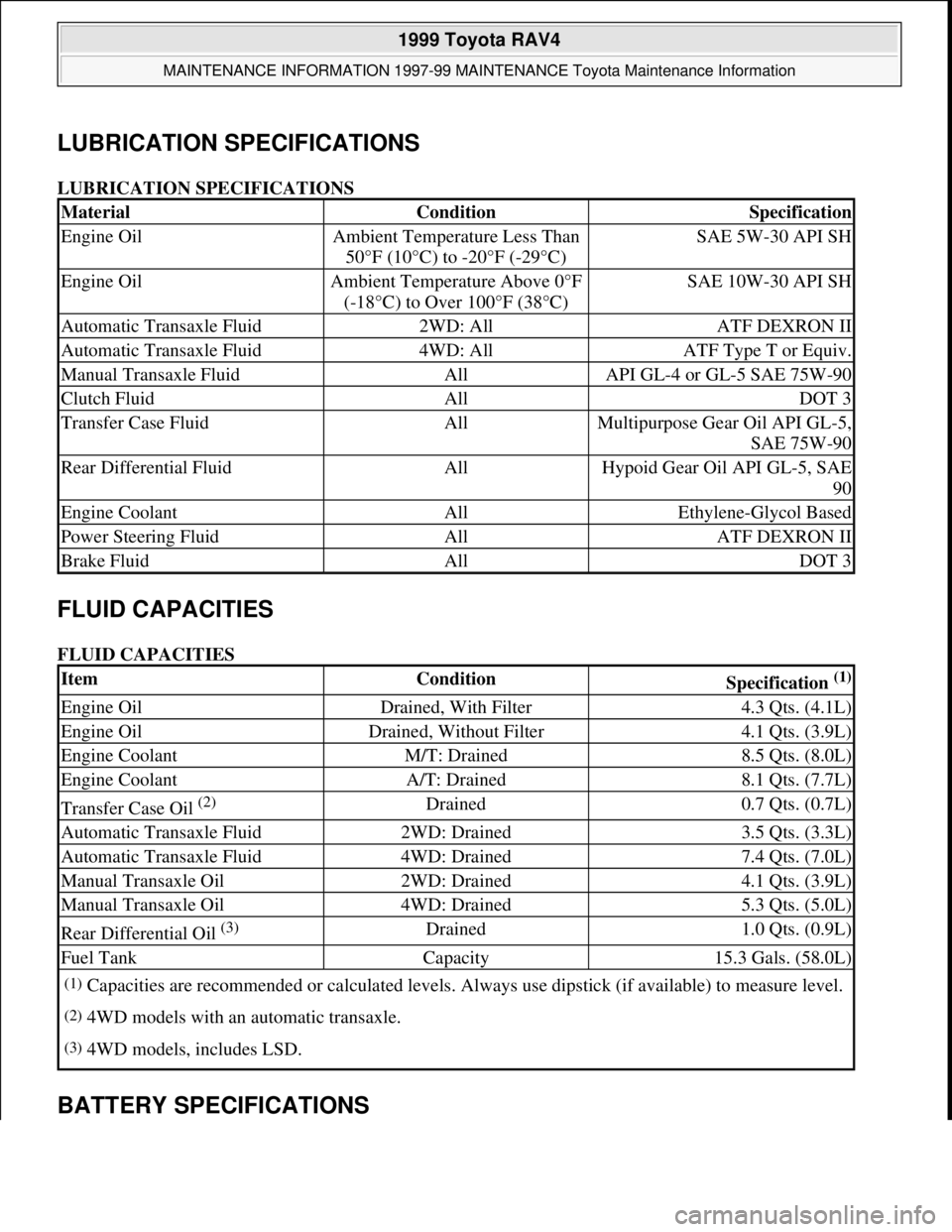
LUBRICATION SPECIFICATIONS
LUBRICATION SPECIFICATIONS
FLUID CAPACITIES
FLUID CAPACITIES
BATTERY SPECIFICATIONS
MaterialConditionSpecification
Engine OilAmbient Temperature Less Than
50°F (10°C) to -20°F (-29°C)SAE 5W-30 API SH
Engine OilAmbient Temperature Above 0°F
(-18°C) to Over 100°F (38°C)SAE 10W-30 API SH
Automatic Transaxle Fluid2WD: AllATF DEXRON II
Automatic Transaxle Fluid4WD: AllATF Type T or Equiv.
Manual Transaxle FluidAllAPI GL-4 or GL-5 SAE 75W-90
Clutch FluidAllDOT 3
Transfer Case FluidAllMultipurpose Gear Oil API GL-5,
SAE 75W-90
Rear Differential FluidAllHypoid Gear Oil API GL-5, SAE
90
Engine CoolantAllEthylene-Glycol Based
Power Steering FluidAllATF DEXRON II
Brake FluidAllDOT 3
ItemConditionSpecification (1)
Engine OilDrained, With Filter4.3 Qts. (4.1L)
Engine OilDrained, Without Filter4.1 Qts. (3.9L)
Engine CoolantM/T: Drained8.5 Qts. (8.0L)
Engine CoolantA/T: Drained8.1 Qts. (7.7L)
Transfer Case Oil (2) Drained0.7 Qts. (0.7L)
Automatic Transaxle Fluid2WD: Drained3.5 Qts. (3.3L)
Automatic Transaxle Fluid4WD: Drained7.4 Qts. (7.0L)
Manual Transaxle Oil2WD: Drained4.1 Qts. (3.9L)
Manual Transaxle Oil4WD: Drained5.3 Qts. (5.0L)
Rear Differential Oil (3) Drained1.0 Qts. (0.9L)
Fuel TankCapacity15.3 Gals. (58.0L)
(1)Capacities are recommended or calculated levels. Always use dipstick (if available) to measure level.
(2)4WD models with an automatic transaxle.
(3)4WD models, includes LSD.
1999 Toyota RAV4
MAINTENANCE INFORMATION 1997-99 MAINTENANCE Toyota Maintenance Information
Microsoft
Sunday, November 22, 2009 10:32:42 AMPage 6 © 2005 Mitchell Repair Information Company, LLC.
Page 950 of 1632
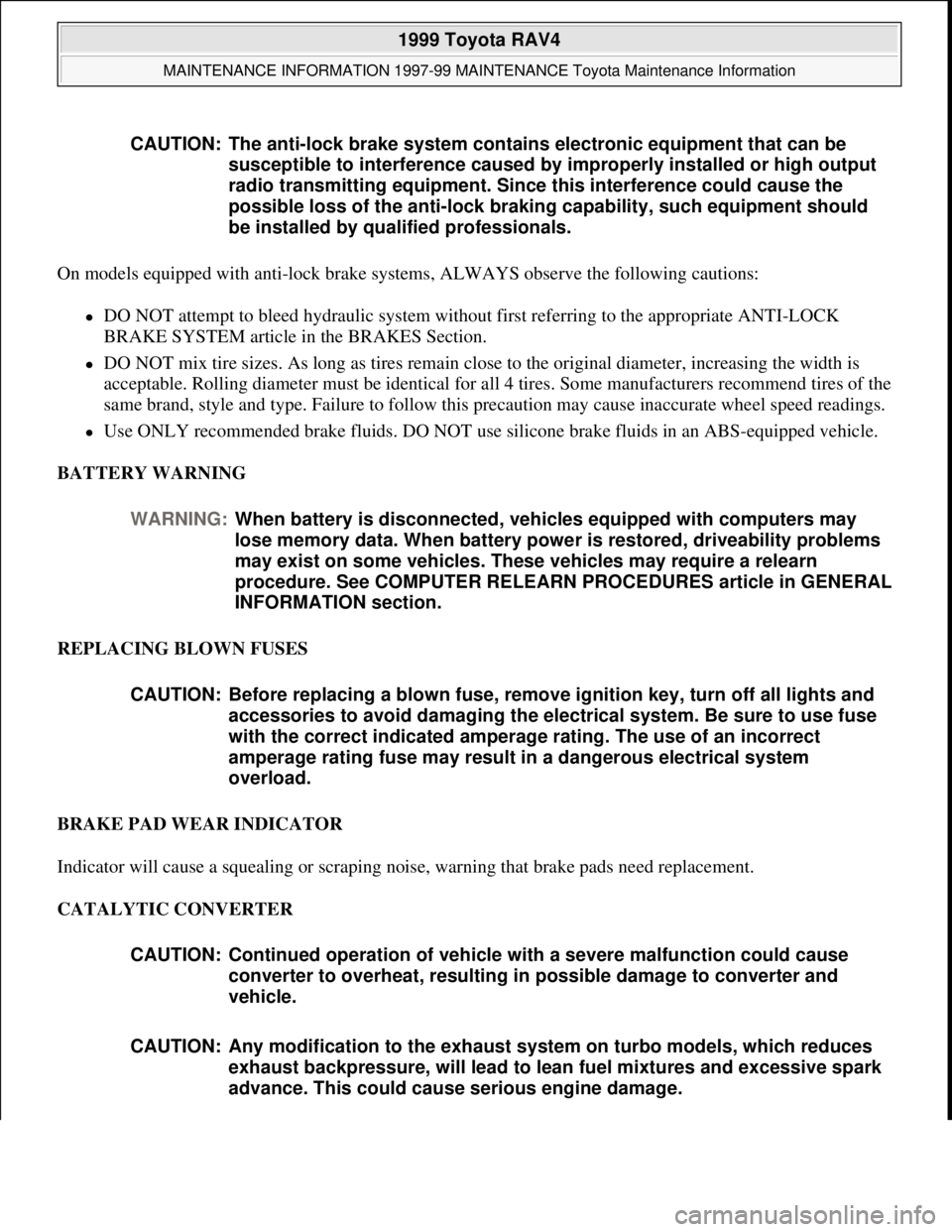
On models equipped with anti-lock brake systems, ALWAYS observe the following cautions:
DO NOT attempt to bleed hydraulic system without first referring to the appropriate ANTI-LOCK
BRAKE SYSTEM article in the BRAKES Section.
DO NOT mix tire sizes. As long as tires remain close to the original diameter, increasing the width is
acceptable. Rolling diameter must be identical for all 4 tires. Some manufacturers recommend tires of the
same brand, style and type. Failure to follow this precaution may cause inaccurate wheel speed readings.
Use ONLY recommended brake fluids. DO NOT use silicone brake fluids in an ABS-equipped vehicle.
BATTERY WARNING
REPLACING BLOWN FUSES
BRAKE PAD WEAR INDICATOR
Indicator will cause a squealing or scraping noise, warning that brake pads need replacement.
CATALYTIC CONVERTER CAUTION: The anti-lock brake system contains electronic equipment that can be
susceptible to interference caused by improperly installed or high output
radio transmitting equipment. Since this interference could cause the
possible loss of the anti-lock braking capability, such equipment should
be installed by qualified professionals.
WARNING:When battery is disconnected, vehicles equipped with computers may
lose memory data. When battery power is restored, driveability problems
may exist on some vehicles. These vehicles may require a relearn
procedure. See COMPUTER RELEARN PROCEDURES article in GENERAL
INFORMATION section.
CAUTION: Before replacing a blown fuse, remove ignition key, turn off all lights and
accessories to avoid damaging the electrical system. Be sure to use fuse
with the correct indicated amperage rating. The use of an incorrect
amperage rating fuse may result in a dangerous electrical system
overload.
CAUTION: Continued operation of vehicle with a severe malfunction could cause
converter to overheat, resulting in possible damage to converter and
vehicle.
CAUTION: Any modification to the exhaust system on turbo models, which reduces
exhaust backpressure, will lead to lean fuel mixtures and excessive spark
advance. This could cause serious engine damage.
1999 Toyota RAV4
MAINTENANCE INFORMATION 1997-99 MAINTENANCE Toyota Maintenance Information
Microsoft
Sunday, November 22, 2009 10:32:42 AMPage 8 © 2005 Mitchell Repair Information Company, LLC.
Page 1002 of 1632
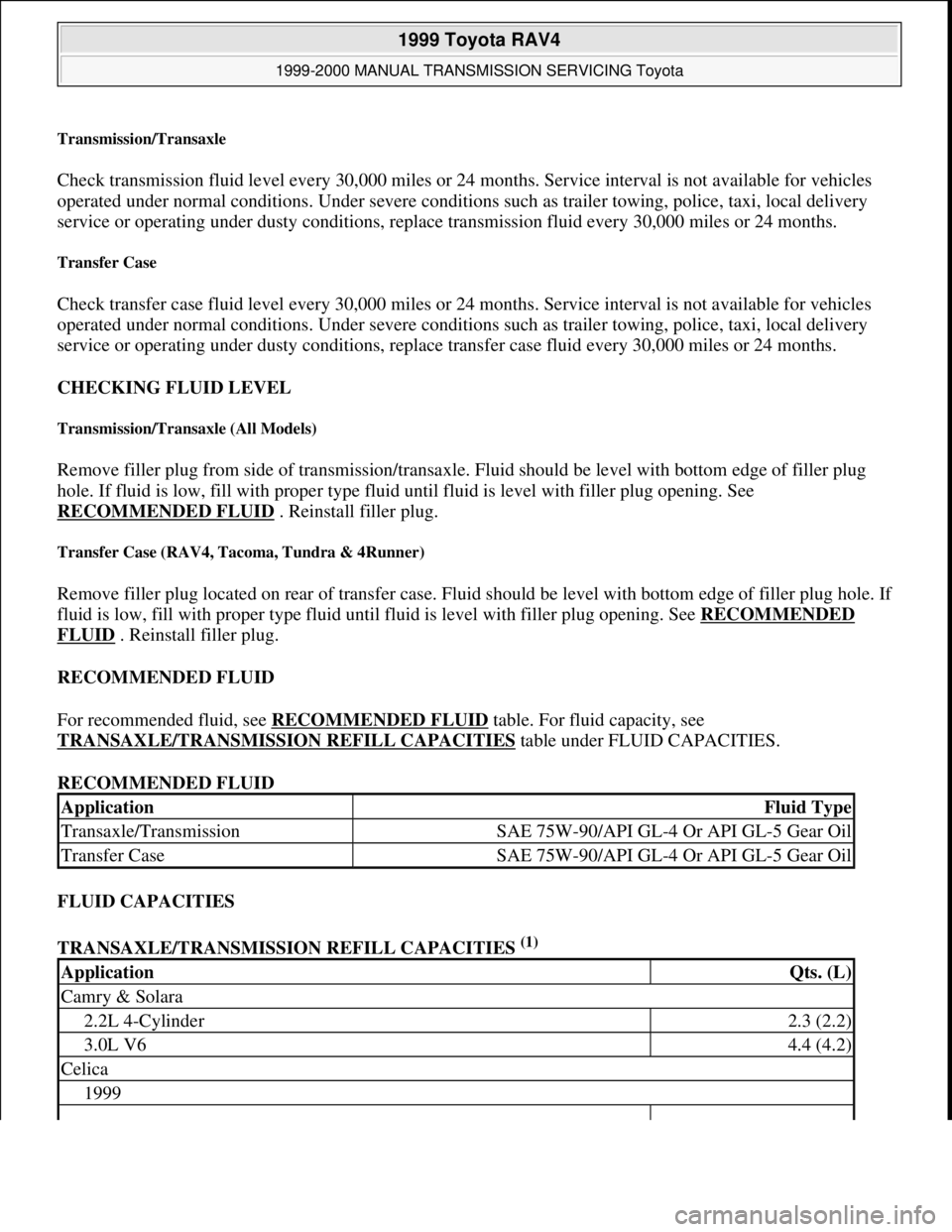
Transmission/Transaxle
Check transmission fluid level every 30,000 miles or 24 months. Service interval is not available for vehicles
operated under normal conditions. Under severe conditions such as trailer towing, police, taxi, local delivery
service or operating under dusty conditions, replace transmission fluid every 30,000 miles or 24 months.
Transfer Case
Check transfer case fluid level every 30,000 miles or 24 months. Service interval is not available for vehicles
operated under normal conditions. Under severe conditions such as trailer towing, police, taxi, local delivery
service or operating under dusty conditions, replace transfer case fluid every 30,000 miles or 24 months.
CHECKING FLUID LEVEL
Transmission/Transaxle (All Models)
Remove filler plug from side of transmission/transaxle. Fluid should be level with bottom edge of filler plug
hole. If fluid is low, fill with proper type fluid until fluid is level with filler plug opening. See
RECOMMENDED FLUID
. Reinstall filler plug.
Transfer Case (RAV4, Tacoma, Tundra & 4Runner)
Remove filler plug located on rear of transfer case. Fluid should be level with bottom edge of filler plug hole. If
fluid is low, fill with proper type fluid until fluid is level with filler plug opening. See RECOMMENDED
FLUID . Reinstall filler plug.
RECOMMENDED FLUID
For recommended fluid, see RECOMMENDED FLUID
table. For fluid capacity, see
TRANSAXLE/TRANSMISSION REFILL CAPACITIES
table under FLUID CAPACITIES.
RECOMMENDED FLUID
FLUID CAPACITIES
TRANSAXLE/TRANSMISSION REFILL CAPACITIES
(1)
ApplicationFluid Type
Transaxle/TransmissionSAE 75W-90/API GL-4 Or API GL-5 Gear Oil
Transfer CaseSAE 75W-90/API GL-4 Or API GL-5 Gear Oil
ApplicationQts. (L)
Camry & Solara
2.2L 4-Cylinder2.3 (2.2)
3.0L V64.4 (4.2)
Celica
1999
1999 Toyota RAV4
1999-2000 MANUAL TRANSMISSION SERVICING Toyota
Microsoft
Sunday, November 22, 2009 10:47:31 AMPage 2 © 2005 Mitchell Repair Information Company, LLC.
Page 1094 of 1632
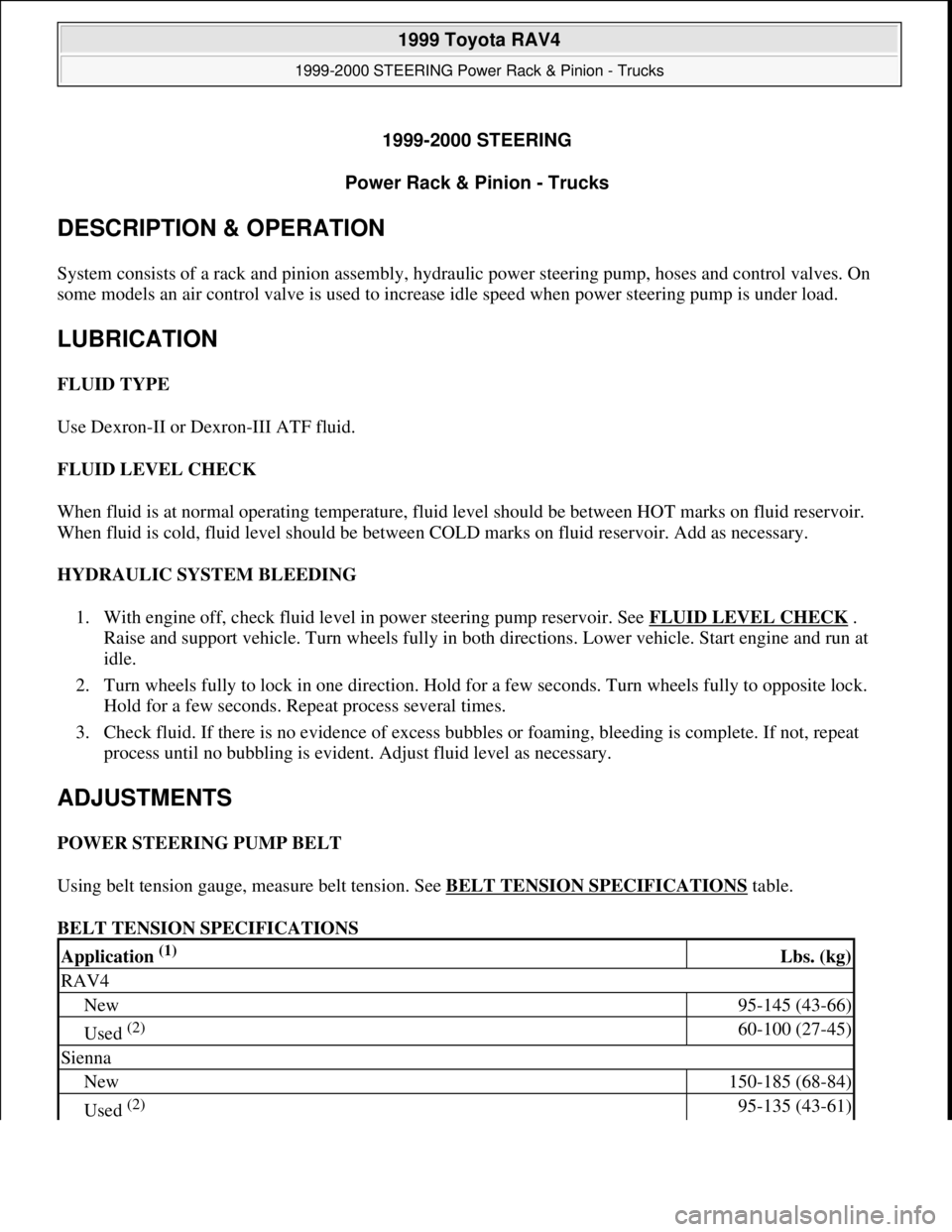
1999-2000 STEERING
Power Rack & Pinion - Trucks
DESCRIPTION & OPERATION
System consists of a rack and pinion assembly, hydraulic power steering pump, hoses and control valves. On
some models an air control valve is used to increase idle speed when power steering pump is under load.
LUBRICATION
FLUID TYPE
Use Dexron-II or Dexron-III ATF fluid.
FLUID LEVEL CHECK
When fluid is at normal operating temperature, fluid level should be between HOT marks on fluid reservoir.
When fluid is cold, fluid level should be between COLD marks on fluid reservoir. Add as necessary.
HYDRAULIC SYSTEM BLEEDING
1. With engine off, check fluid level in power steering pump reservoir. See FLUID LEVEL CHECK
.
Raise and support vehicle. Turn wheels fully in both directions. Lower vehicle. Start engine and run at
idle.
2. Turn wheels fully to lock in one direction. Hold for a few seconds. Turn wheels fully to opposite lock.
Hold for a few seconds. Repeat process several times.
3. Check fluid. If there is no evidence of excess bubbles or foaming, bleeding is complete. If not, repeat
process until no bubbling is evident. Adjust fluid level as necessary.
ADJUSTMENTS
POWER STEERING PUMP BELT
Using belt tension gauge, measure belt tension. See BELT TENSION SPECIFICATIONS
table.
BELT TENSION SPECIFICATIONS
Application (1) Lbs. (kg)
RAV4
New95-145 (43-66)
Used (2) 60-100 (27-45)
Sienna
New150-185 (68-84)
Used (2) 95-135 (43-61)
1999 Toyota RAV4
1999-2000 STEERING Power Rack & Pinion - Trucks
1999 Toyota RAV4
1999-2000 STEERING Power Rack & Pinion - Trucks
Microsoft
Sunday, November 22, 2009 10:35:46 AMPage 1 © 2005 Mitchell Repair Information Company, LLC.
Microsoft
Sunday, November 22, 2009 10:35:50 AMPage 1 © 2005 Mitchell Repair Information Company, LLC.