coolant TOYOTA RAV4 1996 Service Owner's Manual
[x] Cancel search | Manufacturer: TOYOTA, Model Year: 1996, Model line: RAV4, Model: TOYOTA RAV4 1996Pages: 1632, PDF Size: 41.64 MB
Page 765 of 1632
Removal
1. Release fuel pressure. See FUEL PRESSURE RELEASE . Drain cooling system. Raise and support
vehicle. Remove right lower engine cover.
2. Disconnect control cables at throttle body. Remove air cleaner assembly and air cleaner case. Remove
accessory drive belt and generator. On 1997 models, remove distributor with spark plug wires. On 1998
models, remove front exhaust pipe.
3. On 1997 models, disconnect electrical connectors for oxygen sensors and remove exhaust manifold and
front catalytic converter. On 1998 models, disconnect oxygen sensor (except California) or Air/Fuel ratio
(A/F) sensor (California) and remove exhaust manifold and heat shield. On all models, remove sensors
from exhaust manifold and front catalytic converter, if equipped. See Fig. 14
.
4. On 1997 models, separate exhaust manifold and front catalytic converter and disconnect oil pressure
switch. On 1998 models, remove heat insulator from front exhaust pipe. Remove ignition coils with spark
plug wires attached. Disconnect oil pressure switch. See Fig. 14
.
5. On all models, disconnect necessary electrical connectors, coolant hoses and vacuum hoses from throttle
body, cylinder head and intake manifold. Remove coolant outlet, coolant by-pass pipe and gaskets. See
Fig. 14
.
6. Remove throttle body and gasket. Remove union bolt and disconnect fuel line at fuel filter. Remove EGR
valve and vacuum modulator. Remove EGR Vacuum Switching Valve (VSV) from side of cylinder head.
See Fig. 14
.
7. Remove intake manifold brace located between cylinder block and intake manifold. On A/T models,
disconnect control cable bracket from side of intake manifold. On all models, disconnect power steering
fluid reservoir, PCV hoses, cable brackets and control cables for access to valve cover.
8. Disconnect engine wiring harness protector at rear of timing belt cover for access to valve cover. When
disconnecting engine wiring harness protector, remove bolt on intake manifold side of engine first, and
then bolt on exhaust manifold side of engine.
9. Remove nuts, grommets, valve cover and gasket. Note location of grommets for reassembly reference, as
grommets must be installed in original location.
10. Remove bolts and disconnect engine wiring harness protector from rear side of intake manifold.
Disconnect electrical connectors at injectors, A/C compressor and crankshaft position sensor. Remove
engine wiring harness clamps from timing belt cover and generator drive belt adjusting bar.
11. Disconnect engine wiring harness protector from brackets on front side of intake manifold. Remove scuff
plate from passenger-side door opening and passenger-side kick panel. Remove center console trim panel
from passenger-side of center console.
12. Disconnect 2 electrical connectors from Engine Control Module (ECM), and 2 electrical connectors on
bracket. See Fig. 9
. Disconnect electrical connector for relay box located behind passenger-side kick
panel.
13. Disconnect engine wiring harness clamp located on engine wiring, near firewall. Pull engine wiring
harness out through firewall. Remove engine wiring harness from between cylinder head and intake
manifold. NOTE: On 4WD models, manufacturer recommends engine removal for servicing of
cylinder head and manifolds. See ENGINE. Proceed to appropriate step in
following procedure for servicing of cylinder head and manifolds.
1997 Toyota RAV4
2.0L 4-CYL 1997-98 ENGINES Toyota 2.0L 4-Cylinder
Microsoft
Sunday, November 22, 2009 10:23:31 AMPage 17 © 2005 Mitchell Repair Information Company, LLC.
Page 769 of 1632
1. Install NEW insulator at bottom of fuel injector and NEW grommet on top of fuel injector. Coat NEW
"O" rings with gasoline and install on fuel injector.
2. Install 2 spacers on cylinder head. Install fuel injectors on cylinder head. Install fuel delivery pipe on fuel
injectors. Using twisting motion, push fuel injectors into fuel delivery pipe.
3. Install and slightly tighten fuel delivery pipe-to-cylinder head bolts. Ensure all fuel injectors rotate
smoothly. If fuel injector fails to rotate smoothly, check for improperly installed or damaged "O" rings.
4. Position electrical connector on fuel injector facing toward top of engine. Tighten fuel delivery pipe-to-
cylinder head bolts to specification. See TORQUE SPECIFICATIONS
.
5. Using NEW gasket, install intake manifold. Install and tighten bolts/nuts to specification. See TORQUE
SPECIFICATIONS . Install air tube on side of intake manifold.
6. Install adjusting shims and valve lifters in original location on cylinder head (if removed). Ensure valve
lifters rotate smoothly in cylinder head.
7. Install NEW gasket for cylinder head on cylinder block. Ensure all holes in gasket align with holes in
cylinder block.
8. Install cylinder head. Coat threads and bolt-to-cylinder contact surfaces on cylinder head bolts with
engine oil. Install and tighten cylinder head bolts to specification in sequence. See Fig. 15
. See
TORQUE SPECIFICATIONS
.
9. Install camshafts using proper procedure. See CAMSHAFTS. Install No. 3 timing belt cover. Install and
tighten bolts to specification. See TORQUE SPECIFICATIONS
.
10. To install remaining components, reverse removal procedure. If camshaft or cylinder head components
are serviced, adjust valve clearance. See VALVE CLEARANCE ADJUSTMENT
under
ADJUSTMENTS.
11. Before installing gasket and valve cover, apply sealant at front and rear valve cover areas on cylinder
head. See Fig. 4
. Using NEW gasket, install valve cover.
12. Install grommets in original location with marking on grommet aligned in designated area. See Fig. 5
.
Install and tighten valve cover nuts to specification. See TORQUE SPECIFICATIONS
.
13. Install NEW throttle body gasket with protruding area on gasket facing toward bottom of throttle body.
On throttle bodies using 4 mounting bolts, ensure longer bolts are installed in 2 lower bolt holes.
14. Install NEW "O" ring on coolant by-pass pipe and NEW gasket on water pump cover before installing
coolant by-pass pipe. Apply soapy water solution on "O" ring before installing coolant by-pass pipe. Use
NEW gasket when installing catalytic converter on exhaust manifold.
15. Use NEW gasket and NEW nuts when installing front exhaust pipe on front catalytic converter. Ensure
all bolts/nuts are loosely installed on front exhaust pipe before tightening to specification. See TORQUE
SPECIFICATIONS .
16. Install NEW "O" ring on distributor. Coat "O" ring with engine oil. Rotate crankshaft clockwise, as
viewed from timing belt end of engine, so cylinder No. 1 is at TDC on compression stroke and timing
mark on crankshaft pulley aligns with "0" mark on timing belt cover. Cylinder No. 1 is front cylinder at
timing belt end of engine.
17. Ensure slot area on intake camshaft is positioned vertically. Rotate drive coupling on distributor so cutout
aligns with alignment mark on distributor housing. See Fig. 16
.
18. Install distributor so center of flange on distributor is aligned with bolt hole on cylinder head. Install
distributor hol
d-down bolt. Adjust control cables and ignition timing. Fill cooling system.
1997 Toyota RAV4
2.0L 4-CYL 1997-98 ENGINES Toyota 2.0L 4-Cylinder
Microsoft
Sunday, November 22, 2009 10:23:31 AMPage 21 © 2005 Mitchell Repair Information Company, LLC.
Page 787 of 1632
17. Ensure slot area on intake camshaft is vertically positioned. Rotate coupling on distributor so cutout
aligns with alignment mark on distributor housing. See Fig. 16
.
18. Install distributor so center of flange on distributor is aligned with bolt hole on cylinder head. Install
distributor hold-down bolt(s). Adjust ignition timing.
CRANKSHAFT REAR OIL SEAL
Removal
Remove transaxle, clutch assembly (if equipped) and flywheel/drive plate. Using a knife, cut seal lip from oil
seal. Pry oil seal from rear seal housing. DO NOT damage sealing surfaces.
Installation
1. Ensure all sealing surfaces are clean. Apply grease to seal lip of NEW oil seal. Using Oil Seal Installer
(SST 09223-15030), install oil seal in rear seal housing until oil seal is even with surface of rear seal
housing.
2. Apply Loctite to flywheel/drive plate bolts. Install flywheel/drive plate. Install bolts and tighten to
specification using a crisscross pattern. See TORQUE SPECIFICATIONS
. To install remaining
components, reverse removal procedure.
WATER PUMP
Removal
1. Disconnect negative battery cable. Drain cooling system. Remove timing belt and idler pulley(s) as
needed for access to water pump. See TIMING BELT
.
2. Disconnect lower radiator hose from thermostat housing. Remove generator adjusting bracket. Remove
coolant by-pass pipe-to-water pump nuts. See Fig. 28
.
3. Remove water pump bolts in sequence. See Fig. 29
. Remove water pump, water pump cover and "O"
rings. See Fig. 28
. Remove water pump-to-water pump cover bolts. Remove water pump and gasket
from water pump cover. NOTE: On 4WD models, manufacturer recommends removing engine with transaxle for
transaxle removal. On 2WD models, transaxle may be removed with engine in
vehicle.
1997 Toyota RAV4
2.0L 4-CYL 1997-98 ENGINES Toyota 2.0L 4-Cylinder
Microsoft
Sunday, November 22, 2009 10:23:31 AMPage 39 © 2005 Mitchell Repair Information Company, LLC.
Page 790 of 1632
Fig. 29: Water Pump Bolt Removal & Installation Sequence
Courtesy of TOYOTA MOTOR SALES, U.S.A., INC.
Installation
1. To install, reverse removal procedure. Use NEW gaskets and NEW "O" rings. Apply soapy water
solution on coolant by-pass pipe "O" ring before installing water pump.
2. Tighten water pump bolts to specification in sequence BEFORE tightening coolant by-pass pipe-to-water
pump nuts. See Fig. 29
. See TORQUE SPECIFICATIONS . To install remaining components, reverse
removal procedure. Fill cooling system.
OIL PAN
Removal
1. Disconnect negative battery cable. Raise and support vehicle. Remove lower engine covers. Drain engine
oil. Remove oil dipstick. Remove front exhaust pipe that fits between front catalytic converter on exhaust
manifold and rear exhaust pipe for access to oil pan.
2. Remove stiffener plate at rear of oil pan for access to oil pan. Stiffener plate fits between sides of cylinder
block and front of transaxle. Remove bolts/nuts and oil pan.
Installation
1. Ensure sealing surfaces are clean. Apply bead of sealant at center of oil pan sealing surface, between
bolt/nut holes and on inside of bolt/nut holes.
2. Install oil pan. Install and tighten bolts/nuts to specification. See TORQUE SPECIFICATIONS
.
3. To install remaining components, reverse removal procedure. Use NEW gasket and NEW nuts when
installing front exhaust pipe on catalytic converter. Ensure all bolts/nuts are loosely installed before
tightening to specification. See TORQUE SPECIFICATIONS
.
OVERHAUL
CYLINDER HEAD
Cylinder Head
1. Inspect cylinder head warpage at cylinder block, exhaust manifold and intake manifold areas. Replace
cylinder head if warpage exceeds specification. See CYLINDER HEAD
under ENGINE
SPECIFICATIONS.
2. Install camshaft in cylinder head. Using Plastigage, check camshaft oil clearance with camshaft bearing
cap bolts tightened to specification in sequence. See Fig. 23
and Fig. 24 . See TORQUE
SPECIFICATIONS .
3. Check camshaft end play with camshaft bearing cap bolts tightened to specification. Replace camshaft
and/or cylinder head if camshaft oil clearance or end play is not within specification. See CAMSHAFT
under ENGINE SPECIFICATIONS.
1997 Toyota RAV4
2.0L 4-CYL 1997-98 ENGINES Toyota 2.0L 4-Cylinder
Microsoft
Sunday, November 22, 2009 10:23:31 AMPage 42 © 2005 Mitchell Repair Information Company, LLC.
Page 807 of 1632
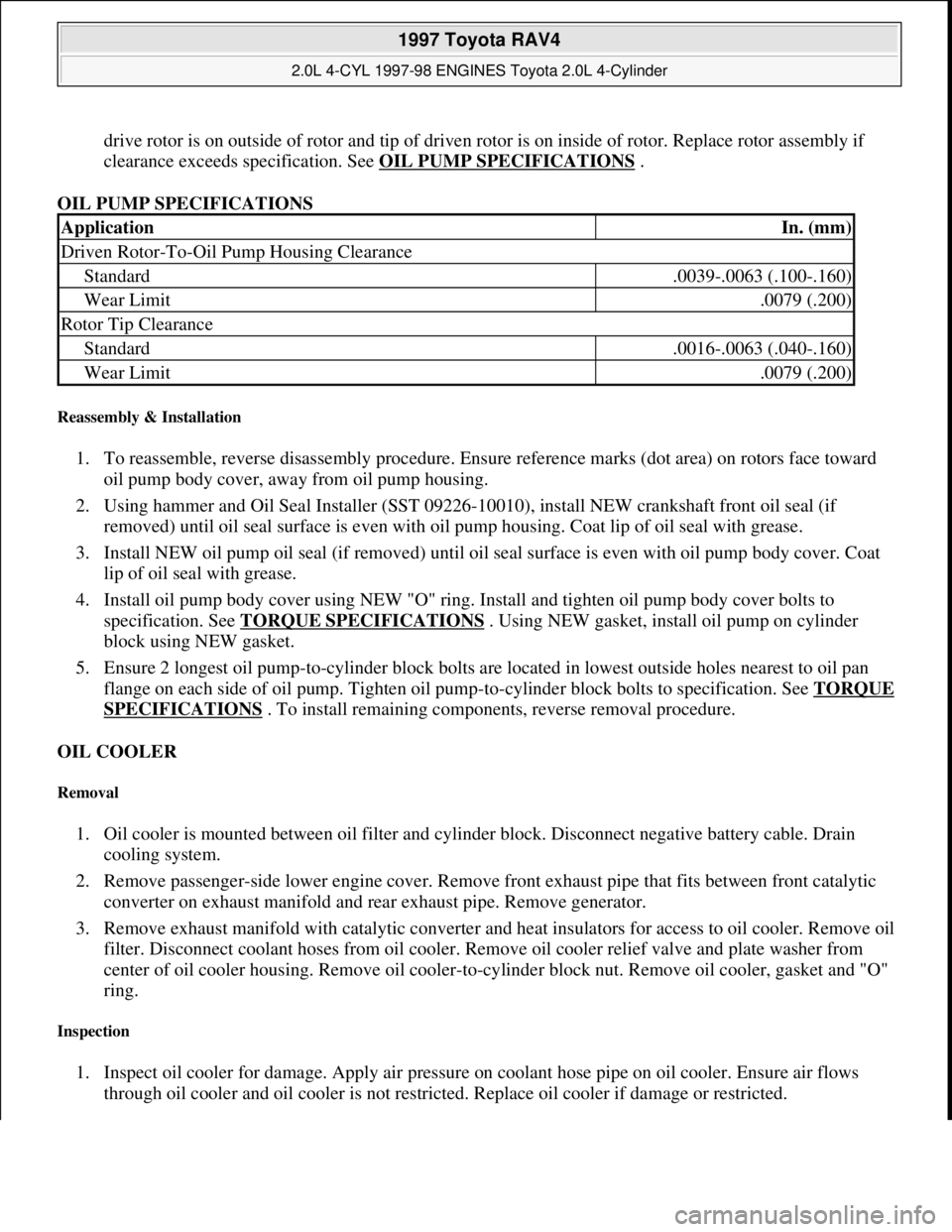
drive rotor is on outside of rotor and tip of driven rotor is on inside of rotor. Replace rotor assembly if
clearance exceeds specification. See OIL PUMP SPECIFICATIONS
.
OIL PUMP SPECIFICATIONS
Reassembly & Installation
1. To reassemble, reverse disassembly procedure. Ensure reference marks (dot area) on rotors face toward
oil pump body cover, away from oil pump housing.
2. Using hammer and Oil Seal Installer (SST 09226-10010), install NEW crankshaft front oil seal (if
removed) until oil seal surface is even with oil pump housing. Coat lip of oil seal with grease.
3. Install NEW oil pump oil seal (if removed) until oil seal surface is even with oil pump body cover. Coat
lip of oil seal with grease.
4. Install oil pump body cover using NEW "O" ring. Install and tighten oil pump body cover bolts to
specification. See TORQUE SPECIFICATIONS
. Using NEW gasket, install oil pump on cylinder
block using NEW gasket.
5. Ensure 2 longest oil pump-to-cylinder block bolts are located in lowest outside holes nearest to oil pan
flange on each side of oil pump. Tighten oil pump-to-cylinder block bolts to specification. See TORQUE
SPECIFICATIONS . To install remaining components, reverse removal procedure.
OIL COOLER
Removal
1. Oil cooler is mounted between oil filter and cylinder block. Disconnect negative battery cable. Drain
cooling system.
2. Remove passenger-side lower engine cover. Remove front exhaust pipe that fits between front catalytic
converter on exhaust manifold and rear exhaust pipe. Remove generator.
3. Remove exhaust manifold with catalytic converter and heat insulators for access to oil cooler. Remove oil
filter. Disconnect coolant hoses from oil cooler. Remove oil cooler relief valve and plate washer from
center of oil cooler housing. Remove oil cooler-to-cylinder block nut. Remove oil cooler, gasket and "O"
ring.
Inspection
1. Inspect oil cooler for damage. Apply air pressure on coolant hose pipe on oil cooler. Ensure air flows
through oil cooler and oil cooler is not restricted. Replace oil cooler if damage or restricted.
ApplicationIn. (mm)
Driven Rotor-To-Oil Pump Housing Clearance
Standard.0039-.0063 (.100-.160)
Wear Limit.0079 (.200)
Rotor Tip Clearance
Standard.0016-.0063 (.040-.160)
Wear Limit.0079 (.200)
1997 Toyota RAV4
2.0L 4-CYL 1997-98 ENGINES Toyota 2.0L 4-Cylinder
Microsoft
Sunday, November 22, 2009 10:23:31 AMPage 59 © 2005 Mitchell Repair Information Company, LLC.
Page 808 of 1632
2. Using wooden stick, push inward on check valve located in center of oil cooler relief valve. Push inward
from threaded end (opposite oil filter threads) on oil cooler relief valve. Replace oil cooler relief valve if
check valve fails to move.
Installation
1. To install, reverse removal procedure. Use a NEW "O" ring and gasket. Coat "O" ring with engine oil.
Coat threads and area below head of oil cooler relief valve with engine oil.
2. Install oil cooler with oil cooler-to-cylinder block nut and oil cooler relief valve loosely installed. Tighten
oil cooler relief valve and then nut to specification. See TORQUE SPECIFICATIONS
.
3. Use NEW gasket and NEW nuts when installing front exhaust pipe on catalytic converter. Ensure all
bolts/nuts are loosely installed before tightening to specification. See TORQUE SPECIFICATIONS
.
Add engine oil as needed. Fill cooling system.
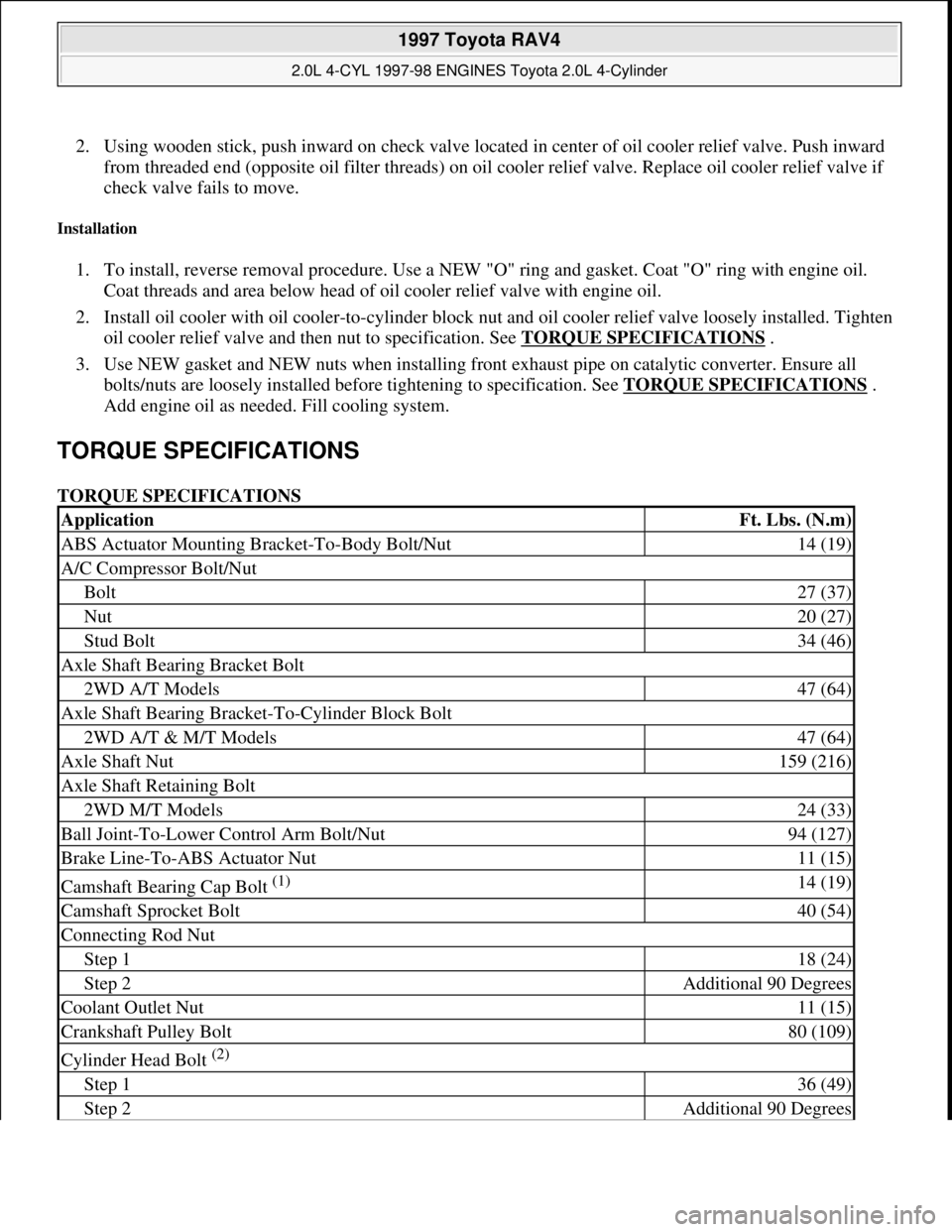
TORQUE SPECIFICATIONS
TORQUE SPECIFICATIONS
ApplicationFt. Lbs. (N.m)
ABS Actuator Mounting Bracket-To-Body Bolt/Nut14 (19)
A/C Compressor Bolt/Nut
Bolt27 (37)
Nut20 (27)
Stud Bolt34 (46)
Axle Shaft Bearing Bracket Bolt
2WD A/T Models47 (64)
Axle Shaft Bearing Bracket-To-Cylinder Block Bolt
2WD A/T & M/T Models47 (64)
Axle Shaft Nut159 (216)
Axle Shaft Retaining Bolt
2WD M/T Models24 (33)
Ball Joint-To-Lower Control Arm Bolt/Nut94 (127)
Brake Line-To-ABS Actuator Nut11 (15)
Camshaft Bearing Cap Bolt (1) 14 (19)
Camshaft Sprocket Bolt40 (54)
Connecting Rod Nut
Step 118 (24)
Step 2Additional 90 Degrees
Coolant Outlet Nut11 (15)
Crankshaft Pulley Bolt80 (109)
Cylinder Head Bolt (2)
Step 136 (49)
Step 2Additional 90 Degrees
1997 Toyota RAV4
2.0L 4-CYL 1997-98 ENGINES Toyota 2.0L 4-Cylinder
Microsoft
Sunday, November 22, 2009 10:23:31 AMPage 60 © 2005 Mitchell Repair Information Company, LLC.
Page 810 of 1632
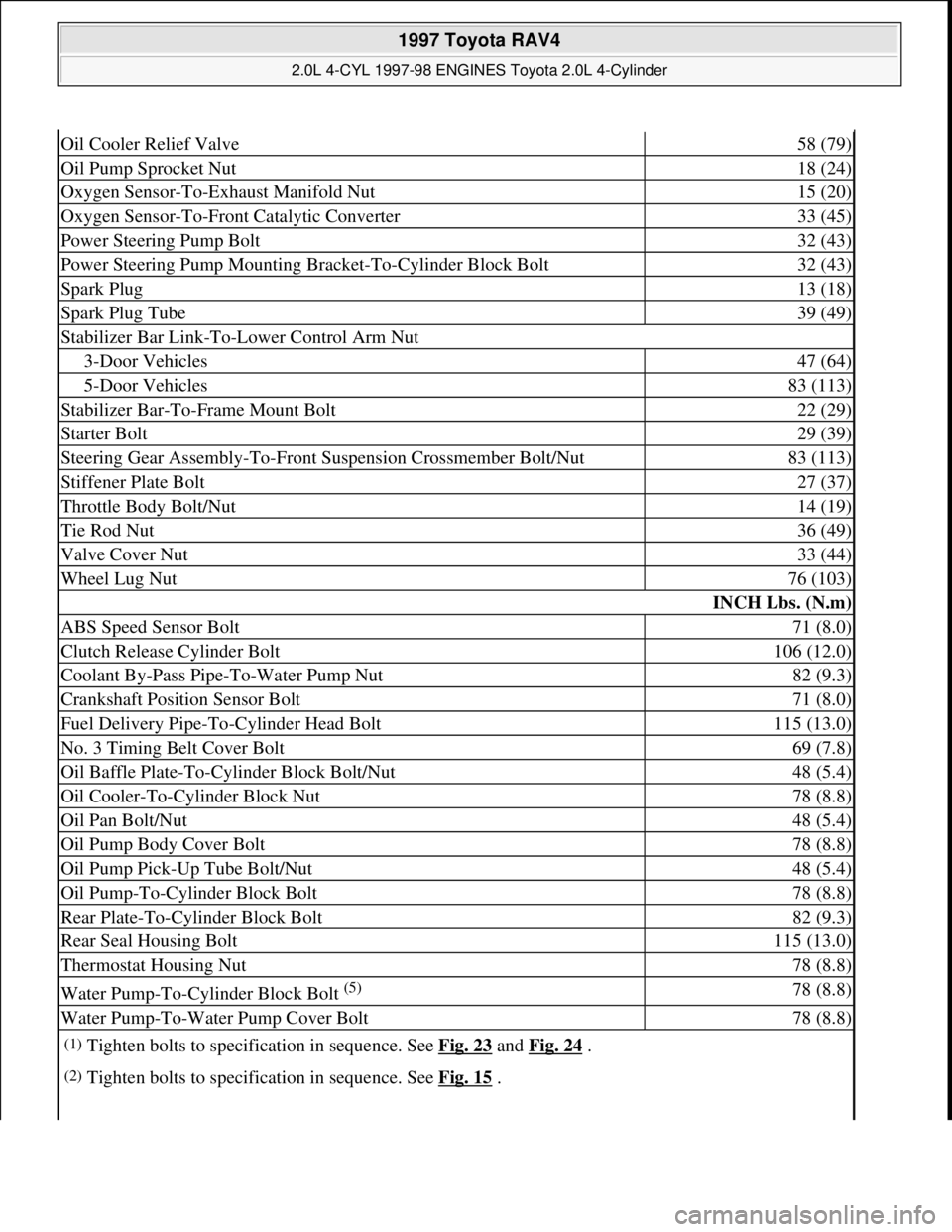
Oil Cooler Relief Valve58 (79)
Oil Pump Sprocket Nut18 (24)
Oxygen Sensor-To-Exhaust Manifold Nut15 (20)
Oxygen Sensor-To-Front Catalytic Converter33 (45)
Power Steering Pump Bolt32 (43)
Power Steering Pump Mounting Bracket-To-Cylinder Block Bolt32 (43)
Spark Plug13 (18)
Spark Plug Tube39 (49)
Stabilizer Bar Link-To-Lower Control Arm Nut
3-Door Vehicles47 (64)
5-Door Vehicles83 (113)
Stabilizer Bar-To-Frame Mount Bolt22 (29)
Starter Bolt29 (39)
Steering Gear Assembly-To-Front Suspension Crossmember Bolt/Nut83 (113)
Stiffener Plate Bolt27 (37)
Throttle Body Bolt/Nut14 (19)
Tie Rod Nut36 (49)
Valve Cover Nut33 (44)
Wheel Lug Nut76 (103)
INCH Lbs. (N.m)
ABS Speed Sensor Bolt71 (8.0)
Clutch Release Cylinder Bolt106 (12.0)
Coolant By-Pass Pipe-To-Water Pump Nut82 (9.3)
Crankshaft Position Sensor Bolt71 (8.0)
Fuel Delivery Pipe-To-Cylinder Head Bolt115 (13.0)
No. 3 Timing Belt Cover Bolt69 (7.8)
Oil Baffle Plate-To-Cylinder Block Bolt/Nut48 (5.4)
Oil Cooler-To-Cylinder Block Nut78 (8.8)
Oil Pan Bolt/Nut48 (5.4)
Oil Pump Body Cover Bolt78 (8.8)
Oil Pump Pick-Up Tube Bolt/Nut48 (5.4)
Oil Pump-To-Cylinder Block Bolt78 (8.8)
Rear Plate-To-Cylinder Block Bolt82 (9.3)
Rear Seal Housing Bolt115 (13.0)
Thermostat Housing Nut78 (8.8)
Water Pump-To-Cylinder Block Bolt (5) 78 (8.8)
Water Pump-To-Water Pump Cover Bolt78 (8.8)
(1)Tighten bolts to specification in sequence. See Fig. 23 and Fig. 24 .
(2)Tighten bolts to specification in sequence. See Fig. 15 .
1997 Toyota RAV4
2.0L 4-CYL 1997-98 ENGINES Toyota 2.0L 4-Cylinder
Microsoft
Sunday, November 22, 2009 10:23:31 AMPage 62 © 2005 Mitchell Repair Information Company, LLC.
Page 851 of 1632
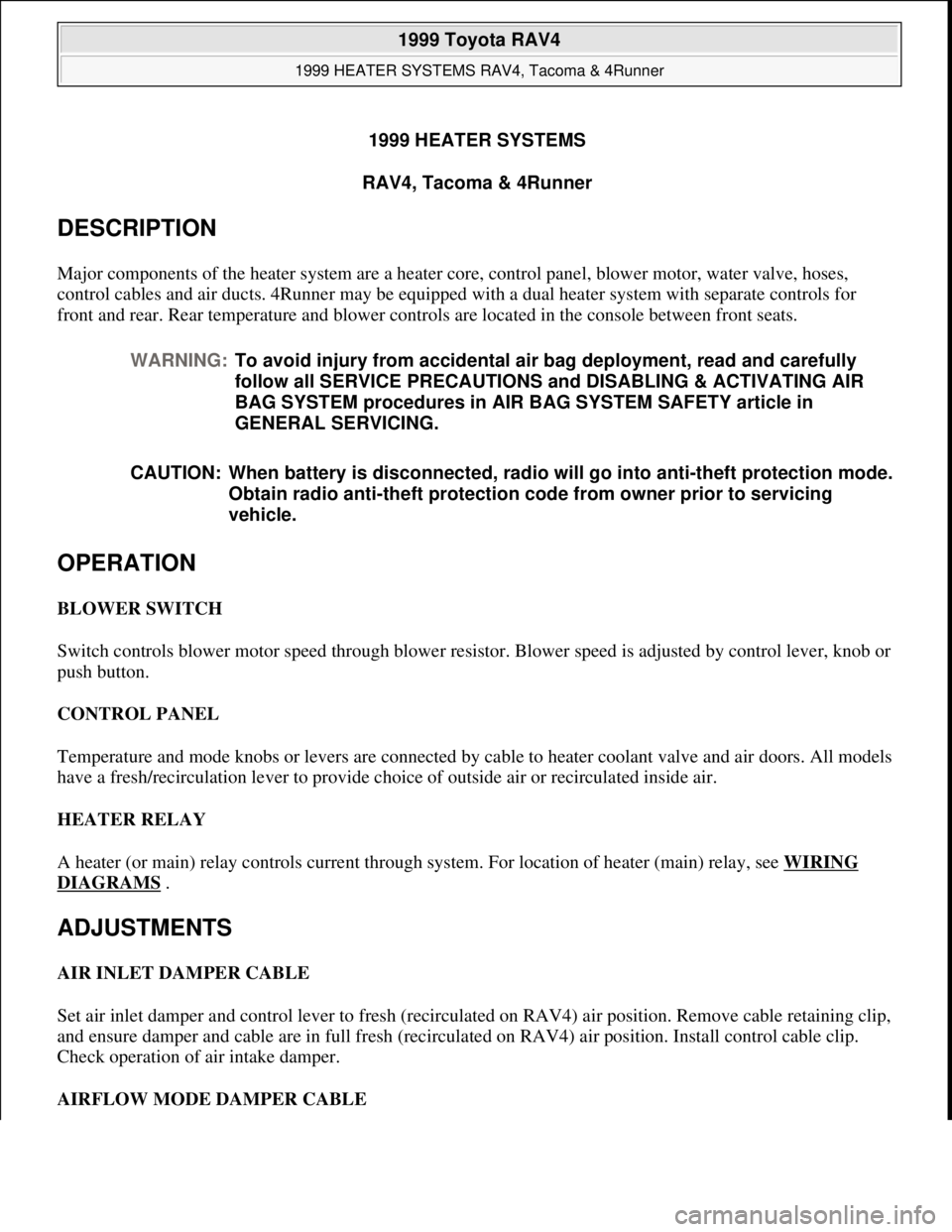
1999 HEATER SYSTEMS
RAV4, Tacoma & 4Runner
DESCRIPTION
Major components of the heater system are a heater core, control panel, blower motor, water valve, hoses,
control cables and air ducts. 4Runner may be equipped with a dual heater system with separate controls for
front and rear. Rear temperature and blower controls are located in the console between front seats.
OPERATION
BLOWER SWITCH
Switch controls blower motor speed through blower resistor. Blower speed is adjusted by control lever, knob or
push button.
CONTROL PANEL
Temperature and mode knobs or levers are connected by cable to heater coolant valve and air doors. All models
have a fresh/recirculation lever to provide choice of outside air or recirculated inside air.
HEATER RELAY
A heater (or main) relay controls current through system. For location of heater (main) relay, see WIRING
DIAGRAMS .
ADJUSTMENTS
AIR INLET DAMPER CABLE
Set air inlet damper and control lever to fresh (recirculated on RAV4) air position. Remove cable retaining clip,
and ensure damper and cable are in full fresh (recirculated on RAV4) air position. Install control cable clip.
Check operation of air intake damper.
AIRFLOW MODE DAMPER CABLE WARNING:To avoid injury from accidental air bag deployment, read and carefully
follow all SERVICE PRECAUTIONS and DISABLING & ACTIVATING AIR
BAG SYSTEM procedures in AIR BAG SYSTEM SAFETY article in
GENERAL SERVICING.
CAUTION: When battery is disconnected, radio will go into anti-theft protection mode.
Obtain radio anti-theft protection code from owner prior to servicing
vehicle.
1999 Toyota RAV4
1999 HEATER SYSTEMS RAV4, Tacoma & 4Runner
1999 Toyota RAV4
1999 HEATER SYSTEMS RAV4, Tacoma & 4Runner
Microsoft
Sunday, November 22, 2009 10:30:50 AMPage 1 © 2005 Mitchell Repair Information Company, LLC.
Microsoft
Sunday, November 22, 2009 10:30:55 AMPage 1 © 2005 Mitchell Repair Information Company, LLC.
Page 874 of 1632
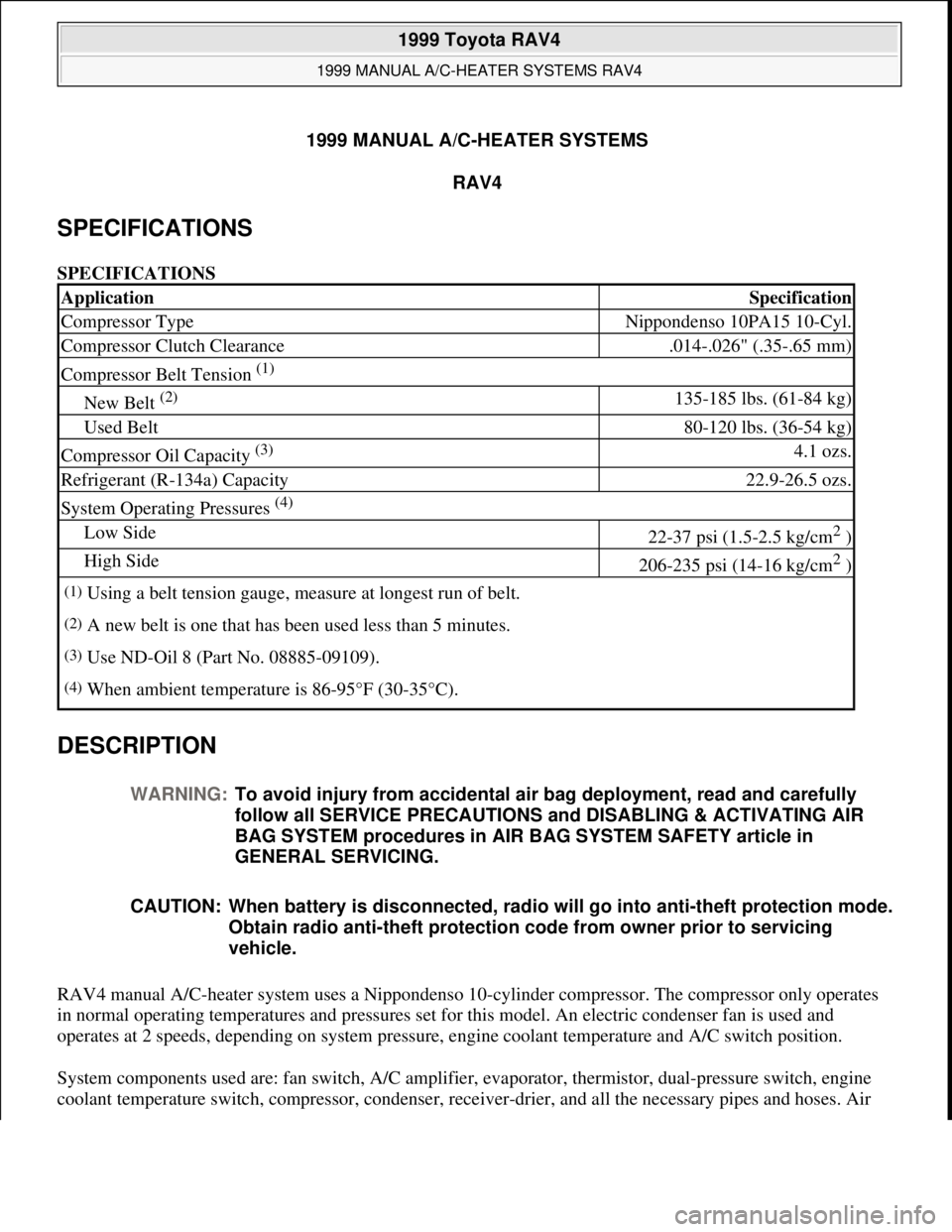
1999 MANUAL A/C-HEATER SYSTEMS
RAV4
SPECIFICATIONS
SPECIFICATIONS
DESCRIPTION
RAV4 manual A/C-heater system uses a Nippondenso 10-cylinder compressor. The compressor only operates
in normal operating temperatures and pressures set for this model. An electric condenser fan is used and
operates at 2 speeds, depending on system pressure, engine coolant temperature and A/C switch position.
System components used are: fan switch, A/C amplifier, evaporator, thermistor, dual-pressure switch, engine
coolant temperature switch, compressor, condenser, receive
r-drier, and all the necessary pipes and hoses. Air
ApplicationSpecification
Compressor TypeNippondenso 10PA15 10-Cyl.
Compressor Clutch Clearance.014-.026" (.35-.65 mm)
Compressor Belt Tension (1)
New Belt (2) 135-185 lbs. (61-84 kg)
Used Belt80-120 lbs. (36-54 kg)
Compressor Oil Capacity (3) 4.1 ozs.
Refrigerant (R-134a) Capacity22.9-26.5 ozs.
System Operating Pressures (4)
Low Side22-37 psi (1.5-2.5 kg/cm2 )
High Side206-235 psi (14-16 kg/cm2 )
(1)Using a belt tension gauge, measure at longest run of belt.
(2)A new belt is one that has been used less than 5 minutes.
(3)Use ND-Oil 8 (Part No. 08885-09109).
(4)When ambient temperature is 86-95°F (30-35°C).
WARNING:To avoid injury from accidental air bag deployment, read and carefully
follow all SERVICE PRECAUTIONS and DISABLING & ACTIVATING AIR
BAG SYSTEM procedures in AIR BAG SYSTEM SAFETY article in
GENERAL SERVICING.
CAUTION: When battery is disconnected, radio will go into anti-theft protection mode.
Obtain radio anti-theft protection code from owner prior to servicing
vehicle.
1999 Toyota RAV4
1999 MANUAL A/C-HEATER SYSTEMS RAV4
1999 Toyota RAV4
1999 MANUAL A/C-HEATER SYSTEMS RAV4
Microsoft
Sunday, November 22, 2009 10:29:27 AMPage 1 © 2005 Mitchell Repair Information Company, LLC.
Microsoft
Sunday, November 22, 2009 10:29:33 AMPage 1 © 2005 Mitchell Repair Information Company, LLC.
Page 888 of 1632
Removal
Discharge A/C system, using approved refrigerant recovery/recycling equipment. Disconnect negative battery
cable and wait at least 90 seconds. Remove engine coolant reservoir and air cleaner case and duct. Disconnect
A/C lines from receiver-drier and plug all openings. Remove mounting bolts and receiver-drier.
Installation
To install, reverse removal procedure. If installing a new receiver-drier, add 0.3 ounce of refrigerant oil before
reassembly. Evacuate, charge and leak test system.
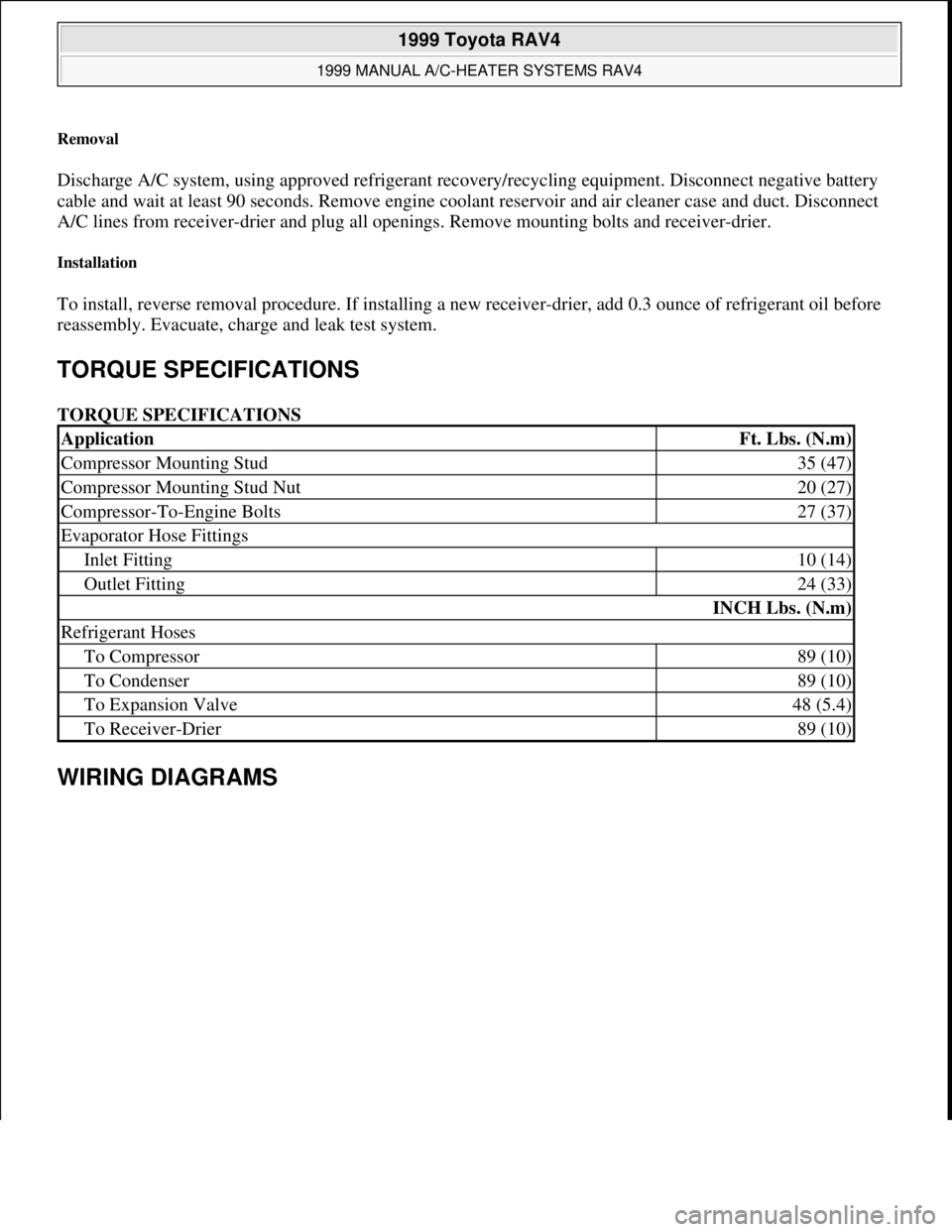
TORQUE SPECIFICATIONS
TORQUE SPECIFICATIONS
WIRING DIAGRAMS
ApplicationFt. Lbs. (N.m)
Compressor Mounting Stud35 (47)
Compressor Mounting Stud Nut20 (27)
Compressor-To-Engine Bolts27 (37)
Evaporator Hose Fittings
Inlet Fitting10 (14)
Outlet Fitting24 (33)
INCH Lbs. (N.m)
Refrigerant Hoses
To Compressor89 (10)
To Condenser89 (10)
To Expansion Valve48 (5.4)
To Receiver-Drier89 (10)
1999 Toyota RAV4
1999 MANUAL A/C-HEATER SYSTEMS RAV4
Microsoft
Sunday, November 22, 2009 10:29:28 AMPage 15 © 2005 Mitchell Repair Information Company, LLC.