service TOYOTA RAV4 1996 Service Owner's Manual
[x] Cancel search | Manufacturer: TOYOTA, Model Year: 1996, Model line: RAV4, Model: TOYOTA RAV4 1996Pages: 1632, PDF Size: 41.64 MB
Page 83 of 1632
1. Before proceeding, see SERVICE PRECAUTIONS . Ensure front wheels are in straight-ahead position.
Turn ignition switch to LOCK position. Disconnect negative battery cable. Wait at least 90 seconds.
Remove steering wheel. See STEERING WHEEL
.
2. Remove lower finish panel and instrument panel lower insert. Remove upper and lower steering column
covers. Disconnect and remove combination switch with spiral cable attached. Remove heater-to-register
duct. Match mark steering shaft and steering gear shaft for reassembly performance. Remove steering
column.
3. To install, reverse removal procedure. Tighten fasteners to specification. See TORQUE
SPECIFICATIONS . Check AIR BAG warning light to ensure system is functioning properly. See
SYSTEM OPERATION CHECK
.
STEERING WHEEL
Removal & Installation
1. Before proceeding, see SERVICE PRECAUTIONS . Ensure front wheels are in straight-ahead position.
Turn ignition switch to LOCK position. Disconnect negative battery cable. Wait at least 90 seconds.
Remove driver-side air bag module. See DRIVER
-SIDE AIR BAG MODULE .
2. Remove steering wheel nut. Match mark steering wheel and steering column for reassembly reference.
Using appropriate puller, remove steering wheel.
3. To install, reverse removal procedure. Ensure front wheels are in straight-ahead position and spiral cable
is properly aligned. See SPIRAL CABLE under ADJUSTMENTS
. Tighten steering wheel nut and
driver-side air bag module screws to specification. See TORQUE SPECIFICATIONS
. Check AIR
BAG warning light to ensure system is functioning properly. See SYSTEM OPERATION CHECK
.
SYSTEM OPERATION CHECK
Turn ignition switch to ACC or ON position. AIR BAG warning light should come on for about 6 seconds and
then go out. If AIR BAG warning light does not operate as specified, see DIAGNOSIS & TESTING
.
DIAGNOSIS & TESTING
AIR BAG WARNING LIGHT CHECK
Turn ignition switch to ACC or ON position. If air bag warning light comes on for about 6 seconds and then
goes off, system is functioning properly. If AIR BAG warning light comes on and stays on (or flashes),
Diagnostic Trouble Code (DTC) is stored in air bag sensor assembly. Go to RETRIEVING CODES
. If AIR
BAG warning light responds in any other way, go to DIAGNOSTIC TESTS
.
RETRIEVING CODES
CAUTION: System may be damaged if jumper wire is incorrectly connected across
terminals of Data Link Connector (DLC1). Use Diagnosis Check Wire
(09843-18020) when connecting terminals of DLC1.
1999 Toyota RAV4
AIR BAG RESTRAINT SYSTEM 1999 Toyota
Microsoft
Sunday, November 22, 2009 10:33:22 AMPage 20 © 2005 Mitchell Repair Information Company, LLC.
Page 88 of 1632
Fig. 15: Releasing Shorting Spring
Courtesy of TOYOTA MOTOR SALES, U.S.A., INC.
DIAGNOSTIC TESTS
AIR BAG WARNING LIGHT DOES NOT ILLUMINATE
Description
AIR BAG warning light is located in instrument cluster. When air bag system is normal, AIR BAG warning
light illuminates for about 6 seconds after ignition switch is turned from LOCK to ACC or ON position, and
turns off automatically. If a malfunction is present in air bag system, AIR BAG warning light illuminates to
inform operator of malfunction. When Data Link Connector 1 (DLC1) terminals Tc and E1 are connected
together, a Diagnostic Trouble Code (DTC) is displayed by flashing AIR BAG warning light.
Diagnostic Procedure
1. Remove SRS-B fuse and check continuity across fuse blades. SRS-B fuse is located in instrument panel
fuse block under left side of instrument panel. If fuse is faulty, go to step 4). If fuse is okay, reinstall fuse
and go to next step.
2. Disable air bag system. See DISABLING SYSTEM
under DISABLING & ACTIVATING AIR BAG
SYSTEM. Reconnect negative battery cable. Turn ignition switch to ACC or ON position. Measure
voltage between ground and harness side of air bag sensor assembly connector C20, terminal No. 3
(circuit LA, Black/Yellow wire). See Fig. 16
. If 10-14 volts is not present, repair AIR BAG warning
light bulb or circuit. If 10-14 volts is present, go to next step.
3. Turn ignition switch to LOCK position. Disconnect negative battery cable. Reconnect 3 air bag sensor
assembly connectors. Leave air bag modules, pretensioners and front air bag sensors disconnected.
Reconnect negative battery cable and wait at least 2 seconds. Turn ignition switch to ACC or ON
position. If AIR BAG warning light illuminates, system operation is normal. If AIR BAG warning light
does not come on, check for poor connection at air bag sensor assembly connector C20, terminal No. 3
(Black/Yellow wire). If connection is oka
y, replace air bag sensor assembly. WARNING:Failure to follow service precautions may result in air bag deployment and
personal injury. See SERVICE PRECAUTIONS
. After component
replacement, check system operation. See SYSTEM OPERATION CHECK
.
CAUTION: Ensure ignition switch is in LOCK position before disconnecting or
connecting negative battery cable. If ignition switch is in ACC or ON
position when negative battery cable is disconnected or connected, air
bag sensor may be damaged. To prevent damage to connector terminals,
DO NOT probe terminal ends. Instead, backprobe terminals (probe
terminal where wire enters harness connector).
NOTE: In the following tests, the term squib connector and module connector may be
used interchangeably.
1999 Toyota RAV4
AIR BAG RESTRAINT SYSTEM 1999 Toyota
Microsoft
Sunday, November 22, 2009 10:33:23 AMPage 25 © 2005 Mitchell Repair Information Company, LLC.
Page 157 of 1632
ON-VEHICLE SERVICE
PARK/NEUTRAL POSITION (PNP) SWITCH
Removal & Installation
1. Disconnect park/neutral position (PNP) switch connector. Remove nut and disconnect shift control cable.
Remove nut, washer and manual shaft lever. Pry back locking tab on manual shaft washer and remove
nut. Remove 2 bolts and remove park/neutral position (PNP) switch.
2. Install PNP switch to manual shaft. Install 2 bolts finger tight. Install NEW locking plate. Install nut and
tighten to 61 INCH lbs. (6.9 N.m). Stake nut with locking plate. Install manual shaft lever, washer and
nut. Tighten nut to 115 INCH lbs. (13 N.m). Install shift control cable and nut. Tighten nut to 11 ft. lbs.
(15 N.m). Adjust switch by aligning groove and neutral basic line. Tighten 2 bolts to 48 INCH lbs. (5.4
N.m). Ensure engine starts in Park and Neutral.
THROTTLE CABLE
See appropriate AUTOMATIC TRANSMISSION SERVICING article in TRANSMISSION SERVICING.
VALVE BODY ASSEMBLY
Removal
1. Clean exterior of transaxle. Remove oil pan plug. Drain transaxle. Remove oil pan and gasket. Discard
gasket. Remove oil strainer. Note location of magnets in oil pan. Remove magnets. Examine particles in
pan. Steel (magnetic) particles indicate bearing, gear, or plate wear. Brass (non-magnetic) particles
indicate bushing wear.
2. Remove tube bracket. Note location of oil tubes, and remove oil tubes. Disconnect solenoid wiring
harness connector(s). Remove manual detent spring. Remove manual valve. Disconnect throttle cable
from cam. Remove valve body assembly. Remove 2nd brake apply gasket.
Installation
1. Install NEW 2nd brake apply gasket. While holding cam down, slip cable end into slot. DO NOT tangle
RAV4
Drain & Refill3.5 (3.3)
Dry Refill7.4 (7.0)
Sienna
Drain & Refill3.7 (3.5)
Dry Refill6.9 (6.5)
CAUTION: Note bolt length and location during disassembly. Proper length bolts
must be installed to prevent case damage.
1998 Toyota Avalon XLS
1997-99 AUTOMATIC TRANSMISSIONS Toyota A-540E, A-540H & A-541E Overhaul
Helpmelearn
November-03-08 10:28:16 AMPage 3 © 2005 Mitchell Repair Information Company, LLC.
Page 163 of 1632
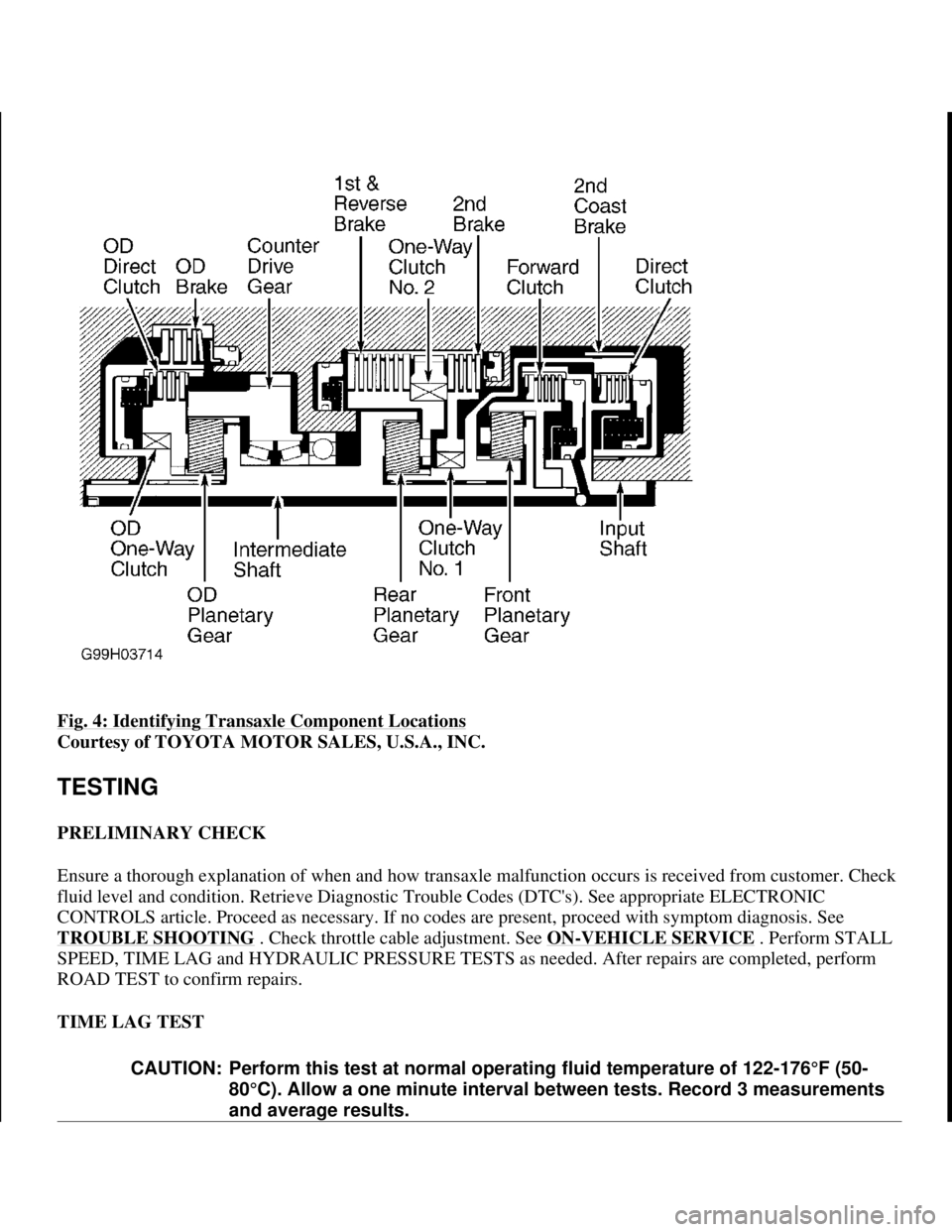
Fig. 4: Identifying Transaxle Component Locations
Courtesy of TOYOTA MOTOR SALES, U.S.A., INC.
TESTING
PRELIMINARY CHECK
Ensure a thorough explanation of when and how transaxle malfunction occurs is received from customer. Check
fluid level and condition. Retrieve Diagnostic Trouble Codes (DTC's). See appropriate ELECTRONIC
CONTROLS article. Proceed as necessary. If no codes are present, proceed with symptom diagnosis. See
TROUBLE SHOOTING
. Check throttle cable adjustment. See ON-VEHICLE SERVICE . Perform STALL
SPEED, TIME LAG and HYDRAULIC PRESSURE TESTS as needed. After repairs are completed, perform
ROAD TEST to confirm repairs.
TIME LAG TEST
CAUTION: Perform this test at normal operating fluid temperature of 122-176°F (50-
80°C). Allow a one minute interval between tests. Record 3 measurements
and average results.
1998 Toyota Avalon XLS
1997-99 AUTOMATIC TRANSMISSIONS Toyota A-540E, A-540H & A-541E Overhaul
Helpmelearn
November-03-08 10:28:17 AMPage 9 © 2005 Mitchell Repair Information Company, LLC.
Page 170 of 1632
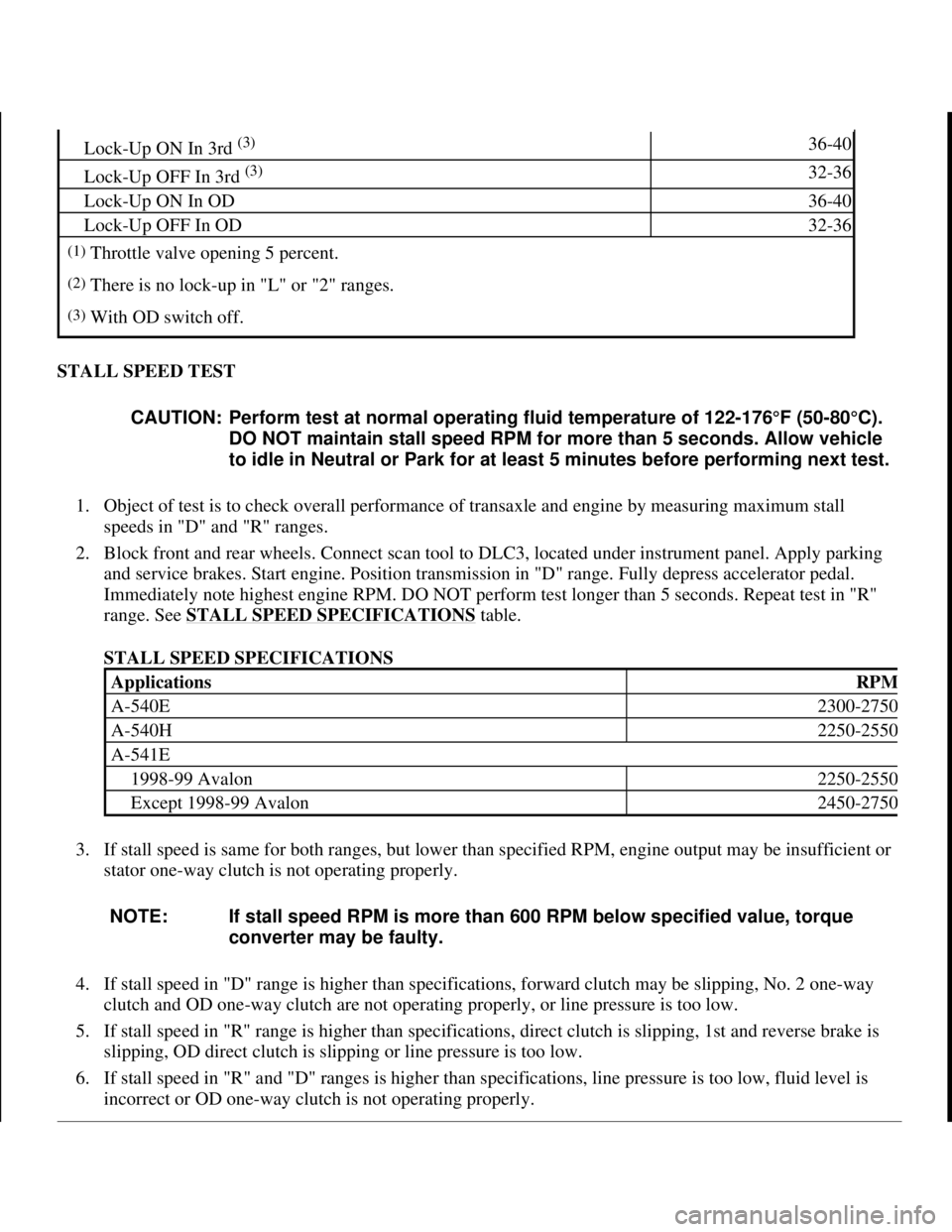
STALL SPEED TEST
1. Object of test is to check overall performance of transaxle and engine by measuring maximum stall
speeds in "D" and "R" ranges.
2. Block front and rear wheels. Connect scan tool to DLC3, located under instrument panel. Apply parking
and service brakes. Start engine. Position transmission in "D" range. Fully depress accelerator pedal.
Immediately note highest engine RPM. DO NOT perform test longer than 5 seconds. Repeat test in "R"
range. See STALL SPEED SPECIFICATIONS
table.
STALL SPEED SPECIFICATIONS
3. If stall speed is same for both ranges, but lower than specified RPM, engine output may be insufficient or
stator one-way clutch is not operating properly.
4. If stall speed in "D" range is higher than specifications, forward clutch may be slipping, No. 2 one-way
clutch and OD one-way clutch are not operating properly, or line pressure is too low.
5. If stall speed in "R" range is higher than specifications, direct clutch is slipping, 1st and reverse brake is
slipping, OD direct clutch is slipping or line pressure is too low.
6. If stall speed in "R" and "D" ranges is higher than specifications, line pressure is too low, fluid level is
incorrect or OD one-wa
y clutch is not operating properly.
Lock-Up ON In 3rd (3)36-40
Lock-Up OFF In 3rd (3)32-36
Lock-Up ON In OD36-40
Lock-Up OFF In OD32-36
(1)Throttle valve opening 5 percent.
(2)There is no lock-up in "L" or "2" ranges.
(3)With OD switch off.
CAUTION: Perform test at normal operating fluid temperature of 122-176°F (50-80°C).
DO NOT maintain stall speed RPM for more than 5 seconds. Allow vehicle
to idle in Neutral or Park for at least 5 minutes before performing next test.
ApplicationsRPM
A-540E2300-2750
A-540H2250-2550
A-541E
1998-99 Avalon2250-2550
Except 1998-99 Avalon2450-2750
NOTE: If stall speed RPM is more than 600 RPM below specified value, torque
converter may be faulty.
1998 Toyota Avalon XLS
1997-99 AUTOMATIC TRANSMISSIONS Toyota A-540E, A-540H & A-541E Overhaul
Helpmelearn
November-03-08 10:28:17 AMPage 16 © 2005 Mitchell Repair Information Company, LLC.
Page 174 of 1632
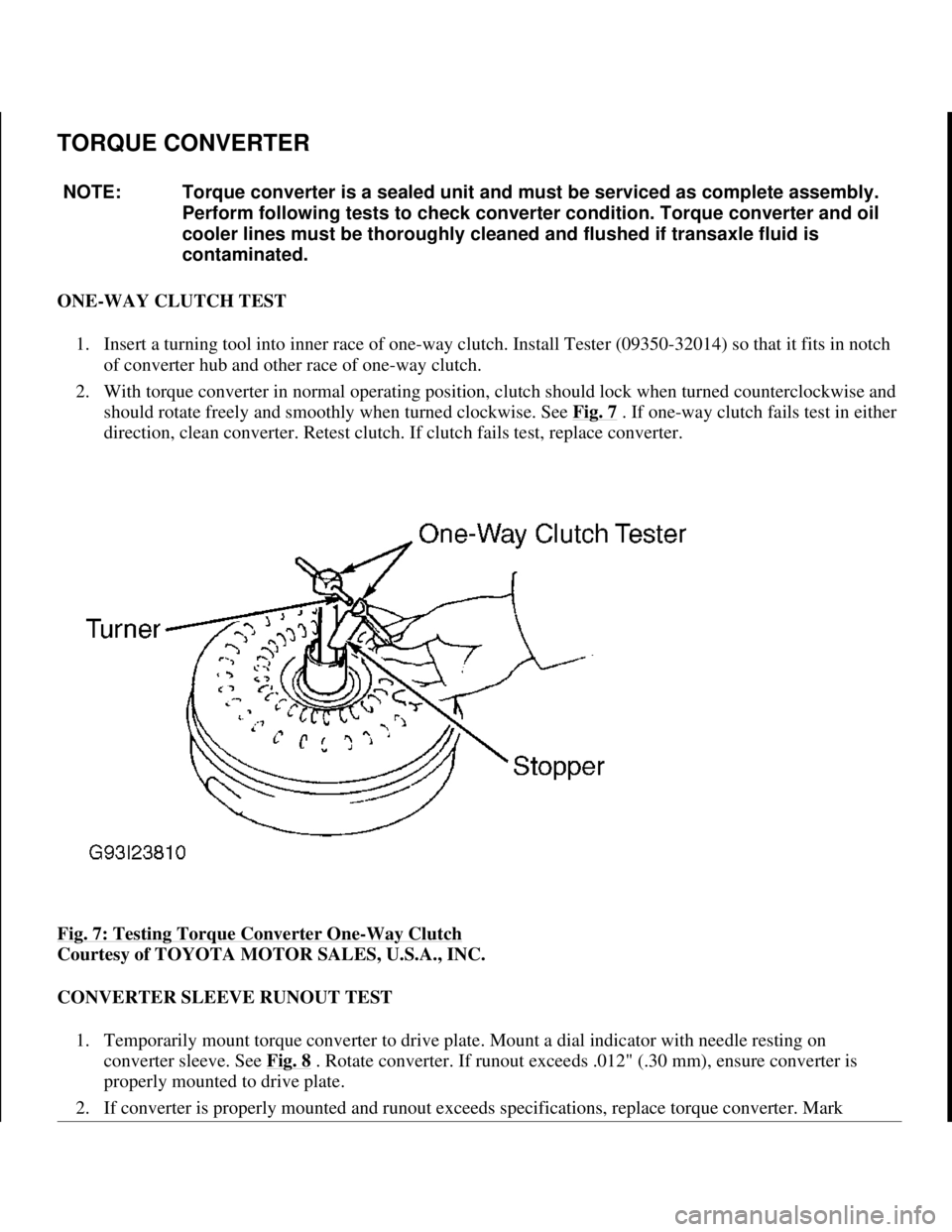
TORQUE CONVERTER
ONE-WAY CLUTCH TEST
1. Insert a turning tool into inner race of one-way clutch. Install Tester (09350-32014) so that it fits in notch
of converter hub and other race of one-way clutch.
2. With torque converter in normal operating position, clutch should lock when turned counterclockwise and
should rotate freely and smoothly when turned clockwise. See Fig. 7
. If one-way clutch fails test in either
direction, clean converter. Retest clutch. If clutch fails test, replace converter.
Fig. 7: Testing Torque Converter One
-Way Clutch
Courtesy of TOYOTA MOTOR SALES, U.S.A., INC.
CONVERTER SLEEVE RUNOUT TEST
1. Temporarily mount torque converter to drive plate. Mount a dial indicator with needle resting on
converter sleeve. See Fig. 8
. Rotate converter. If runout exceeds .012" (.30 mm), ensure converter is
properly mounted to drive plate.
2. If converter is properl
y mounted and runout exceeds specifications, replace torque converter. Mark NOTE: Torque converter is a sealed unit and must be serviced as complete assembly.
Perform following tests to check converter condition. Torque converter and oil
cooler lines must be thoroughly cleaned and flushed if transaxle fluid is
contaminated.
1998 Toyota Avalon XLS
1997-99 AUTOMATIC TRANSMISSIONS Toyota A-540E, A-540H & A-541E Overhaul
Helpmelearn
November-03-08 10:28:17 AMPage 20 © 2005 Mitchell Repair Information Company, LLC.
Page 197 of 1632
Courtesy of TOYOTA MOTOR SALES, U.S.A., INC.
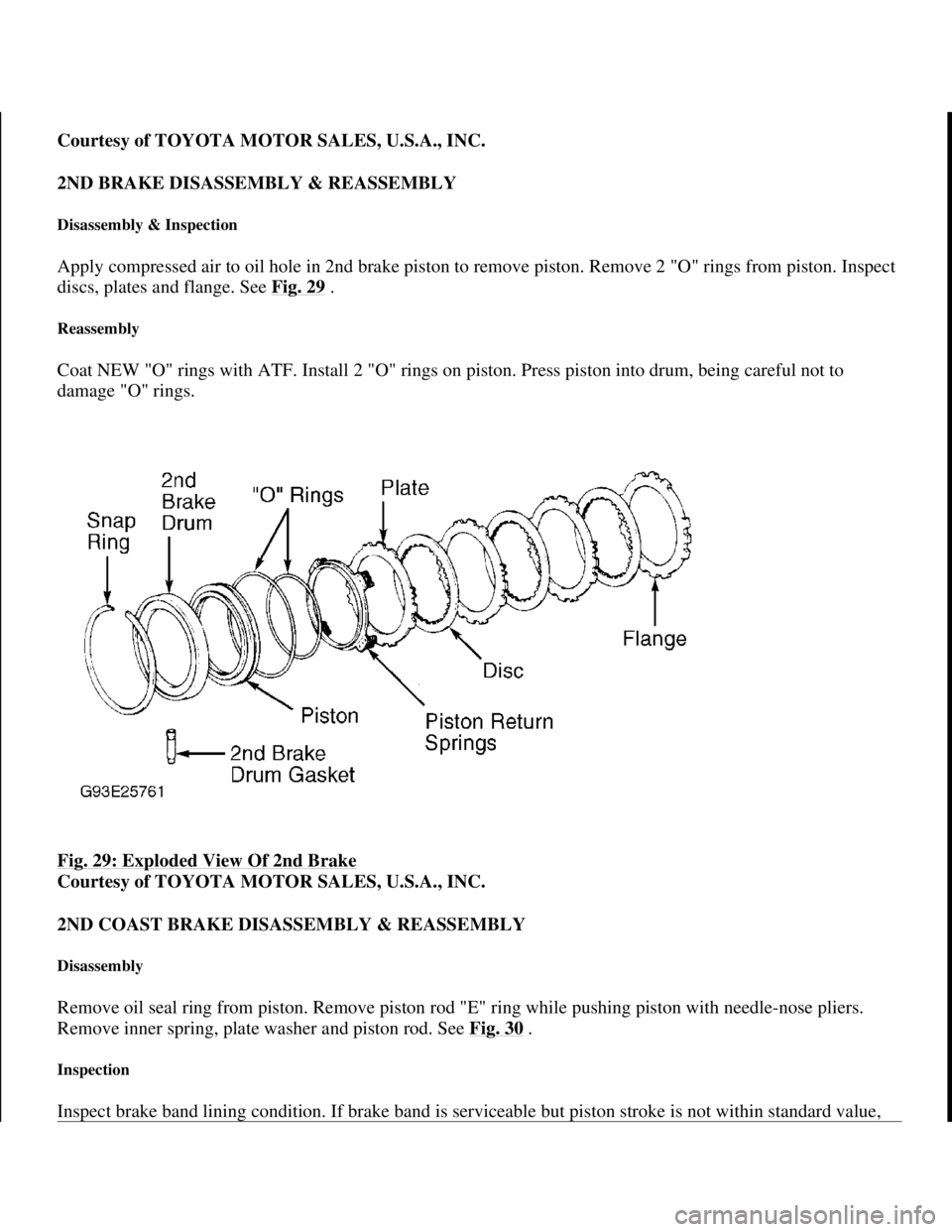
2ND BRAKE DISASSEMBLY & REASSEMBLY
Disassembly & Inspection
Apply compressed air to oil hole in 2nd brake piston to remove piston. Remove 2 "O" rings from piston. Inspect
discs, plates and flange. See Fig. 29
.
Reassembly
Coat NEW "O" rings with ATF. Install 2 "O" rings on piston. Press piston into drum, being careful not to
damage "O" rings.
Fig. 29: Exploded View Of 2nd Brake
Courtesy of TOYOTA MOTOR SALES, U.S.A., INC.
2ND COAST BRAKE DISASSEMBLY & REASSEMBLY
Disassembly
Remove oil seal ring from piston. Remove piston rod "E" ring while pushing piston with needle-nose pliers.
Remove inner spring, plate washer and piston rod. See Fig. 30
.
Inspection
Inspect brake band lining condition. If brake band is serviceable but piston stroke is not within standard value,
1998 Toyota Avalon XLS
1997-99 AUTOMATIC TRANSMISSIONS Toyota A-540E, A-540H & A-541E Overhaul
Helpmelearn
November-03-08 10:28:18 AMPage 43 © 2005 Mitchell Repair Information Company, LLC.
Page 258 of 1632
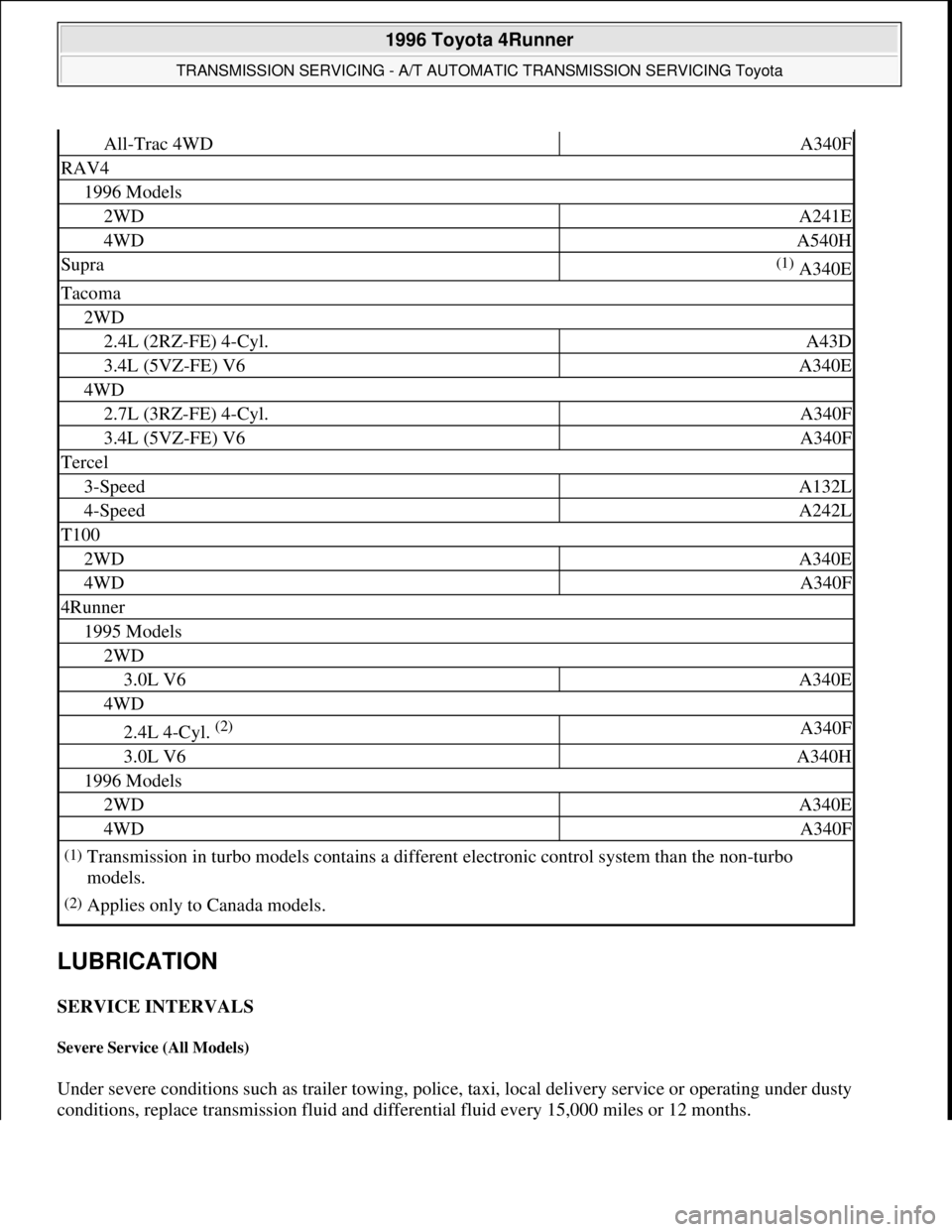
LUBRICATION
SERVICE INTERVALS
Severe Service (All Models)
Under severe conditions such as trailer towing, police, taxi, local delivery service or operating under dusty
conditions, replace transmission fluid and differential fluid ever
y 15,000 miles or 12 months.
All-Trac 4WDA340F
RAV4
1996 Models
2WDA241E
4WDA540H
Supra(1) A340E
Tacoma
2WD
2.4L (2RZ-FE) 4-Cyl.A43D
3.4L (5VZ-FE) V6A340E
4WD
2.7L (3RZ-FE) 4-Cyl.A340F
3.4L (5VZ-FE) V6A340F
Tercel
3-SpeedA132L
4-SpeedA242L
T100
2WDA340E
4WDA340F
4Runner
1995 Models
2WD
3.0L V6A340E
4WD
2.4L 4-Cyl. (2) A340F
3.0L V6A340H
1996 Models
2WDA340E
4WDA340F
(1)Transmission in turbo models contains a different electronic control system than the non-turbo
models.
(2)Applies only to Canada models.
1996 Toyota 4Runner
TRANSMISSION SERVICING - A/T AUTOMATIC TRANSMISSION SERVICING Toyota
Microsoft
Tuesday, August 18, 2009 7:18:46 PMPage 2 © 2005 Mitchell Repair Information Company, LLC.
Page 259 of 1632
Avalon, Camry, Celica 2.2L 5S-FE, Corolla 1.6L 4A-FE & Tercel With 3-Speed
Check transmission fluid level and transmission/differential fluid level every 15,000 miles or 24 months.
Transmission/differential fluid reservoir is independent from the transmission. Normal operating conditions
service interval is not available.
Celica 1.8L 7A-FE, Corolla 1.8L 7A-FE, MR2, Paseo, RAV4 & Tercel With 4-Speed, Land Cruiser, Pickup, Previa,
Supra, Tacoma, T100 & 4Runner
Check transmission fluid level every 15,000 miles or 24 months. Differential fluid reservoir is incorporated with
the transmission. Normal operating conditions service interval is not available.
CHECKING FLUID LEVEL
Transmission
1. Drive vehicle until engine and transmission reach normal operating temperature. Park vehicle on level
surface and apply parking brake. With engine idling and brakes applied, move gearshift from Park
through Low and back to Park.
2. Check fluid level on transmission dipstick. Fluid level should be in HOT range marked on dipstick. Add
proper type of fluid if necessary. See RECOMMENDED FLUID
under LUBRICATION. DO NOT
overfill transmission.
Transmission/Differential (Avalon, Camry, Celica 2.2L 5S-FE, Corolla 1.6L 4A-FE & Tercel 3-Speed)
Remove filler plug. See Fig. 1 -3. Fluid should be level with bottom edge of filler plug hole. If fluid is low, fill
with proper type fluid until fluid is level with filler plug opening. See RECOMMENDED FLUID
under
LUBRICATION. Reinstall filler plu
g. NOTE: When checking fluid level for the transmission, if vehicle has been operating in
heavy traffic, towing a trailer or at high speeds in hot weather, wait 30 minutes
before checking the fluid level.
NOTE: Some models have a transmission/differential unit. On these models the
differential lubrication is separate from the transmission fluid. It must be
checked and filled separately.
1996 Toyota 4Runner
TRANSMISSION SERVICING - A/T AUTOMATIC TRANSMISSION SERVICING Toyota
Microsoft
Tuesday, August 18, 2009 7:18:46 PMPage 3 © 2005 Mitchell Repair Information Company, LLC.
Page 370 of 1632
Fig. 18: Exploded View Of Internal Parking Brake Assembly (Land Cruiser)
Courtesy of TOYOTA MOTOR SALES, U.S.A., INC.
Inspection
Clearance between parking brake shoe and lever should be .014" (.35 mm) or less. If clearance exceeds
specification, replace shim under parking brake lever. Shims are available in sizes from .012" (.30 mm)
to .035" (.90 mm) in .012" (.30 mm) increments. Use NEW "C" washer when installing lever.
Installation
To complete installation, reverse removal procedure. Apply non-melting grease to sliding surfaces of shoes and
adjusting screw threads. Align groove of rear axle shaft flange with service hole on disc. Install disc.
LOAD-SENSING PROPORTIONING VALVE (LSPV) & BY-PASS VALVE (BPV)
Removal (Tacoma & Tundra)
1. Raise and support vehicle. Remove nut, and disconnect shackle No. 2. Remove cushion retainer, 2
cushions and collar. Disconnect No. 2 shackle from bracket. See Fig. 19
.
2. Disconnect brake lines from valve body.
3. On Tacoma, remove clip from flexible hose bracket. On 2WD, remove 3 valve bracket mounting bolts
and spacer. Remove LSPV and BPV assembly. On 4WD, remove 3 mounting bolts, spacer and flexible
hose bracket mounting bolt. Remove LSPV and BPV assembly and flexible hose bracket.
4. On Tundra, remove 2 valve mountin
g bolts, and LSPV and BPV assembly. NOTE: RAV4 & Sienna do not use a Load-Sensing Proportioning Valve (LSPV) or By-
Pass Valve (BPV).
NOTE: Proportioning valve and by-pass valve removal and installation procedures for
Land Cruiser, RAV4 and Sienna not available from manufacturer.
1999 Toyota RAV4
1999-2000 BRAKES Disc & Drum - Trucks & Vans
Microsoft
Sunday, November 22, 2009 10:07:28 AMPage 31 © 2005 Mitchell Repair Information Company, LLC.