Motor oil TOYOTA RAV4 1996 Service Service Manual
[x] Cancel search | Manufacturer: TOYOTA, Model Year: 1996, Model line: RAV4, Model: TOYOTA RAV4 1996Pages: 1632, PDF Size: 41.64 MB
Page 718 of 1632
lifted upward as No. 2 camshaft bearing cap bolts are loosened.
4. If intake camshaft is not lifted upward, reinstall all camshaft bearing caps. Reposition intake camshaft so
knock pin is 80-115 degrees from vertical position. See Fig. 19
. Repeat steps 9) and 10) . Remove No. 2
camshaft bearing cap and intake camshaft.
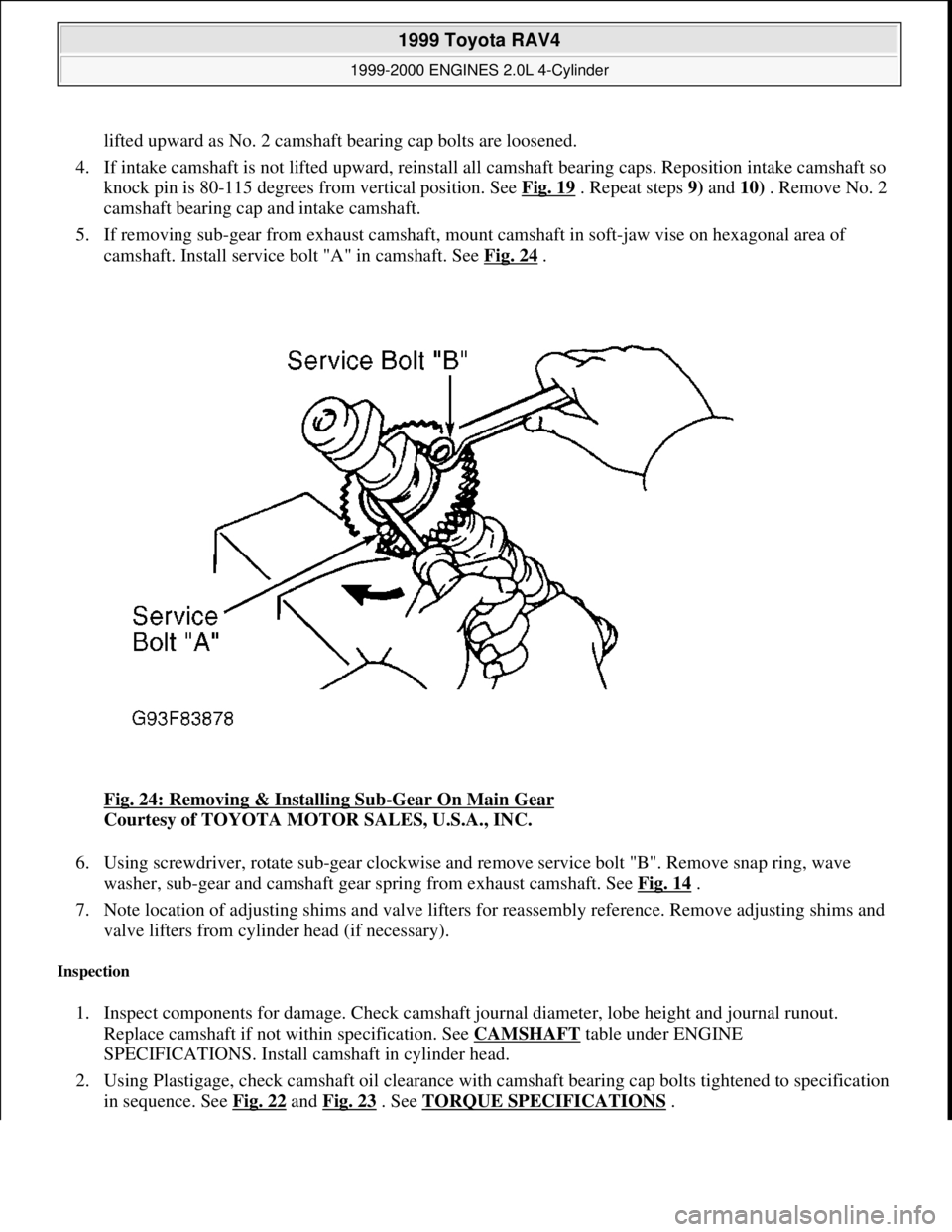
5. If removing sub-gear from exhaust camshaft, mount camshaft in soft-jaw vise on hexagonal area of
camshaft. Install service bolt "A" in camshaft. See Fig. 24
.
Fig. 24: Removing & Installing Sub
-Gear On Main Gear
Courtesy of TOYOTA MOTOR SALES, U.S.A., INC.
6. Using screwdriver, rotate sub-gear clockwise and remove service bolt "B". Remove snap ring, wave
washer, sub-gear and camshaft gear spring from exhaust camshaft. See Fig. 14
.
7. Note location of adjusting shims and valve lifters for reassembly reference. Remove adjusting shims and
valve lifters from cylinder head (if necessary).
Inspection
1. Inspect components for damage. Check camshaft journal diameter, lobe height and journal runout.
Replace camshaft if not within specification. See CAMSHAFT
table under ENGINE
SPECIFICATIONS. Install camshaft in cylinder head.
2. Using Plastigage, check camshaft oil clearance with camshaft bearing cap bolts tightened to specification
in sequence. See Fig. 22
and Fig. 23 . See TORQUE SPECIFICATIONS.
1999 Toyota RAV4
1999-2000 ENGINES 2.0L 4-Cylinder
Microsoft
Sunday, November 22, 2009 10:22:26 AMPage 35 © 2005 Mitchell Repair Information Company, LLC.
Page 720 of 1632
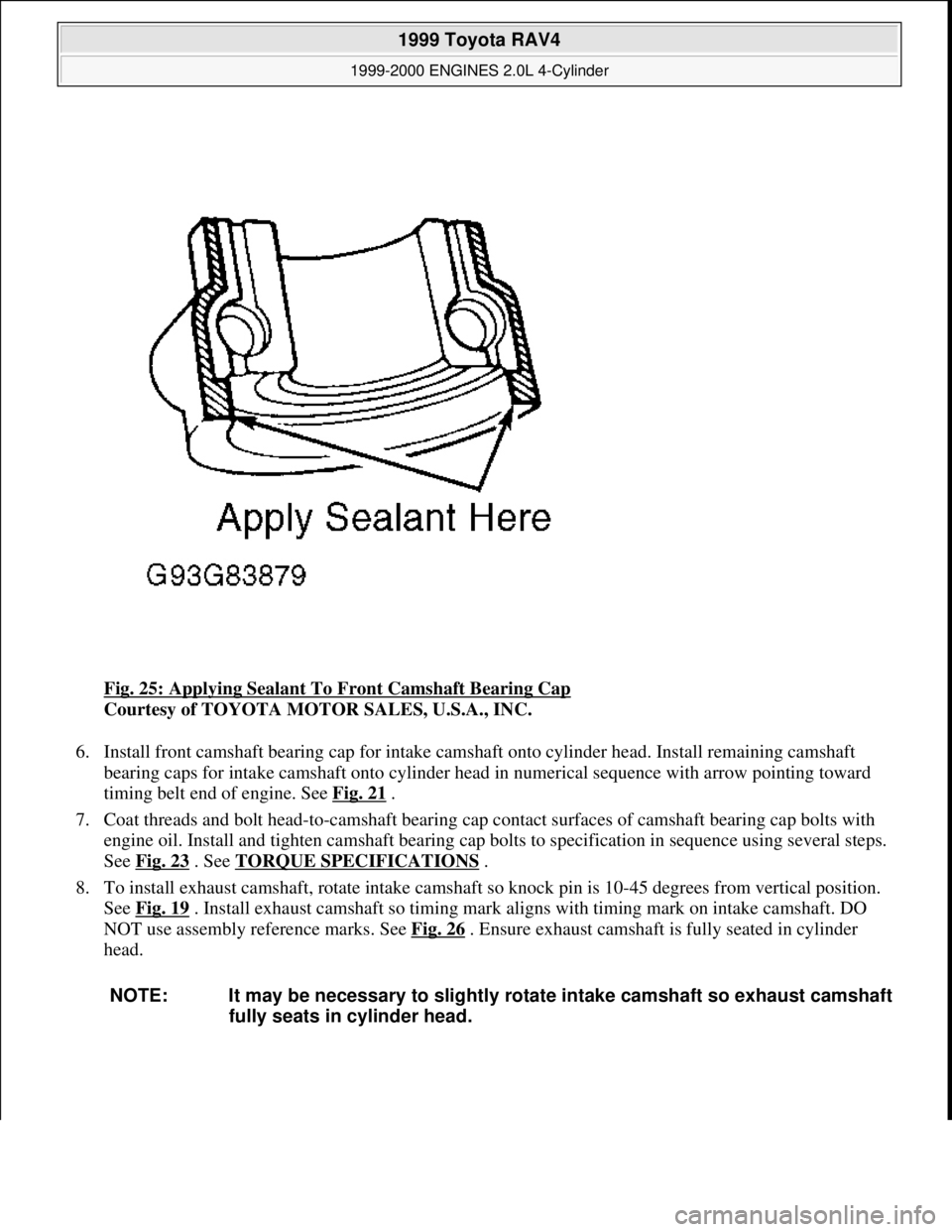
Fig. 25: Applying Sealant To Front Camshaft Bearing Cap
Courtesy of TOYOTA MOTOR SALES, U.S.A., INC.
6. Install front camshaft bearing cap for intake camshaft onto cylinder head. Install remaining camshaft
bearing caps for intake camshaft onto cylinder head in numerical sequence with arrow pointing toward
timing belt end of engine. See Fig. 21
.
7. Coat threads and bolt head-to-camshaft bearing cap contact surfaces of camshaft bearing cap bolts with
engine oil. Install and tighten camshaft bearing cap bolts to specification in sequence using several steps.
See Fig. 23
. See TORQUE SPECIFICATIONS .
8. To install exhaust camshaft, rotate intake camshaft so knock pin is 10-45 degrees from vertical position.
See Fig. 19
. Install exhaust camshaft so timing mark aligns with timing mark on intake camshaft. DO
NOT use assembly reference marks. See Fig. 26
. Ensure exhaust camshaft is fully seated in cylinder
head.
NOTE: It may be necessary to slightly rotate intake camshaft so exhaust camshaft
fully seats in cylinder head.
1999 Toyota RAV4
1999-2000 ENGINES 2.0L 4-Cylinder
Microsoft
Sunday, November 22, 2009 10:22:26 AMPage 37 © 2005 Mitchell Repair Information Company, LLC.
Page 721 of 1632
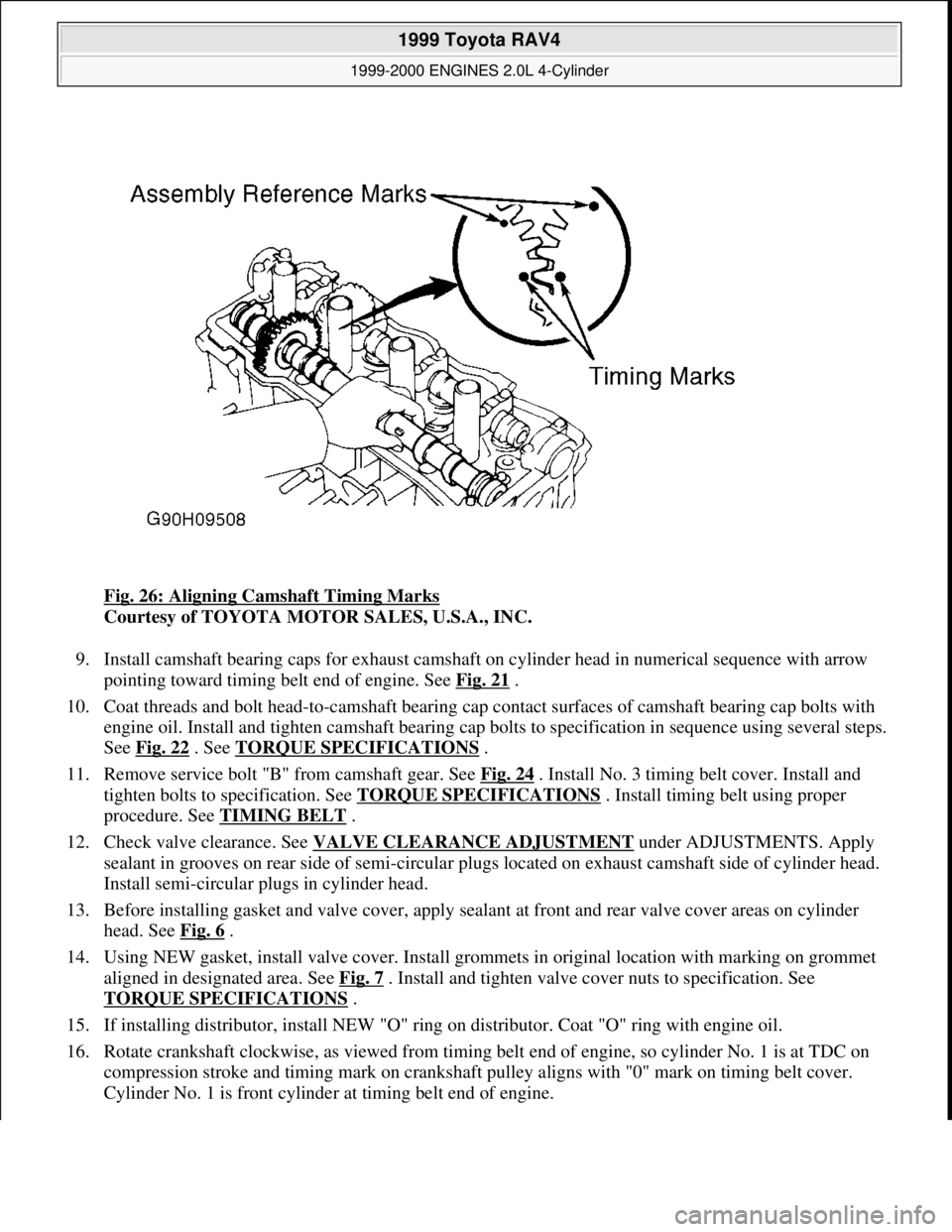
Fig. 26: Aligning Camshaft Timing Marks
Courtesy of TOYOTA MOTOR SALES, U.S.A., INC.
9. Install camshaft bearing caps for exhaust camshaft on cylinder head in numerical sequence with arrow
pointing toward timing belt end of engine. See Fig. 21
.
10. Coat threads and bolt head-to-camshaft bearing cap contact surfaces of camshaft bearing cap bolts with
engine oil. Install and tighten camshaft bearing cap bolts to specification in sequence using several steps.
See Fig. 22
. See TORQUE SPECIFICATIONS .
11. Remove service bolt "B" from camshaft gear. See Fig. 24
. Install No. 3 timing belt cover. Install and
tighten bolts to specification. See TORQUE SPECIFICATIONS
. Install timing belt using proper
procedure. See TIMING BELT
.
12. Check valve clearance. See VALVE CLEARANCE ADJUSTMENT
under ADJUSTMENTS. Apply
sealant in grooves on rear side of semi-circular plugs located on exhaust camshaft side of cylinder head.
Install semi-circular plugs in cylinder head.
13. Before installing gasket and valve cover, apply sealant at front and rear valve cover areas on cylinder
head. See Fig. 6
.
14. Using NEW gasket, install valve cover. Install grommets in original location with marking on grommet
aligned in designated area. See Fig. 7
. Install and tighten valve cover nuts to specification. See
TORQUE SPECIFICATIONS
.
15. If installing distributor, install NEW "O" ring on distributor. Coat "O" ring with engine oil.
16. Rotate crankshaft clockwise, as viewed from timing belt end of engine, so cylinder No. 1 is at TDC on
compression stroke and timing mark on crankshaft pulley aligns with "0" mark on timing belt cover.
C
ylinder No. 1 is front cylinder at timing belt end of engine.
1999 Toyota RAV4
1999-2000 ENGINES 2.0L 4-Cylinder
Microsoft
Sunday, November 22, 2009 10:22:26 AMPage 38 © 2005 Mitchell Repair Information Company, LLC.
Page 725 of 1632
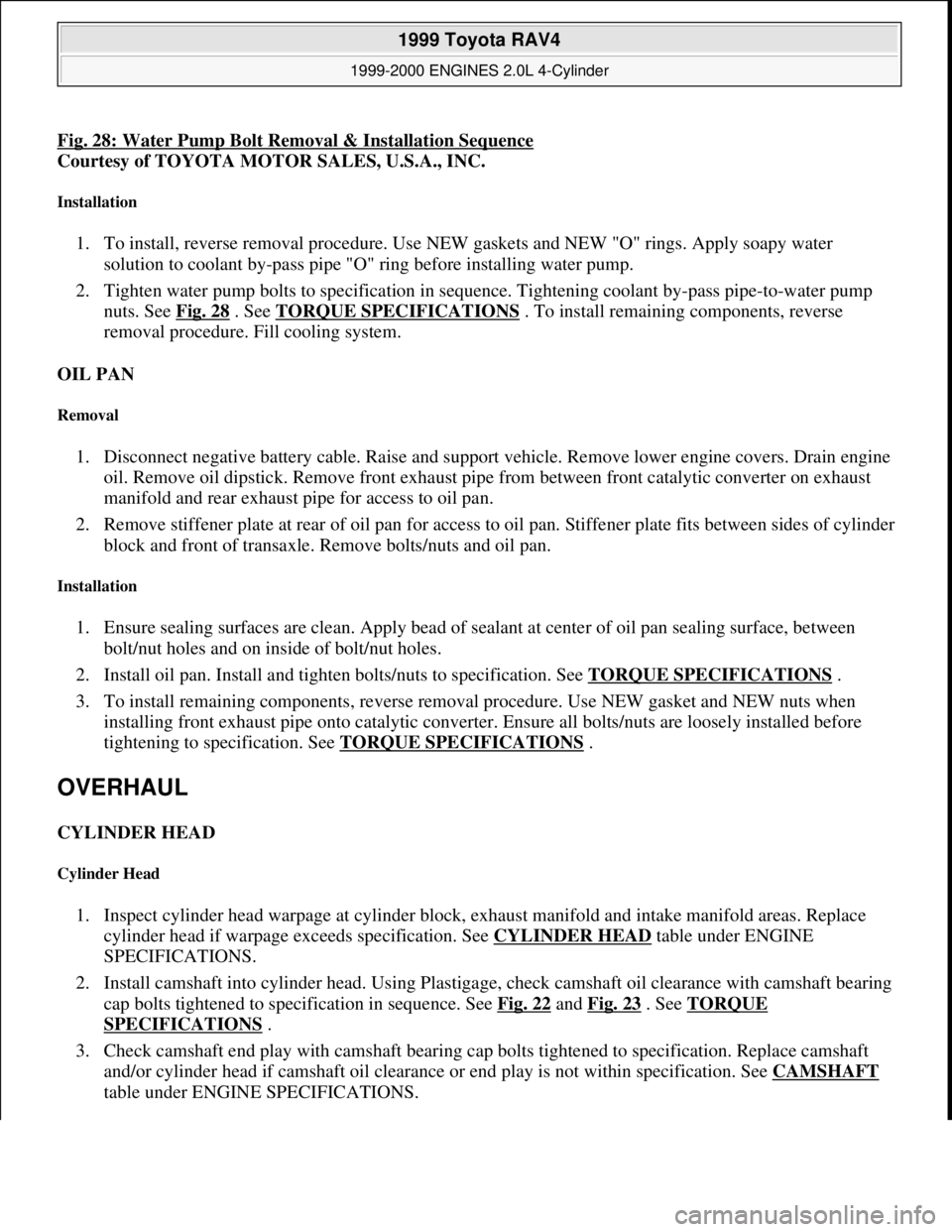
Fig. 28: Water Pump Bolt Removal & Installation Sequence
Courtesy of TOYOTA MOTOR SALES, U.S.A., INC.
Installation
1. To install, reverse removal procedure. Use NEW gaskets and NEW "O" rings. Apply soapy water
solution to coolant by-pass pipe "O" ring before installing water pump.
2. Tighten water pump bolts to specification in sequence. Tightening coolant by-pass pipe-to-water pump
nuts. See Fig. 28
. See TORQUE SPECIFICATIONS . To install remaining components, reverse
removal procedure. Fill cooling system.
OIL PAN
Removal
1. Disconnect negative battery cable. Raise and support vehicle. Remove lower engine covers. Drain engine
oil. Remove oil dipstick. Remove front exhaust pipe from between front catalytic converter on exhaust
manifold and rear exhaust pipe for access to oil pan.
2. Remove stiffener plate at rear of oil pan for access to oil pan. Stiffener plate fits between sides of cylinder
block and front of transaxle. Remove bolts/nuts and oil pan.
Installation
1. Ensure sealing surfaces are clean. Apply bead of sealant at center of oil pan sealing surface, between
bolt/nut holes and on inside of bolt/nut holes.
2. Install oil pan. Install and tighten bolts/nuts to specification. See TORQUE SPECIFICATIONS
.
3. To install remaining components, reverse removal procedure. Use NEW gasket and NEW nuts when
installing front exhaust pipe onto catalytic converter. Ensure all bolts/nuts are loosely installed before
tightening to specification. See TORQUE SPECIFICATIONS
.
OVERHAUL
CYLINDER HEAD
Cylinder Head
1. Inspect cylinder head warpage at cylinder block, exhaust manifold and intake manifold areas. Replace
cylinder head if warpage exceeds specification. See CYLINDER HEAD
table under ENGINE
SPECIFICATIONS.
2. Install camshaft into cylinder head. Using Plastigage, check camshaft oil clearance with camshaft bearing
cap bolts tightened to specification in sequence. See Fig. 22
and Fig. 23 . See TORQUE
SPECIFICATIONS .
3. Check camshaft end play with camshaft bearing cap bolts tightened to specification. Replace camshaft
and/or cylinder head if camshaft oil clearance or end play is not within specification. See CAMSHAFT
table under ENGINE SPECIFICATIONS.
1999 Toyota RAV4
1999-2000 ENGINES 2.0L 4-Cylinder
Microsoft
Sunday, November 22, 2009 10:22:27 AMPage 42 © 2005 Mitchell Repair Information Company, LLC.
Page 727 of 1632
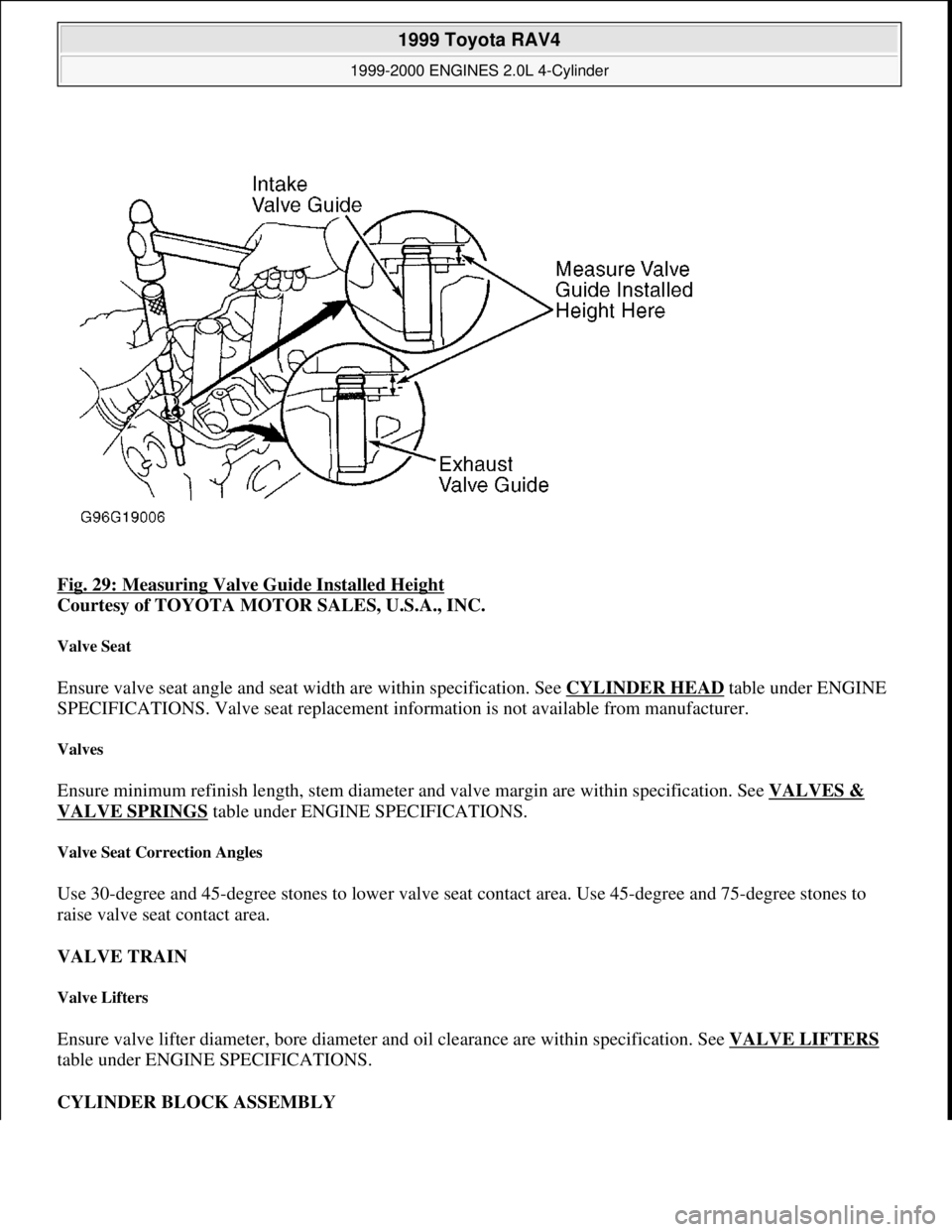
Fig. 29: Measuring Valve Guide Installed Height
Courtesy of TOYOTA MOTOR SALES, U.S.A., INC.
Valve Seat
Ensure valve seat angle and seat width are within specification. See CYLINDER HEAD table under ENGINE
SPECIFICATIONS. Valve seat replacement information is not available from manufacturer.
Valves
Ensure minimum refinish length, stem diameter and valve margin are within specification. See VALVES &
VALVE SPRINGS table under ENGINE SPECIFICATIONS.
Valve Seat Correction Angles
Use 30-degree and 45-degree stones to lower valve seat contact area. Use 45-degree and 75-degree stones to
raise valve seat contact area.
VALVE TRAIN
Valve Lifters
Ensure valve lifter diameter, bore diameter and oil clearance are within specification. See VALVE LIFTERS
table under ENGINE SPECIFICATIONS.
CYLINDER BLOCK ASSEMBLY
1999 Toyota RAV4
1999-2000 ENGINES 2.0L 4-Cylinder
Microsoft
Sunday, November 22, 2009 10:22:27 AMPage 44 © 2005 Mitchell Repair Information Company, LLC.
Page 728 of 1632
Piston & Rod Assembly
1. Ensure connecting rod and connecting rod cap are marked with matching cylinder number for reassembly
reference. Piston, connecting rod and connecting rod must be installed with front mark toward timing belt
end of engine. See Fig. 31
.
2. Before disassembling piston and connecting rod, try to move piston back and forth on piston pin. Replace
piston and piston pin as a set, if any movement is felt.
3. Remove 2 compression rings using a piston ring expander. Remove 2 oil rings and oil ring expander by
hand. Using Piston Pin Remover/Replacer (09221-25026), press piston pin from piston, and remove
connecting rod. See Fig. 32
.
4. Ensure piston pin diameter is within specification. See PISTONS, PINS & RINGS
table under ENGINE
SPECIFICATIONS. Ensure connecting rod bend, twist and piston pin bore diameter (connecting rod
small end) are within specification. See CONNECTING RODS
table under ENGINE
SPECIFICATIONS.
5. If piston pin bore diameter is not within specification, replace connecting rod assembly. See
CONNECTING RODS
table under ENGINE SPECIFICATIONS.
6. Using hand pressure, ensure nut rotates easily on connecting rod bolt. If nut fails to rotate easily, use
caliper to measure connecting rod bolt outside diameter .59" (15.0 mm) from end of bolt. Standard
connecting rod bolt outside diameter is .3094-.3150" (7.860-8.000 mm). Replace connecting rod bolt and
nut assembly if bolt outside diameter is less than .2992" (7.600 mm).
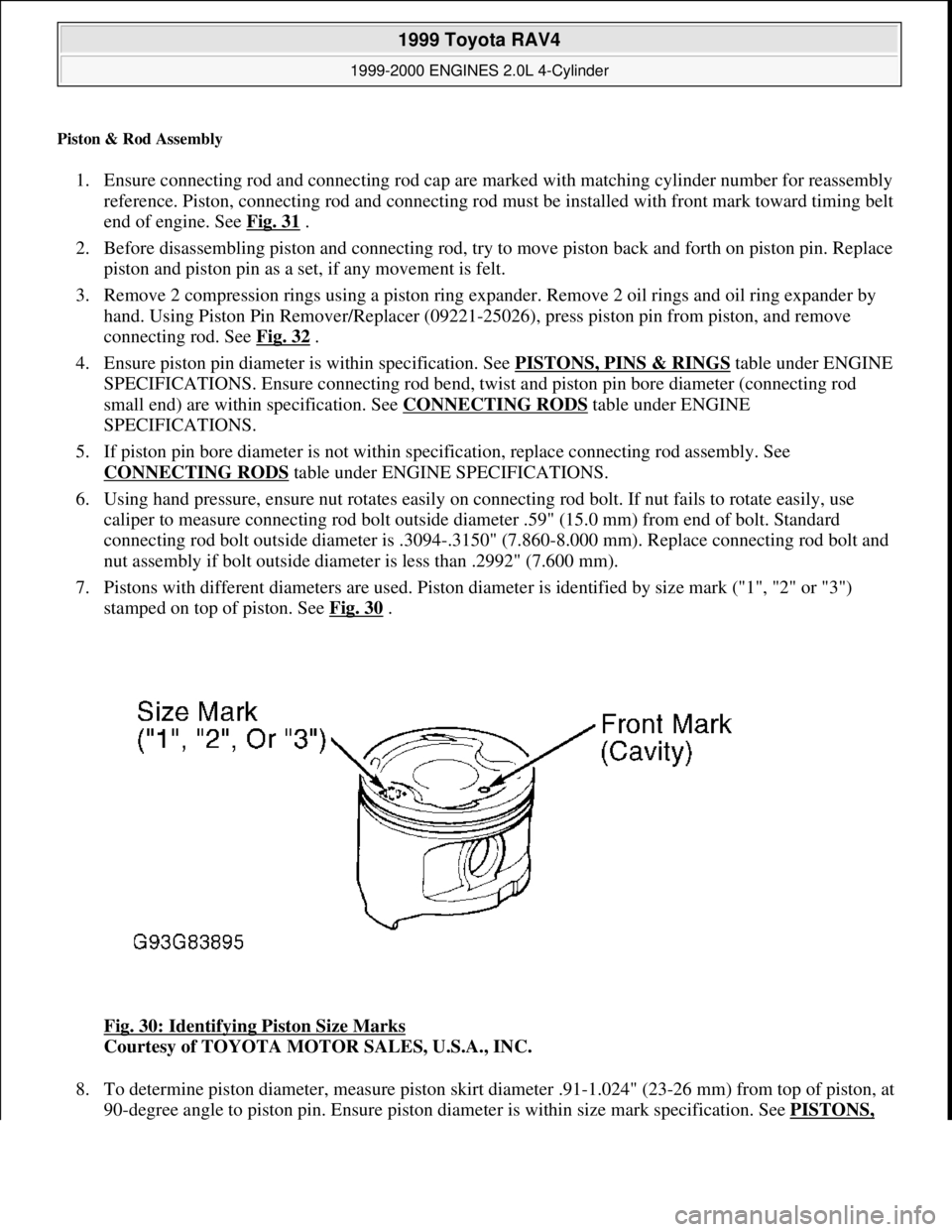
7. Pistons with different diameters are used. Piston diameter is identified by size mark ("1", "2" or "3")
stamped on top of piston. See Fig. 30
.
Fig. 30: Identifying Piston Size Marks
Courtesy of TOYOTA MOTOR SALES, U.S.A., INC.
8. To determine piston diameter, measure piston skirt diameter .91-1.024" (23-26 mm) from top of piston, at
90-de
gree angle to piston pin. Ensure piston diameter is within size mark specification. See PISTONS,
1999 Toyota RAV4
1999-2000 ENGINES 2.0L 4-Cylinder
Microsoft
Sunday, November 22, 2009 10:22:27 AMPage 45 © 2005 Mitchell Repair Information Company, LLC.
Page 729 of 1632
PINS & RINGS table under ENGINE SPECIFICATIONS.
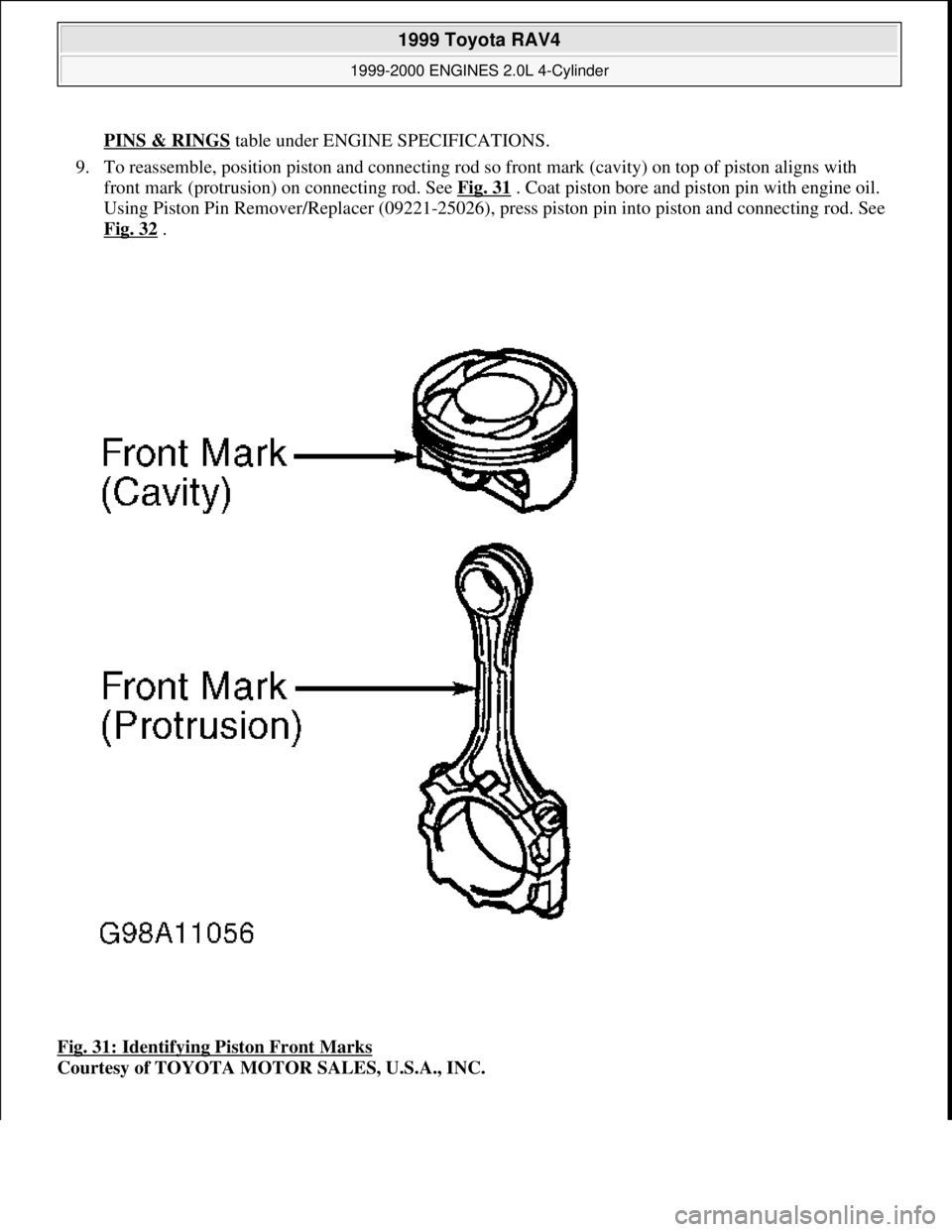
9. To reassemble, position piston and connecting rod so front mark (cavity) on top of piston aligns with
front mark (protrusion) on connecting rod. See Fig. 31
. Coat piston bore and piston pin with engine oil.
Using Piston Pin Remover/Replacer (09221-25026), press piston pin into piston and connecting rod. See
Fig. 32
.
Fig. 31: Identifying Piston Front Marks
Courtesy of TOYOTA MOTOR SALES, U.S.A., INC.
1999 Toyota RAV4
1999-2000 ENGINES 2.0L 4-Cylinder
Microsoft
Sunday, November 22, 2009 10:22:27 AMPage 46 © 2005 Mitchell Repair Information Company, LLC.
Page 731 of 1632
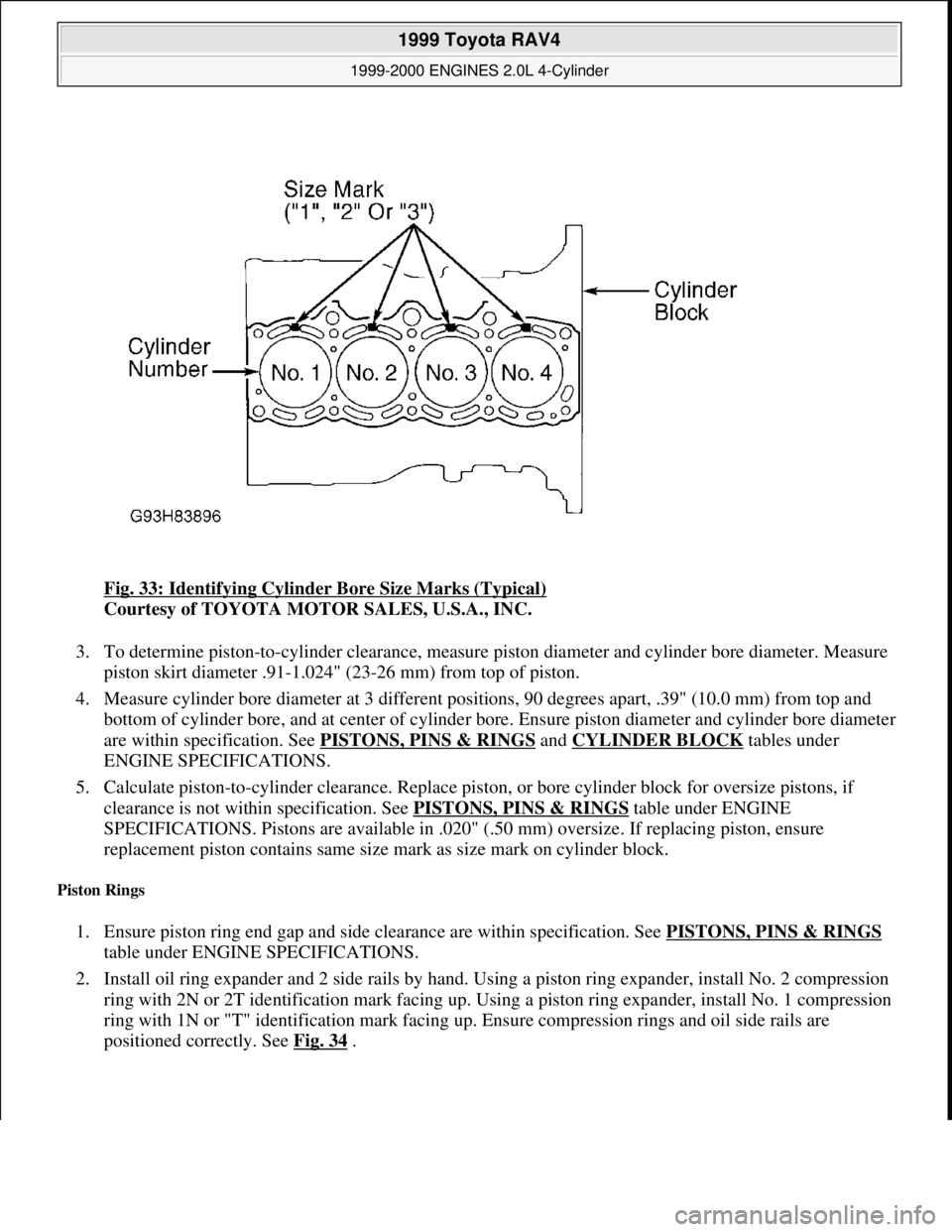
Fig. 33: Identifying Cylinder Bore Size Marks (Typical)
Courtesy of TOYOTA MOTOR SALES, U.S.A., INC.
3. To determine piston-to-cylinder clearance, measure piston diameter and cylinder bore diameter. Measure
piston skirt diameter .91-1.024" (23-26 mm) from top of piston.
4. Measure cylinder bore diameter at 3 different positions, 90 degrees apart, .39" (10.0 mm) from top and
bottom of cylinder bore, and at center of cylinder bore. Ensure piston diameter and cylinder bore diameter
are within specification. See PISTONS, PINS & RINGS
and CYLINDER BLOCK tables under
ENGINE SPECIFICATIONS.
5. Calculate piston-to-cylinder clearance. Replace piston, or bore cylinder block for oversize pistons, if
clearance is not within specification. See PISTONS, PINS & RINGS
table under ENGINE
SPECIFICATIONS. Pistons are available in .020" (.50 mm) oversize. If replacing piston, ensure
replacement piston contains same size mark as size mark on cylinder block.
Piston Rings
1. Ensure piston ring end gap and side clearance are within specification. See PISTONS, PINS & RINGS
table under ENGINE SPECIFICATIONS.
2. Install oil ring expander and 2 side rails by hand. Using a piston ring expander, install No. 2 compression
ring with 2N or 2T identification mark facing up. Using a piston ring expander, install No. 1 compression
ring with 1N or "T" identification mark facing up. Ensure compression rings and oil side rails are
positioned correctl
y. See Fig. 34 .
1999 Toyota RAV4
1999-2000 ENGINES 2.0L 4-Cylinder
Microsoft
Sunday, November 22, 2009 10:22:27 AMPage 48 © 2005 Mitchell Repair Information Company, LLC.
Page 732 of 1632
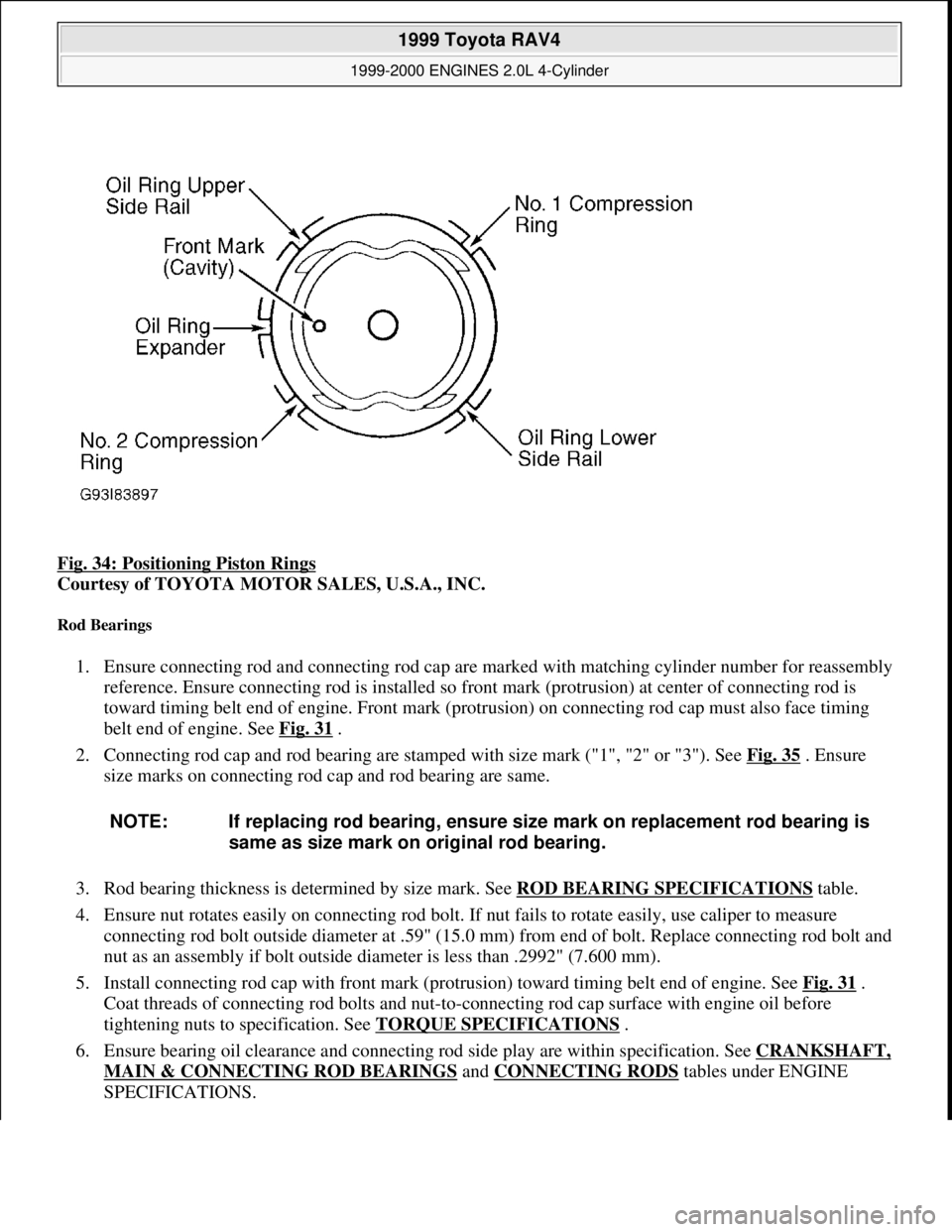
Fig. 34: Positioning Piston Rings
Courtesy of TOYOTA MOTOR SALES, U.S.A., INC.
Rod Bearings
1. Ensure connecting rod and connecting rod cap are marked with matching cylinder number for reassembly
reference. Ensure connecting rod is installed so front mark (protrusion) at center of connecting rod is
toward timing belt end of engine. Front mark (protrusion) on connecting rod cap must also face timing
belt end of engine. See Fig. 31
.
2. Connecting rod cap and rod bearing are stamped with size mark ("1", "2" or "3"). See Fig. 35
. Ensure
size marks on connecting rod cap and rod bearing are same.
3. Rod bearing thickness is determined by size mark. See ROD BEARING SPECIFICATIONS
table.
4. Ensure nut rotates easily on connecting rod bolt. If nut fails to rotate easily, use caliper to measure
connecting rod bolt outside diameter at .59" (15.0 mm) from end of bolt. Replace connecting rod bolt and
nut as an assembly if bolt outside diameter is less than .2992" (7.600 mm).
5. Install connecting rod cap with front mark (protrusion) toward timing belt end of engine. See Fig. 31
.
Coat threads of connecting rod bolts and nut-to-connecting rod cap surface with engine oil before
tightening nuts to specification. See TORQUE SPECIFICATIONS
.
6. Ensure bearing oil clearance and connecting rod side play are within specification. See CRANKSHAFT,
MAIN & CONNECTING ROD BEARINGS and CONNECTING RODS tables under ENGINE
SPECIFICATIONS.
NOTE: If replacing rod bearing, ensure size mark on replacement rod bearing is
same as size mark on original rod bearing.
1999 Toyota RAV4
1999-2000 ENGINES 2.0L 4-Cylinder
Microsoft
Sunday, November 22, 2009 10:22:27 AMPage 49 © 2005 Mitchell Repair Information Company, LLC.
Page 738 of 1632
under REMOVAL & INSTALLATION. Remove oil pan. See OIL PANunder REMOVAL &
INSTALLATION.
2. Remove oil pump pick-up tube, gasket and oil baffle plate. Disconnect electrical connector for crankshaft
position sensor located on from of oil pump housing. Remove bolt and crankshaft position sensor from
front of oil pump housing.
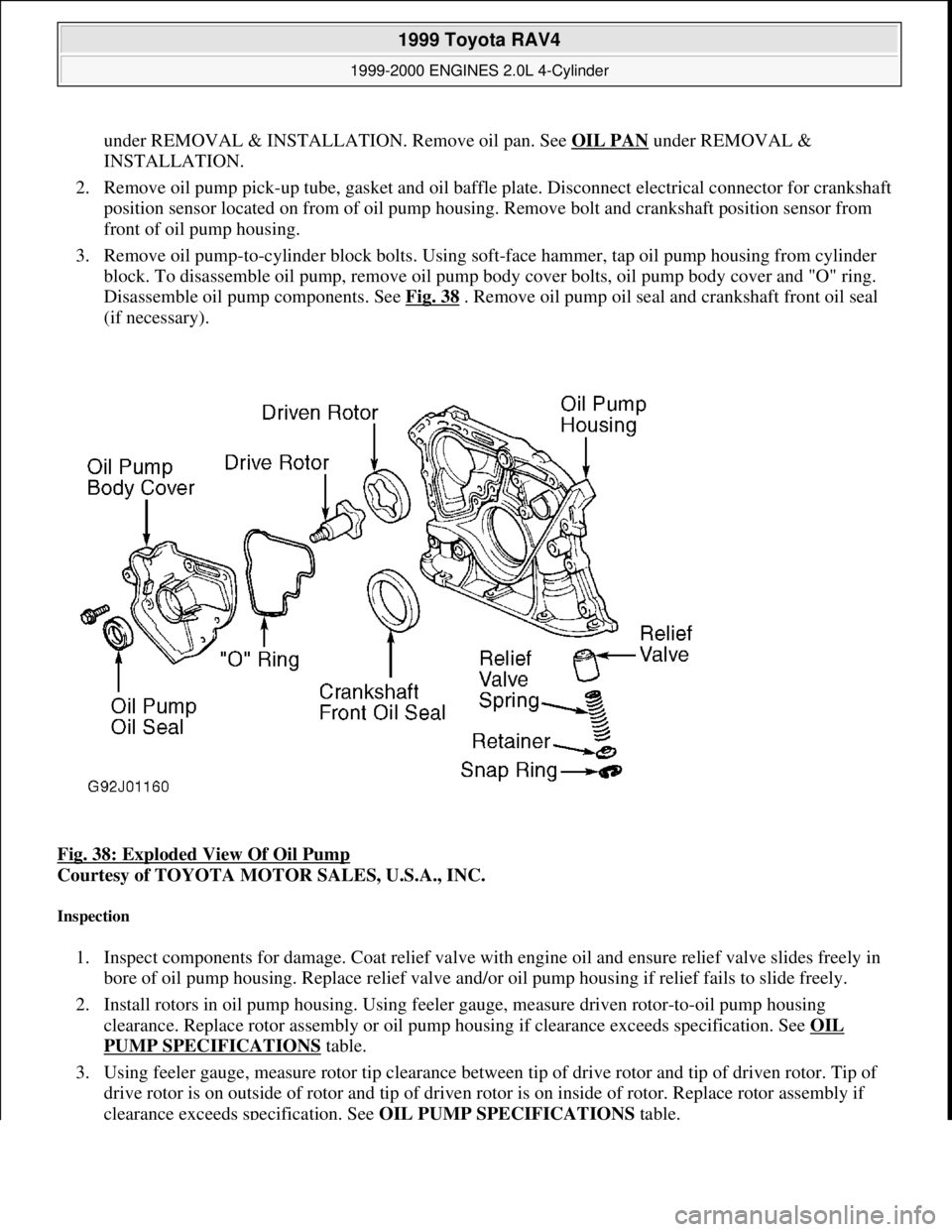
3. Remove oil pump-to-cylinder block bolts. Using soft-face hammer, tap oil pump housing from cylinder
block. To disassemble oil pump, remove oil pump body cover bolts, oil pump body cover and "O" ring.
Disassemble oil pump components. See Fig. 38
. Remove oil pump oil seal and crankshaft front oil seal
(if necessary).
Fig. 38: Exploded View Of Oil Pump
Courtesy of TOYOTA MOTOR SALES, U.S.A., INC.
Inspection
1. Inspect components for damage. Coat relief valve with engine oil and ensure relief valve slides freely in
bore of oil pump housing. Replace relief valve and/or oil pump housing if relief fails to slide freely.
2. Install rotors in oil pump housing. Using feeler gauge, measure driven rotor-to-oil pump housing
clearance. Replace rotor assembly or oil pump housing if clearance exceeds specification. See OIL
PUMP SPECIFICATIONS table.
3. Using feeler gauge, measure rotor tip clearance between tip of drive rotor and tip of driven rotor. Tip of
drive rotor is on outside of rotor and tip of driven rotor is on inside of rotor. Replace rotor assembly if
clearance exceeds specification. See OIL PUMP SPECIFICATIONS
table.
1999 Toyota RAV4
1999-2000 ENGINES 2.0L 4-Cylinder
Microsoft
Sunday, November 22, 2009 10:22:27 AMPage 55 © 2005 Mitchell Repair Information Company, LLC.