air condition TOYOTA RAV4 1996 Service Service Manual
[x] Cancel search | Manufacturer: TOYOTA, Model Year: 1996, Model line: RAV4, Model: TOYOTA RAV4 1996Pages: 1632, PDF Size: 41.64 MB
Page 554 of 1632
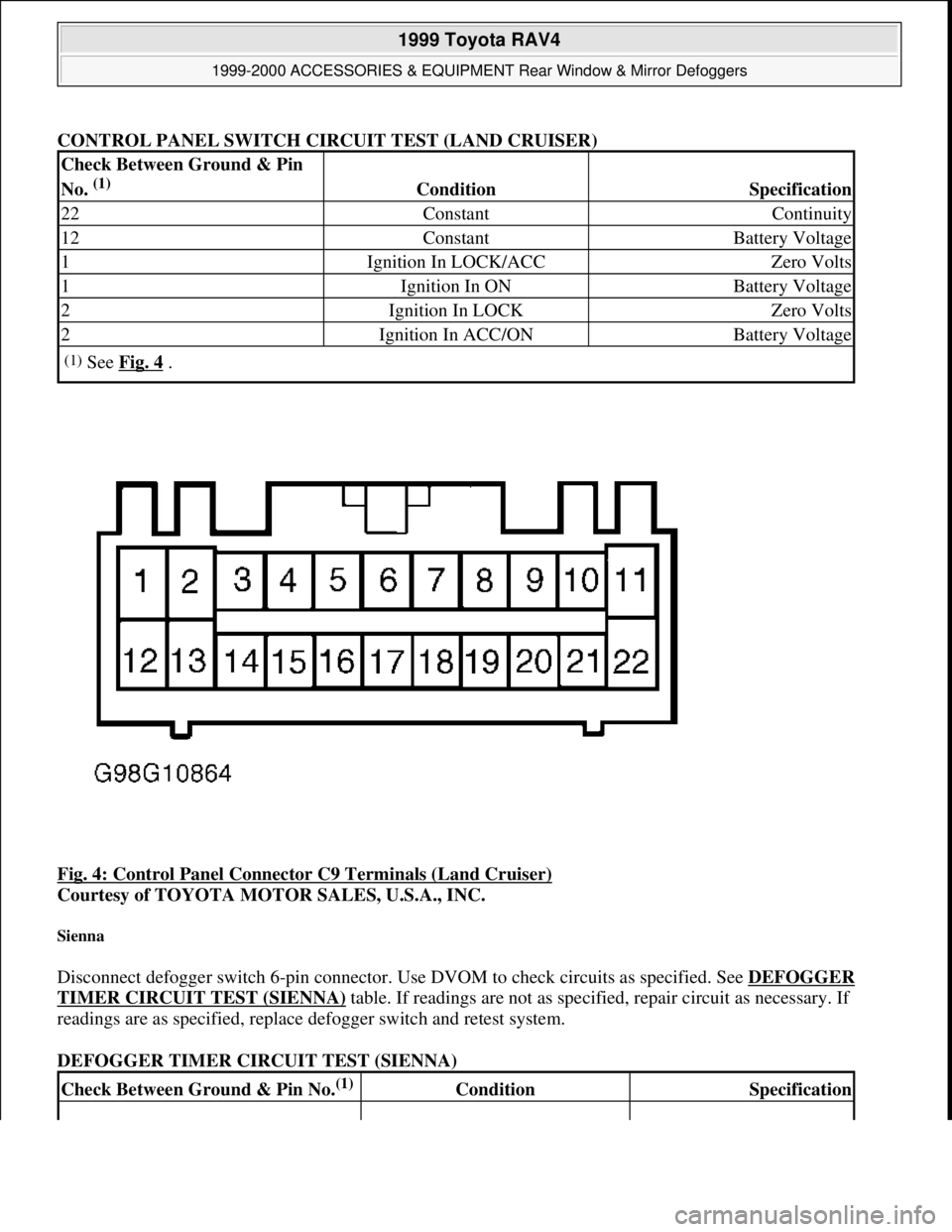
CONTROL PANEL SWITCH CIRCUIT TEST (LAND CRUISER)
Fig. 4: Control Panel Connector C9 Terminals (Land Cruiser)
Courtesy of TOYOTA MOTOR SALES, U.S.A., INC.
Sienna
Disconnect defogger switch 6-pin connector. Use DVOM to check circuits as specified. See DEFOGGER
TIMER CIRCUIT TEST (SIENNA) table. If readings are not as specified, repair circuit as necessary. If
readings are as specified, replace defogger switch and retest system.
DEFOGGER TIMER CIRCUIT TEST (SIENNA)
Check Between Ground & Pin
No.
(1) ConditionSpecification
22ConstantContinuity
12ConstantBattery Voltage
1Ignition In LOCK/ACCZero Volts
1Ignition In ONBattery Voltage
2Ignition In LOCKZero Volts
2Ignition In ACC/ONBattery Voltage
(1)See Fig. 4 .
Check Between Ground & Pin No.(1) ConditionSpecification
1999 Toyota RAV4
1999-2000 ACCESSORIES & EQUIPMENT Rear Window & Mirror Defoggers
Microsoft
Sunday, November 22, 2009 10:55:10 AMPage 6 © 2005 Mitchell Repair Information Company, LLC.
Page 555 of 1632
4Runner
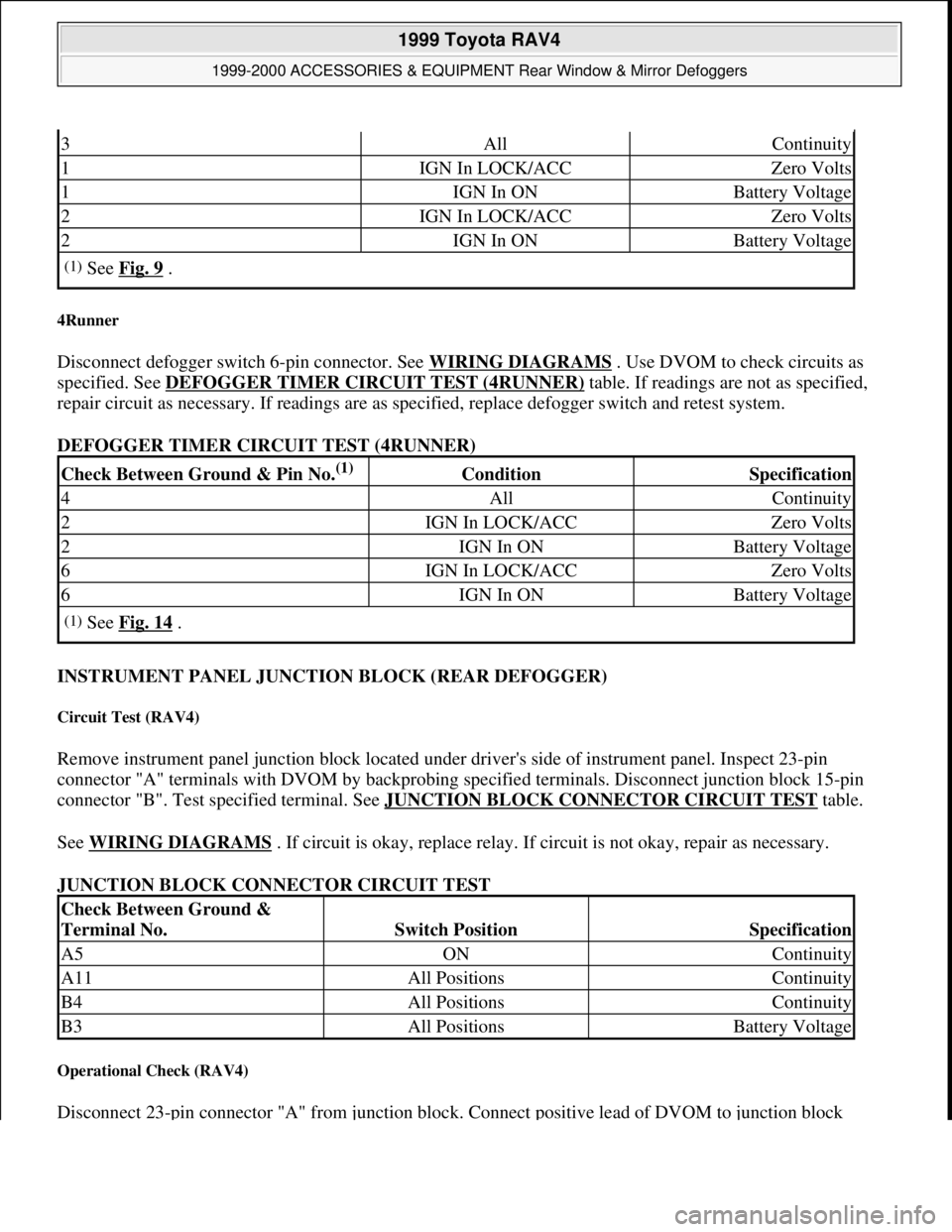
Disconnect defogger switch 6-pin connector. See WIRING DIAGRAMS . Use DVOM to check circuits as
specified. See DEFOGGER TIMER CIRCUIT TEST (4RUNNER)
table. If readings are not as specified,
repair circuit as necessary. If readings are as specified, replace defogger switch and retest system.
DEFOGGER TIMER CIRCUIT TEST (4RUNNER)
INSTRUMENT PANEL JUNCTION BLOCK (REAR DEFOGGER)
Circuit Test (RAV4)
Remove instrument panel junction block located under driver's side of instrument panel. Inspect 23-pin
connector "A" terminals with DVOM by backprobing specified terminals. Disconnect junction block 15-pin
connector "B". Test specified terminal. See JUNCTION BLOCK CONNECTOR CIRCUIT TEST
table.
See WIRING DIAGRAMS
. If circuit is okay, replace relay. If circuit is not okay, repair as necessary.
JUNCTION BLOCK CONNECTOR CIRCUIT TEST
Operational Check (RAV4)
Disconnect 23-pin connector "A" from junction block. Connect positive lead of DVOM to junction block
3AllContinuity
1IGN In LOCK/ACCZero Volts
1IGN In ONBattery Voltage
2IGN In LOCK/ACCZero Volts
2IGN In ONBattery Voltage
(1)See Fig. 9 .
Check Between Ground & Pin No.(1) ConditionSpecification
4AllContinuity
2IGN In LOCK/ACCZero Volts
2IGN In ONBattery Voltage
6IGN In LOCK/ACCZero Volts
6IGN In ONBattery Voltage
(1)See Fig. 14 .
Check Between Ground &
Terminal No.
Switch PositionSpecification
A5ONContinuity
A11All PositionsContinuity
B4All PositionsContinuity
B3All PositionsBattery Voltage
1999 Toyota RAV4
1999-2000 ACCESSORIES & EQUIPMENT Rear Window & Mirror Defoggers
Microsoft
Sunday, November 22, 2009 10:55:10 AMPage 7 © 2005 Mitchell Repair Information Company, LLC.
Page 609 of 1632
1. Mount drive shaft on wood blocks or other stands. With dial indicator, inspect intermediate shaft and rear
drive shaft runout. If runout exceeds .031" (.78 mm), replace shaft.
2. Position dial indicator at end of drive shaft, with tip against inner edge of "U" joint flange. Check
horizontal and vertical runout. If runout exceeds .004" (.10 mm), replace "U" joint flange.
3. Hold drive shaft and attempt to move spider bearing to check for axial play. If axial play is excessive,
repair or replace spider bearing.
4. Ensure cross groove joint turns smoothly in all directions. Check for damage or grease leakage at boot. If
damage is found, replace rear drive shaft.
5. Remove "U" joint flange by loosening stalked part of nut and then removing nut and washer.
6. Turn center support bearing by hand and ensure bearing rotates smoothly. Check condition of seals. If
bearing or seals show wear or damage, replace them.
7. With screwdriver and hammer, remove intermediate shaft dust cover.
Installation
1. Set center support bearing on intermediate shaft. Install plate washer to intermediate shaft. Align
reference marks on flange and shaft. Place flange on shaft.
2. With flange held in vise, press bearing into position by tightening NEW flange nut and washer to 134 ft.
lbs. (182 N.m). Loosen nut and tighten to 51 ft. lbs. (69 N.m). Stake nut.
3. Install NEW intermediate shaft dust cover by tapping into position evenly.
4. Place piece of protective cloth inside "U" joint cover. Align reference marks on intermediate shaft and
rear drive shaft. Install 3 washers and 6 bolts. Temporarily tighten.
5. Insert yoke into "U" joint. Install center support bearing temporarily. Align reference marks on flanges
and connect rear drive shaft with 4 bolts, washers and nuts. Tighten bolts to specification. See TORQUE
SPECIFICATIONS .
6. Depress and hold brake pedal. With hex wrench, tighten cross-groove cover and rear drive shaft. See
TORQUE SPECIFICATIONS
.
7. With vehicle in unladen condition, adjust dimension between rear side of center universal joint and rear
drive shaft. See Fig. 2
.
8. Adjust dimension between rear side of center bearing housing and rear side of bracket to dimension. See
Fig. 3
. Tighten center support bearing bolts to specification. See TORQUE SPECIFICATIONS .
Ensure centerline of bracket is at ri
ght angles to shaft axial line.
1999 Toyota RAV4
1999-2000 DRIVE AXLES Differentials, Axle Shafts & Drive Shafts -- Rear Integral Housing -- RAV4
Microsoft
Sunday, November 22, 2009 10:09:38 AMPage 4 © 2005 Mitchell Repair Information Company, LLC.
Page 685 of 1632
VALVE CLEARANCE ADJUSTMENT
1. Disconnect power steering fluid reservoir, PCV hoses, cable brackets and control cables for access to
valve cover. Disconnect spark plug wires from spark plugs.
2. Disconnect engine wiring harness protector at rear of timing belt cover for access to valve cover. When
disconnecting engine wiring harness protector, remove bolt on intake manifold side of engine first, and
then bolt on exhaust manifold side of engine.
3. Remove nuts, grommets, valve cover and gasket. Note location of grommets for reassembly reference, as
grommets must be installed in original location.
4. Rotate crankshaft clockwise, as viewed from timing belt end of engine, so cylinder No. 1 is at TDC on
compression stroke, and timing mark on crankshaft pulley aligns with "0" mark on timing belt cover.
Cylinder No. 1 is front cylinder at timing belt end of engine.
5. Ensure valve lifters are loose on cylinder No. 1 and tight on cylinder No. 4. If conditions are not as
described, rotate crankshaft clockwise one complete revolution (360 degrees).
6. With cylinder No. 1 at TDC on compression stroke, check valve clearance on specified valves. Perform
STEP 1 in illustration. See Fig. 2
. Using feeler gauge, measure and record valve clearance between valve
lifter and camshaft. NOTE: Adjust valve clearance with engine cold.
1999 Toyota RAV4
1999-2000 ENGINES 2.0L 4-Cylinder
Microsoft
Sunday, November 22, 2009 10:22:26 AMPage 2 © 2005 Mitchell Repair Information Company, LLC.
Page 750 of 1632
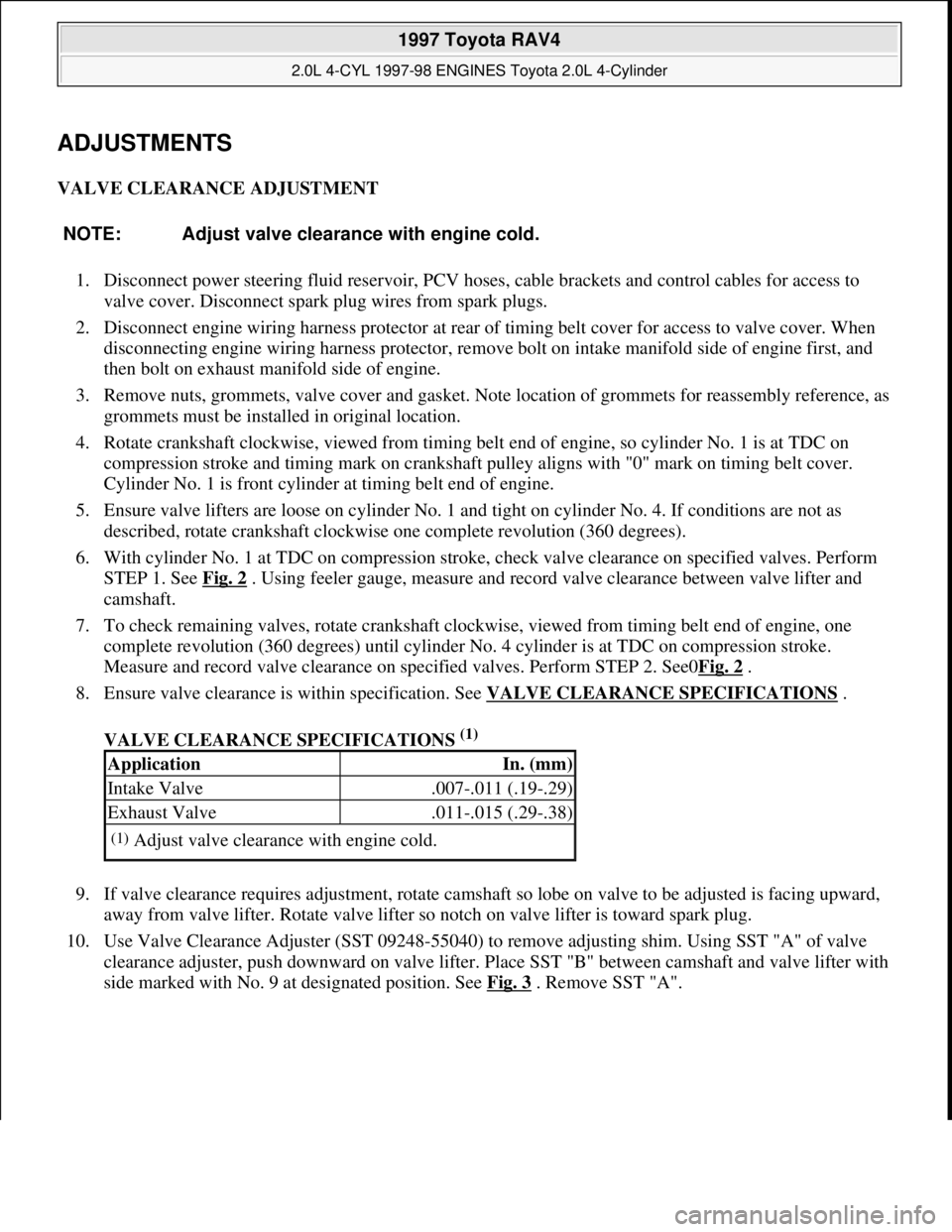
ADJUSTMENTS
VALVE CLEARANCE ADJUSTMENT
1. Disconnect power steering fluid reservoir, PCV hoses, cable brackets and control cables for access to
valve cover. Disconnect spark plug wires from spark plugs.
2. Disconnect engine wiring harness protector at rear of timing belt cover for access to valve cover. When
disconnecting engine wiring harness protector, remove bolt on intake manifold side of engine first, and
then bolt on exhaust manifold side of engine.
3. Remove nuts, grommets, valve cover and gasket. Note location of grommets for reassembly reference, as
grommets must be installed in original location.
4. Rotate crankshaft clockwise, viewed from timing belt end of engine, so cylinder No. 1 is at TDC on
compression stroke and timing mark on crankshaft pulley aligns with "0" mark on timing belt cover.
Cylinder No. 1 is front cylinder at timing belt end of engine.
5. Ensure valve lifters are loose on cylinder No. 1 and tight on cylinder No. 4. If conditions are not as
described, rotate crankshaft clockwise one complete revolution (360 degrees).
6. With cylinder No. 1 at TDC on compression stroke, check valve clearance on specified valves. Perform
STEP 1. See Fig. 2
. Using feeler gauge, measure and record valve clearance between valve lifter and
camshaft.
7. To check remaining valves, rotate crankshaft clockwise, viewed from timing belt end of engine, one
complete revolution (360 degrees) until cylinder No. 4 cylinder is at TDC on compression stroke.
Measure and record valve clearance on specified valves. Perform STEP 2. See0Fig. 2
.
8. Ensure valve clearance is within specification. See VALVE CLEARANCE SPECIFICATIONS
.
VALVE CLEARANCE SPECIFICATIONS
(1)
9. If valve clearance requires adjustment, rotate camshaft so lobe on valve to be adjusted is facing upward,
away from valve lifter. Rotate valve lifter so notch on valve lifter is toward spark plug.
10. Use Valve Clearance Adjuster (SST 09248-55040) to remove adjusting shim. Using SST "A" of valve
clearance adjuster, push downward on valve lifter. Place SST "B" between camshaft and valve lifter with
side marked with No. 9 at desi
gnated position. See Fig. 3. Remove SST "A". NOTE: Adjust valve clearance with engine cold.
ApplicationIn. (mm)
Intake Valve.007-.011 (.19-.29)
Exhaust Valve.011-.015 (.29-.38)
(1)Adjust valve clearance with engine cold.
1997 Toyota RAV4
2.0L 4-CYL 1997-98 ENGINES Toyota 2.0L 4-Cylinder
Microsoft
Sunday, November 22, 2009 10:23:30 AMPage 2 © 2005 Mitchell Repair Information Company, LLC.
Page 877 of 1632
A/C SYSTEM PERFORMANCE
1. Park vehicle out of direct sunlight. Install manifold gauge set and turn A/C controls to recirculated air
position, with inlet air temperature at 86-95°F (30-35°C). Start engine and allow to run at 1500 RPM.
2. Set blower/fan on high speed and temperature control switch to maximum cooling. Verify high-side and
low-side pressures are within specification. See SPECIFICATIONS
table.
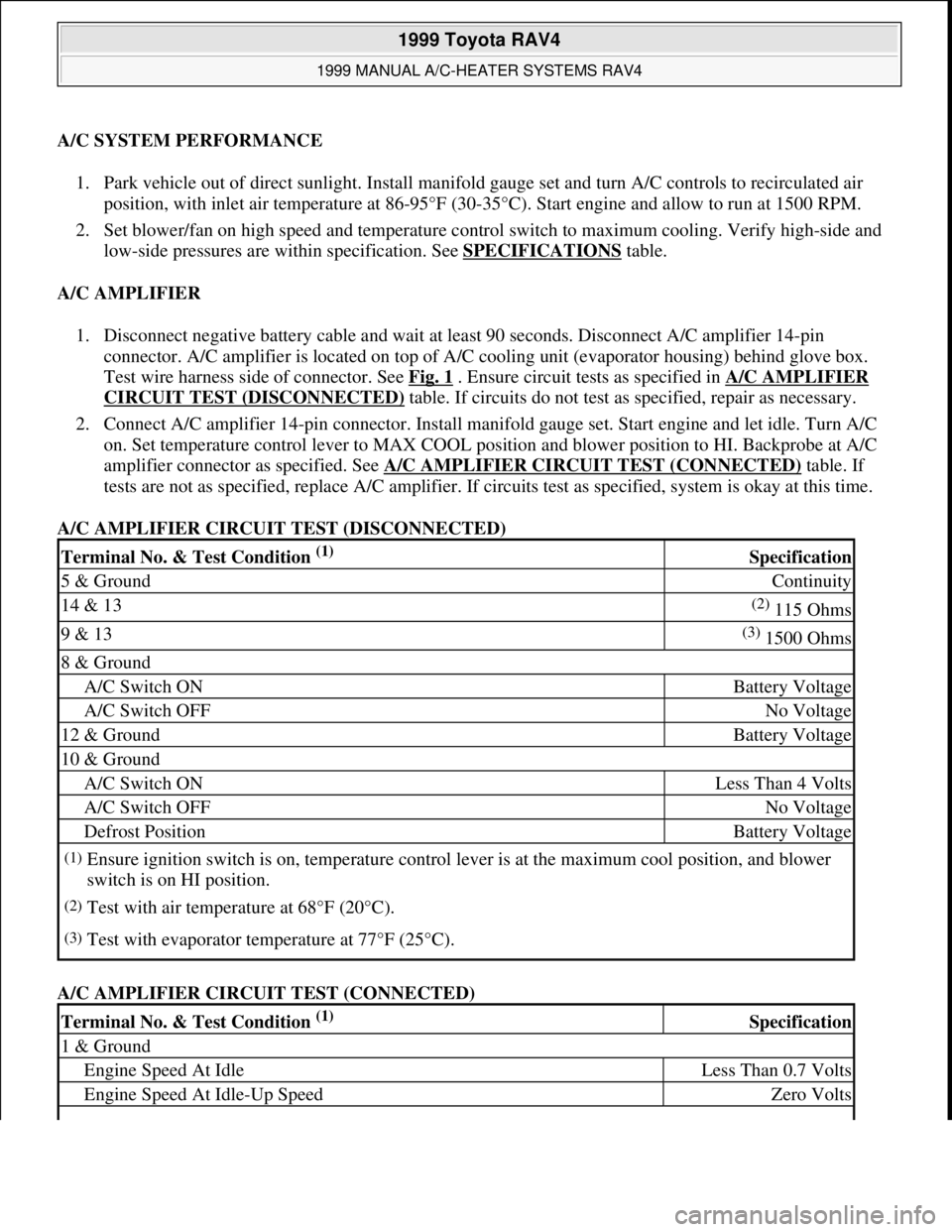
A/C AMPLIFIER
1. Disconnect negative battery cable and wait at least 90 seconds. Disconnect A/C amplifier 14-pin
connector. A/C amplifier is located on top of A/C cooling unit (evaporator housing) behind glove box.
Test wire harness side of connector. See Fig. 1
. Ensure circuit tests as specified in A/C AMPLIFIER
CIRCUIT TEST (DISCONNECTED) table. If circuits do not test as specified, repair as necessary.
2. Connect A/C amplifier 14-pin connector. Install manifold gauge set. Start engine and let idle. Turn A/C
on. Set temperature control lever to MAX COOL position and blower position to HI. Backprobe at A/C
amplifier connector as specified. See A/C AMPLIFIER CIRCUIT TEST (CONNECTED)
table. If
tests are not as specified, replace A/C amplifier. If circuits test as specified, system is okay at this time.
A/C AMPLIFIER CIRCUIT TEST (DISCONNECTED)
A/C AMPLIFIER CIRCUIT TEST (CONNECTED)
Terminal No. & Test Condition (1) Specification
5 & GroundContinuity
14 & 13(2) 115 Ohms
9 & 13(3) 1500 Ohms
8 & Ground
A/C Switch ONBattery Voltage
A/C Switch OFFNo Voltage
12 & GroundBattery Voltage
10 & Ground
A/C Switch ONLess Than 4 Volts
A/C Switch OFFNo Voltage
Defrost PositionBattery Voltage
(1)Ensure ignition switch is on, temperature control lever is at the maximum cool position, and blower
switch is on HI position.
(2)Test with air temperature at 68°F (20°C).
(3)Test with evaporator temperature at 77°F (25°C).
Terminal No. & Test Condition (1) Specification
1 & Ground
Engine Speed At IdleLess Than 0.7 Volts
Engine Speed At Idle-Up SpeedZero Volts
1999 Toyota RAV4
1999 MANUAL A/C-HEATER SYSTEMS RAV4
Microsoft
Sunday, November 22, 2009 10:29:28 AMPage 4 © 2005 Mitchell Repair Information Company, LLC.
Page 944 of 1632
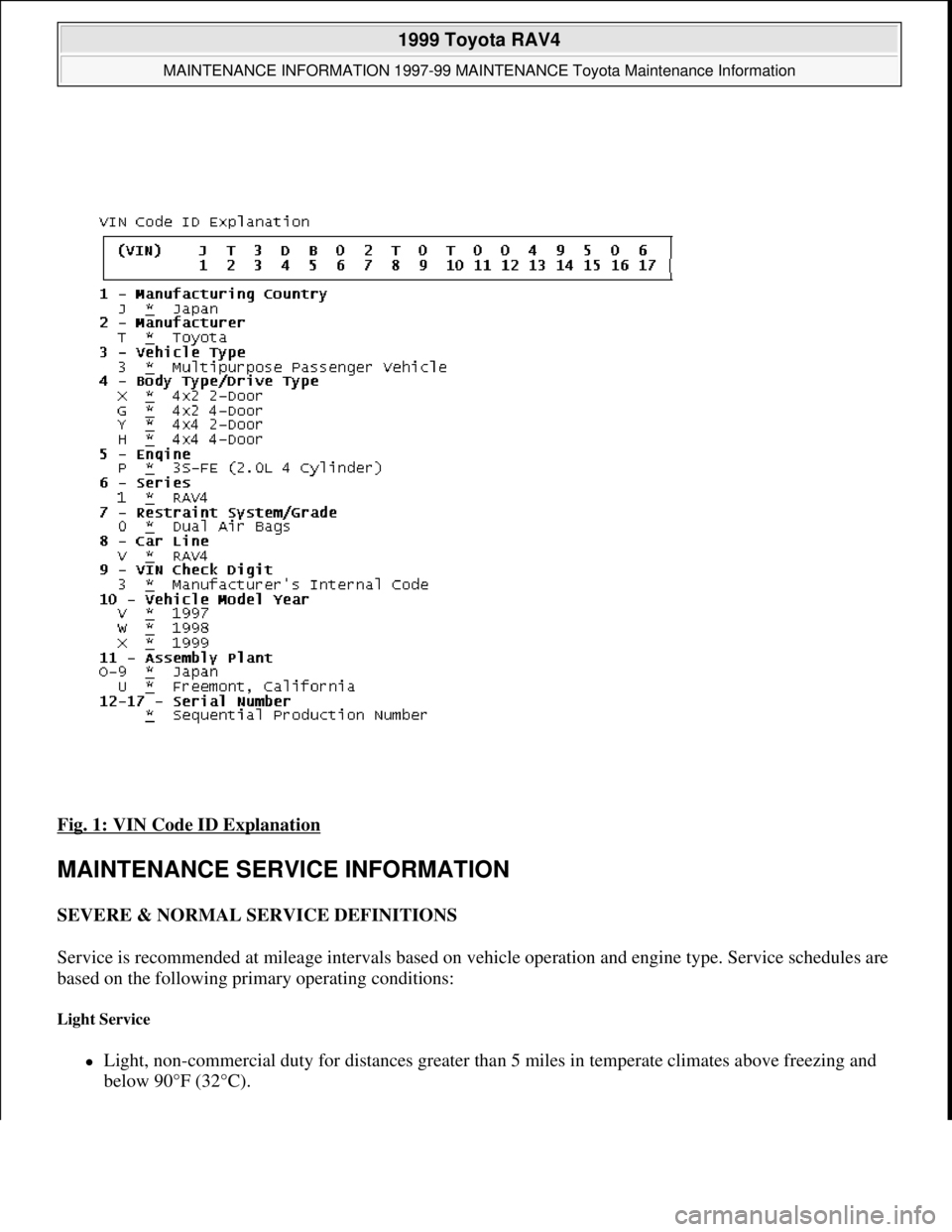
Fig. 1: VIN Code ID Explanation
MAINTENANCE SERVICE INFORMATION
SEVERE & NORMAL SERVICE DEFINITIONS
Service is recommended at mileage intervals based on vehicle operation and engine type. Service schedules are
based on the following primary operating conditions:
Light Service
Light, non-commercial duty for distances greater than 5 miles in temperate climates above freezing and
below 90°F (32°C).
1999 Toyota RAV4
MAINTENANCE INFORMATION 1997-99 MAINTENANCE Toyota Maintenance Information
Microsoft
Sunday, November 22, 2009 10:32:41 AMPage 2 © 2005 Mitchell Repair Information Company, LLC.
Page 945 of 1632
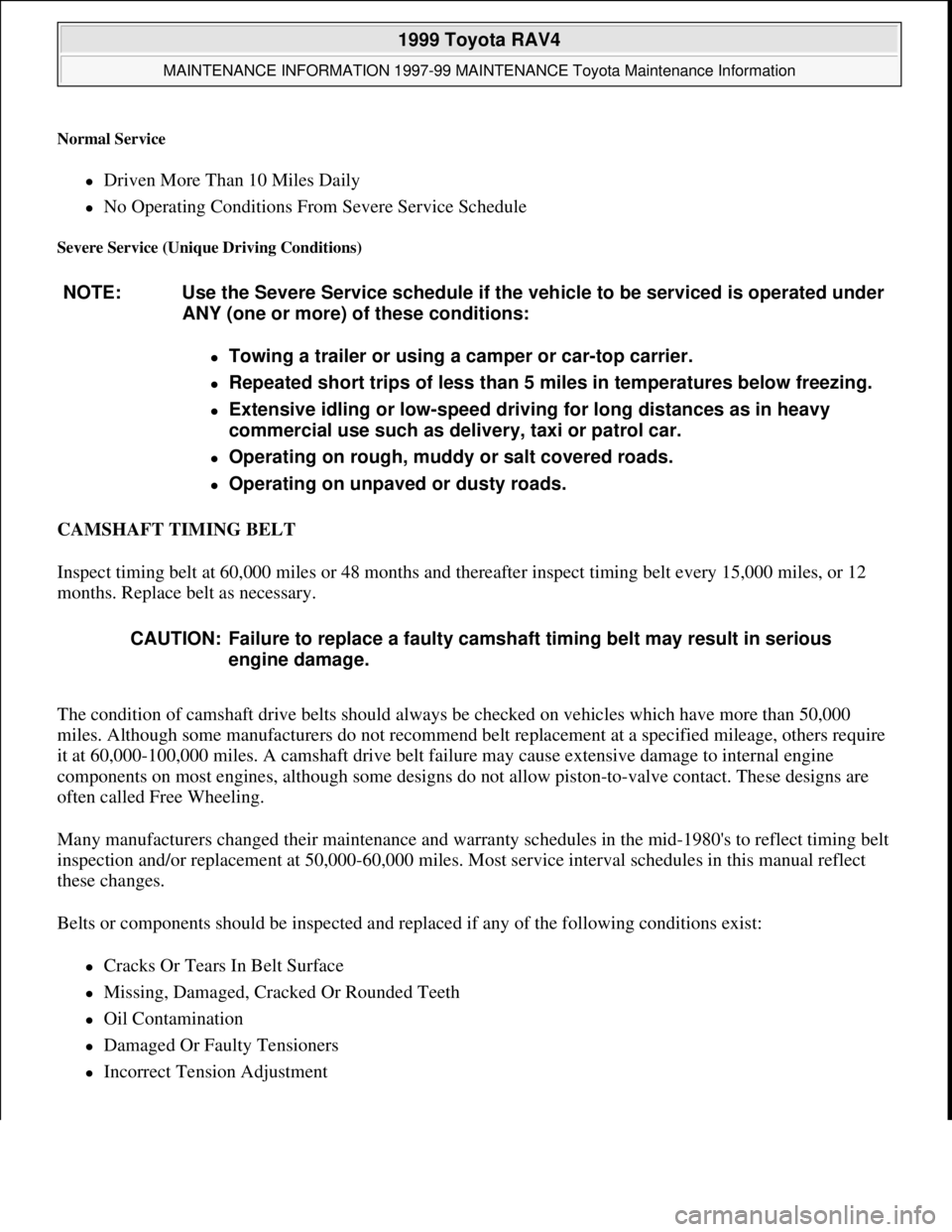
Normal Service
Driven More Than 10 Miles Daily
No Operating Conditions From Severe Service Schedule
Severe Service (Unique Driving Conditions)
CAMSHAFT TIMING BELT
Inspect timing belt at 60,000 miles or 48 months and thereafter inspect timing belt every 15,000 miles, or 12
months. Replace belt as necessary.
The condition of camshaft drive belts should always be checked on vehicles which have more than 50,000
miles. Although some manufacturers do not recommend belt replacement at a specified mileage, others require
it at 60,000-100,000 miles. A camshaft drive belt failure may cause extensive damage to internal engine
components on most engines, although some designs do not allow piston-to-valve contact. These designs are
often called Free Wheeling.
Many manufacturers changed their maintenance and warranty schedules in the mid-1980's to reflect timing belt
inspection and/or replacement at 50,000-60,000 miles. Most service interval schedules in this manual reflect
these changes.
Belts or components should be inspected and replaced if any of the following conditions exist:
Cracks Or Tears In Belt Surface
Missing, Damaged, Cracked Or Rounded Teeth
Oil Contamination
Damaged Or Faulty Tensioners
Incorrect Tension Adjustment NOTE: Use the Severe Service schedule if the vehicle to be serviced is operated under
ANY (one or more) of these conditions:
Towing a trailer or using a camper or car-top carrier.
Repeated short trips of less than 5 miles in temperatures below freezing.
Extensive idling or low-speed driving for long distances as in heavy
commercial use such as delivery, taxi or patrol car.
Operating on rough, muddy or salt covered roads.
Operating on unpaved or dusty roads.
CAUTION: Failure to replace a faulty camshaft timing belt may result in serious
engine damage.
1999 Toyota RAV4
MAINTENANCE INFORMATION 1997-99 MAINTENANCE Toyota Maintenance Information
Microsoft
Sunday, November 22, 2009 10:32:41 AMPage 3 © 2005 Mitchell Repair Information Company, LLC.
Page 948 of 1632
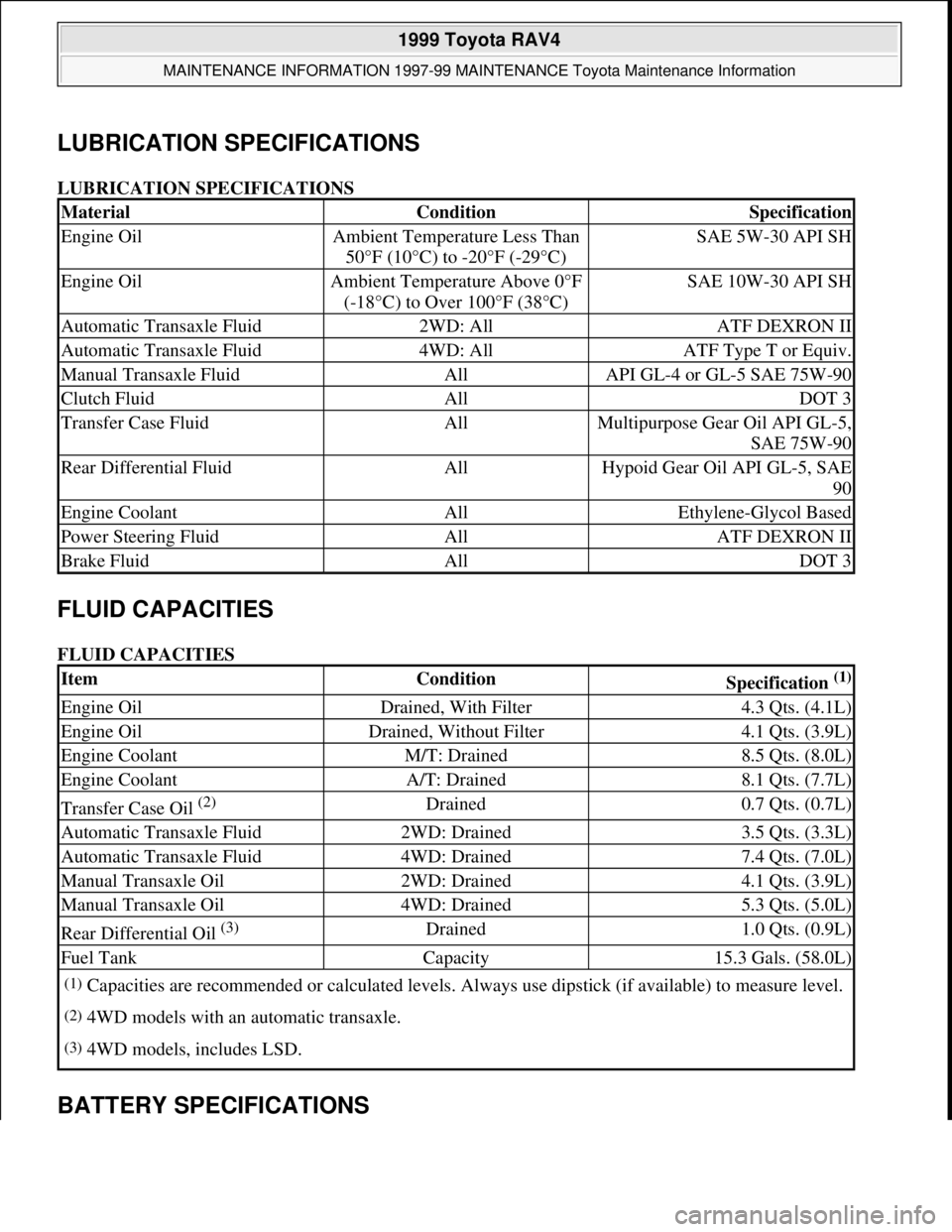
LUBRICATION SPECIFICATIONS
LUBRICATION SPECIFICATIONS
FLUID CAPACITIES
FLUID CAPACITIES
BATTERY SPECIFICATIONS
MaterialConditionSpecification
Engine OilAmbient Temperature Less Than
50°F (10°C) to -20°F (-29°C)SAE 5W-30 API SH
Engine OilAmbient Temperature Above 0°F
(-18°C) to Over 100°F (38°C)SAE 10W-30 API SH
Automatic Transaxle Fluid2WD: AllATF DEXRON II
Automatic Transaxle Fluid4WD: AllATF Type T or Equiv.
Manual Transaxle FluidAllAPI GL-4 or GL-5 SAE 75W-90
Clutch FluidAllDOT 3
Transfer Case FluidAllMultipurpose Gear Oil API GL-5,
SAE 75W-90
Rear Differential FluidAllHypoid Gear Oil API GL-5, SAE
90
Engine CoolantAllEthylene-Glycol Based
Power Steering FluidAllATF DEXRON II
Brake FluidAllDOT 3
ItemConditionSpecification (1)
Engine OilDrained, With Filter4.3 Qts. (4.1L)
Engine OilDrained, Without Filter4.1 Qts. (3.9L)
Engine CoolantM/T: Drained8.5 Qts. (8.0L)
Engine CoolantA/T: Drained8.1 Qts. (7.7L)
Transfer Case Oil (2) Drained0.7 Qts. (0.7L)
Automatic Transaxle Fluid2WD: Drained3.5 Qts. (3.3L)
Automatic Transaxle Fluid4WD: Drained7.4 Qts. (7.0L)
Manual Transaxle Oil2WD: Drained4.1 Qts. (3.9L)
Manual Transaxle Oil4WD: Drained5.3 Qts. (5.0L)
Rear Differential Oil (3) Drained1.0 Qts. (0.9L)
Fuel TankCapacity15.3 Gals. (58.0L)
(1)Capacities are recommended or calculated levels. Always use dipstick (if available) to measure level.
(2)4WD models with an automatic transaxle.
(3)4WD models, includes LSD.
1999 Toyota RAV4
MAINTENANCE INFORMATION 1997-99 MAINTENANCE Toyota Maintenance Information
Microsoft
Sunday, November 22, 2009 10:32:42 AMPage 6 © 2005 Mitchell Repair Information Company, LLC.
Page 949 of 1632
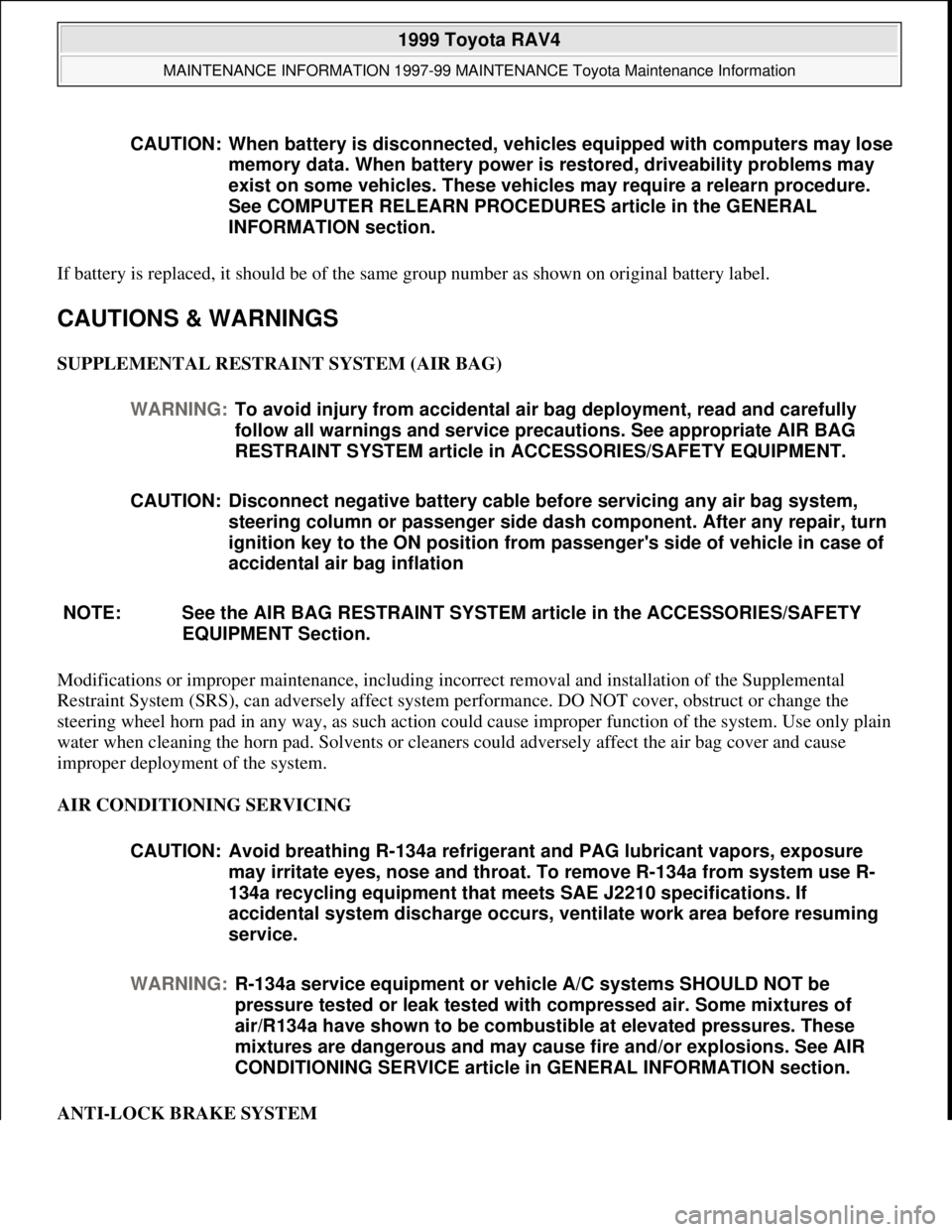
If battery is replaced, it should be of the same group number as shown on original battery label.
CAUTIONS & WARNINGS
SUPPLEMENTAL RESTRAINT SYSTEM (AIR BAG)
Modifications or improper maintenance, including incorrect removal and installation of the Supplemental
Restraint System (SRS), can adversely affect system performance. DO NOT cover, obstruct or change the
steering wheel horn pad in any way, as such action could cause improper function of the system. Use only plain
water when cleaning the horn pad. Solvents or cleaners could adversely affect the air bag cover and cause
improper deployment of the system.
AIR CONDITIONING SERVICING
ANTI-LOCK BRAKE SYSTEM CAUTION: When battery is disconnected, vehicles equipped with computers may lose
memory data. When battery power is restored, driveability problems may
exist on some vehicles. These vehicles may require a relearn procedure.
See COMPUTER RELEARN PROCEDURES article in the GENERAL
INFORMATION section.
WARNING:To avoid injury from accidental air bag deployment, read and carefully
follow all warnings and service precautions. See appropriate AIR BAG
RESTRAINT SYSTEM article in ACCESSORIES/SAFETY EQUIPMENT.
CAUTION: Disconnect negative battery cable before servicing any air bag system,
steering column or passenger side dash component. After any repair, turn
ignition key to the ON position from passenger's side of vehicle in case of
accidental air bag inflation
NOTE: See the AIR BAG RESTRAINT SYSTEM article in the ACCESSORIES/SAFETY
EQUIPMENT Section.
CAUTION: Avoid breathing R-134a refrigerant and PAG lubricant vapors, exposure
may irritate eyes, nose and throat. To remove R-134a from system use R-
134a recycling equipment that meets SAE J2210 specifications. If
accidental system discharge occurs, ventilate work area before resuming
service.
WARNING:R-134a service equipment or vehicle A/C systems SHOULD NOT be
pressure tested or leak tested with compressed air. Some mixtures of
air/R134a have shown to be combustible at elevated pressures. These
mixtures are dangerous and may cause fire and/or explosions. See AIR
CONDITIONING SERVICE article in GENERAL INFORMATION section.
1999 Toyota RAV4
MAINTENANCE INFORMATION 1997-99 MAINTENANCE Toyota Maintenance Information
Microsoft
Sunday, November 22, 2009 10:32:42 AMPage 7 © 2005 Mitchell Repair Information Company, LLC.