timing belt TOYOTA RAV4 1996 Service Service Manual
[x] Cancel search | Manufacturer: TOYOTA, Model Year: 1996, Model line: RAV4, Model: TOYOTA RAV4 1996Pages: 1632, PDF Size: 41.64 MB
Page 786 of 1632
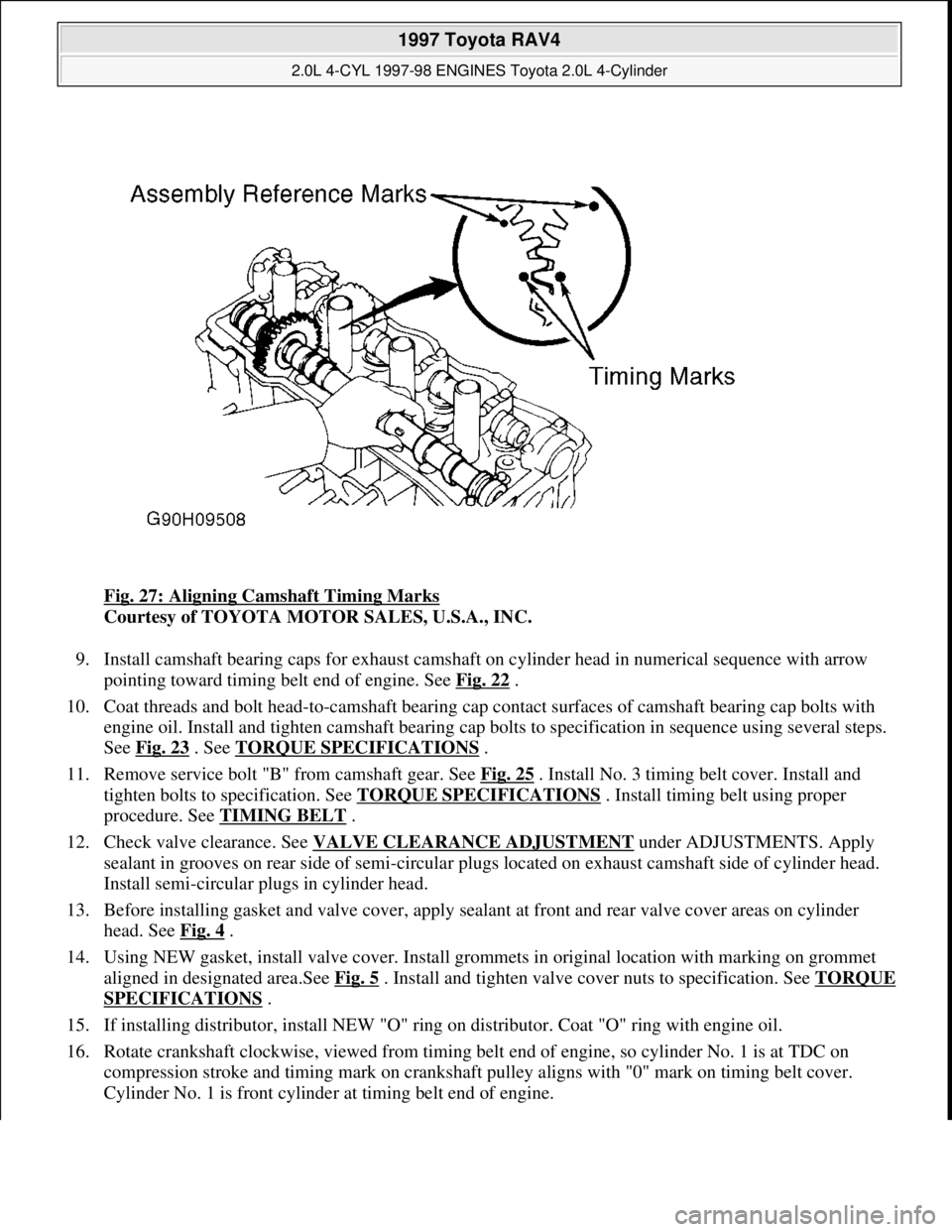
Fig. 27: Aligning Camshaft Timing Marks
Courtesy of TOYOTA MOTOR SALES, U.S.A., INC.
9. Install camshaft bearing caps for exhaust camshaft on cylinder head in numerical sequence with arrow
pointing toward timing belt end of engine. See Fig. 22
.
10. Coat threads and bolt head-to-camshaft bearing cap contact surfaces of camshaft bearing cap bolts with
engine oil. Install and tighten camshaft bearing cap bolts to specification in sequence using several steps.
See Fig. 23
. See TORQUE SPECIFICATIONS .
11. Remove service bolt "B" from camshaft gear. See Fig. 25
. Install No. 3 timing belt cover. Install and
tighten bolts to specification. See TORQUE SPECIFICATIONS
. Install timing belt using proper
procedure. See TIMING BELT
.
12. Check valve clearance. See VALVE CLEARANCE ADJUSTMENT
under ADJUSTMENTS. Apply
sealant in grooves on rear side of semi-circular plugs located on exhaust camshaft side of cylinder head.
Install semi-circular plugs in cylinder head.
13. Before installing gasket and valve cover, apply sealant at front and rear valve cover areas on cylinder
head. See Fig. 4
.
14. Using NEW gasket, install valve cover. Install grommets in original location with marking on grommet
aligned in designated area.See Fig. 5
. Install and tighten valve cover nuts to specification. See TORQUE
SPECIFICATIONS .
15. If installing distributor, install NEW "O" ring on distributor. Coat "O" ring with engine oil.
16. Rotate crankshaft clockwise, viewed from timing belt end of engine, so cylinder No. 1 is at TDC on
compression stroke and timing mark on crankshaft pulley aligns with "0" mark on timing belt cover.
C
ylinder No. 1 is front cylinder at timing belt end of engine.
1997 Toyota RAV4
2.0L 4-CYL 1997-98 ENGINES Toyota 2.0L 4-Cylinder
Microsoft
Sunday, November 22, 2009 10:23:31 AMPage 38 © 2005 Mitchell Repair Information Company, LLC.
Page 787 of 1632
17. Ensure slot area on intake camshaft is vertically positioned. Rotate coupling on distributor so cutout
aligns with alignment mark on distributor housing. See Fig. 16
.
18. Install distributor so center of flange on distributor is aligned with bolt hole on cylinder head. Install
distributor hold-down bolt(s). Adjust ignition timing.
CRANKSHAFT REAR OIL SEAL
Removal
Remove transaxle, clutch assembly (if equipped) and flywheel/drive plate. Using a knife, cut seal lip from oil
seal. Pry oil seal from rear seal housing. DO NOT damage sealing surfaces.
Installation
1. Ensure all sealing surfaces are clean. Apply grease to seal lip of NEW oil seal. Using Oil Seal Installer
(SST 09223-15030), install oil seal in rear seal housing until oil seal is even with surface of rear seal
housing.
2. Apply Loctite to flywheel/drive plate bolts. Install flywheel/drive plate. Install bolts and tighten to
specification using a crisscross pattern. See TORQUE SPECIFICATIONS
. To install remaining
components, reverse removal procedure.
WATER PUMP
Removal
1. Disconnect negative battery cable. Drain cooling system. Remove timing belt and idler pulley(s) as
needed for access to water pump. See TIMING BELT
.
2. Disconnect lower radiator hose from thermostat housing. Remove generator adjusting bracket. Remove
coolant by-pass pipe-to-water pump nuts. See Fig. 28
.
3. Remove water pump bolts in sequence. See Fig. 29
. Remove water pump, water pump cover and "O"
rings. See Fig. 28
. Remove water pump-to-water pump cover bolts. Remove water pump and gasket
from water pump cover. NOTE: On 4WD models, manufacturer recommends removing engine with transaxle for
transaxle removal. On 2WD models, transaxle may be removed with engine in
vehicle.
1997 Toyota RAV4
2.0L 4-CYL 1997-98 ENGINES Toyota 2.0L 4-Cylinder
Microsoft
Sunday, November 22, 2009 10:23:31 AMPage 39 © 2005 Mitchell Repair Information Company, LLC.
Page 793 of 1632
Piston & Rod Assembly (1997)
1. Ensure connecting rod and connecting rod cap are marked with matching cylinder number for reassembly
reference. Piston, connecting rod and connecting rod must be installed with front mark toward timing belt
end of engine. See Fig. 31
.
2. Before disassembling piston and connecting rod, try to move piston back and forth on piston pin. Replace
piston and piston pin if any movement is felt.
3. When removing piston from connecting rod, remove snap rings from piston. Heat piston to 176-194°F
(80-90°C) in water. Remove piston pin. Separate piston from connecting rod.
4. Ensure piston pin diameter is within specification. See PISTONS, PINS & RINGS
under ENGINE
SPECIFICATIONS. Ensure connecting rod bend, twist and piston pin bushing bore diameter are within
specification. See CONNECTING RODS
under ENGINE SPECIFICATIONS.
5. Bushing in connecting rod may be replaced if bore diameter is not within specification. Ensure bushing
oil hole aligns with connecting rod oil hole. Bushing must be honed to obtain correct piston pin-to-rod
clearance. See PISTONS, PINS & RINGS
under ENGINE SPECIFICATIONS.
6. Ensure nut rotates easily on connecting rod bolt. If nut fails to rotate easily, use caliper to measure
connecting rod bolt outside diameter at .59" (15.0 mm) from end of bolt. Standard connecting rod bolt
outside diameter is .3094-.3150" (7.860-8.000 mm). Replace connecting rod bolt and nut assembly if bolt
outside diameter is less than .2992" (7.600 mm).
7. Different diameter pistons are used. Piston diameter may be identified by size mark ("1", "2" or "3")
stamped on top of piston. See Fig. 32
.
8. To determine piston diameter, measure piston skirt diameter 1.024" (26.00 mm) from top of piston at 90-
degree angle to piston pin. Ensure piston diameter is within specification. See PISTONS, PINS &
RINGS under ENGINE SPECIFICATIONS.
9. To reassemble, position piston and connecting rod so front mark (cavity) on top of piston aligns with
front mark (protrusion) on connecting rod. See Fig. 31
.
10. Install one NEW snap ring in piston. Heat piston to about 176-194°F (80-90°C) in hot water. Coat piston
pin with engine oil. Install piston pin into piston and connecting rod using thumb pressure. Install
remaining NEW snap ring. NOTE: With piston at 140°F (60°C), piston pin should be able to be pressed into
piston using thumb pressure.
1997 Toyota RAV4
2.0L 4-CYL 1997-98 ENGINES Toyota 2.0L 4-Cylinder
Microsoft
Sunday, November 22, 2009 10:23:31 AMPage 45 © 2005 Mitchell Repair Information Company, LLC.
Page 795 of 1632
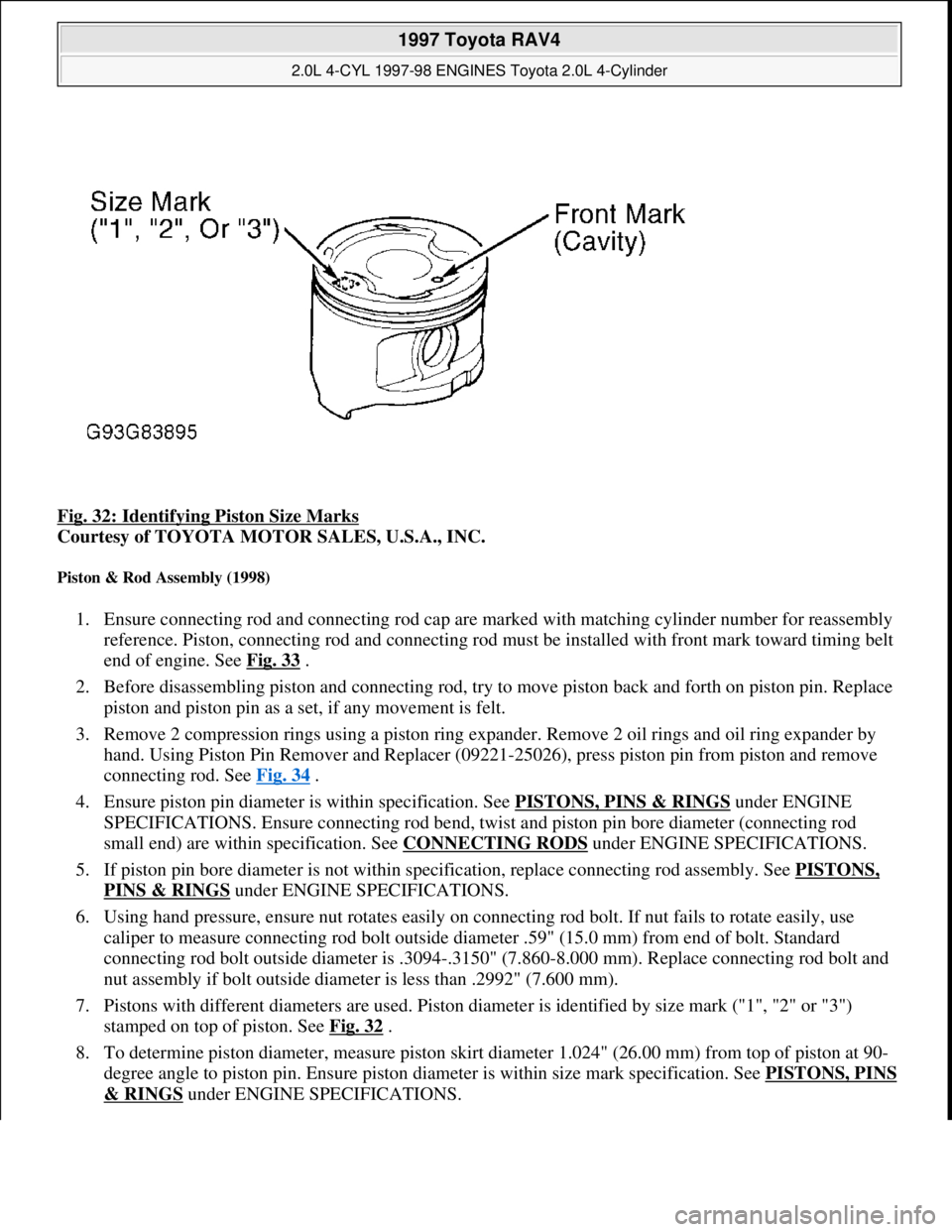
Fig. 32: Identifying Piston Size Marks
Courtesy of TOYOTA MOTOR SALES, U.S.A., INC.
Piston & Rod Assembly (1998)
1. Ensure connecting rod and connecting rod cap are marked with matching cylinder number for reassembly
reference. Piston, connecting rod and connecting rod must be installed with front mark toward timing belt
end of engine. See Fig. 33
.
2. Before disassembling piston and connecting rod, try to move piston back and forth on piston pin. Replace
piston and piston pin as a set, if any movement is felt.
3. Remove 2 compression rings using a piston ring expander. Remove 2 oil rings and oil ring expander by
hand. Using Piston Pin Remover and Replacer (09221-25026), press piston pin from piston and remove
connecting rod. See Fig. 34
.
4. Ensure piston pin diameter is within specification. See PISTONS, PINS & RINGS
under ENGINE
SPECIFICATIONS. Ensure connecting rod bend, twist and piston pin bore diameter (connecting rod
small end) are within specification. See CONNECTING RODS
under ENGINE SPECIFICATIONS.
5. If piston pin bore diameter is not within specification, replace connecting rod assembly. See PISTONS,
PINS & RINGS under ENGINE SPECIFICATIONS.
6. Using hand pressure, ensure nut rotates easily on connecting rod bolt. If nut fails to rotate easily, use
caliper to measure connecting rod bolt outside diameter .59" (15.0 mm) from end of bolt. Standard
connecting rod bolt outside diameter is .3094-.3150" (7.860-8.000 mm). Replace connecting rod bolt and
nut assembly if bolt outside diameter is less than .2992" (7.600 mm).
7. Pistons with different diameters are used. Piston diameter is identified by size mark ("1", "2" or "3")
stamped on top of piston. See Fig. 32
.
8. To determine piston diameter, measure piston skirt diameter 1.024" (26.00 mm) from top of piston at 90-
degree angle to piston pin. Ensure piston diameter is within size mark specification. See PISTONS, PINS
& RINGS under ENGINE SPECIFICATIONS.
1997 Toyota RAV4
2.0L 4-CYL 1997-98 ENGINES Toyota 2.0L 4-Cylinder
Microsoft
Sunday, November 22, 2009 10:23:31 AMPage 47 © 2005 Mitchell Repair Information Company, LLC.
Page 799 of 1632
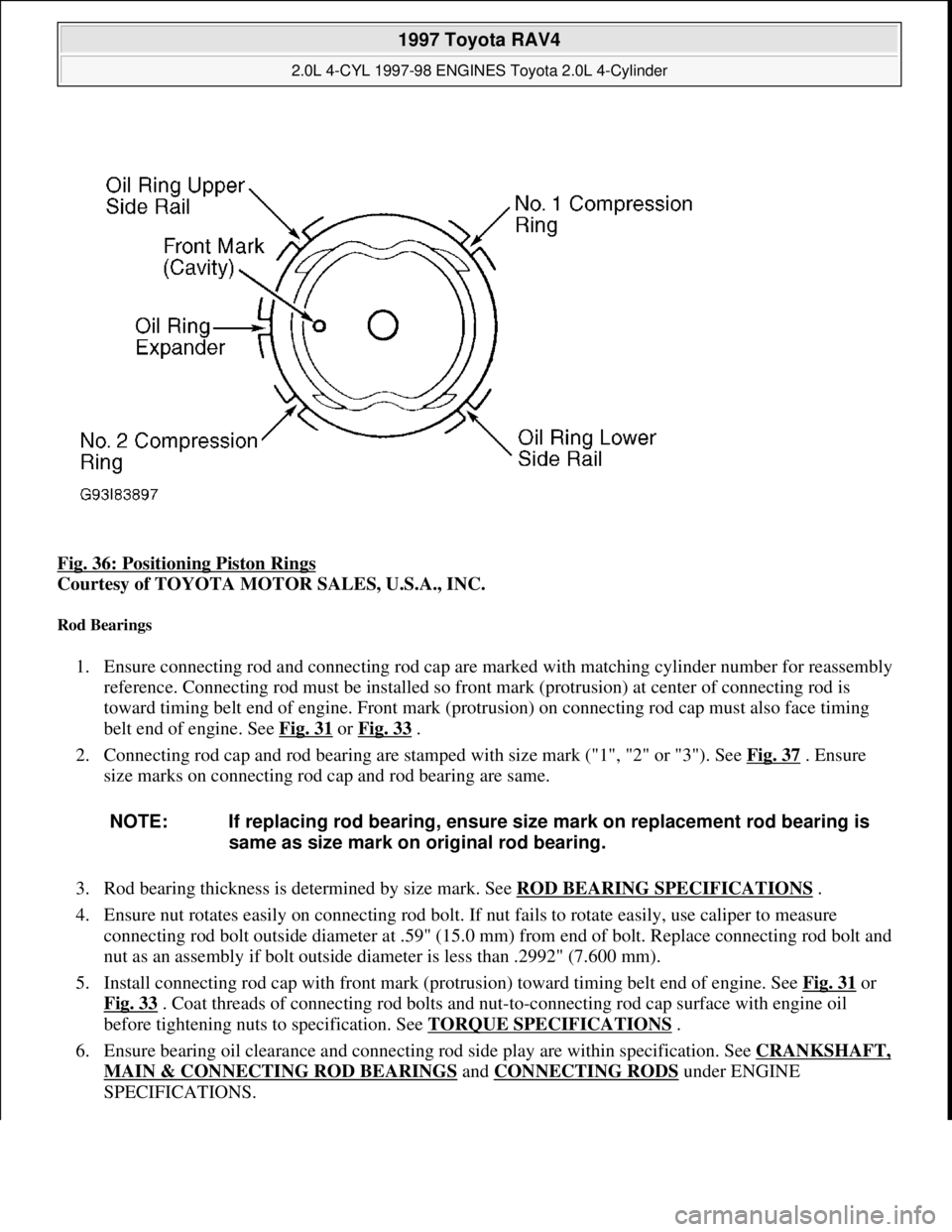
Fig. 36: Positioning Piston Rings
Courtesy of TOYOTA MOTOR SALES, U.S.A., INC.
Rod Bearings
1. Ensure connecting rod and connecting rod cap are marked with matching cylinder number for reassembly
reference. Connecting rod must be installed so front mark (protrusion) at center of connecting rod is
toward timing belt end of engine. Front mark (protrusion) on connecting rod cap must also face timing
belt end of engine. See Fig. 31
or Fig. 33 .
2. Connecting rod cap and rod bearing are stamped with size mark ("1", "2" or "3"). See Fig. 37
. Ensure
size marks on connecting rod cap and rod bearing are same.
3. Rod bearing thickness is determined by size mark. See ROD BEARING SPECIFICATIONS
.
4. Ensure nut rotates easily on connecting rod bolt. If nut fails to rotate easily, use caliper to measure
connecting rod bolt outside diameter at .59" (15.0 mm) from end of bolt. Replace connecting rod bolt and
nut as an assembly if bolt outside diameter is less than .2992" (7.600 mm).
5. Install connecting rod cap with front mark (protrusion) toward timing belt end of engine. See Fig. 31
or
Fig. 33
. Coat threads of connecting rod bolts and nut-to-connecting rod cap surface with engine oil
before tightening nuts to specification. See TORQUE SPECIFICATIONS
.
6. Ensure bearing oil clearance and connecting rod side play are within specification. See CRANKSHAFT,
MAIN & CONNECTING ROD BEARINGS and CONNECTING RODS under ENGINE
SPECIFICATIONS.
NOTE: If replacing rod bearing, ensure size mark on replacement rod bearing is
same as size mark on original rod bearing.
1997 Toyota RAV4
2.0L 4-CYL 1997-98 ENGINES Toyota 2.0L 4-Cylinder
Microsoft
Sunday, November 22, 2009 10:23:31 AMPage 51 © 2005 Mitchell Repair Information Company, LLC.
Page 800 of 1632
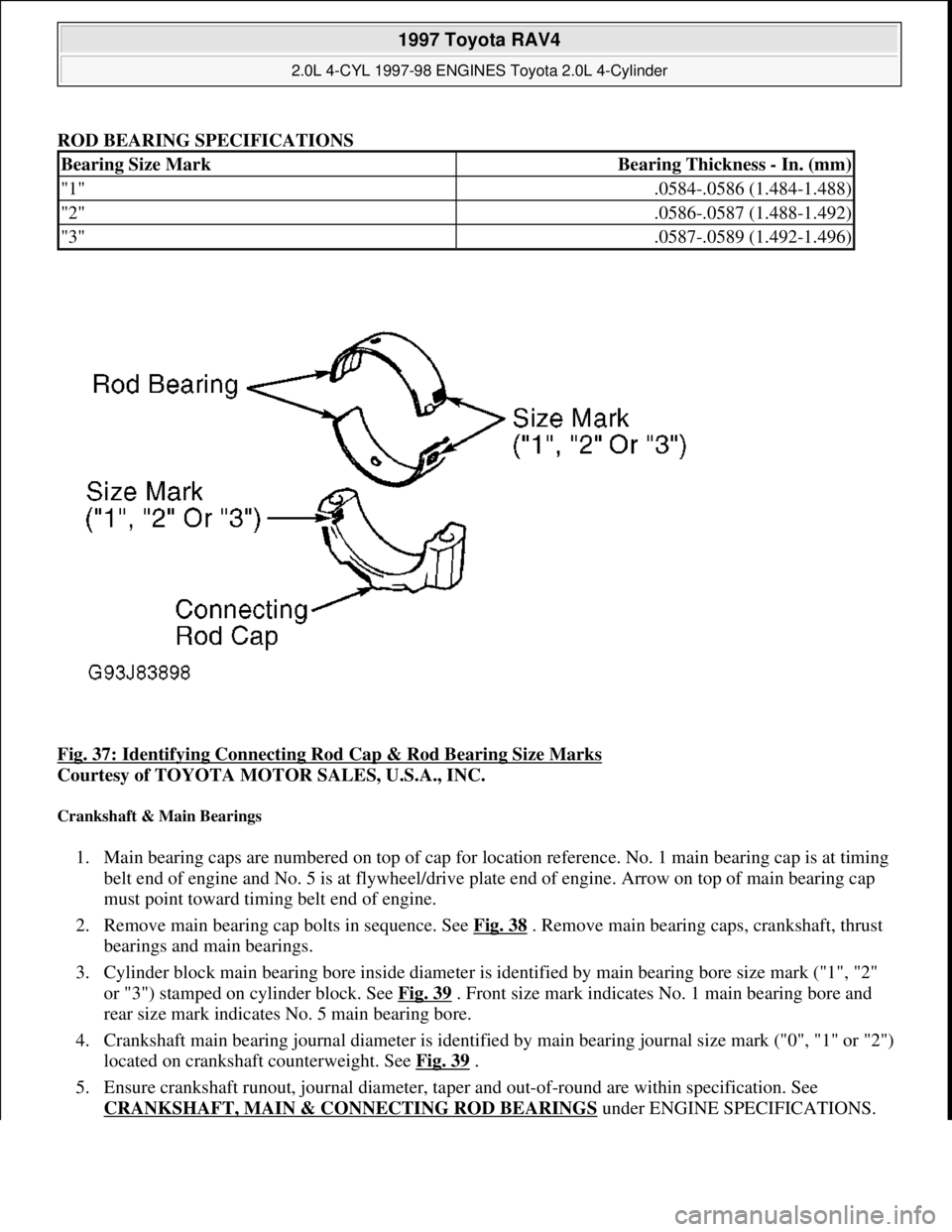
ROD BEARING SPECIFICATIONS
Fig. 37: Identifying Connecting Rod Cap & Rod Bearing Size Marks
Courtesy of TOYOTA MOTOR SALES, U.S.A., INC.
Crankshaft & Main Bearings
1. Main bearing caps are numbered on top of cap for location reference. No. 1 main bearing cap is at timing
belt end of engine and No. 5 is at flywheel/drive plate end of engine. Arrow on top of main bearing cap
must point toward timing belt end of engine.
2. Remove main bearing cap bolts in sequence. See Fig. 38
. Remove main bearing caps, crankshaft, thrust
bearings and main bearings.
3. Cylinder block main bearing bore inside diameter is identified by main bearing bore size mark ("1", "2"
or "3") stamped on cylinder block. See Fig. 39
. Front size mark indicates No. 1 main bearing bore and
rear size mark indicates No. 5 main bearing bore.
4. Crankshaft main bearing journal diameter is identified by main bearing journal size mark ("0", "1" or "2")
located on crankshaft counterweight. See Fig. 39
.
5. Ensure crankshaft runout, journal diameter, taper and out-of-round are within specification. See
CRANKSHAFT, MAIN & CONNECTING ROD BEARINGS
under ENGINE SPECIFICATIONS.
Bearing Size MarkBearing Thickness - In. (mm)
"1".0584-.0586 (1.484-1.488)
"2".0586-.0587 (1.488-1.492)
"3".0587-.0589 (1.492-1.496)
1997 Toyota RAV4
2.0L 4-CYL 1997-98 ENGINES Toyota 2.0L 4-Cylinder
Microsoft
Sunday, November 22, 2009 10:23:31 AMPage 52 © 2005 Mitchell Repair Information Company, LLC.
Page 801 of 1632
6. Main bearing size mark ("1", "2", "3", "4" or "5") is located on side of main bearing. See Fig. 39 . If
replacing main bearing, ensure size mark on replacement main bearing is same as size mark on original
main bearing.
7. If main bearing size mark cannot be obtained, add size marks on cylinder block and crankshaft to
determine size mark of main bearing to be used. For example, if size mark on cylinder block is "2" and
size mark on crankshaft is "1", use main bearing with size mark "3".
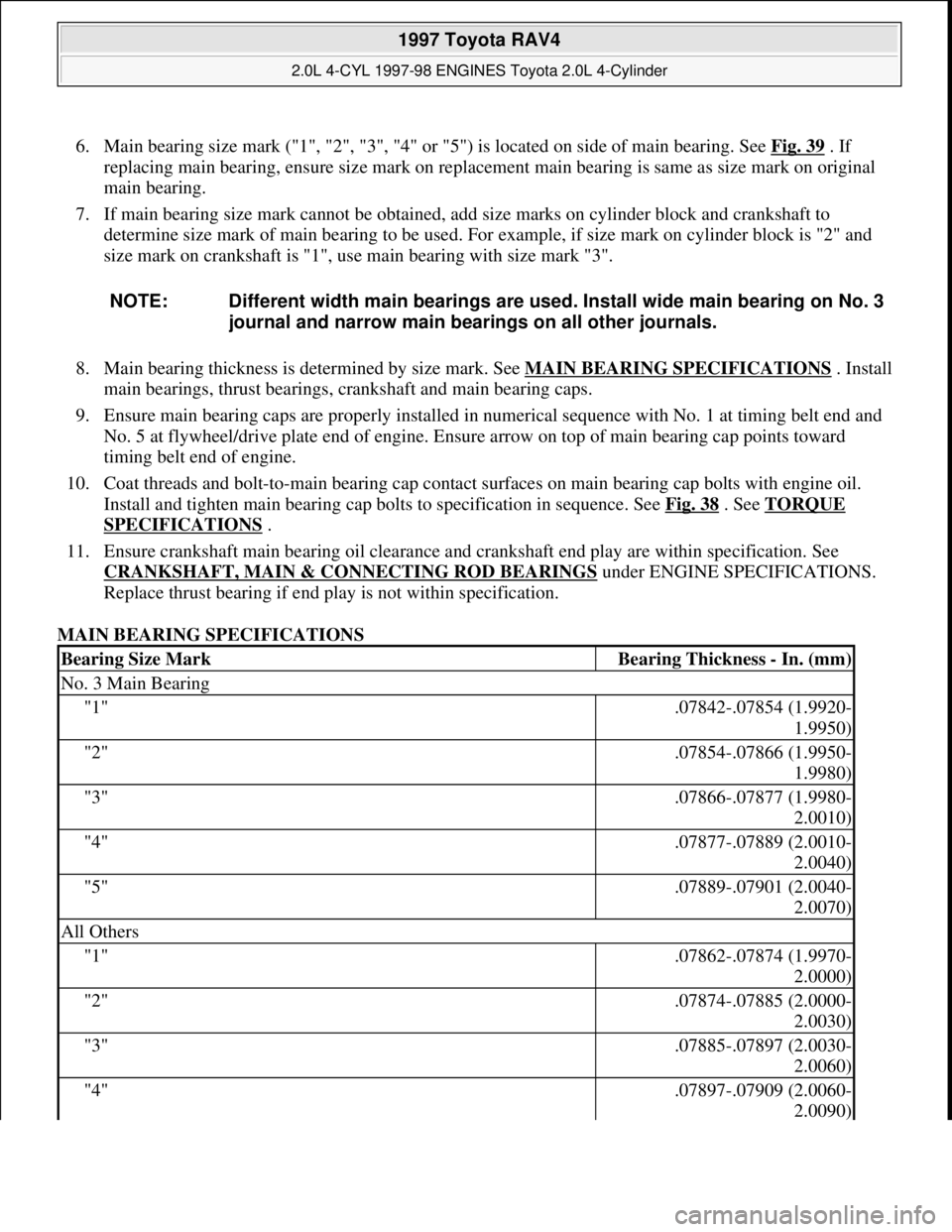
8. Main bearing thickness is determined by size mark. See MAIN BEARING SPECIFICATIONS
. Install
main bearings, thrust bearings, crankshaft and main bearing caps.
9. Ensure main bearing caps are properly installed in numerical sequence with No. 1 at timing belt end and
No. 5 at flywheel/drive plate end of engine. Ensure arrow on top of main bearing cap points toward
timing belt end of engine.
10. Coat threads and bolt-to-main bearing cap contact surfaces on main bearing cap bolts with engine oil.
Install and tighten main bearing cap bolts to specification in sequence. See Fig. 38
. See TORQUE
SPECIFICATIONS .
11. Ensure crankshaft main bearing oil clearance and crankshaft end play are within specification. See
CRANKSHAFT, MAIN & CONNECTING ROD BEARINGS
under ENGINE SPECIFICATIONS.
Replace thrust bearing if end play is not within specification.
MAIN BEARING SPECIFICATIONS NOTE: Different width main bearings are used. Install wide main bearing on No. 3
journal and narrow main bearings on all other journals.
Bearing Size MarkBearing Thickness - In. (mm)
No. 3 Main Bearing
"1".07842-.07854 (1.9920-
1.9950)
"2".07854-.07866 (1.9950-
1.9980)
"3".07866-.07877 (1.9980-
2.0010)
"4".07877-.07889 (2.0010-
2.0040)
"5".07889-.07901 (2.0040-
2.0070)
All Others
"1".07862-.07874 (1.9970-
2.0000)
"2".07874-.07885 (2.0000-
2.0030)
"3".07885-.07897 (2.0030-
2.0060)
"4".07897-.07909 (2.0060-
2.0090)
1997 Toyota RAV4
2.0L 4-CYL 1997-98 ENGINES Toyota 2.0L 4-Cylinder
Microsoft
Sunday, November 22, 2009 10:23:31 AMPage 53 © 2005 Mitchell Repair Information Company, LLC.
Page 805 of 1632
CRANKSHAFT, MAIN & CONNECTING ROD BEARINGSunder ENGINE SPECIFICATIONS.
Cylinder Block
1. Inspect cylinder block deck surface warpage. Replace cylinder block if deck warpage exceeds
specification. See CYLINDER BLOCK
under ENGINE SPECIFICATIONS.
2. Different cylinder bore diameters are used. Cylinder bore diameter may be identified by size mark ("1",
"2" or "3") on cylinder block deck surface. See Fig. 39
.
3. Measure cylinder bore diameter at 2 different places, 90 degrees apart at .39" (10.0 mm) from top and
bottom of cylinder bore and at center of cylinder bore. Ensure cylinder bore diameter is within
specification. See CYLINDER BLOCK
under ENGINE SPECIFICATIONS.
4. Bore cylinder block for oversize pistons if cylinder bore diameter is not within specification. Pistons are
available in .020" (.50 mm) oversize.
5. Install main bearing caps in numerical sequence with No. 1 at timing belt end and No. 5 at flywheel/drive
plate end of engine. Ensure arrow on top of main bearing cap points toward timing belt end of engine.
6. Install and tighten main bearing cap bolts to specification in sequence. See Fig. 38
. See TORQUE
SPECIFICATIONS .
7. Ensure main bearing bore inside diameter is within specification. See CYLINDER BLOCK
under
ENGINE SPECIFICATIONS.
ENGINE OILING
ENGINE LUBRICATION SYSTEM
Crankshaft driven oil pump provides pressurized engine lubrication. Oil cooler is installed between oil filter and
cylinder block.
Crankcase Capacity
On 1997 models, drain and refill capacity with oil filter is approximately 4.1 qts. (3.9L). Dry fill capacity is
approximately 4.7 qts. (4.4L). On 1998 models, drain and refill capacity with oil filter is approximately 4.3 qts.
(4.1L). Dry fill capacity is approximately 4.8 qts. (4.6L).
Oil Pressure
With engine at normal operating temperature, oil pressure should be at least 4.3 psi (0.3 kg/cm2 ) at idle and 36-
71 psi (2.5-5.0 kg/cm
2 ) at 3000 RPM.
OIL PUMP
Removal & Disassembly
NOTE: Main bearing bore inside diameter is identified by main bearing bore size mark
("1", "2" or "3") stamped on cylinder block. See Fig. 39
.
1997 Toyota RAV4
2.0L 4-CYL 1997-98 ENGINES Toyota 2.0L 4-Cylinder
Microsoft
Sunday, November 22, 2009 10:23:31 AMPage 57 © 2005 Mitchell Repair Information Company, LLC.
Page 806 of 1632
1. Remove timing belt, No. 2 idler pulley, crankshaft sprocket and oil pump sprocket. See TIMING BELT
under REMOVAL & INSTALLATION. Remove oil pan. See OIL PAN under REMOVAL &
INSTALLATION.
2. Remove oil pump pick-up tube, gasket and oil baffle plate. Disconnect electrical connector for crankshaft
position sensor located on from of oil pump housing. Remove bolt and crankshaft position sensor from
front of oil pump housing.
3. Remove oil pump-to-cylinder block bolts. Using soft-faced hammer, tap oil pump housing from cylinder
block. To disassemble oil pump, remove oil pump body cover bolts, oil pump body cover and "O" ring.
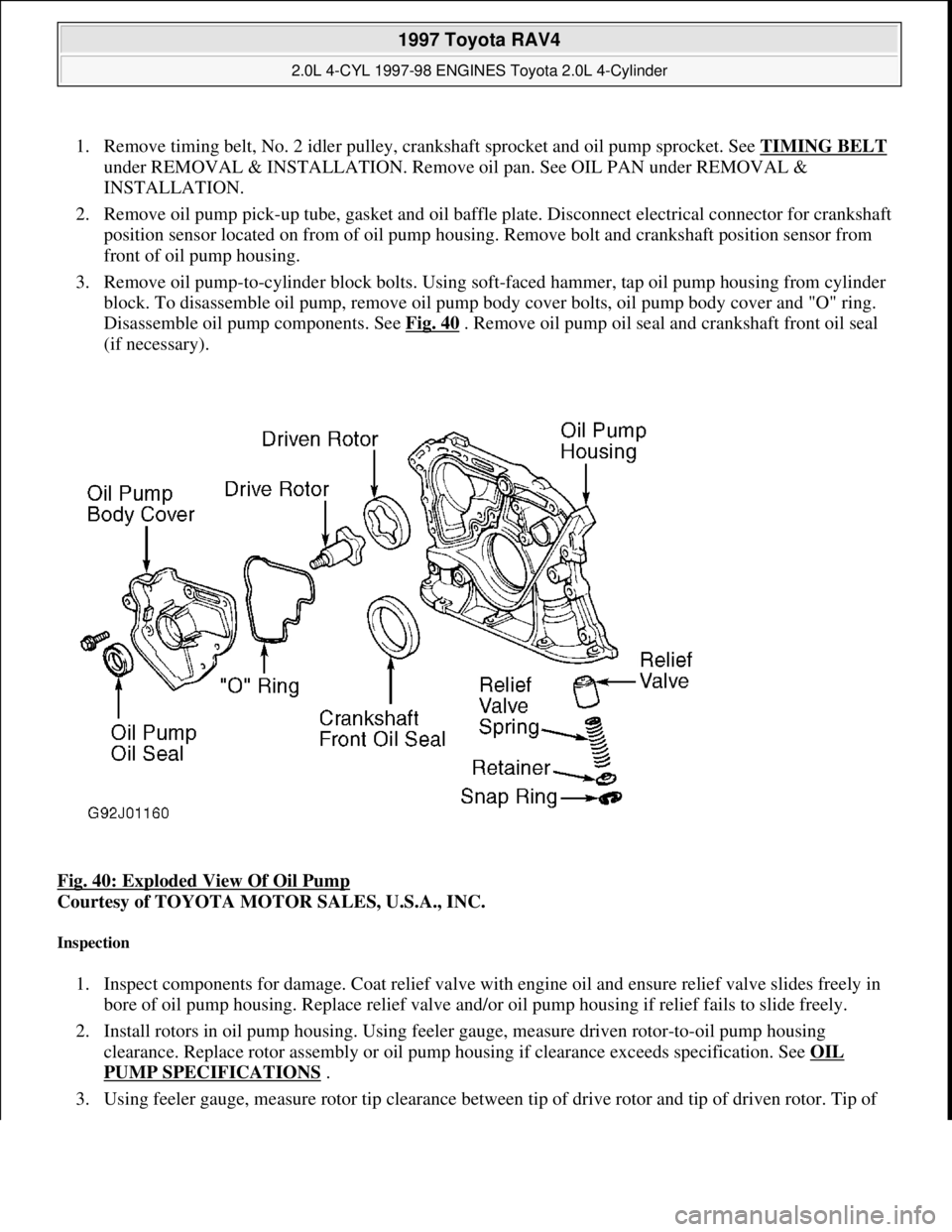
Disassemble oil pump components. See Fig. 40
. Remove oil pump oil seal and crankshaft front oil seal
(if necessary).
Fig. 40: Exploded View Of Oil Pump
Courtesy of TOYOTA MOTOR SALES, U.S.A., INC.
Inspection
1. Inspect components for damage. Coat relief valve with engine oil and ensure relief valve slides freely in
bore of oil pump housing. Replace relief valve and/or oil pump housing if relief fails to slide freely.
2. Install rotors in oil pump housing. Using feeler gauge, measure driven rotor-to-oil pump housing
clearance. Replace rotor assembly or oil pump housing if clearance exceeds specification. See OIL
PUMP SPECIFICATIONS .
3. Usin
g feeler gauge, measure rotor tip clearance between tip of drive rotor and tip of driven rotor. Tip of
1997 Toyota RAV4
2.0L 4-CYL 1997-98 ENGINES Toyota 2.0L 4-Cylinder
Microsoft
Sunday, November 22, 2009 10:23:31 AMPage 58 © 2005 Mitchell Repair Information Company, LLC.
Page 809 of 1632
Distributor Hold-Down Bolt14 (19)
Drive Shaft Center Support Bearing Bolt
4WD Models27 (37)
Drive Shaft Flange Bolt/Nut
4WD Models54 (73)
EGR Valve
Nut(3)
Union Nut43 (58)
Engine Mounts & Brackets
Front (Exhaust Manifold Side) Engine Mount-To-Engine Mount
Crossmember Bolt59 (80)
Left (Transaxle Side) Engine Mounting Bracket-To-Engine Mount
Bolt/Nut47 (64)
Right (Timing Belt Side) Engine Mounting Bracket-To-Cylinder Block
Bolt38 (52)
Right (Timing Belt Side) Engine Mount-To-Body Bolt47 (64)
Right (Timing Belt Side) Engine Mounting Bracket-To-Engine Mount Bolt/Nut
Bolt27 (37)
Nut38 (52)
Engine Mount Crossmember-To-Body Bolt26 (35)
Engine Mount Crossmember-To-Front Suspension Crossmember Nut82 (111)
Exhaust Manifold Nut36 (49)
Flywheel/Drive Plate Bolt
A/T61 (83)
M/T65 (88)
Front Catalytic Converter Brace Bolt/Nut31 (42)
Front Catalytic Converter-To-Exhaust Manifold Bolt/Nut21 (29)
Front Exhaust Pipe-To-Front Catalytic Converter Nut46 (62)
Front Exhaust Pipe-To-Rear Exhaust Pipe Bolt/Nut35 (47)
Front Suspension Crossmember Bolt
Bolt At Body152 (206)
Bolt At Lower Control Arm101 (137)
Fuel Line-To-Fuel Filter Union Bolt21 (29)
Fuel Pipe-To-Delivery Pipe Union Bolt25 (34)
Generator Adjusting Bracket Bolt20 (27)
Generator Mounting Bracket Bolt31 (42)
Intake Manifold Bolt/Nut14 (19)
Intake Manifold Brace Bolt31 (42)
Main Bearing Cap Bolt (4) 43 (58)
No. 1 Idler Pulley Bolt31 (42)
No. 2 Idler Pulley Bolt31 (42)
1997 Toyota RAV4
2.0L 4-CYL 1997-98 ENGINES Toyota 2.0L 4-Cylinder
Microsoft
Sunday, November 22, 2009 10:23:31 AMPage 61 © 2005 Mitchell Repair Information Company, LLC.