ECO mode TOYOTA RAV4 1996 Service Repair Manual
[x] Cancel search | Manufacturer: TOYOTA, Model Year: 1996, Model line: RAV4, Model: TOYOTA RAV4 1996Pages: 1632, PDF Size: 41.64 MB
Page 4 of 1632
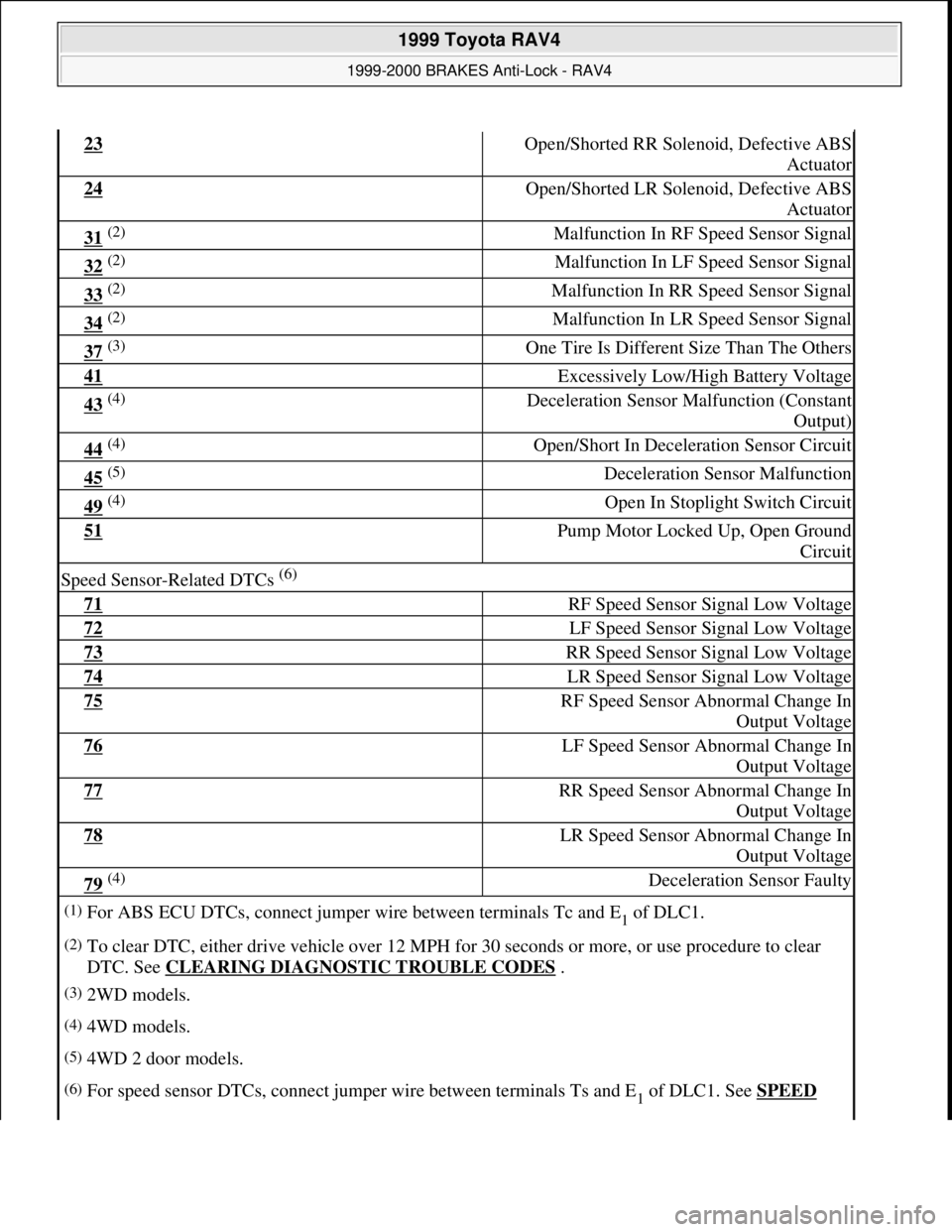
23 Open/Shorted RR Solenoid, Defective ABS
Actuator
24 Open/Shorted LR Solenoid, Defective ABS
Actuator
31 (2) Malfunction In RF Speed Sensor Signal
32 (2) Malfunction In LF Speed Sensor Signal
33 (2) Malfunction In RR Speed Sensor Signal
34 (2) Malfunction In LR Speed Sensor Signal
37 (3) One Tire Is Different Size Than The Others
41 Excessively Low/High Battery Voltage
43 (4) Deceleration Sensor Malfunction (Constant
Output)
44 (4) Open/Short In Deceleration Sensor Circuit
45 (5) Deceleration Sensor Malfunction
49 (4) Open In Stoplight Switch Circuit
51 Pump Motor Locked Up, Open Ground
Circuit
Speed Sensor-Related DTCs (6)
71 RF Speed Sensor Signal Low Voltage
72 LF Speed Sensor Signal Low Voltage
73 RR Speed Sensor Signal Low Voltage
74 LR Speed Sensor Signal Low Voltage
75 RF Speed Sensor Abnormal Change In
Output Voltage
76 LF Speed Sensor Abnormal Change In
Output Voltage
77 RR Speed Sensor Abnormal Change In
Output Voltage
78 LR Speed Sensor Abnormal Change In
Output Voltage
79 (4) Deceleration Sensor Faulty
(1)For ABS ECU DTCs, connect jumper wire between terminals Tc and E1 of DLC1.
(2)To clear DTC, either drive vehicle over 12 MPH for 30 seconds or more, or use procedure to clear
DTC. See CLEARING DIAGNOSTIC TROUBLE CODES
.
(3)2WD models.
(4)4WD models.
(5)4WD 2 door models.
(6)For speed sensor DTCs, connect jumper wire between terminals Ts and E1 of DLC1. See SPEED
1999 Toyota RAV4
1999-2000 BRAKES Anti-Lock - RAV4
Microsoft
Sunday, November 22, 2009 10:06:17 AMPage 4 © 2005 Mitchell Repair Information Company, LLC.
Page 16 of 1632
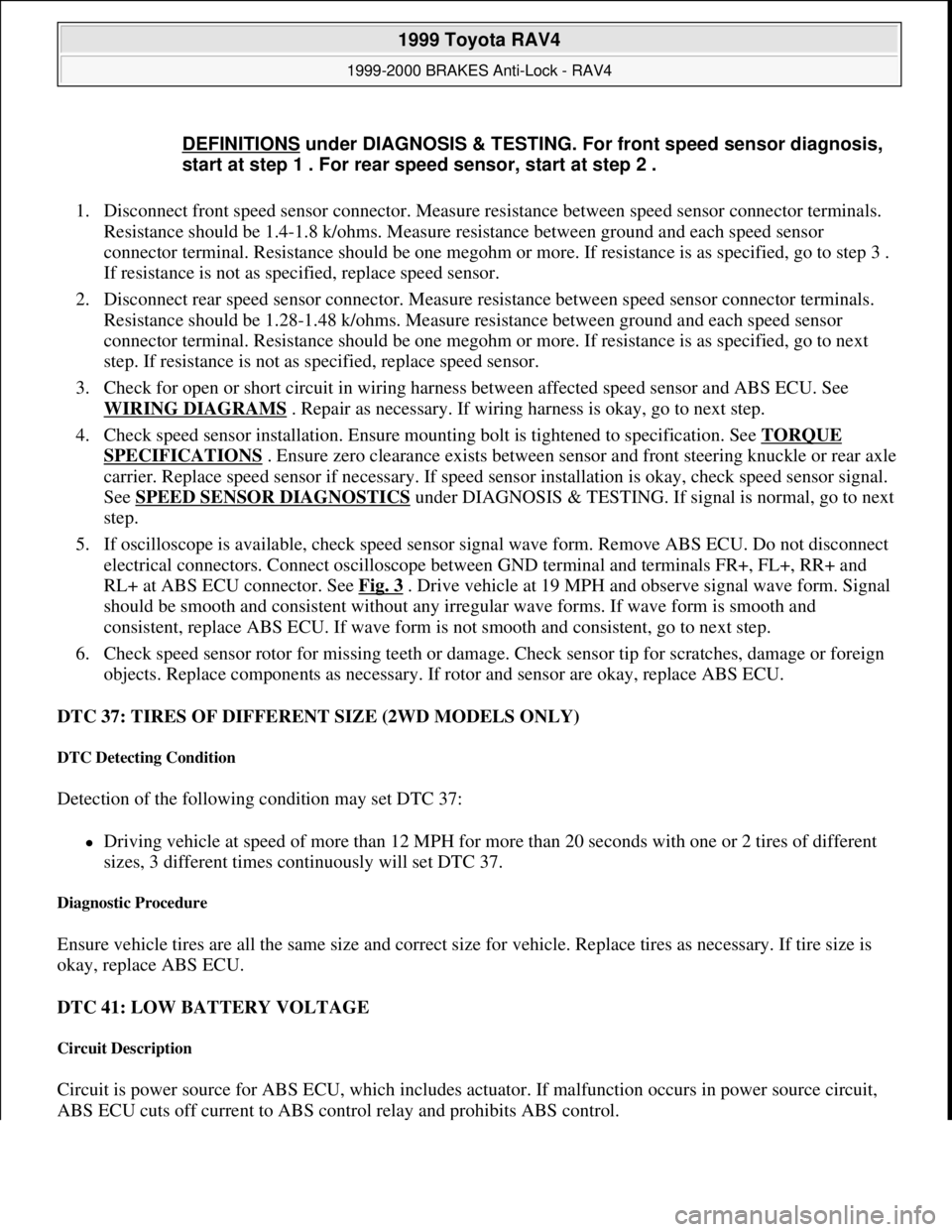
1. Disconnect front speed sensor connector. Measure resistance between speed sensor connector terminals.
Resistance should be 1.4-1.8 k/ohms. Measure resistance between ground and each speed sensor
connector terminal. Resistance should be one megohm or more. If resistance is as specified, go to step 3 .
If resistance is not as specified, replace speed sensor.
2. Disconnect rear speed sensor connector. Measure resistance between speed sensor connector terminals.
Resistance should be 1.28-1.48 k/ohms. Measure resistance between ground and each speed sensor
connector terminal. Resistance should be one megohm or more. If resistance is as specified, go to next
step. If resistance is not as specified, replace speed sensor.
3. Check for open or short circuit in wiring harness between affected speed sensor and ABS ECU. See
WIRING DIAGRAMS
. Repair as necessary. If wiring harness is okay, go to next step.
4. Check speed sensor installation. Ensure mounting bolt is tightened to specification. See TORQUE
SPECIFICATIONS . Ensure zero clearance exists between sensor and front steering knuckle or rear axle
carrier. Replace speed sensor if necessary. If speed sensor installation is okay, check speed sensor signal.
See SPEED SENSOR DIAGNOSTICS
under DIAGNOSIS & TESTING. If signal is normal, go to next
step.
5. If oscilloscope is available, check speed sensor signal wave form. Remove ABS ECU. Do not disconnect
electrical connectors. Connect oscilloscope between GND terminal and terminals FR+, FL+, RR+ and
RL+ at ABS ECU connector. See Fig. 3
. Drive vehicle at 19 MPH and observe signal wave form. Signal
should be smooth and consistent without any irregular wave forms. If wave form is smooth and
consistent, replace ABS ECU. If wave form is not smooth and consistent, go to next step.
6. Check speed sensor rotor for missing teeth or damage. Check sensor tip for scratches, damage or foreign
objects. Replace components as necessary. If rotor and sensor are okay, replace ABS ECU.
DTC 37: TIRES OF DIFFERENT SIZE (2WD MODELS ONLY)
DTC Detecting Condition
Detection of the following condition may set DTC 37:
Driving vehicle at speed of more than 12 MPH for more than 20 seconds with one or 2 tires of different
sizes, 3 different times continuously will set DTC 37.
Diagnostic Procedure
Ensure vehicle tires are all the same size and correct size for vehicle. Replace tires as necessary. If tire size is
okay, replace ABS ECU.
DTC 41: LOW BATTERY VOLTAGE
Circuit Description
Circuit is power source for ABS ECU, which includes actuator. If malfunction occurs in power source circuit,
ABS ECU cuts off current to ABS control relay and prohibits ABS control. DEFINITIONS
under DIAGNOSIS & TESTING. For front speed sensor diagnosis,
start at step 1 . For rear speed sensor, start at step 2 .
1999 Toyota RAV4
1999-2000 BRAKES Anti-Lock - RAV4
Microsoft
Sunday, November 22, 2009 10:06:17 AMPage 16 © 2005 Mitchell Repair Information Company, LLC.
Page 17 of 1632
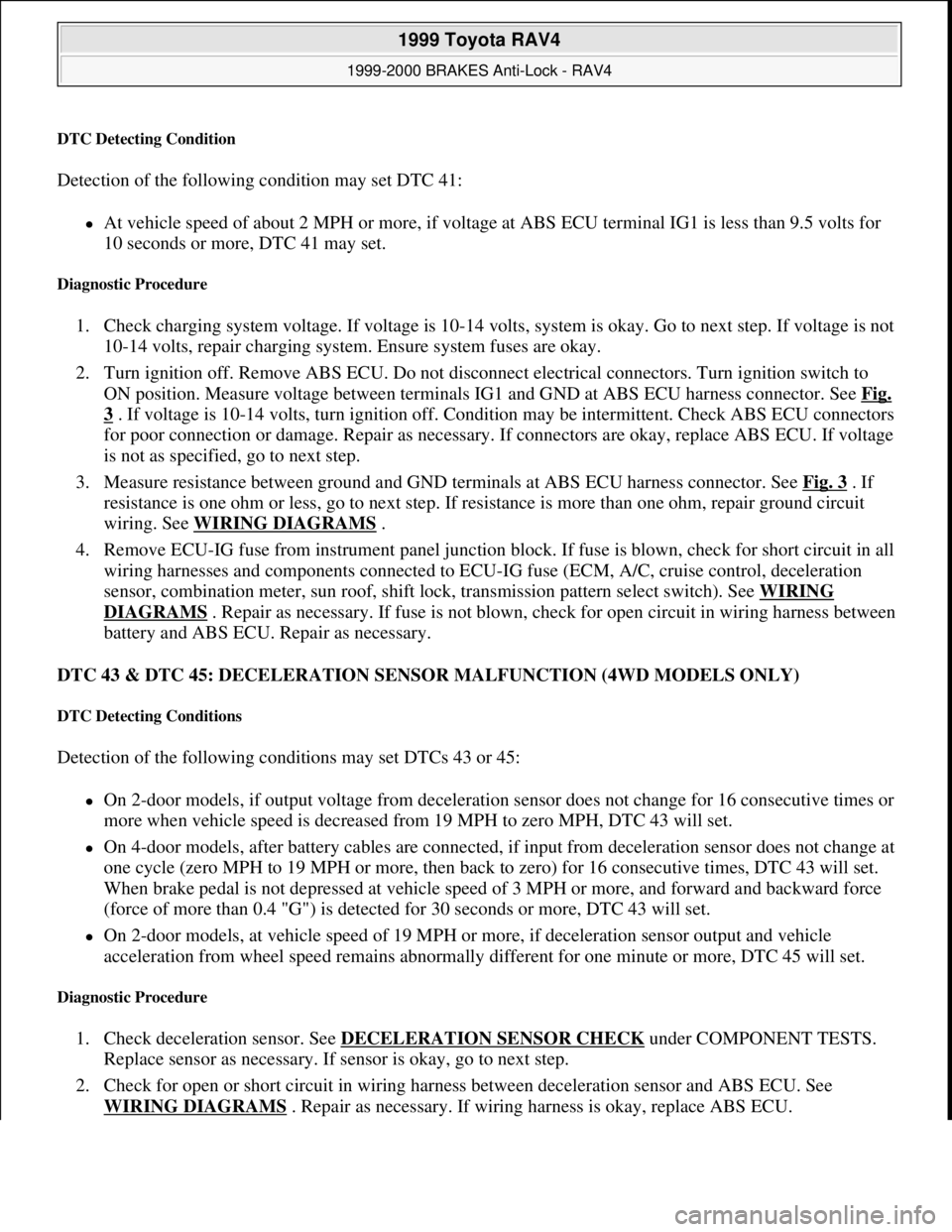
DTC Detecting Condition
Detection of the following condition may set DTC 41:
At vehicle speed of about 2 MPH or more, if voltage at ABS ECU terminal IG1 is less than 9.5 volts for
10 seconds or more, DTC 41 may set.
Diagnostic Procedure
1. Check charging system voltage. If voltage is 10-14 volts, system is okay. Go to next step. If voltage is not
10-14 volts, repair charging system. Ensure system fuses are okay.
2. Turn ignition off. Remove ABS ECU. Do not disconnect electrical connectors. Turn ignition switch to
ON position. Measure voltage between terminals IG1 and GND at ABS ECU harness connector. See Fig.
3 . If voltage is 10-14 volts, turn ignition off. Condition may be intermittent. Check ABS ECU connectors
for poor connection or damage. Repair as necessary. If connectors are okay, replace ABS ECU. If voltage
is not as specified, go to next step.
3. Measure resistance between ground and GND terminals at ABS ECU harness connector. See Fig. 3
. If
resistance is one ohm or less, go to next step. If resistance is more than one ohm, repair ground circuit
wiring. See WIRING DIAGRAMS
.
4. Remove ECU-IG fuse from instrument panel junction block. If fuse is blown, check for short circuit in all
wiring harnesses and components connected to ECU-IG fuse (ECM, A/C, cruise control, deceleration
sensor, combination meter, sun roof, shift lock, transmission pattern select switch). See WIRING
DIAGRAMS . Repair as necessary. If fuse is not blown, check for open circuit in wiring harness between
battery and ABS ECU. Repair as necessary.
DTC 43 & DTC 45: DECELERATION SENSOR MALFUNCTION (4WD MODELS ONLY)
DTC Detecting Conditions
Detection of the following conditions may set DTCs 43 or 45:
On 2-door models, if output voltage from deceleration sensor does not change for 16 consecutive times or
more when vehicle speed is decreased from 19 MPH to zero MPH, DTC 43 will set.
On 4-door models, after battery cables are connected, if input from deceleration sensor does not change at
one cycle (zero MPH to 19 MPH or more, then back to zero) for 16 consecutive times, DTC 43 will set.
When brake pedal is not depressed at vehicle speed of 3 MPH or more, and forward and backward force
(force of more than 0.4 "G") is detected for 30 seconds or more, DTC 43 will set.
On 2-door models, at vehicle speed of 19 MPH or more, if deceleration sensor output and vehicle
acceleration from wheel speed remains abnormally different for one minute or more, DTC 45 will set.
Diagnostic Procedure
1. Check deceleration sensor. See DECELERATION SENSOR CHECK under COMPONENT TESTS.
Replace sensor as necessary. If sensor is okay, go to next step.
2. Check for open or short circuit in wiring harness between deceleration sensor and ABS ECU. See
WIRING DIAGRAMS
. Repair as necessary. If wiring harness is okay, replace ABS ECU.
1999 Toyota RAV4
1999-2000 BRAKES Anti-Lock - RAV4
Microsoft
Sunday, November 22, 2009 10:06:17 AMPage 17 © 2005 Mitchell Repair Information Company, LLC.
Page 18 of 1632
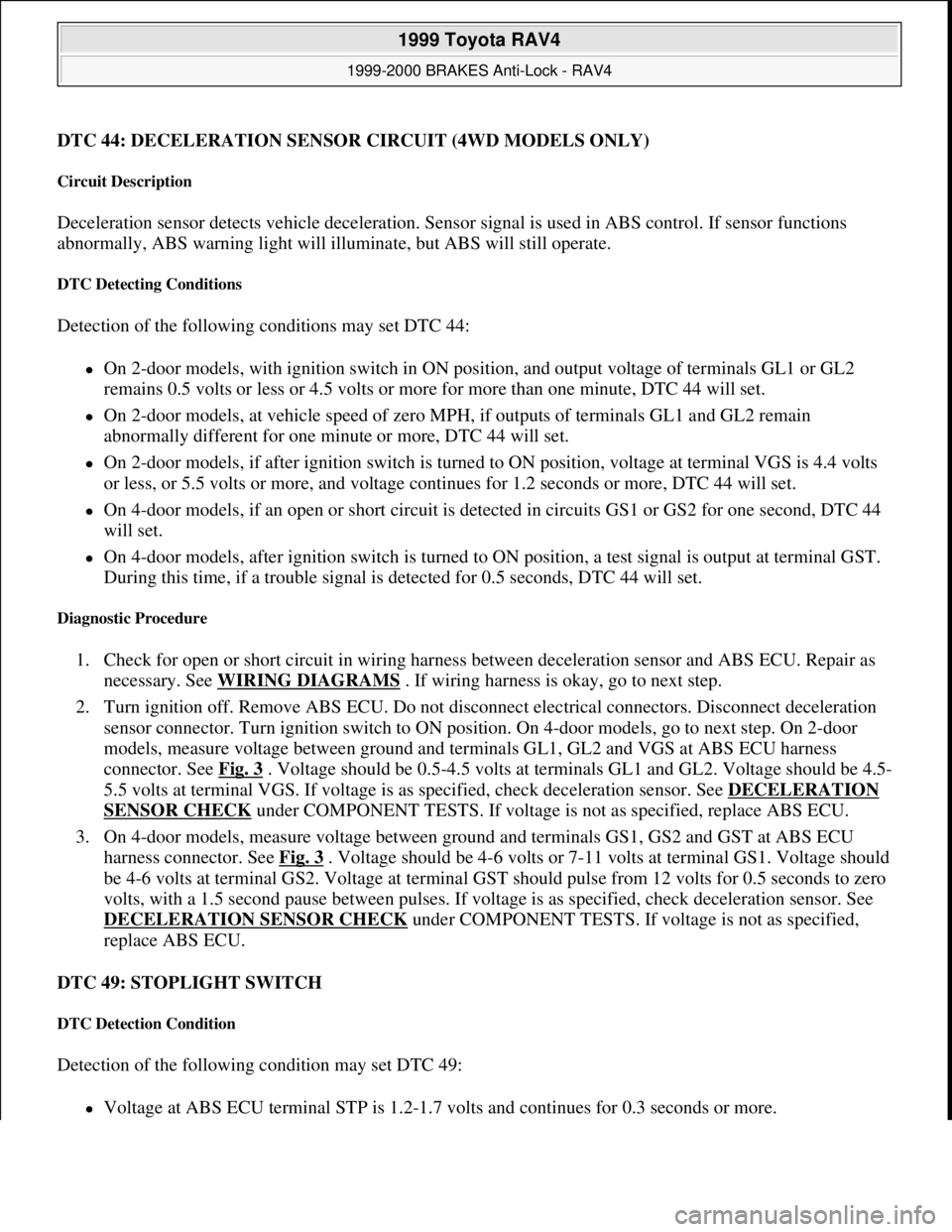
DTC 44: DECELERATION SENSOR CIRCUIT (4WD MODELS ONLY)
Circuit Description
Deceleration sensor detects vehicle deceleration. Sensor signal is used in ABS control. If sensor functions
abnormally, ABS warning light will illuminate, but ABS will still operate.
DTC Detecting Conditions
Detection of the following conditions may set DTC 44:
On 2-door models, with ignition switch in ON position, and output voltage of terminals GL1 or GL2
remains 0.5 volts or less or 4.5 volts or more for more than one minute, DTC 44 will set.
On 2-door models, at vehicle speed of zero MPH, if outputs of terminals GL1 and GL2 remain
abnormally different for one minute or more, DTC 44 will set.
On 2-door models, if after ignition switch is turned to ON position, voltage at terminal VGS is 4.4 volts
or less, or 5.5 volts or more, and voltage continues for 1.2 seconds or more, DTC 44 will set.
On 4-door models, if an open or short circuit is detected in circuits GS1 or GS2 for one second, DTC 44
will set.
On 4-door models, after ignition switch is turned to ON position, a test signal is output at terminal GST.
During this time, if a trouble signal is detected for 0.5 seconds, DTC 44 will set.
Diagnostic Procedure
1. Check for open or short circuit in wiring harness between deceleration sensor and ABS ECU. Repair as
necessary. See WIRING DIAGRAMS
. If wiring harness is okay, go to next step.
2. Turn ignition off. Remove ABS ECU. Do not disconnect electrical connectors. Disconnect deceleration
sensor connector. Turn ignition switch to ON position. On 4-door models, go to next step. On 2-door
models, measure voltage between ground and terminals GL1, GL2 and VGS at ABS ECU harness
connector. See Fig. 3
. Voltage should be 0.5-4.5 volts at terminals GL1 and GL2. Voltage should be 4.5-
5.5 volts at terminal VGS. If voltage is as specified, check deceleration sensor. See DECELERATION
SENSOR CHECK under COMPONENT TESTS. If voltage is not as specified, replace ABS ECU.
3. On 4-door models, measure voltage between ground and terminals GS1, GS2 and GST at ABS ECU
harness connector. See Fig. 3
. Voltage should be 4-6 volts or 7-11 volts at terminal GS1. Voltage should
be 4-6 volts at terminal GS2. Voltage at terminal GST should pulse from 12 volts for 0.5 seconds to zero
volts, with a 1.5 second pause between pulses. If voltage is as specified, check deceleration sensor. See
DECELERATION SENSOR CHECK
under COMPONENT TESTS. If voltage is not as specified,
replace ABS ECU.
DTC 49: STOPLIGHT SWITCH
DTC Detection Condition
Detection of the following condition may set DTC 49:
Voltage at ABS ECU terminal STP is 1.2-1.7 volts and continues for 0.3 seconds or more.
1999 Toyota RAV4
1999-2000 BRAKES Anti-Lock - RAV4
Microsoft
Sunday, November 22, 2009 10:06:17 AMPage 18 © 2005 Mitchell Repair Information Company, LLC.
Page 26 of 1632
1. Check charging system voltage. Ensure 10-14 volts is present. If charging system voltage is okay, go to
next step. If charging system voltage is not okay, check and repair charging system.
2. Turn ignition switch to ON position. Ensure ABS warning light comes on, then goes out after 3 seconds.
If ABS warning light does not illuminate, check fuse, bulb, and wiring harness. See ABS WARNING
LIGHT under DIAGNOSIS & TESTING. Turn ignition off.
3. Using a jumper wire, jumper terminals Ts and E
1 of DLC1. DLC1 is located in engine compartment on
left side of engine. See Fig. 2
. Ensure ABS warning light blinks 4 times per second. If ABS light does
not blink, go to ABS WARNING LIGHT
under DIAGNOSIS & TESTING. If ABS warning light
blinks, go to next step.
4. Using a floor jack, slowly jack up rear of vehicle. On vehicles with 215/70R16 tires, raise vehicle to a
height of 25.59-27.95" (650-710 mm). On vehicles with 235/60R16 tires, raise vehicle to a height of
26.38-28.74" (670-730 mm). If ABS warning light illuminates at specified height, check deceleration
sensor installation. If installation is okay, replace deceleration sensor. Lower vehicle.
5. Using a floor jack, slowly jack up front of vehicle. On vehicles with 215/70R16 tires, raise vehicle to a
height of 21.20-23.56" (550-610 mm). On vehicles with 235/60R16 tires, raise vehicle to a height of
22.44-24.80" (570-630 mm). If ABS warning light illuminates at specified height, check deceleration
sensor installation. If installation is okay, replace deceleration sensor. Lower vehicle.
6. Drive vehicle straight ahead at speed of 13 MPH or more. Lightly depress brake pedal. Ensure ABS
warning light pattern is normal (light blinks 4 times per second).
7. While driving vehicle straight ahead at speed of 13 MPH or more, moderately depress brake pedal.
Ensure ABS warning light illuminates in a solid pattern (light does not blink) while braking.
8. While driving vehicle straight ahead at speed of 13 MPH or more, firmly depress brake pedal. Ensure
ABS warning light illumination pattern changes from a solid pattern (light does not blink) to a normal
pattern (light blinks 4 times per second), then back to a solid pattern while braking.
9. If ABS warning light does not illuminate as described in steps 6 -8 , check deceleration sensor
installation. If installation is okay, replace deceleration sensor. Stop vehicle and turn ignition off. Remove
jumper wire from DLC1.
REMOVAL & INSTALLATION
ACTUATOR
Removal & Installation
Turn ignition off. Disconnect brakelines attached to actuator. Remove power steering hose retaining bracket
bolt and power steering reservoir. Disconnect actuator electrical connectors. Remove bolts, nuts and washers.
Remove actuator assembly. Remove actuator from actuator bracket. Remove cushions and holders from NOTE: When measuring vehicle height in following steps, measure at center of
lower body of vehicle.
WARNING:Hydraulic system may be under high pressure. Use caution when opening
hydraulic system.
1999 Toyota RAV4
1999-2000 BRAKES Anti-Lock - RAV4
Microsoft
Sunday, November 22, 2009 10:06:17 AMPage 26 © 2005 Mitchell Repair Information Company, LLC.
Page 82 of 1632
Removal & Installation
1. Before proceeding, see SERVICE PRECAUTIONS . Turn ignition switch to LOCK position.
Disconnect negative battery cable. Wait at least 90 seconds.
2. Remove glove box door. Disconnect passenger-side air bag module connector. See Fig. 3
. Remove
instrument panel. See INSTRUMENT PANEL
. Working from reverse side of instrument panel, remove
2 bolts and passenger-side air bag module. Remove 3 bolts and pry up 7 clips and remove air bag door.
3. To install, reverse removal procedure. Tighten passenger-side air bag bolts to specification. See
TORQUE SPECIFICATIONS
. There should be no interference between passenger-side air bag door
and instrument panel and clearance should be uniform. Check AIR BAG warning light to ensure system
is functioning properly. See SYSTEM OPERATION CHECK
.
SEAT BELT PRETENSIONERS
Removal & Installation
1. Before proceeding, see SERVICE PRECAUTIONS . Turn ignition switch to LOCK position.
Disconnect negative battery cable. Wait at least 90 seconds.
2. On 2-door models, remove rear seat, rear floor finish panel front door scuff plate, quarter trim and roof
side inner garnish. On 4-door models, remove rear door scuff plate, front door scuff plate and center pillar
lower garnish.
3. On all models, remove bolts and floor anchor. Tape tip of screwdriver and remove seat belt assembly
anchor caps. Remove bolt and shoulder anchor. Disconnect pretensioner connector. Remove 2 bolts and
seat belt pretensioner assembly.
4. To install, reverse removal procedure. Tighten fasteners to specification. See TORQUE
SPECIFICATIONS . Check AIR BAG warning light to ensure system is functioning properly. See
SYSTEM OPERATION CHECK
.
SPIRAL CABLE
Removal & Installation
1. Before proceeding, see SERVICE PRECAUTIONS . Turn ignition switch to LOCK position.
Disconnect negative battery cable. Wait at least 90 seconds. Remove driver-side air bag module. See
DRIVER
-SIDE AIR BAG MODULE .
2. Remove steering wheel. See STEERING WHEEL
. Remove lower steering column cover. Disconnect
lower spiral cable connector. Remove 4 screws and spiral cable.
3. To install, reverse removal procedure. Before installing spiral cable, ensure front wheels are in straight-
ahead position and spiral cable is properly aligned. See SPIRAL CABLE under ADJUSTMENTS
.
Tighten steering wheel nut and driver-side air bag module screws to specification. See TORQUE
SPECIFICATIONS . Check AIR BAG warning light to ensure system is functioning properly. See
SYSTEM OPERATION CHECK
.
STEERING COLUMN
Removal & Installation
1999 Toyota RAV4
AIR BAG RESTRAINT SYSTEM 1999 Toyota
Microsoft
Sunday, November 22, 2009 10:33:22 AMPage 19 © 2005 Mitchell Repair Information Company, LLC.
Page 90 of 1632
AIR BAG WARNING LIGHT INTERMITTENT
If AIR BAG warning light comes on intermittently, perform following tests to simulate driving conditions. If
problem cannot be found, replace all components including wiring harness.
Wiggle-test wiring harness.
Apply heat to components with a hair dryer.
Spray water onto entire vehicle (not directly onto electrical components) to simulate humidity.
DTCS NOT DISPLAYED
Description
When DLC1 terminals Tc and E1 are connected together, air bag sensor assembly is set in Diagnostic Trouble
Code (DTC) output mode. DTC is displayed by flashing AIR BAG warning light.
Diagnostic Procedure
1. Turn ignition switch from LOCK to ACC or ON position. If AIR BAG warning light does not illuminate
for about 6 seconds, repair AIR BAG warning light circuit. See WIRING DIAGRAMS
. If AIR BAG
warning light illuminates for about 6 seconds, go to next step.
2. Measure voltage between DLC1 terminals Tc and E1. See Fig. 14
. If 10-14 volts is present, go to step 4).
If 10-14 volts is not present, go to next step.
3. Measure voltage between ground and DLC1 terminal Tc. If 10-14 volts is present, repair harness between
ground and DLC1 terminal E1. See WIRING DIAGRAMS
. If 10-14 volts is not present, go to next
step.
4. Turn ignition switch to LOCK position. Disconnect negative battery cable and wait at least 90 seconds.
Access and disconnect air bag sensor assembly connector C20 (center connector). See AIR BAG
SENSOR ASSEMBLY under REMOVAL & INSTALLATION
. Connect one end of jumper wire to
harness side of air bag sensor assembly connector C20, terminal No. 19 (Circuit Tc, Pink/Black wire).
See Fig. 16
. Leave other end of jumper wire disconnected. Reconnect air bag sensor assembly connector
with jumper wire connected. Connect negative battery cable and turn ignition switch to ACC or ON
position. Wait at least 20 seconds. Connect unconnected end of jumper wire to ground. If AIR BAG
warning light does not illuminate, replace air bag sensor assembly. If AIR BAG warning light illuminates,
check Pink/Black wire between air bag sensor assembly and DLC1.
DTCS CONTINUOUSLY DISPLAYED
Description
NOTE: Use following procedure if DTCs are not displayed or air bag warning light stays
on when jumper wire is connected between terminals Tc and E1 of DLC1.
NOTE: Use following procedure if DTCs are displayed without connecting jumper wire
between terminals Tc and E1 of DLC1.
1999 Toyota RAV4
AIR BAG RESTRAINT SYSTEM 1999 Toyota
Microsoft
Sunday, November 22, 2009 10:33:23 AMPage 27 © 2005 Mitchell Repair Information Company, LLC.
Page 91 of 1632
When DLC1 terminals Tc and E1 are connected together, air bag sensor assembly is set in Diagnostic Trouble
Code (DTC) output mode. DTC is displayed by flashing AIR BAG warning light.
Diagnostic Procedure
1. Turn ignition switch to LOCK position. Disconnect negative battery cable. Wait at least 90 seconds.
Access and disconnect air bag sensor assembly connector C20 (center connector). See AIR BAG
SENSOR ASSEMBLY under REMOVAL & INSTALLATION
.
2. Measure resistance between ground and air bag sensor assembly connector C20, terminal No. 19 (circuit
Tc, Pink/Black wire). See Fig. 16
. If resistance is more than one megohm, replace air bag sensor
assembly. If resistance is less than one megohm, replace harness and connector.
SOURCE VOLTAGE DROP
Description
The air bag sensor assembly is equipped with a voltage-increase circuit to allow system operation in case source
(battery) voltage drops below minimum. When battery voltage drops, voltage-increase circuit functions to
increase voltage of air bag system to normal voltage.
The malfunction display for this circuit is different from other air bag system circuits. When source voltage
drop is detected and no other DTCs are present, the AIR BAG warning light remains illuminated constantly.
Source voltage drop is not recorded in air bag sensor assembly as a malfunction, and when source voltage
returns to normal, AIR BAG warning light will turn off.
Diagnostic Procedure
1. Turn ignition switch to LOCK position. Disable air bag system. See DISABLING SYSTEM under
DISABLING AND ACTIVATING AIR BAG SYSTEM. Reconnect negative battery cable.
2. Turn ignition switch to ON position. Turn on electrical accessories (defogger, wipers, headlights, blower
motor, etc.). Measure voltage between ground and air bag sensor assembly connector C20, terminals No.
5 (circuit IG2, Black/Orange wire) and No. 6 (circuit ACC, Gray wire). See Fig. 16
. Turn electrical
accessories off. If voltage is 10-14 volts, go to next step. If voltage is not 10-14 volts, check harness
between battery and air bag sensor assembly and check battery and charging system.
3. Turn ignition switch to LOCK position. Activate air bag system. See ACTIVATING SYSTEM
under
DISABLING & ACTIVATING AIR BAG SYSTEM. Turn ignition switch to ON position. Turn on
electrical accessories again. If AIR BAG warning light goes out, system operation is normal at this time.
If AIR BAG warning light does not go out, check for DTCs. See RETRIEVING CODES
under
DIAGNOSIS & TESTING. If DTC is displayed, go to appropriate DTC. If a normal code is displayed (2
flashes per second), replace air bag sensor assembly.
DTC 11/B0102: DRIVER-SIDE AIR BAG SQUIB CIRCUIT SHORT TO GROUND
Description
The driver-side air bag squib circuit consists of the air bag sensor assembly, spiral cable and driver-side air bag
module. The squib causes drive
r-side air bag to deploy when all deployment conditions are satisfied.
1999 Toyota RAV4
AIR BAG RESTRAINT SYSTEM 1999 Toyota
Microsoft
Sunday, November 22, 2009 10:33:23 AMPage 28 © 2005 Mitchell Repair Information Company, LLC.
Page 164 of 1632
1. If shift lever is actuated with engine idling, a time lag will be noted before shock can be felt. This test is
used for checking condition of OD direct clutch, forward clutch, direct clutch, and 1st and reverse brake.
2. Apply parking brake. Start engine. On RAV4, ensure idle speed is 700-800 RPM. On all other models,
ensure idle speed is 650-750 RPM. Shift transaxle from "N" into "D" range. Use a stop watch to measure
elapsed time between shifting of lever until shock is felt. Standard time lag is less than 1.2 seconds.
3. Repeat procedure outlined in step 2) to measure time lag for "N" to "R". Standard lag time is less than 1.5
seconds.
4. If "N" to "D" time lag is longer than specification, line pressure is too low, forward clutch may be worn,
or OD one-way clutch is not operating properly.
5. If "N" to "R" time lag is longer than specified, direct clutch may be worn, 1st and reverse brake may be
worn, line pressure is too low or OD one-way clutch is not operating properly.
ROAD TEST
"D" Range Test In NORM & PWR Pattern Ranges
1. Shift into "D" range. Hold accelerator pedal constant at full throttle. Place shift mode button in NORM or
PWR position. Check 1-2, 2-3, and 3-OD lock-up and upshift points. See appropriate table under SHIFT
SPEED SPECIFICATIONS .
zIf no 1-2 upshift occurs, check 1-2 shift valve or solenoid.
zIf no 2-3 upshift occurs, check 2-3 shift valve or solenoid.
zIf no 3-OD upshift occurs, check 3-OD shift valve.
zIf all shift points are incorrect, check throttle valve, 1-2 shift valve, 2-3 shift valve and 3-OD shift
valve.
zIf all lock-up points are incorrect, check lock-up relay valve or shift solenoid valve SL.
2. Use procedure outlined in step 1) to check for shock and slip between 1-2, 2-3, and 3-OD upshifts. If
shock is harsh, line pressure may be too high. Check accumulator or check ball.
3. Run vehicle in "D" range lock-up or overdrive gear. Check for abnormal noise and vibration.
4. While running in "D" range, confirm correct kickdown vehicle speed limits for 2-1, 3-2, OD-3 shift
points. Check for abnormal shock and slip at kickdown.
5. Check loc
k-up function. Drive vehicle in OD gear of "D" range with lock-up on. Hold vehicle speed NOTE: Perform test at normal operating fluid temperature of 122-176°F (50-80°C).
NOTE: There is no overdrive upshift when coolant temperature is below 140°F
(60°C). There is no lock-up when vehicle speed is 6 MPH less than the set
cruise control speed.
NOTE: Check for cause of abnormal noise and vibration must be made with
extreme care as problem could be due to an unbalanced drive shaft,
differential, tire, torque converter, etc.
1998 Toyota Avalon XLS
1997-99 AUTOMATIC TRANSMISSIONS Toyota A-540E, A-540H & A-541E Overhaul
Helpmelearn
November-03-08 10:28:17 AMPage 10 © 2005 Mitchell Repair Information Company, LLC.
Page 259 of 1632
Avalon, Camry, Celica 2.2L 5S-FE, Corolla 1.6L 4A-FE & Tercel With 3-Speed
Check transmission fluid level and transmission/differential fluid level every 15,000 miles or 24 months.
Transmission/differential fluid reservoir is independent from the transmission. Normal operating conditions
service interval is not available.
Celica 1.8L 7A-FE, Corolla 1.8L 7A-FE, MR2, Paseo, RAV4 & Tercel With 4-Speed, Land Cruiser, Pickup, Previa,
Supra, Tacoma, T100 & 4Runner
Check transmission fluid level every 15,000 miles or 24 months. Differential fluid reservoir is incorporated with
the transmission. Normal operating conditions service interval is not available.
CHECKING FLUID LEVEL
Transmission
1. Drive vehicle until engine and transmission reach normal operating temperature. Park vehicle on level
surface and apply parking brake. With engine idling and brakes applied, move gearshift from Park
through Low and back to Park.
2. Check fluid level on transmission dipstick. Fluid level should be in HOT range marked on dipstick. Add
proper type of fluid if necessary. See RECOMMENDED FLUID
under LUBRICATION. DO NOT
overfill transmission.
Transmission/Differential (Avalon, Camry, Celica 2.2L 5S-FE, Corolla 1.6L 4A-FE & Tercel 3-Speed)
Remove filler plug. See Fig. 1 -3. Fluid should be level with bottom edge of filler plug hole. If fluid is low, fill
with proper type fluid until fluid is level with filler plug opening. See RECOMMENDED FLUID
under
LUBRICATION. Reinstall filler plu
g. NOTE: When checking fluid level for the transmission, if vehicle has been operating in
heavy traffic, towing a trailer or at high speeds in hot weather, wait 30 minutes
before checking the fluid level.
NOTE: Some models have a transmission/differential unit. On these models the
differential lubrication is separate from the transmission fluid. It must be
checked and filled separately.
1996 Toyota 4Runner
TRANSMISSION SERVICING - A/T AUTOMATIC TRANSMISSION SERVICING Toyota
Microsoft
Tuesday, August 18, 2009 7:18:46 PMPage 3 © 2005 Mitchell Repair Information Company, LLC.