power steering fluid TOYOTA RAV4 1996 Service Repair Manual
[x] Cancel search | Manufacturer: TOYOTA, Model Year: 1996, Model line: RAV4, Model: TOYOTA RAV4 1996Pages: 1632, PDF Size: 41.64 MB
Page 115 of 1632
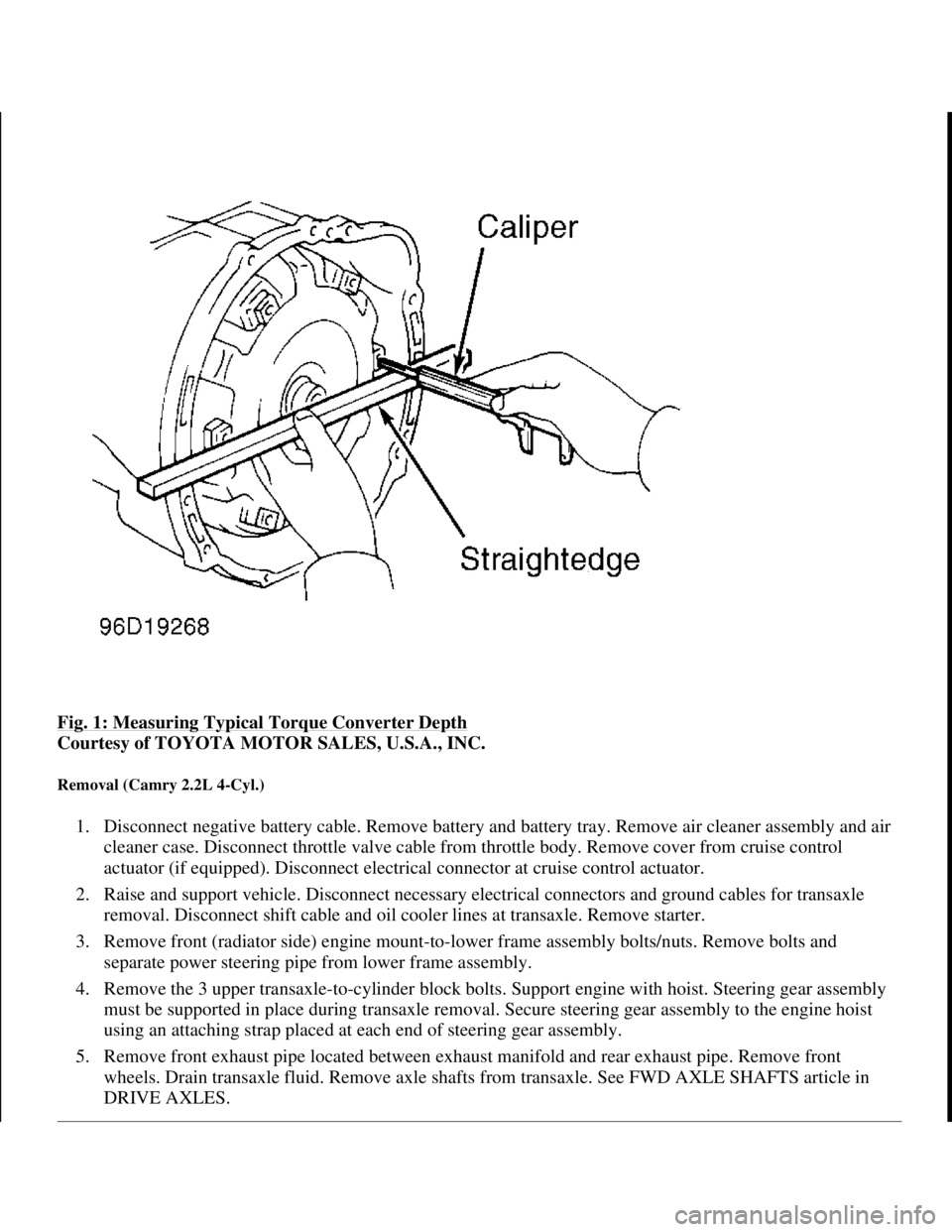
Fig. 1: Measuring Typical Torque Converter Depth
Courtesy of TOYOTA MOTOR SALES, U.S.A., INC.
Removal (Camry 2.2L 4-Cyl.)
1. Disconnect negative battery cable. Remove battery and battery tray. Remove air cleaner assembly and air
cleaner case. Disconnect throttle valve cable from throttle body. Remove cover from cruise control
actuator (if equipped). Disconnect electrical connector at cruise control actuator.
2. Raise and support vehicle. Disconnect necessary electrical connectors and ground cables for transaxle
removal. Disconnect shift cable and oil cooler lines at transaxle. Remove starter.
3. Remove front (radiator side) engine mount-to-lower frame assembly bolts/nuts. Remove bolts and
separate power steering pipe from lower frame assembly.
4. Remove the 3 upper transaxle-to-cylinder block bolts. Support engine with hoist. Steering gear assembly
must be supported in place during transaxle removal. Secure steering gear assembly to the engine hoist
using an attaching strap placed at each end of steering gear assembly.
5. Remove front exhaust pipe located between exhaust manifold and rear exhaust pipe. Remove front
wheels. Drain transaxle fluid. Remove axle shafts from transaxle. See FWD AXLE SHAFTS article in
DRIVE AXLES.
1998 Toyota Avalon XLS
TRANSMISSION SERVICING - A/T 1997-98 TRANSMISSION SERVICING Toyota - Transmission Removal &
Installation
Helpmelearn
November-03-08 10:30:28 AMPage 3 © 2005 Mitchell Repair Information Company, LLC.
Page 134 of 1632
5. Once engine and transaxle are installed, adjust all cables and fill with ATF. See appropriate
TRANSMISSION SERVICING article.
Removal (Sienna)
1. Disconnect negative battery cable. Remove hood. Remove wiper arms. Remove hood-to-cowl top seal.
Remove cowl panel hole cover. Remove clips and left and right side cowl top ventilator louvers.
Disconnect washer hoses. Remove 2 washer nozzles from cowl top ventilator louvers. Remove 11 bolts
and outer front cowl top panel.
2. Remove battery, battery tray, air cleaner assembly and air cleaner case. Disconnect throttle valve cable
from throttle body. Remove cruise control actuator with mounting bracket from the body.
3. Raise and support vehicle. Disconnect necessary electrical connectors and ground cables for transaxle
removal. Remove starter. Disconnect shift cable and oil cooler lines at transaxle. Remove shift cable
clamp bracket from transaxle.
4. Remove front (radiator side) engine mount shock absorber-to-lower frame assembly bolts. Remove front
(radiator side) engine mount-to-lower frame assembly bolts/nuts.
5. Remove front (radiator side) exhaust manifold brace from rear of exhaust manifolds. Brace fits between
rear of exhaust manifold and front of transaxle.
6. Remove the 5 upper transaxle-to-cylinder block bolts. Support engine with hoist. Steering gear assembly
must be supported in place during transaxle removal. Secure steering gear assembly to the engine hoist
using an attaching strap placed at each end of steering gear assembly.
7. Remove front wheels. Remove engine undercover. Remove front exhaust pipe located between exhaust
manifolds and rear exhaust pipe. Drain transaxle fluid. Remove axle shafts from transaxle. See FWD
AXLE SHAFTS article in DRIVE AXLES.
8. Disconnect shift control cable from mounting bracket. Remove rear (firewall side) engine mount-to-lower
frame assembly bolts/nuts. Remove transaxle mount-to-transaxle bolts/nuts at driver's side end of
transaxle.
9. Remove stabilizer bar mount bracket-to-lower frame assembly bolts. Remove steering gear assembly-to-
lower frame assembly bolts/nuts. Support lower frame assembly with floor jack. Lower frame assembly is
located below the engine and transaxle.
10. Disconnect power steering reservoir pipe mounting brackets from lower frame assembly. Remove lower
frame assembly mounting brackets. Lower frame assembly mounting brackets are located on the front
and rear of lower frame assembly attaching the lower frame assembly to the body. Remove lower frame
assembly.
11. Support transaxle with transmission jack. Remove torque converter bracket and cover bolts and nuts from
front of transaxle. Remove torque converter bolts. Remove remaining transaxle-to-cylinder block bolts.
Lower transaxle from vehicle.
Installation
NOTE: Wiper/washer components and output front cowl top panel must be
removed for clearance during transaxle removal and installation.
1998 Toyota Avalon XLS
TRANSMISSION SERVICING - A/T 1997-98 TRANSMISSION SERVICING Toyota - Transmission Removal &
Installation
Helpmelearn
November-03-08 10:30:29 AMPage 22 © 2005 Mitchell Repair Information Company, LLC.
Page 685 of 1632
VALVE CLEARANCE ADJUSTMENT
1. Disconnect power steering fluid reservoir, PCV hoses, cable brackets and control cables for access to
valve cover. Disconnect spark plug wires from spark plugs.
2. Disconnect engine wiring harness protector at rear of timing belt cover for access to valve cover. When
disconnecting engine wiring harness protector, remove bolt on intake manifold side of engine first, and
then bolt on exhaust manifold side of engine.
3. Remove nuts, grommets, valve cover and gasket. Note location of grommets for reassembly reference, as
grommets must be installed in original location.
4. Rotate crankshaft clockwise, as viewed from timing belt end of engine, so cylinder No. 1 is at TDC on
compression stroke, and timing mark on crankshaft pulley aligns with "0" mark on timing belt cover.
Cylinder No. 1 is front cylinder at timing belt end of engine.
5. Ensure valve lifters are loose on cylinder No. 1 and tight on cylinder No. 4. If conditions are not as
described, rotate crankshaft clockwise one complete revolution (360 degrees).
6. With cylinder No. 1 at TDC on compression stroke, check valve clearance on specified valves. Perform
STEP 1 in illustration. See Fig. 2
. Using feeler gauge, measure and record valve clearance between valve
lifter and camshaft. NOTE: Adjust valve clearance with engine cold.
1999 Toyota RAV4
1999-2000 ENGINES 2.0L 4-Cylinder
Microsoft
Sunday, November 22, 2009 10:22:26 AMPage 2 © 2005 Mitchell Repair Information Company, LLC.
Page 700 of 1632
1. Install engine in engine compartment. Loosely install right (timing belt side) engine mounting bracket-to-
engine mount bolts/nuts.
2. Install and tighten left (transaxle side) engine mounting bracket-to-engine mount bolts/nuts to
specification. See TORQUE SPECIFICATIONS
. Tighten right (timing belt side) engine mounting
bracket-to-engine mount bolts/nuts to specification.
3. Install power steering pump. Install and tighten bolts to specification. See TORQUE
SPECIFICATIONS . Install engine mount crossmember with front (exhaust manifold side) engine
mount-to-engine mount crossmember bolts and engine mount crossmember-to-body bolts loosely
installed. DO NOT tighten bolts at this time
4. Install front suspension crossmember on body with bolts loosely installed. Loosely install engine mount
crossmember-to-front suspension crossmember nuts and steering gear assembly-to-front suspension
crossmember bolts/nuts. DO NOT tighten bolts/nuts at this time.
5. Install and tighten front suspension crossmember bolts to specification. See TORQUE
SPECIFICATIONS .
6. Tighten steering gear assembly-to-front suspension crossmember bolts/nuts and then engine mount
crossmember-to-front suspension crossmember nuts to specification. See TORQUE
SPECIFICATIONS .
7. Tighten front (exhaust manifold side) engine mount-to-engine mount crossmember bolts and then engine
mount crossmember-to-body bolts to specification. See TORQUE SPECIFICATIONS
.
8. To install remaining components, reverse removal procedure. Before installing axle shafts coat axle shaft
seals in transaxle with grease.
9. On all axle shafts except right (passenger-side) axle shaft on 2WD models, install NEW snap ring on end
of axle shaft. Position snap ring on end of axle shaft with opening facing downward.
10. Install axle shaft by lightly tapping axle shaft into transaxle. Ensure axle shaft moves inward and outward
approximately .079-.120" (2.00-3.00 mm) and cannot be pulled from transaxle.
11. On 2WD M/T models, when installing right (passenger-side) axle shaft, install NEW axle shaft retaining
bolt. Tighten axle shaft retaining bolt to specification. See TORQUE SPECIFICATIONS
.
12. On 4WD models, ensure reference marks on drive shaft flanges are aligned. Ensure mounting bracket on
drive shaft center support bearing is straight and perpendicular to drive shaft before tightening bolts to
specification.
13. Use NEW gasket and NEW nuts when installing front exhaust pipe on catalytic converter. Ensure all
bolts/nuts are loosely installed before tightening to specification.
14. Adjust fluid levels and control cables. On 2WD models with A/T, use Dexron-II ATF. On 4WD models
with A/T, use Type "T" ATF. On all M/T models, use SAE 75-90 GL-5 gear oil.
CYLINDER HEAD & MANIFOLDS NOTE: All axle shafts, except right (passenger-side) axle shaft on 2WD models,
use a snap ring on end of axle shaft. Ensure NEW snap ring is installed.
NOTE: On 4WD models, manufacturer recommends engine removal for servicing of
cylinder head and manifolds. See ENGINE
.
1999 Toyota RAV4
1999-2000 ENGINES 2.0L 4-Cylinder
Microsoft
Sunday, November 22, 2009 10:22:26 AMPage 17 © 2005 Mitchell Repair Information Company, LLC.
Page 706 of 1632
Removal
1. Disconnect negative battery cable. Remove power steering fluid reservoir with mounting bracket.
Remove accessory drive belts. Remove generator and generator mounting bracket. Remove wiring
brackets for access to timing belt covers.
2. On models with Anti-Lock Brake System (ABS), disconnect electrical connectors and brake lines from
ABS actuator. ABS actuator is located in front of passenger-side strut tower. Remove ABS actuator
mounting bracket-to-body bolts/nuts. Remove ABS actuator with mounting bracket.
3. Raise and support vehicle. Remove passenger-side lower engine cover. Remove passenger-side front
wheel.
4. Using floor jack, slightly raise engine to remove weight from right (timing belt side) engine mount at
timing belt cover. Remove right (timing belt side) engine mount from body and mounting bracket on
cylinder block for access to timing belt covers.
5. Remove spark plugs. Remove crankshaft pulley bolt. Using puller, remove crankshaft pulley. Remove
right (timing belt side) engine mounting bracket from front of cylinder block.
6. Disconnect engine wiring harness protector from rear of No. 2 timing belt cover. When disconnecting
engine wiring harness protector, remove bolt on intake manifold side of engine first and then bolt on
exhaust manifold side of engine.
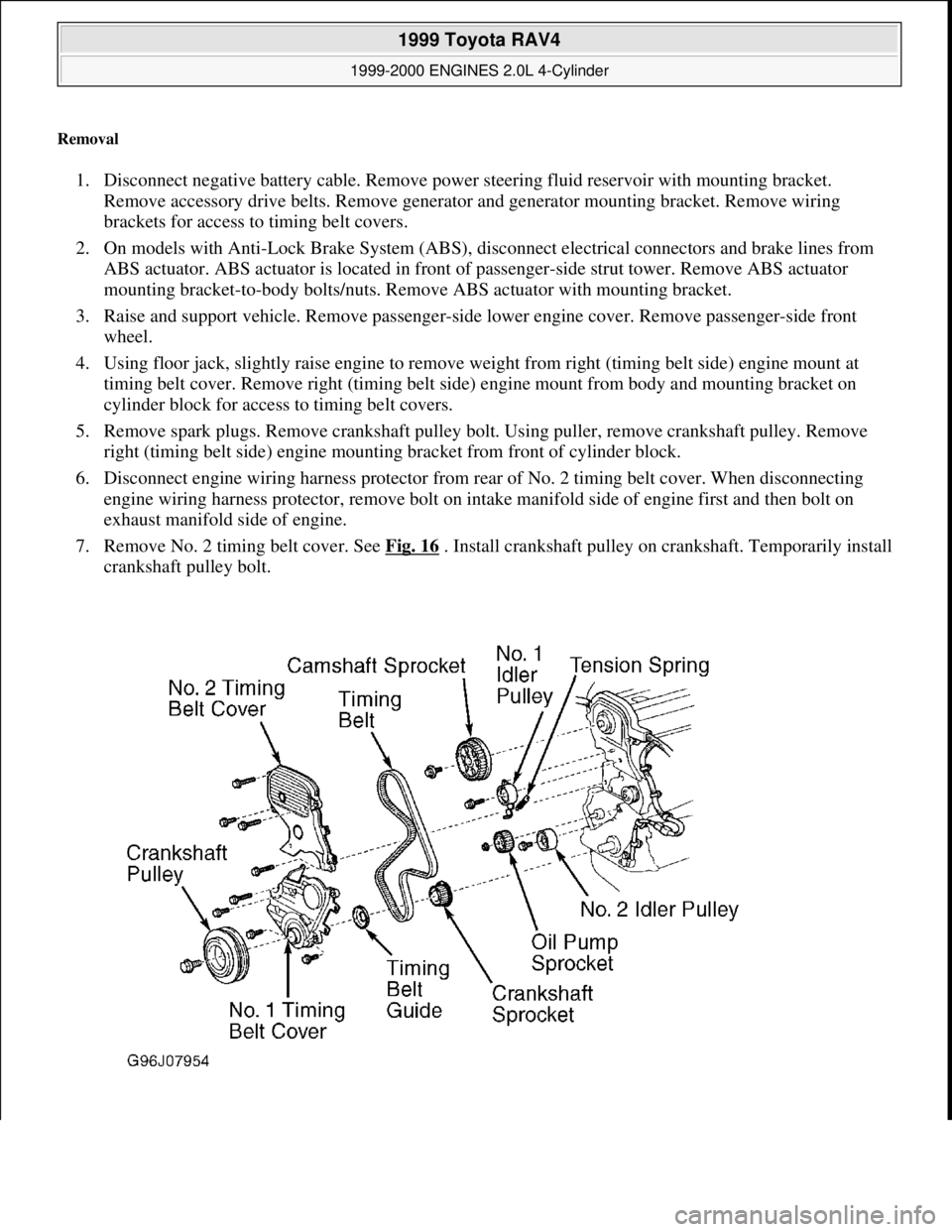
7. Remove No. 2 timing belt cover. See Fig. 16
. Install crankshaft pulley on crankshaft. Temporarily install
crankshaft pulley bolt.
1999 Toyota RAV4
1999-2000 ENGINES 2.0L 4-Cylinder
Microsoft
Sunday, November 22, 2009 10:22:26 AMPage 23 © 2005 Mitchell Repair Information Company, LLC.
Page 711 of 1632
VALVE LIFTER
Removal
Remove camshaft. See CAMSHAFT . Note location of adjusting shims and valve lifters for reassembly
reference. Remove adjusting shims and valve lifters from cylinder head.
Inspection
Inspect components for damage. Measure valve lifter diameter and bore diameter. Ensure oil clearance is within
specification. Replace components if not within specification. See VALVE LIFTERS
table under ENGINE
SPECIFICATIONS.
Installation
To install, reverse removal procedure. Ensure components are installed in original location and valve lifters
rotate smoothly in cylinder head. If camshaft, adjusting shims or valve lifters are replaced, check valve
clearance. See VALVE CLEARANCE ADJUSTMENT
under ADJUSTMENTS.
CAMSHAFT
Removal (Exhaust Side)
1. Remove timing belt and camshaft sprocket. See TIMING BELT . Remove No. 3 timing belt cover. See
Fig. 14
.
2. Disconnect power steering fluid reservoir, PCV hoses, cable brackets and control cables for access to
valve cover. Disconnect spark plug wires from spark plugs. Remove nuts, grommets, valve cover and
gasket. Note location of grommets for reassembly reference, as grommets must be installed in original
location.
3. For servicing of exhaust camshaft, rotate intake camshaft so knock pin is 10-45 degrees from vertical
position. See Fig. 19
. This aids in exhaust camshaft removal by using camshaft lobes on cylinders No. 2
and 4 to push on valve lifters. CAUTION: Camshafts must be properly positioned to lift camshaft straight from
cylinder head to prevent damage to cylinder head and camshaft. DO
NOT pry or force camshafts from cylinder head or component
damage will result.
1999 Toyota RAV4
1999-2000 ENGINES 2.0L 4-Cylinder
Microsoft
Sunday, November 22, 2009 10:22:26 AMPage 28 © 2005 Mitchell Repair Information Company, LLC.
Page 750 of 1632
ADJUSTMENTS
VALVE CLEARANCE ADJUSTMENT
1. Disconnect power steering fluid reservoir, PCV hoses, cable brackets and control cables for access to
valve cover. Disconnect spark plug wires from spark plugs.
2. Disconnect engine wiring harness protector at rear of timing belt cover for access to valve cover. When
disconnecting engine wiring harness protector, remove bolt on intake manifold side of engine first, and
then bolt on exhaust manifold side of engine.
3. Remove nuts, grommets, valve cover and gasket. Note location of grommets for reassembly reference, as
grommets must be installed in original location.
4. Rotate crankshaft clockwise, viewed from timing belt end of engine, so cylinder No. 1 is at TDC on
compression stroke and timing mark on crankshaft pulley aligns with "0" mark on timing belt cover.
Cylinder No. 1 is front cylinder at timing belt end of engine.
5. Ensure valve lifters are loose on cylinder No. 1 and tight on cylinder No. 4. If conditions are not as
described, rotate crankshaft clockwise one complete revolution (360 degrees).
6. With cylinder No. 1 at TDC on compression stroke, check valve clearance on specified valves. Perform
STEP 1. See Fig. 2
. Using feeler gauge, measure and record valve clearance between valve lifter and
camshaft.
7. To check remaining valves, rotate crankshaft clockwise, viewed from timing belt end of engine, one
complete revolution (360 degrees) until cylinder No. 4 cylinder is at TDC on compression stroke.
Measure and record valve clearance on specified valves. Perform STEP 2. See0Fig. 2
.
8. Ensure valve clearance is within specification. See VALVE CLEARANCE SPECIFICATIONS
.
VALVE CLEARANCE SPECIFICATIONS
(1)
9. If valve clearance requires adjustment, rotate camshaft so lobe on valve to be adjusted is facing upward,
away from valve lifter. Rotate valve lifter so notch on valve lifter is toward spark plug.
10. Use Valve Clearance Adjuster (SST 09248-55040) to remove adjusting shim. Using SST "A" of valve
clearance adjuster, push downward on valve lifter. Place SST "B" between camshaft and valve lifter with
side marked with No. 9 at desi
gnated position. See Fig. 3. Remove SST "A". NOTE: Adjust valve clearance with engine cold.
ApplicationIn. (mm)
Intake Valve.007-.011 (.19-.29)
Exhaust Valve.011-.015 (.29-.38)
(1)Adjust valve clearance with engine cold.
1997 Toyota RAV4
2.0L 4-CYL 1997-98 ENGINES Toyota 2.0L 4-Cylinder
Microsoft
Sunday, November 22, 2009 10:23:30 AMPage 2 © 2005 Mitchell Repair Information Company, LLC.
Page 764 of 1632
Installation
1. Install engine in engine compartment. Loosely install right (timing belt side) engine mounting bracket-to-
engine mount bolts/nuts.
2. Install and tighten left (transaxle side) engine mounting bracket-to-engine mount bolts/nuts to
specification. See TORQUE SPECIFICATIONS
. Tighten right (timing belt side) engine mounting
bracket-to-engine mount bolts/nuts to specification.
3. Install power steering pump. Install and tighten bolts to specification. See TORQUE
SPECIFICATIONS .
4. Install engine mount crossmember with front (exhaust manifold side) engine mount-to-engine mount
crossmember bolts and engine mount crossmember-to-
body bolts loosely installed. DO NOT tighten bolts
at this time.
5. Install front suspension crossmember on body with bolts loosely installed. Loosely install engine mount
crossmember-to-front suspension crossmember nuts and steering gear assembly-to-front suspension
crossmember bolts/nuts. DO NOT tighten bolts/nuts at this time.
6. Install and tighten front suspension crossmember bolts to specification. See TORQUE
SPECIFICATIONS .
7. Tighten steering gear assembly-to-front suspension crossmember bolts/nuts and then engine mount
crossmember-to-front suspension crossmember nuts to specification. See TORQUE
SPECIFICATIONS .
8. Tighten front (exhaust manifold side) engine mount-to-engine mount crossmember bolts and then engine
mount crossmember-to-body bolts to specification. See TORQUE SPECIFICATIONS
.
9. To install remaining components, reverse removal procedure. Before installing axle shafts coat axle shaft
seals in transaxle with grease.
10. On all axle shafts except right (passenger-side) axle shaft on 2WD models, install NEW snap ring on end
of axle shaft. Position snap ring on end of axle shaft with opening facing downward.
11. Install axle shaft by lightly tapping axle shaft into transaxle. Ensure axle shaft moves inward and outward
approximately .079-.120"(2.00-3.00 mm) and cannot be pulled from transaxle.
12. On 2WD M/T models, when installing right (passenger-side) axle shaft, install NEW axle shaft retaining
bolt. Tighten axle shaft retaining bolt to specification. See TORQUE SPECIFICATIONS
.
13. On 4WD models, ensure reference marks on drive shaft flanges are aligned. Ensure mounting bracket on
drive shaft center support bearing is straight and perpendicular to drive shaft before tightening bolts to
specification.
14. On all models, use NEW gasket and NEW nuts when installing front exhaust pipe on catalytic converter.
Ensure all bolts/nuts are loosely installed before tightening to specification.
15. Adjust fluid levels and control cables. On 2WD models with A/T, use Dexron-II ATF. On 4WD models
with A/T, use Type "T" ATF. On all M/T models, use SAE 75-90 GL-5 gear oil.
CYLINDER HEAD & MANIFOLDS NOTE: All axle shafts except right (passenger-side) axle shaft on 2WD models,
use a snap ring on end of axle shaft. Ensure NEW snap ring is installed.
1997 Toyota RAV4
2.0L 4-CYL 1997-98 ENGINES Toyota 2.0L 4-Cylinder
Microsoft
Sunday, November 22, 2009 10:23:31 AMPage 16 © 2005 Mitchell Repair Information Company, LLC.
Page 765 of 1632
Removal
1. Release fuel pressure. See FUEL PRESSURE RELEASE . Drain cooling system. Raise and support
vehicle. Remove right lower engine cover.
2. Disconnect control cables at throttle body. Remove air cleaner assembly and air cleaner case. Remove
accessory drive belt and generator. On 1997 models, remove distributor with spark plug wires. On 1998
models, remove front exhaust pipe.
3. On 1997 models, disconnect electrical connectors for oxygen sensors and remove exhaust manifold and
front catalytic converter. On 1998 models, disconnect oxygen sensor (except California) or Air/Fuel ratio
(A/F) sensor (California) and remove exhaust manifold and heat shield. On all models, remove sensors
from exhaust manifold and front catalytic converter, if equipped. See Fig. 14
.
4. On 1997 models, separate exhaust manifold and front catalytic converter and disconnect oil pressure
switch. On 1998 models, remove heat insulator from front exhaust pipe. Remove ignition coils with spark
plug wires attached. Disconnect oil pressure switch. See Fig. 14
.
5. On all models, disconnect necessary electrical connectors, coolant hoses and vacuum hoses from throttle
body, cylinder head and intake manifold. Remove coolant outlet, coolant by-pass pipe and gaskets. See
Fig. 14
.
6. Remove throttle body and gasket. Remove union bolt and disconnect fuel line at fuel filter. Remove EGR
valve and vacuum modulator. Remove EGR Vacuum Switching Valve (VSV) from side of cylinder head.
See Fig. 14
.
7. Remove intake manifold brace located between cylinder block and intake manifold. On A/T models,
disconnect control cable bracket from side of intake manifold. On all models, disconnect power steering
fluid reservoir, PCV hoses, cable brackets and control cables for access to valve cover.
8. Disconnect engine wiring harness protector at rear of timing belt cover for access to valve cover. When
disconnecting engine wiring harness protector, remove bolt on intake manifold side of engine first, and
then bolt on exhaust manifold side of engine.
9. Remove nuts, grommets, valve cover and gasket. Note location of grommets for reassembly reference, as
grommets must be installed in original location.
10. Remove bolts and disconnect engine wiring harness protector from rear side of intake manifold.
Disconnect electrical connectors at injectors, A/C compressor and crankshaft position sensor. Remove
engine wiring harness clamps from timing belt cover and generator drive belt adjusting bar.
11. Disconnect engine wiring harness protector from brackets on front side of intake manifold. Remove scuff
plate from passenger-side door opening and passenger-side kick panel. Remove center console trim panel
from passenger-side of center console.
12. Disconnect 2 electrical connectors from Engine Control Module (ECM), and 2 electrical connectors on
bracket. See Fig. 9
. Disconnect electrical connector for relay box located behind passenger-side kick
panel.
13. Disconnect engine wiring harness clamp located on engine wiring, near firewall. Pull engine wiring
harness out through firewall. Remove engine wiring harness from between cylinder head and intake
manifold. NOTE: On 4WD models, manufacturer recommends engine removal for servicing of
cylinder head and manifolds. See ENGINE. Proceed to appropriate step in
following procedure for servicing of cylinder head and manifolds.
1997 Toyota RAV4
2.0L 4-CYL 1997-98 ENGINES Toyota 2.0L 4-Cylinder
Microsoft
Sunday, November 22, 2009 10:23:31 AMPage 17 © 2005 Mitchell Repair Information Company, LLC.
Page 771 of 1632
Removal
1. Disconnect negative battery cable. Remove power steering fluid reservoir with mounting bracket.
Remove accessory drive belts. Remove generator and generator mounting bracket. Remove wiring
brackets for access to timing belt covers.
2. On models with Anti-Lock Brake System (ABS), disconnect electrical connectors and brake lines from
ABS actuator. ABS actuator is located in front of passenger-side strut tower. Remove ABS actuator
mounting bracket-to-body bolts/nuts. Remove ABS actuator with mounting bracket.
3. On all models, raise and support vehicle. Remove passenger-side lower engine cover. Remove passenger-
side front wheel.
4. Using floor jack, slightly raise engine to remove weight from right (timing belt side) engine mount at
timing belt cover. Remove right (timing belt side) engine mount from body and mounting bracket on
cylinder block for access to timing belt covers.
5. Remove spark plugs. Remove crankshaft pulley bolt. Using puller, remove crankshaft pulley. Remove
right (timing belt side) engine mounting bracket from front of cylinder block.
6. Disconnect engine wiring harness protector from rear of No. 2 timing belt cover. When disconnecting
engine wiring harness protector, remove bolt on intake manifold side of engine first and then bolt on
exhaust manifold side of engine.
7. Remove No. 2 timing belt cover. See Fig. 17
. Install crankshaft pulley on crankshaft. Temporarily install
crankshaft pulley bolt.
8. Rotate crankshaft clockwise, viewed from timing belt end of engine, so cylinder No. 1 is at TDC on
compression stroke and timing mark on crankshaft pulley aligns with "0" mark on timing belt cover.
Cylinder No. 1 is front cylinder at timing belt end of engine.
9. Ensure hole in camshaft sprocket aligns with alignment mark on camshaft bearing cap. See Fig. 18
. If
hole in camshaft sprocket is not aligned with alignment mark, rotate crankshaft clockwise one full
revolution.
1997 Toyota RAV4
2.0L 4-CYL 1997-98 ENGINES Toyota 2.0L 4-Cylinder
Microsoft
Sunday, November 22, 2009 10:23:31 AMPage 23 © 2005 Mitchell Repair Information Company, LLC.