weight TOYOTA RAV4 1996 Service Repair Manual
[x] Cancel search | Manufacturer: TOYOTA, Model Year: 1996, Model line: RAV4, Model: TOYOTA RAV4 1996Pages: 1632, PDF Size: 41.64 MB
Page 32 of 1632
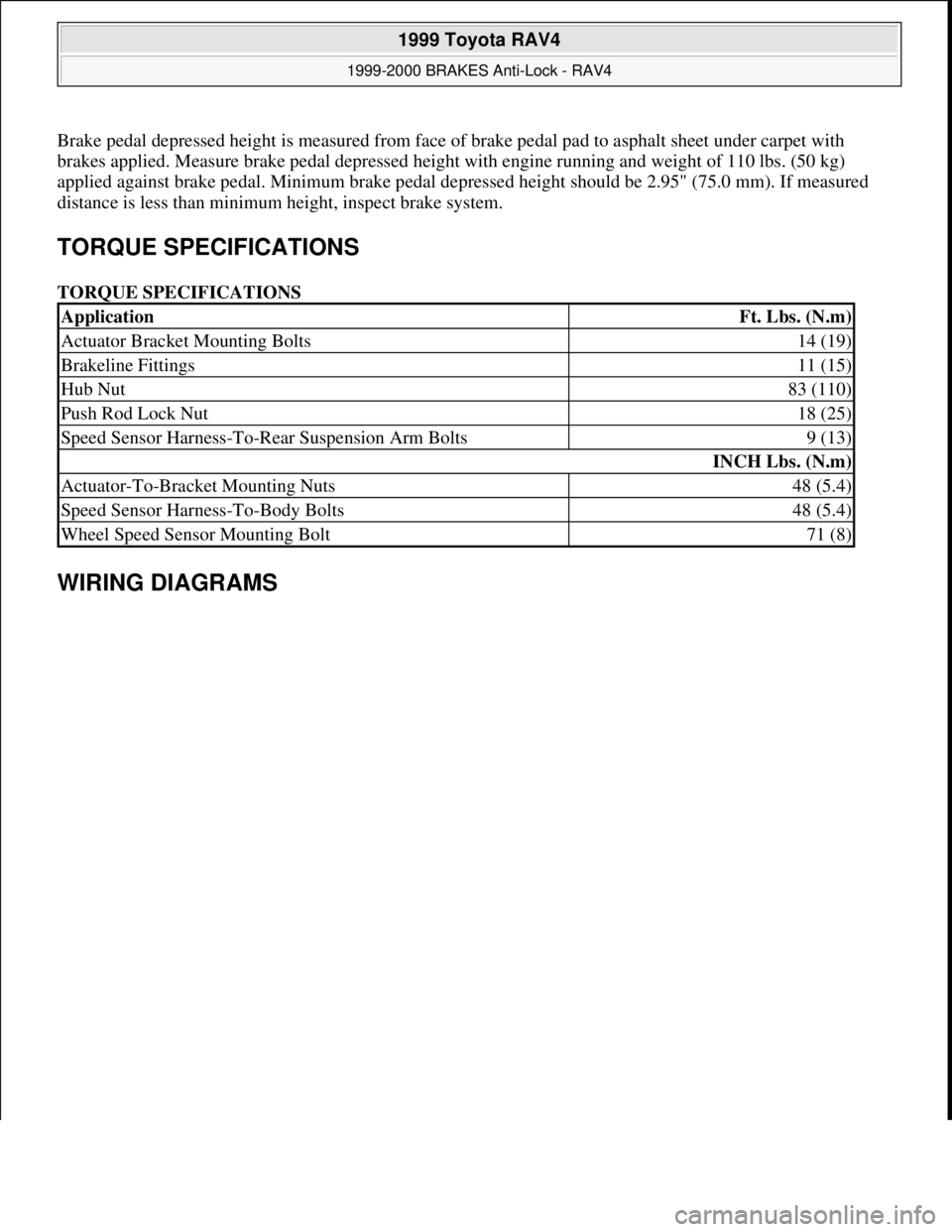
Brake pedal depressed height is measured from face of brake pedal pad to asphalt sheet under carpet with
brakes applied. Measure brake pedal depressed height with engine running and weight of 110 lbs. (50 kg)
applied against brake pedal. Minimum brake pedal depressed height should be 2.95" (75.0 mm). If measured
distance is less than minimum height, inspect brake system.
TORQUE SPECIFICATIONS
TORQUE SPECIFICATIONS
WIRING DIAGRAMS
ApplicationFt. Lbs. (N.m)
Actuator Bracket Mounting Bolts14 (19)
Brakeline Fittings11 (15)
Hub Nut83 (110)
Push Rod Lock Nut18 (25)
Speed Sensor Harness-To-Rear Suspension Arm Bolts9 (13)
INCH Lbs. (N.m)
Actuator-To-Bracket Mounting Nuts48 (5.4)
Speed Sensor Harness-To-Body Bolts48 (5.4)
Wheel Speed Sensor Mounting Bolt71 (8)
1999 Toyota RAV4
1999-2000 BRAKES Anti-Lock - RAV4
Microsoft
Sunday, November 22, 2009 10:06:17 AMPage 32 © 2005 Mitchell Repair Information Company, LLC.
Page 71 of 1632
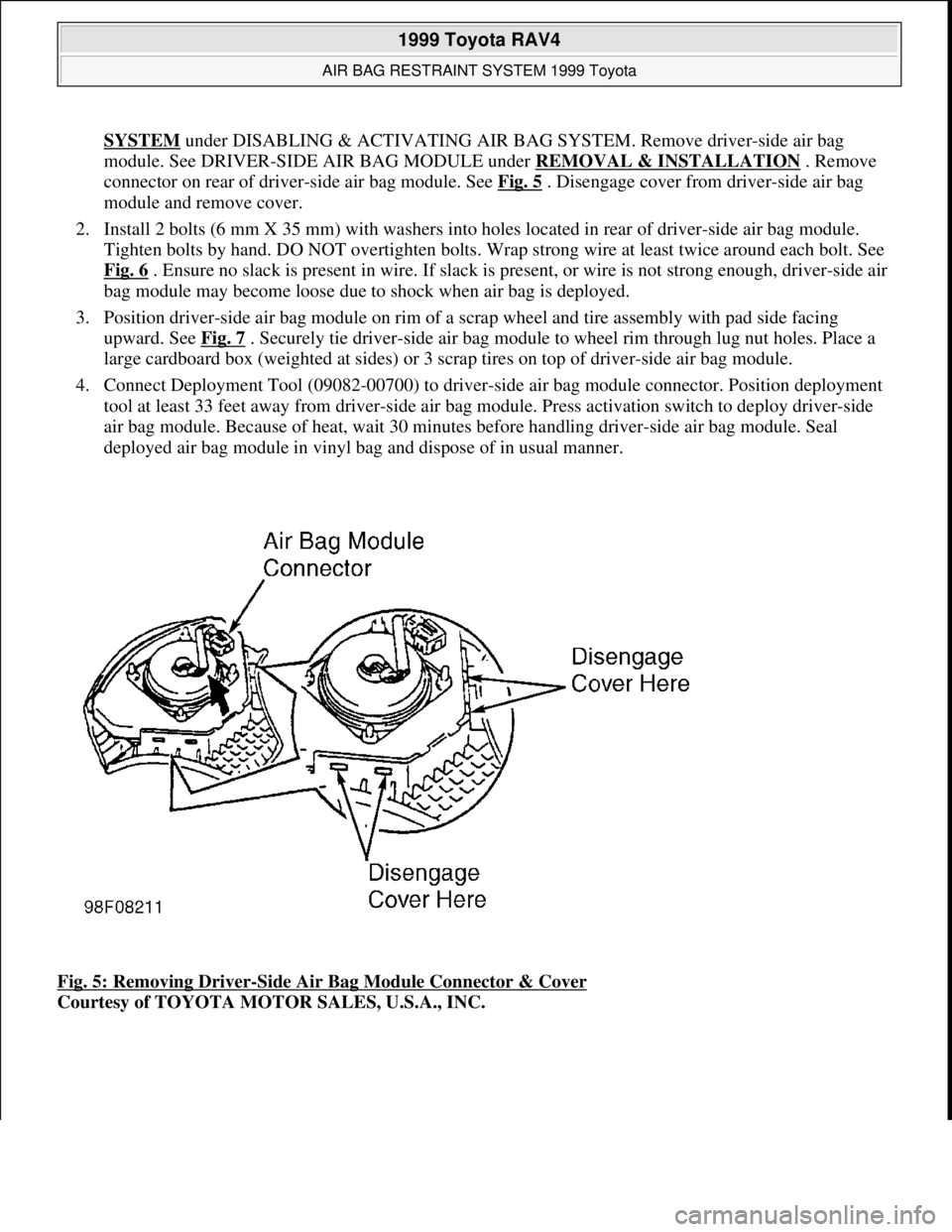
SYSTEM under DISABLING & ACTIVATING AIR BAG SYSTEM. Remove driver-side air bag
module. See DRIVER-SIDE AIR BAG MODULE under REMOVAL & INSTALLATION
. Remove
connector on rear of driver-side air bag module. See Fig. 5
. Disengage cover from driver-side air bag
module and remove cover.
2. Install 2 bolts (6 mm X 35 mm) with washers into holes located in rear of driver-side air bag module.
Tighten bolts by hand. DO NOT overtighten bolts. Wrap strong wire at least twice around each bolt. See
Fig. 6
. Ensure no slack is present in wire. If slack is present, or wire is not strong enough, driver-side air
bag module may become loose due to shock when air bag is deployed.
3. Position driver-side air bag module on rim of a scrap wheel and tire assembly with pad side facing
upward. See Fig. 7
. Securely tie driver-side air bag module to wheel rim through lug nut holes. Place a
large cardboard box (weighted at sides) or 3 scrap tires on top of driver-side air bag module.
4. Connect Deployment Tool (09082-00700) to driver-side air bag module connector. Position deployment
tool at least 33 feet away from driver-side air bag module. Press activation switch to deploy driver-side
air bag module. Because of heat, wait 30 minutes before handling driver-side air bag module. Seal
deployed air bag module in vinyl bag and dispose of in usual manner.
Fig. 5: Removing Driver
-Side Air Bag Module Connector & Cover
Courtesy of TOYOTA MOTOR SALES, U.S.A., INC.
1999 Toyota RAV4
AIR BAG RESTRAINT SYSTEM 1999 Toyota
Microsoft
Sunday, November 22, 2009 10:33:22 AMPage 8 © 2005 Mitchell Repair Information Company, LLC.
Page 342 of 1632
BRAKE PEDAL FREE PLAY
1. Brake pedal free play is distance brake pedal travels before feeling resistance with engine stopped. To
check pedal free play, depress brake pedal several times to exhaust vacuum from booster.
2. Depress pedal and measure travel until initial resistance is felt. See BRAKE PEDAL
SPECIFICATIONS table. If free play is not within specification, adjust by turning push rod. See Fig. 1.
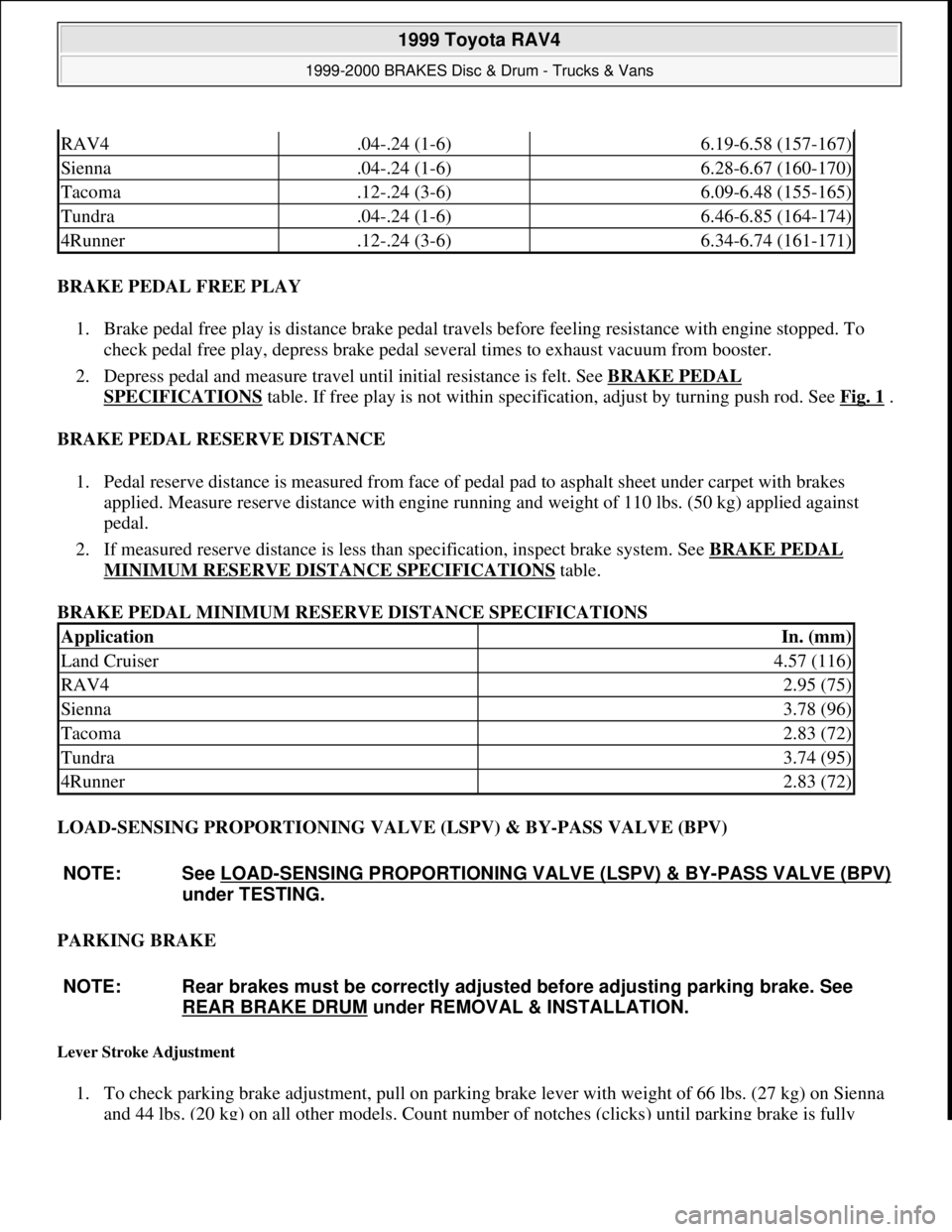
BRAKE PEDAL RESERVE DISTANCE
1. Pedal reserve distance is measured from face of pedal pad to asphalt sheet under carpet with brakes
applied. Measure reserve distance with engine running and weight of 110 lbs. (50 kg) applied against
pedal.
2. If measured reserve distance is less than specification, inspect brake system. See BRAKE PEDAL
MINIMUM RESERVE DISTANCE SPECIFICATIONS table.
BRAKE PEDAL MINIMUM RESERVE DISTANCE SPECIFICATIONS
LOAD-SENSING PROPORTIONING VALVE (LSPV) & BY-PASS VALVE (BPV)
PARKING BRAKE
Lever Stroke Adjustment
1. To check parking brake adjustment, pull on parking brake lever with weight of 66 lbs. (27 kg) on Sienna
and 44 lbs. (20 k
g) on all other models. Count number of notches (clicks) until parking brake is fully
RAV4.04-.24 (1-6)6.19-6.58 (157-167)
Sienna.04-.24 (1-6)6.28-6.67 (160-170)
Tacoma.12-.24 (3-6)6.09-6.48 (155-165)
Tundra.04-.24 (1-6)6.46-6.85 (164-174)
4Runner.12-.24 (3-6)6.34-6.74 (161-171)
ApplicationIn. (mm)
Land Cruiser4.57 (116)
RAV42.95 (75)
Sienna3.78 (96)
Tacoma2.83 (72)
Tundra3.74 (95)
4Runner2.83 (72)
NOTE: See LOAD
-SENSING PROPORTIONING VALVE (LSPV) & BY-PASS VALVE (BPV)
under TESTING.
NOTE: Rear brakes must be correctly adjusted before adjusting parking brake. See
REAR BRAKE DRUM
under REMOVAL & INSTALLATION.
1999 Toyota RAV4
1999-2000 BRAKES Disc & Drum - Trucks & Vans
Microsoft
Sunday, November 22, 2009 10:07:28 AMPage 3 © 2005 Mitchell Repair Information Company, LLC.
Page 345 of 1632
Depress brake pedal and start engine. If pedal goes down slightly, operation is normal.
Air Tightness Check
1. Start engine and run for 1-2 minutes, then turn engine off. Depress brake pedal several times slowly. If
pedal goes down farthest on first time, but gradually rises after second or third time, power brake unit is
airtight.
2. With engine stopped, depress brake pedal several times using normal pressure. Pedal should be low when
first depressed. On consecutive applications, pedal height should gradually rise. If pedal height does not
increase, check for air leaks.
LOAD-SENSING PROPORTIONING VALVE (LSPV) & BY-PASS VALVE (BPV)
Tacoma & Tundra
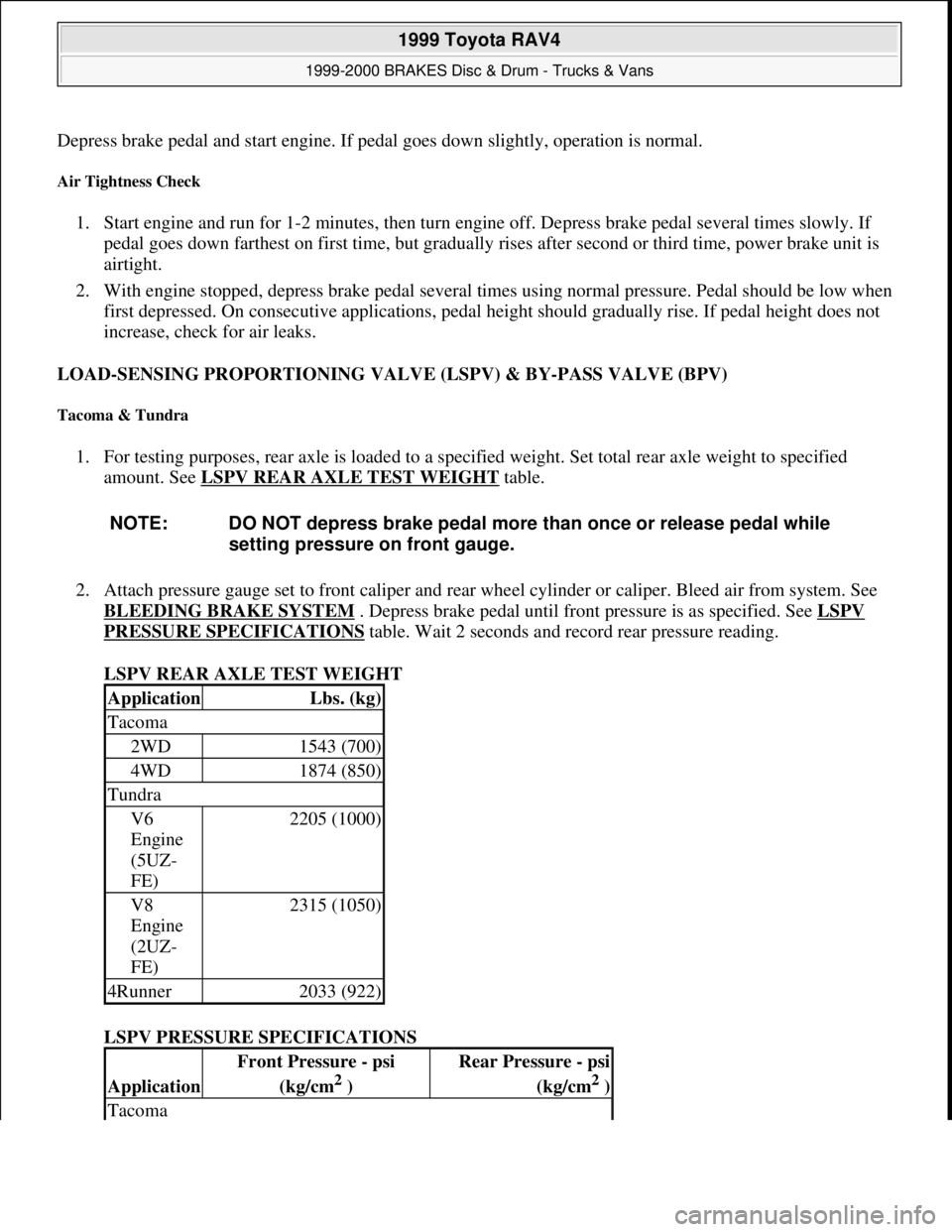
1. For testing purposes, rear axle is loaded to a specified weight. Set total rear axle weight to specified
amount. See LSPV REAR AXLE TEST WEIGHT
table.
2. Attach pressure gauge set to front caliper and rear wheel cylinder or caliper. Bleed air from system. See
BLEEDING BRAKE SYSTEM
. Depress brake pedal until front pressure is as specified. See LSPV
PRESSURE SPECIFICATIONS table. Wait 2 seconds and record rear pressure reading.
LSPV REAR AXLE TEST WEIGHT
LSPV PRESSURE SPECIFICATIONS NOTE: DO NOT depress brake pedal more than once or release pedal while
setting pressure on front gauge.
ApplicationLbs. (kg)
Tacoma
2WD1543 (700)
4WD1874 (850)
Tundra
V6
Engine
(5UZ-
FE)2205 (1000)
V8
Engine
(2UZ-
FE)2315 (1050)
4Runner2033 (922)
Application
Front Pressure - psi
(kg/cm
2 )
Rear Pressure - psi
(kg/cm
2 )
Tacoma
1999 Toyota RAV4
1999-2000 BRAKES Disc & Drum - Trucks & Vans
Microsoft
Sunday, November 22, 2009 10:07:28 AMPage 6 © 2005 Mitchell Repair Information Company, LLC.
Page 347 of 1632
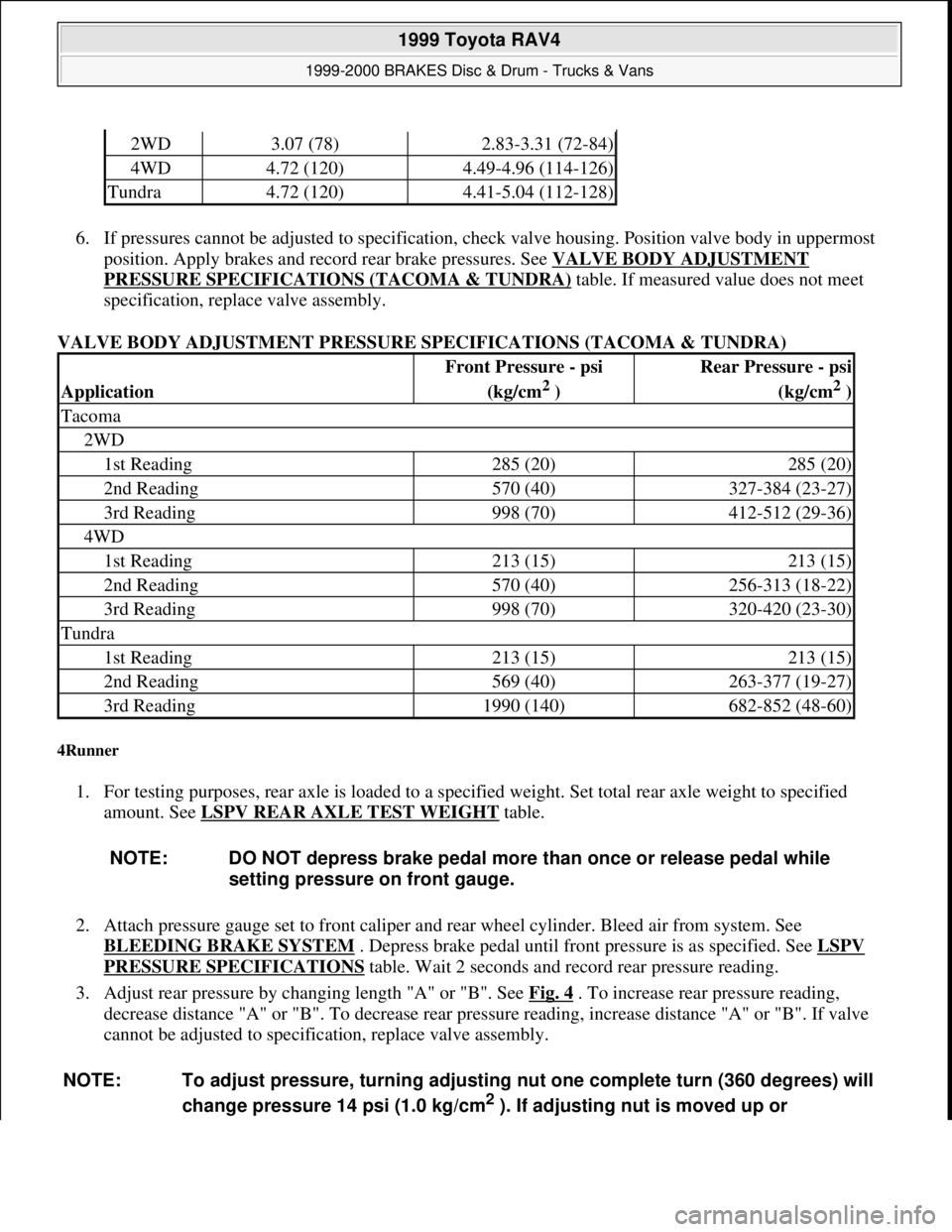
6. If pressures cannot be adjusted to specification, check valve housing. Position valve body in uppermost
position. Apply brakes and record rear brake pressures. See VALVE BODY ADJUSTMENT
PRESSURE SPECIFICATIONS (TACOMA & TUNDRA) table. If measured value does not meet
specification, replace valve assembly.
VALVE BODY ADJUSTMENT PRESSURE SPECIFICATIONS (TACOMA & TUNDRA)
4Runner
1. For testing purposes, rear axle is loaded to a specified weight. Set total rear axle weight to specified
amount. See LSPV REAR AXLE TEST WEIGHT
table.
2. Attach pressure gauge set to front caliper and rear wheel cylinder. Bleed air from system. See
BLEEDING BRAKE SYSTEM
. Depress brake pedal until front pressure is as specified. See LSPV
PRESSURE SPECIFICATIONS table. Wait 2 seconds and record rear pressure reading.
3. Adjust rear pressure by changing length "A" or "B". See Fig. 4
. To increase rear pressure reading,
decrease distance "A" or "B". To decrease rear pressure reading, increase distance "A" or "B". If valve
cannot be adjusted to specification, replace valve assembly.
2WD3.07 (78)2.83-3.31 (72-84)
4WD4.72 (120)4.49-4.96 (114-126)
Tundra4.72 (120)4.41-5.04 (112-128)
Application
Front Pressure - psi
(kg/cm
2 )
Rear Pressure - psi
(kg/cm
2 )
Tacoma
2WD
1st Reading285 (20)285 (20)
2nd Reading570 (40)327-384 (23-27)
3rd Reading998 (70)412-512 (29-36)
4WD
1st Reading213 (15)213 (15)
2nd Reading570 (40)256-313 (18-22)
3rd Reading998 (70)320-420 (23-30)
Tundra
1st Reading213 (15)213 (15)
2nd Reading569 (40)263-377 (19-27)
3rd Reading1990 (140)682-852 (48-60)
NOTE: DO NOT depress brake pedal more than once or release pedal while
setting pressure on front gauge.
NOTE: To adjust pressure, turning adjusting nut one complete turn (360 degrees) will
change pressure 14 psi (1.0 kg/cm
2 ). If adjusting nut is moved up or
1999 Toyota RAV4
1999-2000 BRAKES Disc & Drum - Trucks & Vans
Microsoft
Sunday, November 22, 2009 10:07:28 AMPage 8 © 2005 Mitchell Repair Information Company, LLC.
Page 706 of 1632
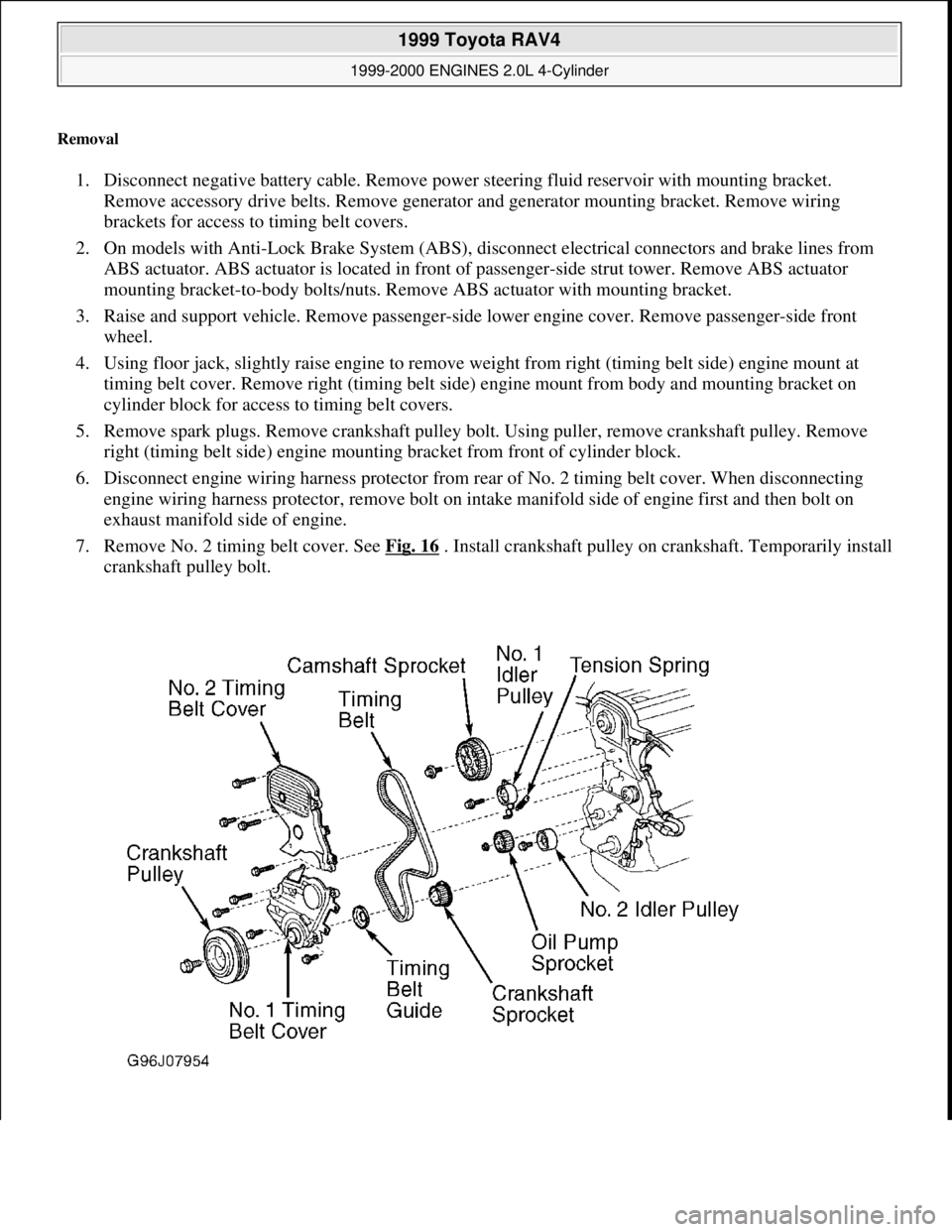
Removal
1. Disconnect negative battery cable. Remove power steering fluid reservoir with mounting bracket.
Remove accessory drive belts. Remove generator and generator mounting bracket. Remove wiring
brackets for access to timing belt covers.
2. On models with Anti-Lock Brake System (ABS), disconnect electrical connectors and brake lines from
ABS actuator. ABS actuator is located in front of passenger-side strut tower. Remove ABS actuator
mounting bracket-to-body bolts/nuts. Remove ABS actuator with mounting bracket.
3. Raise and support vehicle. Remove passenger-side lower engine cover. Remove passenger-side front
wheel.
4. Using floor jack, slightly raise engine to remove weight from right (timing belt side) engine mount at
timing belt cover. Remove right (timing belt side) engine mount from body and mounting bracket on
cylinder block for access to timing belt covers.
5. Remove spark plugs. Remove crankshaft pulley bolt. Using puller, remove crankshaft pulley. Remove
right (timing belt side) engine mounting bracket from front of cylinder block.
6. Disconnect engine wiring harness protector from rear of No. 2 timing belt cover. When disconnecting
engine wiring harness protector, remove bolt on intake manifold side of engine first and then bolt on
exhaust manifold side of engine.
7. Remove No. 2 timing belt cover. See Fig. 16
. Install crankshaft pulley on crankshaft. Temporarily install
crankshaft pulley bolt.
1999 Toyota RAV4
1999-2000 ENGINES 2.0L 4-Cylinder
Microsoft
Sunday, November 22, 2009 10:22:26 AMPage 23 © 2005 Mitchell Repair Information Company, LLC.
Page 733 of 1632
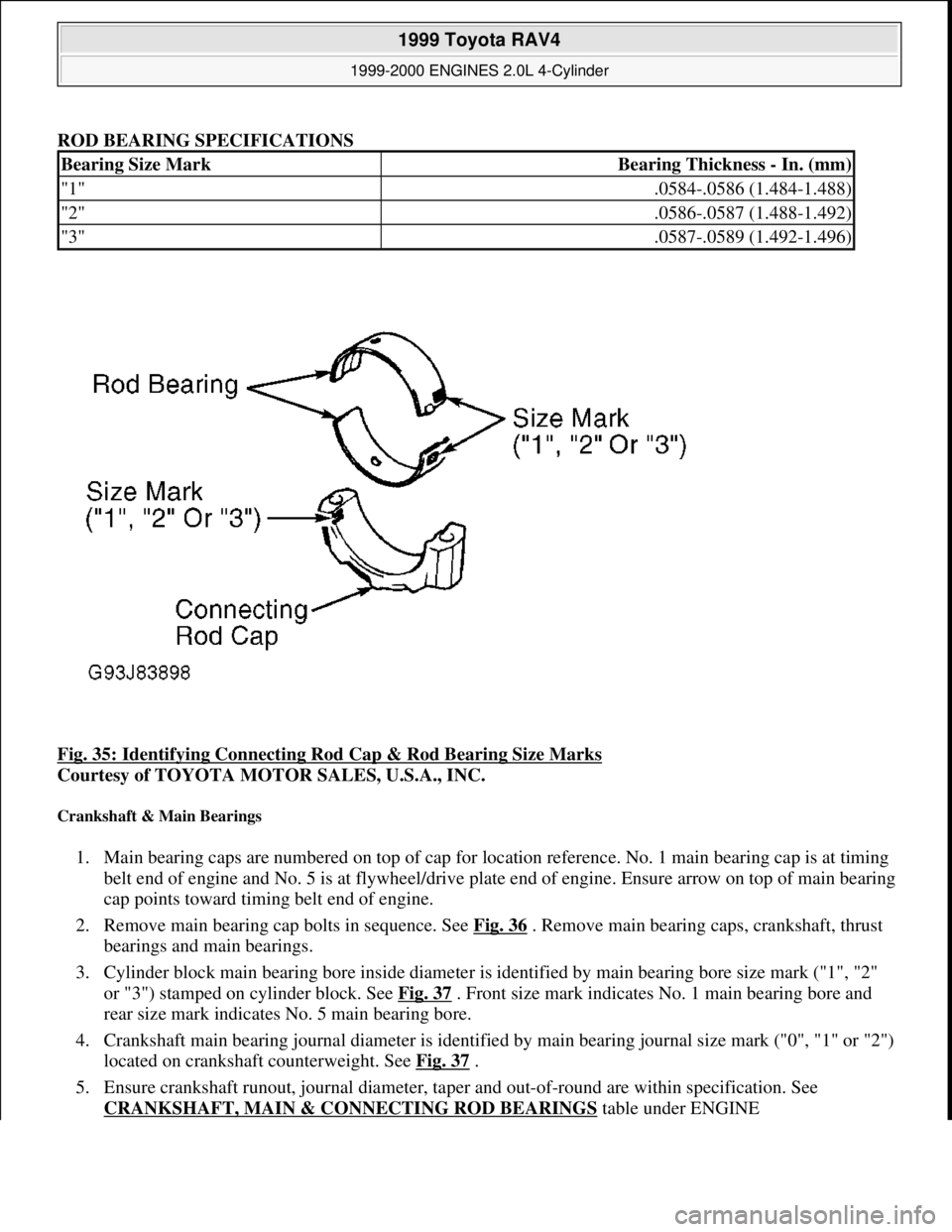
ROD BEARING SPECIFICATIONS
Fig. 35: Identifying Connecting Rod Cap & Rod Bearing Size Marks
Courtesy of TOYOTA MOTOR SALES, U.S.A., INC.
Crankshaft & Main Bearings
1. Main bearing caps are numbered on top of cap for location reference. No. 1 main bearing cap is at timing
belt end of engine and No. 5 is at flywheel/drive plate end of engine. Ensure arrow on top of main bearing
cap points toward timing belt end of engine.
2. Remove main bearing cap bolts in sequence. See Fig. 36
. Remove main bearing caps, crankshaft, thrust
bearings and main bearings.
3. Cylinder block main bearing bore inside diameter is identified by main bearing bore size mark ("1", "2"
or "3") stamped on cylinder block. See Fig. 37
. Front size mark indicates No. 1 main bearing bore and
rear size mark indicates No. 5 main bearing bore.
4. Crankshaft main bearing journal diameter is identified by main bearing journal size mark ("0", "1" or "2")
located on crankshaft counterweight. See Fig. 37
.
5. Ensure crankshaft runout, journal diameter, taper and out-of-round are within specification. See
CRANKSHAFT, MAIN & CONNECTING ROD BEARINGS
table under ENGINE
Bearing Size MarkBearing Thickness - In. (mm)
"1".0584-.0586 (1.484-1.488)
"2".0586-.0587 (1.488-1.492)
"3".0587-.0589 (1.492-1.496)
1999 Toyota RAV4
1999-2000 ENGINES 2.0L 4-Cylinder
Microsoft
Sunday, November 22, 2009 10:22:27 AMPage 50 © 2005 Mitchell Repair Information Company, LLC.
Page 771 of 1632
Removal
1. Disconnect negative battery cable. Remove power steering fluid reservoir with mounting bracket.
Remove accessory drive belts. Remove generator and generator mounting bracket. Remove wiring
brackets for access to timing belt covers.
2. On models with Anti-Lock Brake System (ABS), disconnect electrical connectors and brake lines from
ABS actuator. ABS actuator is located in front of passenger-side strut tower. Remove ABS actuator
mounting bracket-to-body bolts/nuts. Remove ABS actuator with mounting bracket.
3. On all models, raise and support vehicle. Remove passenger-side lower engine cover. Remove passenger-
side front wheel.
4. Using floor jack, slightly raise engine to remove weight from right (timing belt side) engine mount at
timing belt cover. Remove right (timing belt side) engine mount from body and mounting bracket on
cylinder block for access to timing belt covers.
5. Remove spark plugs. Remove crankshaft pulley bolt. Using puller, remove crankshaft pulley. Remove
right (timing belt side) engine mounting bracket from front of cylinder block.
6. Disconnect engine wiring harness protector from rear of No. 2 timing belt cover. When disconnecting
engine wiring harness protector, remove bolt on intake manifold side of engine first and then bolt on
exhaust manifold side of engine.
7. Remove No. 2 timing belt cover. See Fig. 17
. Install crankshaft pulley on crankshaft. Temporarily install
crankshaft pulley bolt.
8. Rotate crankshaft clockwise, viewed from timing belt end of engine, so cylinder No. 1 is at TDC on
compression stroke and timing mark on crankshaft pulley aligns with "0" mark on timing belt cover.
Cylinder No. 1 is front cylinder at timing belt end of engine.
9. Ensure hole in camshaft sprocket aligns with alignment mark on camshaft bearing cap. See Fig. 18
. If
hole in camshaft sprocket is not aligned with alignment mark, rotate crankshaft clockwise one full
revolution.
1997 Toyota RAV4
2.0L 4-CYL 1997-98 ENGINES Toyota 2.0L 4-Cylinder
Microsoft
Sunday, November 22, 2009 10:23:31 AMPage 23 © 2005 Mitchell Repair Information Company, LLC.
Page 800 of 1632
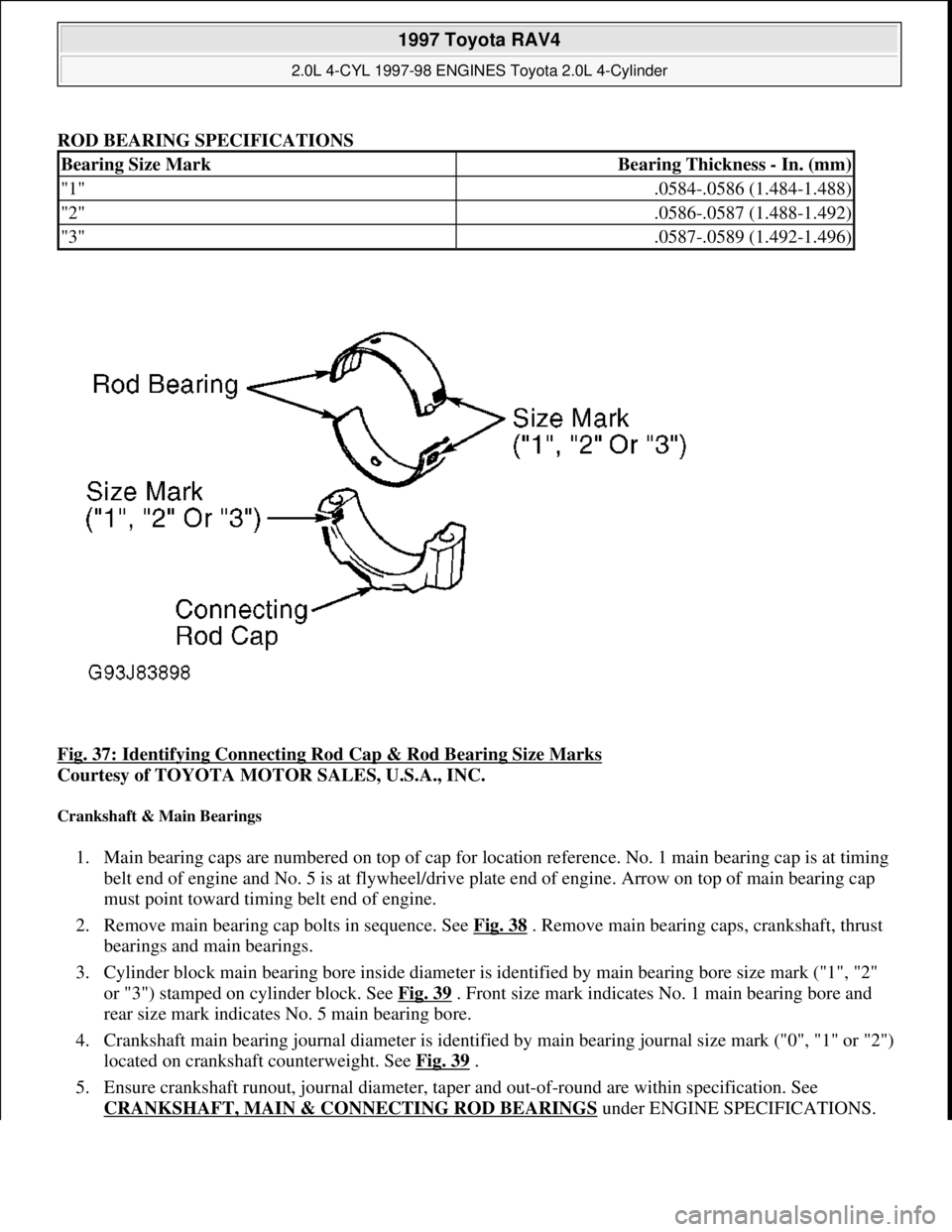
ROD BEARING SPECIFICATIONS
Fig. 37: Identifying Connecting Rod Cap & Rod Bearing Size Marks
Courtesy of TOYOTA MOTOR SALES, U.S.A., INC.
Crankshaft & Main Bearings
1. Main bearing caps are numbered on top of cap for location reference. No. 1 main bearing cap is at timing
belt end of engine and No. 5 is at flywheel/drive plate end of engine. Arrow on top of main bearing cap
must point toward timing belt end of engine.
2. Remove main bearing cap bolts in sequence. See Fig. 38
. Remove main bearing caps, crankshaft, thrust
bearings and main bearings.
3. Cylinder block main bearing bore inside diameter is identified by main bearing bore size mark ("1", "2"
or "3") stamped on cylinder block. See Fig. 39
. Front size mark indicates No. 1 main bearing bore and
rear size mark indicates No. 5 main bearing bore.
4. Crankshaft main bearing journal diameter is identified by main bearing journal size mark ("0", "1" or "2")
located on crankshaft counterweight. See Fig. 39
.
5. Ensure crankshaft runout, journal diameter, taper and out-of-round are within specification. See
CRANKSHAFT, MAIN & CONNECTING ROD BEARINGS
under ENGINE SPECIFICATIONS.
Bearing Size MarkBearing Thickness - In. (mm)
"1".0584-.0586 (1.484-1.488)
"2".0586-.0587 (1.488-1.492)
"3".0587-.0589 (1.492-1.496)
1997 Toyota RAV4
2.0L 4-CYL 1997-98 ENGINES Toyota 2.0L 4-Cylinder
Microsoft
Sunday, November 22, 2009 10:23:31 AMPage 52 © 2005 Mitchell Repair Information Company, LLC.
Page 1104 of 1632
Courtesy of TOYOTA MOTOR SALES, U.S.A., INC.
Inspection
1. Using micrometer, measure diameter of pump shaft. Using calipers, measure diameter or pump housing
shaft bushing. Determine amount of clearance. Clearance should be .0012-.0020" (.030-.050 mm).
Clearance should not exceed .0028" (.071 mm). If clearance exceeds maximum specification, replace
front housing and pump shaft.
2. Using micrometer, measure height, thickness and length of 10 vane plates. See VANE PLATE
SPECIFICATIONS table. Use feeler gauge to measure clearance between rotor groove and plate.
Maximum clearance is .0012" (.030 mm). If clearance exceeds maximum, replace plate and/or rotor with
one having same mark stamp of "1", "2", "3", "4" or no marking.
3. Coat flow control valve with power steering fluid and check that it falls smoothly into valve hole on its
own weight.
4. Check flow control valve for leakage by closing one hose and applying 57-71 psi (4-5 kg/cm2) air
pressure to opposite hole. Air should NOT come out hole on end of valve. If valve does not respond as
indicated, replace valve with one having same letter mark as on front housing and/or on valve.
5. Using calipers, measure free length of flow control valve spring. Minimum free length is 1.42" (36.0
mm). If not within specification, replace spring.
6. If necessary, replace oil seal. Coat NEW seal lip with power steering fluid and carefully press NEW oil
seal into position. Ensure seal is in same direction as removed.
VANE PLATE SPECIFICATIONS
Reassembly
1. Coat all internal components with power steering fluid. Install long straight pin into front housing and
short straight pin into side front plate.
2. Install 2 NEW "O" rings to side front plate. Coat "O" rings with power steering fluid. Install front plate to
pump shaft. Install rotor to pump shaft with mark facing outward. Install NEW snap ring to pump shaft.
3. Align hole of plate and longer straight pin, and tap shaft into place with soft-face hammer. Use care not to
damage oil seal and "O" rings. Align holes of cam ring and 2 straight pins, and install cam ring with mark
facing outward. Install 10 vane plates, with round end facing outward.
4. Coat a NEW "O" ring with power steering fluid. Install "O" ring to side rear plate. Align holes on plate
and 2 straight pins, and install plate. Install wave washer so protrusions fit into slots in side rear plate.
ApplicationIn. (mm)
RAV4
Height.319 (8.1)
Length.59008 (14.988)
Thickness.0707 (1.796)
Land Cruiser, Sienna, Tacoma, Tundra & 4Runner
Height.339 (8.6)
Length.5902 (14.991)
Thickness.0550 (1.397)
1999 Toyota RAV4
1999-2000 STEERING Power Rack & Pinion - Trucks
Microsoft
Sunday, November 22, 2009 10:35:46 AMPage 11 © 2005 Mitchell Repair Information Company, LLC.