Fuel line TOYOTA RAV4 2006 Service User Guide
[x] Cancel search | Manufacturer: TOYOTA, Model Year: 2006, Model line: RAV4, Model: TOYOTA RAV4 2006Pages: 2000, PDF Size: 45.84 MB
Page 72 of 2000

ENGINE - 2GR-FE ENGINE
285EG12
Liner
Cylinder
Block
Irregularly shaped
outer casting
surface of liner A
A
A - A Cross Section
285EG13
Front MarkResin CoatingTaper Squish Shape
Alumite
Coating EG-76
A compact block has been achieved by producing the thin cast-iron liners and cylinder block as a unit. It
is not possible to bore the block with this liner.
The liners are the spiny-type, which have been manufactured so that their casting exteriors form large
irregular surfaces in order to enhance the adhesion between the liners and the aluminum cylinder block.
The enhanced adhesion helps improve heat dissipation, resulting in a lower overall temperature and heat
deformation of the cylinder bores.
5. Piston
The piston is made of aluminum alloy.
The piston head portion uses a taper squish shape to accomplish fuel combustion efficiency.
The piston skirt is coated with resin to reduce the friction loss.
The groove of the top ring is coated with alumite to ensure wear resistance.
By increasing the machining precision of the cylinder bore diameter, the outer diameter of the piston is
made into one size.
Page 97 of 2000

ENGINE - 2GR-FE ENGINEEG-101
ENGINE CONTROL SYSTEM
1. General
The engine control system of the 2GR-FE engine has the following features.
System
Outline
SFI
(Sequential Multiport
Fuel Injection)
[See page EG-117]
An L-type SFI system detects the intake air mass with a hot-wire type air
flow meter.
ESA
(Electronic Spark
Advance)
Ignition timing is determined by the ECM based on signals from various
sensors. The ECM corrects ignition timing in response to engine
knocking.
This system selects the optimal ignition timing in accordance with the
signals received from the sensors and sends the (IGT) ignition signal to
the igniter.
ETCS-i
(Electronic Throttle
Control
System-intelligent)
[See page EG-118]
Optimally controls the throttle valve opening in accordance with the amount
of accelerator pedal effort and the condition of the engine and the vehicle.
Dual VVT-i
(Variable Valve
Timing-intelligent)
System
[See page EG-120]
Controls the intake and exhaust camshafts to an optimal valve timing in
accordance with the engine condition.
ACIS
(Acoustic Control
Induction System)
[See page EG-126]The intake air passages are switched according to the engine speed and
throttle valve opening angle to provided high performance in all speed
ranges.
Air Intake Control
System
[See page EG-128]The intake air duct is divided into two areas, and the ECM controls the air
intake control valve and the actuator that are provided in one of the areas to
reduce the amount of engine noise.
Fuel Pump Control
[See page EG-53 in
2AZ-FE section]Fuel pump operation is controlled by signals from the ECM.
The fuel pump is stopped, when the SRS airbag is deployed in a frontal,
side, and rear side collision.
Air Conditioning Cut-off
ControlBy turning the air conditioning compressor ON or OFF in accordance with
the engine condition, drivability is maintained.
Charging Control
[See page EG-65 in
2AZ-FE section]The engine ECU regulates the charging voltage of the generator in
accordance with the driving conditions and the charging state of the battery.
Cooling Fan Control
[See page EG-129]
The cooling fan ECU steplessly controls the speed of the fans in accordance
with the engine coolant temperature, vehicle speed, engine speed, and air
conditioning operating conditions. As a result, the cooling performance is
improved.
(Continued)
Page 98 of 2000

ENGINE - 2GR-FE ENGINE EG-102
System
Outline
Air-fuel Ratio Sensor and
Oxygen Sensor Heater
ControlMaintains the temperature of the air-fuel ratio sensor or oxygen sensor at an
appropriate level to increase accuracy of detection of the oxygen
concentration in the exhaust gas.
Evaporative Emission
Control
[See page EG-131]
The ECM controls the purge flow of evaporative emission (HC) in the
canister in accordance with engine conditions.
Approximately five hours after the ignition switch has been turned OFF,
the ECM operates the canister pump module to detect any evaporative
emission leakage occurring in the EVAP (evaporative emission) control
system through changes in the EVAP control system pressure.
Engine ImmobilizerProhibits fuel delivery and ignition if an attempt is made to start the engine
with an invalid ignition key.
Diagnosis
[See page EG-132]When the ECM detects a malfunction, the ECM diagnoses and memorizes
the failed section.
Fail-safe
[See page EG-133]When the ECM detects a malfunction, the ECM stops or controls the engine
according to the data already stored in the memory.
Page 105 of 2000

ENGINE - 2GR-FE ENGINEEG-109
5. Main Components of Engine Control System
General
The main components of the 2GR-FE engine control system are as follows:
Component
OutlineQuantity
ECM32-bit CPU1
Mass Air Flow MeterHot-wire Type1
Crankshaft Position Sensor (Rotor Teeth)Pick-up Coil Type (36 - 2)1
Intake VVT Sensor (Rotor Teeth)MRE (Magnetic Resistance Element)
Ty p e ( 3 )2
Exhaust VVT Sensor (Rotor Teeth)MRE (Magnetic Resistance Element)
Ty p e ( 3 )2
Accelerator Pedal Position SensorNon-contact Type1
Throttle Position SensorNon-contact Type1
Knock SensorBuilt-in Piezoelectric Type
(Non-resonant Type / Flat Type)2
Air fuel Ratio Sensor(Bank 1, Sensor 1)Type with Heater (Planar Type)1 eachAir-fuel Ratio Sensor(Bank 2, Sensor 1)Type with Heater (Planar Type)1 each
Heated Oxygen (Bank 1, Sensor 2)Type with Heater (Cup Type)1 eachHeated Oxygen
Sensor
(Bank 2, Sensor 2)Type with Heater (Cup Type)1 each
Injector12-hole Type6
Page 114 of 2000

ENGINE - 2GR-FE ENGINE
01MEG18Y
Accelerator Pedal
Position SensorThrottle ValveThrottle Position Sensor
Throttle Control
Motor
Mass Air
Flow Meter
Cruise Control
Switch
Skid Control
ECUECMIgnition Coil
Fuel Injection EG-118
8. ETCS-i (Electronic Throttle Control System-intelligent)
General
In the conventional throttle body, the throttle valve angle is determined invariably by the amount of the
accelerator pedal effort. In contrast, ETCS-i uses the ECM to calculate the optimal throttle valve angle that
is appropriate for the respective driving condition and uses a throttle control motor to control the angle.
System Diagram
Control
1) General
The ETCS-i consists of the following five functions:
Normal Throttle Control (Non-linear Control)
IAC (Idle Air Control)
TRAC (Traction Control)
VSC (Vehicle Stability Control)
Cruise Control
Page 127 of 2000

ENGINE - 2GR-FE ENGINE
01MEG23Y
Purge Line
Purge VSV
Fuel Tank
Canister Pump Module
Canister Pressure Sensor
Leak Detection Pump
Vent Valve
Front
Fresh Air Line
Air Filter
Refueling Valve CanisterEG-131
13. Evaporative Emission Control System
General
The 2GR-FE engine uses the same type of evaporative emission control system as the 2AZ-FE engine. For
details, see page EG-54.
Layout of Main Components
Page 133 of 2000

CHASSIS - 4WD SYSTEM CH-66
4WD SYSTEM
DESCRIPTION
The 4WD system of the ’06 RAV4 uses an active torque control 4WD system.
It is a compact, lightweight, and high performance 4WD system that optimally controls the torque
distribution to the front and rear wheels through the electric control coupling in the rear differential.
ACTIVE TORQUE CONTROL 4WD SYSTEM
1. General
Based on information provided by various sensors, the 4WD ECU controls the amperage that is applied
to the electric control coupling, in order to transmit drive torque to the rear wheels when needed, and in
the amount needed. The following describes the features of the active torque control 4WD system.
Traction performance
Realizes stable start-off and acceleration performance
Driving stability performanceRealizes stable cornering performance
Fuel economyRealizes better fuel economy by transmitting drive torque to the rear
wheels when needed, in the amount needed.
A four-wheel drive lock switch has been provided. This enables the driver to select between the AUTO
and LOCK modes by operating the switch. The system optimally controls the torque distribution to the
front and rear wheels in the respective modes.
Mode
Four-wheel Drive
Lock Switch and
Indicator Light
Outline
AUTOOFF
Optimally distributes drive torque to the front and rear wheels.
Ensures optimal start-off performance during a start-off, based on
information provided by various sensors.
Suppresses the tight corner braking phenomenon* during low-speed
cornering.
Reduces the amount of torque distribution to the rear wheels and
improves fuel economy when the system judges that the vehicle is
traveling steadily.
Disengages the 4WD during braking deceleration.
LOCKON
Distributes the maximum torque limit to the rear wheels.
Distributes the maximum torque limit to the rear wheels during
start-off.
Distributes optimal torque during low-speed cornering.
Disengages the 4WD during braking deceleration.
Disengages the LOCK mode and transfers to the AUTO mode when
the vehicle speed exceeds 40 km / h (25 mph).
*: Tight corner braking phenomenon: a condition in which the brakes are applied due to a rotational difference
between the front and rear wheels, such as during low-speed cornering in the 4WD mode.
The 4WD ECU effects cooperative control with the skid control ECU, in order to control the drive torque
distribution to the front and rear wheels in accordance with information received from the skid control
ECU. These controls ensure a smooth acceleration and driving stability.
Page 137 of 2000

CHASSIS - 4WD SYSTEM
01NCH38Y
Torque Distribution
to Rear WheelsTorque Distribution
to Rear Wheels
Straightline Driving Low-Speed Cornering
01NCH39Y
Torque Distribution
to Rear WheelsTorque Distribution
to Rear Wheels
Steady Driving Straightline Acceleration
NOTICE
In the LOCK mode after the four-wheel drive lock switch is pressed, the system starts control upon
judging that the vehicle is operating in a stable manner. During this judgment, the 4WD LOCK
indicator light blinks.
CH-70
5. System Operation
Auto Mode
1) Starting Off
The system ensures start-off performance by optimally distributing the entire drive torque, which is
transmitted by the engine, to the front and rear wheels.
To prevent the tight corner braking phenomenon from occurring during low-speed cornering, the
system reduces the amount of torque distribution to the rear wheels.
2) Normal Driving
During normal driving, when the system judges that the vehicle is traveling steadily, it reduces the
amount of torque distribution to the rear wheels. This allows the vehicle to operate in conditions
similar to front-wheel-drive, which improves fuel economy.
To ensure excellent acceleration performance during straightline acceleration and excellent driving
stability during cornering, the system controls the amount of torque distribution to the rear wheels.
Lock Mode
When the vehicle is in a situation that poses difficulty for it to pull itself out, such as sand, the driver can
switch to LOCK mode by operating the four-wheel drive lock switch. Thus, this mode effects optimal
control in accordance with the driving conditions and transmits as much drive torque as possible to the rear
wheels, in a mode that is similar to the locked 4WD mode.
Page 208 of 2000
FU–62AZ-FE FUEL – FUEL SYSTEM
FU
ON-VEHICLE INSPECTION
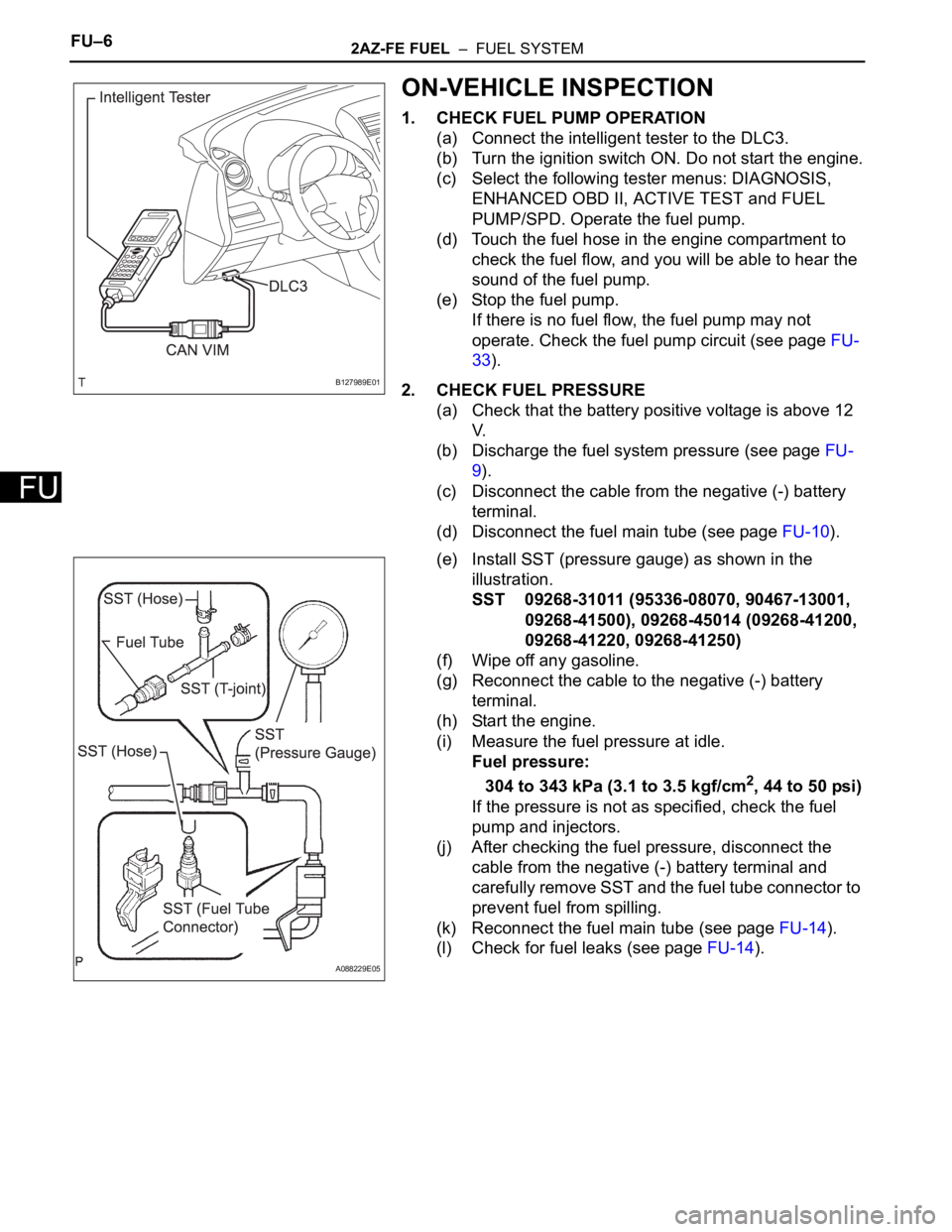
1. CHECK FUEL PUMP OPERATION
(a) Connect the intelligent tester to the DLC3.
(b) Turn the ignition switch ON. Do not start the engine.
(c) Select the following tester menus: DIAGNOSIS,
ENHANCED OBD II, ACTIVE TEST and FUEL
PUMP/SPD. Operate the fuel pump.
(d) Touch the fuel hose in the engine compartment to
check the fuel flow, and you will be able to hear the
sound of the fuel pump.
(e) Stop the fuel pump.
If there is no fuel flow, the fuel pump may not
operate. Check the fuel pump circuit (see page FU-
33).
2. CHECK FUEL PRESSURE
(a) Check that the battery positive voltage is above 12
V.
(b) Discharge the fuel system pressure (see page FU-
9).
(c) Disconnect the cable from the negative (-) battery
terminal.
(d) Disconnect the fuel main tube (see page FU-10).
(e) Install SST (pressure gauge) as shown in the
illustration.
SST 09268-31011 (95336-08070, 90467-13001,
09268-41500), 09268-45014 (09268-41200,
09268-41220, 09268-41250)
(f) Wipe off any gasoline.
(g) Reconnect the cable to the negative (-) battery
terminal.
(h) Start the engine.
(i) Measure the fuel pressure at idle.
Fuel pressure:
304 to 343 kPa (3.1 to 3.5 kgf/cm
2, 44 to 50 psi)
If the pressure is not as specified, check the fuel
pump and injectors.
(j) After checking the fuel pressure, disconnect the
cable from the negative (-) battery terminal and
carefully remove SST and the fuel tube connector to
prevent fuel from spilling.
(k) Reconnect the fuel main tube (see page FU-14).
(l) Check for fuel leaks (see page FU-14).
B127989E01
A088229E05
Page 227 of 2000
2AZ-FE EMISSION CONTROL – EMISSION CONTROL SYSTEMEC–7
EC
ON-VEHICLE INSPECTION
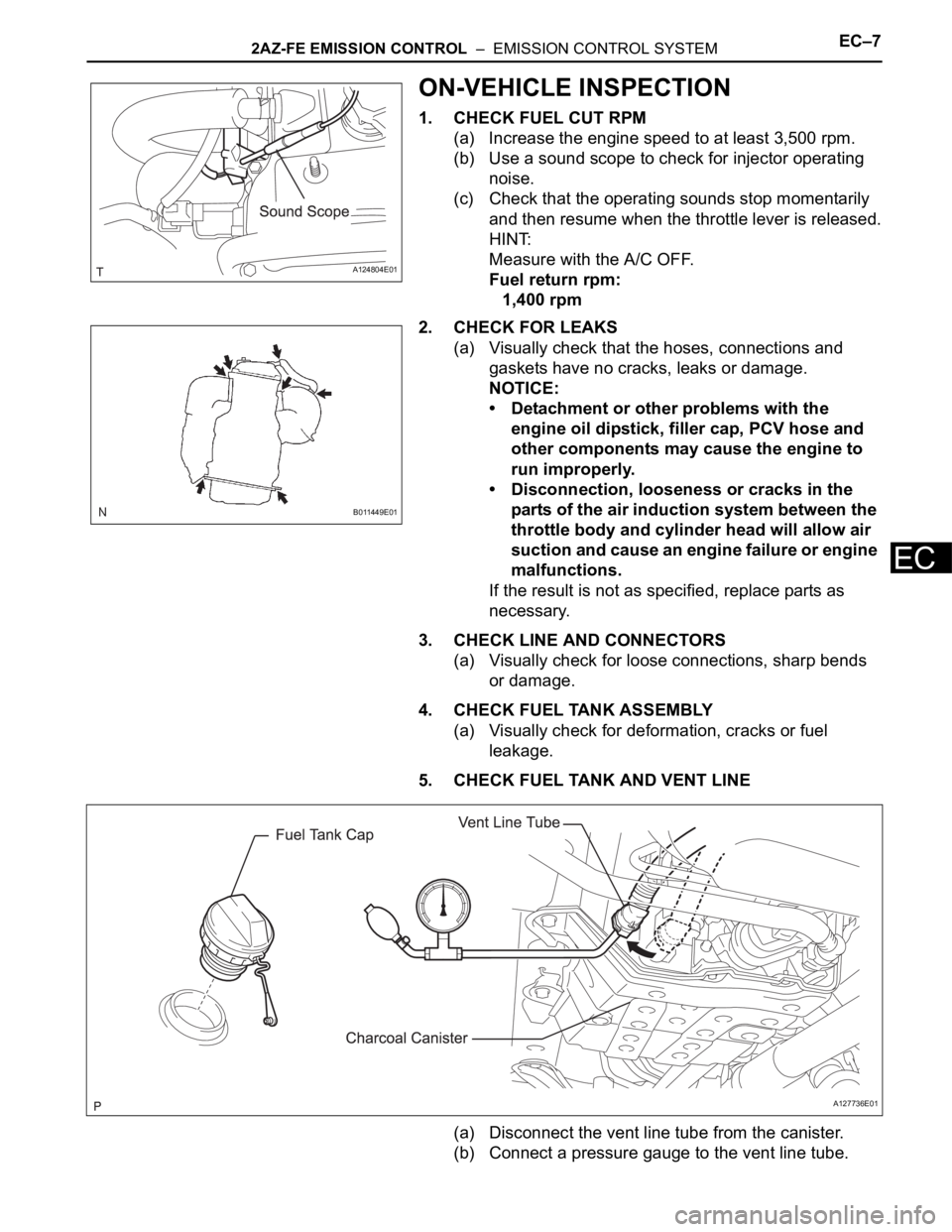
1. CHECK FUEL CUT RPM
(a) Increase the engine speed to at least 3,500 rpm.
(b) Use a sound scope to check for injector operating
noise.
(c) Check that the operating sounds stop momentarily
and then resume when the throttle lever is released.
HINT:
Measure with the A/C OFF.
Fuel return rpm:
1,400 rpm
2. CHECK FOR LEAKS
(a) Visually check that the hoses, connections and
gaskets have no cracks, leaks or damage.
NOTICE:
• Detachment or other problems with the
engine oil dipstick, filler cap, PCV hose and
other components may cause the engine to
run improperly.
• Disconnection, looseness or cracks in the
parts of the air induction system between the
throttle body and cylinder head will allow air
suction and cause an engine failure or engine
malfunctions.
If the result is not as specified, replace parts as
necessary.
3. CHECK LINE AND CONNECTORS
(a) Visually check for loose connections, sharp bends
or damage.
4. CHECK FUEL TANK ASSEMBLY
(a) Visually check for deformation, cracks or fuel
leakage.
5. CHECK FUEL TANK AND VENT LINE
(a) Disconnect the vent line tube from the canister.
(b) Connect a pressure gauge to the vent line tube.
A124804E01
B011449E01
A127736E01