check oil TOYOTA RAV4 2006 Service User Guide
[x] Cancel search | Manufacturer: TOYOTA, Model Year: 2006, Model line: RAV4, Model: TOYOTA RAV4 2006Pages: 2000, PDF Size: 45.84 MB
Page 402 of 2000

DF–8DIFFERENTIAL – REAR DIFFERENTIAL SIDE GEAR SHAFT OIL SEAL
DF
9. CHECK FOR DIFFERENTIAL OIL LEAKAGE
10. CHECK FOR EXHAUST GAS LEAKAGE
If gas is leaking, tighten the areas necessary to stop the
leak. Replace damaged parts as necessary.
Page 407 of 2000
SUSPENSION – FRONT SHOCK ABSORBER WITH COIL SPRINGSP–11
SP
9. REMOVE FRONT COIL SPRING LH
(a) Remove the coil spring from the shock absorber.
(b) Remove SST from the coil spring.
10. REMOVE FRONT COIL SPRING INSULATOR LOWER
LH
(a) Remove the insulator lower from the shock
absorber.
INSPECTION
1. INSPECT FRONT SHOCK ABSORBER ASSEMBLY
LH
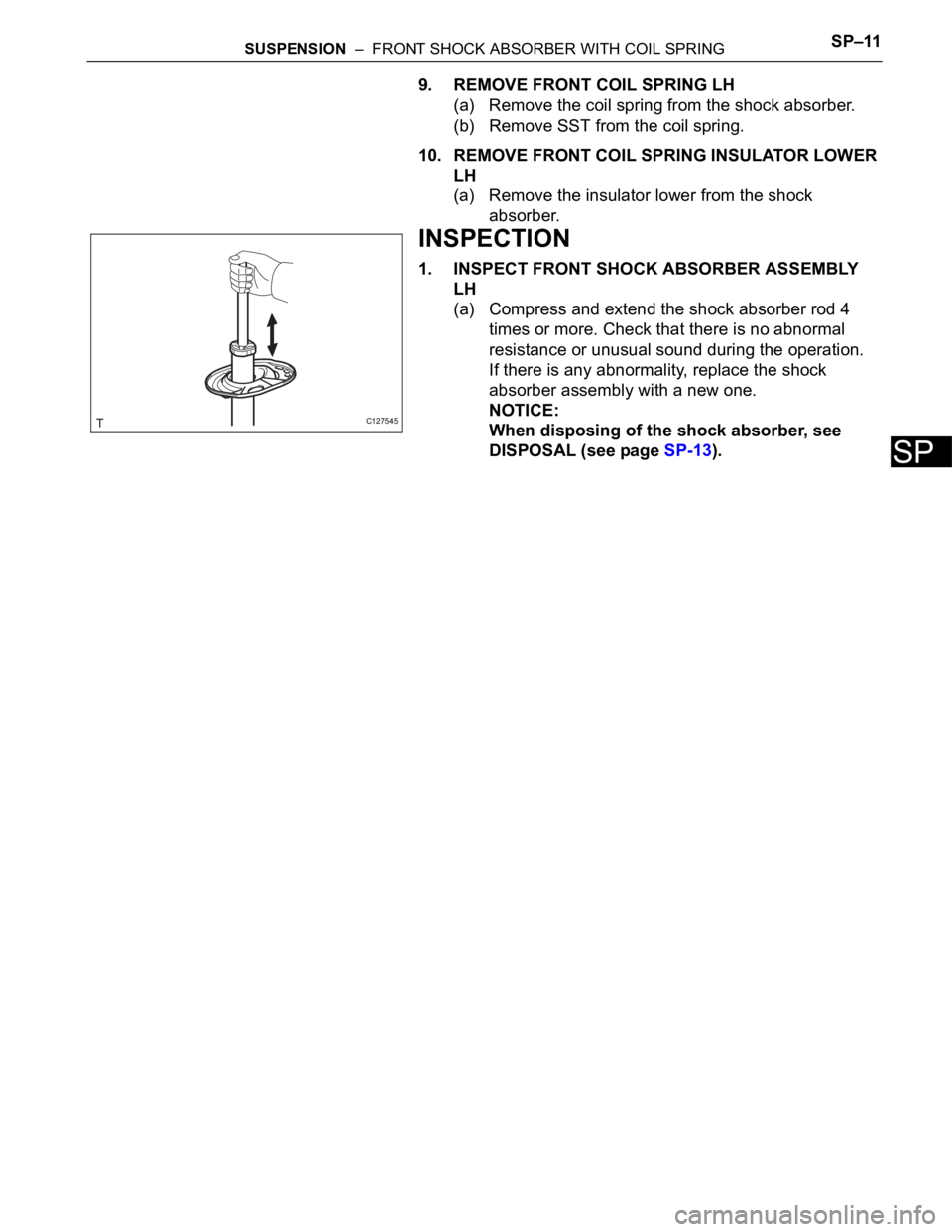
(a) Compress and extend the shock absorber rod 4
times or more. Check that there is no abnormal
resistance or unusual sound during the operation.
If there is any abnormality, replace the shock
absorber assembly with a new one.
NOTICE:
When disposing of the shock absorber, see
DISPOSAL (see page SP-13).
C127545
Page 415 of 2000
BRAKE – BRAKE SYSTEMBR–3
BR
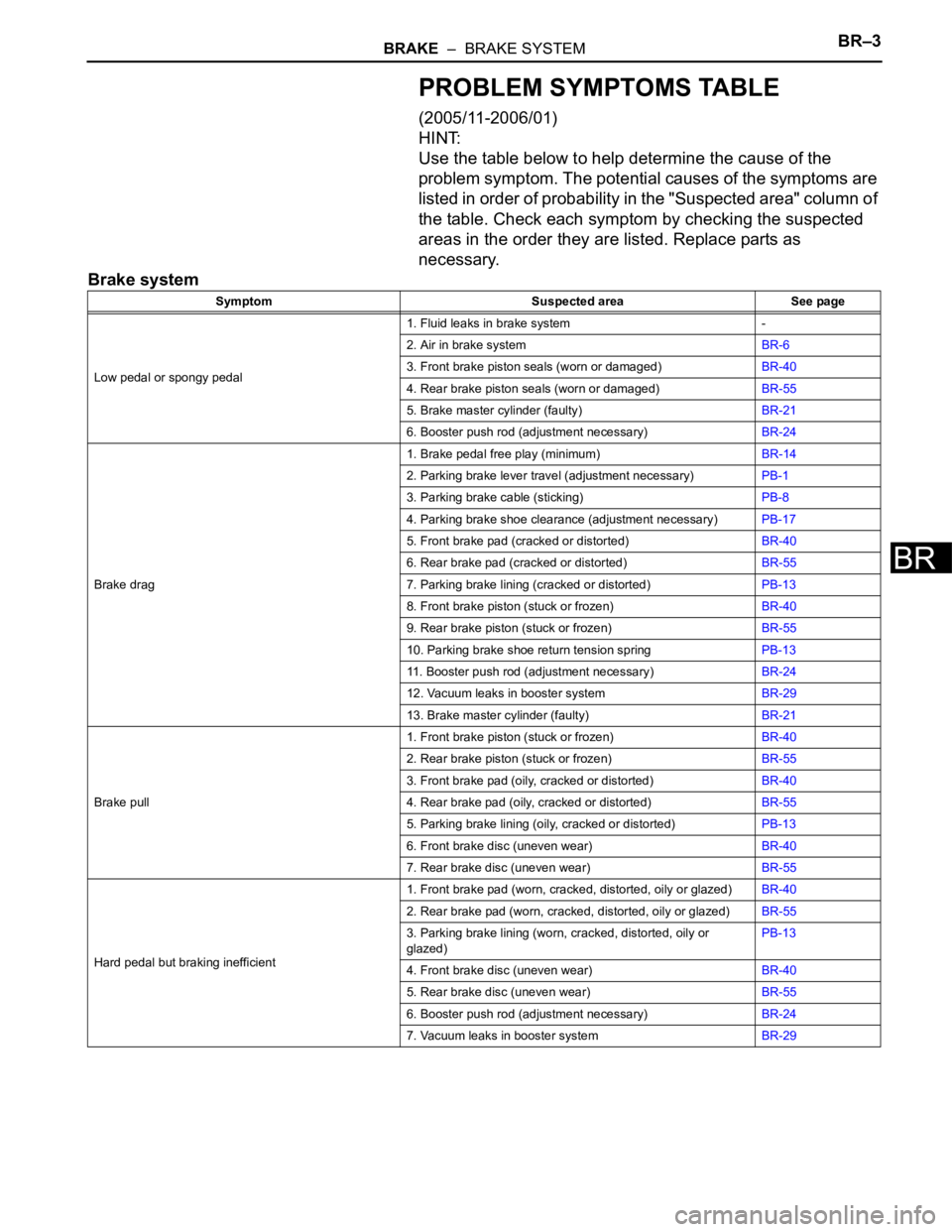
PROBLEM SYMPTOMS TABLE
(2005/11-2006/01)
HINT:
Use the table below to help determine the cause of the
problem symptom. The potential causes of the symptoms are
listed in order of probability in the "Suspected area" column of
the table. Check each symptom by checking the suspected
areas in the order they are listed. Replace parts as
necessary.
Brake system
Symptom Suspected area See page
Low pedal or spongy pedal1. Fluid leaks in brake system -
2. Air in brake systemBR-6
3. Front brake piston seals (worn or damaged)BR-40
4. Rear brake piston seals (worn or damaged)BR-55
5. Brake master cylinder (faulty)BR-21
6. Booster push rod (adjustment necessary)BR-24
Brake drag1. Brake pedal free play (minimum)BR-14
2. Parking brake lever travel (adjustment necessary)PB-1
3. Parking brake cable (sticking)PB-8
4. Parking brake shoe clearance (adjustment necessary)PB-17
5. Front brake pad (cracked or distorted)BR-40
6. Rear brake pad (cracked or distorted)BR-55
7. Parking brake lining (cracked or distorted)PB-13
8. Front brake piston (stuck or frozen)BR-40
9. Rear brake piston (stuck or frozen)BR-55
10. Parking brake shoe return tension springPB-13
11. Booster push rod (adjustment necessary)BR-24
12. Vacuum leaks in booster systemBR-29
13. Brake master cylinder (faulty)BR-21
Brake pull1. Front brake piston (stuck or frozen)BR-40
2. Rear brake piston (stuck or frozen)BR-55
3. Front brake pad (oily, cracked or distorted)BR-40
4. Rear brake pad (oily, cracked or distorted)BR-55
5. Parking brake lining (oily, cracked or distorted)PB-13
6. Front brake disc (uneven wear)BR-40
7. Rear brake disc (uneven wear)BR-55
Hard pedal but braking inefficient1. Front brake pad (worn, cracked, distorted, oily or glazed)BR-40
2. Rear brake pad (worn, cracked, distorted, oily or glazed)BR-55
3. Parking brake lining (worn, cracked, distorted, oily or
glazed)PB-13
4. Front brake disc (uneven wear)BR-40
5. Rear brake disc (uneven wear)BR-55
6. Booster push rod (adjustment necessary)BR-24
7. Vacuum leaks in booster systemBR-29
Page 419 of 2000

MA–12MAINTENANCE – CHASSIS
MA
GENERAL MAINTENANCE
(2006/01- )
1. INSPECT STEERING LINKAGE AND GEAR HOUSING
(a) Check the steering wheel free play.
(b) Check the steering linkage for looseness or
damage.
(1) Check that the tie rod ends do not have
excessive play.
(2) Check that the dust seals and boots are not
damaged.
(3) Check that the boot clamps are not loose.
(4) Check that the steering gear housing is not
damaged.
(5) Check that the connectors are properly
connected to the steering gear housing.
2. INSPECT BALL JOINTS AND DUST COVERS
(a) Inspect the ball joints for excessive looseness.
(1) Jack up the front of the vehicle and place
wooden blocks with a height of 180 to 200 mm
(7.09 to 7.87 in.) under the front tires.
(2) Lower the vehicle until the front coil spring has
about half its ordinary load. Place stands under
the vehicle for safety.
(3) Check that the front wheels are pointing
straight ahead. Use wheel chocks on all 4
wheels.
(4) Using a lever, pry up the end of the lower arm.
Check the amount of play.
Maximum ball joint vertical play:
0 mm (0 in.)
If there is any play, replace the ball joint.
(b) Check the dust cover for damage.
3. INSPECT DRIVE SHAFT BOOTS
(a) Check the drive shaft boots for loose clamps,
grease leakage, kinks or damage.
4. INSPECT AUTOMATIC TRANSAXLE FLUID LEVEL
(a) Visually check the transmission for fluid leakage. If
oil is leaking, find the cause and repair it.
5. INSPECT TRANSFER OIL (for 4WD)
(a) Visually check the transfer for oil leakage. If oil is
leaking, find the cause and repair it.
6. INSPECT REAR DIFFERENTIAL OIL (for 4WD)
(a) For the rear differential oil inspection, refer to the
following procedures (see page DF-3).
Type See procedures
U151E See page AX-126
U151F See page AX-126
Type See procedures
Front Oil See page TF-45
Rear Oil See page TF-45
Page 468 of 2000
ES–142AZ-FE ENGINE CONTROL SYSTEM – SFI SYSTEM
ES
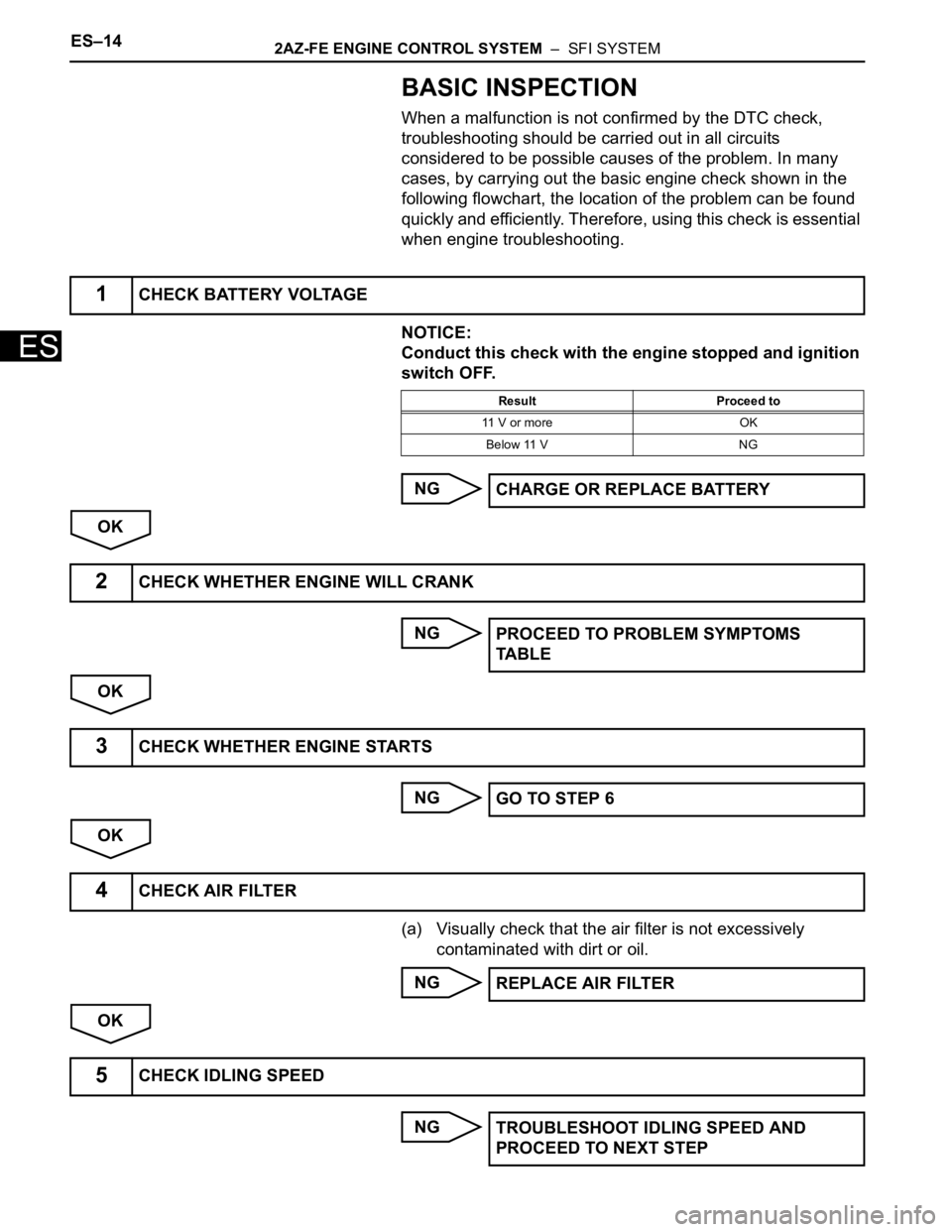
BASIC INSPECTION
When a malfunction is not confirmed by the DTC check,
troubleshooting should be carried out in all circuits
considered to be possible causes of the problem. In many
cases, by carrying out the basic engine check shown in the
following flowchart, the location of the problem can be found
quickly and efficiently. Therefore, using this check is essential
when engine troubleshooting.
NOTICE:
Conduct this check with the engine stopped and ignition
switch OFF.
NG
OK
NG
OK
NG
OK
(a) Visually check that the air filter is not excessively
contaminated with dirt or oil.
NG
OK
NG
1CHECK BATTERY VOLTAGE
Result Proceed to
11 V or more OK
Below 11 V NG
CHARGE OR REPLACE BATTERY
2CHECK WHETHER ENGINE WILL CRANK
PROCEED TO PROBLEM SYMPTOMS
TA B L E
3CHECK WHETHER ENGINE STARTS
GO TO STEP 6
4CHECK AIR FILTER
REPLACE AIR FILTER
5CHECK IDLING SPEED
TROUBLESHOOT IDLING SPEED AND
PROCEED TO NEXT STEP
Page 485 of 2000
2AZ-FE ENGINE CONTROL SYSTEM – SFI SYSTEMES–31
ES
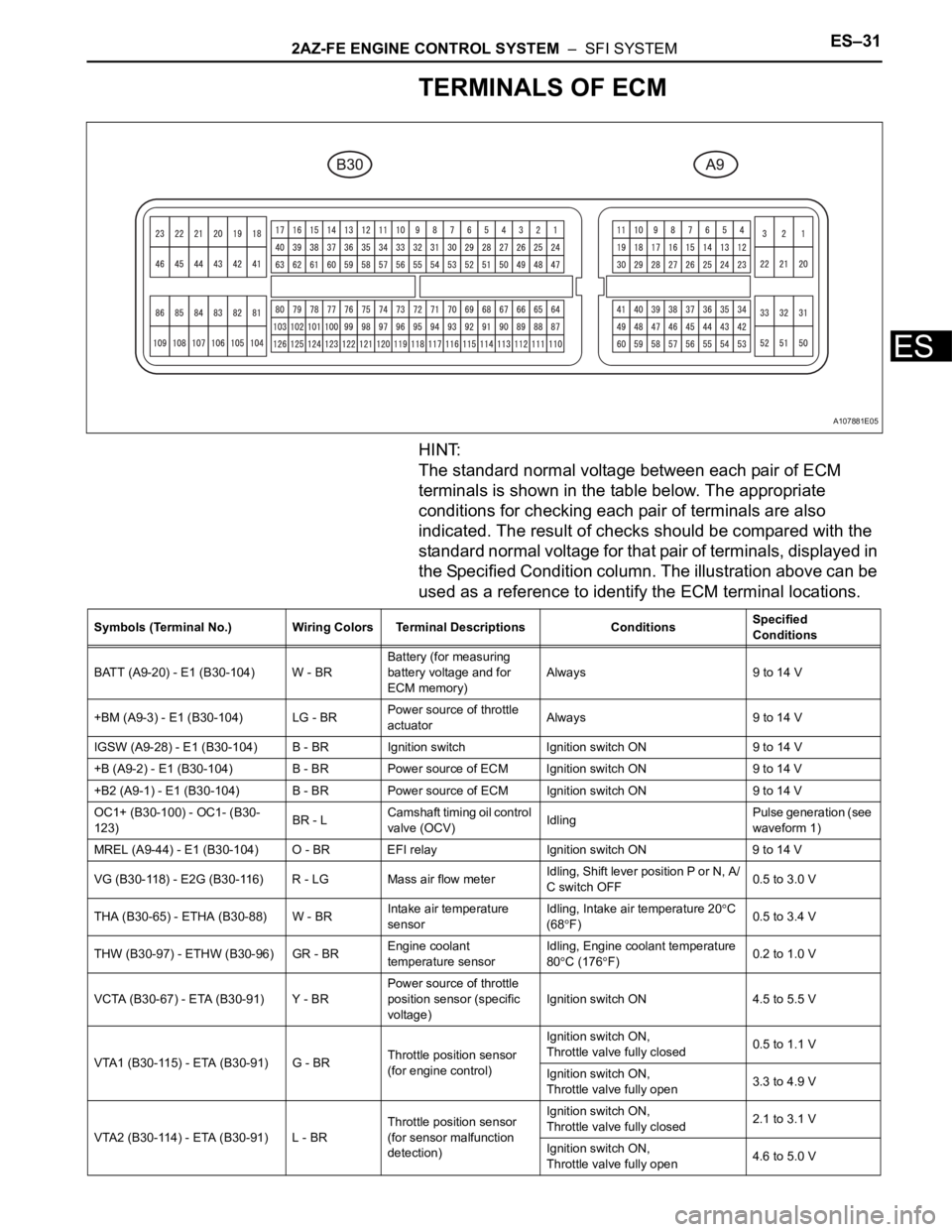
TERMINALS OF ECM
HINT:
The standard normal voltage between each pair of ECM
terminals is shown in the table below. The appropriate
conditions for checking each pair of terminals are also
indicated. The result of checks should be compared with the
standard normal voltage for that pair of terminals, displayed in
the Specified Condition column. The illustration above can be
used as a reference to identify the ECM terminal locations.
A107881E05
Symbols (Terminal No.) Wiring Colors Terminal Descriptions ConditionsSpecified
Conditions
BATT (A9-20) - E1 (B30-104) W - BRBattery (for measuring
battery voltage and for
ECM memory)Always 9 to 14 V
+BM (A9-3) - E1 (B30-104) LG - BRPower source of throttle
actuatorAlways 9 to 14 V
IGSW (A9-28) - E1 (B30-104) B - BR Ignition switch Ignition switch ON 9 to 14 V
+B (A9-2) - E1 (B30-104) B - BR Power source of ECM Ignition switch ON 9 to 14 V
+B2 (A9-1) - E1 (B30-104) B - BR Power source of ECM Ignition switch ON 9 to 14 V
OC1+ (B30-100) - OC1- (B30-
123)BR - LCamshaft timing oil control
valve (OCV)IdlingPulse generation (see
waveform 1)
MREL (A9-44) - E1 (B30-104) O - BR EFI relay Ignition switch ON 9 to 14 V
VG (B30-118) - E2G (B30-116) R - LG Mass air flow meterIdling, Shift lever position P or N, A/
C switch OFF0.5 to 3.0 V
THA (B30-65) - ETHA (B30-88) W - BRIntake air temperature
sensorIdling, Intake air temperature 20
C
(68
F)0.5 to 3.4 V
THW (B30-97) - ETHW (B30-96) GR - BREngine coolant
temperature sensorIdling, Engine coolant temperature
80
C (176F)0.2 to 1.0 V
VCTA (B30-67) - ETA (B30-91) Y - BRPower source of throttle
position sensor (specific
voltage)Ignition switch ON 4.5 to 5.5 V
VTA1 (B30-115) - ETA (B30-91) G - BRThrottle position sensor
(for engine control)Ignition switch ON,
Throttle valve fully closed0.5 to 1.1 V
Ignition switch ON,
Throttle valve fully open3.3 to 4.9 V
VTA2 (B30-114) - ETA (B30-91) L - BRThrottle position sensor
(for sensor malfunction
detection)Ignition switch ON,
Throttle valve fully closed2.1 to 3.1 V
Ignition switch ON,
Throttle valve fully open4.6 to 5.0 V
Page 540 of 2000
ES–162GR-FE ENGINE CONTROL SYSTEM – SFI SYSTEM
ES
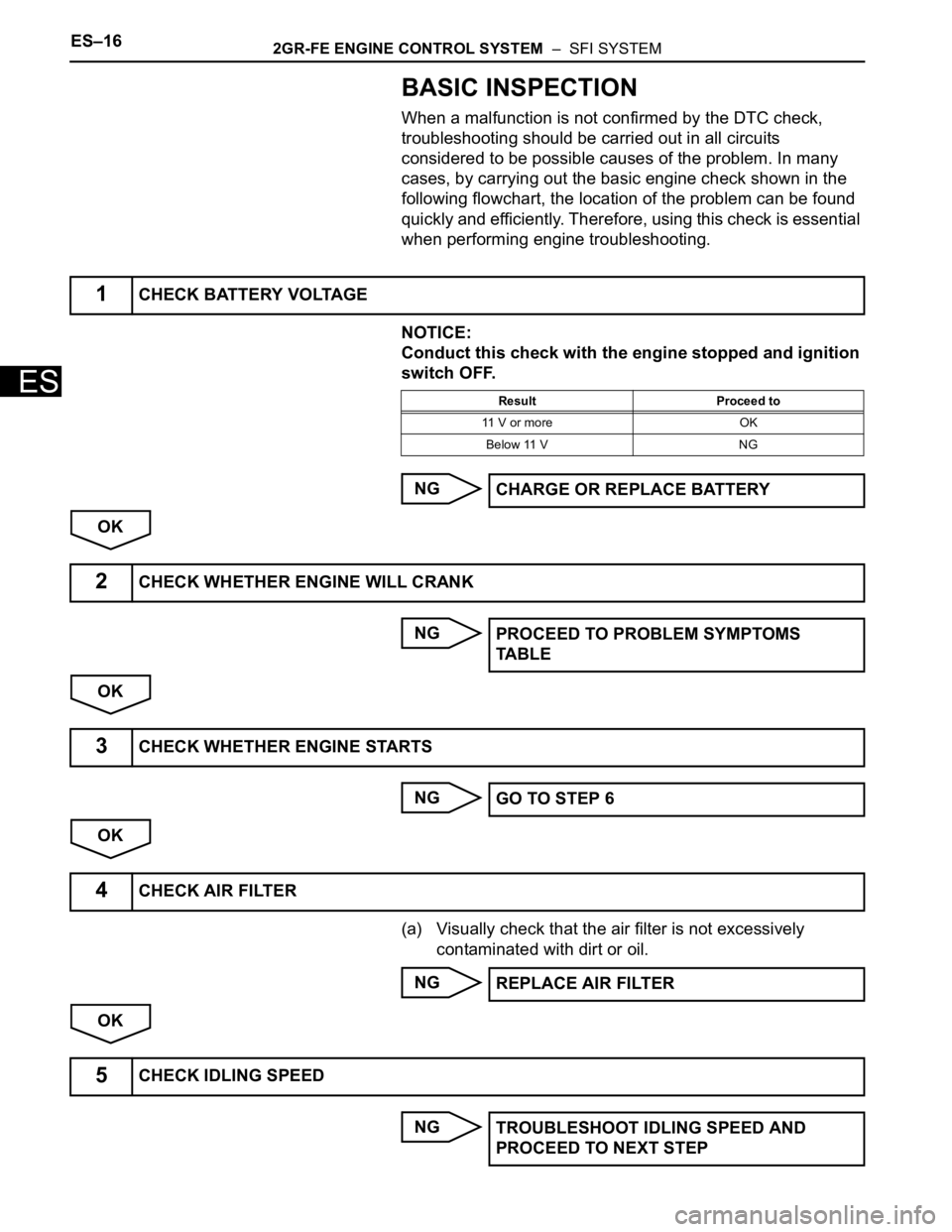
BASIC INSPECTION
When a malfunction is not confirmed by the DTC check,
troubleshooting should be carried out in all circuits
considered to be possible causes of the problem. In many
cases, by carrying out the basic engine check shown in the
following flowchart, the location of the problem can be found
quickly and efficiently. Therefore, using this check is essential
when performing engine troubleshooting.
NOTICE:
Conduct this check with the engine stopped and ignition
switch OFF.
NG
OK
NG
OK
NG
OK
(a) Visually check that the air filter is not excessively
contaminated with dirt or oil.
NG
OK
NG
1CHECK BATTERY VOLTAGE
Result Proceed to
11 V or more OK
Below 11 V NG
CHARGE OR REPLACE BATTERY
2CHECK WHETHER ENGINE WILL CRANK
PROCEED TO PROBLEM SYMPTOMS
TA B L E
3CHECK WHETHER ENGINE STARTS
GO TO STEP 6
4CHECK AIR FILTER
REPLACE AIR FILTER
5CHECK IDLING SPEED
TROUBLESHOOT IDLING SPEED AND
PROCEED TO NEXT STEP
Page 558 of 2000
ES–342GR-FE ENGINE CONTROL SYSTEM – SFI SYSTEM
ES
TERMINALS OF ECM
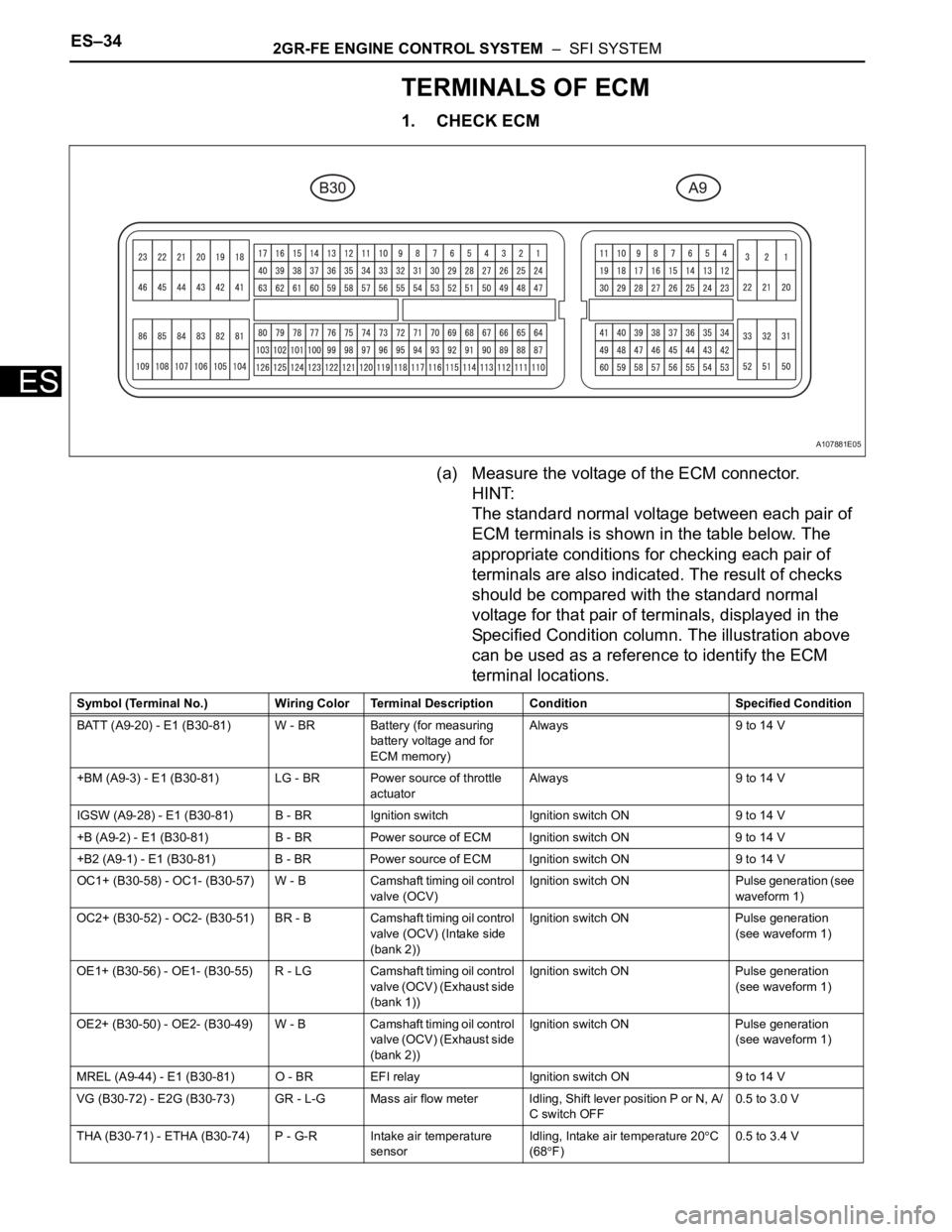
1. CHECK ECM
(a) Measure the voltage of the ECM connector.
HINT:
The standard normal voltage between each pair of
ECM terminals is shown in the table below. The
appropriate conditions for checking each pair of
terminals are also indicated. The result of checks
should be compared with the standard normal
voltage for that pair of terminals, displayed in the
Specified Condition column. The illustration above
can be used as a reference to identify the ECM
terminal locations.
A107881E05
Symbol (Terminal No.) Wiring Color Terminal Description Condition Specified Condition
BATT (A9-20) - E1 (B30-81) W - BR Battery (for measuring
battery voltage and for
ECM memory)Always 9 to 14 V
+BM (A9-3) - E1 (B30-81) LG - BR Power source of throttle
actuatorAlways 9 to 14 V
IGSW (A9-28) - E1 (B30-81) B - BR Ignition switch Ignition switch ON 9 to 14 V
+B (A9-2) - E1 (B30-81) B - BR Power source of ECM Ignition switch ON 9 to 14 V
+B2 (A9-1) - E1 (B30-81) B - BR Power source of ECM Ignition switch ON 9 to 14 V
OC1+ (B30-58) - OC1- (B30-57) W - B Camshaft timing oil control
valve (OCV)Ignition switch ON Pulse generation (see
waveform 1)
OC2+ (B30-52) - OC2- (B30-51) BR - B Camshaft timing oil control
valve (OCV) (Intake side
(bank 2))Ignition switch ON Pulse generation
(see waveform 1)
OE1+ (B30-56) - OE1- (B30-55) R - LG Camshaft timing oil control
valve (OCV) (Exhaust side
(bank 1))Ignition switch ON Pulse generation
(see waveform 1)
OE2+ (B30-50) - OE2- (B30-49) W - B Camshaft timing oil control
valve (OCV) (Exhaust side
(bank 2))Ignition switch ON Pulse generation
(see waveform 1)
MREL (A9-44) - E1 (B30-81) O - BR EFI relay Ignition switch ON 9 to 14 V
VG (B30-72) - E2G (B30-73) GR - L-G Mass air flow meter Idling, Shift lever position P or N, A/
C switch OFF0.5 to 3.0 V
THA (B30-71) - ETHA (B30-74) P - G-R Intake air temperature
sensorIdling, Intake air temperature 20
C
(68F)0.5 to 3.4 V
Page 582 of 2000
2AZ-FE ENGINE MECHANICAL – TIMING CHAINEM–25
EM
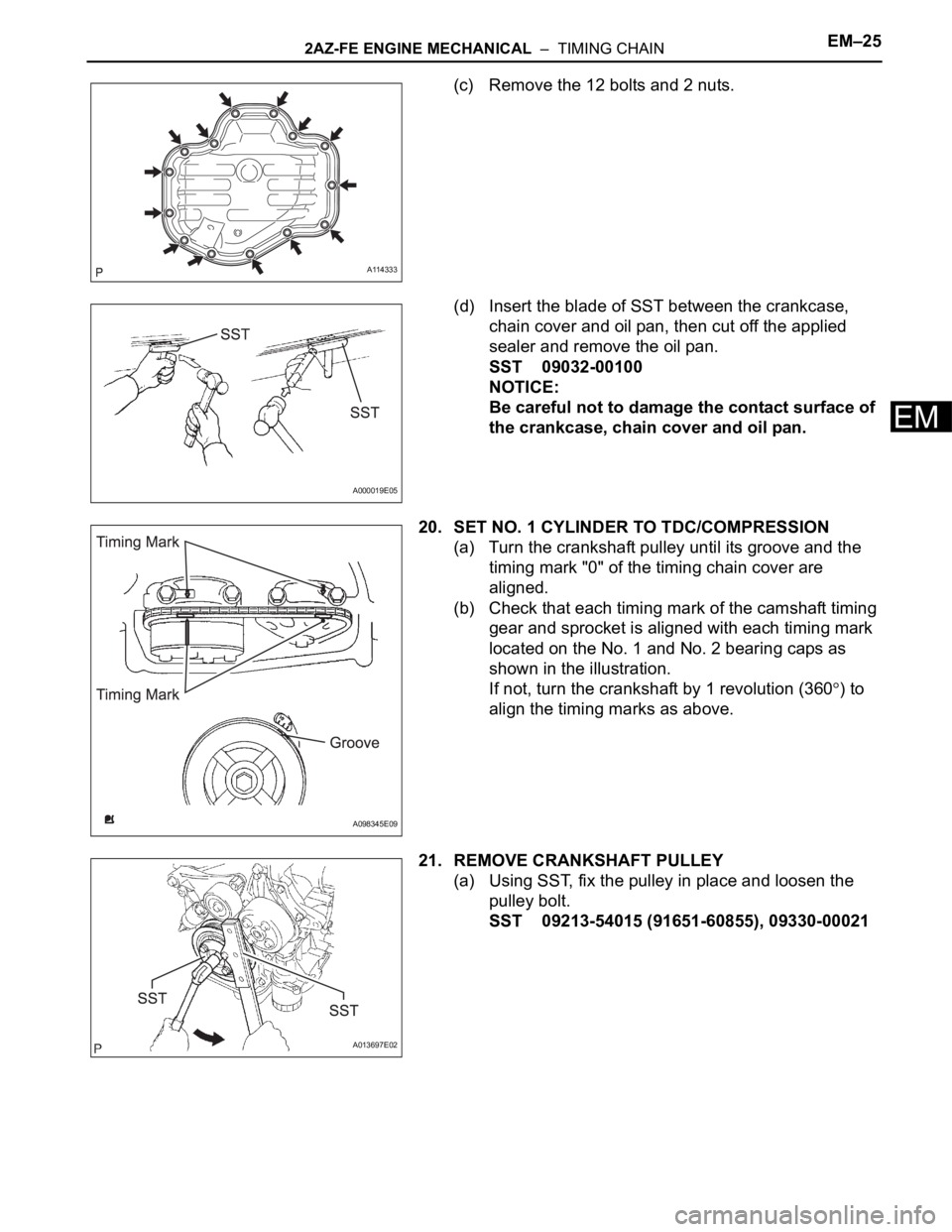
(c) Remove the 12 bolts and 2 nuts.
(d) Insert the blade of SST between the crankcase,
chain cover and oil pan, then cut off the applied
sealer and remove the oil pan.
SST 09032-00100
NOTICE:
Be careful not to damage the contact surface of
the crankcase, chain cover and oil pan.
20. SET NO. 1 CYLINDER TO TDC/COMPRESSION
(a) Turn the crankshaft pulley until its groove and the
timing mark "0" of the timing chain cover are
aligned.
(b) Check that each timing mark of the camshaft timing
gear and sprocket is aligned with each timing mark
located on the No. 1 and No. 2 bearing caps as
shown in the illustration.
If not, turn the crankshaft by 1 revolution (360
) to
align the timing marks as above.
21. REMOVE CRANKSHAFT PULLEY
(a) Using SST, fix the pulley in place and loosen the
pulley bolt.
SST 09213-54015 (91651-60855), 09330-00021
A114333
A000019E05
A098345E09
A013697E02
Page 586 of 2000
2AZ-FE ENGINE MECHANICAL – TIMING CHAINEM–29
EM
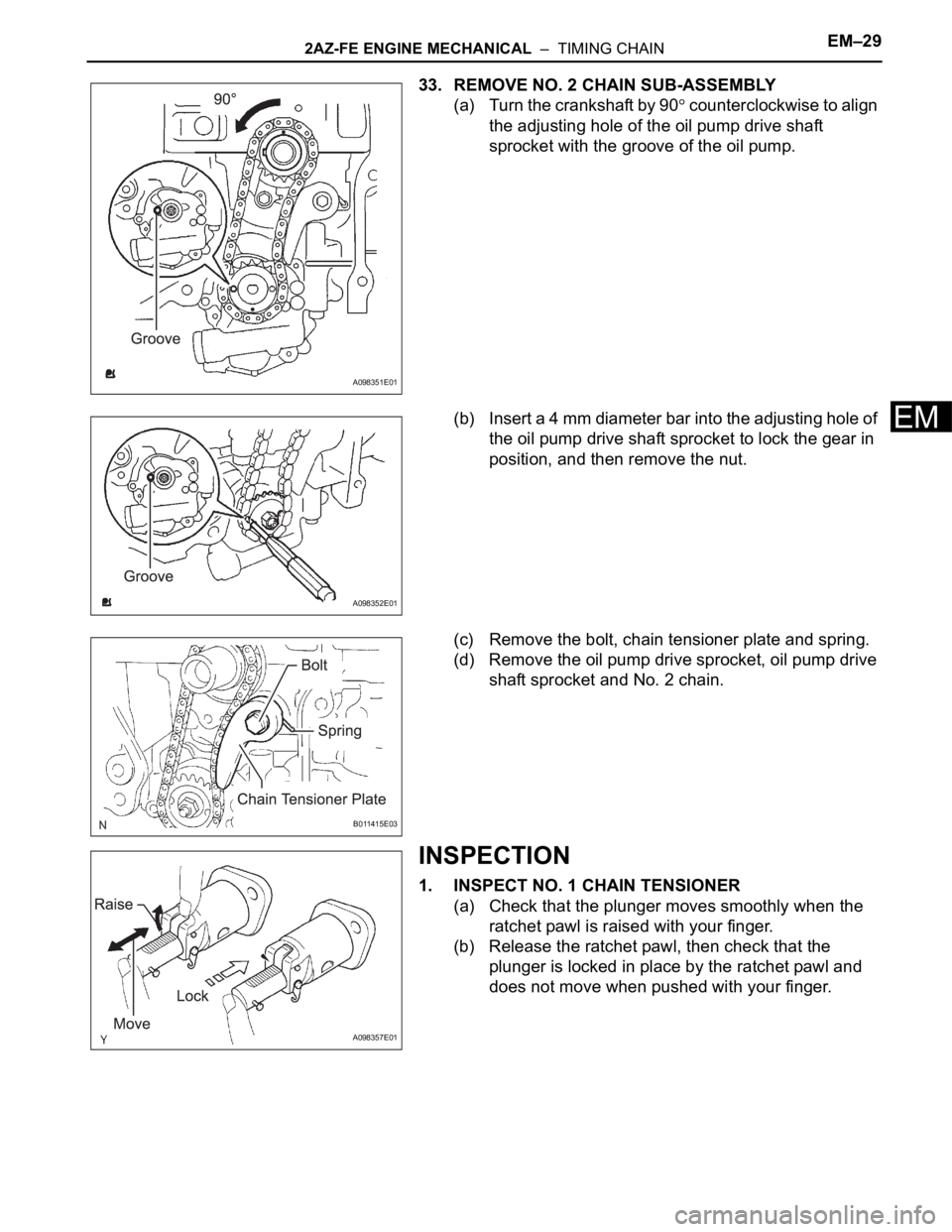
33. REMOVE NO. 2 CHAIN SUB-ASSEMBLY
(a) Turn the crankshaft by 90
counterclockwise to align
the adjusting hole of the oil pump drive shaft
sprocket with the groove of the oil pump.
(b) Insert a 4 mm diameter bar into the adjusting hole of
the oil pump drive shaft sprocket to lock the gear in
position, and then remove the nut.
(c) Remove the bolt, chain tensioner plate and spring.
(d) Remove the oil pump drive sprocket, oil pump drive
shaft sprocket and No. 2 chain.
INSPECTION
1. INSPECT NO. 1 CHAIN TENSIONER
(a) Check that the plunger moves smoothly when the
ratchet pawl is raised with your finger.
(b) Release the ratchet pawl, then check that the
plunger is locked in place by the ratchet pawl and
does not move when pushed with your finger.
A098351E01
A098352E01
B011415E03
A098357E01