coolant temperature TOYOTA RAV4 2006 Service User Guide
[x] Cancel search | Manufacturer: TOYOTA, Model Year: 2006, Model line: RAV4, Model: TOYOTA RAV4 2006Pages: 2000, PDF Size: 45.84 MB
Page 71 of 2000

ENGINE - 2GR-FE ENGINE
285EG10 285EG09
60
Knock Sensor Bosses
36.6 mm
(1.441 in.)
105.5 mm
(4.15 in.)
View from Top Side
285EG11
Wa t e r P a s s a g eEG-75
4. Cylinder Block
The cylinder block is made of aluminum alloy, so it is lightweight.
The cylinder block has a bank angle of 60, a bank offset of 36.6 mm (1.441 in.) and a bore pitch of 105.5
mm (4.15 in.), resulting in a compact block in its length and width even for its displacement.
Installation bosses of the two knock sensors are located on the inside of left and right banks.
A water passage has been provided between the cylinder bores. By allowing the engine coolant to flow
between the cylinder bores, this construction enables the temperature of the cylinder walls to be kept
uniform.
Page 84 of 2000
ENGINE - 2GR-FE ENGINE
285EG27
Air Bleeder PlugTo Throttle Body
From Throttle Body
To H e a t e r
From Heater
To Radiator
From Radiator Thermostat
Opening Temperature:
80 - 84
C (176 - 183F)
01MEG35Y
ThermostatBypass Pipe
Heater Return Pipe
Air Bleeder Plug
Cylinder Head
Cylinder Block
Wa t e r P u m p
Radiator
Throttle
Body
Heater
Reservoir
Ta n k
EG-88
COOLING SYSTEM
1. General
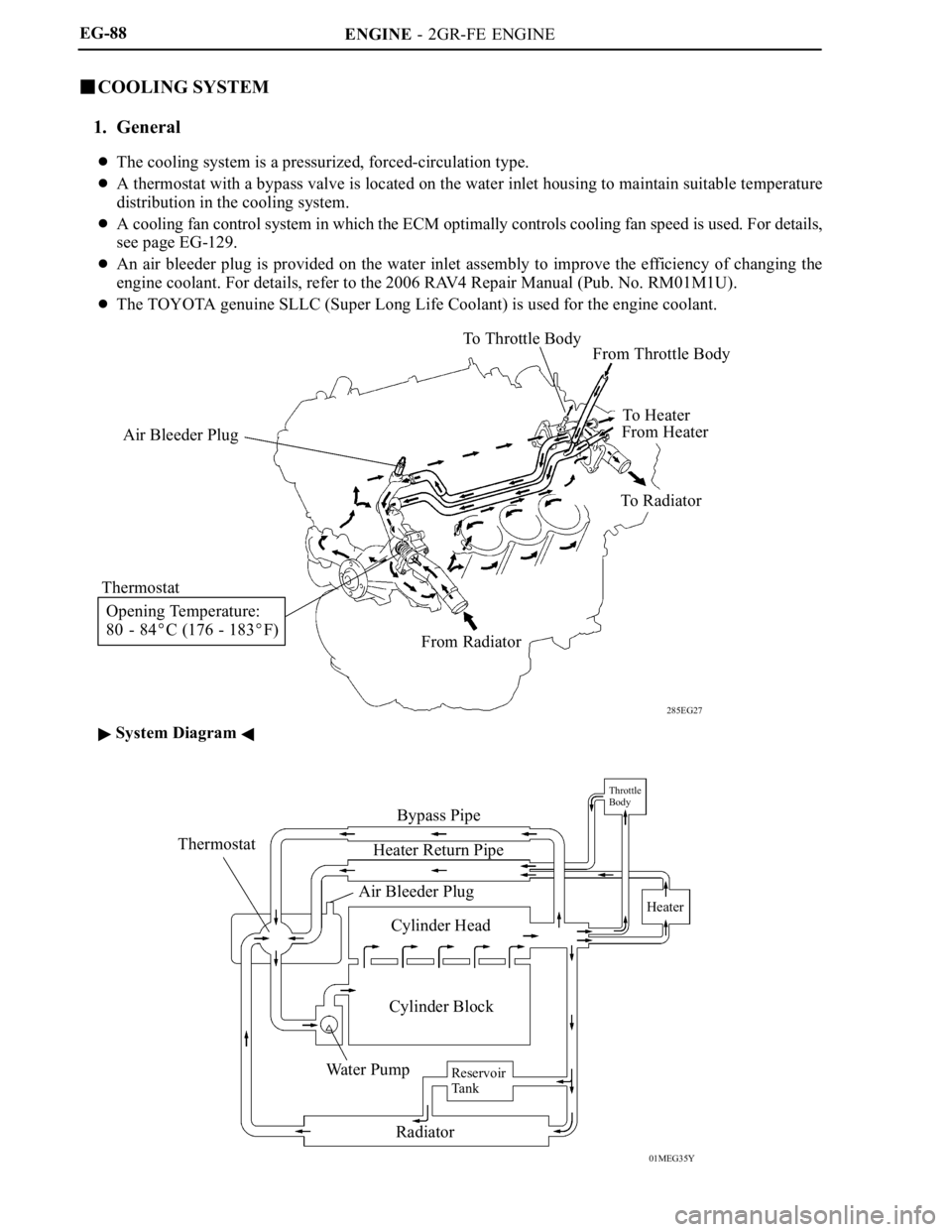
The cooling system is a pressurized, forced-circulation type.
A thermostat with a bypass valve is located on the water inlet housing to maintain suitable temperature
distribution in the cooling system.
A cooling fan control system in which the ECM optimally controls cooling fan speed is used. For details,
see page EG-129.
An air bleeder plug is provided on the water inlet assembly to improve the efficiency of changing the
engine coolant. For details, refer to the 2006 RAV4 Repair Manual (Pub. No. RM01M1U).
The TOYOTA genuine SLLC (Super Long Life Coolant) is used for the engine coolant.
System Diagram
Page 97 of 2000

ENGINE - 2GR-FE ENGINEEG-101
ENGINE CONTROL SYSTEM
1. General
The engine control system of the 2GR-FE engine has the following features.
System
Outline
SFI
(Sequential Multiport
Fuel Injection)
[See page EG-117]
An L-type SFI system detects the intake air mass with a hot-wire type air
flow meter.
ESA
(Electronic Spark
Advance)
Ignition timing is determined by the ECM based on signals from various
sensors. The ECM corrects ignition timing in response to engine
knocking.
This system selects the optimal ignition timing in accordance with the
signals received from the sensors and sends the (IGT) ignition signal to
the igniter.
ETCS-i
(Electronic Throttle
Control
System-intelligent)
[See page EG-118]
Optimally controls the throttle valve opening in accordance with the amount
of accelerator pedal effort and the condition of the engine and the vehicle.
Dual VVT-i
(Variable Valve
Timing-intelligent)
System
[See page EG-120]
Controls the intake and exhaust camshafts to an optimal valve timing in
accordance with the engine condition.
ACIS
(Acoustic Control
Induction System)
[See page EG-126]The intake air passages are switched according to the engine speed and
throttle valve opening angle to provided high performance in all speed
ranges.
Air Intake Control
System
[See page EG-128]The intake air duct is divided into two areas, and the ECM controls the air
intake control valve and the actuator that are provided in one of the areas to
reduce the amount of engine noise.
Fuel Pump Control
[See page EG-53 in
2AZ-FE section]Fuel pump operation is controlled by signals from the ECM.
The fuel pump is stopped, when the SRS airbag is deployed in a frontal,
side, and rear side collision.
Air Conditioning Cut-off
ControlBy turning the air conditioning compressor ON or OFF in accordance with
the engine condition, drivability is maintained.
Charging Control
[See page EG-65 in
2AZ-FE section]The engine ECU regulates the charging voltage of the generator in
accordance with the driving conditions and the charging state of the battery.
Cooling Fan Control
[See page EG-129]
The cooling fan ECU steplessly controls the speed of the fans in accordance
with the engine coolant temperature, vehicle speed, engine speed, and air
conditioning operating conditions. As a result, the cooling performance is
improved.
(Continued)
Page 99 of 2000

ENGINE - 2GR-FE ENGINE
01MEG07Y
SENSORSACTUATORS
MASS AIR FLOW METER
INTAKE AIR TEMPERATURE
SENSOR
CRANKSHAFT POSITION
SENSOR
ENGINE COOLANT
TEMPERATURE SENSOR
ACCELERATOR PEDAL
POSITION SENSOR
THROTTLE POSITION
SENSOR
KNOCK SENSOR (Bank 1)
KNOCK SENSOR (Bank 2)
INTAKE VVT SENSOR (Bank 1)
INTAKE VVT SENSOR (Bank 2)
EXHAUST VVT SENSOR
(Bank 1)
EXHAUST VVT SENSOR
(Bank 2)
IGNITION SWITCHVG
THA
NE
THW
VPA
VPA2
VTA1
VTA2
KNK1
KNK2
VV1
VV2
EV1
EV2
IGSWECM#10
#20
#30
#40
#50
#60
IGT1 -
IGT6
IGF1
M
OC1
OC2
OE1
OE2SFI
NO. 1 INJECTOR
NO. 2 INJECTOR
NO. 3 INJECTOR
NO. 4 INJECTOR
NO. 5 INJECTOR
NO. 6 INJECTOR
ESA
IGNITION COIL with
IGNITER
SPARK PLUG
ETCS-i
THROTTLE CONTROL
MOTOR
VVT-i (INTAKE SIDE)
CAMSHAFT TIMING OIL
CONTROL VALVE (Bank 1)
CAMSHAFT TIMING OIL
CONTROL VALVE (Bank 2)
VVT-i (EXHAUST SIDE)
CAMSHAFT TIMING OIL
CONTROL VALVE (Bank 1)
CAMSHAFT TIMING OIL
CONTROL VALVE (Bank 2)EG-103
2. Construction
The configuration of the engine control system is as shown in the following chart.
(Continued)
Page 102 of 2000

ENGINE - 2GR-FE ENGINE
01MEG29Y
Ignition SwitchCombination Meter
Vehicle Speed Signal
MIL
Battery Current Sensor
(Built-in Battery
Temperature Sensor)
Park / Neutral
Position Switch
Battery
Generator
Fuel Pump Relay
Fuel Pump
Vent Valve
Circuit Opening
RelayDLC3*1*2*3
CAN
ECM
Cruise Control Switch
Accelerator Pedal
Position Sensor
Stop Light Switch
Canister
Pressure
SensorLeak
Detection
Pump
Intake Air
Temp. Sensor
VSV (For
Air Intake
Control)Mass Air
Flow Meter
AirThrottle Position
Sensor
Purge VSV
Throttle
Control
Motor
*4*5
Fan
Motor No. 1Fan
Motor
No. 2
Cooling
Fan
ECUCooling
Fan
ECU
No. 1Cooling
Fan
ECU
No. 2
Fan Motor No. 1
Fan Motor No. 2
ACIS Actuator
Intake Camshaft Timing
Oil Control Valve (Bank 2)Injector Injector
Intake Camshaft Timing
Oil Control Valve (Bank 1)
Intake VVT Sensor (Bank 1)
Ignition Coil With Igniter
Exhaust VVT Sensor (Bank 1)
Exhaust Camshaft Timing
Oil Control Valve (Bank 1)
Air-fuel Ratio Sensor
(Bank1, Sensor1)
TWC
Knock
Sensor
Intake VVT
Sensor (Bank 2)
Exhaust VVT
Sensor (Bank 2)
Air-fuel Ratio Sensor
(Bank2, Sensor1)Exhaust Camshaft
Timing Oil Control
Valve (Bank 2)
Crankshaft Position
Sensor
Engine Coolant
Temperature Sensor Heated Oxygen Sensor
(Bank1, Sensor2)Heated Oxygen Sensor
(Bank2, Sensor2)TWCTWC
EG-106
3. Engine Control System Diagram
*1: Air Conditioning ECU
*
2: Airbag Sensor Assembly
*
3: Skid Control ECU
*
4: Except Towing Package Models
*
5: Towing Package Models
Page 104 of 2000

ENGINE - 2GR-FE ENGINE
01MEG27Y
01MEG28Y
Intake Camshaft Timing Oil Control Valve (Bank 2)
Ignition Coil with Igniter
Injector
Intake VVT Sensor
(Bank 2)
Exhaust Camshaft
Timing Oil Control
Valve (Bank 2)
Crankshaft
Position Sensor
Exhaust VVT Sensor
(Bank 2)Air-fuel Ratio
Sensor
(Bank 2, Sensor 1)Engine Coolant
Temperature SensorIntake Camshaft Timing Oil Control
Valve (Bank 1)
Intake VVT
Sensor (Bank 1)
Exhaust VVT Sensor
(Bank 1)
Exhaust Camshaft
Timing Oil Control
Valve (Bank 1)
Air-fuel Ratio Sensor
(Bank 1, Sensor 1)
ACIS ActuatorThrottle Position Sensor
Knock Sensor (Bank 1)
Knock Sensor (Bank 2) EG-108
Page 113 of 2000

ENGINE - 2GR-FE ENGINE
238EG70
Synchronous Injection
IgnitionNon-synchronous Injection
Crankshaft Angle # 1
# 2
# 3
# 4
# 5
# 6
0
120240360480600720
Independent InjectionEG-117
Air-fuel Ratio Sensor and Heated Oxygen Sensor
The planar type air-fuel ratio sensor and the cup type heated oxygen sensor are used. For details, see page
EG-37.
6. SFI (Sequential Multiport Fuel Injection) System
An L-type SFI system directly detects the intake air mass with a hot wire type mass air flow meter.
An independent injection system (in which fuel is injected once into each cylinder for each two revolution
of the crankshaft) is used.
There are two (synchronous and non-synchronous) injections:
a) The synchronous injection in which corrections based on the signals from the sensors are added to the
basic injection time so that injection occurs always at the same position.
b) The non-synchronous injection in which injection is effected by detecting the requests from the signals
of the sensors regardless of the crankshaft angle.
Furthermore, to protect the engine and achieve lower fuel consumption, the system uses a fuel cutoff in
which the injection of fuel is stopped temporarily in accordance with the driving conditions.
This system performs group injection when the engine coolant temperature is extremely low and the
engine is operating at a low speed.
7. ESA (Electronic Spark Advance) System
This system selects the optimal ignition timing in accordance with the signals received from the sensors and
sends the (IGT) ignition signal to the igniter.
Page 116 of 2000
ENGINE - 2GR-FE ENGINE
285EG57
Exhaust Camshaft Timing OCV* (Bank 1)
Intake Camshaft Timing OCV* (Bank 1)
Exhaust VVT Sensor (Bank 1)
Engine Coolant Temperature Sensor
Intake Camshaft
Timing OCV* (Bank 2)
Exhaust VVT
Sensor (Bank 2)
Exhaust Camshaft
Timing OCV*
(Bank 2)
Intake VVT Sensor (Bank 2)
Crankshaft Position Sensor
Intake VVT Sensor (Bank 1)ECM
Mass Air Flow MeterThrottle Position Sensor
221EG16
Crankshaft Position Sensor
Mass Air Flow Meter
Throttle Position Sensor
Engine Coolant Temp. Sensor
Intake and Exhaust VVT Sensors
Vehicle Speed SignalECM
Ta r g e t Va l v e Ti m i n g
Feedback
Correction
Actual Valve Timing
Duty-cycle
Control
Camshaft Timing
Oil Control Valve
EG-120
9. Dual VVT-i (Variable Valve Timing-intelligent) System
General
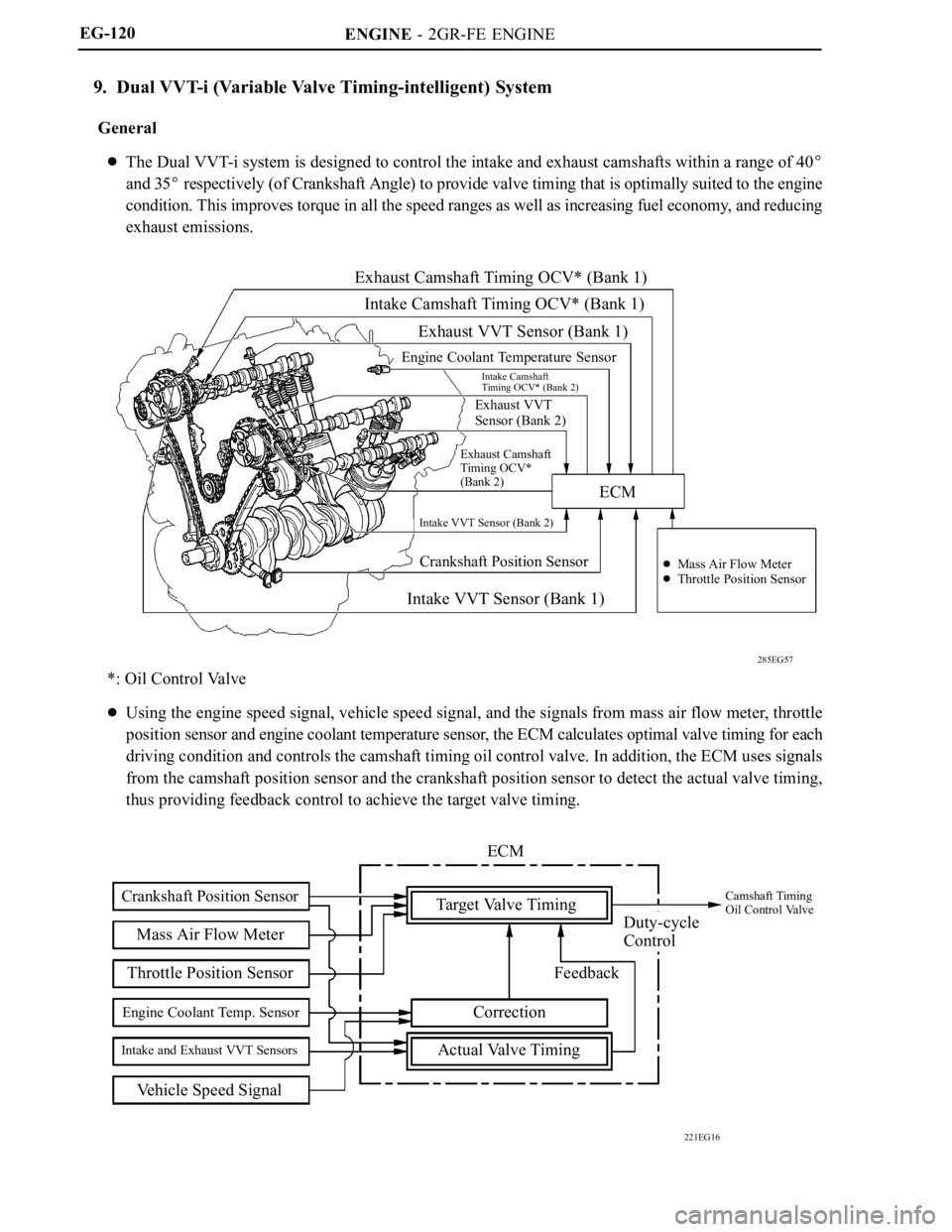
The Dual VVT-i system is designed to control the intake and exhaust camshafts within a range of 40
and 35 respectively (of Crankshaft Angle) to provide valve timing that is optimally suited to the engine
condition. This improves torque in all the speed ranges as well as increasing fuel economy, and reducing
exhaust emissions.
*: Oil Control Valve
Using the engine speed signal, vehicle speed signal, and the signals from mass air flow meter, throttle
position sensor and engine coolant temperature sensor, the ECM calculates optimal valve timing for each
driving condition and controls the camshaft timing oil control valve. In addition, the ECM uses signals
from the camshaft position sensor and the crankshaft position sensor to detect the actual valve timing,
thus providing feedback control to achieve the target valve timing.
Page 125 of 2000

ENGINE - 2GR-FE ENGINE
01MEG21Y
01MEG22Y
Engine Coolant Temperature
Sensor
Crankshaft Position Sensor
Combination Meter
Vehicle Speed SignalECM
CAN
Air Conditioning ECUCooling
Fan
ECUFan Motor
No. 1
Fan Motor
No. 2
Except Towing Package Models
Towing Package Models Engine Coolant Temperature
Sensor
Crankshaft Position Sensor
Combination Meter
Vehicle Speed SignalECM
CAN
Air Conditioning ECUCooling
Fan
ECU
No. 1
Cooling
Fan
ECU
No. 2Fan Motor
No. 1
Fan Motor
No. 2EG-129
12. Cooling Fan Control System
General
A cooling fan control system is used. To achieve an optimal fan speed in accordance with the engine coolant
temperature, vehicle speed, engine speed, and air conditioning operating conditions, the ECM calculates
the proper fan speed and sends the signals to the front controller. By receiving the signals from the ECM,
the front controller sends proper fan speed control signals to the cooling fan ECU.
Upon receiving the signals from the front controller, the cooling fan ECU actuates the fan motors.
Wiring Diagram
Page 126 of 2000

ENGINE - 2GR-FE ENGINE
189EG14 189EG13
189EG16 189EG15
Fan
Speed
Engine Coolant TemperatureFan
Speed
Refrigerant Pressure
Fan
Speed
Engine SpeedFan
Speed
Vehicle Speed (A) Fan speed required by
engine coolant temperature(B) Fan speed required by
air conditioning
refrigerant pressure
(C) Fan speed required by
engine speed(D) Fan speed required by
vehicle speed EG-130
Operation
As illustrated below, the ECM determines the required fan speed by selecting the fastest fan speed from
among the following:
(A) Fan speed required by the engine coolant temperature
(B) Fan speed required by the air conditioning refrigerant pressure
(C) Fan speed required by the engine speed
(D) Fan speed required by the vehicle speed