fuel pump TOYOTA RAV4 2006 Service User Guide
[x] Cancel search | Manufacturer: TOYOTA, Model Year: 2006, Model line: RAV4, Model: TOYOTA RAV4 2006Pages: 2000, PDF Size: 45.84 MB
Page 90 of 2000

ENGINE - 2GR-FE ENGINE
01MEG17Y
Injector
Quick Connector
Pulsation Damper
Fuel Pump Assembly
Fuel Filter
Pressure Regulator
Fuel Tank
Canister
Injector Fuel Delivery Pipe EG-94
FUEL SYSTEM
1. General
The fuel returnless system is used to reduce evaporative emissions.
A fuel cut control is used to stop the fuel pump when the SRS airbag is deployed in a frontal or side
collision. For details, see page EG-53.
The fuel delivery pipe made of plastic is used.
A quick connector is used to connect the fuel pipe with the fuel hose for excellent serviceability.
Compact 12-hole type injectors are used to increase atomization of the fuel.
A compact fuel pump in which a fuel filter is integrated in the fuel pump assembly is used.
The ORVR (On-board Refueling Vapor Recovery) system is used. For details, see page EG-131.
Page 91 of 2000
ENGINE - 2GR-FE ENGINE
01MEG34Y
Pulsation Damper
Fuel Filter
Fuel PumpPressure Regulator
Fuel Pump
Assembly
Fuel Tank
285EG38
Fuel Delivery PipesPulsation Damper
Holder
O-ring
Nylon TubeEG-95
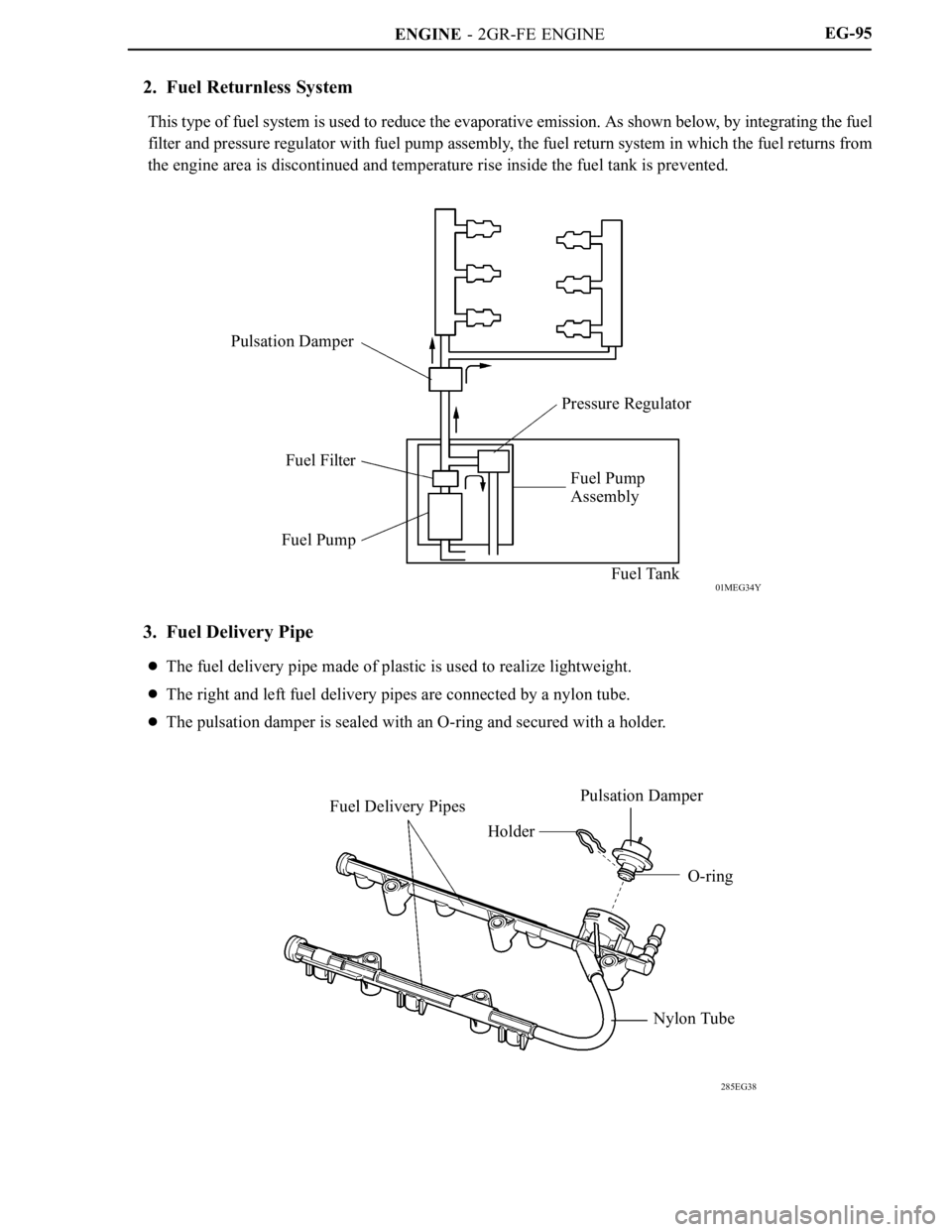
2. Fuel Returnless System
This type of fuel system is used to reduce the evaporative emission. As shown below, by integrating the fuel
filter and pressure regulator with fuel pump assembly, the fuel return system in which the fuel returns from
the engine area is discontinued and temperature rise inside the fuel tank is prevented.
3. Fuel Delivery Pipe
The fuel delivery pipe made of plastic is used to realize lightweight.
The right and left fuel delivery pipes are connected by a nylon tube.
The pulsation damper is sealed with an O-ring and secured with a holder.
Page 97 of 2000

ENGINE - 2GR-FE ENGINEEG-101
ENGINE CONTROL SYSTEM
1. General
The engine control system of the 2GR-FE engine has the following features.
System
Outline
SFI
(Sequential Multiport
Fuel Injection)
[See page EG-117]
An L-type SFI system detects the intake air mass with a hot-wire type air
flow meter.
ESA
(Electronic Spark
Advance)
Ignition timing is determined by the ECM based on signals from various
sensors. The ECM corrects ignition timing in response to engine
knocking.
This system selects the optimal ignition timing in accordance with the
signals received from the sensors and sends the (IGT) ignition signal to
the igniter.
ETCS-i
(Electronic Throttle
Control
System-intelligent)
[See page EG-118]
Optimally controls the throttle valve opening in accordance with the amount
of accelerator pedal effort and the condition of the engine and the vehicle.
Dual VVT-i
(Variable Valve
Timing-intelligent)
System
[See page EG-120]
Controls the intake and exhaust camshafts to an optimal valve timing in
accordance with the engine condition.
ACIS
(Acoustic Control
Induction System)
[See page EG-126]The intake air passages are switched according to the engine speed and
throttle valve opening angle to provided high performance in all speed
ranges.
Air Intake Control
System
[See page EG-128]The intake air duct is divided into two areas, and the ECM controls the air
intake control valve and the actuator that are provided in one of the areas to
reduce the amount of engine noise.
Fuel Pump Control
[See page EG-53 in
2AZ-FE section]Fuel pump operation is controlled by signals from the ECM.
The fuel pump is stopped, when the SRS airbag is deployed in a frontal,
side, and rear side collision.
Air Conditioning Cut-off
ControlBy turning the air conditioning compressor ON or OFF in accordance with
the engine condition, drivability is maintained.
Charging Control
[See page EG-65 in
2AZ-FE section]The engine ECU regulates the charging voltage of the generator in
accordance with the driving conditions and the charging state of the battery.
Cooling Fan Control
[See page EG-129]
The cooling fan ECU steplessly controls the speed of the fans in accordance
with the engine coolant temperature, vehicle speed, engine speed, and air
conditioning operating conditions. As a result, the cooling performance is
improved.
(Continued)
Page 98 of 2000

ENGINE - 2GR-FE ENGINE EG-102
System
Outline
Air-fuel Ratio Sensor and
Oxygen Sensor Heater
ControlMaintains the temperature of the air-fuel ratio sensor or oxygen sensor at an
appropriate level to increase accuracy of detection of the oxygen
concentration in the exhaust gas.
Evaporative Emission
Control
[See page EG-131]
The ECM controls the purge flow of evaporative emission (HC) in the
canister in accordance with engine conditions.
Approximately five hours after the ignition switch has been turned OFF,
the ECM operates the canister pump module to detect any evaporative
emission leakage occurring in the EVAP (evaporative emission) control
system through changes in the EVAP control system pressure.
Engine ImmobilizerProhibits fuel delivery and ignition if an attempt is made to start the engine
with an invalid ignition key.
Diagnosis
[See page EG-132]When the ECM detects a malfunction, the ECM diagnoses and memorizes
the failed section.
Fail-safe
[See page EG-133]When the ECM detects a malfunction, the ECM stops or controls the engine
according to the data already stored in the memory.
Page 100 of 2000

ENGINE - 2GR-FE ENGINE
01MEG06Y
COMBINATION METER
Vehicle Speed Signal
AIR-FUEL RATIO SENSOR
Bank 1, Sensor 1
Bank 2, Sensor 1
HEATED OXYGEN SENSOR
Bank 1, Sensor 2
Bank 2, Sensor 2
CANISTER PUMP MODULE
CANISTER PRESSURE
SENSOR
PARK / NEUTRAL POSITION
SWITCH
TRANSMISSION CONTROL
SWITCH
TRANSPONDER KEY ECU
GENERATOR
BATTERY CURRENT SENSOR
(BUILT-IN BATTERY
TEMPERATURE SENSOR)
WIPER CONTROL SWITCHSPD
A1A
A2A
OX1B
OX2B
PPMP
STA
P, R, N, D
4, L
IMI
IMO
DF
THB VCIB
INHECMACIS
AICV
FC
FPR
HA1A
HA2A
HT1B
HT2B
RLOACIS
ACIS ACTUATOR
AIR INTAKE CONTROL
SYSTEM
VSV
FUEL PUMP CONTROL
CIRCUIT OPENING RELAY
FUEL PUMP RELAY
AIR-FUEL RATIO SENSOR
HEATER CONTROL
AIR-FUEL RATIO SENSOR
HEATER
Bank 1, Sensor 1
Bank 2, Sensor 1
HEATED OXYGEN SENSOR
HEATER CONTROL
HEATED OXYGEN SENSOR
HEATER
Bank 1, Sensor 2
Bank 2, Sensor 2
CHARGING CONTROL
GENERATOR EG-104
(Continued)
Page 102 of 2000

ENGINE - 2GR-FE ENGINE
01MEG29Y
Ignition SwitchCombination Meter
Vehicle Speed Signal
MIL
Battery Current Sensor
(Built-in Battery
Temperature Sensor)
Park / Neutral
Position Switch
Battery
Generator
Fuel Pump Relay
Fuel Pump
Vent Valve
Circuit Opening
RelayDLC3*1*2*3
CAN
ECM
Cruise Control Switch
Accelerator Pedal
Position Sensor
Stop Light Switch
Canister
Pressure
SensorLeak
Detection
Pump
Intake Air
Temp. Sensor
VSV (For
Air Intake
Control)Mass Air
Flow Meter
AirThrottle Position
Sensor
Purge VSV
Throttle
Control
Motor
*4*5
Fan
Motor No. 1Fan
Motor
No. 2
Cooling
Fan
ECUCooling
Fan
ECU
No. 1Cooling
Fan
ECU
No. 2
Fan Motor No. 1
Fan Motor No. 2
ACIS Actuator
Intake Camshaft Timing
Oil Control Valve (Bank 2)Injector Injector
Intake Camshaft Timing
Oil Control Valve (Bank 1)
Intake VVT Sensor (Bank 1)
Ignition Coil With Igniter
Exhaust VVT Sensor (Bank 1)
Exhaust Camshaft Timing
Oil Control Valve (Bank 1)
Air-fuel Ratio Sensor
(Bank1, Sensor1)
TWC
Knock
Sensor
Intake VVT
Sensor (Bank 2)
Exhaust VVT
Sensor (Bank 2)
Air-fuel Ratio Sensor
(Bank2, Sensor1)Exhaust Camshaft
Timing Oil Control
Valve (Bank 2)
Crankshaft Position
Sensor
Engine Coolant
Temperature Sensor Heated Oxygen Sensor
(Bank1, Sensor2)Heated Oxygen Sensor
(Bank2, Sensor2)TWCTWC
EG-106
3. Engine Control System Diagram
*1: Air Conditioning ECU
*
2: Airbag Sensor Assembly
*
3: Skid Control ECU
*
4: Except Towing Package Models
*
5: Towing Package Models
Page 103 of 2000

ENGINE - 2GR-FE ENGINE
01MEG24Y
01MEG25Y
01MEG26Y
Heated Oxygen Sensor
(Bank 2, Sensor2)
Battery Current Sensor
(Built-in Battery Temperature Sensor)ECMHeated Oxygen Sensor
(Bank 1, Sensor 2)Canister Pump Module
Ve n t Va l v e
Leak Detection Pump
Canister Pressure SensorFuel Pump
VSV (for Air Intake Control)
Mass Air Flow Meter
Intake Air Temperature Sensor
Air Cleaner Cap
Vacuum Tank
Actuator (For Air Intake Control)
Combination Meter
Malfunction Indicator Lamp
DLC3
Accelerator Pedal
Position SensorEG-107
4. Layout of Main Components
Page 117 of 2000

ENGINE - 2GR-FE ENGINE
285EG62 285EG61 285EG60
285EG63
285EG59
285EG59 285EG59
Earliest Timing
(EX)Latest Timing
(IN)TDC
EX IN
BDC
To Advance
Side (EX)To R e t a r d
Side (IN)
EX IN
To Advance
Side (IN)To R e t a r d
Side (EX)
EX IN
EX IN
EX IN
To Retard
Side (EX)To Advance
Side (IN)
To R e t a r d
Side (IN)To A d v a n c e
Side (EX)
Earliest Timing
(EX)Latest Timing
(IN)
Earliest Timing
(EX)Latest Timing
(IN)
EX IN
EX IN
EG-121
Effectiveness of the VVT-i System
Operation State
ObjectiveEffect
During Idling
Eliminating overlap to
reduce blow back to the
intake side.Stabilized idling rpm
Better fuel economy
At Light Load
Eliminating overlap to
reduce blow back to the
intake side.
Ensured engine stability
At Medium Load
Increasing overlap
increases internal EGR,
reducing pumping loss.Better fuel economy
Improved emission
control
In Low to
Medium Speed
Range with
Heavy LoadAdvancing the intake
valve close timing for
volumetric efficiency
improvement.
Improved torque in low
to medium speed range
In High Speed
Range with
Heavy LoadRetarding the intake
valve close timing for
volumetric efficiency
improvement.
Improved output
At Low
Temperatures
Eliminating overlap to
reduce blow back to the
intake side leads to the
lean burning condition,
and stabilizes the idling
speed at fast idle.
Stabilized fast idle
rpm
Better fuel economy
Upon Starting
Stopping the
Engine
Eliminating overlap to
minimize blow back to
the intake side.
Improved startability
Page 127 of 2000

ENGINE - 2GR-FE ENGINE
01MEG23Y
Purge Line
Purge VSV
Fuel Tank
Canister Pump Module
Canister Pressure Sensor
Leak Detection Pump
Vent Valve
Front
Fresh Air Line
Air Filter
Refueling Valve CanisterEG-131
13. Evaporative Emission Control System
General
The 2GR-FE engine uses the same type of evaporative emission control system as the 2AZ-FE engine. For
details, see page EG-54.
Layout of Main Components
Page 208 of 2000
FU–62AZ-FE FUEL – FUEL SYSTEM
FU
ON-VEHICLE INSPECTION
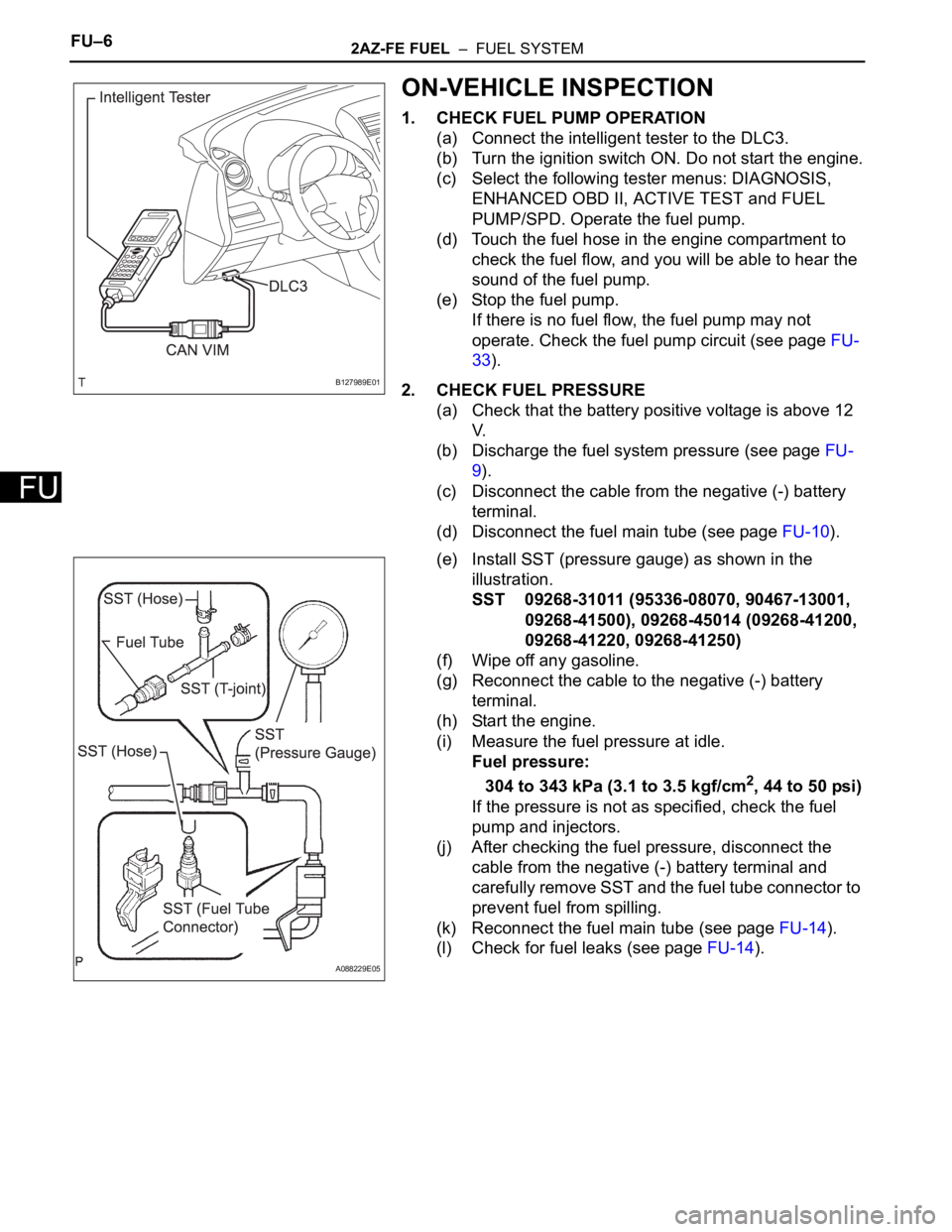
1. CHECK FUEL PUMP OPERATION
(a) Connect the intelligent tester to the DLC3.
(b) Turn the ignition switch ON. Do not start the engine.
(c) Select the following tester menus: DIAGNOSIS,
ENHANCED OBD II, ACTIVE TEST and FUEL
PUMP/SPD. Operate the fuel pump.
(d) Touch the fuel hose in the engine compartment to
check the fuel flow, and you will be able to hear the
sound of the fuel pump.
(e) Stop the fuel pump.
If there is no fuel flow, the fuel pump may not
operate. Check the fuel pump circuit (see page FU-
33).
2. CHECK FUEL PRESSURE
(a) Check that the battery positive voltage is above 12
V.
(b) Discharge the fuel system pressure (see page FU-
9).
(c) Disconnect the cable from the negative (-) battery
terminal.
(d) Disconnect the fuel main tube (see page FU-10).
(e) Install SST (pressure gauge) as shown in the
illustration.
SST 09268-31011 (95336-08070, 90467-13001,
09268-41500), 09268-45014 (09268-41200,
09268-41220, 09268-41250)
(f) Wipe off any gasoline.
(g) Reconnect the cable to the negative (-) battery
terminal.
(h) Start the engine.
(i) Measure the fuel pressure at idle.
Fuel pressure:
304 to 343 kPa (3.1 to 3.5 kgf/cm
2, 44 to 50 psi)
If the pressure is not as specified, check the fuel
pump and injectors.
(j) After checking the fuel pressure, disconnect the
cable from the negative (-) battery terminal and
carefully remove SST and the fuel tube connector to
prevent fuel from spilling.
(k) Reconnect the fuel main tube (see page FU-14).
(l) Check for fuel leaks (see page FU-14).
B127989E01
A088229E05