heater TOYOTA RAV4 2006 Service User Guide
[x] Cancel search | Manufacturer: TOYOTA, Model Year: 2006, Model line: RAV4, Model: TOYOTA RAV4 2006Pages: 2000, PDF Size: 45.84 MB
Page 172 of 2000

PP–22PREPARATION – 2AZ-FE COOLING
PP
EQUIPMENT
Ohmmeter -
Radiator cap tester -
Thermometer -
To r q u e w r e n c h -
Slide calipers -
Heater -
Page 198 of 2000
2GR-FE ENGINE MECHANICAL – ENGINE ASSEMBLYEM–23
EM
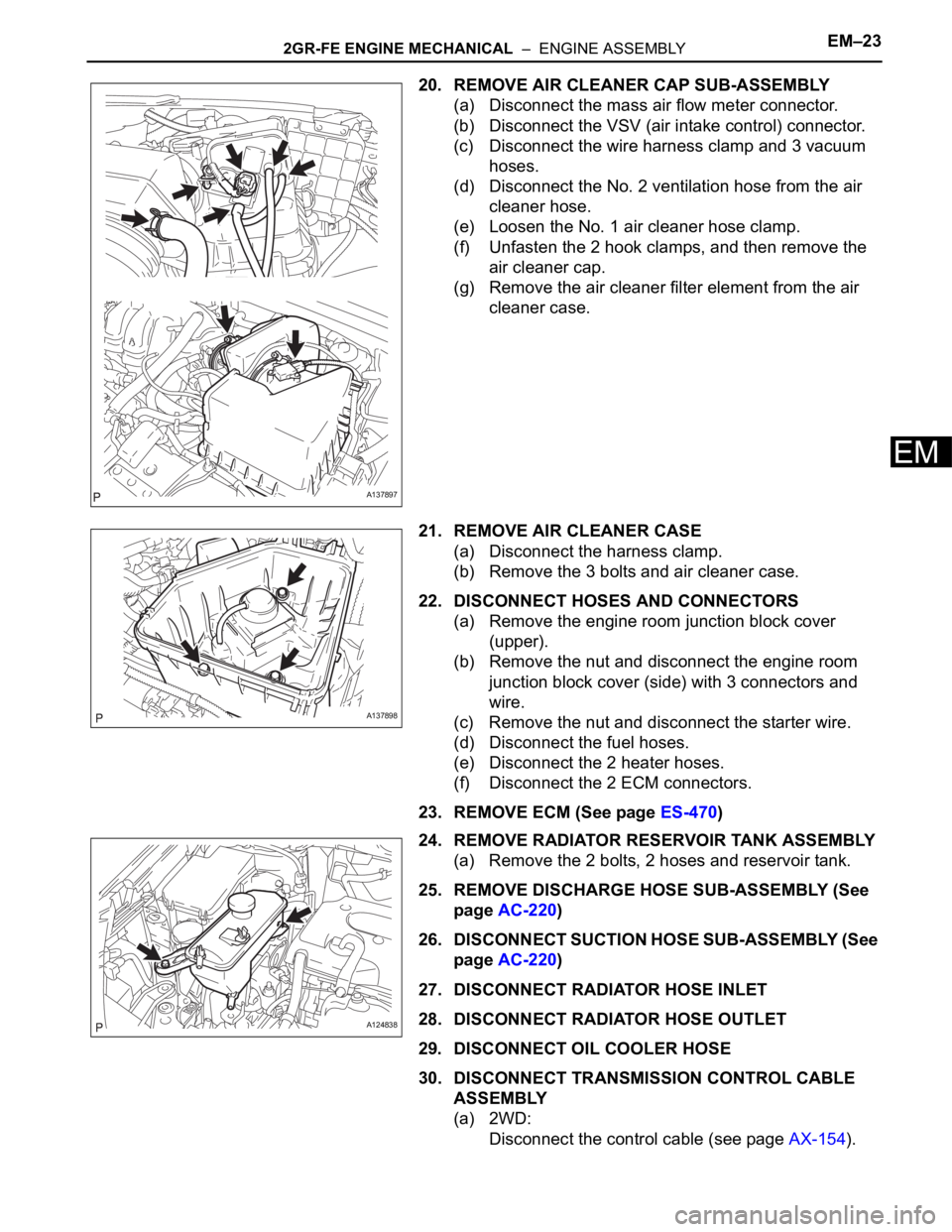
20. REMOVE AIR CLEANER CAP SUB-ASSEMBLY
(a) Disconnect the mass air flow meter connector.
(b) Disconnect the VSV (air intake control) connector.
(c) Disconnect the wire harness clamp and 3 vacuum
hoses.
(d) Disconnect the No. 2 ventilation hose from the air
cleaner hose.
(e) Loosen the No. 1 air cleaner hose clamp.
(f) Unfasten the 2 hook clamps, and then remove the
air cleaner cap.
(g) Remove the air cleaner filter element from the air
cleaner case.
21. REMOVE AIR CLEANER CASE
(a) Disconnect the harness clamp.
(b) Remove the 3 bolts and air cleaner case.
22. DISCONNECT HOSES AND CONNECTORS
(a) Remove the engine room junction block cover
(upper).
(b) Remove the nut and disconnect the engine room
junction block cover (side) with 3 connectors and
wire.
(c) Remove the nut and disconnect the starter wire.
(d) Disconnect the fuel hoses.
(e) Disconnect the 2 heater hoses.
(f) Disconnect the 2 ECM connectors.
23. REMOVE ECM (See page ES-470)
24. REMOVE RADIATOR RESERVOIR TANK ASSEMBLY
(a) Remove the 2 bolts, 2 hoses and reservoir tank.
25. REMOVE DISCHARGE HOSE SUB-ASSEMBLY (See
page AC-220)
26. DISCONNECT SUCTION HOSE SUB-ASSEMBLY (See
page AC-220)
27. DISCONNECT RADIATOR HOSE INLET
28. DISCONNECT RADIATOR HOSE OUTLET
29. DISCONNECT OIL COOLER HOSE
30. DISCONNECT TRANSMISSION CONTROL CABLE
ASSEMBLY
(a) 2WD:
Disconnect the control cable (see page AX-154).
A137897
A137898
A124838
Page 220 of 2000

IN–48INTRODUCTION – TERMS
IN
GLOSSARY OF SAE AND TOYOTA
TERMS
This glossary lists all SAE-J1930 terms and abbreviations
used in this manual in compliance with SAE
recommendations, as well as their TOYOTA equivalents.
SAE
ABBREVIATIONSSAE TERMS TOYOTA TERMS ( )-ABBREVIATIONS
3GR Third Gear -
4GR Fourth Gear -
A/C Air Conditioning Air Conditioner
ACL Air Cleaner Air Cleaner, A/CL
AIR Secondary Air Injection Air Injection (AI)
AP Accelerator Pedal -
B+ Battery Positive Voltage +B, Battery Voltage
BARO Barometric Pressure HAC
CAC Charge Air Cooler Intercooler
CARB Carburetor Carburetor
CFI Continuous Fuel Injection -
CKP Crankshaft Position Crank Angle
CL Closed Loop Closed Loop
CMP Camshaft Position Cam Angle
CPP Clutch Pedal Position -
CTOX Continuous Trap Oxidizer -
CTP Closed Throttle Position LL ON, Idle ON
DFI Direct Fuel Injection Direct Injection (DI/INJ)
DI Distributor Ignition -
DLC3 Data Link Connector 3 OBD II Diagnostic Connector
DTC Diagnostic Trouble Code Diagnostic Trouble Code
DTM Diagnostic Test Mode -
ECL Engine Coolant Level -
ECM Engine Control Module Engine Electronic Control Unit (ECU)
ECT Engine Coolant Temperature Coolant Temperature, Water Temperature (THW)
EEPROM Electrically Erasable Programmable Read Only MemoryElectrically Erasable Programmable Read Only Memory
(EEPROM)
EFE Early Fuel Evaporation Cold Mixture Heater (CMH), Heat Control Valve (HCV)
EGR Exhaust Gas Recirculation Exhaust Gas Recirculation (EGR)
EI Electronic Ignition Distributorless Ignition (DLI)
EM Engine Modification Engine Modification (EM)
EPROM Erasable Programmable Read Only Memory Programmable Read Only Memory (PROM)
EVAP Evaporative Emission Evaporative Emission Control (EVAP)
FC Fan Control -
FEEPROMFlash Electrically Erasable Programmable Read Only
Memory-
FEPROM Flash Erasable Programmable Read Only Memory -
FF Flexible Fuel -
FP Fuel Pump Fuel Pump
GEN Generator Alternator
GND Ground Ground (GND)
HO2S Heated Oxygen Sensor Heated Oxygen Sensor (HO2S)
IAC Idle Air Control Idle Speed Control (ISC)
Page 252 of 2000

PREPARATION – 2AZ-FE ENGINE MECHANICALPP–7
PP
EQUIPMENT
V-block -
Piston ring compressor -
Piston ring expander -
Valve seat cutter -
Feeler gauge -
CO/HC meter -
Connecting rod aligner -
Cylinder gauge -
Micrometer -
Precision straight edge -
Radiator cap tester -
Steel square -
Tachometer -
Torque wrench -
Vernier calipers -
Dial indicator with magnetic base -
Alignment tester -
toe-in gauge -
Spring tension gauge -
Slide calipers -
Sandpaper (#400) -
Piston heater -
Wooden block -
Plastigage -
Angle gauge -
Timing light -
Page 257 of 2000

PP–10PREPARATION – 2GR-FE ENGINE MECHANICAL
PP
EQUIPMENT
Alignment tester -
Angle gauge -
Brass bar -
Caliper gauge -
Chain block -
Compression gauge -
CO/HC meter -
Connecting rod aligner -
Cylinder gauge -
Dial indicator with magnetic base -
Engine stand -
Feeler gauge -
Gasket scraper -
Magnetic finger -
Micrometer -
Needle-nose pliers -
No. 1 engine hanger -
No. 2 engine hanger -
Pin hole grinder -
Piston ring compressor -
Piston ring expander -
Piston heater -
Plastigage -
Plastic-faced hammer -
Press -
Radiator cap tester -
Reamer (5.5 mm) -
Ridge reamer -
Rod aligner -
Sandpaper (#400) -
Slide calipers -
Straightedge -
Spring scale -
Spring tension gauge -
Steel square -
Tachometer -
Timing light -
Toe-in gauge -
To r q u e w r e n c h -
Valve seat cutter -
V-block -
Vernier calipers -
Vise -
Wooden block -
Page 299 of 2000

PREPARATION – 2GR-FE COOLINGPP–23
PP
EQUIPMENT
Ohmmeter -
Radiator cap tester -
Thermometer -
Torque wrench -
Side calipers -
Heater -
Page 341 of 2000

CH–62AZ-FE CHARGING – CHARGING SYSTEM
CH
8. INSPECT CHARGING CIRCUIT WITH LOAD
(a) With the engine running at 2,000 rpm, turn the high
beam headlights ON and turn the heater blower
switch to the "HI" position.
(b) Check the reading on the ammeter.
Standard amperage:
30 A or more
If the ammeter reading is less than the standard
amperage, repair the generator.
HINT:
If the battery is fully charged, the indication will
sometimes be less than the standard amperage. If
this is the case, add more electrical load (operate
the wipers, rear window defogger, etc.) and check
the reading on the ammeter again.
Page 368 of 2000
AX–292U151F AUTOMATIC TRANSAXLE – DIFFERENTIAL CASE
AX
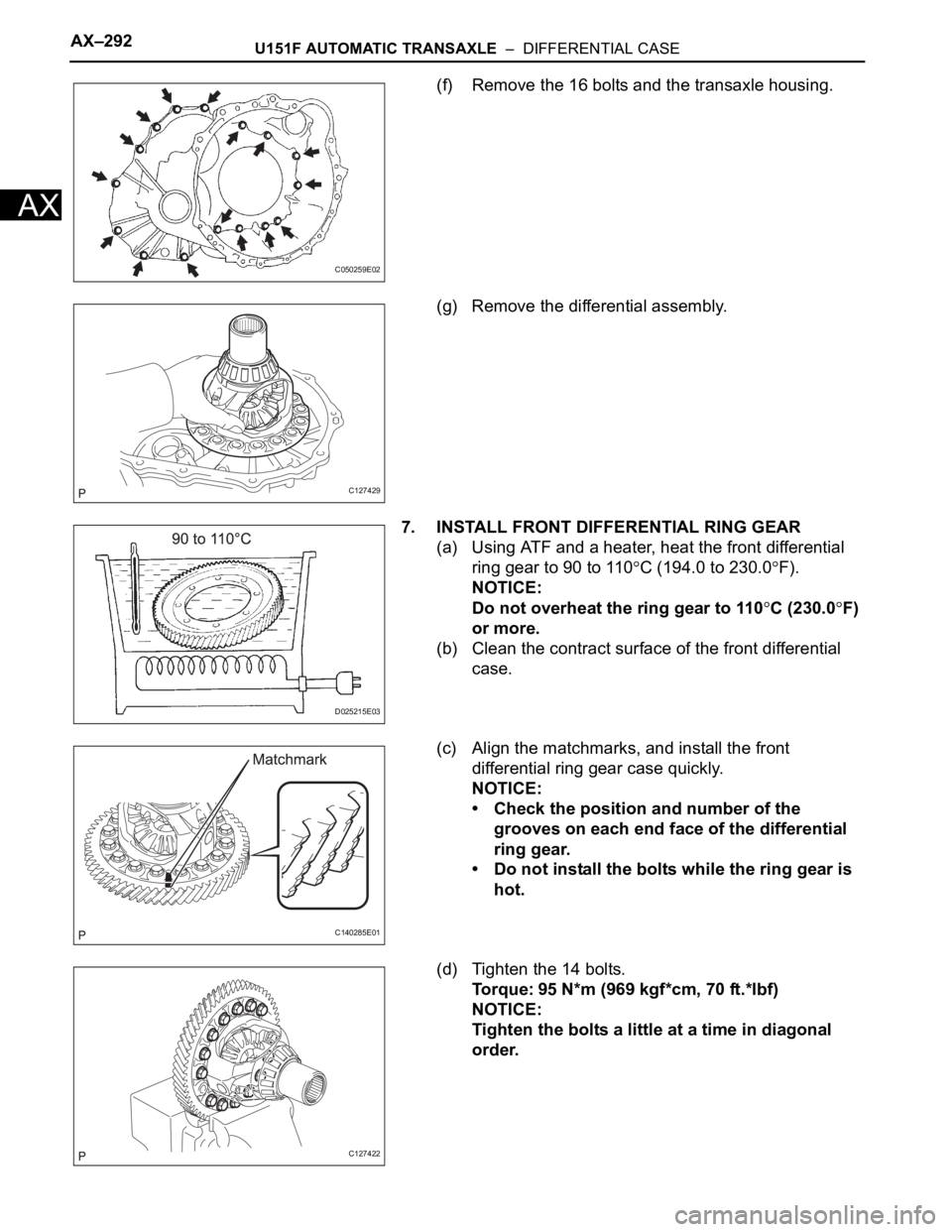
(f) Remove the 16 bolts and the transaxle housing.
(g) Remove the differential assembly.
7. INSTALL FRONT DIFFERENTIAL RING GEAR
(a) Using ATF and a heater, heat the front differential
ring gear to 90 to 110
C (194.0 to 230.0F).
NOTICE:
Do not overheat the ring gear to 110
C (230.0F)
or more.
(b) Clean the contract surface of the front differential
case.
(c) Align the matchmarks, and install the front
differential ring gear case quickly.
NOTICE:
• Check the position and number of the
grooves on each end face of the differential
ring gear.
• Do not install the bolts while the ring gear is
hot.
(d) Tighten the 14 bolts.
Torque: 95 N*m (969 kgf*cm, 70 ft.*lbf)
NOTICE:
Tighten the bolts a little at a time in diagonal
order.
C050259E02
C127429
D025215E03
C140285E01
C127422
Page 436 of 2000

SEAT BELT – SEAT BELT WARNING SYSTEMSB–3
SB
SYSTEM DESCRIPTION
1. DRIVER SEAT BELT WARNING LIGHT
(a) When the driver seat belt is not fastened with the
ignition switch ON, the driver seat belt warning light
on the combination meter comes on to inform the
driver. The center airbag sensor detects the driver
seat belt status and sends signals to the
combination meter through the CAN bus line.
2. PASSENGER SEAT BELT WARNING LIGHT
(a) for Automatic air conditioning system:
When the passenger seat belt is not fastened with
the ignition switch ON and the passenger seat
occupied, check that the passenger seat belt
warning light on the heater control panel display
blinks. The combination meter detects the
passenger seat belt status and whether the
passenger seat is occupied.
(b) for Manual air conditioning system:
When the passenger seat belt is not fastened with
the ignition switch ON and the passenger seat
occupied, check that the passenger seat belt
warning light on the clock panel blinks. The
combination meter detects the passenger seat belt
status and whether the passenger seat is occupied.
Page 481 of 2000
2AZ-FE ENGINE CONTROL SYSTEM – SFI SYSTEMES–27
ES
– Air-fuel ratio feedback control is performed.
(b) Drive Pattern for front A/F sensor and HO2 sensor
(1) Connect the intelligent tester to the DLC3.
(2) Turn the ignition switch ON.
(3) Turn the tester ON.
(4) Clear DTCs (see page ES-35).
(5) Start the engine, and warm it up until the ECT
reaches 75
C (167F) or higher.
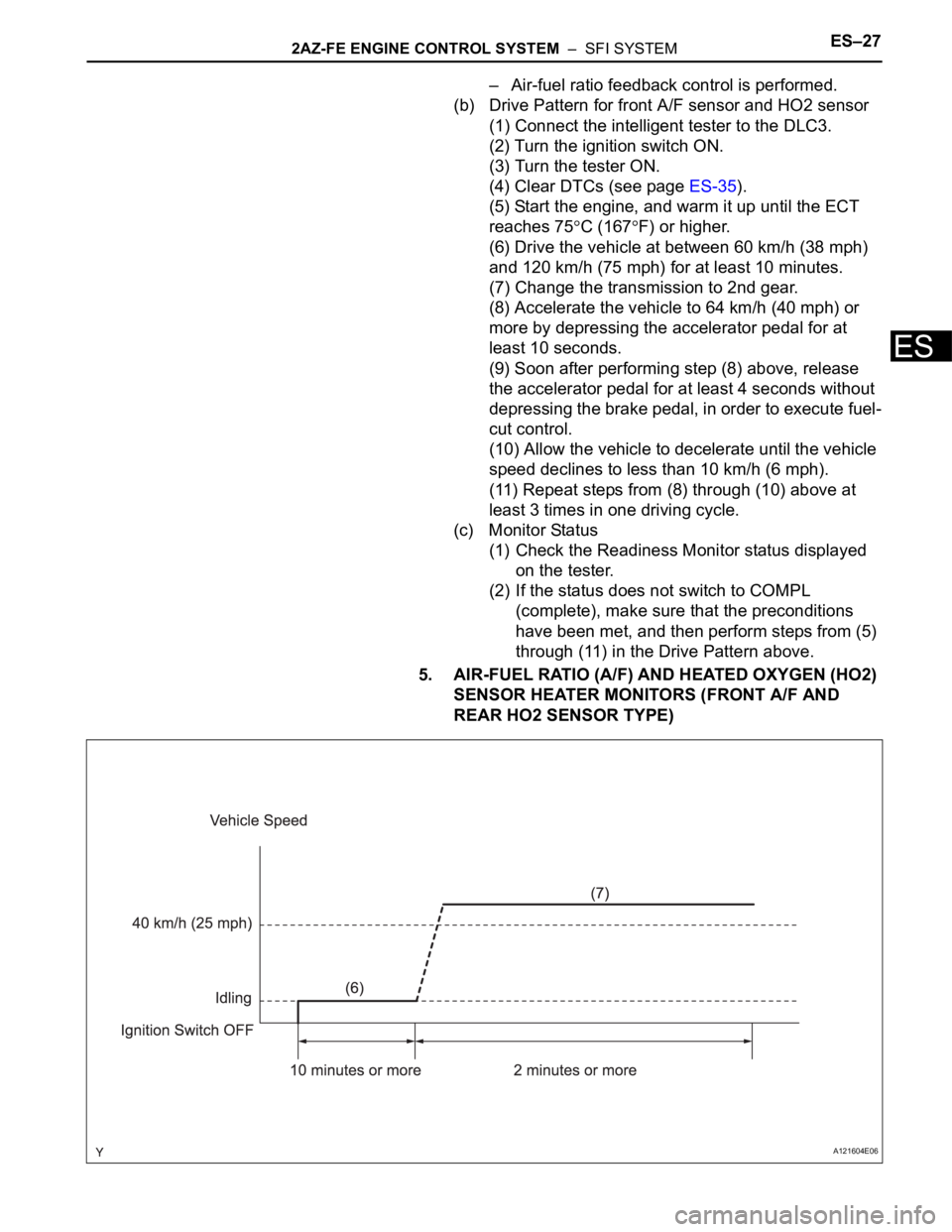
(6) Drive the vehicle at between 60 km/h (38 mph)
and 120 km/h (75 mph) for at least 10 minutes.
(7) Change the transmission to 2nd gear.
(8) Accelerate the vehicle to 64 km/h (40 mph) or
more by depressing the accelerator pedal for at
least 10 seconds.
(9) Soon after performing step (8) above, release
the accelerator pedal for at least 4 seconds without
depressing the brake pedal, in order to execute fuel-
cut control.
(10) Allow the vehicle to decelerate until the vehicle
speed declines to less than 10 km/h (6 mph).
(11) Repeat steps from (8) through (10) above at
least 3 times in one driving cycle.
(c) Monitor Status
(1) Check the Readiness Monitor status displayed
on the tester.
(2) If the status does not switch to COMPL
(complete), make sure that the preconditions
have been met, and then perform steps from (5)
through (11) in the Drive Pattern above.
5. AIR-FUEL RATIO (A/F) AND HEATED OXYGEN (HO2)
SENSOR HEATER MONITORS (FRONT A/F AND
REAR HO2 SENSOR TYPE)
A121604E06