injector TOYOTA RAV4 2006 Service User Guide
[x] Cancel search | Manufacturer: TOYOTA, Model Year: 2006, Model line: RAV4, Model: TOYOTA RAV4 2006Pages: 2000, PDF Size: 45.84 MB
Page 67 of 2000

ENGINE - 2GR-FE ENGINEEG-71
FEATURES OF 2GR-FE ENGINE
The 2GR-FE engine has achieved the following performance through the use of the items listed below.
(1) High performance and reliability
(2) Low noise and vibration
(3) Lightweight and compact design
(4) Good serviceability
(5) Clean emission and fuel economy
Item
(1)(2)(3)(4)(5)
A steel laminate type cylinder head gasket is used.
An upright intake port is used.
EngineA taper squish shape is used for combustion chamber.Engine
ProperA cylinder block made of aluminum alloy is used.Proper
The skirt portion of the piston is applied with resin to
reduce friction.
An oil pan No. 1 made of aluminum alloy is used.
The Dual VVT-i (Variable Valve Timing-intelligent)
system is used.
Va l v e
Mh i
Hydraulic lash adjusters are used.
MechanismTiming chains and chain tensioners are used.
Roller rocker arms are used.
Lubrication
SystemAn oil filter with a replaceable element is used.
Cooling SystemThe TOYOTA Genuine SLLC (Super Long Life Coolant)Cooling SystemThe TOYOTA Genuine SLLC (Super Long Life Coolant)
is used for the engine coolant.
The linkless-type throttle body is used.
Intake andThe intake air chamber made of plastic is used.Intake and
Exhaust
S
A stainless steel exhaust manifold is used.
SystemAn ultra thin-wall, high-cell density ceramic type TWC
(Three-Way Catalytic converter) is used.
The fuel delivery pipe made of plastic is used.
Fuel SystemA compact 12-hole type injector is used.Fuel SystemQuick connectors are used to connect the fuel hose with
the fuel pipe.
Ignition System
The DIS (Direct Ignition System) makes ignition timing
adjustment unnecessary.
Ignition System
The long-reach type spark plugs are used.
(Continued)
Page 90 of 2000

ENGINE - 2GR-FE ENGINE
01MEG17Y
Injector
Quick Connector
Pulsation Damper
Fuel Pump Assembly
Fuel Filter
Pressure Regulator
Fuel Tank
Canister
Injector Fuel Delivery Pipe EG-94
FUEL SYSTEM
1. General
The fuel returnless system is used to reduce evaporative emissions.
A fuel cut control is used to stop the fuel pump when the SRS airbag is deployed in a frontal or side
collision. For details, see page EG-53.
The fuel delivery pipe made of plastic is used.
A quick connector is used to connect the fuel pipe with the fuel hose for excellent serviceability.
Compact 12-hole type injectors are used to increase atomization of the fuel.
A compact fuel pump in which a fuel filter is integrated in the fuel pump assembly is used.
The ORVR (On-board Refueling Vapor Recovery) system is used. For details, see page EG-131.
Page 99 of 2000

ENGINE - 2GR-FE ENGINE
01MEG07Y
SENSORSACTUATORS
MASS AIR FLOW METER
INTAKE AIR TEMPERATURE
SENSOR
CRANKSHAFT POSITION
SENSOR
ENGINE COOLANT
TEMPERATURE SENSOR
ACCELERATOR PEDAL
POSITION SENSOR
THROTTLE POSITION
SENSOR
KNOCK SENSOR (Bank 1)
KNOCK SENSOR (Bank 2)
INTAKE VVT SENSOR (Bank 1)
INTAKE VVT SENSOR (Bank 2)
EXHAUST VVT SENSOR
(Bank 1)
EXHAUST VVT SENSOR
(Bank 2)
IGNITION SWITCHVG
THA
NE
THW
VPA
VPA2
VTA1
VTA2
KNK1
KNK2
VV1
VV2
EV1
EV2
IGSWECM#10
#20
#30
#40
#50
#60
IGT1 -
IGT6
IGF1
M
OC1
OC2
OE1
OE2SFI
NO. 1 INJECTOR
NO. 2 INJECTOR
NO. 3 INJECTOR
NO. 4 INJECTOR
NO. 5 INJECTOR
NO. 6 INJECTOR
ESA
IGNITION COIL with
IGNITER
SPARK PLUG
ETCS-i
THROTTLE CONTROL
MOTOR
VVT-i (INTAKE SIDE)
CAMSHAFT TIMING OIL
CONTROL VALVE (Bank 1)
CAMSHAFT TIMING OIL
CONTROL VALVE (Bank 2)
VVT-i (EXHAUST SIDE)
CAMSHAFT TIMING OIL
CONTROL VALVE (Bank 1)
CAMSHAFT TIMING OIL
CONTROL VALVE (Bank 2)EG-103
2. Construction
The configuration of the engine control system is as shown in the following chart.
(Continued)
Page 102 of 2000

ENGINE - 2GR-FE ENGINE
01MEG29Y
Ignition SwitchCombination Meter
Vehicle Speed Signal
MIL
Battery Current Sensor
(Built-in Battery
Temperature Sensor)
Park / Neutral
Position Switch
Battery
Generator
Fuel Pump Relay
Fuel Pump
Vent Valve
Circuit Opening
RelayDLC3*1*2*3
CAN
ECM
Cruise Control Switch
Accelerator Pedal
Position Sensor
Stop Light Switch
Canister
Pressure
SensorLeak
Detection
Pump
Intake Air
Temp. Sensor
VSV (For
Air Intake
Control)Mass Air
Flow Meter
AirThrottle Position
Sensor
Purge VSV
Throttle
Control
Motor
*4*5
Fan
Motor No. 1Fan
Motor
No. 2
Cooling
Fan
ECUCooling
Fan
ECU
No. 1Cooling
Fan
ECU
No. 2
Fan Motor No. 1
Fan Motor No. 2
ACIS Actuator
Intake Camshaft Timing
Oil Control Valve (Bank 2)Injector Injector
Intake Camshaft Timing
Oil Control Valve (Bank 1)
Intake VVT Sensor (Bank 1)
Ignition Coil With Igniter
Exhaust VVT Sensor (Bank 1)
Exhaust Camshaft Timing
Oil Control Valve (Bank 1)
Air-fuel Ratio Sensor
(Bank1, Sensor1)
TWC
Knock
Sensor
Intake VVT
Sensor (Bank 2)
Exhaust VVT
Sensor (Bank 2)
Air-fuel Ratio Sensor
(Bank2, Sensor1)Exhaust Camshaft
Timing Oil Control
Valve (Bank 2)
Crankshaft Position
Sensor
Engine Coolant
Temperature Sensor Heated Oxygen Sensor
(Bank1, Sensor2)Heated Oxygen Sensor
(Bank2, Sensor2)TWCTWC
EG-106
3. Engine Control System Diagram
*1: Air Conditioning ECU
*
2: Airbag Sensor Assembly
*
3: Skid Control ECU
*
4: Except Towing Package Models
*
5: Towing Package Models
Page 104 of 2000

ENGINE - 2GR-FE ENGINE
01MEG27Y
01MEG28Y
Intake Camshaft Timing Oil Control Valve (Bank 2)
Ignition Coil with Igniter
Injector
Intake VVT Sensor
(Bank 2)
Exhaust Camshaft
Timing Oil Control
Valve (Bank 2)
Crankshaft
Position Sensor
Exhaust VVT Sensor
(Bank 2)Air-fuel Ratio
Sensor
(Bank 2, Sensor 1)Engine Coolant
Temperature SensorIntake Camshaft Timing Oil Control
Valve (Bank 1)
Intake VVT
Sensor (Bank 1)
Exhaust VVT Sensor
(Bank 1)
Exhaust Camshaft
Timing Oil Control
Valve (Bank 1)
Air-fuel Ratio Sensor
(Bank 1, Sensor 1)
ACIS ActuatorThrottle Position Sensor
Knock Sensor (Bank 1)
Knock Sensor (Bank 2) EG-108
Page 105 of 2000

ENGINE - 2GR-FE ENGINEEG-109
5. Main Components of Engine Control System
General
The main components of the 2GR-FE engine control system are as follows:
Component
OutlineQuantity
ECM32-bit CPU1
Mass Air Flow MeterHot-wire Type1
Crankshaft Position Sensor (Rotor Teeth)Pick-up Coil Type (36 - 2)1
Intake VVT Sensor (Rotor Teeth)MRE (Magnetic Resistance Element)
Ty p e ( 3 )2
Exhaust VVT Sensor (Rotor Teeth)MRE (Magnetic Resistance Element)
Ty p e ( 3 )2
Accelerator Pedal Position SensorNon-contact Type1
Throttle Position SensorNon-contact Type1
Knock SensorBuilt-in Piezoelectric Type
(Non-resonant Type / Flat Type)2
Air fuel Ratio Sensor(Bank 1, Sensor 1)Type with Heater (Planar Type)1 eachAir-fuel Ratio Sensor(Bank 2, Sensor 1)Type with Heater (Planar Type)1 each
Heated Oxygen (Bank 1, Sensor 2)Type with Heater (Cup Type)1 eachHeated Oxygen
Sensor
(Bank 2, Sensor 2)Type with Heater (Cup Type)1 each
Injector12-hole Type6
Page 203 of 2000
EM–282GR-FE ENGINE MECHANICAL – ENGINE ASSEMBLY
EM
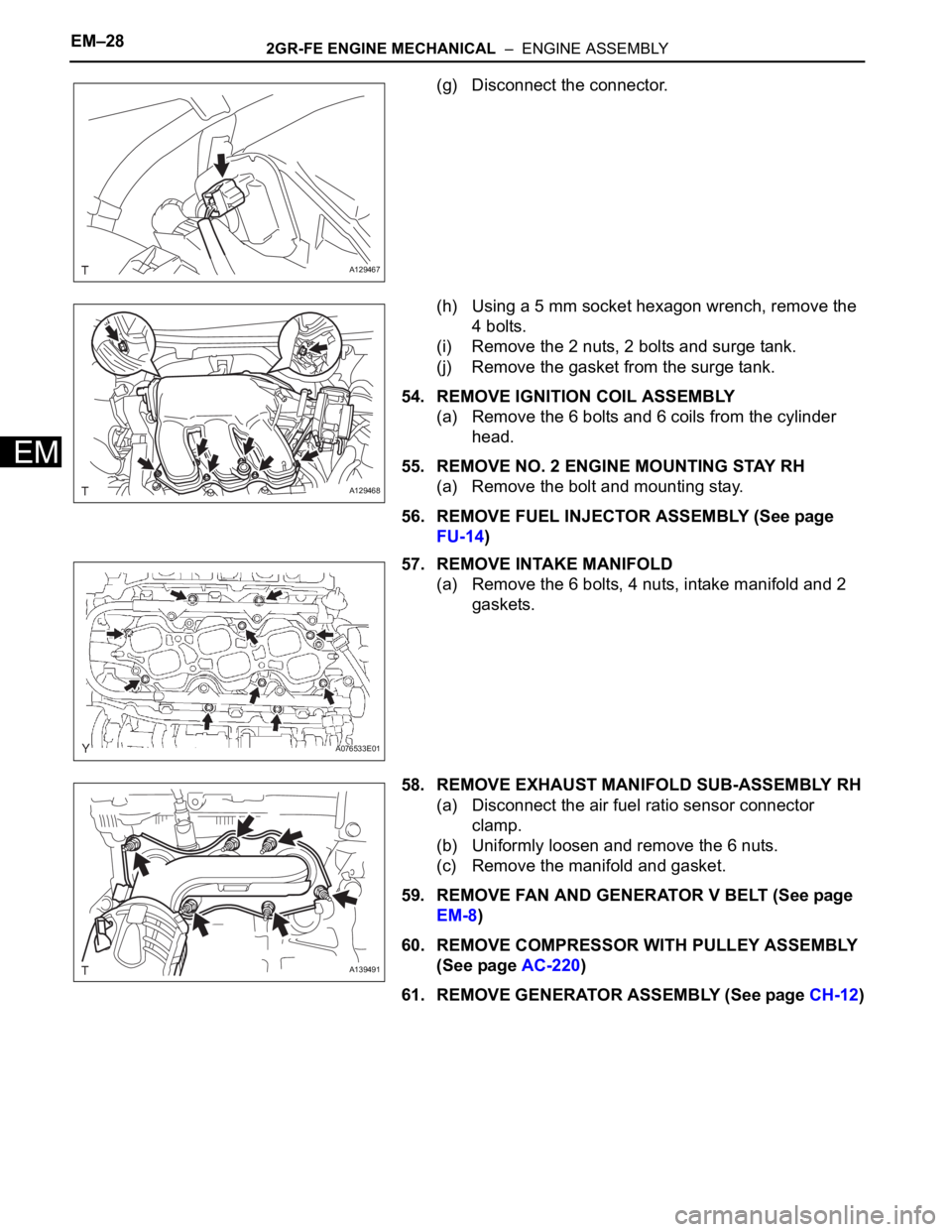
(g) Disconnect the connector.
(h) Using a 5 mm socket hexagon wrench, remove the
4 bolts.
(i) Remove the 2 nuts, 2 bolts and surge tank.
(j) Remove the gasket from the surge tank.
54. REMOVE IGNITION COIL ASSEMBLY
(a) Remove the 6 bolts and 6 coils from the cylinder
head.
55. REMOVE NO. 2 ENGINE MOUNTING STAY RH
(a) Remove the bolt and mounting stay.
56. REMOVE FUEL INJECTOR ASSEMBLY (See page
FU-14)
57. REMOVE INTAKE MANIFOLD
(a) Remove the 6 bolts, 4 nuts, intake manifold and 2
gaskets.
58. REMOVE EXHAUST MANIFOLD SUB-ASSEMBLY RH
(a) Disconnect the air fuel ratio sensor connector
clamp.
(b) Uniformly loosen and remove the 6 nuts.
(c) Remove the manifold and gasket.
59. REMOVE FAN AND GENERATOR V BELT (See page
EM-8)
60. REMOVE COMPRESSOR WITH PULLEY ASSEMBLY
(See page AC-220)
61. REMOVE GENERATOR ASSEMBLY (See page CH-12)
A129467
A129468
A076533E01
A139491
Page 208 of 2000
FU–62AZ-FE FUEL – FUEL SYSTEM
FU
ON-VEHICLE INSPECTION
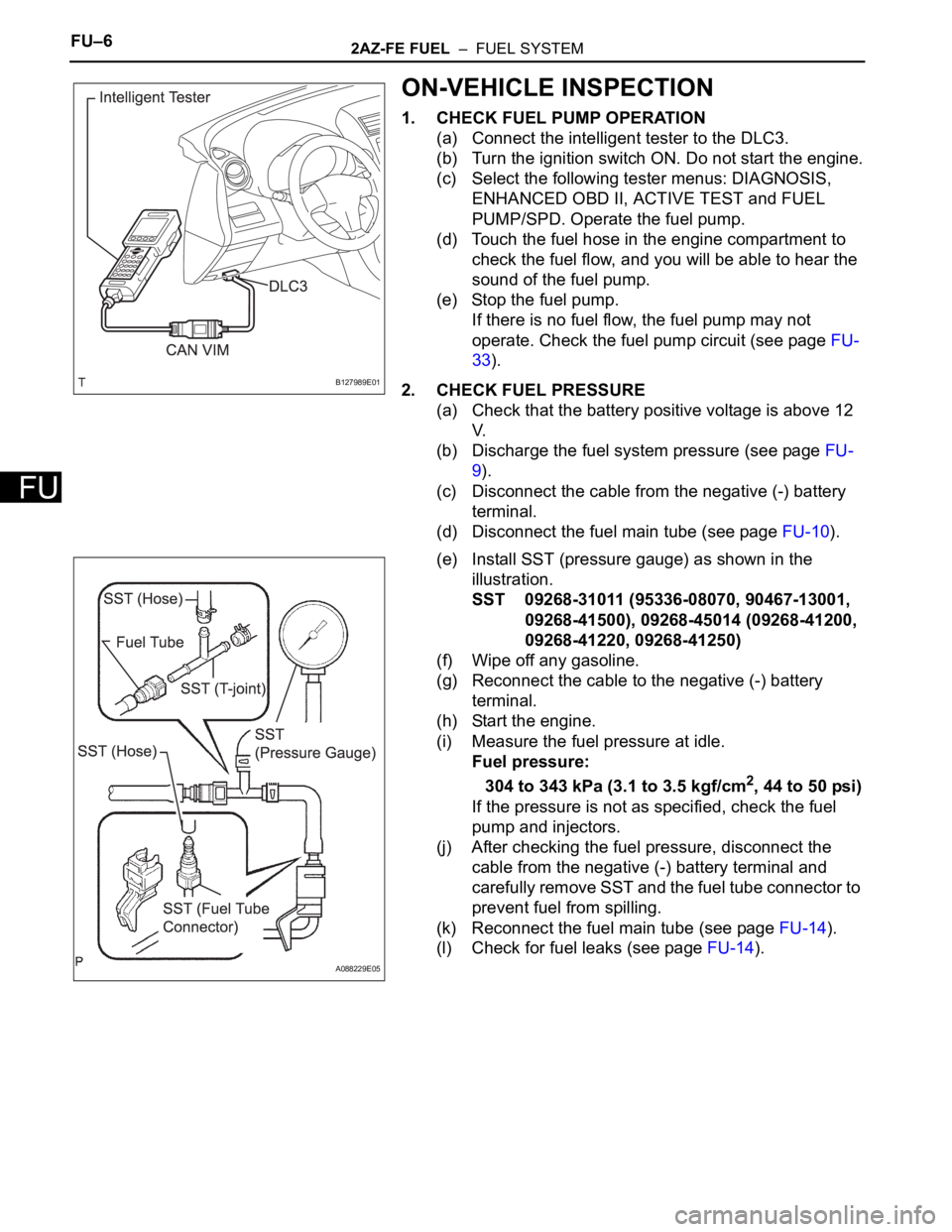
1. CHECK FUEL PUMP OPERATION
(a) Connect the intelligent tester to the DLC3.
(b) Turn the ignition switch ON. Do not start the engine.
(c) Select the following tester menus: DIAGNOSIS,
ENHANCED OBD II, ACTIVE TEST and FUEL
PUMP/SPD. Operate the fuel pump.
(d) Touch the fuel hose in the engine compartment to
check the fuel flow, and you will be able to hear the
sound of the fuel pump.
(e) Stop the fuel pump.
If there is no fuel flow, the fuel pump may not
operate. Check the fuel pump circuit (see page FU-
33).
2. CHECK FUEL PRESSURE
(a) Check that the battery positive voltage is above 12
V.
(b) Discharge the fuel system pressure (see page FU-
9).
(c) Disconnect the cable from the negative (-) battery
terminal.
(d) Disconnect the fuel main tube (see page FU-10).
(e) Install SST (pressure gauge) as shown in the
illustration.
SST 09268-31011 (95336-08070, 90467-13001,
09268-41500), 09268-45014 (09268-41200,
09268-41220, 09268-41250)
(f) Wipe off any gasoline.
(g) Reconnect the cable to the negative (-) battery
terminal.
(h) Start the engine.
(i) Measure the fuel pressure at idle.
Fuel pressure:
304 to 343 kPa (3.1 to 3.5 kgf/cm
2, 44 to 50 psi)
If the pressure is not as specified, check the fuel
pump and injectors.
(j) After checking the fuel pressure, disconnect the
cable from the negative (-) battery terminal and
carefully remove SST and the fuel tube connector to
prevent fuel from spilling.
(k) Reconnect the fuel main tube (see page FU-14).
(l) Check for fuel leaks (see page FU-14).
B127989E01
A088229E05
Page 227 of 2000
2AZ-FE EMISSION CONTROL – EMISSION CONTROL SYSTEMEC–7
EC
ON-VEHICLE INSPECTION
1. CHECK FUEL CUT RPM
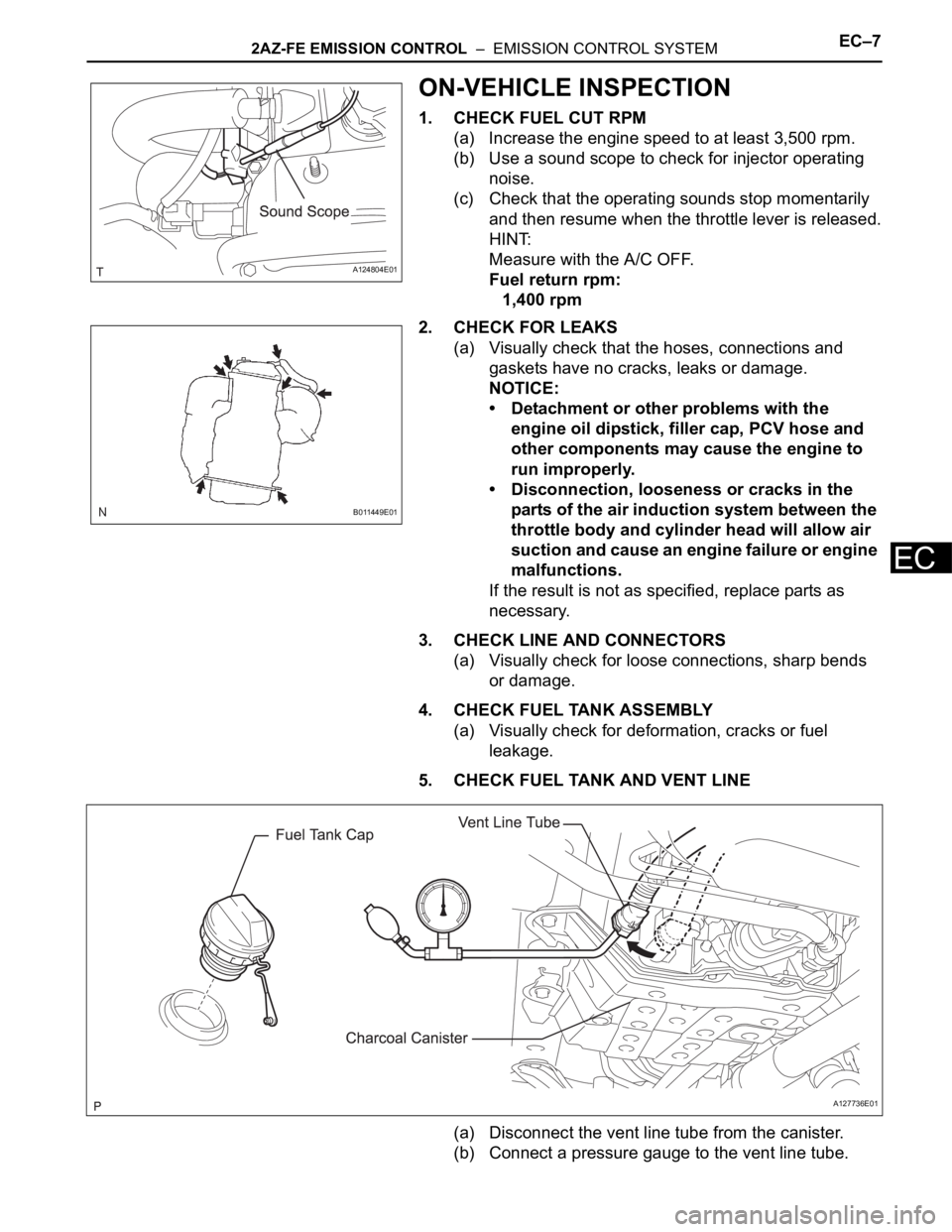
(a) Increase the engine speed to at least 3,500 rpm.
(b) Use a sound scope to check for injector operating
noise.
(c) Check that the operating sounds stop momentarily
and then resume when the throttle lever is released.
HINT:
Measure with the A/C OFF.
Fuel return rpm:
1,400 rpm
2. CHECK FOR LEAKS
(a) Visually check that the hoses, connections and
gaskets have no cracks, leaks or damage.
NOTICE:
• Detachment or other problems with the
engine oil dipstick, filler cap, PCV hose and
other components may cause the engine to
run improperly.
• Disconnection, looseness or cracks in the
parts of the air induction system between the
throttle body and cylinder head will allow air
suction and cause an engine failure or engine
malfunctions.
If the result is not as specified, replace parts as
necessary.
3. CHECK LINE AND CONNECTORS
(a) Visually check for loose connections, sharp bends
or damage.
4. CHECK FUEL TANK ASSEMBLY
(a) Visually check for deformation, cracks or fuel
leakage.
5. CHECK FUEL TANK AND VENT LINE
(a) Disconnect the vent line tube from the canister.
(b) Connect a pressure gauge to the vent line tube.
A124804E01
B011449E01
A127736E01
Page 483 of 2000
2AZ-FE ENGINE CONTROL SYSTEM – SFI SYSTEMES–29
ES
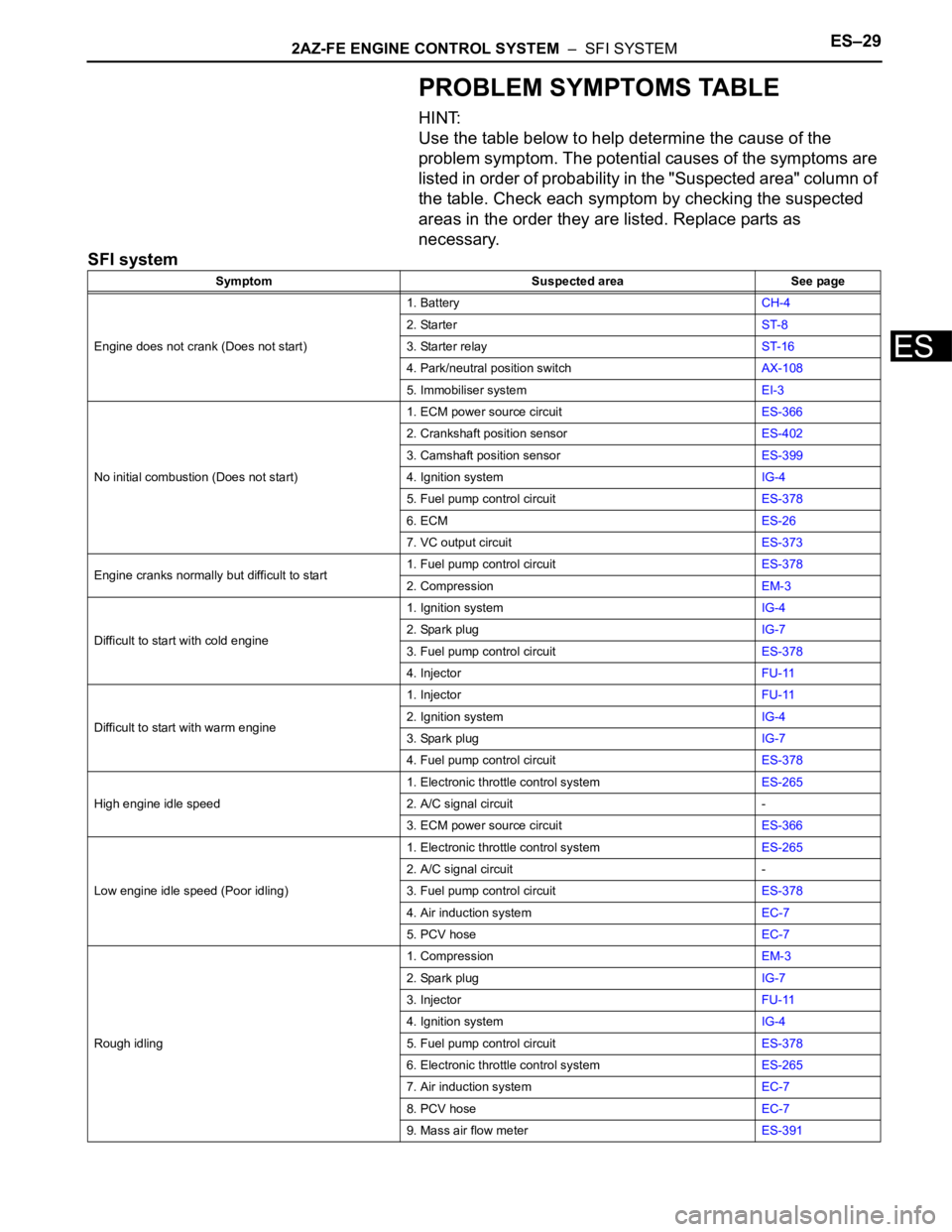
PROBLEM SYMPTOMS TABLE
HINT:
Use the table below to help determine the cause of the
problem symptom. The potential causes of the symptoms are
listed in order of probability in the "Suspected area" column of
the table. Check each symptom by checking the suspected
areas in the order they are listed. Replace parts as
necessary.
SFI system
Symptom Suspected area See page
Engine does not crank (Does not start)1. BatteryCH-4
2. StarterST-8
3. Starter relayST-16
4. Park/neutral position switchAX-108
5. Immobiliser systemEI-3
No initial combustion (Does not start)1. ECM power source circuitES-366
2. Crankshaft position sensorES-402
3. Camshaft position sensorES-399
4. Ignition systemIG-4
5. Fuel pump control circuitES-378
6. ECMES-26
7. VC output circuitES-373
Engine cranks normally but difficult to start1. Fuel pump control circuitES-378
2. CompressionEM-3
Difficult to start with cold engine1. Ignition systemIG-4
2. Spark plugIG-7
3. Fuel pump control circuitES-378
4. InjectorFU-11
Difficult to start with warm engine1. InjectorFU-11
2. Ignition systemIG-4
3. Spark plugIG-7
4. Fuel pump control circuitES-378
High engine idle speed1. Electronic throttle control systemES-265
2. A/C signal circuit -
3. ECM power source circuitES-366
Low engine idle speed (Poor idling)1. Electronic throttle control systemES-265
2. A/C signal circuit -
3. Fuel pump control circuitES-378
4. Air induction systemEC-7
5. PCV hoseEC-7
Rough idling1. CompressionEM-3
2. Spark plugIG-7
3. InjectorFU-11
4. Ignition systemIG-4
5. Fuel pump control circuitES-378
6. Electronic throttle control systemES-265
7. Air induction systemEC-7
8. PCV hoseEC-7
9. Mass air flow meterES-391