key battery TOYOTA RAV4 2006 Service User Guide
[x] Cancel search | Manufacturer: TOYOTA, Model Year: 2006, Model line: RAV4, Model: TOYOTA RAV4 2006Pages: 2000, PDF Size: 45.84 MB
Page 1838 of 2000

LIGHTING – LIGHTING SYSTEMLI–7
LI
SYSTEM DESCRIPTION
1. LIGHTING SYSTEM
(a) Illumination control system (Illuminated entry
system):
When the doors are unlocked by a key or
transmitter operation, or when a door is opened or
closed, the illuminated entry system turns on the
room light, map light, foot light and ignition key
cylinder light*1 or transponder key amplifier*2.
(1) The main body ECU receives the following
signals (A).
• Door courtesy switch signal
• Door detection switch signal
• Ignition switch signal
(2) The main body ECU controls the following signal
based on the signals listed in A.
• Illumination operation signal
(3) The main body ECU controls the on/off and
fade-in/fade-out operation of the following parts.
•Room light
• Map light
•Foot light
• Ignition key cylinder light*1 or transponder
key amplifier*2
HINT:
*1: w/o Engine immobiliser system
*2: w/ Engine immobiliser system
(b) Battery saver system:
When the ignition switch is turned off and any of the
doors is open continuously for 20 minutes, the main
body ECU turns the illumination operation signal off.
As a result, the room light, map light, foot light and
ignition key cylinder lights*1 or transponder key
amplifier*2 turn off.
HINT:
*1: w/o Engine immobiliser system
*2: w/ Engine immobiliser system
(1) The main body ECU receives the following
signals (B).
• Door courtesy switch signal
• Ignition switch signal
(2) The main body ECU controls the following signal
based on the signals listed in B (C).
• Illumination operation signal
(3) The main body ECU controls the illumination
period of the following parts based on the
signals listed in C.
•Room light
• Map light
•Foot light
• Ignition key cylinder light*1 or transponder
key amplifier*2
HINT:
*1: w/o Engine immobiliser system
Page 1907 of 2000
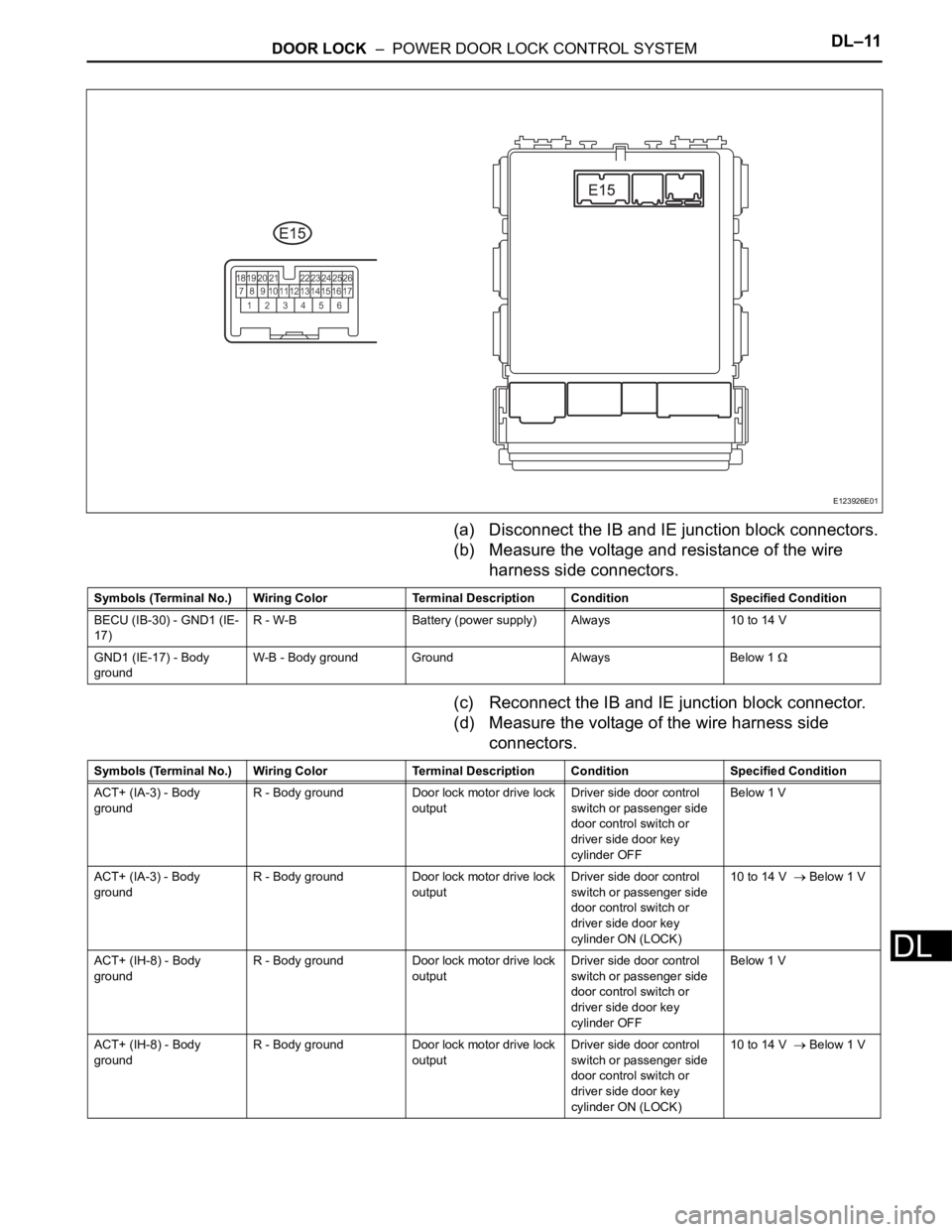
DOOR LOCK – POWER DOOR LOCK CONTROL SYSTEMDL–11
DL
(a) Disconnect the IB and IE junction block connectors.
(b) Measure the voltage and resistance of the wire
harness side connectors.
(c) Reconnect the IB and IE junction block connector.
(d) Measure the voltage of the wire harness side
connectors.
E123926E01
Symbols (Terminal No.) Wiring Color Terminal Description ConditionSpecified Condition
BECU (IB-30) - GND1 (IE-
17)R - W-B Battery (power supply) Always 10 to 14 V
GND1 (IE-17) - Body
groundW-B - Body ground Ground Always Below 1
Symbols (Terminal No.) Wiring Color Terminal Description ConditionSpecified Condition
ACT+ (IA-3) - Body
groundR - Body ground Door lock motor drive lock
outputDriver side door control
switch or passenger side
door control switch or
driver side door key
cylinder OFFBelow 1 V
ACT+ (IA-3) - Body
groundR - Body ground Door lock motor drive lock
outputDriver side door control
switch or passenger side
door control switch or
driver side door key
cylinder ON (LOCK)10 to 14 V
Below 1 V
ACT+ (IH-8) - Body
groundR - Body ground Door lock motor drive lock
outputDriver side door control
switch or passenger side
door control switch or
driver side door key
cylinder OFFBelow 1 V
ACT+ (IH-8) - Body
groundR - Body ground Door lock motor drive lock
outputDriver side door control
switch or passenger side
door control switch or
driver side door key
cylinder ON (LOCK)10 to 14 V
Below 1 V
Page 1945 of 2000

2AZ-FE ENGINE CONTROL SYSTEM – SFI SYSTEMES–57
ES
• When the COMPRESS CHECK test is OFF and the
engine is cranked, the engine will start.
• If the COMPRESS CHECK test needs to be
performed after it is turned ON and performed once,
press EXIT to return to the ACTIVE TEST menu
screen. Then perform the COMPRESS CHECK test
again.
• Use a fully-charged battery.
3. SYSTEM CHECK
HINT:
Performing a SYSTEM CHECK enables the system,
which consists of multiple actuators, to be operated
without removing any parts. In addition, it can show
whether or not any DTCs are set, and can detect
potential malfunctions in the system. The SYSTEM
CHECK can be performed with the intelligent tester.
(a) Connect the intelligent tester to the DLC3.
(b) Turn the ignition switch ON.
(c) Turn the tester ON.
(d) Select the following menu items: DIAGNOSIS /
ENHANCED OBD II / SYSTEM CHECK.
(e) Perform the SYSTEM CHECK by referring to the
table below.
ECM:
Intelligent Tester Display Test DetailRecommended Fuel
Te m p e r a t u r eDiagnostic Note
EVAP SYS CHECK
(AUTO OPERATION)Perform 5 steps in order to
operate EVAP key-off monitor
automatically35
C (95F) or less• If no DTCs in PENDING
CODE after performing this
test, system functioning
normally
• Refer to EVAP system
EVAP SYS CHECK
(MANUAL OPERATION)Perform 5 steps in order to
operate EVAP key-off monitor
manually35
C (95F) or less• Used to detect malfunctioning
parts
• Refer to EVAP system
Page 1998 of 2000

ES–1102AZ-FE ENGINE CONTROL SYSTEM – SFI SYSTEM
ES
MONITOR STRATEGY
TYPICAL ENABLING CONDITIONS
All:
After engine stop:
After cold engine start:
TYPICAL MALFUNCTION THRESHOLDS
After engine stop:
After cold engine start:
WIRING DIAGRAM
Refer to DTC P0110 (see page ES-88).
INSPECTION PROCEDURE
(a) Connect the intelligent tester to the DLC3.
Related DTCsP0111: Intake air temperature sensor rationality (After engine stop)
P0111: Intake air temperature sensor rationality (After cold engine
start)
Required Sensors/Components (Main) Intake Air Temperature (IAT) sensor
Required Sensors/Components (Sub) -
Frequency of Operation Once per driving cycle
Duration 5 hours or more
MIL Operation 2 driving cycles
Sequence of Operation None
Monitor runs whenever following DTCs are not present None
Time after engine start 10 seconds or more
Battery voltage 10.5 V or more
ECT sensor circuit OK
ECT change since engine Less than 180
C (356F)
ECT before engine stop 70
C (158F) or more
Time that MAF is low before engine stop 70 minutes
Accumulated MAF amount before engine stop 3,451 g or more
Key-off duration 30 minutes
Key-off duration 5 hours
Time after engine start 10 seconds or more
ECT sensor circuit OK
ECT 70
C (158F) or more
Accumulated MAF amount 3,451 g or more
One of the following conditions 1 or 2 is met: -
1. Duration while engine load is low 120 seconds or more
2. Duration while engine load is high 10 seconds or more
IAT change Less than 1
C (2F)
IAT change Less than 1
C (2F)
1CHECK ANY OTHER DTCS OUTPUT (IN ADDITION TO DTC P0111)