Heated Oxygen TOYOTA RAV4 2006 Service Owner's Manual
[x] Cancel search | Manufacturer: TOYOTA, Model Year: 2006, Model line: RAV4, Model: TOYOTA RAV4 2006Pages: 2000, PDF Size: 45.84 MB
Page 553 of 2000
2GR-FE ENGINE CONTROL SYSTEM – SFI SYSTEMES–29
ES
(b) Monitor Conditions
(1) Turn the ignition switch OFF and wait for 6
hours.
HINT:
Do not start the engine until checking Readiness
Monitor status. If the engine is started, the step
described above must be repeated.
(c) Monitor Status
(1) Connect the intelligent tester to the DLC3.
(2) Turn the ignition switch ON.
(3) Turn the tester ON.
(4) Check the Readiness Monitor status displayed
on the tester.
If the status does not switch to COMPL (complete), restart the
engine, make sure that the preconditions have been met, and
then perform the Monitor Conditions again.
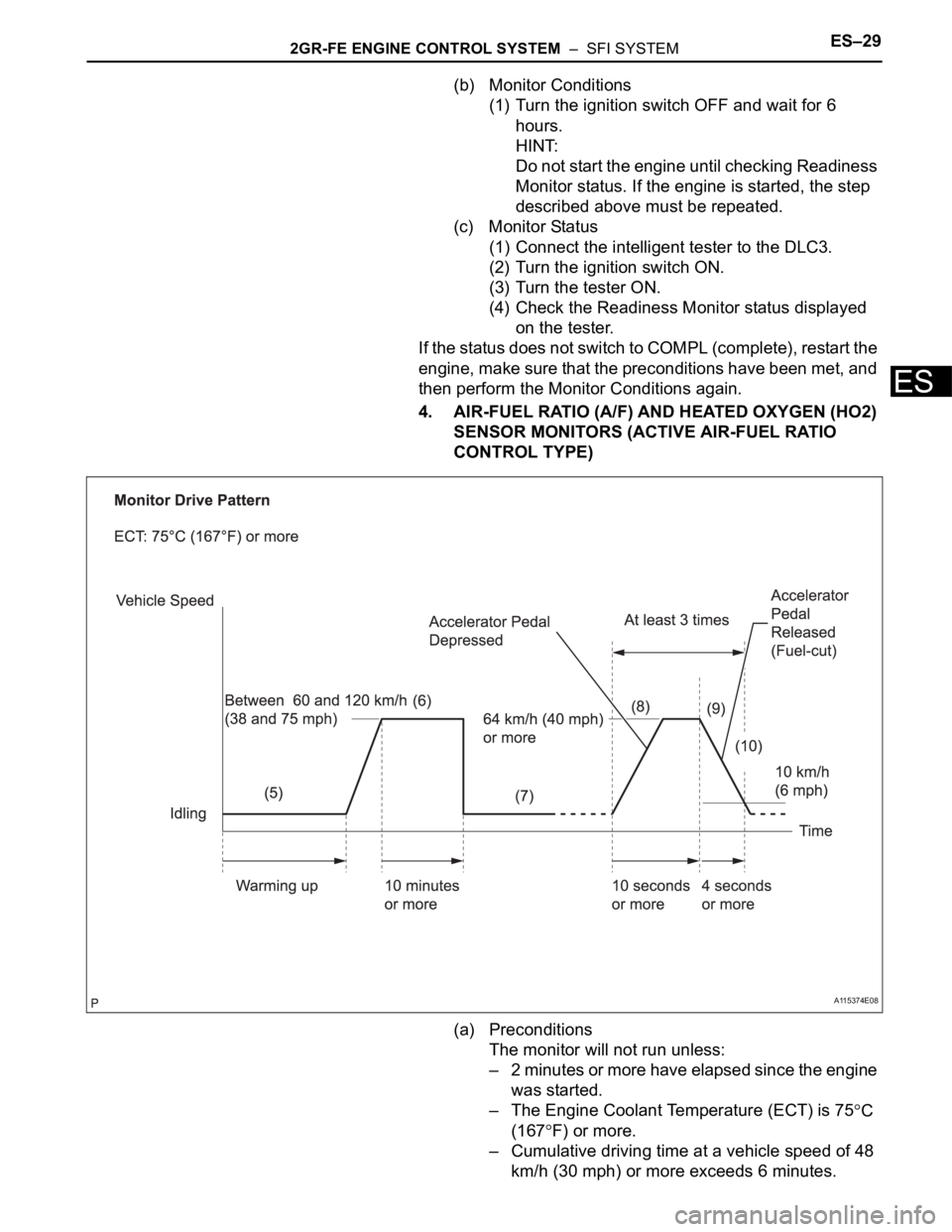
4. AIR-FUEL RATIO (A/F) AND HEATED OXYGEN (HO2)
SENSOR MONITORS (ACTIVE AIR-FUEL RATIO
CONTROL TYPE)
(a) Preconditions
The monitor will not run unless:
– 2 minutes or more have elapsed since the engine
was started.
– The Engine Coolant Temperature (ECT) is 75
C
(167
F) or more.
– Cumulative driving time at a vehicle speed of 48
km/h (30 mph) or more exceeds 6 minutes.
A115374E08
Page 554 of 2000
ES–302GR-FE ENGINE CONTROL SYSTEM – SFI SYSTEM
ES
– Air-fuel ratio feedback control is performed.
(b) Drive Pattern for front A/F sensor and HO2 sensor
(1) Connect the intelligent tester to the DLC3.
(2) Turn the ignition switch ON.
(3) Turn the tester ON.
(4) Clear DTCs (see page ES-39).
(5) Start the engine, and warm it up until the ECT
reaches 75
C (167F) or higher.
(6) Drive the vehicle at between 60 km/h (38 mph)
and 120 km/h (75 mph) for at least 10 minutes.
(7) Change the transmission to 2nd gear.
(8) Accelerate the vehicle to 64 km/h (40 mph) or
more by depressing the accelerator pedal for at
least 10 seconds.
(9) Soon after performing step (8) above, release
the accelerator pedal for at least 4 seconds without
depressing the brake pedal in order to execute fuel-
cut control.
(10) Allow the vehicle to decelerate until the vehicle
speed declines to less than 10 km/h (6 mph).
(11) Repeat steps from (8) through (10) above at
least 3 times in one driving cycle.
(c) Monitor Status
(1) Check the Readiness Monitor status displayed
on the tester.
(2) If the status does not switch to COMPL
(complete), make sure that the preconditions
have been met, and then perform steps from (5)
through (11) in the Drive Pattern above.
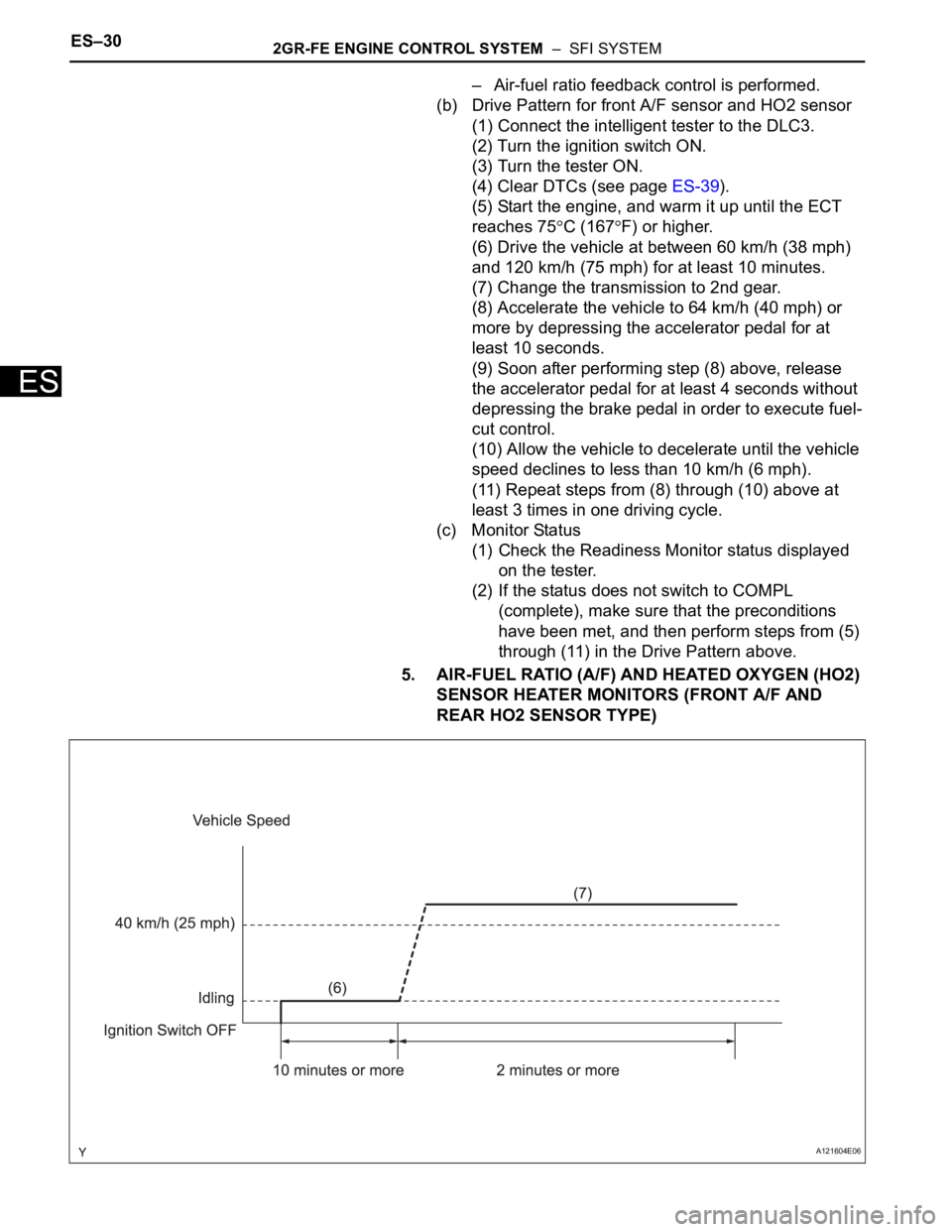
5. AIR-FUEL RATIO (A/F) AND HEATED OXYGEN (HO2)
SENSOR HEATER MONITORS (FRONT A/F AND
REAR HO2 SENSOR TYPE)
A121604E06
Page 559 of 2000

2GR-FE ENGINE CONTROL SYSTEM – SFI SYSTEMES–35
ES
THW (B30-79) - ETHW (B30-78) L - BR Engine coolant
temperature sensorIdling, Engine coolant temperature
80
C (176F)0.2 to 1.0 V
VCTA (B30-96) - ETA (B30-97) B - W Power source of throttle
position sensor (specific
voltage)Ignition switch ON 4.5 to 5.5 V
VTA1 (B30-98) - ETA (B30-97) Y - W Throttle position sensor
(for engine control)Ignition switch ON,
Throttle valve fully closed0.5 to 1.1 V
Ignition switch ON,
Throttle valve fully open3.3 to 4.9 V
VTA2 (B30-99) - ETA (B30-97) GR - W Throttle position sensor
(for sensor malfunction
detection)Ignition switch ON,
Throttle valve fully closed2.1 to 3.1 V
Ignition switch ON,
Throttle valve fully open4.6 to 5.0 V
VPA (A9-55) - EPA (A9-59) W - Y Accelerator pedal position
sensor (for engine control)Ignition switch ON,
Accelerator pedal released0.5 to 1.1 V
Ignition switch ON,
Accelerator pedal fully depressed2.6 to 4.5 V
VPA2 (A9-56) - EPA2 (A9-60) R - O Accelerator pedal position
sensor (for sensor
malfunctioning detection)Ignition switch ON,
Accelerator pedal released1.2 to 2.0 V
Ignition switch ON,
Accelerator pedal fully depressed3.4 to 5.0 V
VCPA (A9-57) - EPA (A9-59) B - Y Power source of
accelerator pedal position
sensor (for VPA)Ignition switch ON 4.5 to 5.5 V
VCP2 (A9-58) - EPA2 (A9-60) L - O Power source of
accelerator pedal position
sensor (for VPA2)Ignition switch ON 4.5 to 5.5 V
HA1A (B30-86) - E04 (B30-23)
HA2A (B30-109) - E04 (B30-23) G - BR
B - BRA/F sensor heater Idling Below 3.0 V
Ignition switch ON 9 to 14 V
A1A+ (B30-93) - E1 (B30-81) W -BR A/F sensor Ignition switch ON 3.3 V*
A1A- (B30-116) - E1 (B30-81) BR - BR A/F sensor Ignition switch ON3.0 V*
A2A+ (B30-120) - E1 (B30-81) L - BR A/F sensor Ignition switch ON 3.3 V*
A2A- (B30-119) - E1 (B30-81) Y - BR A/F sensor Ignition switch ON 3.0 V*
HT1B (B30-48) - E03 (B30-104)
HT2B (B30-47) - E03 (B30-104)LG - BR
Y - BRHeated oxygen sensor
heaterIdling Below 3.0 V
Ignition switch ON 9 to 14 V
OX1B (B30-88) - EX1B (B30-65)
OX2B (B30-87) - EX2B- (B30-64)W - GR
B - B-WHeated oxygen sensor Engine speed maintained at 2,500
rpm for 2 minutes after warming up
sensorPulse generation (see
waveform 2)
#10 (B30-45) - E01 (B30-22)
#20 (B30-85) - E01 (B30-22)
#30 (B30-44) - E01 (B30-22)
#40 (B30-84) - E01 (B30-22)
#50 (B30-43) - E01 (B30-22)
#60 (B30-83) - E01 (B30-22)Y - BR
W - BR
B - BR
BR - BR
L - BR
G - BRInjector Ignition switch ON 9 to 14 V
Idling Pulse generation (see
waveform 3)
KNK1 (B30-95) - EKNK (B30-94)
KNK2 (B30-118) - EKN2 (B30-
11 7 )R - G
B - WKnock sensor Engine speed maintained at 4,000
rpm after warming up enginePulse generation (see
waveform 4)
VCV1 (B30-115) - E1 (B30-81) G-R - BR Power source for VVT
sensor (specific voltage)Ignition switch ON 4.5 to 5.0 V
VCV2 (B30-113) - E1 (B30-81) V - BR Power source for VVT
sensor (specific voltage)Ignition switch ON 4.5 to 5.0 V
VCE1 (B30-114) - E1 (B30-81) GR - BR Power source for VVT
sensor specific voltage)Ignition switch ON 4.5 to 5.0 V
VCE2 (B30-112) - E1 (B30-81) Y - BR Power source for VVT
sensor (specific voltage)Ignition switch ON 4.5 to 5.0 V
VV1+ (B30-69) - VV1- (B30-92) P - L-B Variable valve timing
(VVT) sensor (Intake side
(bank 1))Idling Pulse generation
(see waveform 5) Symbol (Terminal No.) Wiring Color Terminal Description Condition Specified Condition
Page 562 of 2000
ES–382GR-FE ENGINE CONTROL SYSTEM – SFI SYSTEM
ES
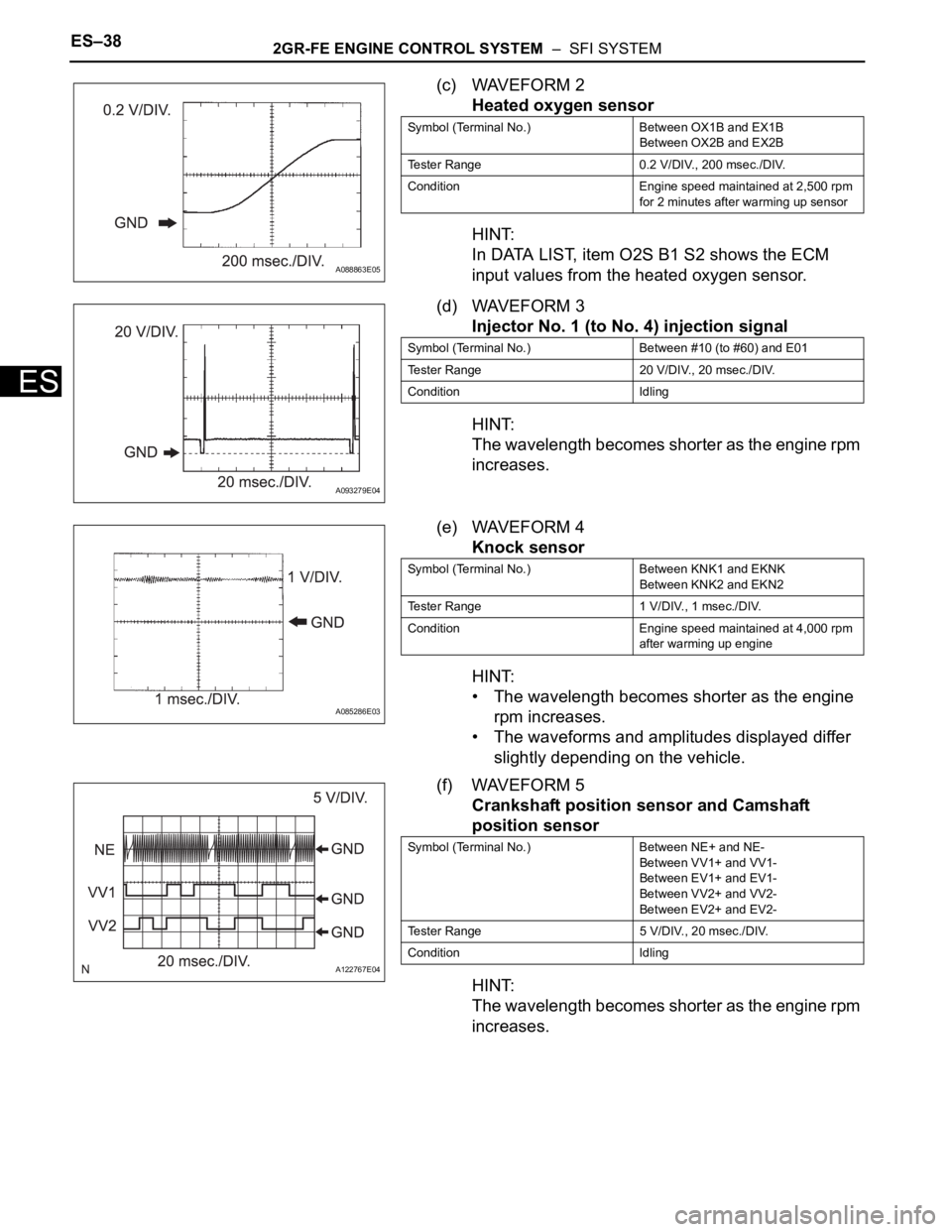
(c) WAVEFORM 2
Heated oxygen sensor
HINT:
In DATA LIST, item O2S B1 S2 shows the ECM
input values from the heated oxygen sensor.
(d) WAVEFORM 3
Injector No. 1 (to No. 4) injection signal
HINT:
The wavelength becomes shorter as the engine rpm
increases.
(e) WAVEFORM 4
Knock sensor
HINT:
• The wavelength becomes shorter as the engine
rpm increases.
• The waveforms and amplitudes displayed differ
slightly depending on the vehicle.
(f) WAVEFORM 5
Crankshaft position sensor and Camshaft
position sensor
HINT:
The wavelength becomes shorter as the engine rpm
increases.
A088863E05
Symbol (Terminal No.) Between OX1B and EX1B
Between OX2B and EX2B
Tester Range 0.2 V/DIV., 200 msec./DIV.
Condition Engine speed maintained at 2,500 rpm
for 2 minutes after warming up sensor
A093279E04
Symbol (Terminal No.) Between #10 (to #60) and E01
Tester Range 20 V/DIV., 20 msec./DIV.
Condition Idling
A085286E03
Symbol (Terminal No.) Between KNK1 and EKNK
Between KNK2 and EKN2
Tester Range 1 V/DIV., 1 msec./DIV.
Condition Engine speed maintained at 4,000 rpm
after warming up engine
A122767E04
Symbol (Terminal No.) Between NE+ and NE-
Between VV1+ and VV1-
Between EV1+ and EV1-
Between VV2+ and VV2-
Between EV2+ and EV2-
Tester Range 5 V/DIV., 20 msec./DIV.
Condition Idling
Page 571 of 2000

2GR-FE ENGINE CONTROL SYSTEM – SFI SYSTEMES–47
ES
KNOCK FB VAL Feedback value of knocking -
ACCEL POS #1Absolute Accelerator Pedal Position (APP)
No.1-
ACCEL POS #2 Absolute APP No. 2 -
THROTTLE POS Throttle sensor positioning -
THROTTLE POS Throttle position -
THROTTLE POS #2 Throttle sensor positioning #2 -
THROTTLE MOT Throttle motor -
O2S B1 S2
O2S B2 S2Heated oxygen sensor outputPerforming INJ VOL or A/F CONTROL
function of ACTIVE TEST enables technician
to check output voltage of sensor
AFS B1 S1
AFS B2 S1A/F sensor outputPerforming INJ VOL or A/F CONTROL
function of ACTIVE TEST enables technician
to check output voltage of sensor
TOTAL FT #1
TOTAL FT #2Total fuel trim -
SHORT FT #1
SHORT FT #2Short-term fuel trimShort-term fuel compensation used to
maintain air-fuel ratio at stoichiometric air-fuel
ratio
LONG FT #1
LONG FT #2Long-term fuel trimOverall fuel compensation carried out in long-
term to compensate a continual deviation of
short-term fuel trim from central valve
O2FT B1 S2
O2FT B2 S2Fuel trim at heated oxygen sensor -
AF FT B1 S1
AF FT B2 S1Fuel trim at A/F sensor-
AFS B1 S1
AFS B2 S1A/F sensor current-
CAT TEMP B1S1
CAT TEMP B2S1Estimated catalyst temperature (sensor 1)-
CAT TEMP B1S2
CAT TEMP B2S2Estimated catalyst temperature (sensor 2)-
S O2S B1S2
S O2S B2S2Sub heated oxygen sensor impedance
(sensor 2)-
INI COOL TEMP Engine coolant temperature at engine start -
INI INTAKE TEMP Intake air temperature at engine start -
INJ VOL Injection volume -
STARTER SIG Starter switch (STSW) signal -
PS SW Power steering signal -
PS SIGNAL Power steering signal (history)Signal status usually ON until ignition switch
turned OFF
CTP SW Closed throttle position switch -
A/C SIGNAL A/C signal -
PNP SW (NSW) Park/Neutral Position (PNP) switch signal -
ELECT LOAD SIG Electrical load signal -
STOP LIGHT SW Stop light switch -
BATTERY VOLTAGE Battery voltage -
ATM PRESSURE Atmosphere pressure -
FUEL PMP SP CTL Fuel pump speed control status -
ACIS VSVVSV for Acoustic Control Induction System
(ACIS)-
EVAP (Purge) VSV EVAP Purge VSV -
FUEL PUMP/SPD Fuel pump/speed status -LABEL
(Intelligent Tester Display)Measurement Item Diagnostic Note
Page 839 of 2000
EC–262GR-FE EMISSION CONTROL – HEATED OXYGEN SENSOR
EC
REMOVAL
1. DISCONNECT CABLE FROM NEGATIVE BATTERY
TERMINAL
CAUTION:
Wait at least 90 seconds after disconnecting the
cable from the negative (-) battery terminal to
prevent airbag and seat belt pretensioner activation.
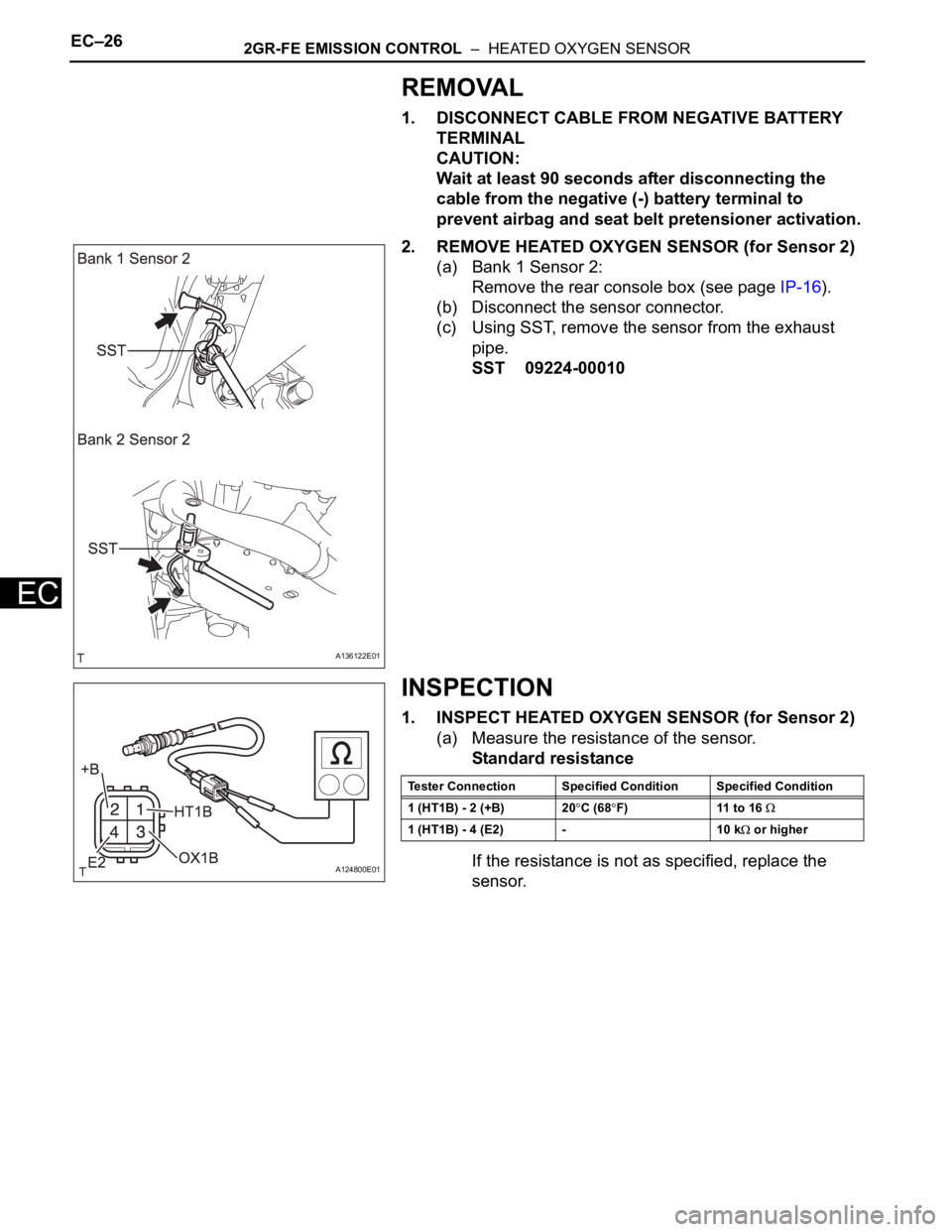
2. REMOVE HEATED OXYGEN SENSOR (for Sensor 2)
(a) Bank 1 Sensor 2:
Remove the rear console box (see page IP-16).
(b) Disconnect the sensor connector.
(c) Using SST, remove the sensor from the exhaust
pipe.
SST 09224-00010
INSPECTION
1. INSPECT HEATED OXYGEN SENSOR (for Sensor 2)
(a) Measure the resistance of the sensor.
Standard resistance
If the resistance is not as specified, replace the
sensor.
A136122E01
A124800E01
Tester Connection Specified Condition Specified Condition
1 (HT1B) - 2 (+B) 20
C (68F) 11 to 16
1 (HT1B) - 4 (E2) - 10 k or higher
Page 840 of 2000
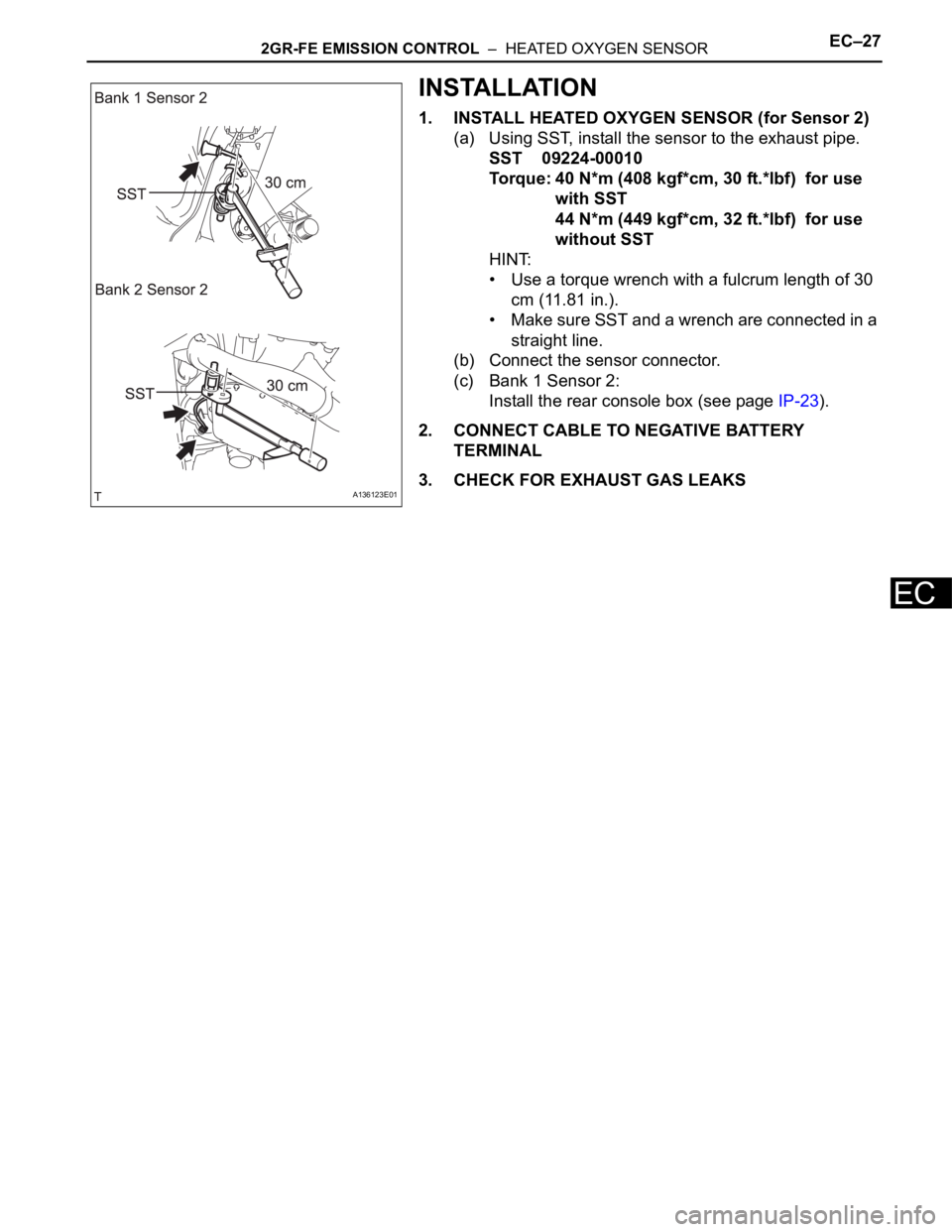
2GR-FE EMISSION CONTROL – HEATED OXYGEN SENSOREC–27
EC
INSTALLATION
1. INSTALL HEATED OXYGEN SENSOR (for Sensor 2)
(a) Using SST, install the sensor to the exhaust pipe.
SST 09224-00010
Torque: 40 N*m (408 kgf*cm, 30 ft.*lbf) for use
with SST
44 N*m (449 kgf*cm, 32 ft.*lbf) for use
without SST
HINT:
• Use a torque wrench with a fulcrum length of 30
cm (11.81 in.).
• Make sure SST and a wrench are connected in a
straight line.
(b) Connect the sensor connector.
(c) Bank 1 Sensor 2:
Install the rear console box (see page IP-23).
2. CONNECT CABLE TO NEGATIVE BATTERY
TERMINAL
3. CHECK FOR EXHAUST GAS LEAKS
A136123E01
Page 1934 of 2000

ES–462AZ-FE ENGINE CONTROL SYSTEM – SFI SYSTEM
ES
FAIL-SAFE CHART
If any of the following DTCs are set, the ECM enters fail-safe
mode to allow the vehicle to be driven temporarily.
HINT:
*: The vehicle can be driven slowly when the accelerator
pedal is depressed firmly and slowly. If the accelerator pedal
is depressed quickly, the vehicle may speed up and slow
down erratically.
DTCs Components Fail-Safe OperationsFail-Safe Deactivation
Conditions
P0031 and P0032Air-Fuel Ratio (A/F) Sensor
HeaterECM turns off A/F sensor heater. Ignition switch OFF
P0037 and P0038Heated Oxygen (HO2) Sensor
HeaterECM turns off HO2 sensor heater. Ignition switch OFF
P0100, P0102 and P0103 Mass Air Flow (MAF) MeterECM calculates ignition timing
according to engine speed and
throttle valve position.Pass condition detected
P0110, P0112 and P0113Intake Air Temperature (IAT)
SensorECM estimates IAT to be 20
C
(68
F).Pass condition detected
P0115, P0117 and P0118Engine Coolant Temperature
(ECT) SensorECM estimates ECT to be 80
C
(176
F).Pass condition detected
P0120, P0121, P0122, P0123,
P0220, P0222, P0223, P0604,
P0606, P0607, P0657, P2102,
P2103, P2111, P2112, P2118,
P2119 and P2135Electronic Throttle Control
System (ETCS)ECM cuts off throttle actuator
current and throttle valve returned
to 6
throttle position by return
spring.
ECM then adjusts engine output
by controlling fuel injection
(intermittent fuel-cut) and ignition
timing in accordance with
accelerator pedal opening angle
to allow vehicle to continue at
minimal speed*.Pass condition detected and then
ignition switch turned OFF
P0327 and P0328 Knock SensorECM sets ignition timing to
maximum retard.Ignition switch OFF
P0351 to P0354 Igniter ECM cuts fuel. Pass condition detected
P1550, P1551, P1552 and P1602 Generator Alternator command is fixed. Pass condition detected
P2120, P2121, P2122, P2123,
P2125, P2127, P2128 and P2138Accelerator Pedal Position (APP)
SensorAPP sensor has 2 sensor circuits:
Main and Sub.
If either circuit malfunctions, ECM
controls engine using other
circuit.
If both circuits malfunction, ECM
regards accelerator pedal as
being released. As result, throttle
valve closed and engine idles.Pass condition detected and then
ignition switch turned OFF
Page 1938 of 2000

ES–502AZ-FE ENGINE CONTROL SYSTEM – SFI SYSTEM
ES
THROTL OPN DUTYThrottle actuator opening duty
ratio:
Min.: 0 %, Max.: 100 %0 to 40 %: During idling• When accelerator pedal
depressed, duty ratio
increased
• Read value with ignition switch
ON (Do not start engine)
THROTL CLS DUTYThrottle actuator closed duty ratio:
Min.: 0 %, Max.: 100 %0 to 40 %: During idling• When accelerator pedal
released quickly, duty ratio
increased
• Read value with ignition switch
ON (Do not start engine)
THRTL MOT (OPN)Throttle actuator duty ratio (open):
Min.: 0 %, Max.: 100 %0 to 40 %: During idling ETCS service data
THRTL MOT (CLS)Throttle actuator duty ratio
(closed):
Min.: 0 %, Max.: 100 %0 to 40 %: During idling ETCS service data
O2S B1 S2Heated oxygen sensor output
voltage for sensor 2:
Min.: 0 V Max.: 1.275 V0.1 to 0.9 V: Driving at 70 km/h
(44 mph)Performing INJ VOL or A/F
CONTROL function of ACTIVE
TEST enables technician to check
output voltage of sensor
AFS B1 S1A/F sensor output voltage for
sensor 1:
Min.: 0 V Max.: 7.999 V2.8 to 3.8 V: IdlingPerforming INJ VOL or A/F
CONTROL function of ACTIVE
TEST enables technician to check
output voltage of sensor
TOTAL FT #1Total fuel trim value for fuel
system:
Min.: -0.5, Max.: 0.496-0.2 to 0.2 -
SHORT FT #1Short-term fuel trim:
Min.: -100 %, Max.: 99.2 %-20 to 20 %Short-term fuel compensation
used to maintain air-fuel ratio at
stoichiometric air-fuel ratio
LONG FT #1Long-term fuel trim:
Min.: -100 %, Max.: 99.2 %-20 to 20 %Overall fuel compensation carried
out in long-term to compensate
continual deviation of short-term
fuel trim from central value
FUEL SYS #1Fuel system status:
OL or CL or OL DRIVE or OL
FAULT or CL FAULTCL: Idling after warming up• OL (Open Loop): Has not yet
satisfied conditions to go
closed loop
• CL (Closed Loop): Using A/F
sensor as feedback for fuel
control
• OL DRIVE: Open loop due to
driving conditions (fuel
enrichment)
• OL FAULT: Open loop due to
detected system fault
• CL FAULT: Closed loop but A/
F sensor, which used for fuel
control malfunctioning
O2FT B1 S2Short-term fuel trim associated
with sensor 2:
Min.: -100 %, Max.: 99.2 %--
AF FT B1 S1Short-term fuel trim associated
with sensor 1:
Min.: 0, Max.: 1.999• Value less than 1 (0.000 to
0.999) =Lean
• Stoichiometric air-fuel
ratio=1
• Value greater than 1 (1.001
to 1.999) = Rich-
AFS B1 S1A/F sensor current:
Min.: -128 mA, Max.: 127.99 mA--
CAT TEMP B1S1Estimated catalyst temperature
(sensor 1):
Min.: -40
C, Max.: 6,513.5C-- Intelligent Tester Display Measurement: Range (Display) Normal Condition*1 Diagnostic Note
Page 1939 of 2000

2AZ-FE ENGINE CONTROL SYSTEM – SFI SYSTEMES–51
ES
CAT TEMP B1S2Estimated catalyst temperature
(sensor 2):
Min.: -40C, Max.: 6,513.5C--
S O2S B1S2Sub heated oxygen sensor
impedance (sensor2):
Min.: 0
, Max.: 21247.68
--
INI COOL TEMPEngine coolant temperature at
engine start:
Min.: -40
C, Max.: 120CClose to ambient air
temperature-
INI INTAKE TEMPIntake air temperature at engine
start:
Min.: -40
C, Max.: 120CClose to ambient air
temperature-
INJ VOLInjection volume (Cylinder 1):
Min.: 0 ml, Max.: 2.048 ml0 to 0.15 ml: IdlingQuantity of fuel injection volume
for 10 times
STARTER SIGStarter switch (STSW) signal:
ON or OFFON: Cranking -
PS SWPower steering signal:
ON or OFFON: Power steering operation -
PS SIGNALPower steering signal (history):
ON or OFFON: When steering wheel first
turned after battery terminals
connectedSignal status usually ON until
battery terminals disconnected
CTP SWClosed throttle position switch:
ON or OFF• ON: Throttle fully closed
• OFF: Throttle open-
A/C SIGNALA/C signal:
ON or OFFON: A/C ON -
PNP SW [NSW]PNP switch status:
ON or OFFON: P or N position -
ELECT LOAD SIGElectrical load signal:
ON or OFFON: Headlights or defogger
turned ON-
STOP LIGHT SWStop light switch:
ON or OFFON: Brake pedal depressed -
+BMWhether or not electric throttle
control system power inputted:
ON or OFFON: Ignition switch ON and
system normal-
+BM VOLTAGE+BM voltage:
Min.: 0, Max.: 19.9229 to 14 (V): Ignition switch ON
and system normalETCS service data
BATTERY VOLTAGEBattery voltage:
Min.: 0 V, Max.: 65.535 V9 to 14 V: Ignition switch ON -
ACTUATOR POWERActuator power supply:
ON or OFFON: Idling ETCS service data
ATM PRESSUREAtmospheric pressure:
Min.: 0 kPa, Max.: 255 kPaApproximately 100 kPa: Ignition
switch ON-
BATTERY CURRENTBattery current:
Min.: -100 A, Max.: 100 A--
BATTERY TEMPBattery temperature:
Min.: -45
C, Max.: 156.4 F--
ALT OUTPUT DUTYGenerator output duty ratio:
Min.: 0 %, Max.: 100 %- During charge control
ALT V NORMALRequest voltage when regulator
not under forced activation:
Min.: 0 V, Max.: 20 VBattery electrolyte temperature
varies (12.5 to 14.8 V) while
driving:
After engine startAlternator regulator output voltage
is out put
When performing Active Test,
value is 0V
ALT V TSTRequest voltage when regulator
under forced activation:
Min.: 0 V, Max.: 20 VRequest instruction voltage
value:
After engine startCharging control service data
When not performing Active Test,
value is 0V
EVAP (Purge) VSVPurge VSV status:
ON or OFF--
FUEL PUMP / SPDFuel pump status:
ON or OFFON: Engine running Active Test support data Intelligent Tester Display Measurement: Range (Display) Normal Condition*1 Diagnostic Note