automatic transmission TOYOTA RAV4 2006 Service Owner's Manual
[x] Cancel search | Manufacturer: TOYOTA, Model Year: 2006, Model line: RAV4, Model: TOYOTA RAV4 2006Pages: 2000, PDF Size: 45.84 MB
Page 492 of 2000
ES–382AZ-FE ENGINE CONTROL SYSTEM – SFI SYSTEM
ES
DIAGNOSIS SYSTEM
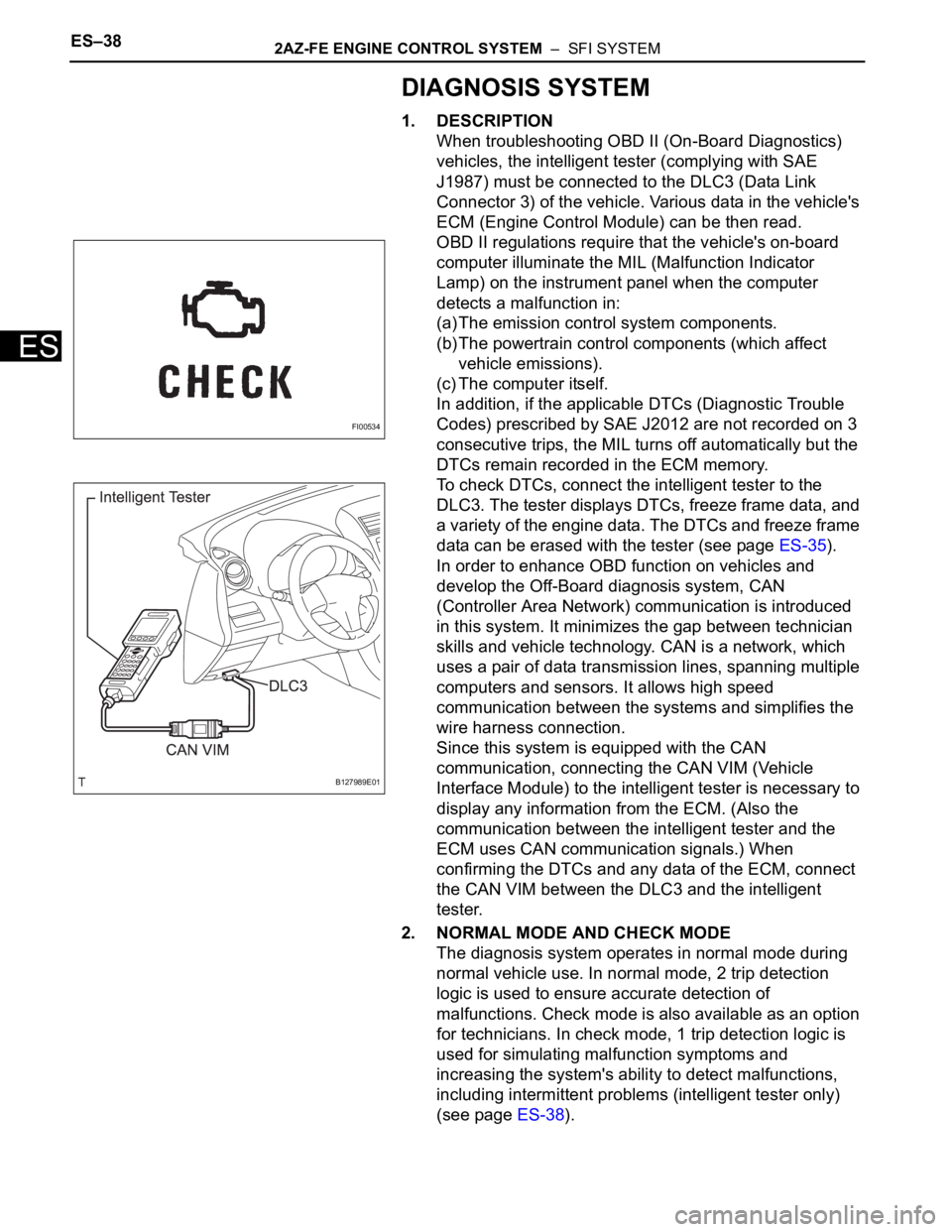
1. DESCRIPTION
When troubleshooting OBD II (On-Board Diagnostics)
vehicles, the intelligent tester (complying with SAE
J1987) must be connected to the DLC3 (Data Link
Connector 3) of the vehicle. Various data in the vehicle's
ECM (Engine Control Module) can be then read.
OBD II regulations require that the vehicle's on-board
computer illuminate the MIL (Malfunction Indicator
Lamp) on the instrument panel when the computer
detects a malfunction in:
(a) The emission control system components.
(b) The powertrain control components (which affect
vehicle emissions).
(c) The computer itself.
In addition, if the applicable DTCs (Diagnostic Trouble
Codes) prescribed by SAE J2012 are not recorded on 3
consecutive trips, the MIL turns off automatically but the
DTCs remain recorded in the ECM memory.
To check DTCs, connect the intelligent tester to the
DLC3. The tester displays DTCs, freeze frame data, and
a variety of the engine data. The DTCs and freeze frame
data can be erased with the tester (see page ES-35).
In order to enhance OBD function on vehicles and
develop the Off-Board diagnosis system, CAN
(Controller Area Network) communication is introduced
in this system. It minimizes the gap between technician
skills and vehicle technology. CAN is a network, which
uses a pair of data transmission lines, spanning multiple
computers and sensors. It allows high speed
communication between the systems and simplifies the
wire harness connection.
Since this system is equipped with the CAN
communication, connecting the CAN VIM (Vehicle
Interface Module) to the intelligent tester is necessary to
display any information from the ECM. (Also the
communication between the intelligent tester and the
ECM uses CAN communication signals.) When
confirming the DTCs and any data of the ECM, connect
the CAN VIM between the DLC3 and the intelligent
tester.
2. NORMAL MODE AND CHECK MODE
The diagnosis system operates in normal mode during
normal vehicle use. In normal mode, 2 trip detection
logic is used to ensure accurate detection of
malfunctions. Check mode is also available as an option
for technicians. In check mode, 1 trip detection logic is
used for simulating malfunction symptoms and
increasing the system's ability to detect malfunctions,
including intermittent problems (intelligent tester only)
(see page ES-38).
FI00534
B127989E01
Page 566 of 2000
ES–422GR-FE ENGINE CONTROL SYSTEM – SFI SYSTEM
ES
DIAGNOSIS SYSTEM
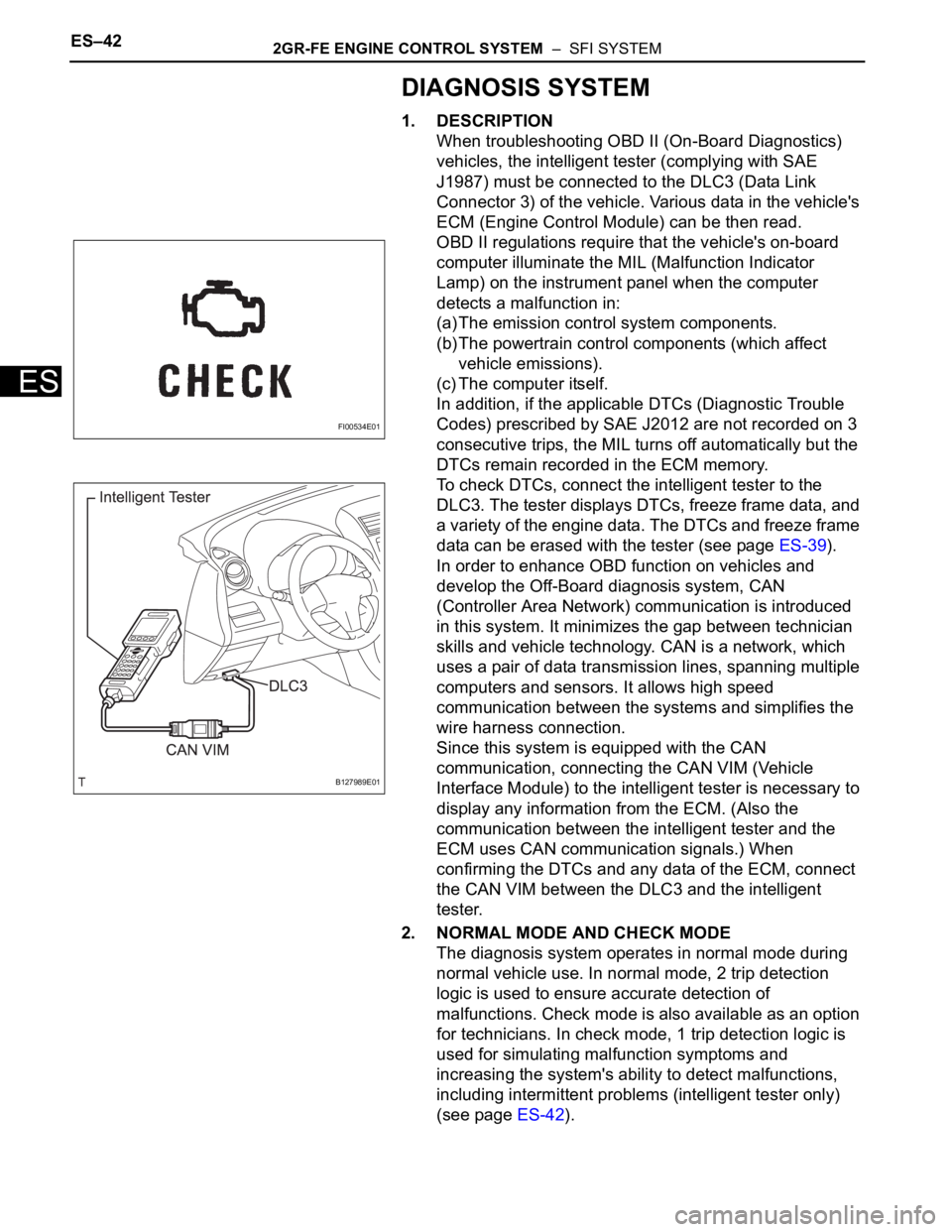
1. DESCRIPTION
When troubleshooting OBD II (On-Board Diagnostics)
vehicles, the intelligent tester (complying with SAE
J1987) must be connected to the DLC3 (Data Link
Connector 3) of the vehicle. Various data in the vehicle's
ECM (Engine Control Module) can be then read.
OBD II regulations require that the vehicle's on-board
computer illuminate the MIL (Malfunction Indicator
Lamp) on the instrument panel when the computer
detects a malfunction in:
(a) The emission control system components.
(b) The powertrain control components (which affect
vehicle emissions).
(c) The computer itself.
In addition, if the applicable DTCs (Diagnostic Trouble
Codes) prescribed by SAE J2012 are not recorded on 3
consecutive trips, the MIL turns off automatically but the
DTCs remain recorded in the ECM memory.
To check DTCs, connect the intelligent tester to the
DLC3. The tester displays DTCs, freeze frame data, and
a variety of the engine data. The DTCs and freeze frame
data can be erased with the tester (see page ES-39).
In order to enhance OBD function on vehicles and
develop the Off-Board diagnosis system, CAN
(Controller Area Network) communication is introduced
in this system. It minimizes the gap between technician
skills and vehicle technology. CAN is a network, which
uses a pair of data transmission lines, spanning multiple
computers and sensors. It allows high speed
communication between the systems and simplifies the
wire harness connection.
Since this system is equipped with the CAN
communication, connecting the CAN VIM (Vehicle
Interface Module) to the intelligent tester is necessary to
display any information from the ECM. (Also the
communication between the intelligent tester and the
ECM uses CAN communication signals.) When
confirming the DTCs and any data of the ECM, connect
the CAN VIM between the DLC3 and the intelligent
tester.
2. NORMAL MODE AND CHECK MODE
The diagnosis system operates in normal mode during
normal vehicle use. In normal mode, 2 trip detection
logic is used to ensure accurate detection of
malfunctions. Check mode is also available as an option
for technicians. In check mode, 1 trip detection logic is
used for simulating malfunction symptoms and
increasing the system's ability to detect malfunctions,
including intermittent problems (intelligent tester only)
(see page ES-42).
FI00534E01
B127989E01
Page 687 of 2000
2GR-FE ENGINE MECHANICAL – ENGINE ASSEMBLYEM–41
EM
62. ADD AUTOMATIC TRANSAXLE FLUID
(a) 2WD:
Add automatic transmission fluid (see page AX-
177).
(b) 4WD:
Add automatic transmission fluid (see page AX-
178).
63. ADD TRANSFER OIL (for 4WD) (See page TF-45)
64. ADD ENGINE OIL (See page LU-6)
65. ADD ENGINE COOLANT (See page CO-8)
66. CHARGE REFRIGERANT (See page AC-172)
67. CHECK FOR LEAKAGE OF REFRIGERANT (See
page AC-173)
68. CHECK FOR ENGINE OIL LEAKS (See page LU-6)
69. CHECK FOR ENGINE COOLANT LEAKS (See page
CO-1)
70. CHECK FOR FUEL LEAKS
71. INSPECT EXHAUST GAS LEAKS
72. INSPECT SHIFT LEVER POSITION
(a) 2WD:
Inspect the shift lever position (see page AX-159).
(b) 4WD:
Inspect the shift lever position (see page AX-158).
73. ADJUST TRANSMISSION CONTROL CABLE
(a) 2WD:
Adjust the shift lever position (see page AX-159).
(b) 4WD:
Adjust the shift lever position (see page AX-159).
74. INSTALL FRONT FLOOR COVER (See page FU-39)
75. INSTALL NO. 2 ENGINE UNDER COVER
(a) Install the under cover with the 2 clips.
76. INSTALL REAR ENGINE UNDER COVER LH
(a) Install the under cover with the 2 clips.
77. INSTALL REAR ENGINE UNDER COVER RH
(a) Install the under cover with the 2 clips.
78. INSTALL NO. 1 ENGINE UNDER COVER
(a) Install the under cover with the 4 bolts and 12 clips.
Page 946 of 2000
AX–12U140F AUTOMATIC TRANSAXLE – AUTOMATIC TRANSAXLE SYSTEM
AX
NEXT
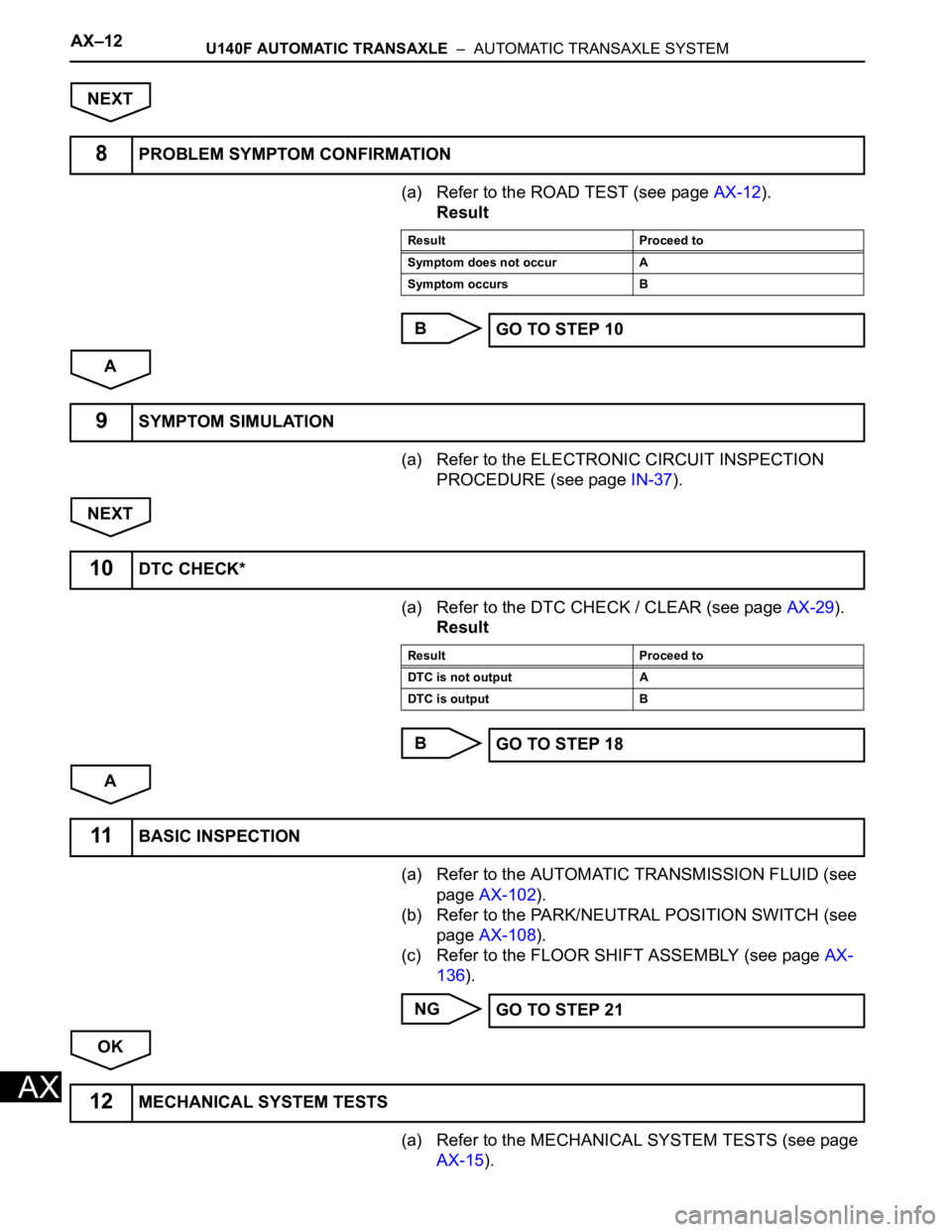
(a) Refer to the ROAD TEST (see page AX-12).
Result
B
A
(a) Refer to the ELECTRONIC CIRCUIT INSPECTION
PROCEDURE (see page IN-37).
NEXT
(a) Refer to the DTC CHECK / CLEAR (see page AX-29).
Result
B
A
(a) Refer to the AUTOMATIC TRANSMISSION FLUID (see
page AX-102).
(b) Refer to the PARK/NEUTRAL POSITION SWITCH (see
page AX-108).
(c) Refer to the FLOOR SHIFT ASSEMBLY (see page AX-
136).
NG
OK
(a) Refer to the MECHANICAL SYSTEM TESTS (see page
AX-15).
8PROBLEM SYMPTOM CONFIRMATION
Result Proceed to
Symptom does not occur A
Symptom occurs B
GO TO STEP 10
9SYMPTOM SIMULATION
10DTC CHECK*
Result Proceed to
DTC is not output A
DTC is output B
GO TO STEP 18
11BASIC INSPECTION
GO TO STEP 21
12MECHANICAL SYSTEM TESTS
Page 952 of 2000

AX–18U140F AUTOMATIC TRANSAXLE – AUTOMATIC TRANSAXLE SYSTEM
AX
MECHANICAL SYSTEM TESTS
1. STALL SPEED TEST
HINT:
This test is to check the overall performance of the
engine and transaxle.
NOTICE:
• Do not perform the stall speed test longer than 5
seconds.
• To ensure safety, perform this test in an open and
level area that provides good traction.
• The stall speed test should always be performed
with at least 2 people. One person should observe
the condition of the wheels and wheel chocks
while the other is performing the test.
(a) Connect the intelligent tester to the CAN VIM. Then
connect the CAN VIM to the DLC3.
(b) Run the vehicle until the transmission fluid
temperature has reached 50 to 80
C (122 to 176F).
(c) Allow the engine to idle with the air conditioning
OFF.
(d) Chock all 4 wheels.
(e) Set the parking brake and keep the brake pedal
depressed firmly with your left foot.
(f) Move the shift lever to the D position.
(g) Depress the accelerator pedal as much as possible
with your right foot.
(h) Read the engine rpm (stall speed) and release the
accelerator pedal immediately.
Standard value:
2,150 to 2,450 rpm
Evaluation:
NOTICE:
Perform the test at the normal operating ATF
temperature of 50 to 80
C (122 to 176F).
2. SHIFT TIME LAG TEST
HINT:
This test is to check the condition of the direct clutch,
forward clutch, 1st brake and reverse brake.
(a) Connect the intelligent tester to the CAN VIM. Then
connect the CAN VIM to the DLC3.
(b) Run the vehicle until the transmission fluid
temperature has reached 50 to 80
C (122 to 176F).
(c) Allow the engine to idle with the air conditioning
OFF.
Test Result Possible Cause
Stall speed is lower than standard value • Stator one-way clutch is not operating properly
• Torque converter is faulty (stall speed is less than standard value
by 600 rpm or more)
• Engine power may be insufficient
Stall speed is higher than standard value • Line pressure is low
• C1 clutch slipping
• F3 one-way clutch is not operating properly
• F4 one-way clutch is not operating properly
Page 955 of 2000
U140F AUTOMATIC TRANSAXLE – AUTOMATIC TRANSAXLE SYSTEMAX–21
AX
MANUAL SHIFTING TEST
1. MANUAL SHIFTING TEST
HINT:
• Through this test, it can be determined whether the
trouble occurs in the electrical circuit or if it is a
mechanical problem in the transaxle.
• If any abnormalities are found in the following test, the
problem is in the transaxle itself.
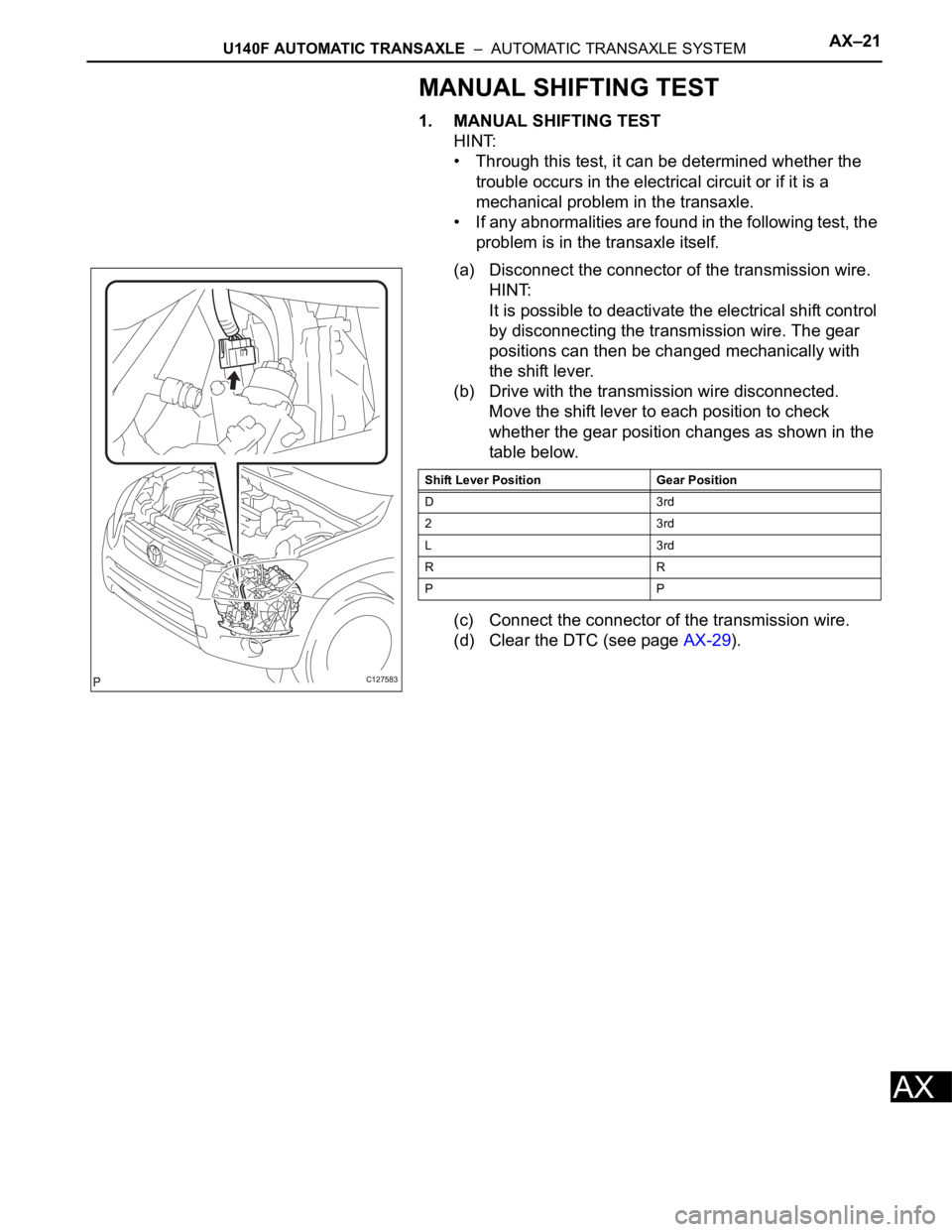
(a) Disconnect the connector of the transmission wire.
HINT:
It is possible to deactivate the electrical shift control
by disconnecting the transmission wire. The gear
positions can then be changed mechanically with
the shift lever.
(b) Drive with the transmission wire disconnected.
Move the shift lever to each position to check
whether the gear position changes as shown in the
table below.
(c) Connect the connector of the transmission wire.
(d) Clear the DTC (see page AX-29).
C127583
Shift Lever Position Gear Position
D3rd
23rd
L3rd
RR
PP
Page 959 of 2000
U140F AUTOMATIC TRANSAXLE – AUTOMATIC TRANSAXLE SYSTEMAX–25
AX
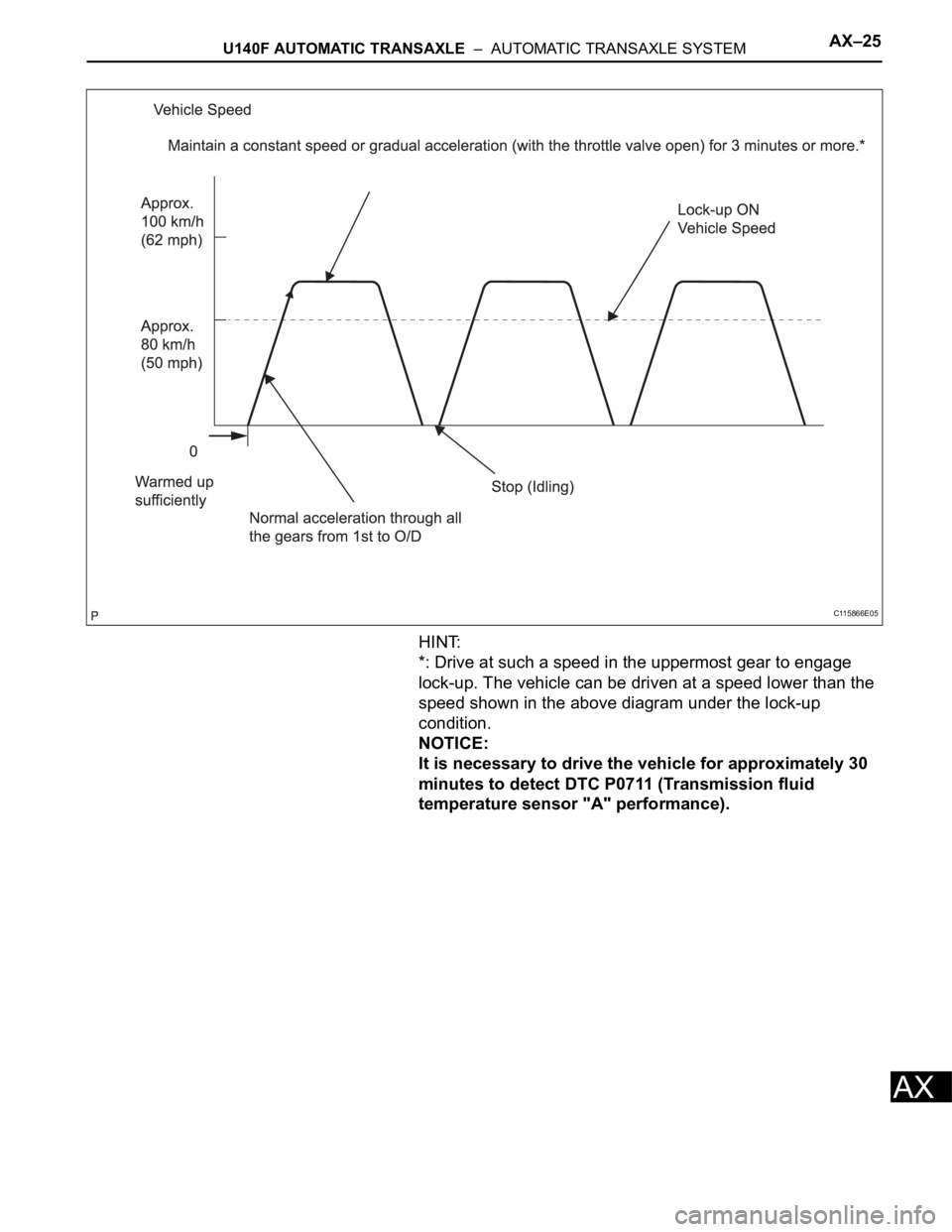
HINT:
*: Drive at such a speed in the uppermost gear to engage
lock-up. The vehicle can be driven at a speed lower than the
speed shown in the above diagram under the lock-up
condition.
NOTICE:
It is necessary to drive the vehicle for approximately 30
minutes to detect DTC P0711 (Transmission fluid
temperature sensor "A" performance).
C115866E05
Page 968 of 2000
AX–34U140F AUTOMATIC TRANSAXLE – AUTOMATIC TRANSAXLE SYSTEM
AX
4. FREEZE FRAME DATA
(a) Freeze frame data records the engine conditions
(fuel system, calculated load, engine coolant
temperature, fuel trim, engine speed, vehicle speed,
etc.) when a malfunction is detected. When
troubleshooting, freeze frame data can help
determine if the vehicle was running or stopped, if
the engine was warmed up or not, if the air-fuel ratio
was lean or rich, and other data from the time the
malfunction occurred.
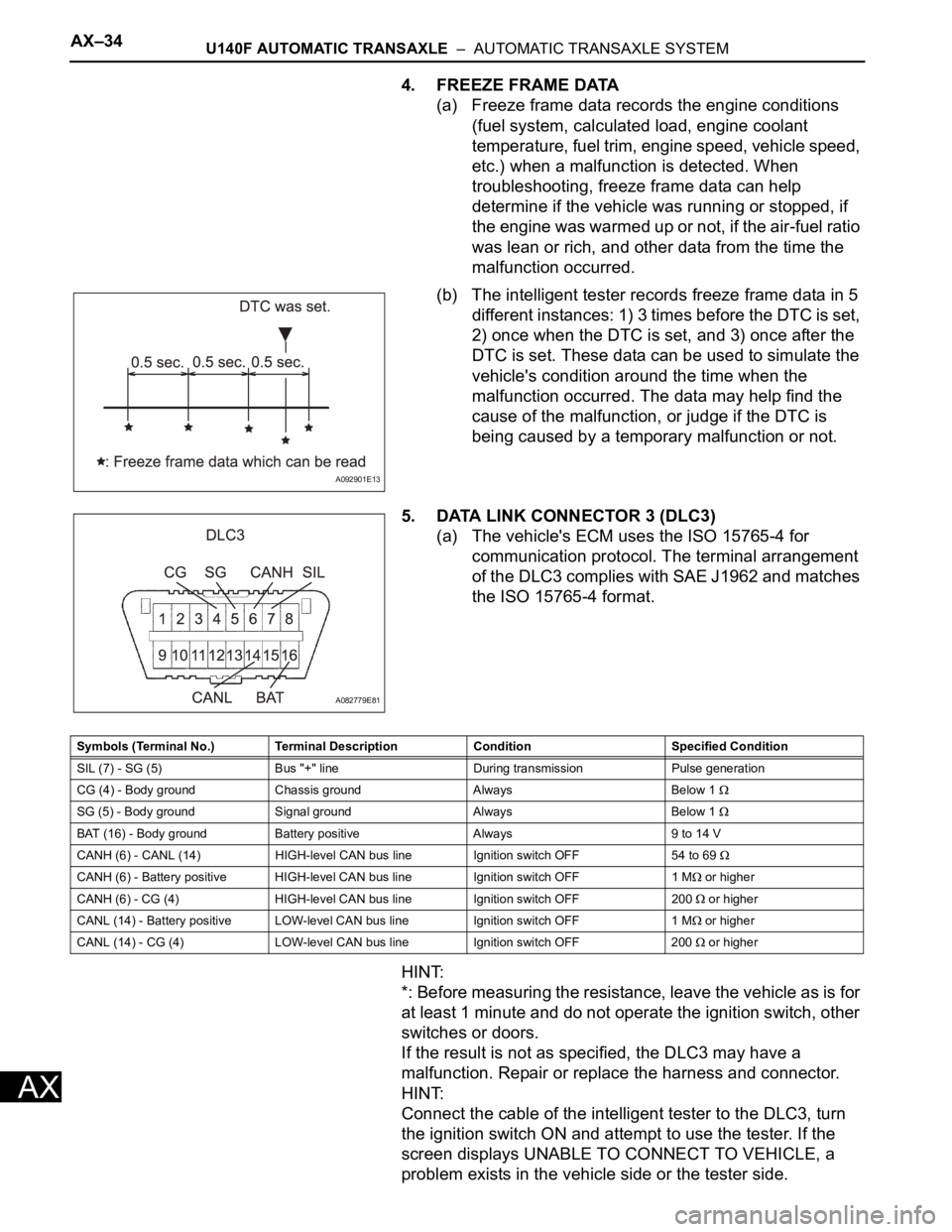
(b) The intelligent tester records freeze frame data in 5
different instances: 1) 3 times before the DTC is set,
2) once when the DTC is set, and 3) once after the
DTC is set. These data can be used to simulate the
vehicle's condition around the time when the
malfunction occurred. The data may help find the
cause of the malfunction, or judge if the DTC is
being caused by a temporary malfunction or not.
5. DATA LINK CONNECTOR 3 (DLC3)
(a) The vehicle's ECM uses the ISO 15765-4 for
communication protocol. The terminal arrangement
of the DLC3 complies with SAE J1962 and matches
the ISO 15765-4 format.
HINT:
*: Before measuring the resistance, leave the vehicle as is for
at least 1 minute and do not operate the ignition switch, other
switches or doors.
If the result is not as specified, the DLC3 may have a
malfunction. Repair or replace the harness and connector.
HINT:
Connect the cable of the intelligent tester to the DLC3, turn
the ignition switch ON and attempt to use the tester. If the
screen displays UNABLE TO CONNECT TO VEHICLE, a
problem exists in the vehicle side or the tester side.
A092901E13
A082779E81
Symbols (Terminal No.) Terminal Description Condition Specified Condition
SIL (7) - SG (5) Bus "+" line During transmission Pulse generation
CG (4) - Body ground Chassis ground Always Below 1
SG (5) - Body ground Signal ground Always Below 1
BAT (16) - Body ground Battery positive Always 9 to 14 V
CANH (6) - CANL (14) HIGH-level CAN bus line Ignition switch OFF 54 to 69
CANH (6) - Battery positive HIGH-level CAN bus line Ignition switch OFF 1 M or higher
CANH (6) - CG (4) HIGH-level CAN bus line Ignition switch OFF 200
or higher
CANL (14) - Battery positive LOW-level CAN bus line Ignition switch OFF 1 M
or higher
CANL (14) - CG (4) LOW-level CAN bus line Ignition switch OFF 200
or higher
Page 978 of 2000
AX–150U140F AUTOMATIC TRANSAXLE – AUTOMATIC TRANSAXLE ASSEMBLY
AX
INSTALLATION
1. INSPECT TORQUE CONVERTER CLUTCH
ASSEMBLY
(a) Inspect the torque converter (see page AX-153).
2. INSTALL TORQUE CONVERTER CLUTCH
ASSEMBLY
(a) Install the torque converter clutch to the automatic
transaxle.
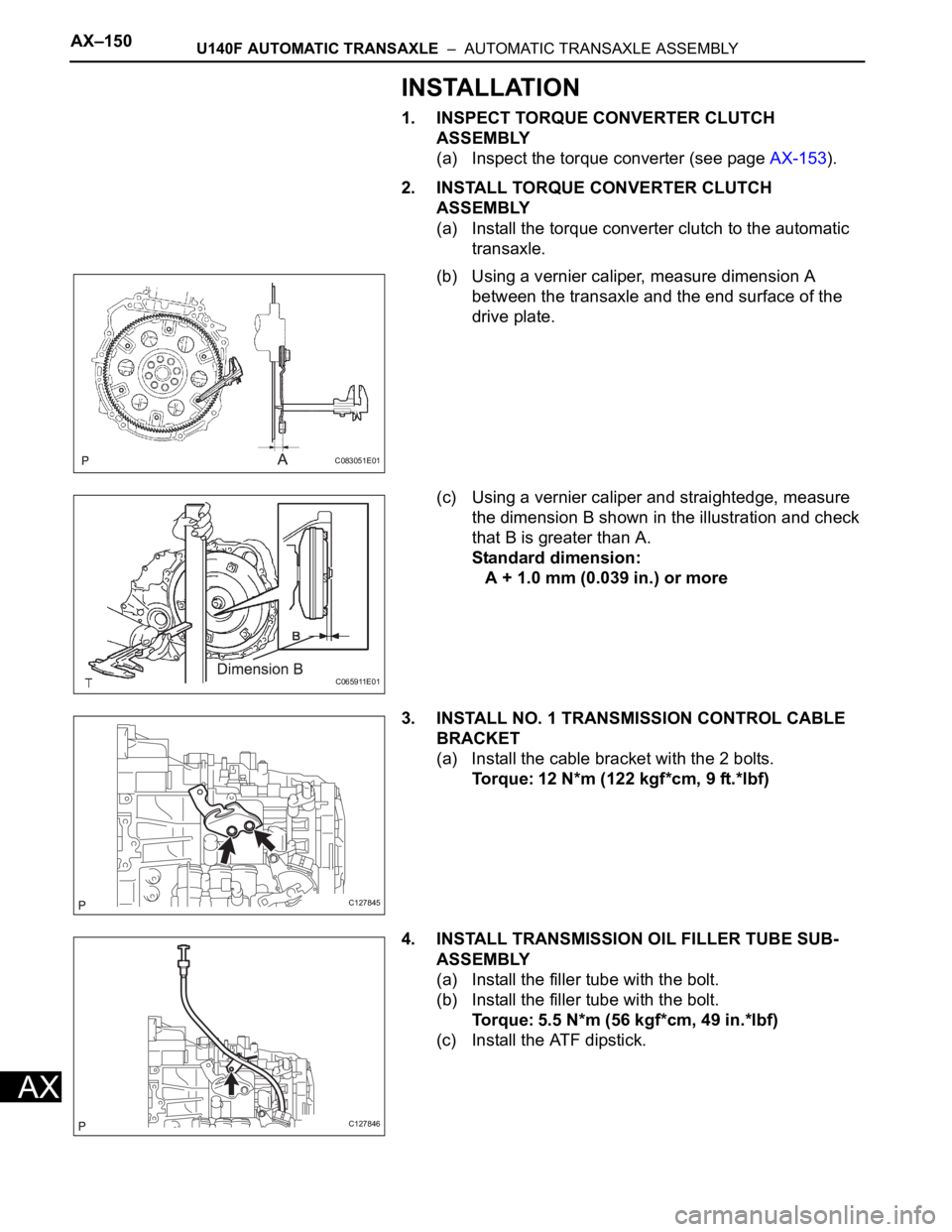
(b) Using a vernier caliper, measure dimension A
between the transaxle and the end surface of the
drive plate.
(c) Using a vernier caliper and straightedge, measure
the dimension B shown in the illustration and check
that B is greater than A.
Standard dimension:
A + 1.0 mm (0.039 in.) or more
3. INSTALL NO. 1 TRANSMISSION CONTROL CABLE
BRACKET
(a) Install the cable bracket with the 2 bolts.
Torque: 12 N*m (122 kgf*cm, 9 ft.*lbf)
4. INSTALL TRANSMISSION OIL FILLER TUBE SUB-
ASSEMBLY
(a) Install the filler tube with the bolt.
(b) Install the filler tube with the bolt.
Torque: 5.5 N*m (56 kgf*cm, 49 in.*lbf)
(c) Install the ATF dipstick.
C083051E01
C065911E01
C127845
C127846
Page 980 of 2000
AX–152U140F AUTOMATIC TRANSAXLE – AUTOMATIC TRANSAXLE ASSEMBLY
AX
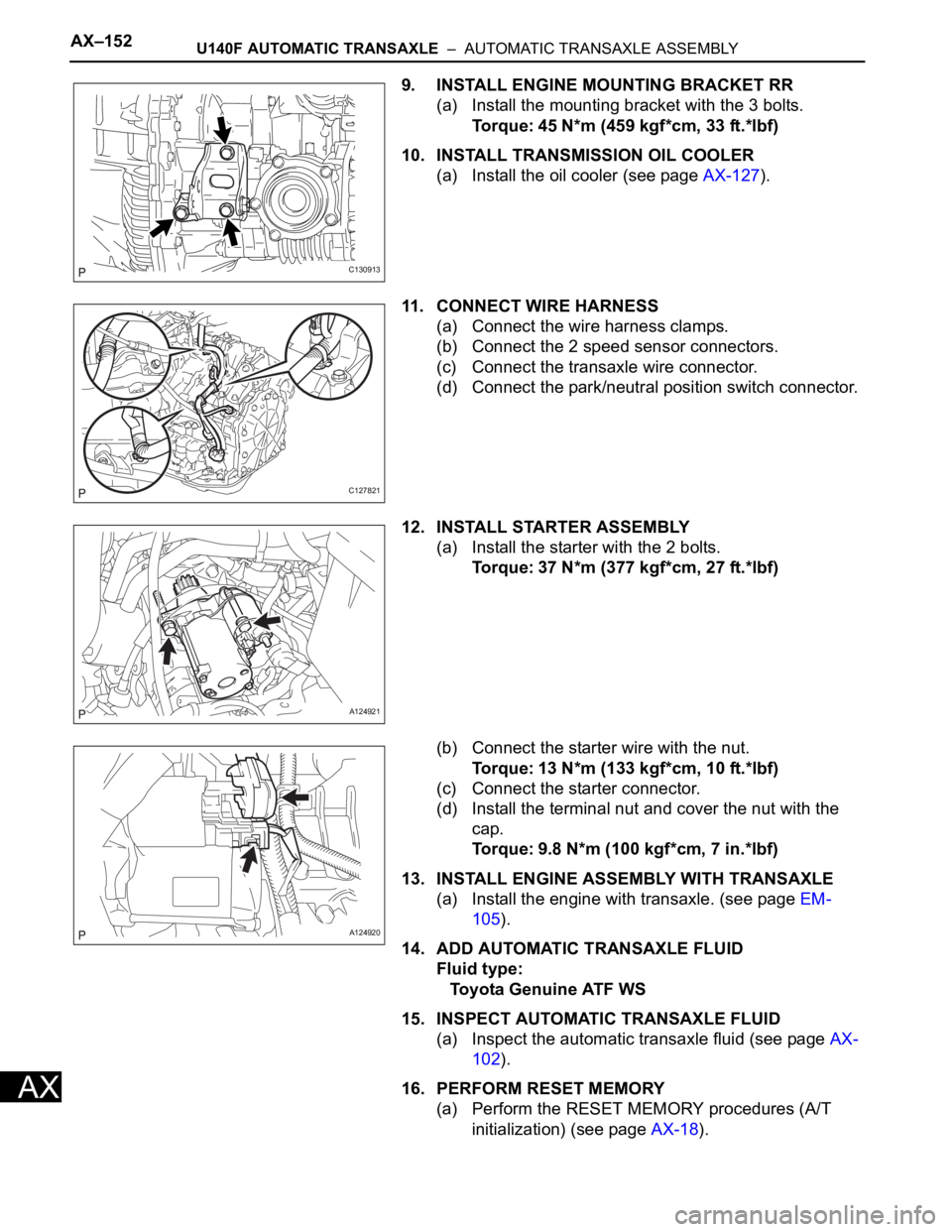
9. INSTALL ENGINE MOUNTING BRACKET RR
(a) Install the mounting bracket with the 3 bolts.
Torque: 45 N*m (459 kgf*cm, 33 ft.*lbf)
10. INSTALL TRANSMISSION OIL COOLER
(a) Install the oil cooler (see page AX-127).
11. CONNECT WIRE HARNESS
(a) Connect the wire harness clamps.
(b) Connect the 2 speed sensor connectors.
(c) Connect the transaxle wire connector.
(d) Connect the park/neutral position switch connector.
12. INSTALL STARTER ASSEMBLY
(a) Install the starter with the 2 bolts.
Torque: 37 N*m (377 kgf*cm, 27 ft.*lbf)
(b) Connect the starter wire with the nut.
Torque: 13 N*m (133 kgf*cm, 10 ft.*lbf)
(c) Connect the starter connector.
(d) Install the terminal nut and cover the nut with the
cap.
Torque: 9.8 N*m (100 kgf*cm, 7 in.*lbf)
13. INSTALL ENGINE ASSEMBLY WITH TRANSAXLE
(a) Install the engine with transaxle. (see page EM-
105).
14. ADD AUTOMATIC TRANSAXLE FLUID
Fluid type:
Toyota Genuine ATF WS
15. INSPECT AUTOMATIC TRANSAXLE FLUID
(a) Inspect the automatic transaxle fluid (see page AX-
102).
16. PERFORM RESET MEMORY
(a) Perform the RESET MEMORY procedures (A/T
initialization) (see page AX-18).
C130913
C127821
A124921
A124920