fuel type TOYOTA RAV4 2006 Service Owner's Manual
[x] Cancel search | Manufacturer: TOYOTA, Model Year: 2006, Model line: RAV4, Model: TOYOTA RAV4 2006Pages: 2000, PDF Size: 45.84 MB
Page 480 of 2000
ES–262AZ-FE ENGINE CONTROL SYSTEM – SFI SYSTEM
ES
(b) Monitor Conditions
(1) Turn the ignition switch OFF and wait for 6
hours.
HINT:
Do not start the engine until checking Readiness
Monitor status. If the engine is started, the step
described above must be repeated.
(c) Monitor Status
(1) Connect the intelligent tester to the DLC3.
(2) Turn the ignition switch ON.
(3) Turn the tester ON.
(4) Check the Readiness Monitor status displayed
on the tester.
If the status does not switch to COMPL (complete), restart the
engine, make sure that the preconditions have been met, and
then perform the Monitor Conditions again.
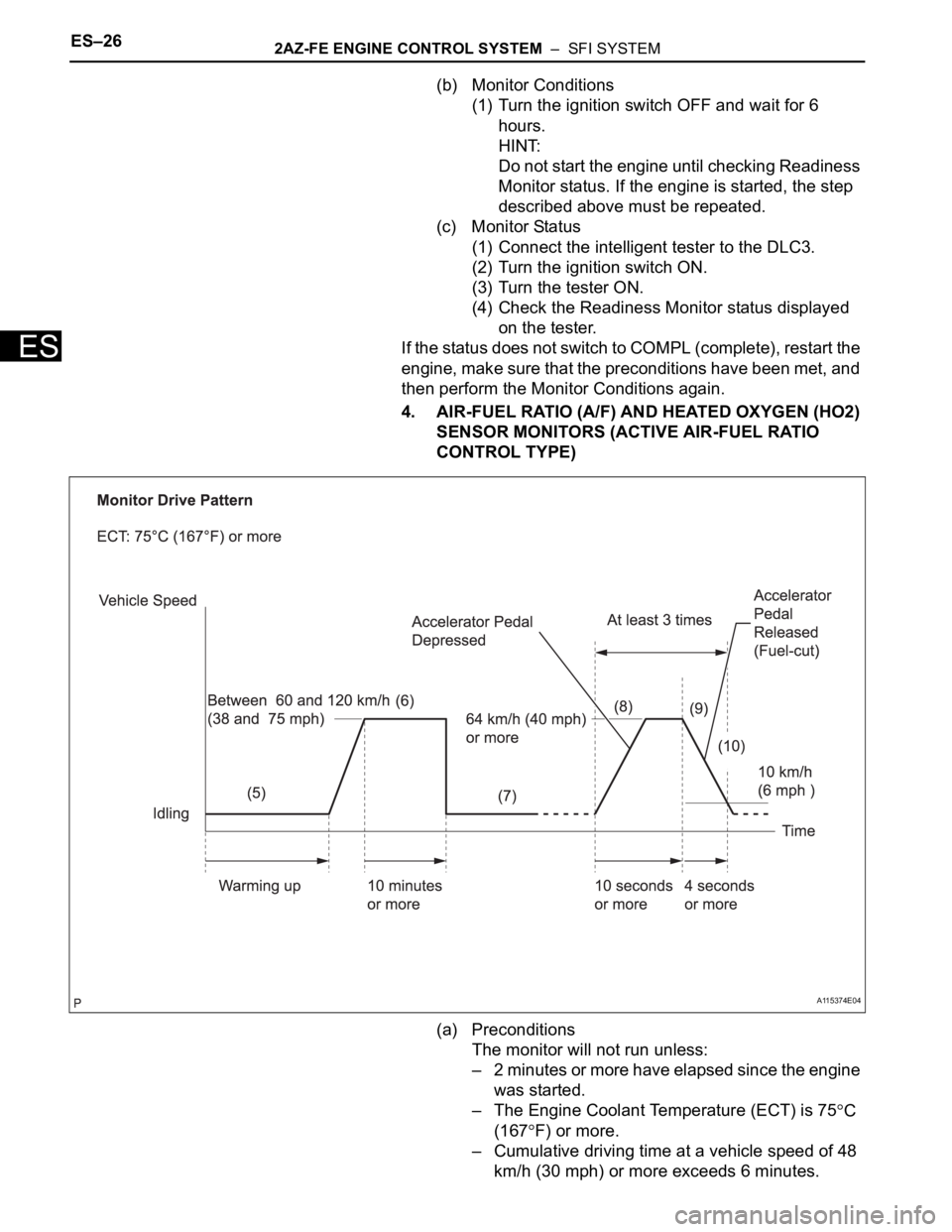
4. AIR-FUEL RATIO (A/F) AND HEATED OXYGEN (HO2)
SENSOR MONITORS (ACTIVE AIR-FUEL RATIO
CONTROL TYPE)
(a) Preconditions
The monitor will not run unless:
– 2 minutes or more have elapsed since the engine
was started.
– The Engine Coolant Temperature (ECT) is 75
C
(167
F) or more.
– Cumulative driving time at a vehicle speed of 48
km/h (30 mph) or more exceeds 6 minutes.
A115374E04
Page 481 of 2000
2AZ-FE ENGINE CONTROL SYSTEM – SFI SYSTEMES–27
ES
– Air-fuel ratio feedback control is performed.
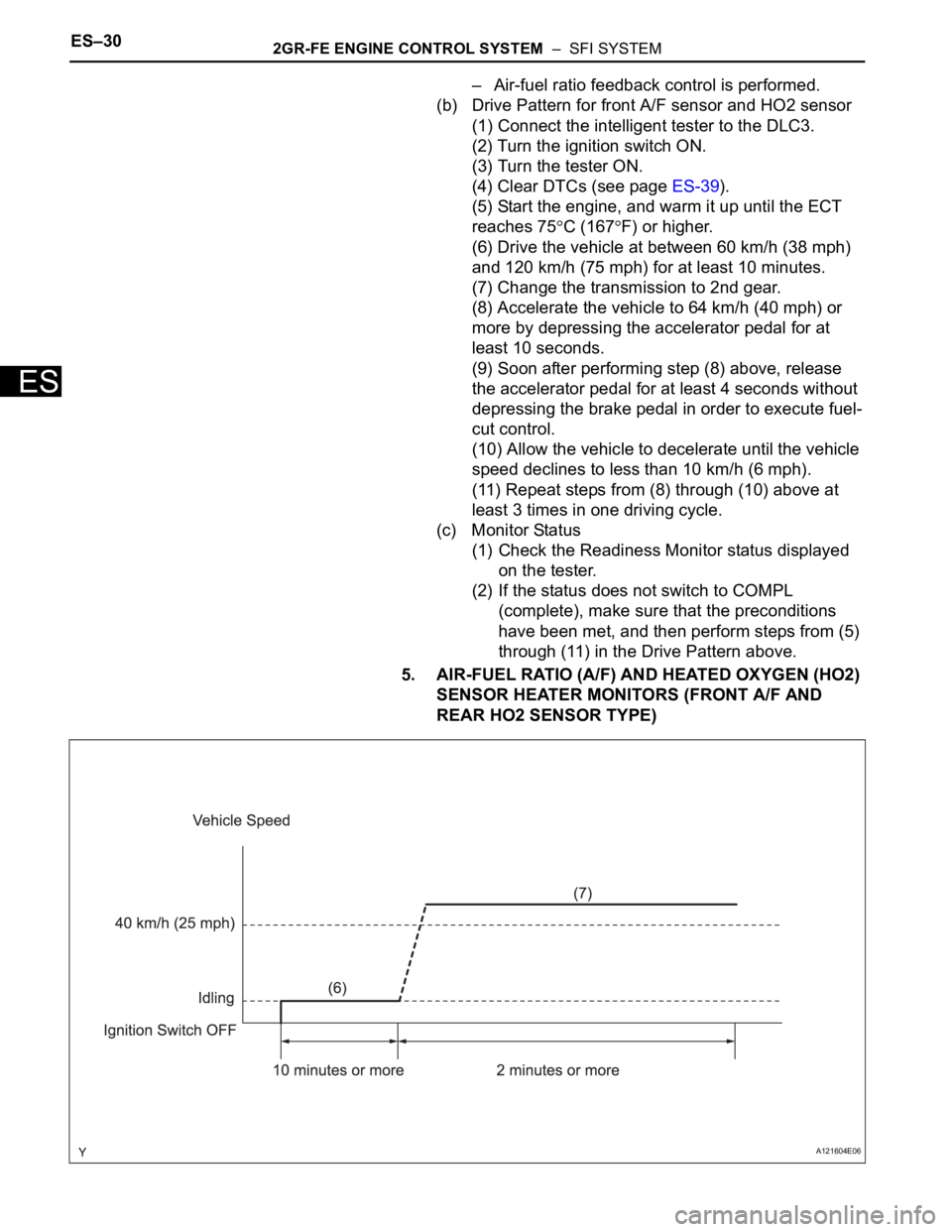
(b) Drive Pattern for front A/F sensor and HO2 sensor
(1) Connect the intelligent tester to the DLC3.
(2) Turn the ignition switch ON.
(3) Turn the tester ON.
(4) Clear DTCs (see page ES-35).
(5) Start the engine, and warm it up until the ECT
reaches 75
C (167F) or higher.
(6) Drive the vehicle at between 60 km/h (38 mph)
and 120 km/h (75 mph) for at least 10 minutes.
(7) Change the transmission to 2nd gear.
(8) Accelerate the vehicle to 64 km/h (40 mph) or
more by depressing the accelerator pedal for at
least 10 seconds.
(9) Soon after performing step (8) above, release
the accelerator pedal for at least 4 seconds without
depressing the brake pedal, in order to execute fuel-
cut control.
(10) Allow the vehicle to decelerate until the vehicle
speed declines to less than 10 km/h (6 mph).
(11) Repeat steps from (8) through (10) above at
least 3 times in one driving cycle.
(c) Monitor Status
(1) Check the Readiness Monitor status displayed
on the tester.
(2) If the status does not switch to COMPL
(complete), make sure that the preconditions
have been met, and then perform steps from (5)
through (11) in the Drive Pattern above.
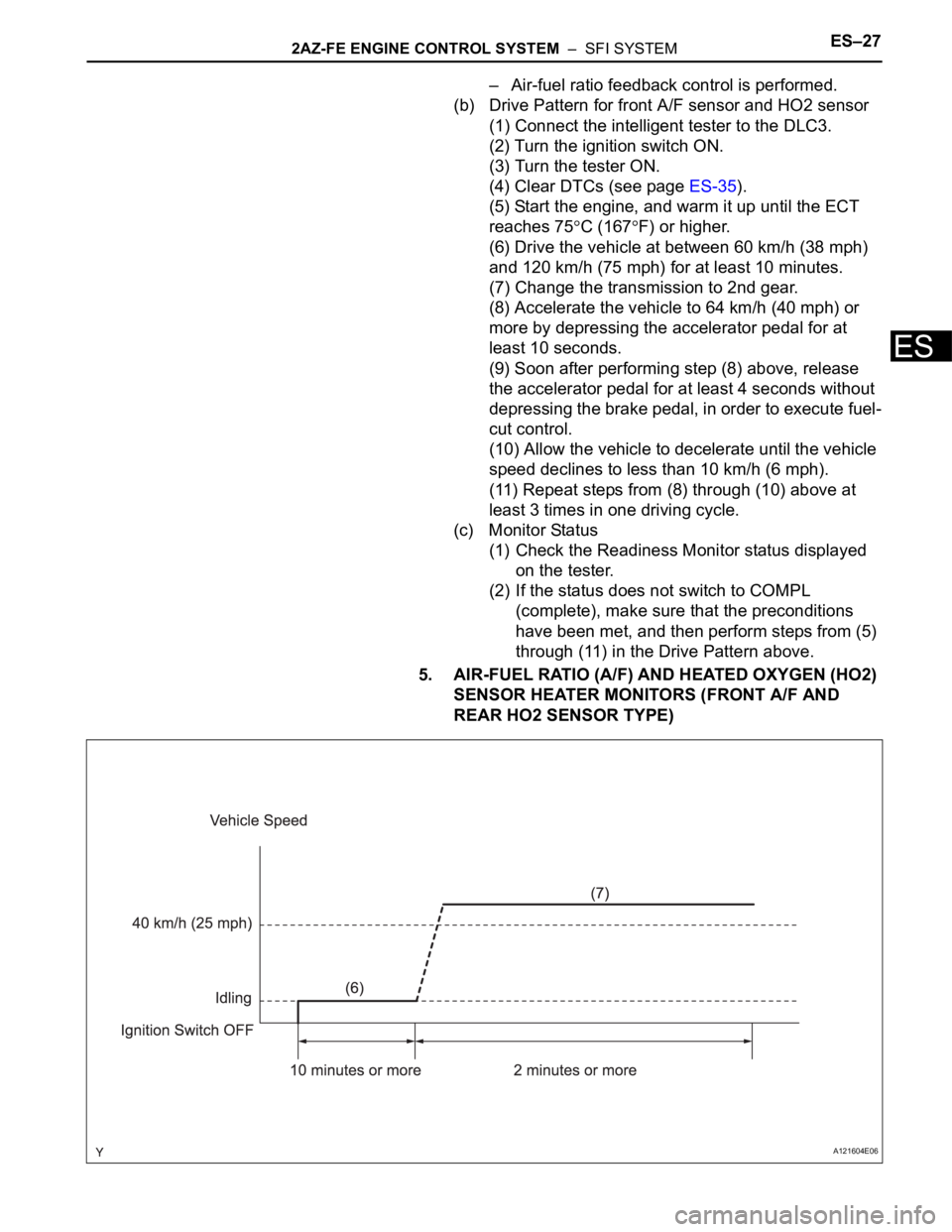
5. AIR-FUEL RATIO (A/F) AND HEATED OXYGEN (HO2)
SENSOR HEATER MONITORS (FRONT A/F AND
REAR HO2 SENSOR TYPE)
A121604E06
Page 552 of 2000
ES–282GR-FE ENGINE CONTROL SYSTEM – SFI SYSTEM
ES
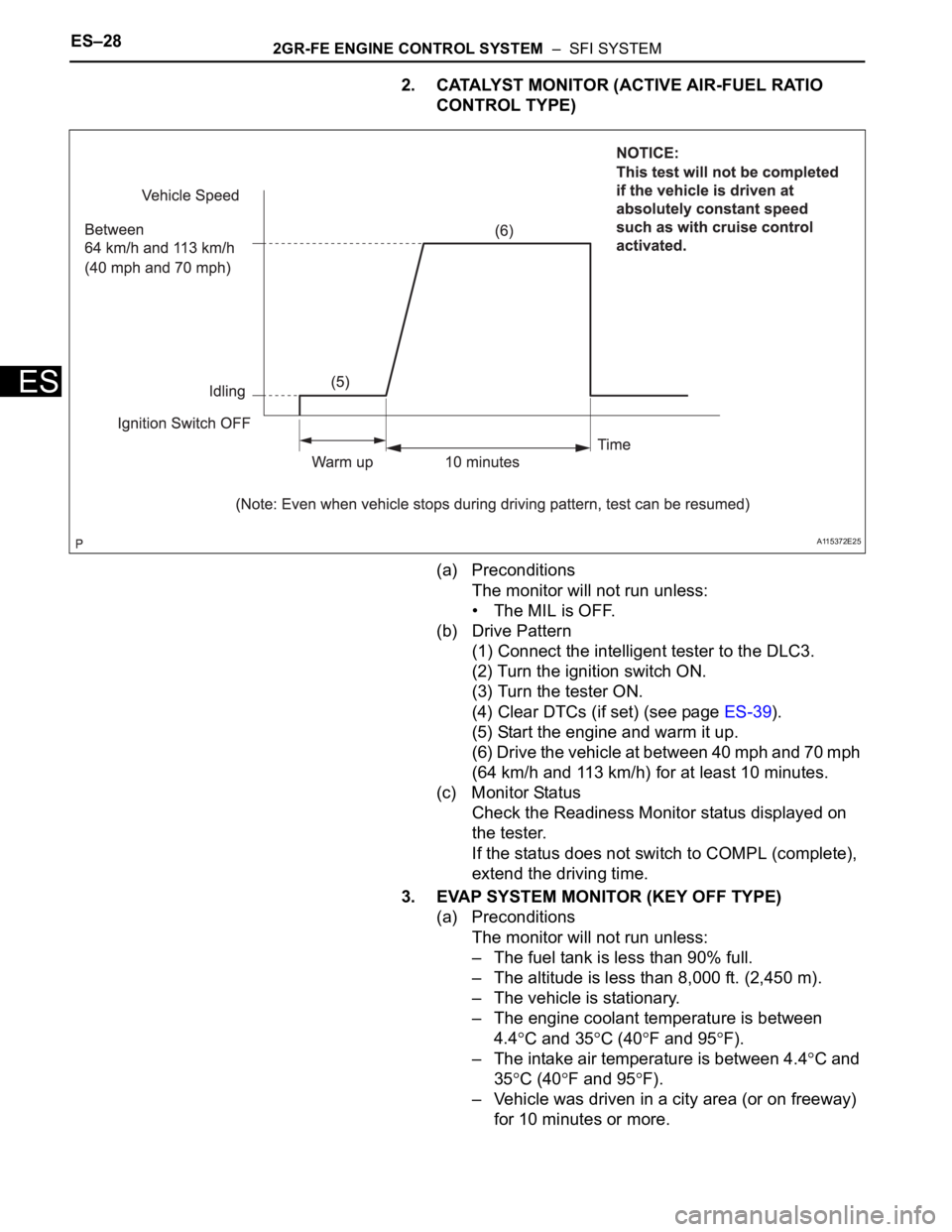
2. CATALYST MONITOR (ACTIVE AIR-FUEL RATIO
CONTROL TYPE)
(a) Preconditions
The monitor will not run unless:
• The MIL is OFF.
(b) Drive Pattern
(1) Connect the intelligent tester to the DLC3.
(2) Turn the ignition switch ON.
(3) Turn the tester ON.
(4) Clear DTCs (if set) (see page ES-39).
(5) Start the engine and warm it up.
(6) Drive the vehicle at between 40 mph and 70 mph
(64 km/h and 113 km/h) for at least 10 minutes.
(c) Monitor Status
Check the Readiness Monitor status displayed on
the tester.
If the status does not switch to COMPL (complete),
extend the driving time.
3. EVAP SYSTEM MONITOR (KEY OFF TYPE)
(a) Preconditions
The monitor will not run unless:
– The fuel tank is less than 90% full.
– The altitude is less than 8,000 ft. (2,450 m).
– The vehicle is stationary.
– The engine coolant temperature is between
4.4
C and 35C (40F and 95F).
– The intake air temperature is between 4.4
C and
35
C (40F and 95F).
– Vehicle was driven in a city area (or on freeway)
for 10 minutes or more.
A115372E25
Page 553 of 2000
2GR-FE ENGINE CONTROL SYSTEM – SFI SYSTEMES–29
ES
(b) Monitor Conditions
(1) Turn the ignition switch OFF and wait for 6
hours.
HINT:
Do not start the engine until checking Readiness
Monitor status. If the engine is started, the step
described above must be repeated.
(c) Monitor Status
(1) Connect the intelligent tester to the DLC3.
(2) Turn the ignition switch ON.
(3) Turn the tester ON.
(4) Check the Readiness Monitor status displayed
on the tester.
If the status does not switch to COMPL (complete), restart the
engine, make sure that the preconditions have been met, and
then perform the Monitor Conditions again.
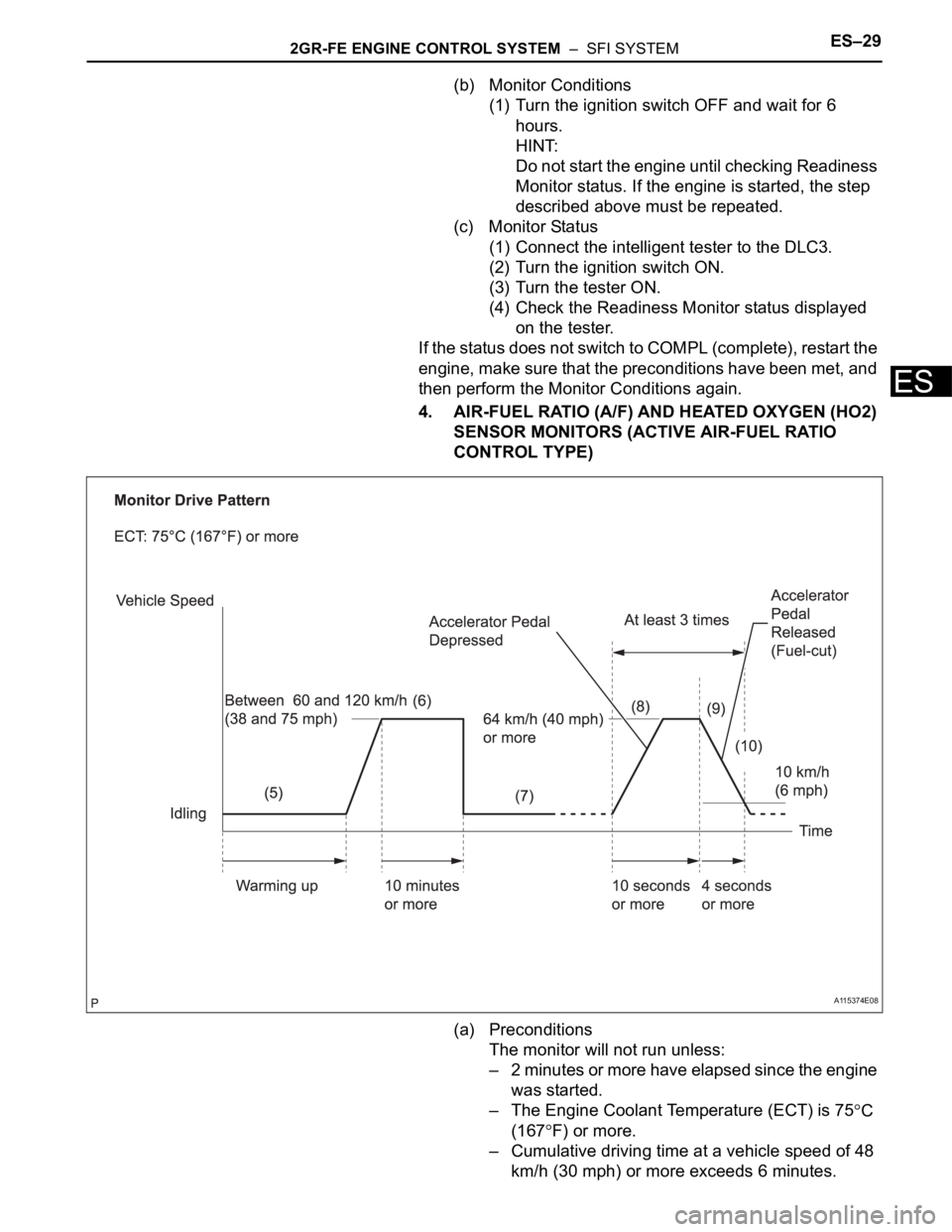
4. AIR-FUEL RATIO (A/F) AND HEATED OXYGEN (HO2)
SENSOR MONITORS (ACTIVE AIR-FUEL RATIO
CONTROL TYPE)
(a) Preconditions
The monitor will not run unless:
– 2 minutes or more have elapsed since the engine
was started.
– The Engine Coolant Temperature (ECT) is 75
C
(167
F) or more.
– Cumulative driving time at a vehicle speed of 48
km/h (30 mph) or more exceeds 6 minutes.
A115374E08
Page 554 of 2000
ES–302GR-FE ENGINE CONTROL SYSTEM – SFI SYSTEM
ES
– Air-fuel ratio feedback control is performed.
(b) Drive Pattern for front A/F sensor and HO2 sensor
(1) Connect the intelligent tester to the DLC3.
(2) Turn the ignition switch ON.
(3) Turn the tester ON.
(4) Clear DTCs (see page ES-39).
(5) Start the engine, and warm it up until the ECT
reaches 75
C (167F) or higher.
(6) Drive the vehicle at between 60 km/h (38 mph)
and 120 km/h (75 mph) for at least 10 minutes.
(7) Change the transmission to 2nd gear.
(8) Accelerate the vehicle to 64 km/h (40 mph) or
more by depressing the accelerator pedal for at
least 10 seconds.
(9) Soon after performing step (8) above, release
the accelerator pedal for at least 4 seconds without
depressing the brake pedal in order to execute fuel-
cut control.
(10) Allow the vehicle to decelerate until the vehicle
speed declines to less than 10 km/h (6 mph).
(11) Repeat steps from (8) through (10) above at
least 3 times in one driving cycle.
(c) Monitor Status
(1) Check the Readiness Monitor status displayed
on the tester.
(2) If the status does not switch to COMPL
(complete), make sure that the preconditions
have been met, and then perform steps from (5)
through (11) in the Drive Pattern above.
5. AIR-FUEL RATIO (A/F) AND HEATED OXYGEN (HO2)
SENSOR HEATER MONITORS (FRONT A/F AND
REAR HO2 SENSOR TYPE)
A121604E06
Page 1674 of 2000

SUPPLEMENTAL RESTRAINT SYSTEM – AIRBAG SYSTEMRS–25
RS
SYSTEM DESCRIPTION
1. GENERAL
(a) In conjunction with an impact absorbing structure for
a frontal collision, the SRS (Supplemental Restraint
System) driver airbag, front passenger airbag and
driver side knee airbag were designed to
supplement seat belts in the event of a frontal
collision in order to help reduce shock to the head,
chest and knee of the driver and front passenger.
This system is a 3-sensor type airbag system to
detect the impact during a frontal collision using the
center airbag sensor and front airbag sensors. It
also operates the airbag system and seat belt
pretensioner.
(b) In order to detect the extent of the collision during
the initial stages of the collision in further detail, the
front airbag sensors have been changed from
mechanical type to electrical type deceleration
sensors. Accordingly, the deployment of the driver
airbag and front passenger airbag is controlled in
two stages according to the severity of the impact.
(c) In conjunction with an impact absorbing structure for
a side collision, the side airbag and curtain shield
airbag were designed to help reduce shock to the
driver and front passenger in the event of a side
collision.
(d) A curtain shield airbag that helps reduce shock to
the front and rear seat occupants with a single
curtain shield airbag has been adopted. In
conjunction with this system, the side airbag
sensors have been installed at the bottom of the
center pillars and rear airbag sensors have been
installed at the bottom of the rear pillars.
(e) In this system, a front side collision is detected by
the side airbag sensor in order to simultaneously
deploy the side airbag. A rear side collision is
detected by the rear airbag sensor and the center
airbag sensor in order to deploy the side airbag and
curtain shield airbag.
(f) The center airbag sensor sends the airbag
deployment signal to the ECM through the CAN
(Controller Area Network) to operate the fuel pump
control.
2. CONSTRUCTION AND OPERATION
(a) FRONT AIRBAG SENSOR
(1) The front airbag sensors are installed on the
right and left radiator supports.
(2) The front airbag sensor consists of the
deceleration sensor.
Page 1942 of 2000

ES–542AZ-FE ENGINE CONTROL SYSTEM – SFI SYSTEM
ES
HINT:
• *1: If no idling conditions are specified, the transmission
gear selector lever should be in the N or P position, and
the A/C switch and all accessory switches should be OFF.
• *2: DATA LIST values are only displayed when performing
the following ACTIVE TEST: VVT B1. For other ACTIVE
TESTs, the DATA LIST value will be 0.
2. ACTIVE TEST
HINT:
Performing an ACTIVE TEST enables components
including the relays, VSV (Vacuum Switching Valve) and
actuators, to be operated without removing any parts.
The ACTIVE TEST can be performed with the intelligent
tester. Performing the ACTIVE TEST as the first step of
troubleshooting is one method of shortening diagnostic
time.
DATA LIST can be displayed during ACTIVE TEST.
(a) Connect the intelligent tester to the DLC3.
(b) Turn the ignition switch ON.
CCM CMPLComprehensive component
monitor:
COMPL or INCMPL--
FUEL ENAFuel system monitor:
UNABLE or ENABLE--
FUEL CMPLFuel system monitor:
COMPL or INCMPL--
MISFIRE ENAMisfire monitor:
UNABLE or ENABLE--
MISFIRE CMPLMisfire monitor:
COMPL or INCMPL--
HTR ENAO2S (A/FS) heater monitor:
UNABLE or ENABLE--
HTR CMPLO2S (A/FS) heater monitor:
COMPL or INCMPL--
O2S (A/FS) ENAO2S (A/FS) monitor:
UNABLE or ENABLE--
O2S (A/FS) CMPLO2S (A/FS) monitor:
COMPL or INCMPL--
EVAP ENAEVAP monitor:
UNABLE or ENABLE--
EVAP CMPLEVAP monitor:
COMPL or INCMPL--
CAT ENACatalyst monitor:
UNABLE or ENABLE--
CAT CMPLCatalyst monitor:
COMPL or INCMPL--
MODEL CODE Identifying model code ACA3# -
ENGINE TYPE Identifying engine type 2AZFE -
CYLINDER NUMBERIdentifying cylinder number:
Min.: 0, Max.: 2554-
TRANSMISSION Identifying transmission type 4AT -
DESTINATION Identifying destination A (America) -
MODEL YEARIdentifying model year:
Min.: 1900, Max.: 2155200# -
SYSTEM Identifying engine system GASLIN (gasoline engine) -Intelligent Tester Display Measurement: Range (Display) Normal Condition*1 Diagnostic Note
Page 1946 of 2000

ES–582AZ-FE ENGINE CONTROL SYSTEM – SFI SYSTEM
ES
DIAGNOSTIC TROUBLE CODE CHART
HINT:
Parameters listed in the chart may be different than your
readings depending on the type of instrument and other
factors.
If any DTCs are displayed during a check mode DTC check,
check the circuit for the DTCs listed in the table below. For
details of each DTC, refer to the page indicated.
DTC No. Detection Item Trouble Areas MIL Memory See page
P0010 Camshaft Position
"A" Actuator Circuit
(Bank 1)- Open or short in Oil
Control Valve (OCV)
circuit
- OCV
- ECMComes on DTC storedES-62
P0011 Camshaft Position
"A" - Timing Over-
Advanced or System
Performance (Bank
1)- Valve timing
- OCV
- OCV filter
- Camshaft timing
gear assembly
- ECMComes on DTC storedES-66
P0012 Camshaft Position
"A" - Timing Over-
Retarded (Bank 1)- Same as DTC
P0011Comes on DTC storedES-66
P0016 Crankshaft Position -
Camshaft Position
Correlation (Bank 1
Sensor A)- Mechanical system
(Timing chain has
jumped tooth or chain
stretched)
- ECMComes on DTC storedES-72
P0031 Oxygen (A/F) Sensor
Heater Control Circuit
Low (Bank 1 Sensor
1)- Open in Air-Fuel
Ratio (A/F) sensor
heater circuit
- A/F sensor heater
(sensor 1)
- Integration relay
(EFI MAIN relay)
- ECMComes on DTC storedES-74
P0032 Oxygen (A/F) Sensor
Heater Control Circuit
High (Bank 1 Sensor
1)- Short in A/F sensor
heater circuit
- A/F sensor heater
(sensor 1)
- Integration relay
(EFI MAIN relay)
- ECMComes on DTC storedES-74
P0037 Oxygen Sensor
Heater Control Circuit
Low (Bank 1 Sensor
2)- Open in Heated
Oxygen (HO2)
sensor heater circuit
- HO2 sensor heater
(sensor 2)
- Integration relay
(EFI MAIN relay)
- ECMComes on DTC storedES-80
P0038 Oxygen Sensor
Heater Control Circuit
High (Bank 1 Sensor
2)- Short in HO2 sensor
heater circuit
- HO2 sensor heater
(sensor 2)
- Integration relay
(EFI MAIN relay)
- ECMComes on DTC storedES-80