heater TOYOTA RAV4 2006 Service Owner's Guide
[x] Cancel search | Manufacturer: TOYOTA, Model Year: 2006, Model line: RAV4, Model: TOYOTA RAV4 2006Pages: 2000, PDF Size: 45.84 MB
Page 1021 of 2000
U140F AUTOMATIC TRANSAXLE – DIFFERENTIAL CASEAX–261
AX
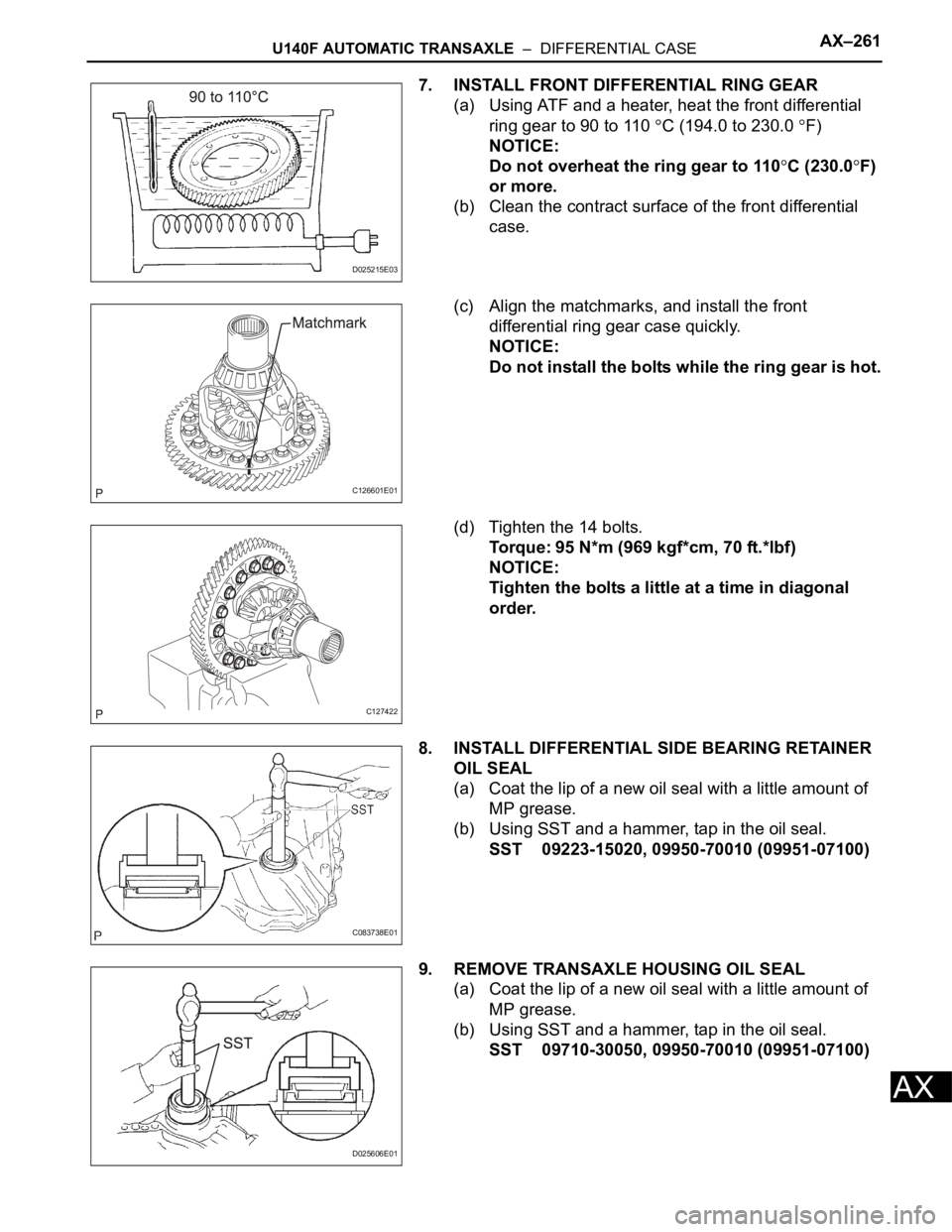
7. INSTALL FRONT DIFFERENTIAL RING GEAR
(a) Using ATF and a heater, heat the front differential
ring gear to 90 to 110
C (194.0 to 230.0 F)
NOTICE:
Do not overheat the ring gear to 110
C (230.0F)
or more.
(b) Clean the contract surface of the front differential
case.
(c) Align the matchmarks, and install the front
differential ring gear case quickly.
NOTICE:
Do not install the bolts while the ring gear is hot.
(d) Tighten the 14 bolts.
Torque: 95 N*m (969 kgf*cm, 70 ft.*lbf)
NOTICE:
Tighten the bolts a little at a time in diagonal
order.
8. INSTALL DIFFERENTIAL SIDE BEARING RETAINER
OIL SEAL
(a) Coat the lip of a new oil seal with a little amount of
MP grease.
(b) Using SST and a hammer, tap in the oil seal.
SST 09223-15020, 09950-70010 (09951-07100)
9. REMOVE TRANSAXLE HOUSING OIL SEAL
(a) Coat the lip of a new oil seal with a little amount of
MP grease.
(b) Using SST and a hammer, tap in the oil seal.
SST 09710-30050, 09950-70010 (09951-07100)
D025215E03
C126601E01
C127422
C083738E01
D025606E01
Page 1329 of 2000
U241E AUTOMATIC TRANSAXLE – DIFFERENTIAL CASEAX–259
AX
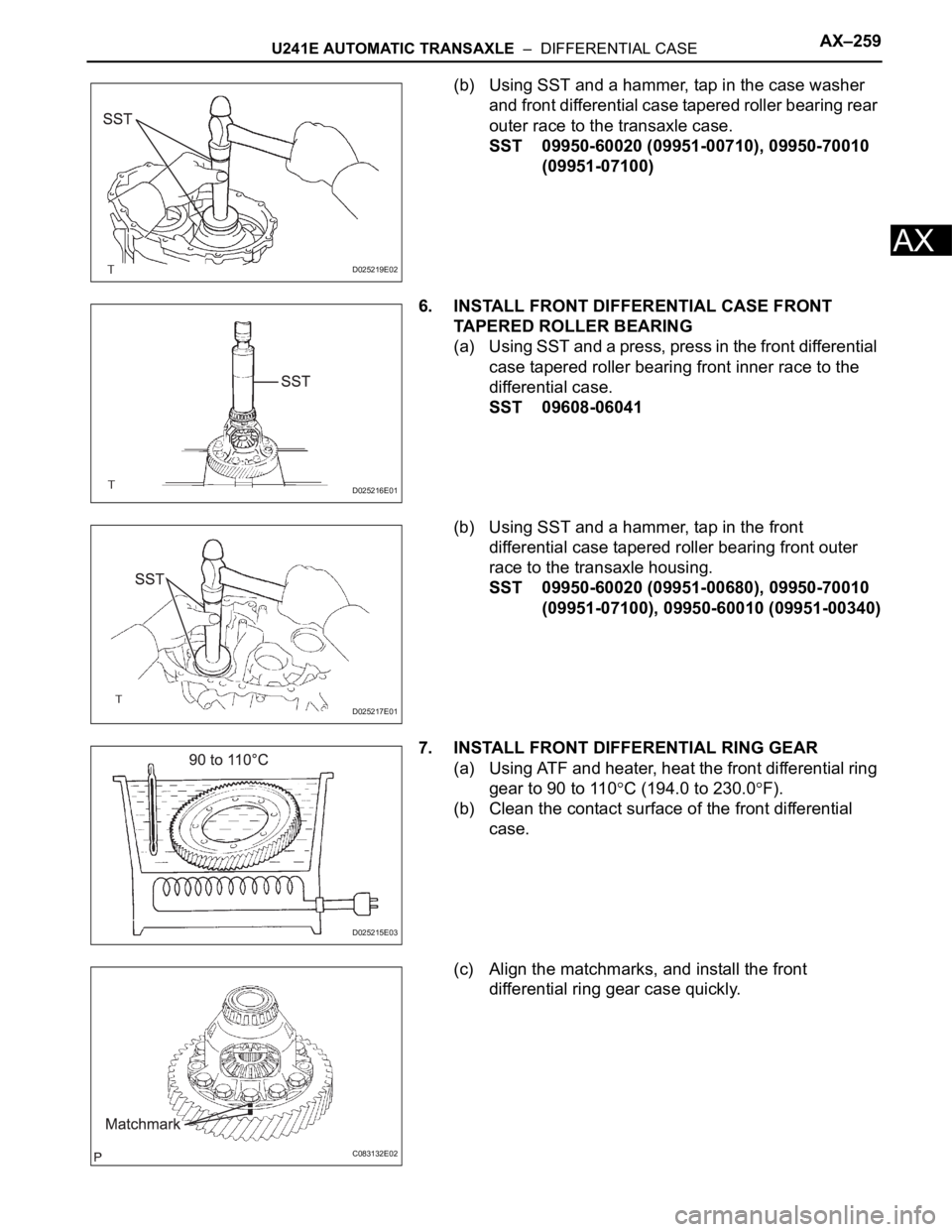
(b) Using SST and a hammer, tap in the case washer
and front differential case tapered roller bearing rear
outer race to the transaxle case.
SST 09950-60020 (09951-00710), 09950-70010
(09951-07100)
6. INSTALL FRONT DIFFERENTIAL CASE FRONT
TAPERED ROLLER BEARING
(a) Using SST and a press, press in the front differential
case tapered roller bearing front inner race to the
differential case.
SST 09608-06041
(b) Using SST and a hammer, tap in the front
differential case tapered roller bearing front outer
race to the transaxle housing.
SST 09950-60020 (09951-00680), 09950-70010
(09951-07100), 09950-60010 (09951-00340)
7. INSTALL FRONT DIFFERENTIAL RING GEAR
(a) Using ATF and heater, heat the front differential ring
gear to 90 to 110
C (194.0 to 230.0F).
(b) Clean the contact surface of the front differential
case.
(c) Align the matchmarks, and install the front
differential ring gear case quickly.
D025219E02
D025216E01
D025217E01
D025215E03
C083132E02
Page 1641 of 2000

AIR CONDITIONING – AIR CONDITIONING SYSTEM (for Automatic Air Conditioning Sys-
tem)AC–13
AC
SYSTEM DESCRIPTION
1. GENERAL
(a) The air conditioning system has the following
features:
• In accordance with the temperature set using the
temperature control switch, the air conditioning
amplifier determines the outlet temperature
based on the input signals from various sensors.
In addition, corrections are made in accordance
with the signals from the water temperature
sensor to control the outlet air temperature.
• Controls the blower motor in accordance with the
airflow volume determined by the air conditioning
amplifier based on the input signals from various
sensors.
• Automatically changes the outlets in accordance
with the outlet mode ratio that is determined by
the air conditioning amplifier based on the input
signals from various sensors.
• Based on the signals from the ambient
temperature sensor, this system calculates the
outside temperature and indicates it in the multi-
information display in the combination meter
assembly.
• The left/right independent temperature control
and neural network control make air conditioner
control available to suit the persons in the driver
seat and in the passenger seat.
• Turns the rear defogger and outside rear mirror
heaters on for 15 minutes when the rear
defogger switch is pressed. Turns them off if the
switch is pressed while they are operating.
• Checks the sensors in accordance with the
operation of the air conditioner switches.
• The air conditioning amplifier has the function of
controlling the indicator lighting.
Page 1651 of 2000
AIR CONDITIONING – AIR CONDITIONING SYSTEM (for Automatic Air Conditioning Sys-
tem)AC–23
AC
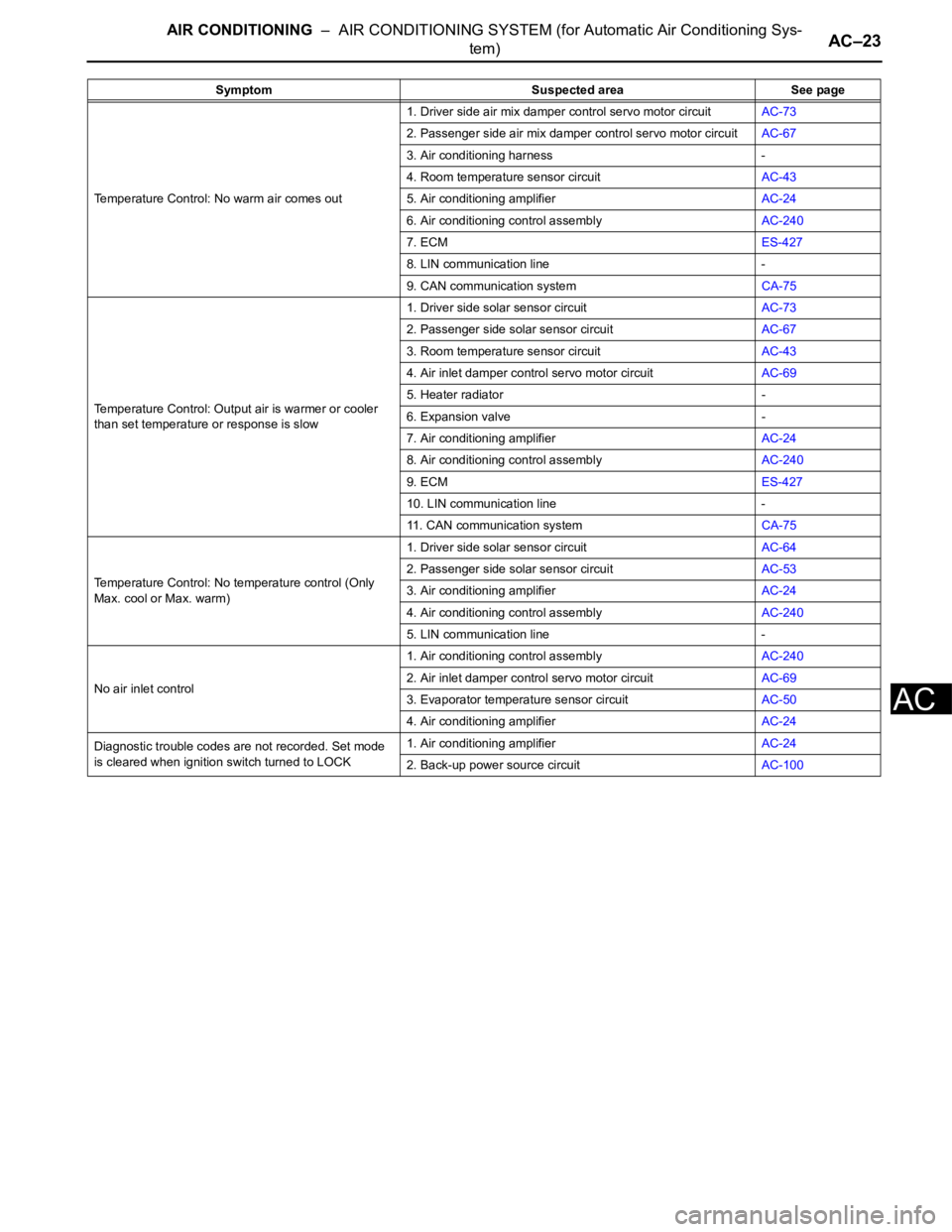
Temperature Control: No warm air comes out1. Driver side air mix damper control servo motor circuitAC-73
2. Passenger side air mix damper control servo motor circuitAC-67
3. Air conditioning harness -
4. Room temperature sensor circuitAC-43
5. Air conditioning amplifierAC-24
6. Air conditioning control assemblyAC-240
7. ECMES-427
8. LIN communication line -
9. CAN communication systemCA-75
Temperature Control: Output air is warmer or cooler
than set temperature or response is slow1. Driver side solar sensor circuitAC-73
2. Passenger side solar sensor circuitAC-67
3. Room temperature sensor circuitAC-43
4. Air inlet damper control servo motor circuitAC-69
5. Heater radiator -
6. Expansion valve -
7. Air conditioning amplifierAC-24
8. Air conditioning control assemblyAC-240
9. ECMES-427
10. LIN communication line -
11. CAN communication systemCA-75
Temperature Control: No temperature control (Only
Max. cool or Max. warm)1. Driver side solar sensor circuitAC-64
2. Passenger side solar sensor circuitAC-53
3. Air conditioning amplifierAC-24
4. Air conditioning control assemblyAC-240
5. LIN communication line -
No air inlet control1. Air conditioning control assemblyAC-240
2. Air inlet damper control servo motor circuitAC-69
3. Evaporator temperature sensor circuitAC-50
4. Air conditioning amplifierAC-24
Diagnostic trouble codes are not recorded. Set mode
is cleared when ignition switch turned to LOCK1. Air conditioning amplifierAC-24
2. Back-up power source circuitAC-100 Symptom Suspected area See page
Page 1653 of 2000
AIR CONDITIONING – AIR CONDITIONING SYSTEM (for Automatic Air Conditioning Sys-
tem)AC–25
AC
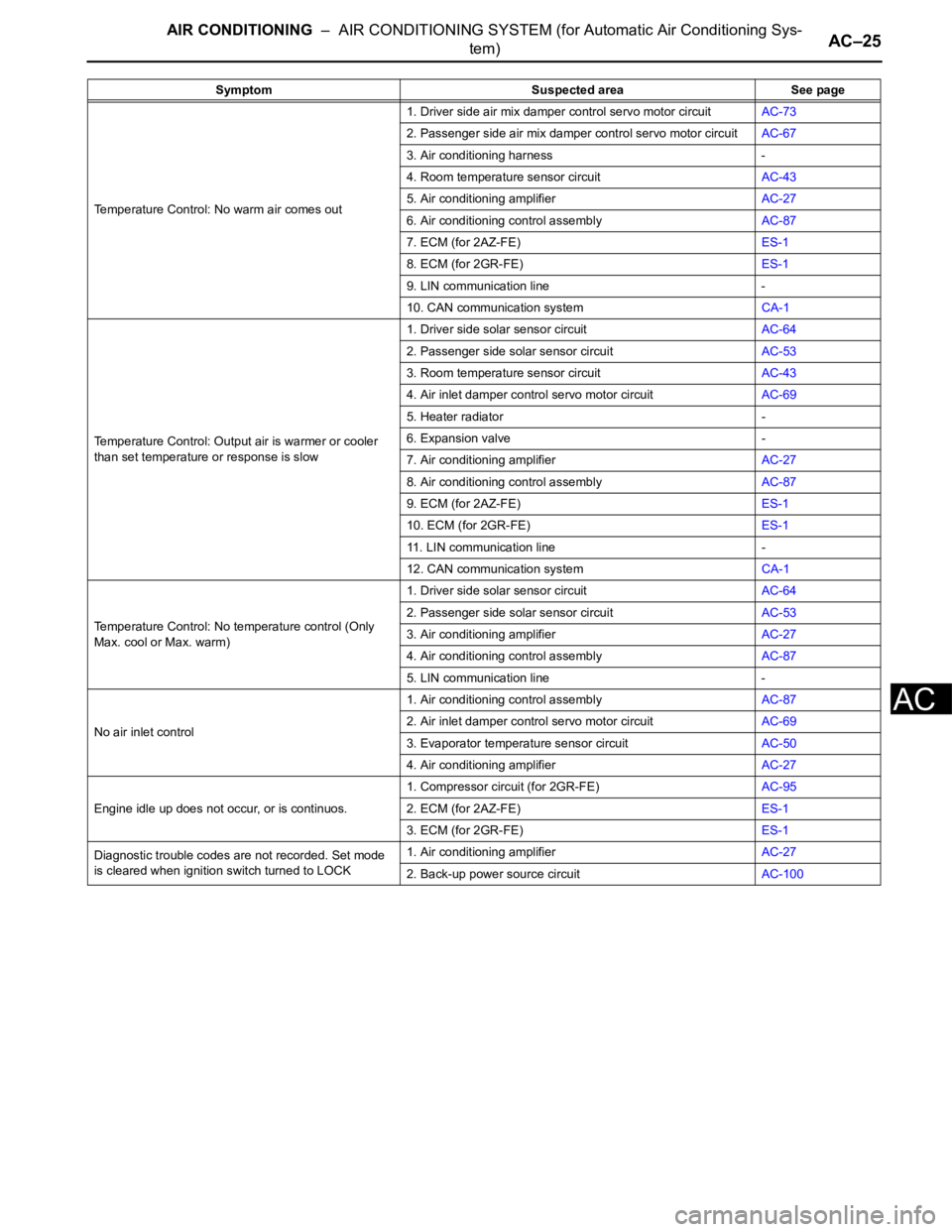
Temperature Control: No warm air comes out1. Driver side air mix damper control servo motor circuitAC-73
2. Passenger side air mix damper control servo motor circuitAC-67
3. Air conditioning harness -
4. Room temperature sensor circuitAC-43
5. Air conditioning amplifierAC-27
6. Air conditioning control assemblyAC-87
7. ECM (for 2AZ-FE)ES-1
8. ECM (for 2GR-FE)ES-1
9. LIN communication line -
10. CAN communication systemCA-1
Temperature Control: Output air is warmer or cooler
than set temperature or response is slow1. Driver side solar sensor circuitAC-64
2. Passenger side solar sensor circuitAC-53
3. Room temperature sensor circuitAC-43
4. Air inlet damper control servo motor circuitAC-69
5. Heater radiator -
6. Expansion valve -
7. Air conditioning amplifierAC-27
8. Air conditioning control assemblyAC-87
9. ECM (for 2AZ-FE)ES-1
10. ECM (for 2GR-FE)ES-1
11. LIN communication line -
12. CAN communication systemCA-1
Temperature Control: No temperature control (Only
Max. cool or Max. warm)1. Driver side solar sensor circuitAC-64
2. Passenger side solar sensor circuitAC-53
3. Air conditioning amplifierAC-27
4. Air conditioning control assemblyAC-87
5. LIN communication line -
No air inlet control1. Air conditioning control assemblyAC-87
2. Air inlet damper control servo motor circuitAC-69
3. Evaporator temperature sensor circuitAC-50
4. Air conditioning amplifierAC-27
Engine idle up does not occur, or is continuos.1. Compressor circuit (for 2GR-FE)AC-95
2. ECM (for 2AZ-FE)ES-1
3. ECM (for 2GR-FE)ES-1
Diagnostic trouble codes are not recorded. Set mode
is cleared when ignition switch turned to LOCK1. Air conditioning amplifierAC-27
2. Back-up power source circuitAC-100 Symptom Suspected area See page
Page 1743 of 2000
SUPPLEMENTAL RESTRAINT SYSTEM – OCCUPANT CLASSIFICATION ECURS–395
RS
INSTALLATION
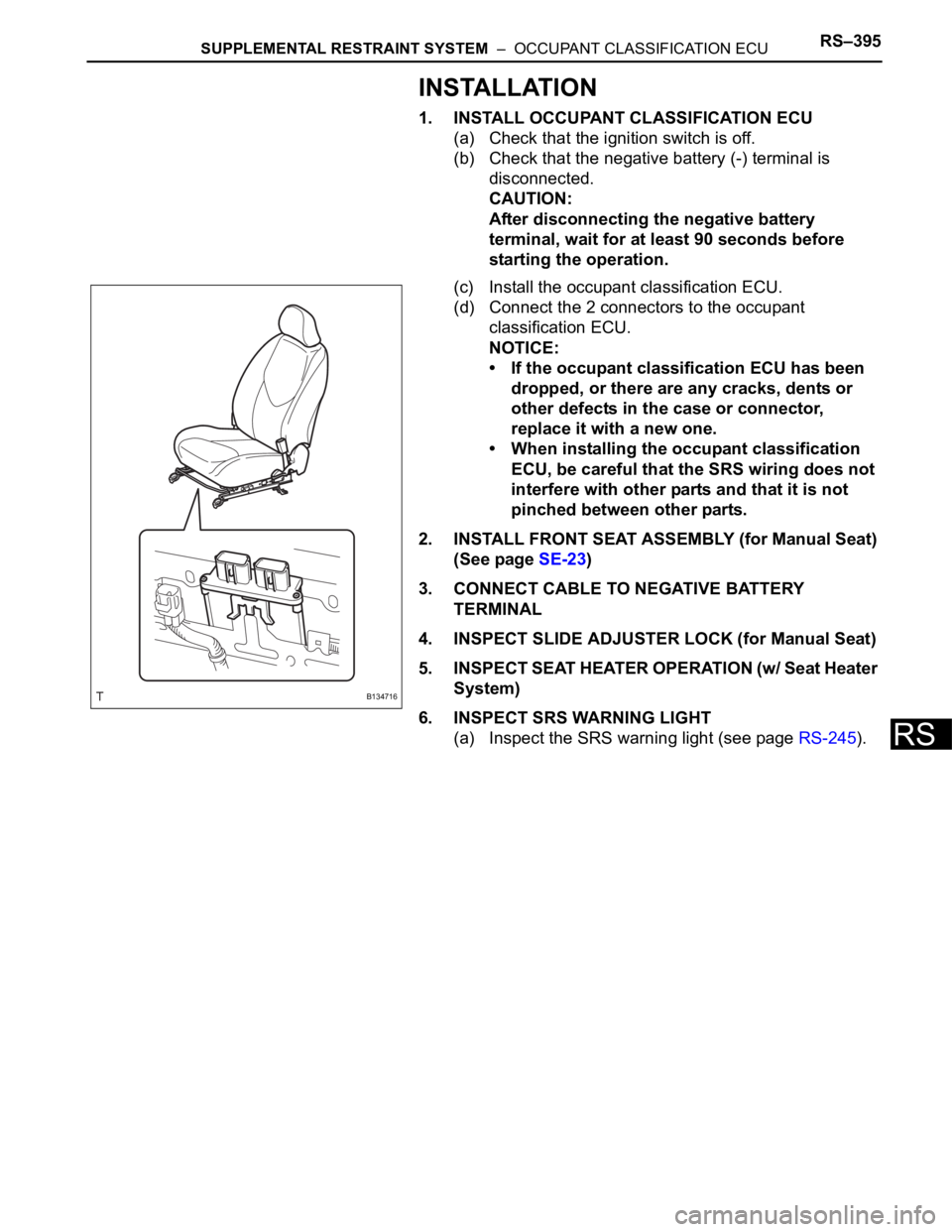
1. INSTALL OCCUPANT CLASSIFICATION ECU
(a) Check that the ignition switch is off.
(b) Check that the negative battery (-) terminal is
disconnected.
CAUTION:
After disconnecting the negative battery
terminal, wait for at least 90 seconds before
starting the operation.
(c) Install the occupant classification ECU.
(d) Connect the 2 connectors to the occupant
classification ECU.
NOTICE:
• If the occupant classification ECU has been
dropped, or there are any cracks, dents or
other defects in the case or connector,
replace it with a new one.
• When installing the occupant classification
ECU, be careful that the SRS wiring does not
interfere with other parts and that it is not
pinched between other parts.
2. INSTALL FRONT SEAT ASSEMBLY (for Manual Seat)
(See page SE-23)
3. CONNECT CABLE TO NEGATIVE BATTERY
TERMINAL
4. INSPECT SLIDE ADJUSTER LOCK (for Manual Seat)
5. INSPECT SEAT HEATER OPERATION (w/ Seat Heater
System)
6. INSPECT SRS WARNING LIGHT
(a) Inspect the SRS warning light (see page RS-245).
B134716
Page 1744 of 2000

SB–6SEAT BELT – SEAT BELT WARNING SYSTEM
SB
OPERATION CHECK
1. INSPECT DRIVER SIDE SEAT BELT WARNING LIGHT
(a) Turn the ignition switch ON.
(b) When the driver seat belt is not fastened, check that
the driver seat belt warning light on the combination
meter blinks.
(c) When the driver seat belt is fastened, check that the
driver seat belt warning light on the combination
meter is off.
2. INSPECT PASSENGER SIDE SEAT BELT WARNING
LIGHT (For Automatic Air Conditioning System)
(a) Turn the ignition switch ON.
(b) When the front passenger seat belt is not fastened
with the passenger seat occupied, check that the
front passenger seat belt warning light on the heater
control panel display blinks.
(c) When the front passenger seat belt is fastened with
the passenger seat occupied, check that the front
passenger seat belt warning light on the heater
control panel display is off.
3. REMOVE PASSENGER SIDE SEAT BELT WARNING
LIGHT (For Manual Air Conditioning System)
(a) Turn the ignition switch ON.
(b) When the front passenger seat belt is not fastened
with the passenger seat occupied, check that the
front passenger seat belt warning light on the clock
panel blinks.
(c) When the front passenger seat belt is fastened with
the passenger seat occupied, check that the front
passenger seat belt warning light on the clock panel
is off.
4. INSPECT SEAT BELT WARNING BUZZER
HINT:
If the buzzer does not sound, the buzzer cancel setting
may be set to ON.
(a) Turn the ignition switch ON.
(b) When the vehicle is driven at approximately 20 km/h
(12.4 mph) or more while the driver or front
passenger seat belt is not fastened, check that the
buzzer in the combination meter sounds at 1.2
second intervals for 30 seconds.
(c) 30 seconds after the buzzer has first sounded,
check that the buzzer sounds at 0.4 second
intervals for 90 seconds.
(d) 120 seconds after the buzzer has first sounded,
check that the buzzer stops.
(e) After the buzzer has stopped, turn the ignition
switch off and then start the engine again. Drive the
vehicle at approximately 25 km/h (16 mph) or more
while the driver or front passenger seat belt is not
fastened, and then check that the buzzer sounds
again.
Page 1746 of 2000
SB–8SEAT BELT – SEAT BELT WARNING SYSTEM
SB
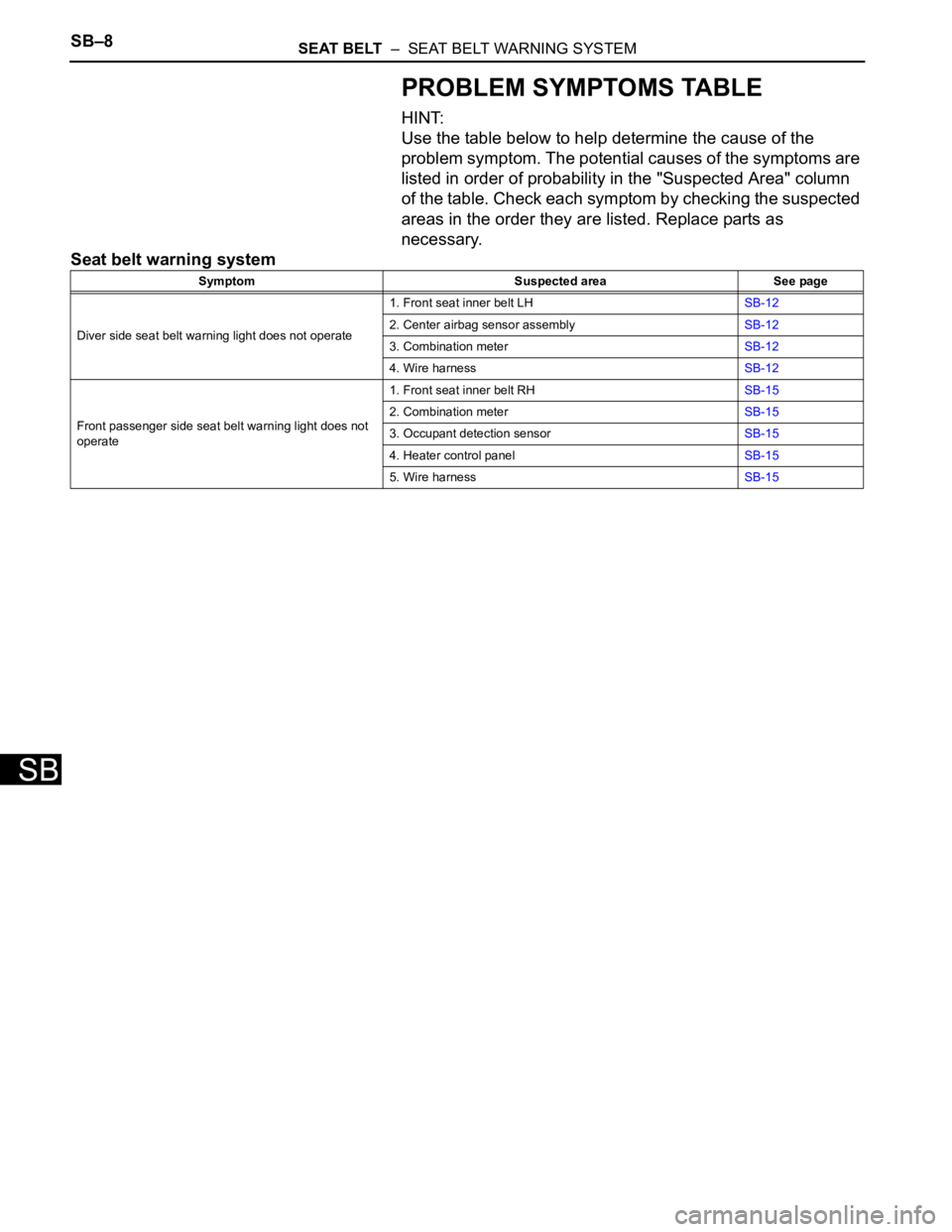
PROBLEM SYMPTOMS TABLE
HINT:
Use the table below to help determine the cause of the
problem symptom. The potential causes of the symptoms are
listed in order of probability in the "Suspected Area" column
of the table. Check each symptom by checking the suspected
areas in the order they are listed. Replace parts as
necessary.
Seat belt warning system
Symptom Suspected area See page
Diver side seat belt warning light does not operate1. Front seat inner belt LHSB-12
2. Center airbag sensor assemblySB-12
3. Combination meterSB-12
4. Wire harnessSB-12
Front passenger side seat belt warning light does not
operate1. Front seat inner belt RHSB-15
2. Combination meterSB-15
3. Occupant detection sensorSB-15
4. Heater control panelSB-15
5. Wire harnessSB-15
Page 1747 of 2000
SEAT BELT – SEAT BELT WARNING SYSTEMSB–9
SB
TERMINALS OF ECU
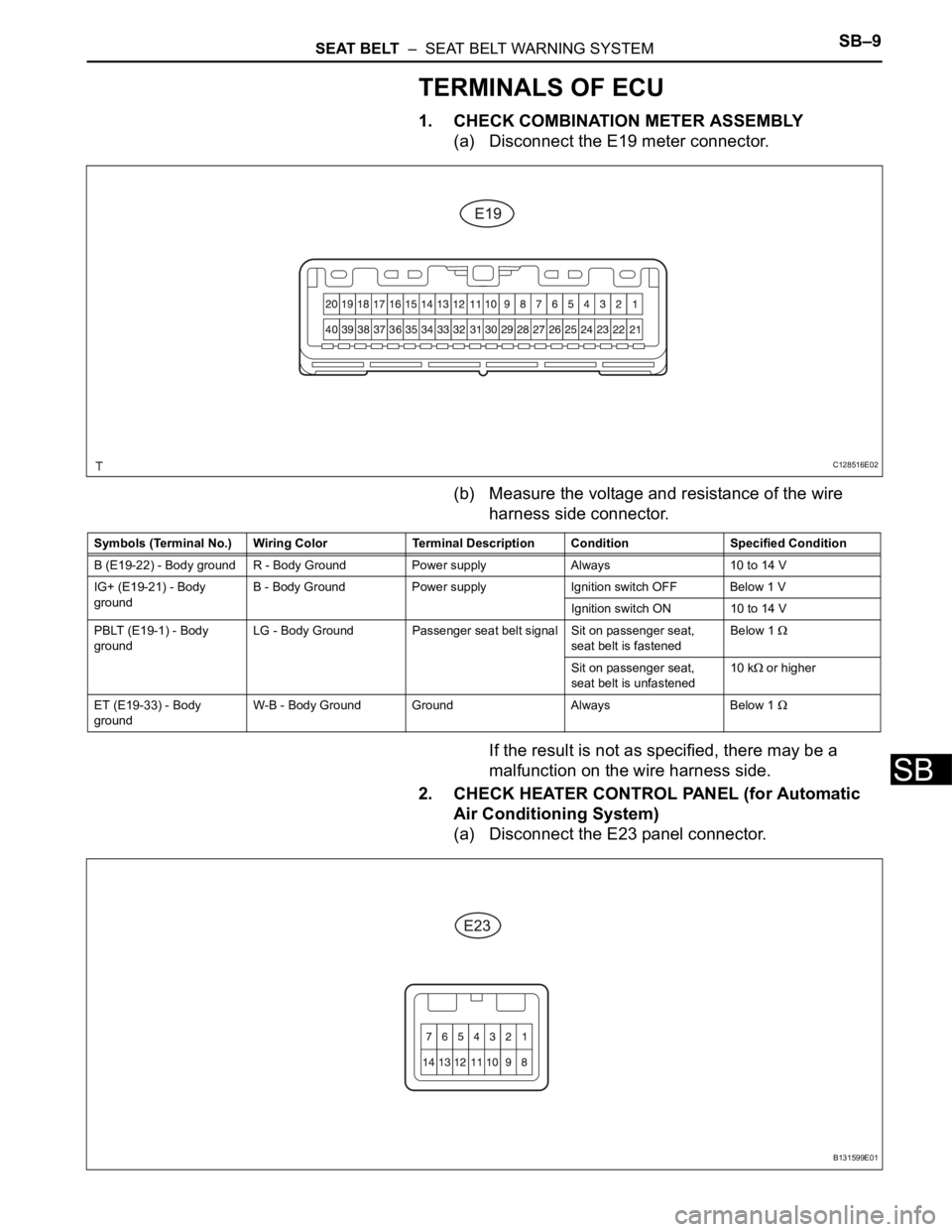
1. CHECK COMBINATION METER ASSEMBLY
(a) Disconnect the E19 meter connector.
(b) Measure the voltage and resistance of the wire
harness side connector.
If the result is not as specified, there may be a
malfunction on the wire harness side.
2. CHECK HEATER CONTROL PANEL (for Automatic
Air Conditioning System)
(a) Disconnect the E23 panel connector.
C128516E02
Symbols (Terminal No.) Wiring Color Terminal Description ConditionSpecified Condition
B (E19-22) - Body ground R - Body Ground Power supply Always 10 to 14 V
IG+ (E19-21) - Body
groundB - Body Ground Power supply Ignition switch OFF Below 1 V
Ignition switch ON 10 to 14 V
PBLT (E19-1) - Body
groundLG - Body Ground Passenger seat belt signal Sit on passenger seat,
seat belt is fastenedBelow 1
Sit on passenger seat,
seat belt is unfastened10 k or higher
ET (E19-33) - Body
groundW-B - Body Ground Ground Always Below 1
B131599E01
Page 1751 of 2000

SEAT BELT – SEAT BELT WARNING SYSTEMSB–13
SB
ON-VEHICLE INSPECTION
1. CHECK DRIVER SIDE SEAT BELT WARNING LIGHT
(a) Turn the ignition switch ON.
(b) When the driver side seat belt is not fastened, check
that the combination meter's driver side seat belt
warning light starts blinking.
(c) When the seat belt is fastened, check that the
combination meter's driver side seat belt warning
light turns off.
2. CHECK PASSENGER SIDE SEAT BELT WARNING
LIGHT
(a) Turn the ignition switch ON.
(b) When the front passenger seat belt is not fastened,
check that the heater control panel's front
passenger side seat belt warning light starts
blinking.
(c) When the front passenger seat belt is fastened,
check that the heater control panel's front
passenger side seat belt warning light turns off.
3. CHECK SEAT BELT WARNING BUZZER
(a) Turn the ignition switch ON.
(b) After turning the ignition switch ON, if the vehicle is
driven at 20 km/h (12.4 mph) or more and the driver
side or front passenger side seat belt is not
fastened, check that the combination meter's buzzer
sounds at 1.2 second intervals for 30 seconds.
(c) 30 seconds after the buzzer first sounds, check that
the buzzer sounds at 0.4 second intervals for 90
seconds.
(d) 120 seconds after the buzzer has first sounded,
check that the buzzer stops.
(e) After the buzzer has stopped, turn the ignition
switch OFF and then start the engine again. With
the driver side or front passenger side seat belt
unfastened, drive the vehicle at 20 km/h (12.4 mph)
or more. Check that the buzzer sounds.
(f) After the buzzer has stopped, fasten the driver side
or front passenger side seat belt, drive the vehicle at
20 km/h (12.4 mph) or more, and then unfasten the
seat belt. Check that the buzzer sounds.
(g) After the buzzer has stopped, move the shift lever to
R. Then move the shift lever to D and with the driver
side or front passenger side seat belt unfastened,
drive the vehicle at 20 km/h (12.4 mph) or more.
Check that the buzzer sounds.