motor TOYOTA RAV4 2006 Service Owner's Guide
[x] Cancel search | Manufacturer: TOYOTA, Model Year: 2006, Model line: RAV4, Model: TOYOTA RAV4 2006Pages: 2000, PDF Size: 45.84 MB
Page 336 of 2000
2AZ-FE STARTING – STARTING SYSTEMST–3
ST
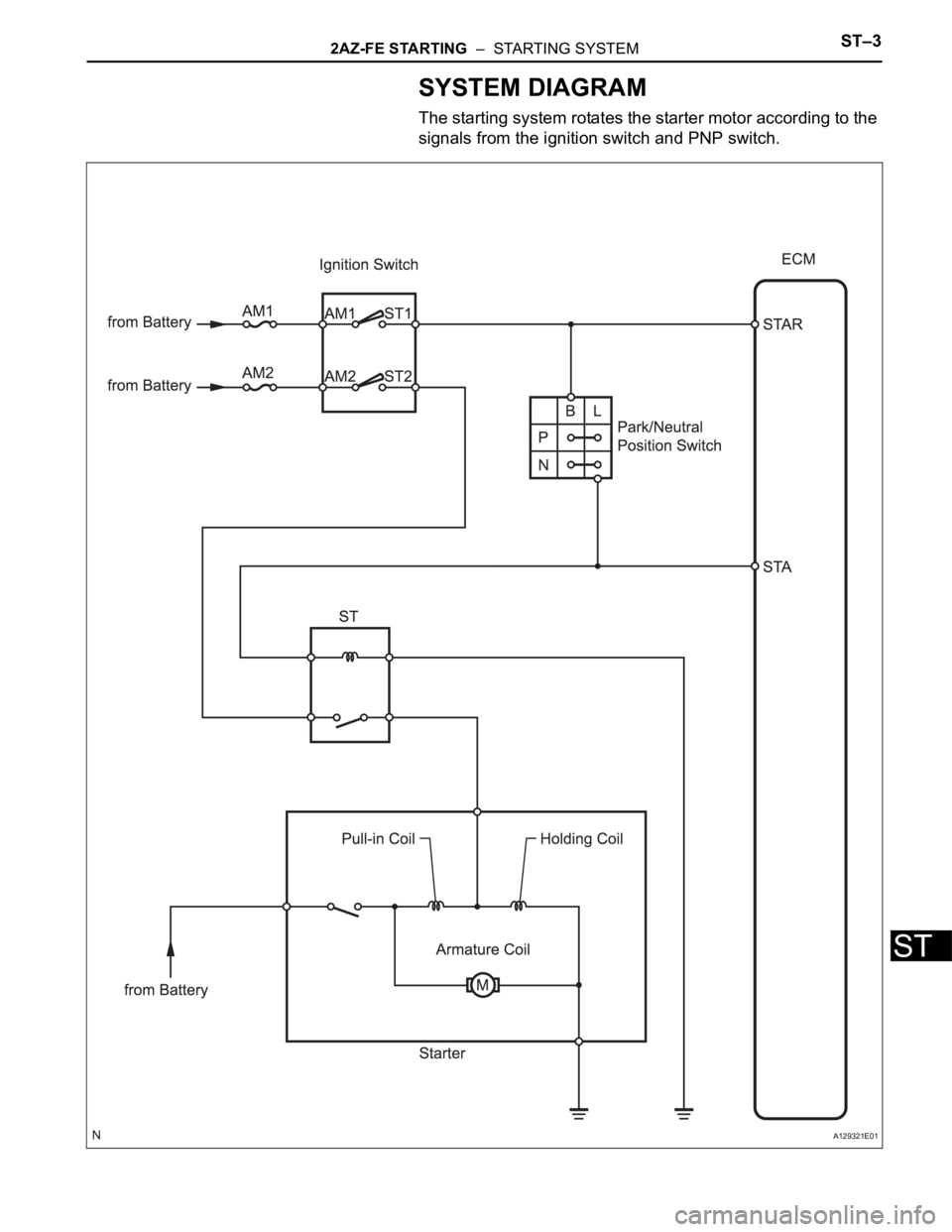
SYSTEM DIAGRAM
The starting system rotates the starter motor according to the
signals from the ignition switch and PNP switch.
A129321E01
Page 337 of 2000
2GR-FE STARTING – STARTING SYSTEMST–3
ST
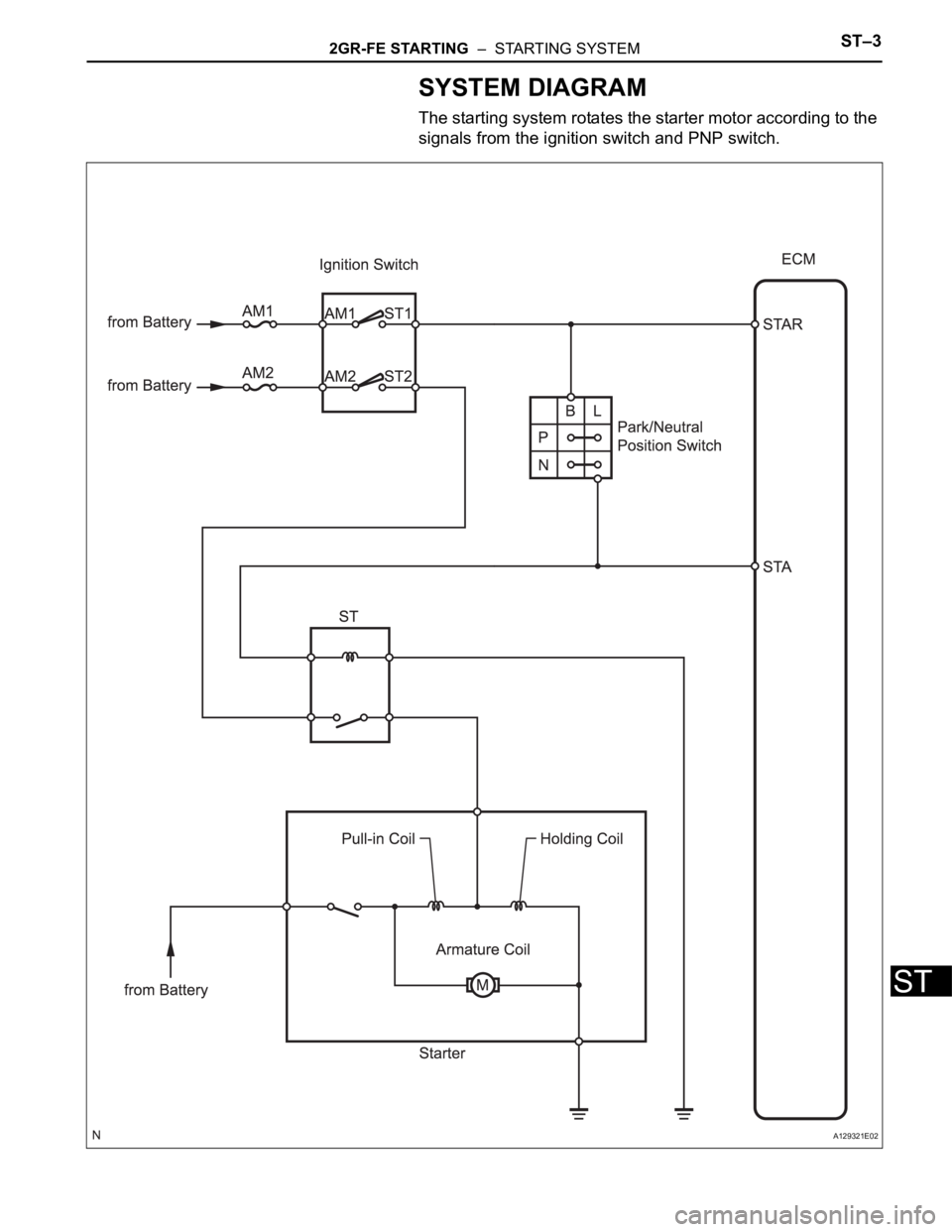
SYSTEM DIAGRAM
The starting system rotates the starter motor according to the
signals from the ignition switch and PNP switch.
A129321E02
Page 339 of 2000
CH–42AZ-FE CHARGING – CHARGING SYSTEM
CH
ON-VEHICLE INSPECTION
1. CHECK BATTERY CONDITION
NOTICE:
If the battery is weak or if the engine is difficult to
start, perform the following procedures.
(a) Check the battery for damage and deformation. If
severe damage, deformation or leakage is found,
replace the battery.
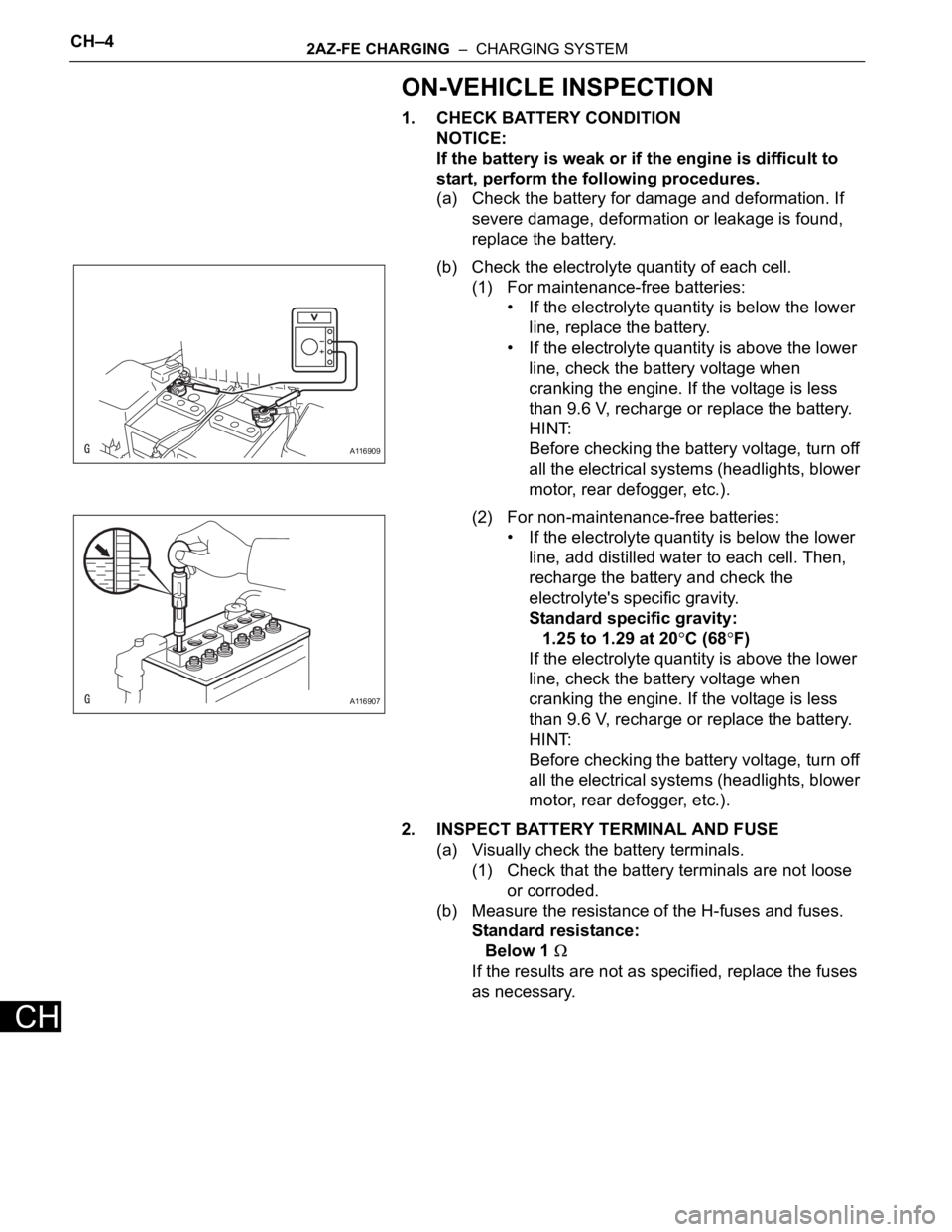
(b) Check the electrolyte quantity of each cell.
(1) For maintenance-free batteries:
• If the electrolyte quantity is below the lower
line, replace the battery.
• If the electrolyte quantity is above the lower
line, check the battery voltage when
cranking the engine. If the voltage is less
than 9.6 V, recharge or replace the battery.
HINT:
Before checking the battery voltage, turn off
all the electrical systems (headlights, blower
motor, rear defogger, etc.).
(2) For non-maintenance-free batteries:
• If the electrolyte quantity is below the lower
line, add distilled water to each cell. Then,
recharge the battery and check the
electrolyte's specific gravity.
Standard specific gravity:
1.25 to 1.29 at 20
C (68F)
If the electrolyte quantity is above the lower
line, check the battery voltage when
cranking the engine. If the voltage is less
than 9.6 V, recharge or replace the battery.
HINT:
Before checking the battery voltage, turn off
all the electrical systems (headlights, blower
motor, rear defogger, etc.).
2. INSPECT BATTERY TERMINAL AND FUSE
(a) Visually check the battery terminals.
(1) Check that the battery terminals are not loose
or corroded.
(b) Measure the resistance of the H-fuses and fuses.
Standard resistance:
Below 1
If the results are not as specified, replace the fuses
as necessary.
A116909
A116907
Page 421 of 2000
STEERING COLUMN – STEERING SYSTEMSR–3
SR
PROBLEM SYMPTOMS TABLE
(2006/01- )
HINT:
Use the table below to help determine the cause of the
problem symptom. The potential causes of the symptoms are
listed in order of probability in the "Suspected Area" column
of the table. Check each symptom by checking the suspected
areas in the order they are listed. Replace parts as
necessary.
Steering system
ON-VEHICLE INSPECTION
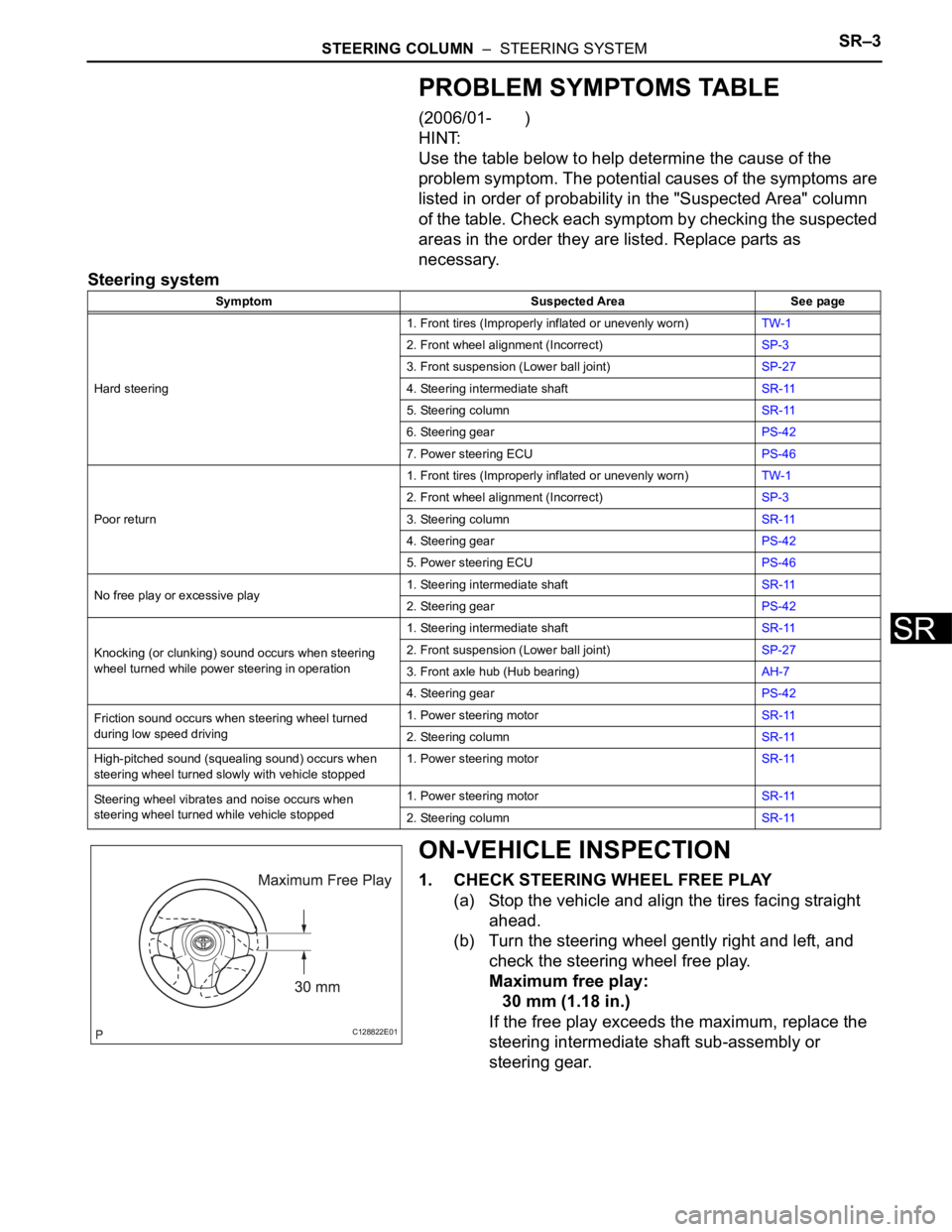
1. CHECK STEERING WHEEL FREE PLAY
(a) Stop the vehicle and align the tires facing straight
ahead.
(b) Turn the steering wheel gently right and left, and
check the steering wheel free play.
Maximum free play:
30 mm (1.18 in.)
If the free play exceeds the maximum, replace the
steering intermediate shaft sub-assembly or
steering gear.
Symptom Suspected Area See page
Hard steering1. Front tires (Improperly inflated or unevenly worn)TW-1
2. Front wheel alignment (Incorrect)SP-3
3. Front suspension (Lower ball joint)SP-27
4. Steering intermediate shaftSR-11
5. Steering columnSR-11
6. Steering gearPS-42
7. Power steering ECUPS-46
Poor return1. Front tires (Improperly inflated or unevenly worn)TW-1
2. Front wheel alignment (Incorrect)SP-3
3. Steering columnSR-11
4. Steering gearPS-42
5. Power steering ECUPS-46
No free play or excessive play1. Steering intermediate shaftSR-11
2. Steering gearPS-42
Knocking (or clunking) sound occurs when steering
wheel turned while power steering in operation1. Steering intermediate shaftSR-11
2. Front suspension (Lower ball joint)SP-27
3. Front axle hub (Hub bearing)AH-7
4. Steering gearPS-42
Friction sound occurs when steering wheel turned
during low speed driving1. Power steering motorSR-11
2. Steering columnSR-11
High-pitched sound (squealing sound) occurs when
steering wheel turned slowly with vehicle stopped1. Power steering motorSR-11
Steering wheel vibrates and noise occurs when
steering wheel turned while vehicle stopped1. Power steering motorSR-11
2. Steering columnSR-11
C128822E01
Page 425 of 2000

POWER STEERING – ELECTRONIC POWER STEERING SYSTEMPS–5
PS
SYSTEM DESCRIPTION
1. DESCRIPTION
The EPS (Electronic Power Steering) system generates
torque through the operation of the motor and the
reduction gear installed on the column shaft in order to
assist steering effort.
The power steering ECU determines directions and the
amount of assisting power in accordance with vehicle
speed signals and signals from the torque sensor built
into the steering column assembly. As a result, the power
steering adjusts the steering effort so that it is lighter
during low speed driving and heavier during high speed
driving.
(a) Power steering ECU:
The power steering ECU calculates assisting power
based on steering torque signals from the torque
sensor and vehicle speed signals from the skid
control ECU.
(b) Torque sensor:
The torque sensor detects the steering effort
generated when the steering wheel is turned and
converts it to an electrical signal.
(c) EPS motor:
The EPS motor is activated by the current from the
power steering ECU and generates torque to assist
the steering effort.
(d) Motor rotation angle sensor:
The motor rotation angle sensor consists of the
resolver sensor, which excels in reliability and
durability. The rotation angle sensor detects the
rotation angle of the motor and outputs it to the
power steering ECU. As a result, it ensures efficient
EPS control.
Page 429 of 2000
AIR CONDITIONING – AIR OUTLET CONTROL SERVO MOTOR (for Automatic Air Condi-
tioning System)AC–213
AC
INSTALLATION
1. INSTALL AIR OUTLET CONTROL SERVO MOTOR
(See page AC-196)
2. INSTALL AIR CONDITIONING UNIT
(a) Install the air conditioning radiator (see page AC-
197).
Page 443 of 2000

CRUISE CONTROL – CRUISE CONTROL SYSTEMCC–5
CC
SYSTEM DESCRIPTION
1. CRUISE CONTROL SYSTEM
This system is controlled by the ECM, and is activated by
the throttle position sensor and motor. The ECM controls
the following functions: ON-OFF, SET / COAST,
RESUME / ACCEL, CANCEL, vehicle speed operation,
motor output control, and overdrive control.
• The ECM compares the driving vehicle speed from
the combination meter with the stored vehicle speed
set through the cruise control switch. The ECM
controls the throttle valve motor of the throttle body to
open the valve when the driving speed is less than the
stored speed.
• The ECM receives signals such as ON-OFF, SET /
COAST, RESUME / ACCEL, and CANCEL from the
cruise control switch.
• The ECM illuminates the combination meter CRUISE
main indicator light when it receives the cruise control
switch ON signal.
• The ECM cancels the cruise control system when the
brake pedal is depressed and the ECM receives the
stop light switch signal.
• The ECM cancels the cruise control system when the
shift lever is moved from D or 3 to a position other
than D or 3, and the ECM receives the PNP switch
signal.
2. LIMIT CONTROL
(a) Low speed limit
The lowest possible limit of the speed setting range
is set at approximately 40 km/h (25 mph). The
cruise control system cannot be set when the
driving vehicle speed is below the low speed limit.
Cruise control operation will be automatically
canceled when the vehicle speed decreases below
the low speed limit 40 km/h (25 mph) while the
cruise control is in operation.
(b) High speed limit
The highest possible limit of the speed setting range
is set at approximately 200 km/h (125 mph). The
cruise control system cannot be set when the
driving vehicle speed is over the high speed limit.
Also, +/RES cannot be used to increase speed
beyond the high speed limit.
Page 444 of 2000

CC–6CRUISE CONTROL – CRUISE CONTROL SYSTEM
CC
3. OPERATION OF CRUISE CONTROL
The cruise control switch operates 7 functions: SET,
COAST, TAP-DOWN, RESUME, ACCELERATION
(ACCEL), TAP-UP, and CANCEL. The SET, TAP-DOWN
and COAST functions, and the RESUME, TAP-UP and
ACCEL functions are operated with the same switch.
The cruise control switch is an automatic return type
switch which turns on only when pressed in each arrow
direction and turns off when released.
(a) SET CONTROL
Vehicle speed is stored and constant speed control
is maintained when pushing the switch to -/SET
while driving with the cruise control switch ON (the
CRUISE main indicator light is illuminated), and the
vehicle speed is within the set speed range
(between the low and high speed limits).
(b) COAST CONTROL
The ECM changes the cruise control demanding
throttle opening angle to 0
and decelerates the
vehicle when -/SET on the cruise control switch is
pressed and held while the cruise control system is
operating. When the cruise control switch is
released from -/SET, the vehicle speed is stored and
constant speed control is maintained.
HINT:
• The throttle valve is not fully closed due to idle
speed control, etc.
•w/ VSC:
The brake is also used to decelerate the vehicle.
(c) TAP-DOWN CONTROL
When tapping down the cruise control switch to -/
SET (for approximately 0.5 seconds) while the
cruise control system is in operation, the stored
vehicle speed decreases each time by
approximately 1.6 km/h (1.0 mph). When the cruise
control switch is released from -/SET and the
difference between the driving and stored vehicle
speed is less than 5 km/h (3 mph), the vehicle
speed is stored and constant speed control is
maintained.
(d) ACCEL CONTROL
The throttle valve motor of the throttle position
sensor and motor is instructed by the ECM to open
the throttle valve when +/RES on the cruise control
switch is pressed and held while the cruise control
system is operating. When the cruise control switch
is released from +/RES, the vehicle speed is stored
and constant speed is maintained.
Page 454 of 2000
WW–4WIPER AND WASHER – WIPER AND WASHER SYSTEM
WW
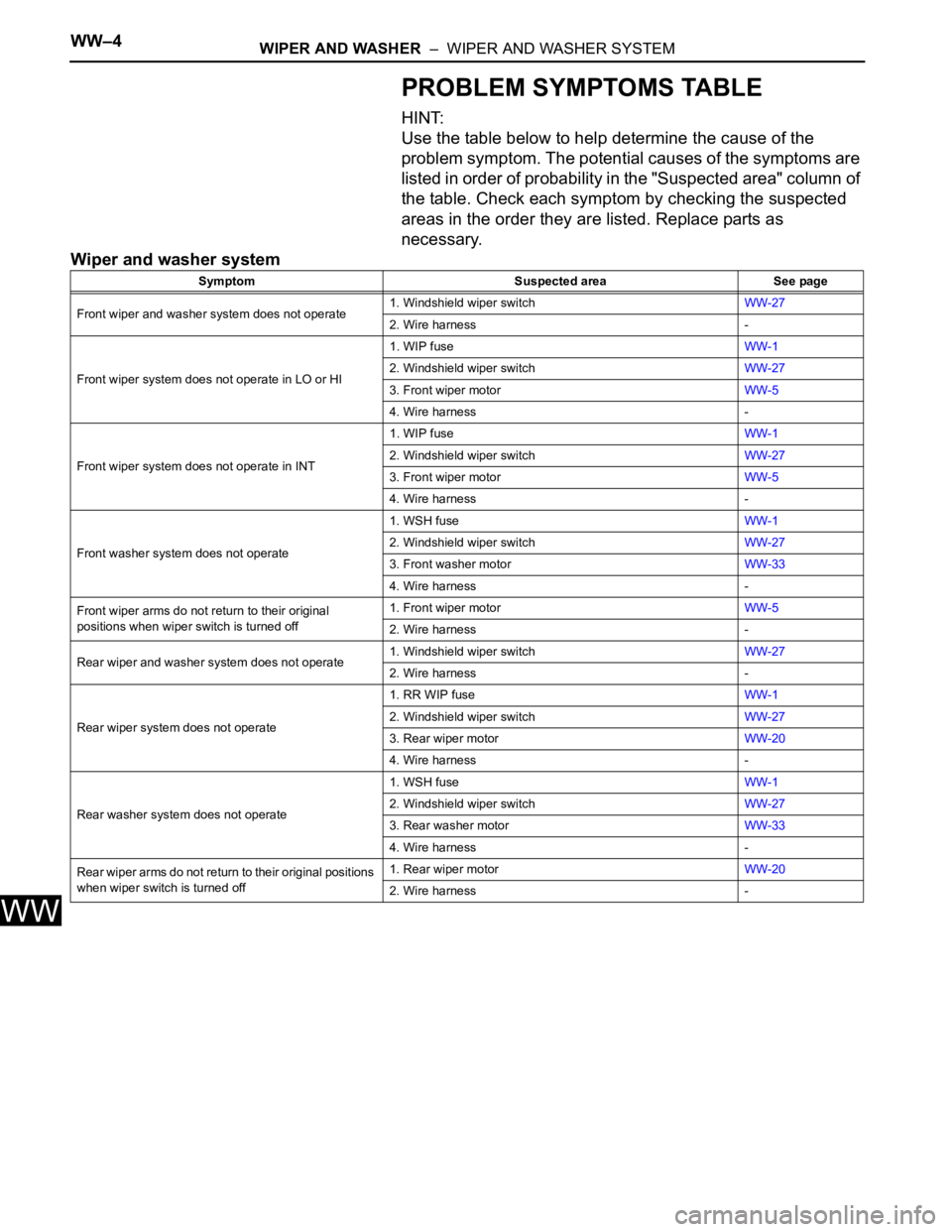
PROBLEM SYMPTOMS TABLE
HINT:
Use the table below to help determine the cause of the
problem symptom. The potential causes of the symptoms are
listed in order of probability in the "Suspected area" column of
the table. Check each symptom by checking the suspected
areas in the order they are listed. Replace parts as
necessary.
Wiper and washer system
Symptom Suspected area See page
Front wiper and washer system does not operate1. Windshield wiper switchWW-27
2. Wire harness -
Front wiper system does not operate in LO or HI1. WIP fuseWW-1
2. Windshield wiper switchWW-27
3. Front wiper motorWW-5
4. Wire harness -
Front wiper system does not operate in INT1. WIP fuseWW-1
2. Windshield wiper switchWW-27
3. Front wiper motorWW-5
4. Wire harness -
Front washer system does not operate1. WSH fuseWW-1
2. Windshield wiper switchWW-27
3. Front washer motorWW-33
4. Wire harness -
Front wiper arms do not return to their original
positions when wiper switch is turned off1. Front wiper motorWW-5
2. Wire harness -
Rear wiper and washer system does not operate1. Windshield wiper switchWW-27
2. Wire harness -
Rear wiper system does not operate1. RR WIP fuseWW-1
2. Windshield wiper switchWW-27
3. Rear wiper motorWW-20
4. Wire harness -
Rear washer system does not operate1. WSH fuseWW-1
2. Windshield wiper switchWW-27
3. Rear washer motorWW-33
4. Wire harness -
Rear wiper arms do not return to their original positions
when wiper switch is turned off1. Rear wiper motorWW-20
2. Wire harness -
Page 456 of 2000

DL–4DOOR LOCK – POWER DOOR LOCK CONTROL SYSTEM
DL
SYSTEM DESCRIPTION
1. POWER DOOR LOCK SYSTEM DESCRIPTION
(a) The power door lock system locks / unlocks all
doors with a one-touch operation.
• The door control switch of the power window
regulator master switch or door control switch on
passenger side sends lock / unlock request
signals to the main body ECU. Then, the main
body ECU sends these requests to the lock
motors in each door to lock / unlock all the doors
simultaneously.
• Operating the driver side door lock using a key
sends lock / unlock request signals to the main
body ECU.
2. COMPONENTS
3. FUNCTIONS
This system is controlled by the main body ECU. The
main body ECU outputs signals to each door lock motor.
The door lock control system in the vehicle has the
following functions:
Components Function
Door control switch on power window regulator master switch Locks / unlocks all doors
Door control switch Locks / unlocks all doors
Door courtesy switch • Placed on each door.
• Detects door status (open or closed) and outputs data to main
body ECU.
• Turns on when door is open and off when door is closed.
Driver door lock • Built-in motor locks / unlocks door.
• Built-in door control switch (key-linked) detects door key
operation's door status (locked or unlocked) and outputs data to
main body ECU.
• Built-in position switch detects door status (locked or unlocked)
and outputs data to main body ECU. This switch turns off when
door is locked and on when door is unlocked.
• Front passenger door lock
• Rear door lock LH
• Rear door lock RH
• Back door lockBuilt-in motor locks / unlocks door.
Functions Outlines
Key-linked lock and unlock function Linked with key cylinder. Locks / unlocks all doors when lock / unlock
operation is possible.
Key lock-in prevention function When key is inserted in ignition key cylinder and door lock operation is
performed, all doors are unlocked.
Manual unlock prohibition function Performing door lock operation with transmitter or key disables unlock
operation by door control switch.
2-step unlock function Unlocks only driver door by turning key cylinder once and unlocks
other doors by turning it twice.