oil temperature TOYOTA RAV4 2006 Service Owner's Guide
[x] Cancel search | Manufacturer: TOYOTA, Model Year: 2006, Model line: RAV4, Model: TOYOTA RAV4 2006Pages: 2000, PDF Size: 45.84 MB
Page 896 of 2000
IG–62GR-FE IGNITION – IGNITION SYSTEM
IG
(c) Perform troubleshooting using the spark test
flowchart.
(1) Check that the ignition coil connector is
securely connected.
Result
(2) Perform the spark test on each ignition coil.
1. Replace the ignition coil with a normal one.
2. Perform the spark test again.
Result
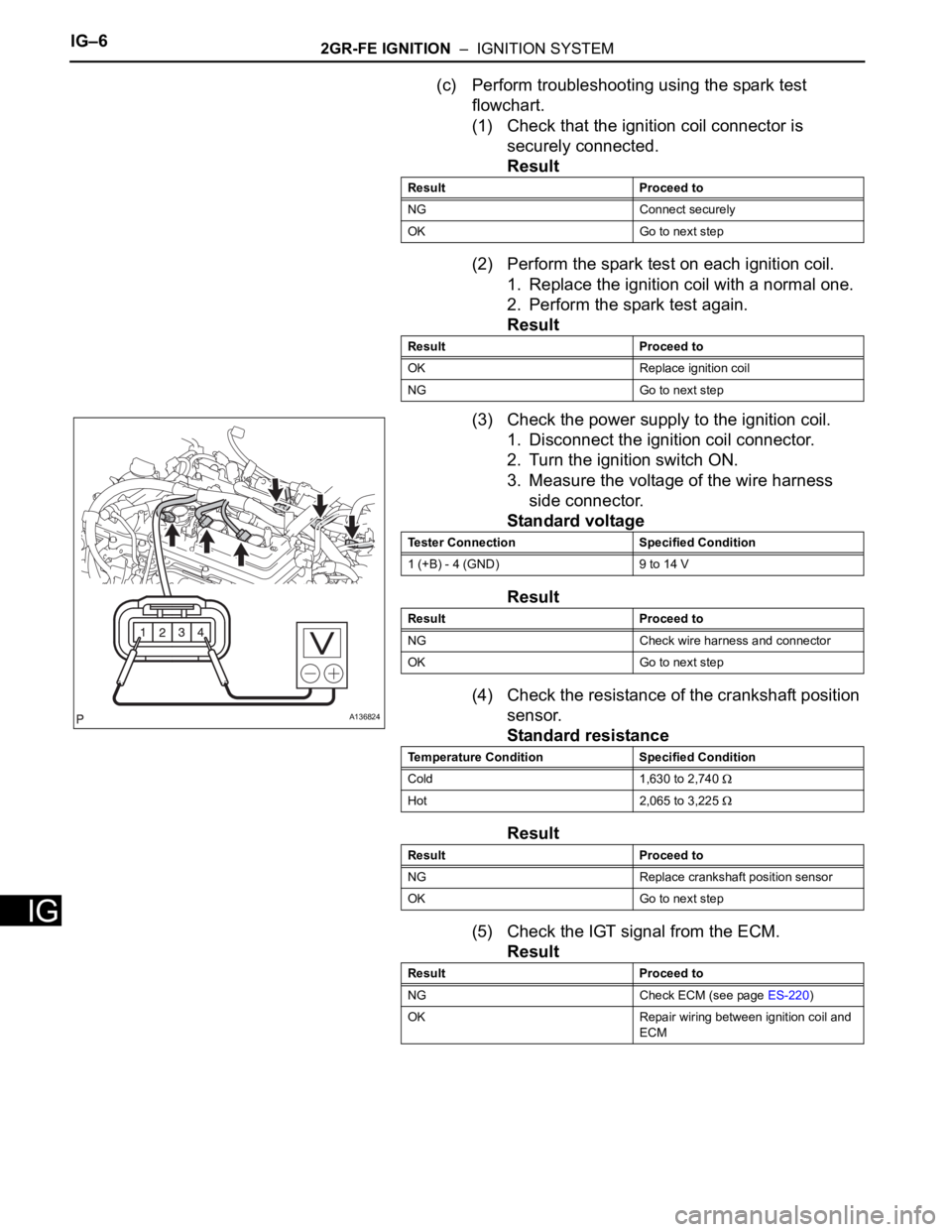
(3) Check the power supply to the ignition coil.
1. Disconnect the ignition coil connector.
2. Turn the ignition switch ON.
3. Measure the voltage of the wire harness
side connector.
Standard voltage
Result
(4) Check the resistance of the crankshaft position
sensor.
Standard resistance
Result
(5) Check the IGT signal from the ECM.
Result
Result Proceed to
NG Connect securely
OK Go to next step
Result Proceed to
OK Replace ignition coil
NG Go to next step
A136824
Tester Connection Specified Condition
1 (+B) - 4 (GND) 9 to 14 V
Result Proceed to
NG Check wire harness and connector
OK Go to next step
Temperature Condition Specified Condition
Cold 1,630 to 2,740
Hot 2,065 to 3,225
Result Proceed to
NG Replace crankshaft position sensor
OK Go to next step
Result Proceed to
NG Check ECM (see page ES-220)
OK Repair wiring between ignition coil and
ECM
Page 1006 of 2000
AX–212U140F AUTOMATIC TRANSAXLE – AUTOMATIC TRANSAXLE UNIT
AX
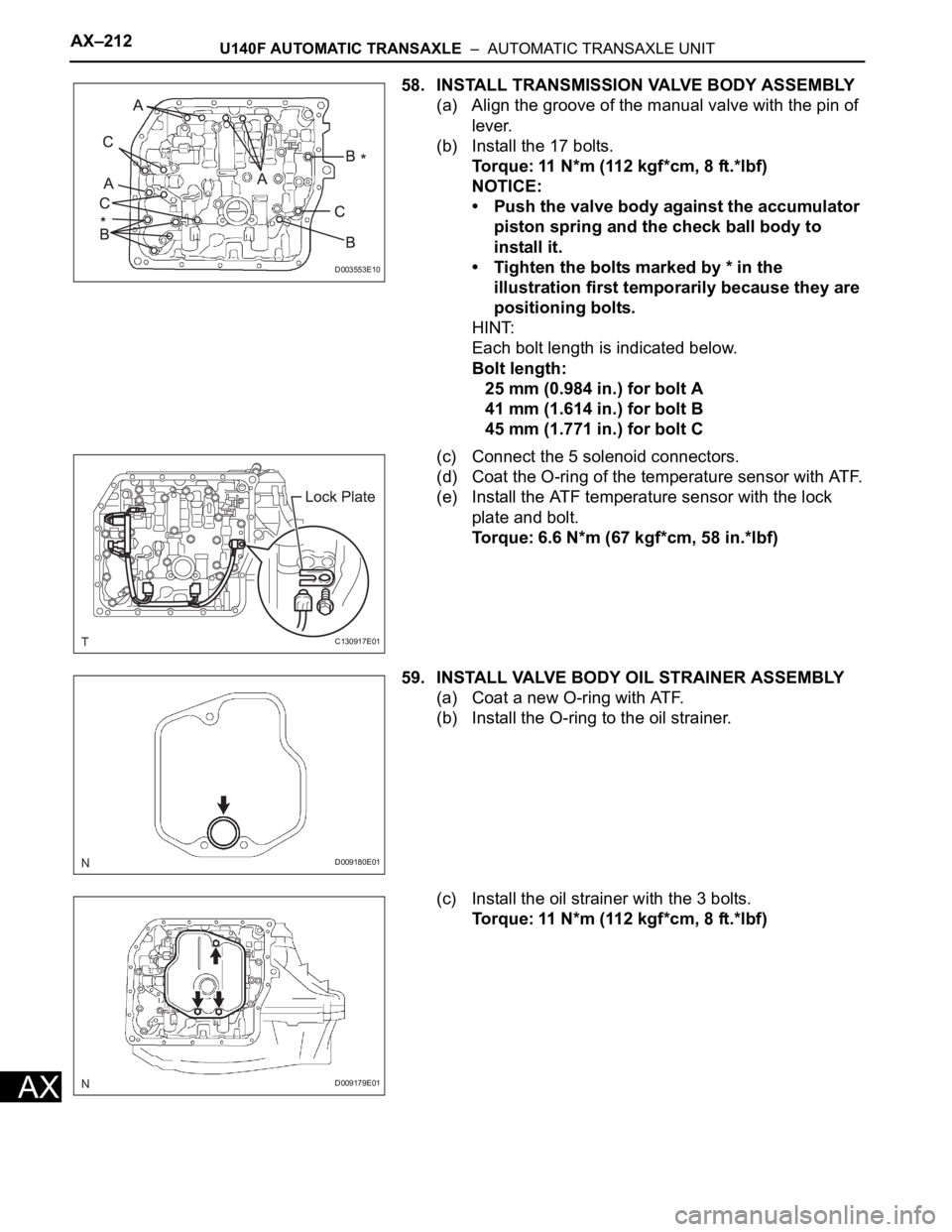
58. INSTALL TRANSMISSION VALVE BODY ASSEMBLY
(a) Align the groove of the manual valve with the pin of
lever.
(b) Install the 17 bolts.
Torque: 11 N*m (112 kgf*cm, 8 ft.*lbf)
NOTICE:
• Push the valve body against the accumulator
piston spring and the check ball body to
install it.
• Tighten the bolts marked by * in the
illustration first temporarily because they are
positioning bolts.
HINT:
Each bolt length is indicated below.
Bolt length:
25 mm (0.984 in.) for bolt A
41 mm (1.614 in.) for bolt B
45 mm (1.771 in.) for bolt C
(c) Connect the 5 solenoid connectors.
(d) Coat the O-ring of the temperature sensor with ATF.
(e) Install the ATF temperature sensor with the lock
plate and bolt.
Torque: 6.6 N*m (67 kgf*cm, 58 in.*lbf)
59. INSTALL VALVE BODY OIL STRAINER ASSEMBLY
(a) Coat a new O-ring with ATF.
(b) Install the O-ring to the oil strainer.
(c) Install the oil strainer with the 3 bolts.
Torque: 11 N*m (112 kgf*cm, 8 ft.*lbf)
D003553E10
C130917E01
D009180E01
D009179E01
Page 1065 of 2000
U151E AUTOMATIC TRANSAXLE – AUTOMATIC TRANSAXLE UNITAX–191
AX
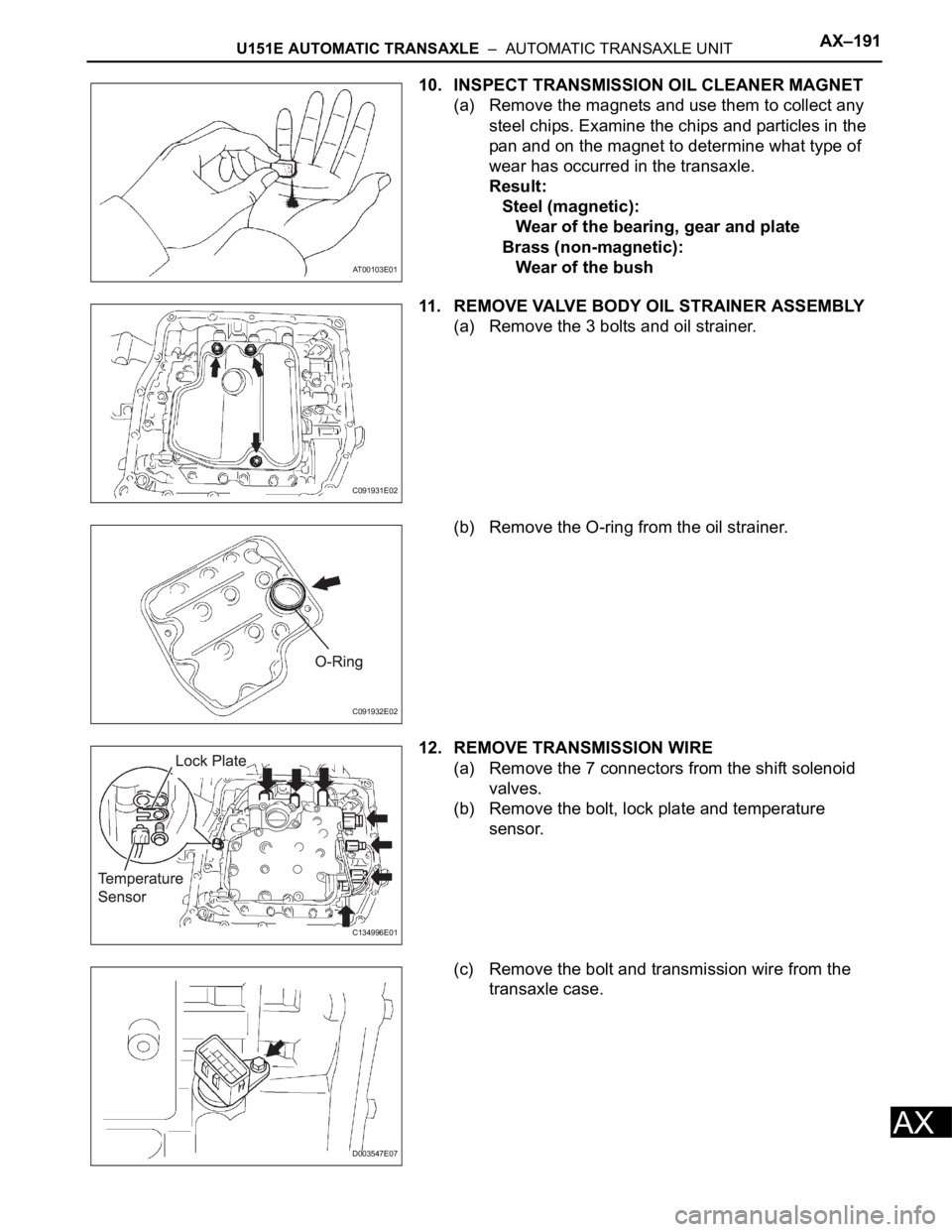
10. INSPECT TRANSMISSION OIL CLEANER MAGNET
(a) Remove the magnets and use them to collect any
steel chips. Examine the chips and particles in the
pan and on the magnet to determine what type of
wear has occurred in the transaxle.
Result:
Steel (magnetic):
Wear of the bearing, gear and plate
Brass (non-magnetic):
Wear of the bush
11. REMOVE VALVE BODY OIL STRAINER ASSEMBLY
(a) Remove the 3 bolts and oil strainer.
(b) Remove the O-ring from the oil strainer.
12. REMOVE TRANSMISSION WIRE
(a) Remove the 7 connectors from the shift solenoid
valves.
(b) Remove the bolt, lock plate and temperature
sensor.
(c) Remove the bolt and transmission wire from the
transaxle case.
AT00103E01
C091931E02
C091932E02
C134996E01
D003547E07
Page 1170 of 2000
AX–192U151F AUTOMATIC TRANSAXLE – AUTOMATIC TRANSAXLE UNIT
AX
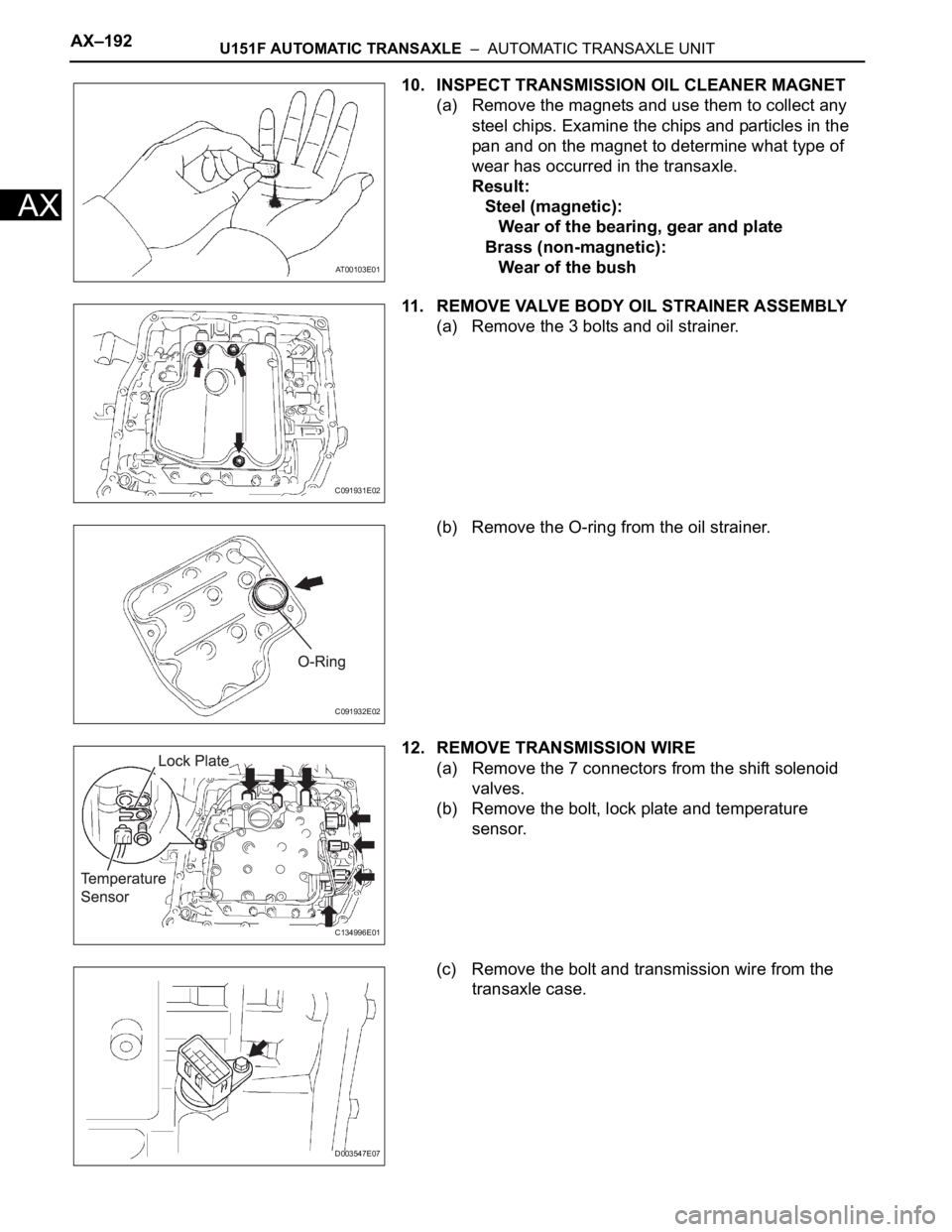
10. INSPECT TRANSMISSION OIL CLEANER MAGNET
(a) Remove the magnets and use them to collect any
steel chips. Examine the chips and particles in the
pan and on the magnet to determine what type of
wear has occurred in the transaxle.
Result:
Steel (magnetic):
Wear of the bearing, gear and plate
Brass (non-magnetic):
Wear of the bush
11. REMOVE VALVE BODY OIL STRAINER ASSEMBLY
(a) Remove the 3 bolts and oil strainer.
(b) Remove the O-ring from the oil strainer.
12. REMOVE TRANSMISSION WIRE
(a) Remove the 7 connectors from the shift solenoid
valves.
(b) Remove the bolt, lock plate and temperature
sensor.
(c) Remove the bolt and transmission wire from the
transaxle case.
AT00103E01
C091931E02
C091932E02
C134996E01
D003547E07
Page 1271 of 2000
U241E AUTOMATIC TRANSAXLE – AUTOMATIC TRANSAXLE UNITAX–167
AX
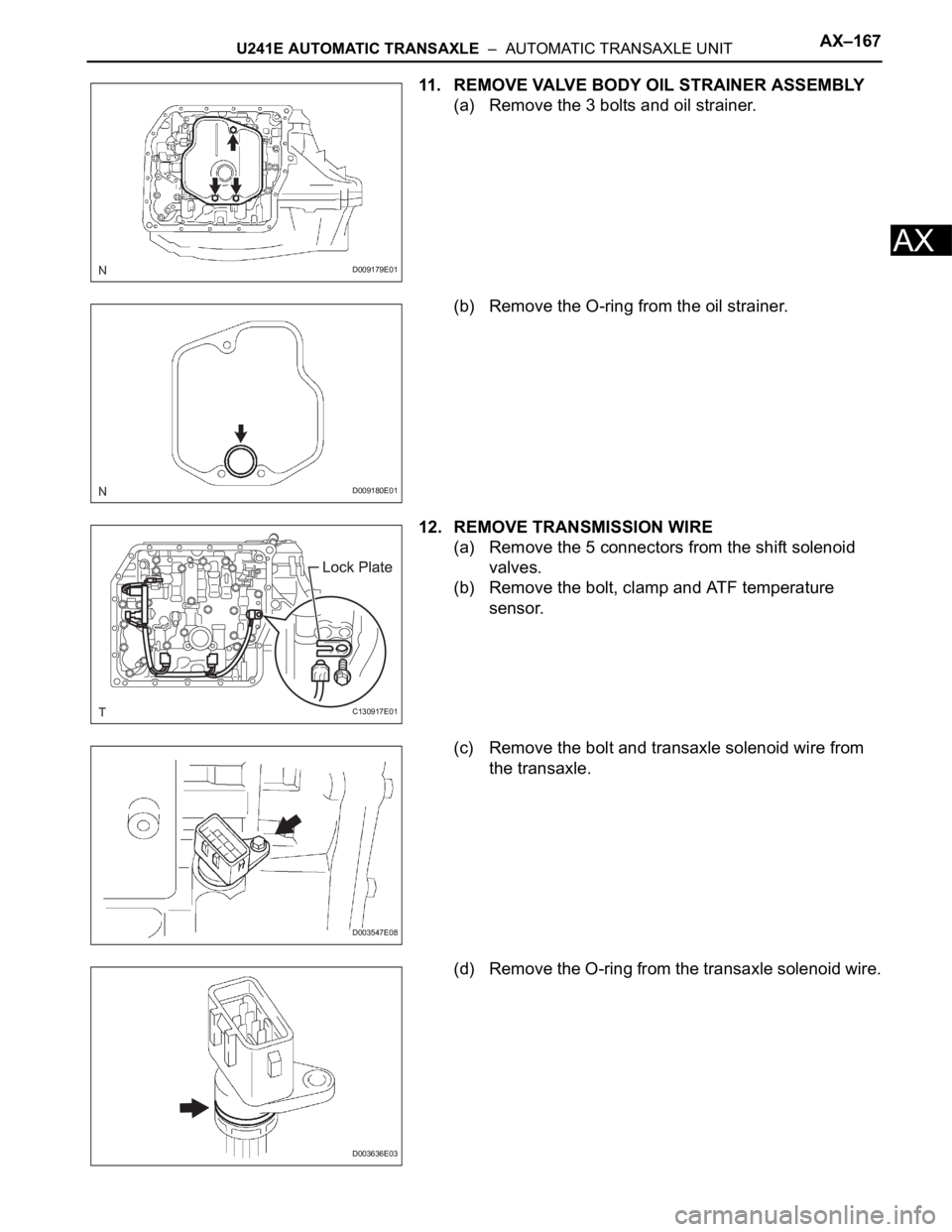
11. REMOVE VALVE BODY OIL STRAINER ASSEMBLY
(a) Remove the 3 bolts and oil strainer.
(b) Remove the O-ring from the oil strainer.
12. REMOVE TRANSMISSION WIRE
(a) Remove the 5 connectors from the shift solenoid
valves.
(b) Remove the bolt, clamp and ATF temperature
sensor.
(c) Remove the bolt and transaxle solenoid wire from
the transaxle.
(d) Remove the O-ring from the transaxle solenoid wire.
D009179E01
D009180E01
C130917E01
D003547E08
D003636E03
Page 1957 of 2000
2AZ-FE ENGINE CONTROL SYSTEM – SFI SYSTEMES–69
ES
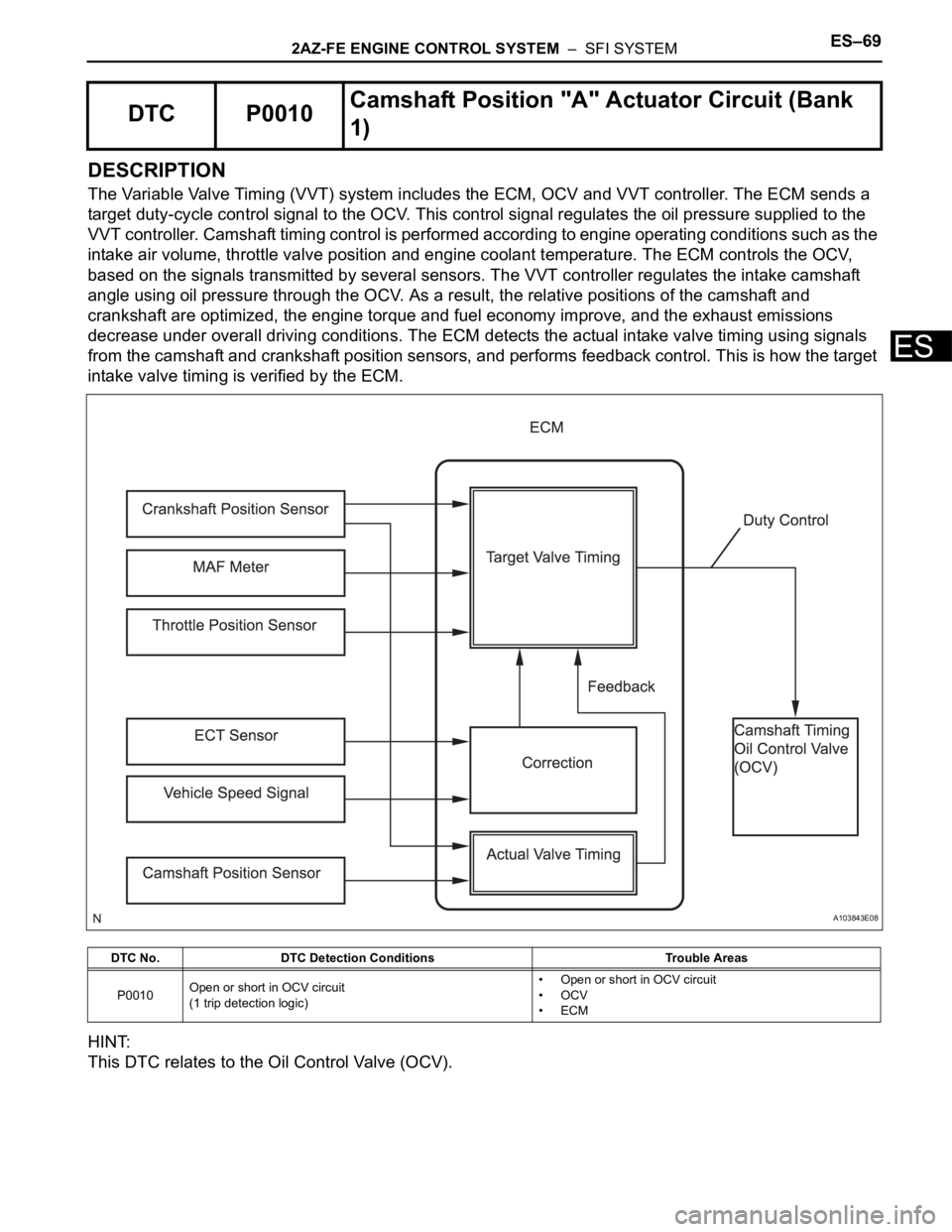
DESCRIPTION
The Variable Valve Timing (VVT) system includes the ECM, OCV and VVT controller. The ECM sends a
target duty-cycle control signal to the OCV. This control signal regulates the oil pressure supplied to the
VVT controller. Camshaft timing control is performed according to engine operating conditions such as the
intake air volume, throttle valve position and engine coolant temperature. The ECM controls the OCV,
based on the signals transmitted by several sensors. The VVT controller regulates the intake camshaft
angle using oil pressure through the OCV. As a result, the relative positions of the camshaft and
crankshaft are optimized, the engine torque and fuel economy improve, and the exhaust emissions
decrease under overall driving conditions. The ECM detects the actual intake valve timing using signals
from the camshaft and crankshaft position sensors, and performs feedback control. This is how the target
intake valve timing is verified by the ECM.
HINT:
This DTC relates to the Oil Control Valve (OCV).
DTC P0010Camshaft Position "A" Actuator Circuit (Bank
1)
DTC No. DTC Detection Conditions Trouble Areas
P0010Open or short in OCV circuit
(1 trip detection logic)• Open or short in OCV circuit
•OCV
•ECM
A103843E08
Page 1961 of 2000
2AZ-FE ENGINE CONTROL SYSTEM – SFI SYSTEMES–73
ES
DESCRIPTION
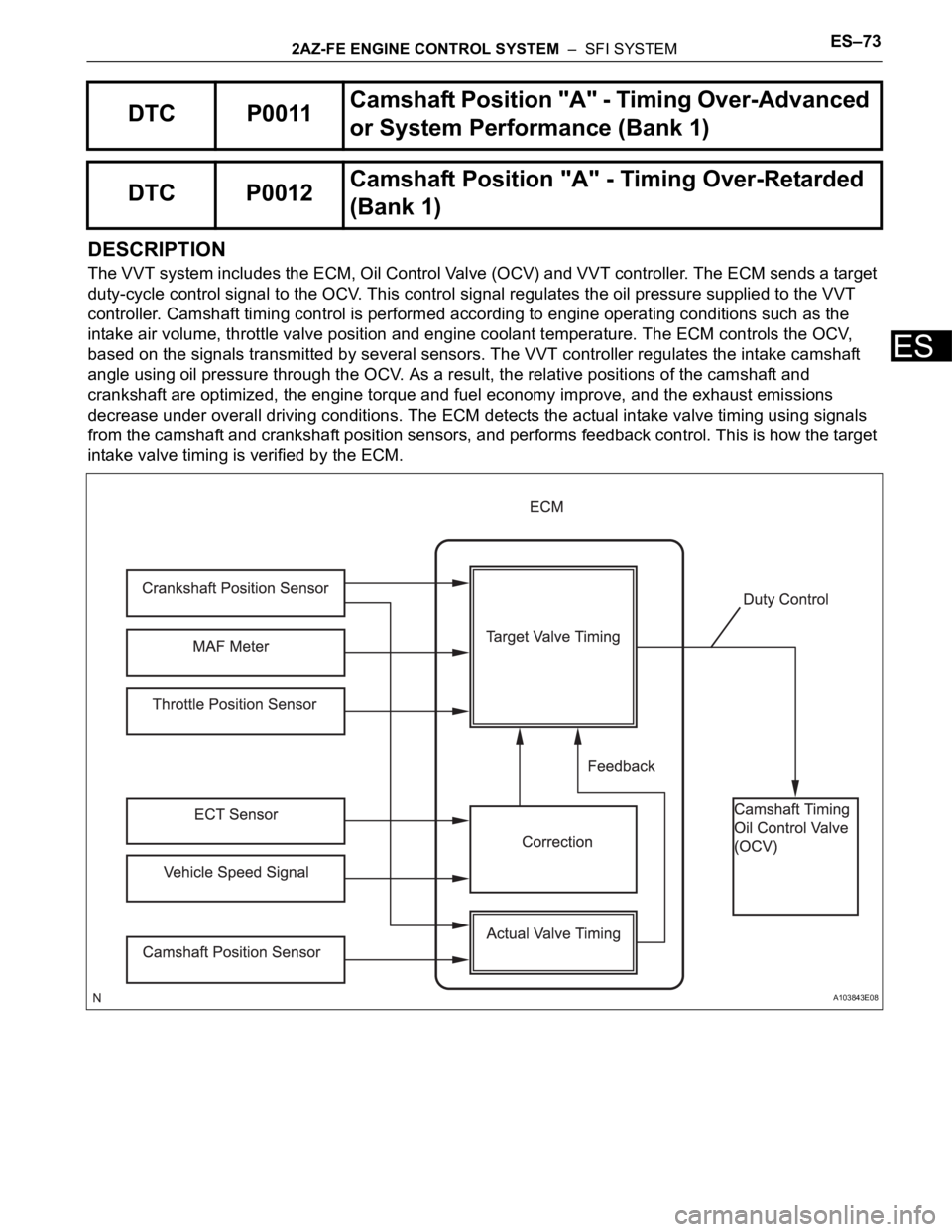
The VVT system includes the ECM, Oil Control Valve (OCV) and VVT controller. The ECM sends a target
duty-cycle control signal to the OCV. This control signal regulates the oil pressure supplied to the VVT
controller. Camshaft timing control is performed according to engine operating conditions such as the
intake air volume, throttle valve position and engine coolant temperature. The ECM controls the OCV,
based on the signals transmitted by several sensors. The VVT controller regulates the intake camshaft
angle using oil pressure through the OCV. As a result, the relative positions of the camshaft and
crankshaft are optimized, the engine torque and fuel economy improve, and the exhaust emissions
decrease under overall driving conditions. The ECM detects the actual intake valve timing using signals
from the camshaft and crankshaft position sensors, and performs feedback control. This is how the target
intake valve timing is verified by the ECM.
DTC P0011Camshaft Position "A" - Timing Over-Advanced
or System Performance (Bank 1)
DTC P0012Camshaft Position "A" - Timing Over-Retarded
(Bank 1)
A103843E08
Page 1962 of 2000

ES–742AZ-FE ENGINE CONTROL SYSTEM – SFI SYSTEM
ES
MONITOR DESCRIPTION
The ECM optimizes the intake valve timing using the VVT (Variable Valve Timing) system to control the
intake camshaft. The VVT system includes the ECM, the Oil Control Valve (OCV) and the VVT controller.
The ECM sends a target duty-cycle control signal to the OCV. This control signal regulates the oil
pressure supplied to the VVT controller. The VVT controller can advance or retard the intake camshaft.
If the difference between the target and actual intake valve timings is large, and changes in the actual
intake valve timing are small, the ECM interprets this as the VVT controller stuck malfunction and sets a
DTC.
Example:
A DTC is set when the following conditions 1, 2 and 3 are met:
1. The difference between the target and actual intake valve timing is more than 5
CA (Crankshaft
Angle) and the condition continues for more than 4.5 seconds.
2. It takes 5 seconds or more to change the valve timing by 5
CA.
3. After above conditions 1 and 2 are met, the OCV is forcibly activated 63 times or more.
DTC P0011 (Advanced Cam Timing) is subject to 1 trip detection logic.
DTC P0012 (Retarded Cam Timing) is subject to 2 trip detection logic.
These DTCs indicate that the VVT controller cannot operate properly due to OCV malfunctions or the
presence of foreign objects in the OCV.
The monitor will run if all of the following conditions are met:
– The engine is warm (the engine coolant temperature is 75
C [167F] or more).
– The vehicle has been driven at more than 64 km/h (40 mph) for 3 minutes.
– The engine has idled for 3 minutes.
MONITOR STRATEGY
DTC No. DTC Detection Conditions Trouble Areas
P0011Advanced camshaft timing:
With warm engine and engine speed of between 550 rpm and
4,000 rpm, all conditions (1), (2) and (3) met (1 trip detection
logic):
1. Difference between target and actual intake valve timings
more than 5
CA (Crankshaft Angle) for 4.5 seconds
2. Current intake valve timing fixed (timing changes less than
5
CA in 5 seconds)
3. Variations in VVT controller timing more than 19
CA of
maximum delayed timing (malfunction in advance timing)• Valve timing
•OCV
• OCV filter
• Camshaft timing gear assembly
•ECM
P0012Retarded camshaft timing:
With warm engine and engine speed of between 550 rpm and
4,000 rpm, all conditions (1), (2) and (3) met (2 trip detection
logic):
1. Difference between target and actual intake valve timings
more than 5
CA (Crankshaft Angle) for 4.5 seconds
2. Current intake valve timing fixed (timing changes less than
5
CA in 5 seconds)
3. Variations in VVT controller timing 19CA or less of
maximum delayed timing (malfunction in retarded timing)• Valve timing
•OCV
• OCV filter
• Camshaft timing gear assembly
•ECM
Related DTCsP0011: Advanced camshaft timing
P0012: Retarded camshaft timing
Required Sensors/Components (Main) VVT OCV and VVT Actuator
Required Sensors/Components (Related)Crankshaft position sensor, camshaft position sensor and Engine
coolant temperature sensor
Frequency of Operation Once per driving cycle
Duration Within 10 seconds
MIL OperationAdvanced camshaft timing: Immediate
Retarded camshaft timing: 2 driving cycles
Sequence of Operation None