coil TOYOTA RAV4 2006 Service Service Manual
[x] Cancel search | Manufacturer: TOYOTA, Model Year: 2006, Model line: RAV4, Model: TOYOTA RAV4 2006Pages: 2000, PDF Size: 45.84 MB
Page 886 of 2000
IG–62AZ-FE IGNITION – IGNITION SYSTEM
IG
(9) Install the ignition coil with the bolt.
Torque: 9.0 N*m (92 kgf*cm, 80 in.*lbf)
(10) Connect the 4 fuel injector connectors.
(11) Install the No. 1 engine cover.
(c) Spark test flow chart.
(1) Check that the ignition coil connector is
securely connected.
Result
(2) Perform the spark test on each ignition coil.
1. Replace the ignition coil with a normal one.
2. Perform the spark test again.
Result
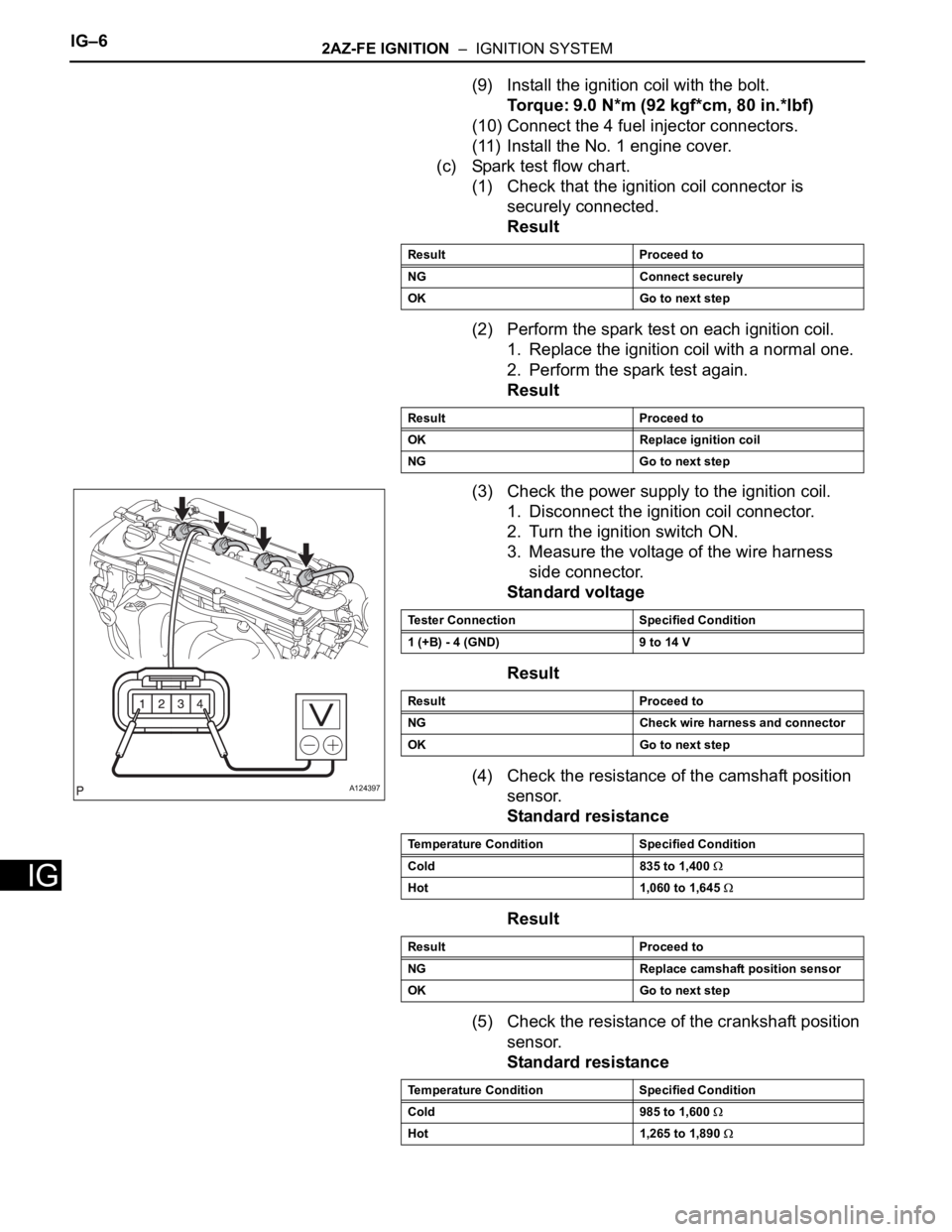
(3) Check the power supply to the ignition coil.
1. Disconnect the ignition coil connector.
2. Turn the ignition switch ON.
3. Measure the voltage of the wire harness
side connector.
Standard voltage
Result
(4) Check the resistance of the camshaft position
sensor.
Standard resistance
Result
(5) Check the resistance of the crankshaft position
sensor.
Standard resistance
Result Proceed to
NG Connect securely
OK Go to next step
Result Proceed to
OK Replace ignition coil
NG Go to next step
A124397
Tester Connection Specified Condition
1 (+B) - 4 (GND) 9 to 14 V
Result Proceed to
NG Check wire harness and connector
OK Go to next step
Temperature Condition Specified Condition
Cold 835 to 1,400
Hot 1,060 to 1,645
Result Proceed to
NG Replace camshaft position sensor
OK Go to next step
Temperature Condition Specified Condition
Cold 985 to 1,600
Hot 1,265 to 1,890
Page 887 of 2000
2AZ-FE IGNITION – IGNITION SYSTEMIG–7
IG
Result
(6) Check the IGT signal from the ECM.
Result
2. CHECK SPARK PLUG
(a) Check the electrode.
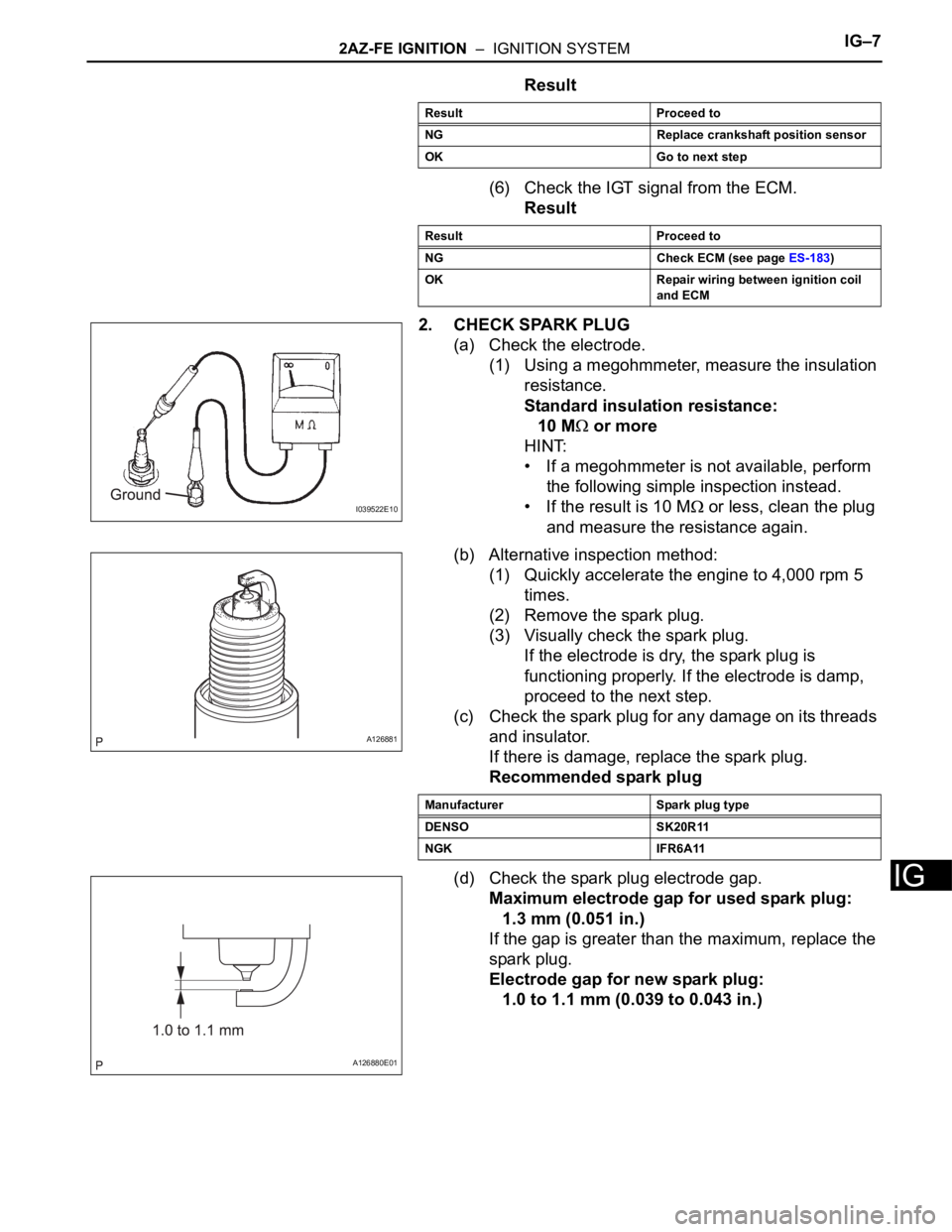
(1) Using a megohmmeter, measure the insulation
resistance.
Standard insulation resistance:
10 M
or more
HINT:
• If a megohmmeter is not available, perform
the following simple inspection instead.
• If the result is 10 M
or less, clean the plug
and measure the resistance again.
(b) Alternative inspection method:
(1) Quickly accelerate the engine to 4,000 rpm 5
times.
(2) Remove the spark plug.
(3) Visually check the spark plug.
If the electrode is dry, the spark plug is
functioning properly. If the electrode is damp,
proceed to the next step.
(c) Check the spark plug for any damage on its threads
and insulator.
If there is damage, replace the spark plug.
Recommended spark plug
(d) Check the spark plug electrode gap.
Maximum electrode gap for used spark plug:
1.3 mm (0.051 in.)
If the gap is greater than the maximum, replace the
spark plug.
Electrode gap for new spark plug:
1.0 to 1.1 mm (0.039 to 0.043 in.)
Result Proceed to
NG Replace crankshaft position sensor
OK Go to next step
Result Proceed to
NG Check ECM (see page ES-183)
OK Repair wiring between ignition coil
and ECM
I039522E10
A126881
Manufacturer Spark plug type
DENSO SK20R11
NGK IFR6A11
A126880E01
Page 895 of 2000
2GR-FE IGNITION – IGNITION SYSTEMIG–5
IG
ON-VEHICLE INSPECTION
1. CHECK IGNITION COIL ASSEMBLY AND PERFORM
SPARK TEST
NOTICE:
In this section, the terms "Cold" and "Hot" refer to
the temperature of the sensor. "Cold" means
approximately -10 to 50
C (14 to 122F). "Hot" means
approximately 50 to 100
C (122 to 212F).
(a) Check the DTCs.
NOTICE:
If a DTC is present, perform troubleshooting in
accordance with the procedure for that DTC.
(b) Check that sparks occur.
(1) Remove the V-bank cover.
(2) Remove the intake air surge tank (see page
EM-27).
(3) Remove the bolt and ignition coil.
(4) Using a 16 mm spark plug wrench, remove the
spark plug.
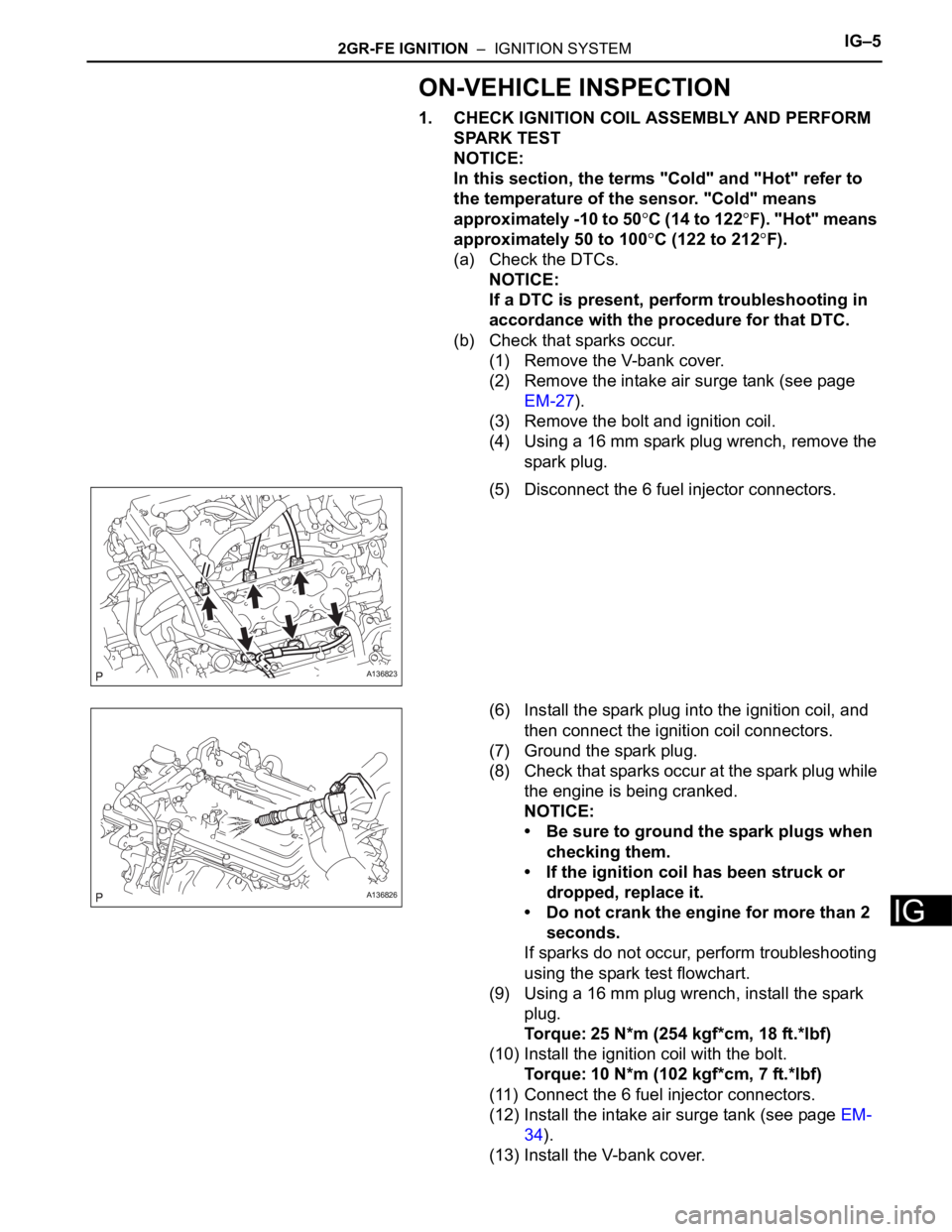
(5) Disconnect the 6 fuel injector connectors.
(6) Install the spark plug into the ignition coil, and
then connect the ignition coil connectors.
(7) Ground the spark plug.
(8) Check that sparks occur at the spark plug while
the engine is being cranked.
NOTICE:
• Be sure to ground the spark plugs when
checking them.
• If the ignition coil has been struck or
dropped, replace it.
• Do not crank the engine for more than 2
seconds.
If sparks do not occur, perform troubleshooting
using the spark test flowchart.
(9) Using a 16 mm plug wrench, install the spark
plug.
Torque: 25 N*m (254 kgf*cm, 18 ft.*lbf)
(10) Install the ignition coil with the bolt.
Torque: 10 N*m (102 kgf*cm, 7 ft.*lbf)
(11) Connect the 6 fuel injector connectors.
(12) Install the intake air surge tank (see page EM-
34).
(13) Install the V-bank cover.
A136823
A136826
Page 896 of 2000
IG–62GR-FE IGNITION – IGNITION SYSTEM
IG
(c) Perform troubleshooting using the spark test
flowchart.
(1) Check that the ignition coil connector is
securely connected.
Result
(2) Perform the spark test on each ignition coil.
1. Replace the ignition coil with a normal one.
2. Perform the spark test again.
Result
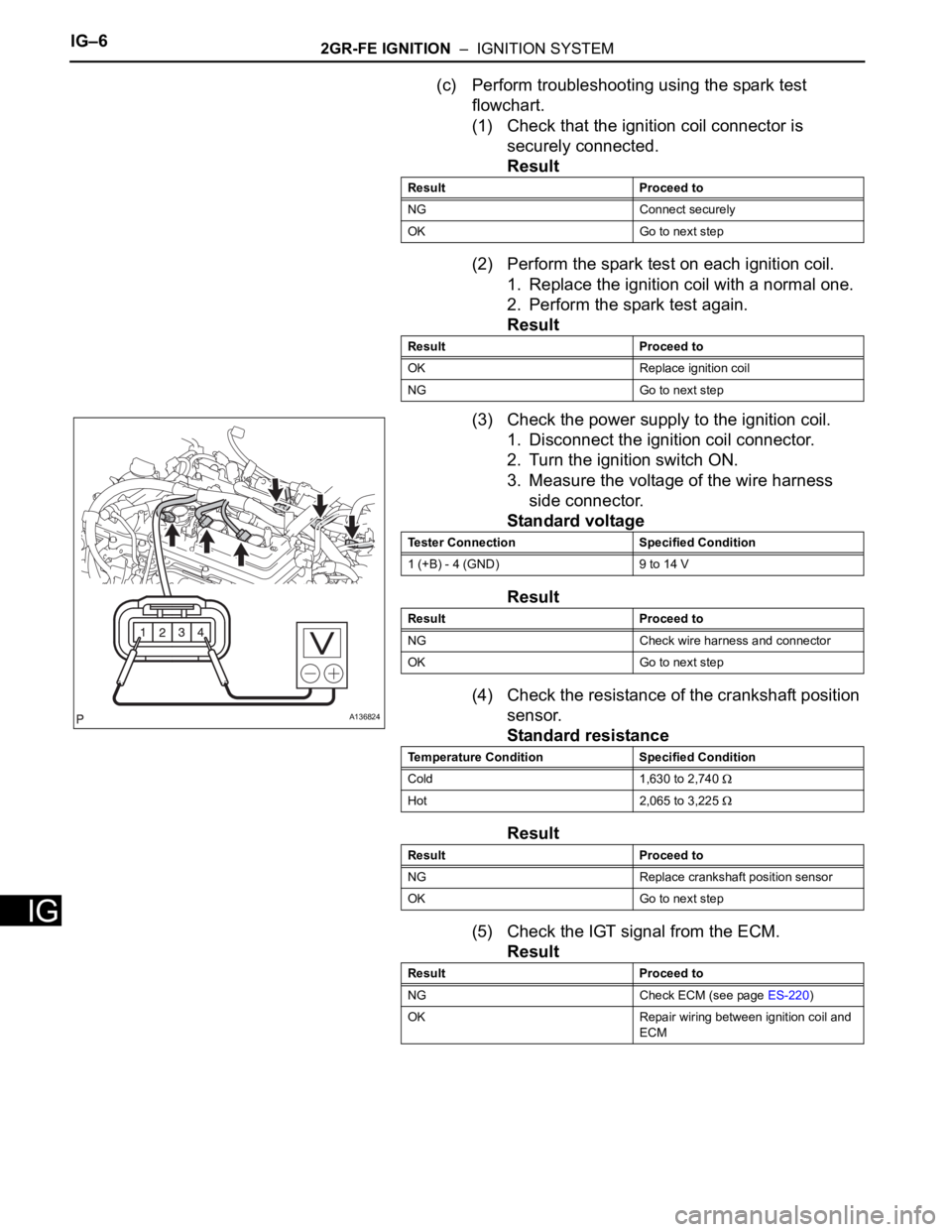
(3) Check the power supply to the ignition coil.
1. Disconnect the ignition coil connector.
2. Turn the ignition switch ON.
3. Measure the voltage of the wire harness
side connector.
Standard voltage
Result
(4) Check the resistance of the crankshaft position
sensor.
Standard resistance
Result
(5) Check the IGT signal from the ECM.
Result
Result Proceed to
NG Connect securely
OK Go to next step
Result Proceed to
OK Replace ignition coil
NG Go to next step
A136824
Tester Connection Specified Condition
1 (+B) - 4 (GND) 9 to 14 V
Result Proceed to
NG Check wire harness and connector
OK Go to next step
Temperature Condition Specified Condition
Cold 1,630 to 2,740
Hot 2,065 to 3,225
Result Proceed to
NG Replace crankshaft position sensor
OK Go to next step
Result Proceed to
NG Check ECM (see page ES-220)
OK Repair wiring between ignition coil and
ECM
Page 901 of 2000
2AZ-FE STARTING – STARTERST–9
ST
INSPECTION
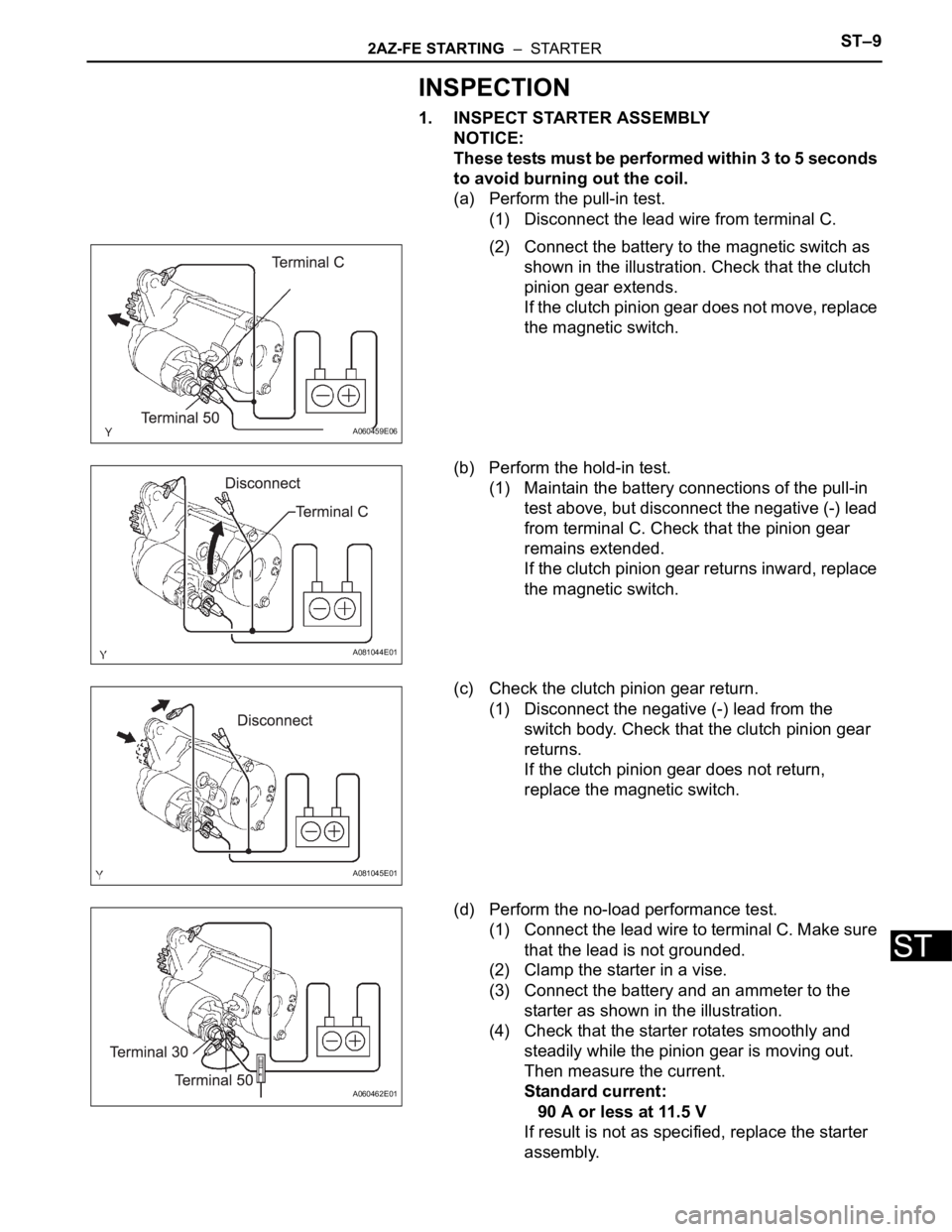
1. INSPECT STARTER ASSEMBLY
NOTICE:
These tests must be performed within 3 to 5 seconds
to avoid burning out the coil.
(a) Perform the pull-in test.
(1) Disconnect the lead wire from terminal C.
(2) Connect the battery to the magnetic switch as
shown in the illustration. Check that the clutch
pinion gear extends.
If the clutch pinion gear does not move, replace
the magnetic switch.
(b) Perform the hold-in test.
(1) Maintain the battery connections of the pull-in
test above, but disconnect the negative (-) lead
from terminal C. Check that the pinion gear
remains extended.
If the clutch pinion gear returns inward, replace
the magnetic switch.
(c) Check the clutch pinion gear return.
(1) Disconnect the negative (-) lead from the
switch body. Check that the clutch pinion gear
returns.
If the clutch pinion gear does not return,
replace the magnetic switch.
(d) Perform the no-load performance test.
(1) Connect the lead wire to terminal C. Make sure
that the lead is not grounded.
(2) Clamp the starter in a vise.
(3) Connect the battery and an ammeter to the
starter as shown in the illustration.
(4) Check that the starter rotates smoothly and
steadily while the pinion gear is moving out.
Then measure the current.
Standard current:
90 A or less at 11.5 V
If result is not as specified, replace the starter
assembly.
A060459E06
A081044E01
A081045E01
A060462E01
Page 902 of 2000
ST–102AZ-FE STARTING – STARTER
ST
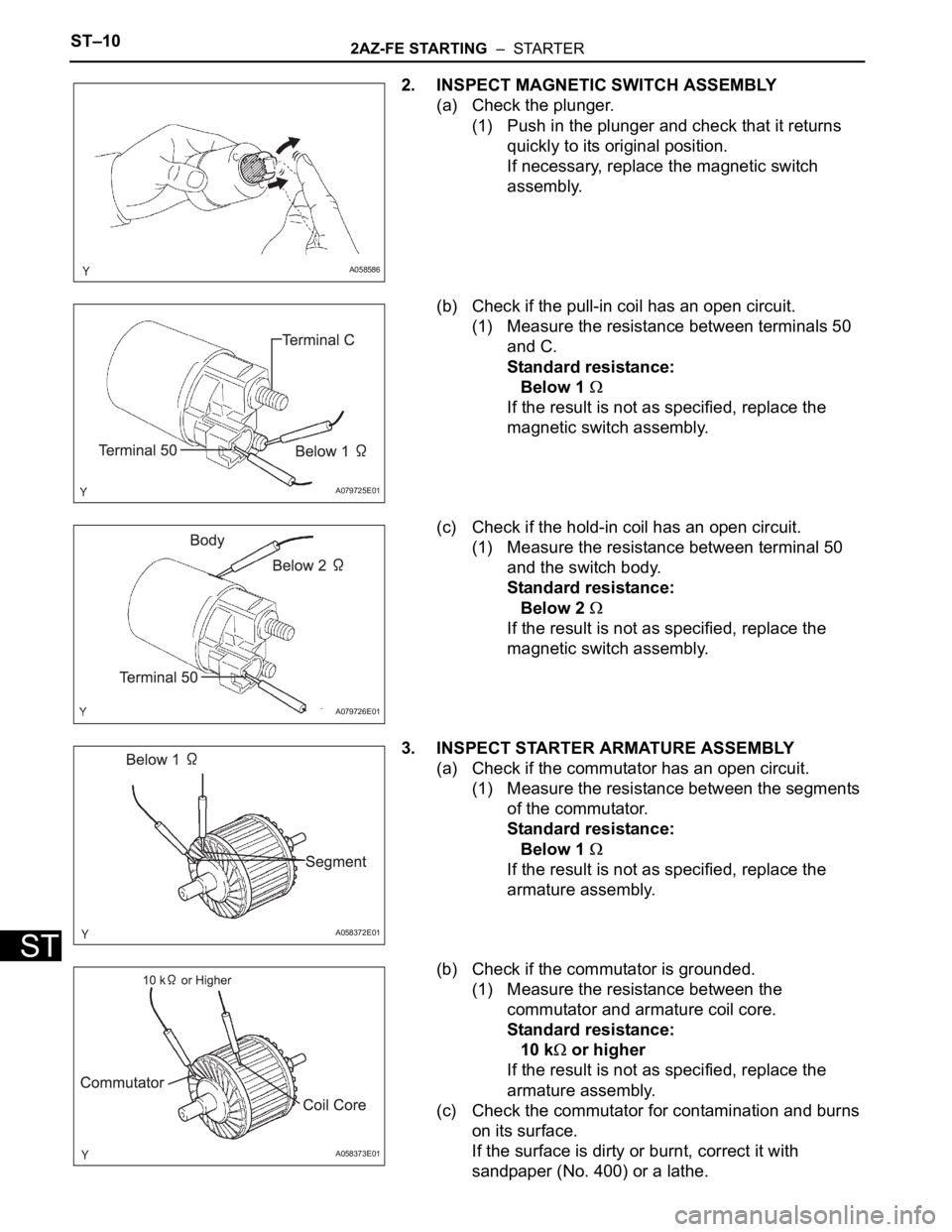
2. INSPECT MAGNETIC SWITCH ASSEMBLY
(a) Check the plunger.
(1) Push in the plunger and check that it returns
quickly to its original position.
If necessary, replace the magnetic switch
assembly.
(b) Check if the pull-in coil has an open circuit.
(1) Measure the resistance between terminals 50
and C.
Standard resistance:
Below 1
If the result is not as specified, replace the
magnetic switch assembly.
(c) Check if the hold-in coil has an open circuit.
(1) Measure the resistance between terminal 50
and the switch body.
Standard resistance:
Below 2
If the result is not as specified, replace the
magnetic switch assembly.
3. INSPECT STARTER ARMATURE ASSEMBLY
(a) Check if the commutator has an open circuit.
(1) Measure the resistance between the segments
of the commutator.
Standard resistance:
Below 1
If the result is not as specified, replace the
armature assembly.
(b) Check if the commutator is grounded.
(1) Measure the resistance between the
commutator and armature coil core.
Standard resistance:
10 k
or higher
If the result is not as specified, replace the
armature assembly.
(c) Check the commutator for contamination and burns
on its surface.
If the surface is dirty or burnt, correct it with
sandpaper (No. 400) or a lathe.
A058586
A079725E01
A079726E01
A058372E01
A058373E01
Page 912 of 2000
2GR-FE STARTING – STARTERST–9
ST
INSPECTION
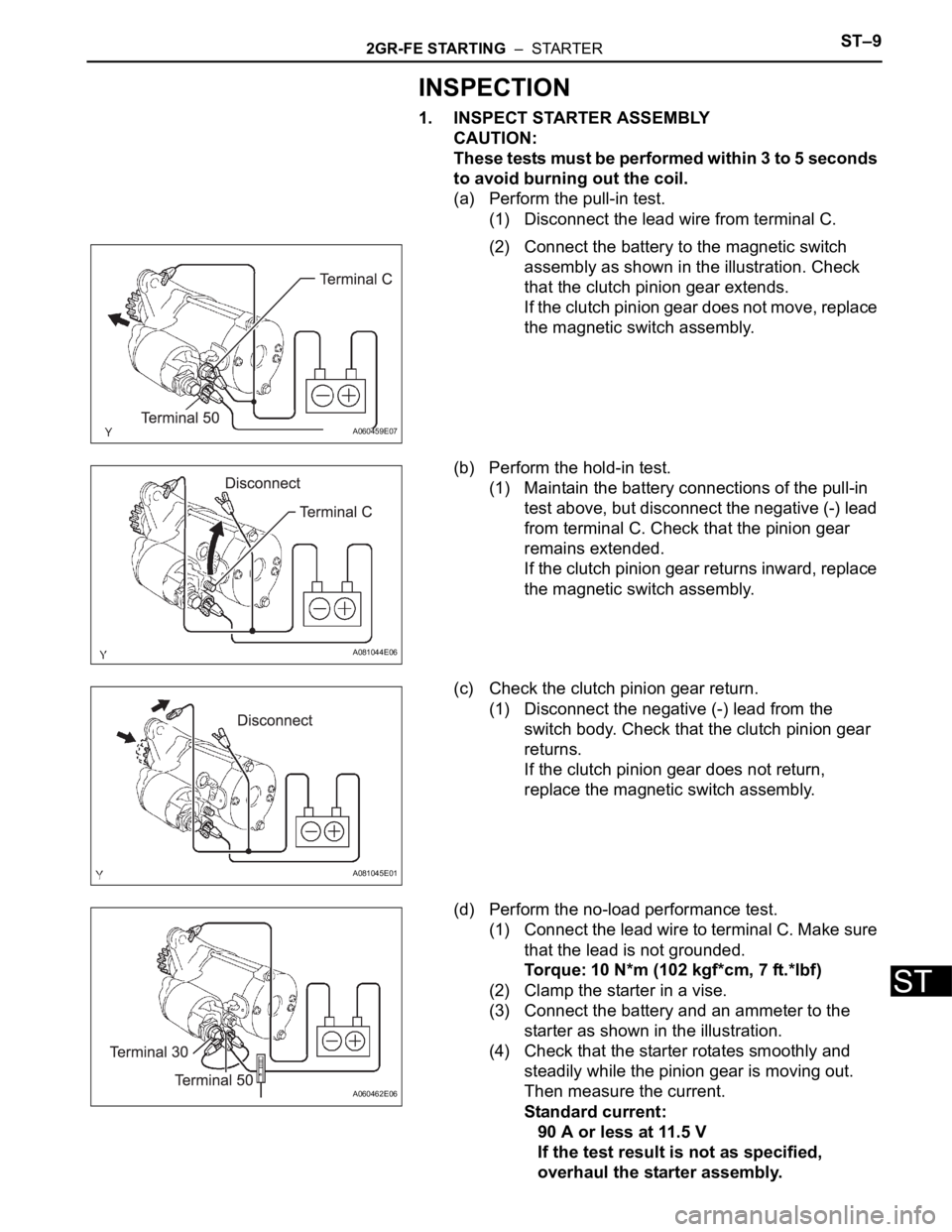
1. INSPECT STARTER ASSEMBLY
CAUTION:
These tests must be performed within 3 to 5 seconds
to avoid burning out the coil.
(a) Perform the pull-in test.
(1) Disconnect the lead wire from terminal C.
(2) Connect the battery to the magnetic switch
assembly as shown in the illustration. Check
that the clutch pinion gear extends.
If the clutch pinion gear does not move, replace
the magnetic switch assembly.
(b) Perform the hold-in test.
(1) Maintain the battery connections of the pull-in
test above, but disconnect the negative (-) lead
from terminal C. Check that the pinion gear
remains extended.
If the clutch pinion gear returns inward, replace
the magnetic switch assembly.
(c) Check the clutch pinion gear return.
(1) Disconnect the negative (-) lead from the
switch body. Check that the clutch pinion gear
returns.
If the clutch pinion gear does not return,
replace the magnetic switch assembly.
(d) Perform the no-load performance test.
(1) Connect the lead wire to terminal C. Make sure
that the lead is not grounded.
Torque: 10 N*m (102 kgf*cm, 7 ft.*lbf)
(2) Clamp the starter in a vise.
(3) Connect the battery and an ammeter to the
starter as shown in the illustration.
(4) Check that the starter rotates smoothly and
steadily while the pinion gear is moving out.
Then measure the current.
Standard current:
90 A or less at 11.5 V
If the test result is not as specified,
overhaul the starter assembly.
A060459E07
A081044E06
A081045E01
A060462E06
Page 913 of 2000
ST–102GR-FE STARTING – STARTER
ST
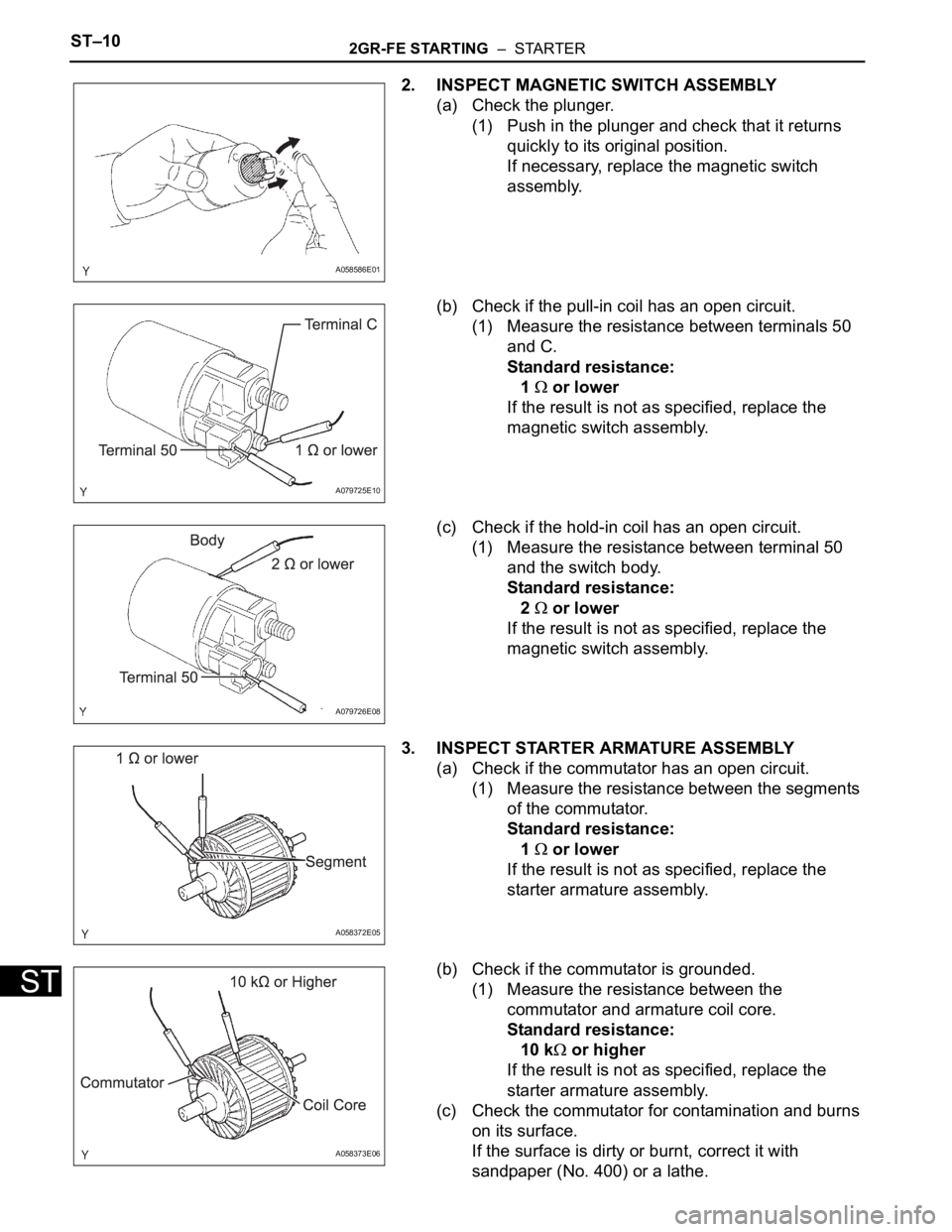
2. INSPECT MAGNETIC SWITCH ASSEMBLY
(a) Check the plunger.
(1) Push in the plunger and check that it returns
quickly to its original position.
If necessary, replace the magnetic switch
assembly.
(b) Check if the pull-in coil has an open circuit.
(1) Measure the resistance between terminals 50
and C.
Standard resistance:
1
or lower
If the result is not as specified, replace the
magnetic switch assembly.
(c) Check if the hold-in coil has an open circuit.
(1) Measure the resistance between terminal 50
and the switch body.
Standard resistance:
2
or lower
If the result is not as specified, replace the
magnetic switch assembly.
3. INSPECT STARTER ARMATURE ASSEMBLY
(a) Check if the commutator has an open circuit.
(1) Measure the resistance between the segments
of the commutator.
Standard resistance:
1
or lower
If the result is not as specified, replace the
starter armature assembly.
(b) Check if the commutator is grounded.
(1) Measure the resistance between the
commutator and armature coil core.
Standard resistance:
10 k
or higher
If the result is not as specified, replace the
starter armature assembly.
(c) Check the commutator for contamination and burns
on its surface.
If the surface is dirty or burnt, correct it with
sandpaper (No. 400) or a lathe.
A058586E01
A079725E10
A079726E08
A058372E05
A058373E06
Page 922 of 2000
2AZ-FE CHARGING – GENERATORCH–11
CH
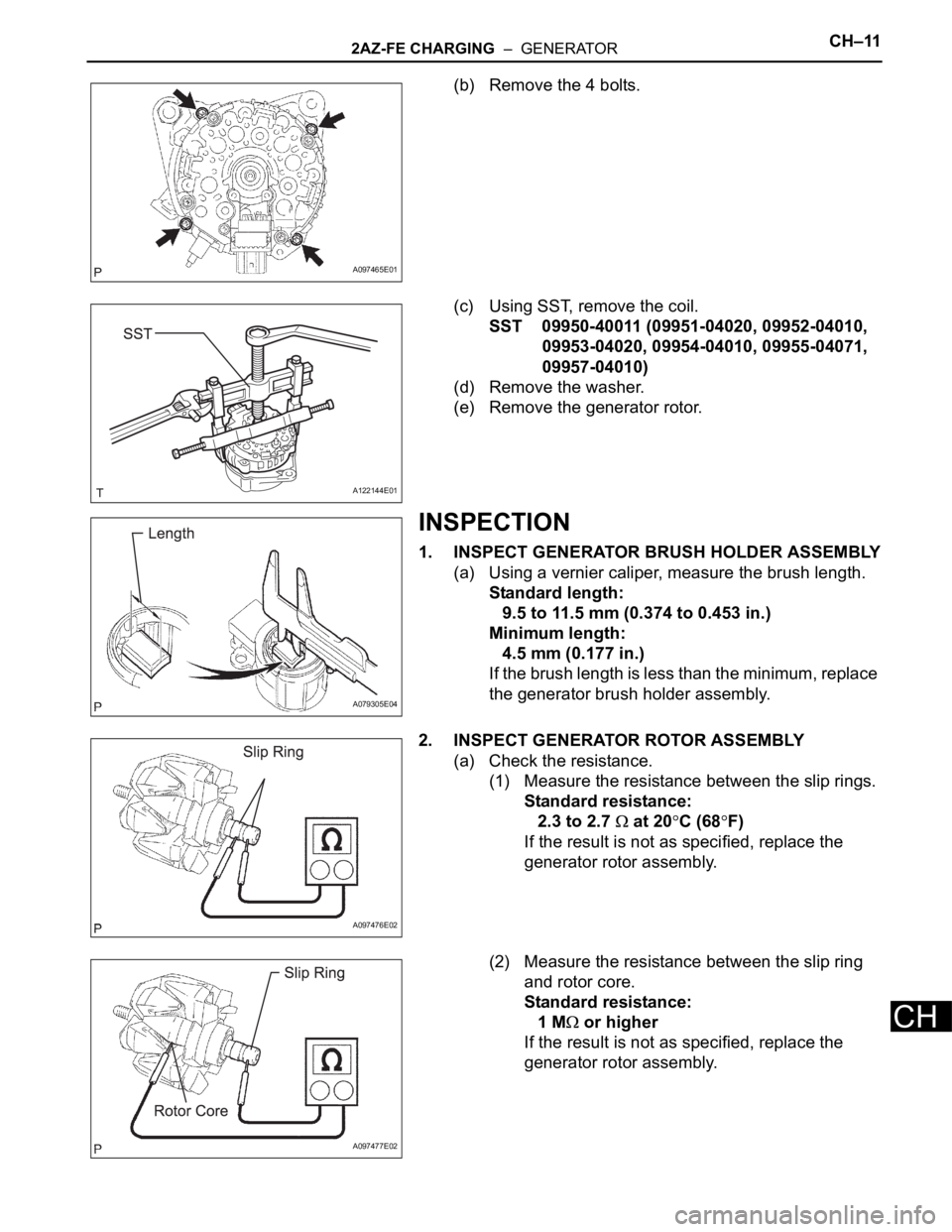
(b) Remove the 4 bolts.
(c) Using SST, remove the coil.
SST 09950-40011 (09951-04020, 09952-04010,
09953-04020, 09954-04010, 09955-04071,
09957-04010)
(d) Remove the washer.
(e) Remove the generator rotor.
INSPECTION
1. INSPECT GENERATOR BRUSH HOLDER ASSEMBLY
(a) Using a vernier caliper, measure the brush length.
Standard length:
9.5 to 11.5 mm (0.374 to 0.453 in.)
Minimum length:
4.5 mm (0.177 in.)
If the brush length is less than the minimum, replace
the generator brush holder assembly.
2. INSPECT GENERATOR ROTOR ASSEMBLY
(a) Check the resistance.
(1) Measure the resistance between the slip rings.
Standard resistance:
2.3 to 2.7
at 20C (68F)
If the result is not as specified, replace the
generator rotor assembly.
(2) Measure the resistance between the slip ring
and rotor core.
Standard resistance:
1 M
or higher
If the result is not as specified, replace the
generator rotor assembly.
A097465E01
A122144E01
A079305E04
A097476E02
A097477E02
Page 1460 of 2000
SP–14SUSPENSION – FRONT SHOCK ABSORBER WITH COIL SPRING
SP
INSTALLATION
HINT:
• Use the same procedures for the RH side and LH side.
• The procedures listed below are for the LH side.
1. INSTALL FRONT SHOCK ABSORBER WITH COIL
SPRING LH
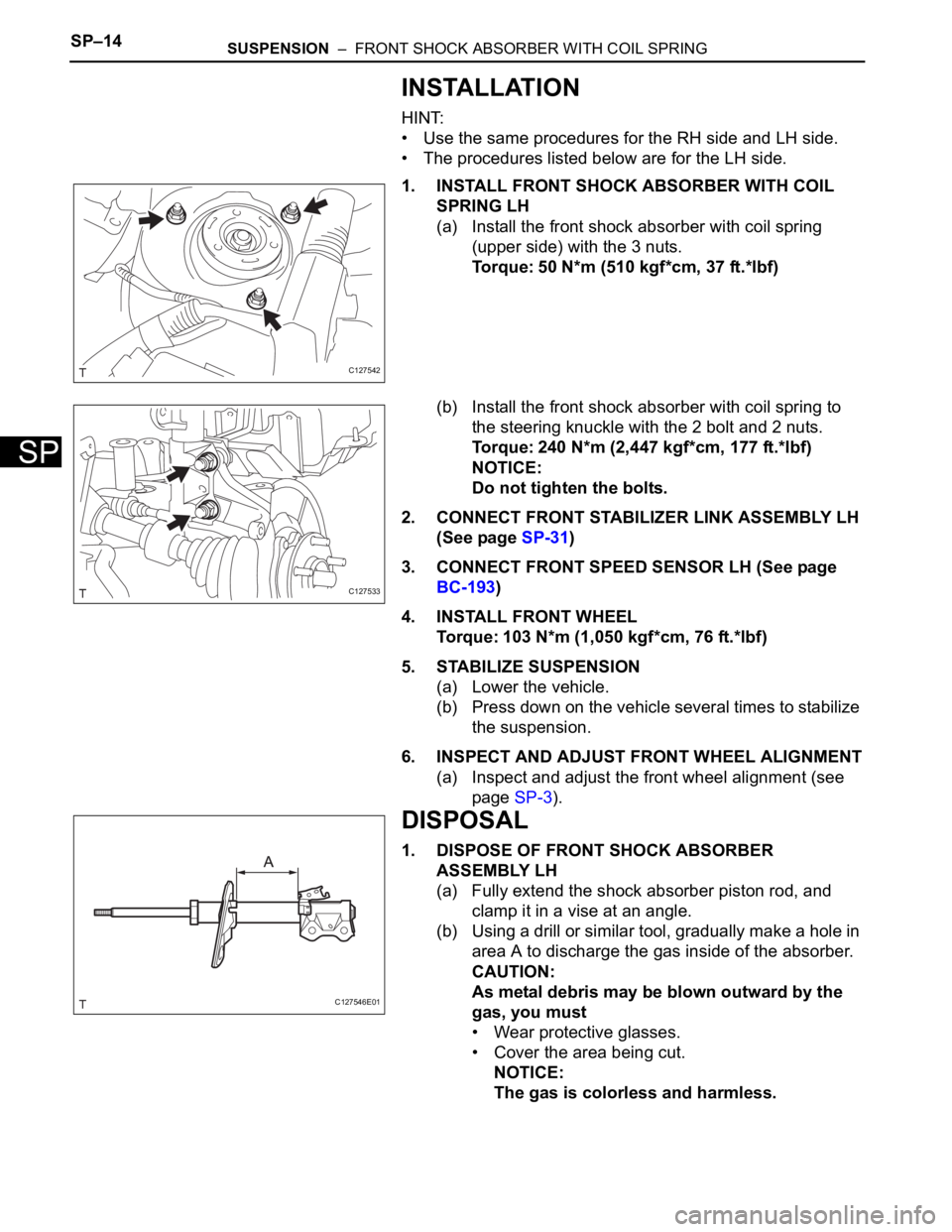
(a) Install the front shock absorber with coil spring
(upper side) with the 3 nuts.
Torque: 50 N*m (510 kgf*cm, 37 ft.*lbf)
(b) Install the front shock absorber with coil spring to
the steering knuckle with the 2 bolt and 2 nuts.
Torque: 240 N*m (2,447 kgf*cm, 177 ft.*lbf)
NOTICE:
Do not tighten the bolts.
2. CONNECT FRONT STABILIZER LINK ASSEMBLY LH
(See page SP-31)
3. CONNECT FRONT SPEED SENSOR LH (See page
BC-193)
4. INSTALL FRONT WHEEL
Torque: 103 N*m (1,050 kgf*cm, 76 ft.*lbf)
5. STABILIZE SUSPENSION
(a) Lower the vehicle.
(b) Press down on the vehicle several times to stabilize
the suspension.
6. INSPECT AND ADJUST FRONT WHEEL ALIGNMENT
(a) Inspect and adjust the front wheel alignment (see
page SP-3).
DISPOSAL
1. DISPOSE OF FRONT SHOCK ABSORBER
ASSEMBLY LH
(a) Fully extend the shock absorber piston rod, and
clamp it in a vise at an angle.
(b) Using a drill or similar tool, gradually make a hole in
area A to discharge the gas inside of the absorber.
CAUTION:
As metal debris may be blown outward by the
gas, you must
• Wear protective glasses.
• Cover the area being cut.
NOTICE:
The gas is colorless and harmless.
C127542
C127533
C127546E01