injector TOYOTA RAV4 2006 Service Service Manual
[x] Cancel search | Manufacturer: TOYOTA, Model Year: 2006, Model line: RAV4, Model: TOYOTA RAV4 2006Pages: 2000, PDF Size: 45.84 MB
Page 806 of 2000
FU–162GR-FE FUEL – FUEL INJECTOR
FU
INSPECTION
1. INSPECT FUEL INJECTOR ASSEMBLY
(a) Inspect injector resistance.
(1) Measure the resistance between the terminals.
Standard resistance:
11.6 to 12.4
at 20C (68F)
If the result is not as specified, replace the
injector.
(b) Inspect the injection volume.
CAUTION:
This test involves high-pressure fuel and
electricity. Take every precaution regarding safe
handling of both the fuel and the electricity.
Perform this test in a safe area, and avoid any
sparks or flames. Do not smoke.
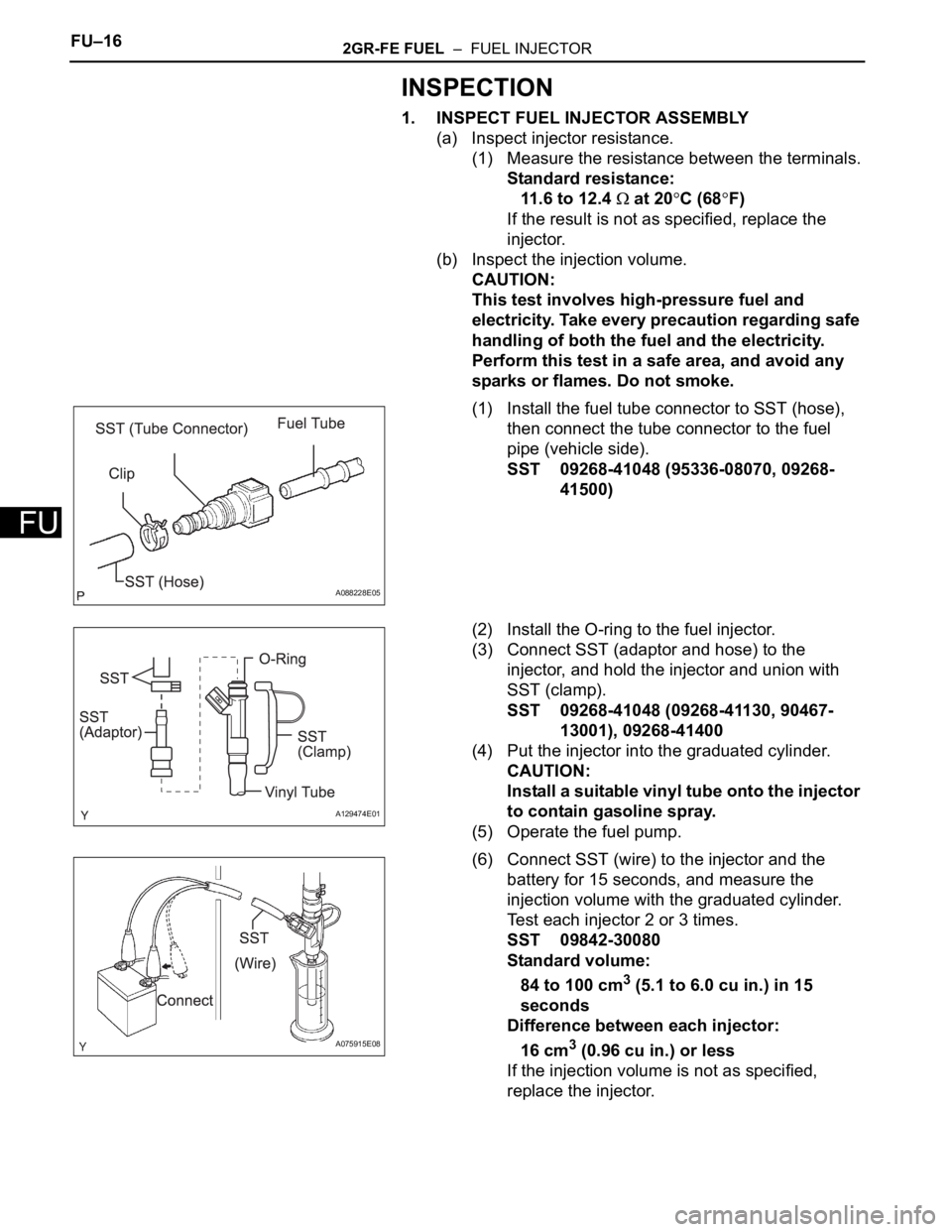
(1) Install the fuel tube connector to SST (hose),
then connect the tube connector to the fuel
pipe (vehicle side).
SST 09268-41048 (95336-08070, 09268-
41500)
(2) Install the O-ring to the fuel injector.
(3) Connect SST (adaptor and hose) to the
injector, and hold the injector and union with
SST (clamp).
SST 09268-41048 (09268-41130, 90467-
13001), 09268-41400
(4) Put the injector into the graduated cylinder.
CAUTION:
Install a suitable vinyl tube onto the injector
to contain gasoline spray.
(5) Operate the fuel pump.
(6) Connect SST (wire) to the injector and the
battery for 15 seconds, and measure the
injection volume with the graduated cylinder.
Test each injector 2 or 3 times.
SST 09842-30080
Standard volume:
84 to 100 cm
3 (5.1 to 6.0 cu in.) in 15
seconds
Difference between each injector:
16 cm
3 (0.96 cu in.) or less
If the injection volume is not as specified,
replace the injector.
A088228E05
A129474E01
A075915E08
Page 807 of 2000
2GR-FE FUEL – FUEL INJECTORFU–17
FU
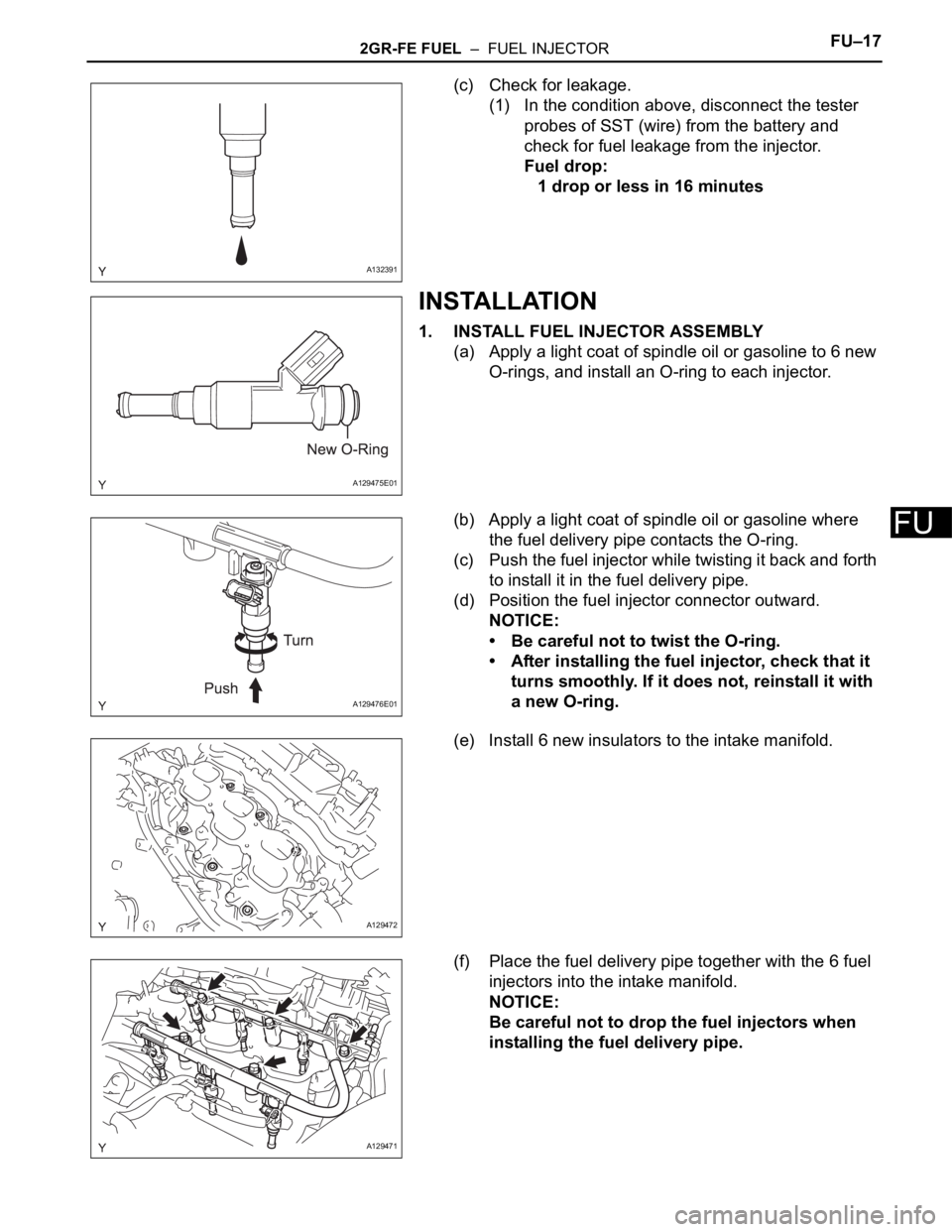
(c) Check for leakage.
(1) In the condition above, disconnect the tester
probes of SST (wire) from the battery and
check for fuel leakage from the injector.
Fuel drop:
1 drop or less in 16 minutes
INSTALLATION
1. INSTALL FUEL INJECTOR ASSEMBLY
(a) Apply a light coat of spindle oil or gasoline to 6 new
O-rings, and install an O-ring to each injector.
(b) Apply a light coat of spindle oil or gasoline where
the fuel delivery pipe contacts the O-ring.
(c) Push the fuel injector while twisting it back and forth
to install it in the fuel delivery pipe.
(d) Position the fuel injector connector outward.
NOTICE:
• Be careful not to twist the O-ring.
• After installing the fuel injector, check that it
turns smoothly. If it does not, reinstall it with
a new O-ring.
(e) Install 6 new insulators to the intake manifold.
(f) Place the fuel delivery pipe together with the 6 fuel
injectors into the intake manifold.
NOTICE:
Be careful not to drop the fuel injectors when
installing the fuel delivery pipe.
A132391
A129475E01
A129476E01
A129472
A129471
Page 808 of 2000
FU–182GR-FE FUEL – FUEL INJECTOR
FU
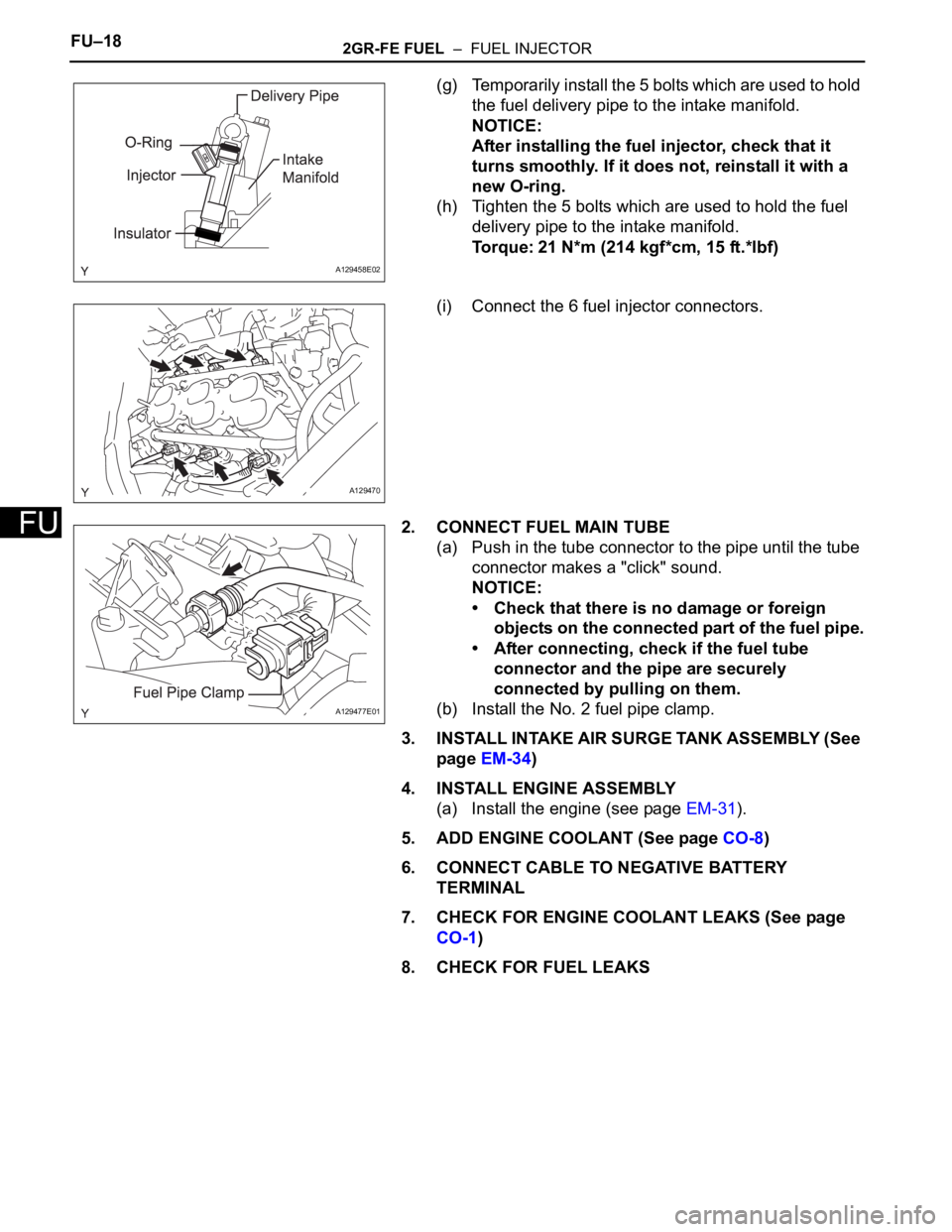
(g) Temporarily install the 5 bolts which are used to hold
the fuel delivery pipe to the intake manifold.
NOTICE:
After installing the fuel injector, check that it
turns smoothly. If it does not, reinstall it with a
new O-ring.
(h) Tighten the 5 bolts which are used to hold the fuel
delivery pipe to the intake manifold.
Torque: 21 N*m (214 kgf*cm, 15 ft.*lbf)
(i) Connect the 6 fuel injector connectors.
2. CONNECT FUEL MAIN TUBE
(a) Push in the tube connector to the pipe until the tube
connector makes a "click" sound.
NOTICE:
• Check that there is no damage or foreign
objects on the connected part of the fuel pipe.
• After connecting, check if the fuel tube
connector and the pipe are securely
connected by pulling on them.
(b) Install the No. 2 fuel pipe clamp.
3. INSTALL INTAKE AIR SURGE TANK ASSEMBLY (See
page EM-34)
4. INSTALL ENGINE ASSEMBLY
(a) Install the engine (see page EM-31).
5. ADD ENGINE COOLANT (See page CO-8)
6. CONNECT CABLE TO NEGATIVE BATTERY
TERMINAL
7. CHECK FOR ENGINE COOLANT LEAKS (See page
CO-1)
8. CHECK FOR FUEL LEAKS
A129458E02
A129470
A129477E01
Page 832 of 2000
EC–82GR-FE EMISSION CONTROL – EMISSION CONTROL SYSTEM
EC
ON-VEHICLE INSPECTION
1. CHECK FUEL CUT RPM
(a) Increase the engine speed to at least 3,500 rpm.
(b) Use a sound scope to check for injector operating
noise.
(c) Check that the operating sounds stop momentarily
and then resume when the throttle lever is released.
HINT:
Measure with the A/C OFF.
Fuel return rpm:
1,400 rpm
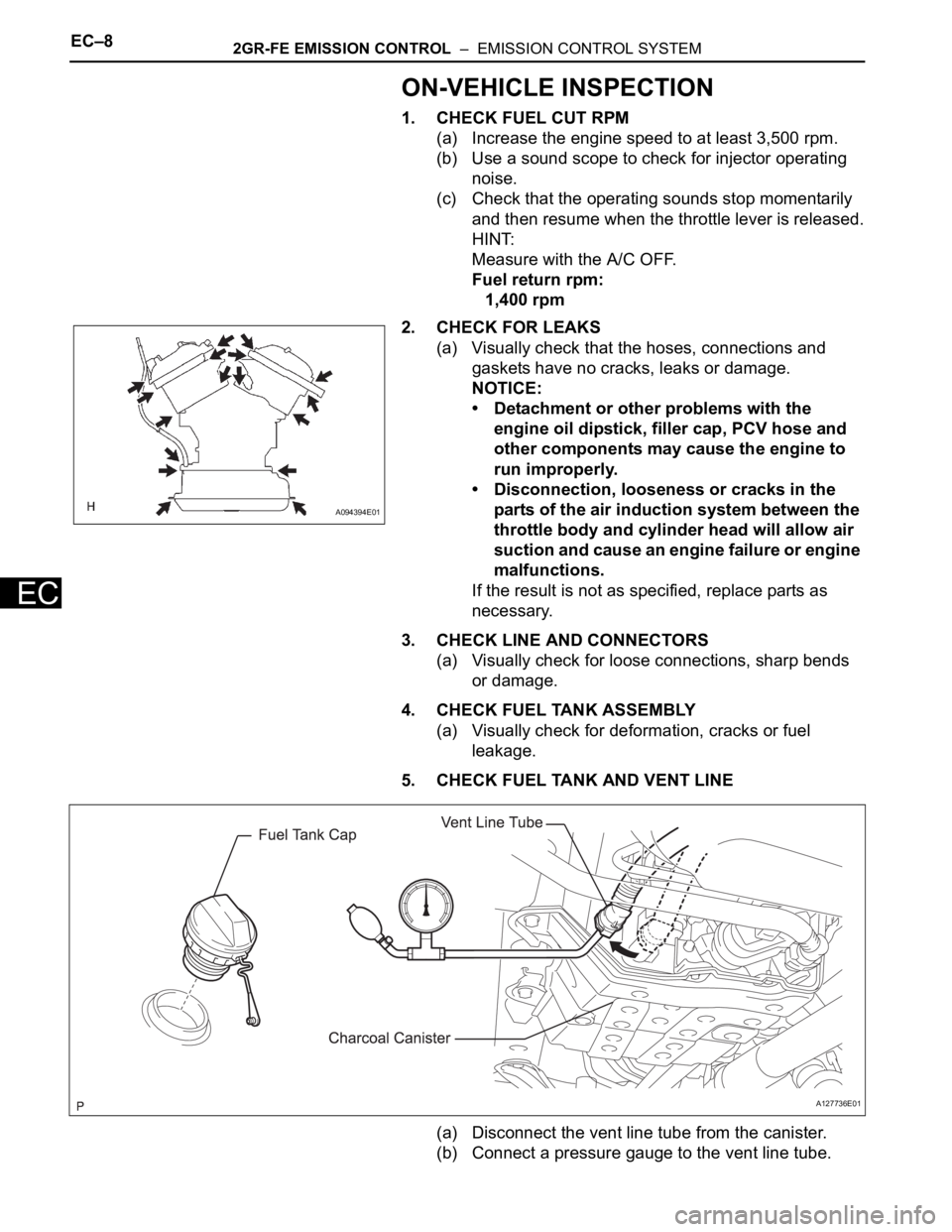
2. CHECK FOR LEAKS
(a) Visually check that the hoses, connections and
gaskets have no cracks, leaks or damage.
NOTICE:
• Detachment or other problems with the
engine oil dipstick, filler cap, PCV hose and
other components may cause the engine to
run improperly.
• Disconnection, looseness or cracks in the
parts of the air induction system between the
throttle body and cylinder head will allow air
suction and cause an engine failure or engine
malfunctions.
If the result is not as specified, replace parts as
necessary.
3. CHECK LINE AND CONNECTORS
(a) Visually check for loose connections, sharp bends
or damage.
4. CHECK FUEL TANK ASSEMBLY
(a) Visually check for deformation, cracks or fuel
leakage.
5. CHECK FUEL TANK AND VENT LINE
(a) Disconnect the vent line tube from the canister.
(b) Connect a pressure gauge to the vent line tube.
A094394E01
A127736E01
Page 885 of 2000
2AZ-FE IGNITION – IGNITION SYSTEMIG–5
IG
ON-VEHICLE INSPECTION
1. CHECK IGNITION COIL ASSEMBLY AND PERFORM
SPARK TEST
NOTICE:
In this section, the terms "cold" and "hot" refer to
the temperature of the coils. "Cold" means
approximately -10 to 50
C (14 to 122F). "Hot" means
approximately 50 to 100
C (122 to 212F).
(a) Check the DTCs.
NOTICE:
If a DTC is present, perform troubleshooting in
accordance with the procedure for that DTC.
(b) Check that sparks occur.
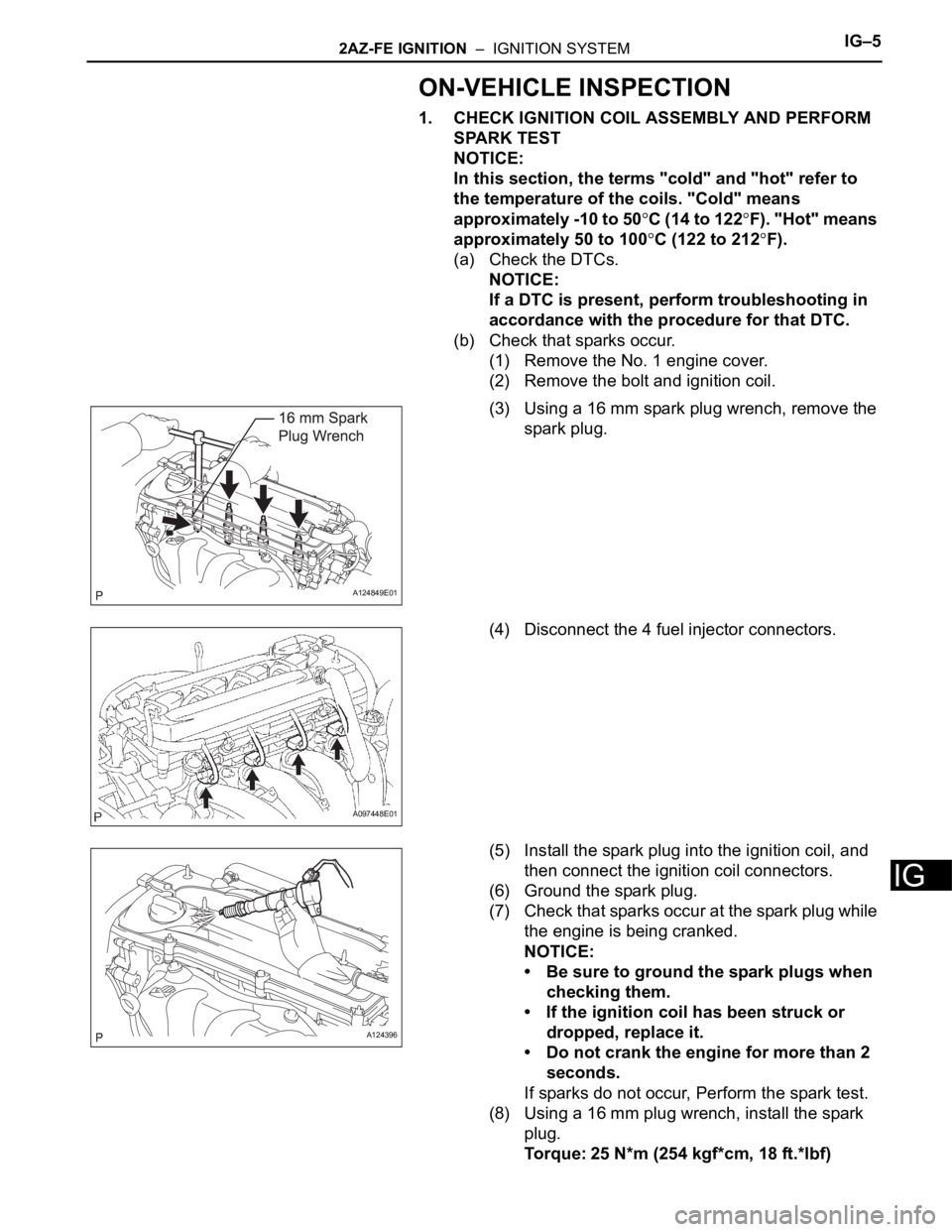
(1) Remove the No. 1 engine cover.
(2) Remove the bolt and ignition coil.
(3) Using a 16 mm spark plug wrench, remove the
spark plug.
(4) Disconnect the 4 fuel injector connectors.
(5) Install the spark plug into the ignition coil, and
then connect the ignition coil connectors.
(6) Ground the spark plug.
(7) Check that sparks occur at the spark plug while
the engine is being cranked.
NOTICE:
• Be sure to ground the spark plugs when
checking them.
• If the ignition coil has been struck or
dropped, replace it.
• Do not crank the engine for more than 2
seconds.
If sparks do not occur, Perform the spark test.
(8) Using a 16 mm plug wrench, install the spark
plug.
Torque: 25 N*m (254 kgf*cm, 18 ft.*lbf)
A124849E01
A097448E01
A124396
Page 886 of 2000
IG–62AZ-FE IGNITION – IGNITION SYSTEM
IG
(9) Install the ignition coil with the bolt.
Torque: 9.0 N*m (92 kgf*cm, 80 in.*lbf)
(10) Connect the 4 fuel injector connectors.
(11) Install the No. 1 engine cover.
(c) Spark test flow chart.
(1) Check that the ignition coil connector is
securely connected.
Result
(2) Perform the spark test on each ignition coil.
1. Replace the ignition coil with a normal one.
2. Perform the spark test again.
Result
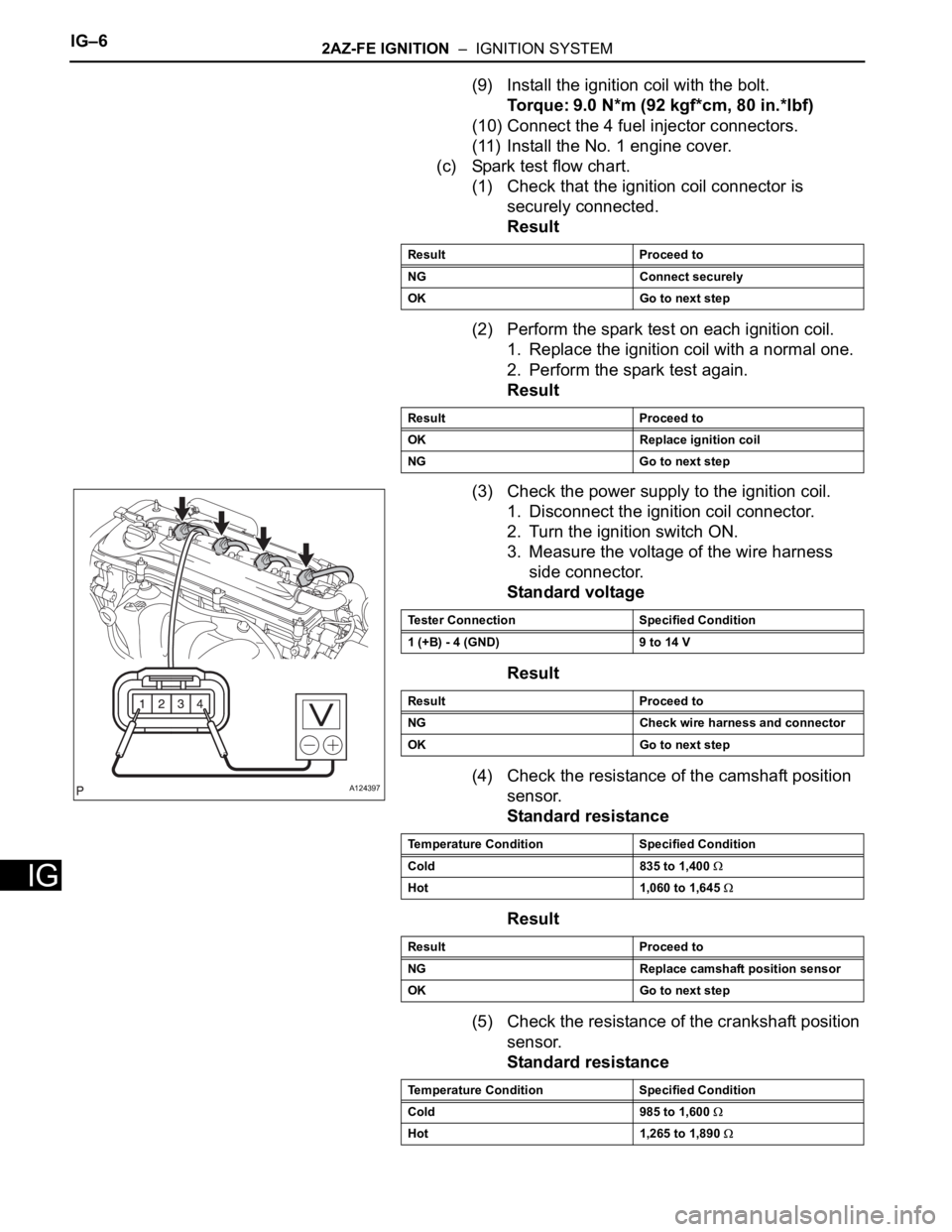
(3) Check the power supply to the ignition coil.
1. Disconnect the ignition coil connector.
2. Turn the ignition switch ON.
3. Measure the voltage of the wire harness
side connector.
Standard voltage
Result
(4) Check the resistance of the camshaft position
sensor.
Standard resistance
Result
(5) Check the resistance of the crankshaft position
sensor.
Standard resistance
Result Proceed to
NG Connect securely
OK Go to next step
Result Proceed to
OK Replace ignition coil
NG Go to next step
A124397
Tester Connection Specified Condition
1 (+B) - 4 (GND) 9 to 14 V
Result Proceed to
NG Check wire harness and connector
OK Go to next step
Temperature Condition Specified Condition
Cold 835 to 1,400
Hot 1,060 to 1,645
Result Proceed to
NG Replace camshaft position sensor
OK Go to next step
Temperature Condition Specified Condition
Cold 985 to 1,600
Hot 1,265 to 1,890
Page 895 of 2000
2GR-FE IGNITION – IGNITION SYSTEMIG–5
IG
ON-VEHICLE INSPECTION
1. CHECK IGNITION COIL ASSEMBLY AND PERFORM
SPARK TEST
NOTICE:
In this section, the terms "Cold" and "Hot" refer to
the temperature of the sensor. "Cold" means
approximately -10 to 50
C (14 to 122F). "Hot" means
approximately 50 to 100
C (122 to 212F).
(a) Check the DTCs.
NOTICE:
If a DTC is present, perform troubleshooting in
accordance with the procedure for that DTC.
(b) Check that sparks occur.
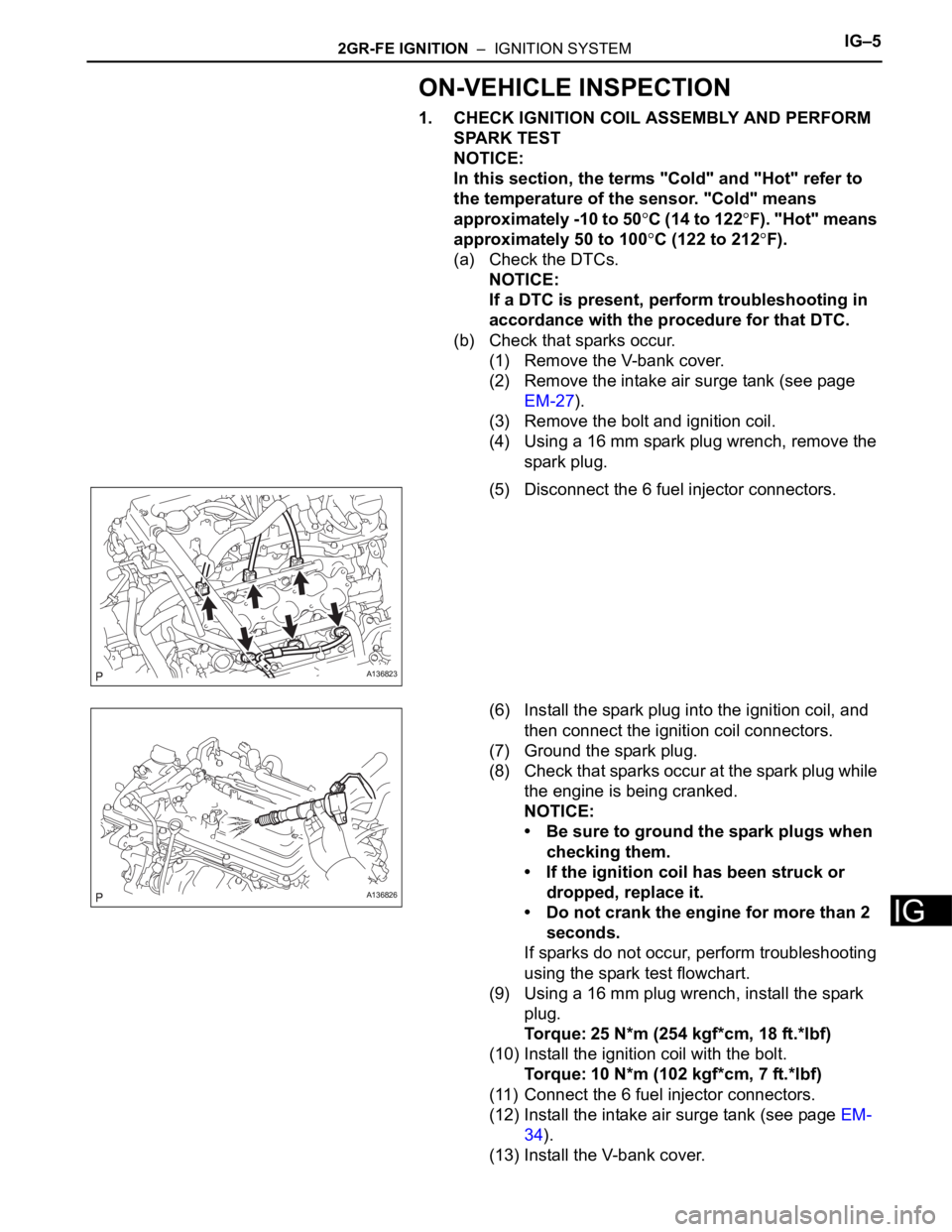
(1) Remove the V-bank cover.
(2) Remove the intake air surge tank (see page
EM-27).
(3) Remove the bolt and ignition coil.
(4) Using a 16 mm spark plug wrench, remove the
spark plug.
(5) Disconnect the 6 fuel injector connectors.
(6) Install the spark plug into the ignition coil, and
then connect the ignition coil connectors.
(7) Ground the spark plug.
(8) Check that sparks occur at the spark plug while
the engine is being cranked.
NOTICE:
• Be sure to ground the spark plugs when
checking them.
• If the ignition coil has been struck or
dropped, replace it.
• Do not crank the engine for more than 2
seconds.
If sparks do not occur, perform troubleshooting
using the spark test flowchart.
(9) Using a 16 mm plug wrench, install the spark
plug.
Torque: 25 N*m (254 kgf*cm, 18 ft.*lbf)
(10) Install the ignition coil with the bolt.
Torque: 10 N*m (102 kgf*cm, 7 ft.*lbf)
(11) Connect the 6 fuel injector connectors.
(12) Install the intake air surge tank (see page EM-
34).
(13) Install the V-bank cover.
A136823
A136826
Page 1620 of 2000

PS–20POWER STEERING – ELECTRONIC POWER STEERING SYSTEM
PS
HINT:
: Warning light comes on
X: Warning light turns off (normal reset)
U0105/41 Lost Communication
with Fuel Injector
Control Module- CAN
communication
system
- ECMIgnition switch ON
again or after normal
confirmationX PS-34
U0121/42 Lost Communication
with Anti-Lock Brake
System (ABS)
Control Module- CAN
communication
system
- Skid control ECUIgnition switch ON
again or after normal
confirmation
PS-34 DTC No. Detection Item Trouble Area Normal Function
Return ConditionP/S Warning Light See page
Page 1935 of 2000

2AZ-FE ENGINE CONTROL SYSTEM – SFI SYSTEMES–47
ES
DATA LIST / ACTIVE TEST
1. DATA LIST
HINT:
By reading the DATA LIST displayed on an intelligent
tester, values can be checked, including those of the
switches, sensors, and actuators, without removing any
parts. Reading the DATA LIST as the first step of
troubleshooting is one method of shortening diagnostic
time.
NOTICE:
In the table below, the values listed under Normal
Condition are for reference only. Do not depend
solely on these values when determining whether or
not a part is faulty.
(a) Warm up the engine.
(b) Turn the ignition switch OFF.
(c) Connect the intelligent tester to the DLC3.
(d) Turn the ignition switch ON.
(e) Turn the tester ON.
(f) Select the following menu items: DIAGNOSIS /
ENHANCED OBD II / DATA LIST.
(g) Check the values by referring to the table below.
ECM:
Intelligent Tester Display Measurement: Range (Display) Normal Condition*1 Diagnostic Note
INJECTORInjection period of No. 1 cylinder:
Min.: 0 ms, Max.: 32.64 ms1.0 to 3.0 ms: Idling -
IGN ADVANCE Ignition timing advance for No. 1
cylinder:
Min.: -64 deg, Max.: 63.5 degBTDC 0 to 14 deg: Idling -
CALC LOADCalculated load by ECM:
Min.: 0 %, Max.: 100 %• 10 to 30 %: Idling
• 10 to 30 %: Running without
load at 2,500 rpmLoad value
VEHICLE LOADVehicle load:
Min.: 0 %, Max.: 25,700 %Actual vehicle loadLoad percentage in terms of
maximum intake air flow amount
MAFAir flow rate from Mass Air Flow
(MAF) meter:
Min.: 0 g/sec., Max.: 655.35 g/sec.1 to 3 g/sec.: Idling
2 to 6 g/sec.: Running without
load at 2,500 rpmIf value approximately 0.0 g/sec.:
• MAF meter power source
circuit open
• VG circuit open or short
If value 160.0 g/sec. or more:
• E2G circuit open
ENGINE SPDEngine speed:
Min.: 0 rpm, Max.: 16,383.75 rpm650 to 750 rpm: Idling -
VEHICLE SPDVehicle speed:
Min.: 0 km/h, Max.: 255 km/hActual vehicle speed Speed indicated on speedometer
COOLANT TEMPEngine coolant temperature:
Min.: -40
C, Max.: 140C80 to 100C (176 to 212F):
After warming up• If -40
C (-40F): sensor circuit
open
• If 140
C (284F) or more:
sensor circuit shorted
INTAKE AIRIntake air temperature:
Min.: -40
C, Max.: 140CEquivalent to ambient air
temperature• If -40
C (-40F): sensor circuit
open
• If 140
C (284F) or more:
sensor circuit shorted
AIR-FUEL RATIORatio compared to stoichiometric
level:
Min.: 0, Max.: 1.9990.8 to 1.2: Idling• Less than 1 (0 to 0.999) =
Lean
• Stoichiometric air-fuel ratio = 1
• Greater than 1 (1.001 to
1.999) = Rich
Page 1943 of 2000

2AZ-FE ENGINE CONTROL SYSTEM – SFI SYSTEMES–55
ES
(c) Turn the tester ON.
(d) Select the following menu items: DIAGNOSIS /
ENHANCED OBD II / ACTIVE TEST.
(e) Perform the ACTIVE TEST by referring to the table
below.
ECM:
Intelligent Tester Displays Test Details Control Ranges Diagnostic Notes
INJ VOL Change injection volume Between -12.5 and 24.8 %• All injectors tested at same
time
• Perform test at less than
3,000 rpm
• Injection volume can be
changed in 0.1 % graduations
within control range
A/F CONTROL Change injection volumeDecrease by 12.5 % or increase
by 24.8 %• Perform test at less than
3,000 rpm
• A/F CONTROL enables
checking and graphing of A/F
(Air-Fuel Ratio) sensor and
Heated Oxygen (HO2) sensor
voltage outputs
• To conduct test, select
following menu items:
ACTIVE TEST / A/F
CONTROL / USER DATA /
AFS B1S1 and O2S B1S2;
then press YES and ENTER
followed by F4.
EVAP VSV (ALONE) Activate purge VSV control ON/OFF -
VVT B1 Control VVT (bank 1)-128 to 127 %
This value added to present OCV
control duty
100 %: Maximum advance
-100 %: Maximum retardEngine stall or rough idle when
VVT actuator operated by 100 %.
Test possible while vehicle
stopped and engine idling
VVT CTRL B1Turn on and off OCV
(Oil Control Valve)ON/OFF• Engine stalls or idles roughly
when OCV turned ON
• Normal engine running or
idling when OCV OFF
• Test possible while vehicle
stopped and engine idling
FUEL PUMP / SPDActivate fuel pump (C/OPN
Relay)ON/OFFTest possible when engine
stopped
TC/TE1Turn on and off TC and TE1
connectionON/OFF• ON: TC and TE1 connected
• OFF: TC and TE1
disconnected
FC IDL PROHBT Prohibit idling fuel cut control ON/OFF -
COOLING FAN Control electric cooling fan ON/OFF -
ETCS OPEN SLOW Throttle actuator ON: Throttle valve opens slowly Test possible when following
conditions met:
• Engine stopped
• Shift position in P
• Fully depressing accelerator
pedal (APP: 59
or more) ETCS CLOSE SLOW Throttle actuator ON: Throttle valve closes slowly
ETCS OPEN FAST Throttle actuator ON: Throttle valve opens fast
ETCS CLOSE FAST Throttle actuator ON: Throttle valve closes fast
FUEL CUT #1 Cylinder #1 injector fuel cut ON/OFF
Test possible during vehicle
stopping and engine idling
ON: All cylinder injector fuel cut
and ignition stop FUEL CUT #2 Cylinder #2 injector fuel cut ON/OFF
FUEL CUT #3 Cylinder #3 injector fuel cut ON/OFF
FUEL CUT #4 Cylinder #4 injector fuel cut ON/OFF
FUEL CUT ALL All cylinder injector fuel cut ON/OFF ON: All cylinder injector fuel cut
VACUUM PUMP Leak detection pump ON/OFF -
VENT VALVE Vent valve ON/OFF -