automatic transmission TOYOTA RAV4 2006 Service Workshop Manual
[x] Cancel search | Manufacturer: TOYOTA, Model Year: 2006, Model line: RAV4, Model: TOYOTA RAV4 2006Pages: 2000, PDF Size: 45.84 MB
Page 1141 of 2000
AX–22U151F AUTOMATIC TRANSAXLE – AUTOMATIC TRANSAXLE SYSTEM
AX
MANUAL SHIFTING TEST
1. MANUAL SHIFTING TEST
HINT:
• Through this test, it can be determined whether the
trouble occurs in the electrical circuit or if it is a
mechanical problem in the transaxle.
• If any abnormalities are found in the following test, the
problem is in the transaxle itself.
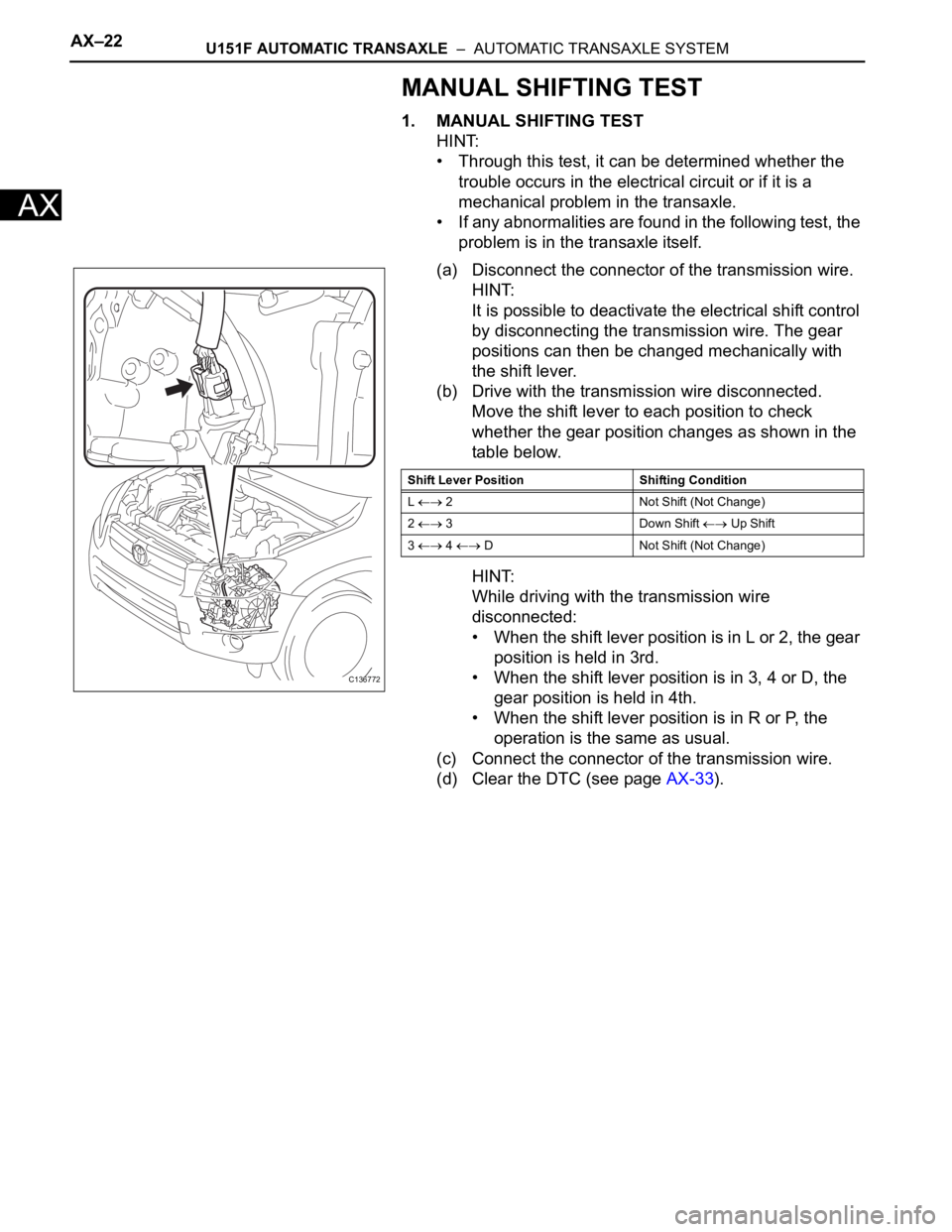
(a) Disconnect the connector of the transmission wire.
HINT:
It is possible to deactivate the electrical shift control
by disconnecting the transmission wire. The gear
positions can then be changed mechanically with
the shift lever.
(b) Drive with the transmission wire disconnected.
Move the shift lever to each position to check
whether the gear position changes as shown in the
table below.
HINT:
While driving with the transmission wire
disconnected:
• When the shift lever position is in L or 2, the gear
position is held in 3rd.
• When the shift lever position is in 3, 4 or D, the
gear position is held in 4th.
• When the shift lever position is in R or P, the
operation is the same as usual.
(c) Connect the connector of the transmission wire.
(d) Clear the DTC (see page AX-33).
C136772
Shift Lever Position Shifting Condition
L
2 Not Shift (Not Change)
2
3 Down Shift Up Shift
3
4 D Not Shift (Not Change)
Page 1145 of 2000
AX–26U151F AUTOMATIC TRANSAXLE – AUTOMATIC TRANSAXLE SYSTEM
AX
HINT:
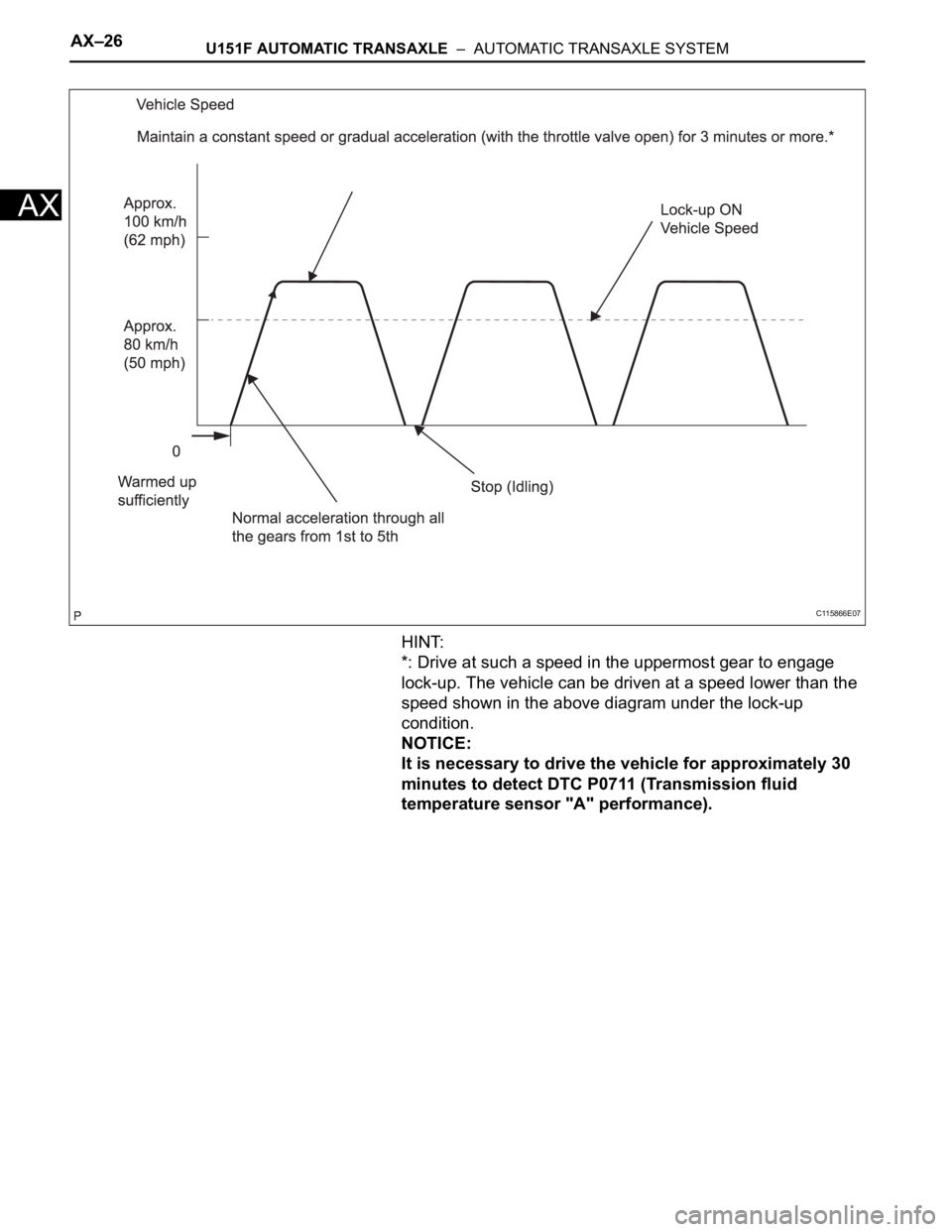
*: Drive at such a speed in the uppermost gear to engage
lock-up. The vehicle can be driven at a speed lower than the
speed shown in the above diagram under the lock-up
condition.
NOTICE:
It is necessary to drive the vehicle for approximately 30
minutes to detect DTC P0711 (Transmission fluid
temperature sensor "A" performance).
C115866E07
Page 1146 of 2000

U151F AUTOMATIC TRANSAXLE – AUTOMATIC TRANSAXLE SYSTEMAX–27
AX
PROBLEM SYMPTOMS TABLE
HINT:
• Use the table below to help determine the cause of the
problem symptom. The potential causes of the symptoms
are listed in order of probability in the "Suspected area"
column of the table. Check each symptom by checking the
suspected areas in the order they are listed. Replace parts
as necessary.
• The Matrix Chart is divided into 2 chapters. When
troubleshooting, check Chapter 1 first. If instructions are
given in Chapter 1 to proceed to 2, proceed as instructed.
• If the instruction "Proceed to next circuit inspection shown
in problem symptoms table" is given in the flowchart for
each circuit, proceed to the next suspected area in the
table.
• If the problem still occurs even though there are no
malfunctions in any of the circuits, check the ECM and
replace it if necessary.
1. Chapter 1: Electronic Circuit Matrix Chart
Symptom Suspected area See page
No down-shift (a particular gear, from 1st to 4th gear, is
not down-shifted)ECMIN-37
No down-shift (5th -> 4th)1. Transmission control switch (4 <--> D position) circuitAX-44
2. Shift solenoid valve S4 circuit*AX-106
3. ECMIN-37
No up-shift (a particular gear, from 1st to 4th gear, is
not up-shifted)ECMIN-37
No up-shift (4th -> 5th)1. Transmission control switch (4 <--> D position) circuitAX-44
2. Shift solenoid valve S4 circuit*AX-106
3. ECMIN-37
No lock-up1. Stop light switch circuit*AX-62
2. Engine coolant temperature sensor circuit*ES-56
3. ECMIN-37
No lock-up off ECMIN-37
Shift point too high or too low1. Throttle position sensor circuit*ES-56
2. ECMIN-37
Up-shift to 5th from 4th while shift lever on 41. Transmission control switch (4 <--> D position) circuitAX-44
2. ECMIN-37
Up-shift to 5th from 4th while engine is cold1. Engine coolant temperature sensor circuit*ES-56
2. ECMIN-37
Up-shift to 2nd from 1st while shift lever is on L1. Transmission control switch (2 <--> L position) circuit*AX-44
2. ECMIN-37
Harsh engagement (N -> D)1. Shift solenoid valve SL1 circuit*AX-76
2. ECMIN-37
Harsh engagement (lock-up) ECMIN-37
Harsh engagement (any driving position) ECMIN-37
Poor acceleration ECMIN-37
No kick-down ECMIN-37
Engine stalls when starting off or stopping ECMIN-37
Malfunction in shifting1. Park/Neutral position switch circuit*AX-44
2. Transmission control switch (4 <--> D position) circuitAX-44
3. ECMIN-37
Page 1154 of 2000
U151F AUTOMATIC TRANSAXLE – AUTOMATIC TRANSAXLE SYSTEMAX–35
AX
4. FREEZE FRAME DATA
(a) Freeze frame data records the engine conditions
(fuel system, calculated load, engine coolant
temperature, fuel trim, engine speed, vehicle speed,
etc.) when a malfunction is detected. When
troubleshooting, freeze frame data can help
determine if the vehicle was running or stopped, if
the engine was warmed up or not, if the air-fuel ratio
was lean or rich, and other data from the time the
malfunction occurred.
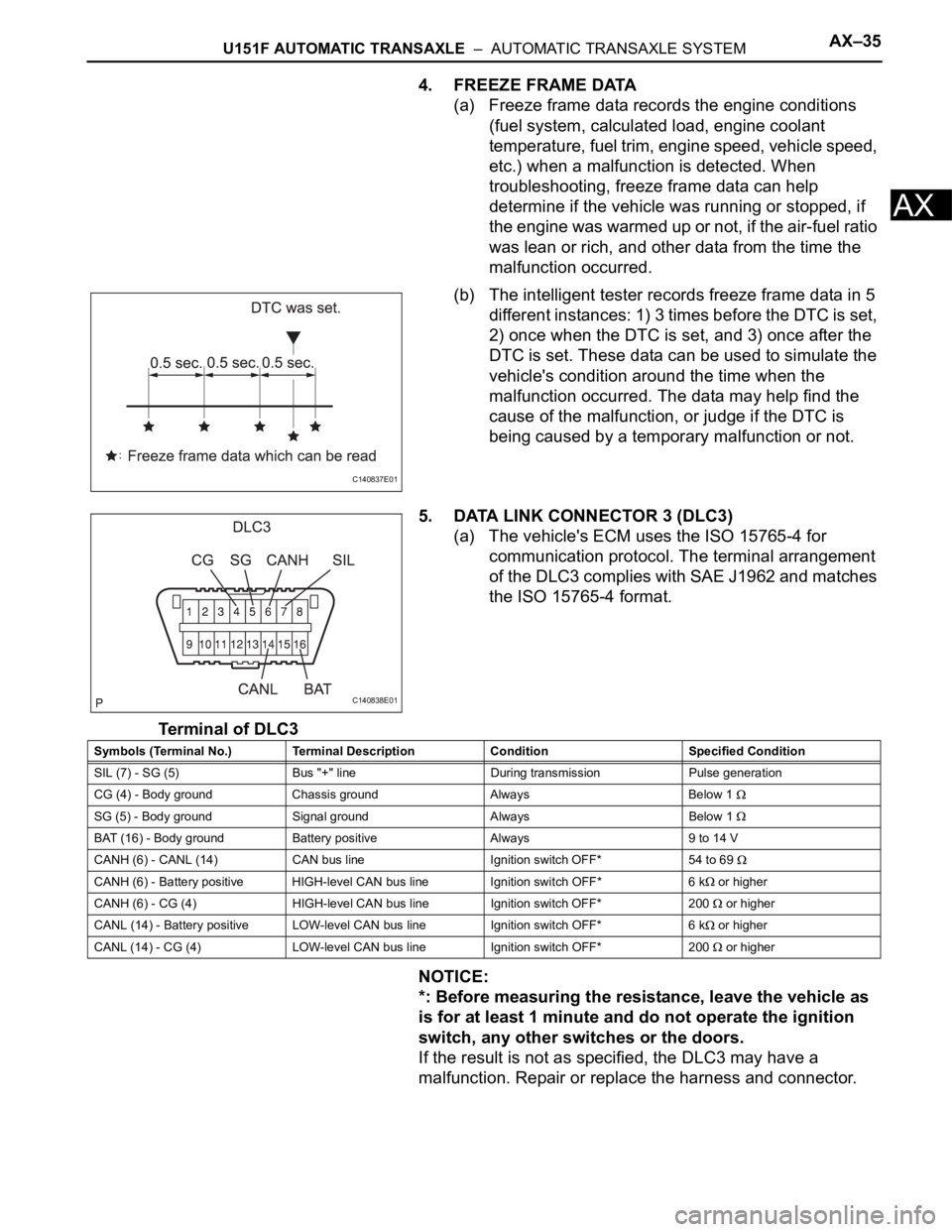
(b) The intelligent tester records freeze frame data in 5
different instances: 1) 3 times before the DTC is set,
2) once when the DTC is set, and 3) once after the
DTC is set. These data can be used to simulate the
vehicle's condition around the time when the
malfunction occurred. The data may help find the
cause of the malfunction, or judge if the DTC is
being caused by a temporary malfunction or not.
5. DATA LINK CONNECTOR 3 (DLC3)
(a) The vehicle's ECM uses the ISO 15765-4 for
communication protocol. The terminal arrangement
of the DLC3 complies with SAE J1962 and matches
the ISO 15765-4 format.
Terminal of DLC3
NOTICE:
*: Before measuring the resistance, leave the vehicle as
is for at least 1 minute and do not operate the ignition
switch, any other switches or the doors.
If the result is not as specified, the DLC3 may have a
malfunction. Repair or replace the harness and connector.
C140837E01
C140838E01
Symbols (Terminal No.) Terminal Description Condition Specified Condition
SIL (7) - SG (5) Bus "+" line During transmission Pulse generation
CG (4) - Body ground Chassis ground Always Below 1
SG (5) - Body ground Signal ground Always Below 1
BAT (16) - Body ground Battery positive Always 9 to 14 V
CANH (6) - CANL (14) CAN bus line Ignition switch OFF* 54 to 69
CANH (6) - Battery positive HIGH-level CAN bus line Ignition switch OFF* 6 k or higher
CANH (6) - CG (4) HIGH-level CAN bus line Ignition switch OFF* 200
or higher
CANL (14) - Battery positive LOW-level CAN bus line Ignition switch OFF* 6 k
or higher
CANL (14) - CG (4) LOW-level CAN bus line Ignition switch OFF* 200
or higher
Page 1160 of 2000
U151F AUTOMATIC TRANSAXLE – FLOOR SHIFT ASSEMBLYAX–167
AX
INSTALLATION
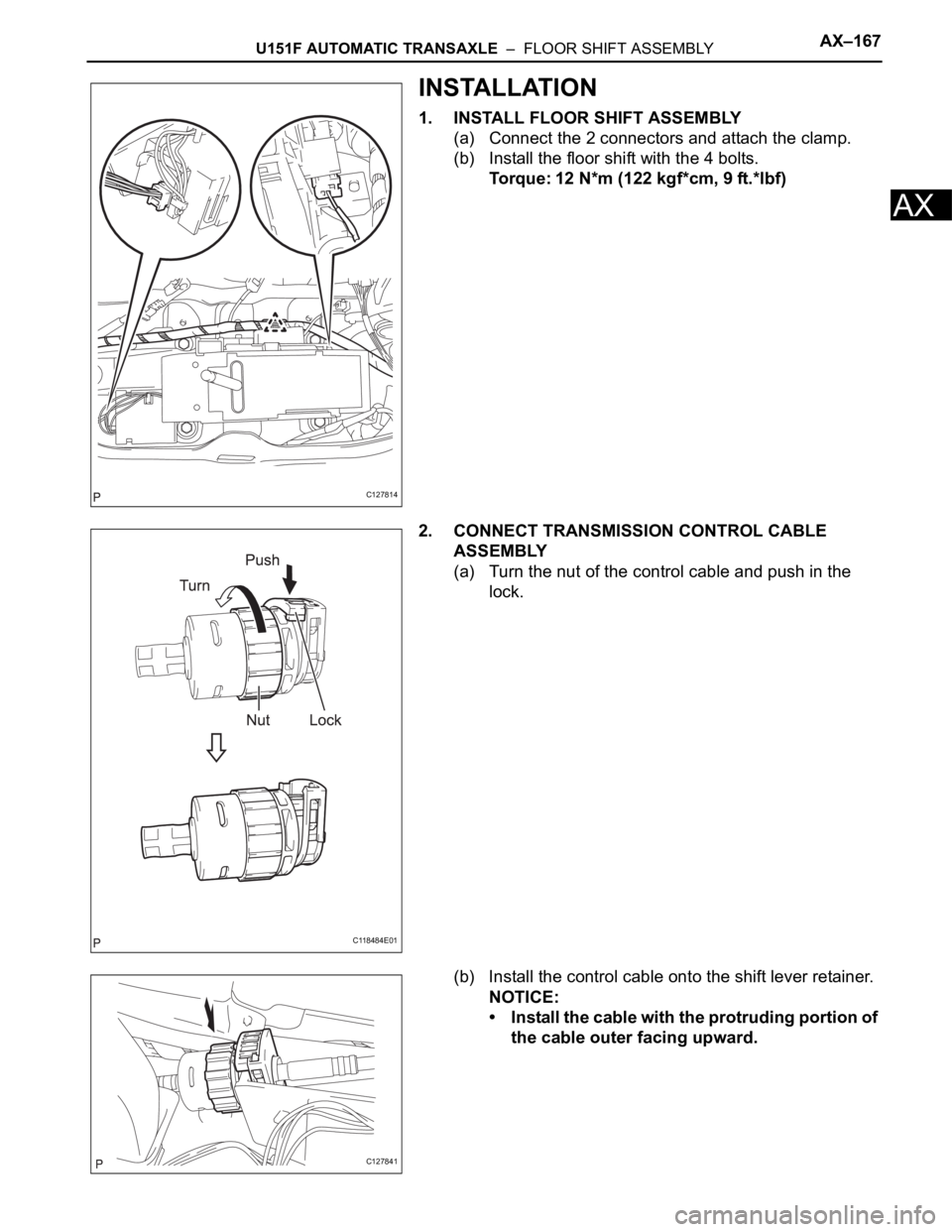
1. INSTALL FLOOR SHIFT ASSEMBLY
(a) Connect the 2 connectors and attach the clamp.
(b) Install the floor shift with the 4 bolts.
Torque: 12 N*m (122 kgf*cm, 9 ft.*lbf)
2. CONNECT TRANSMISSION CONTROL CABLE
ASSEMBLY
(a) Turn the nut of the control cable and push in the
lock.
(b) Install the control cable onto the shift lever retainer.
NOTICE:
• Install the cable with the protruding portion of
the cable outer facing upward.
C127814
C118484E01
C127841
Page 1164 of 2000
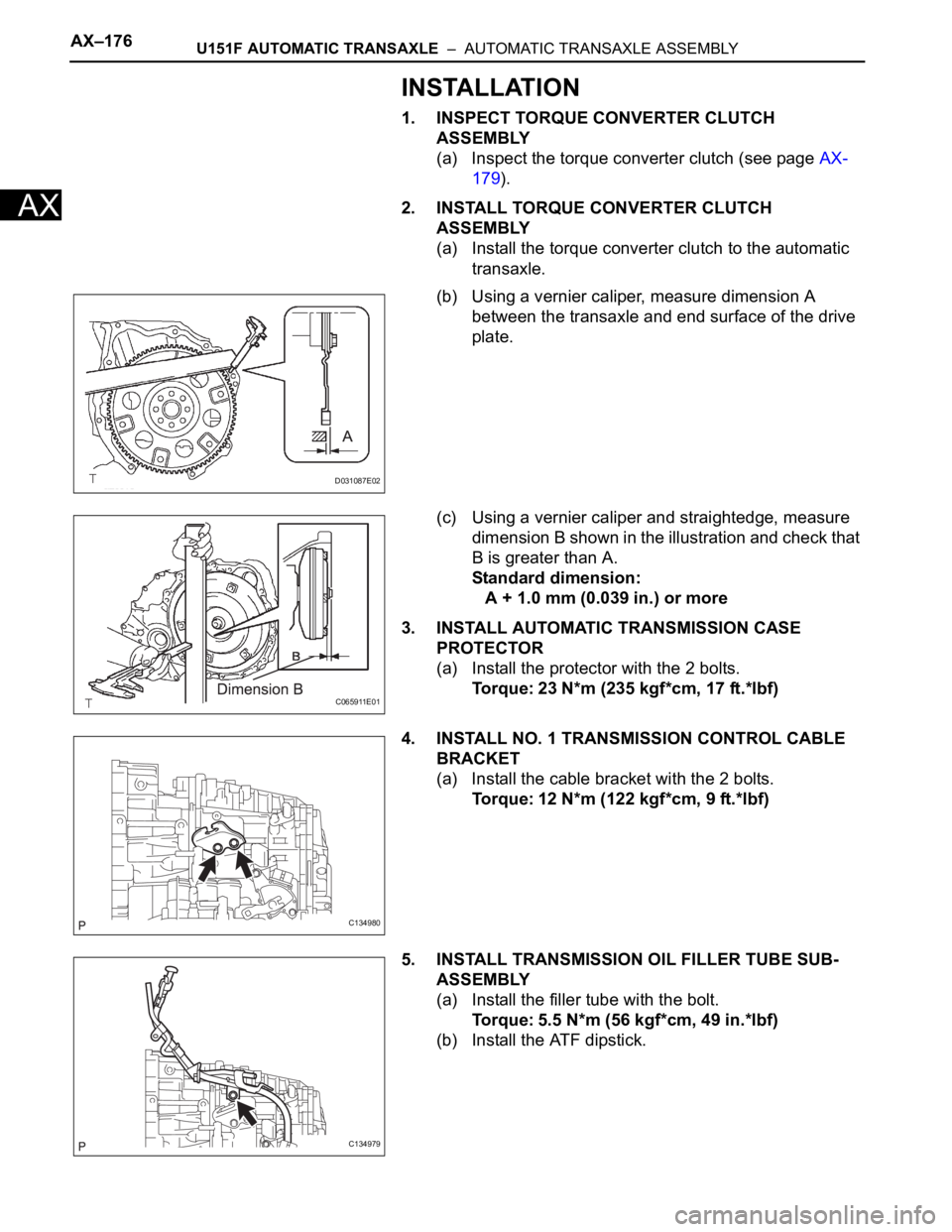
AX–176U151F AUTOMATIC TRANSAXLE – AUTOMATIC TRANSAXLE ASSEMBLY
AX
INSTALLATION
1. INSPECT TORQUE CONVERTER CLUTCH
ASSEMBLY
(a) Inspect the torque converter clutch (see page AX-
179).
2. INSTALL TORQUE CONVERTER CLUTCH
ASSEMBLY
(a) Install the torque converter clutch to the automatic
transaxle.
(b) Using a vernier caliper, measure dimension A
between the transaxle and end surface of the drive
plate.
(c) Using a vernier caliper and straightedge, measure
dimension B shown in the illustration and check that
B is greater than A.
Standard dimension:
A + 1.0 mm (0.039 in.) or more
3. INSTALL AUTOMATIC TRANSMISSION CASE
PROTECTOR
(a) Install the protector with the 2 bolts.
Torque: 23 N*m (235 kgf*cm, 17 ft.*lbf)
4. INSTALL NO. 1 TRANSMISSION CONTROL CABLE
BRACKET
(a) Install the cable bracket with the 2 bolts.
Torque: 12 N*m (122 kgf*cm, 9 ft.*lbf)
5. INSTALL TRANSMISSION OIL FILLER TUBE SUB-
ASSEMBLY
(a) Install the filler tube with the bolt.
Torque: 5.5 N*m (56 kgf*cm, 49 in.*lbf)
(b) Install the ATF dipstick.
D031087E02
C065911E01
C134980
C134979
Page 1166 of 2000
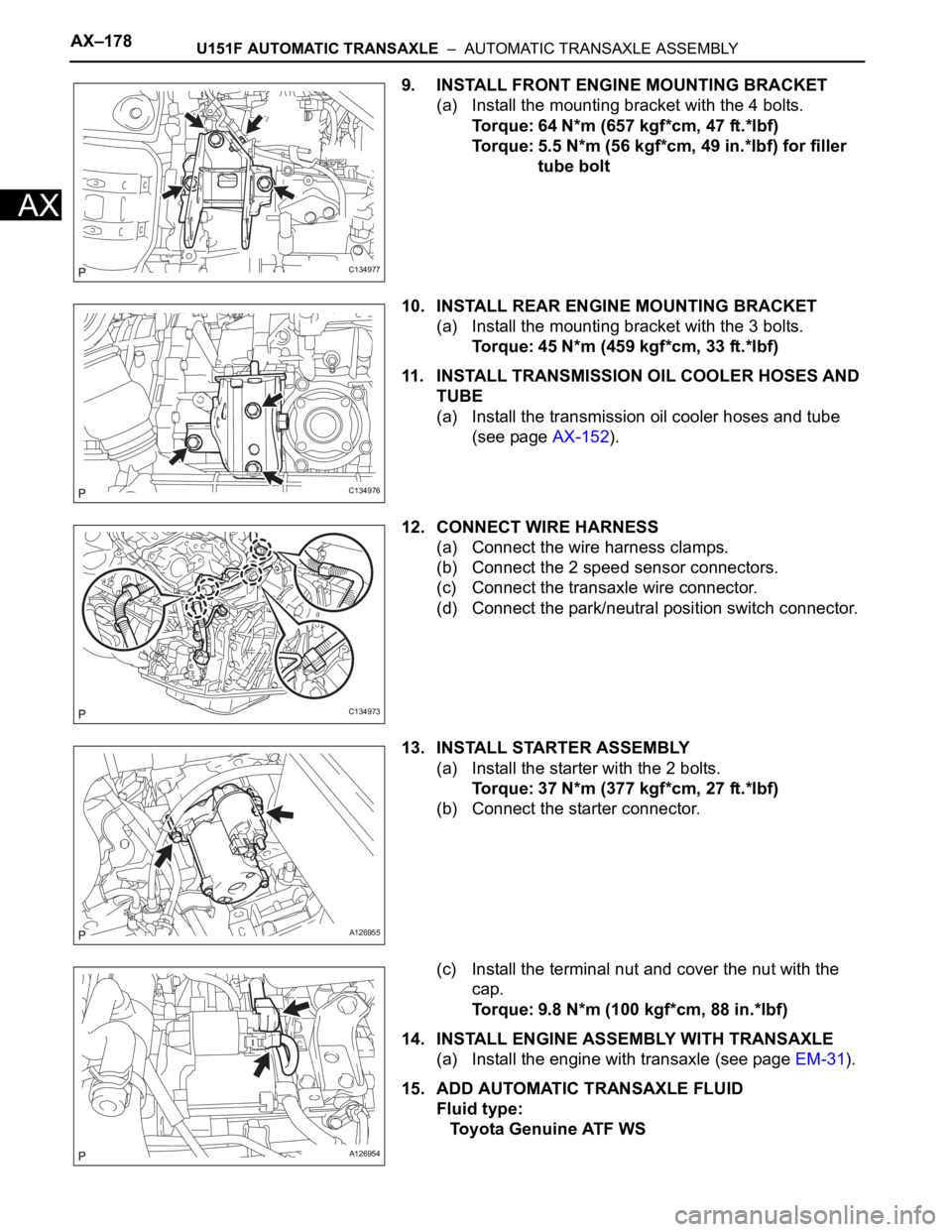
AX–178U151F AUTOMATIC TRANSAXLE – AUTOMATIC TRANSAXLE ASSEMBLY
AX
9. INSTALL FRONT ENGINE MOUNTING BRACKET
(a) Install the mounting bracket with the 4 bolts.
Torque: 64 N*m (657 kgf*cm, 47 ft.*lbf)
Torque: 5.5 N*m (56 kgf*cm, 49 in.*lbf) for filler
tube bolt
10. INSTALL REAR ENGINE MOUNTING BRACKET
(a) Install the mounting bracket with the 3 bolts.
Torque: 45 N*m (459 kgf*cm, 33 ft.*lbf)
11. INSTALL TRANSMISSION OIL COOLER HOSES AND
TUBE
(a) Install the transmission oil cooler hoses and tube
(see page AX-152).
12. CONNECT WIRE HARNESS
(a) Connect the wire harness clamps.
(b) Connect the 2 speed sensor connectors.
(c) Connect the transaxle wire connector.
(d) Connect the park/neutral position switch connector.
13. INSTALL STARTER ASSEMBLY
(a) Install the starter with the 2 bolts.
Torque: 37 N*m (377 kgf*cm, 27 ft.*lbf)
(b) Connect the starter connector.
(c) Install the terminal nut and cover the nut with the
cap.
Torque: 9.8 N*m (100 kgf*cm, 88 in.*lbf)
14. INSTALL ENGINE ASSEMBLY WITH TRANSAXLE
(a) Install the engine with transaxle (see page EM-31).
15. ADD AUTOMATIC TRANSAXLE FLUID
Fluid type:
Toyota Genuine ATF WS
C134977
C134976
C134973
A126955
A126954
Page 1170 of 2000
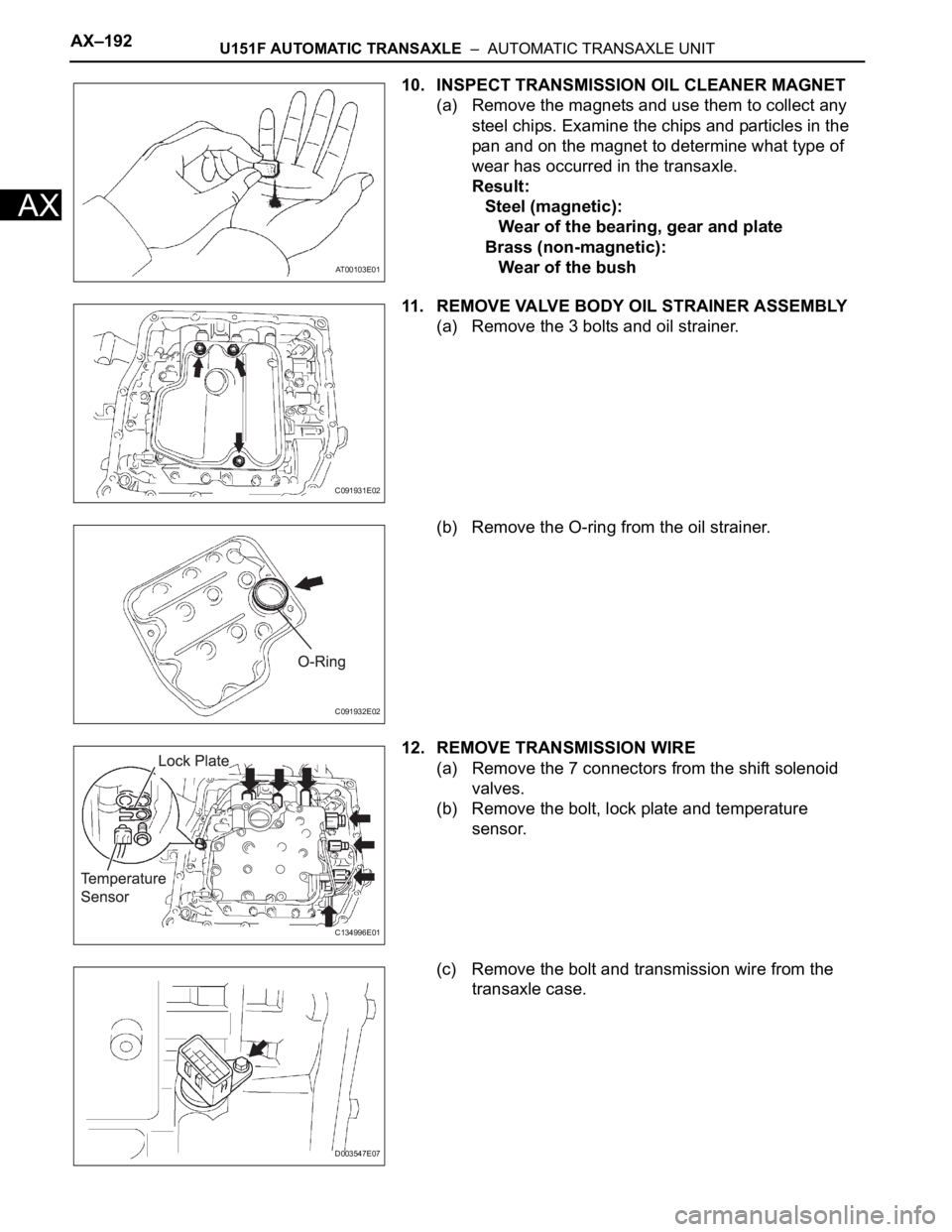
AX–192U151F AUTOMATIC TRANSAXLE – AUTOMATIC TRANSAXLE UNIT
AX
10. INSPECT TRANSMISSION OIL CLEANER MAGNET
(a) Remove the magnets and use them to collect any
steel chips. Examine the chips and particles in the
pan and on the magnet to determine what type of
wear has occurred in the transaxle.
Result:
Steel (magnetic):
Wear of the bearing, gear and plate
Brass (non-magnetic):
Wear of the bush
11. REMOVE VALVE BODY OIL STRAINER ASSEMBLY
(a) Remove the 3 bolts and oil strainer.
(b) Remove the O-ring from the oil strainer.
12. REMOVE TRANSMISSION WIRE
(a) Remove the 7 connectors from the shift solenoid
valves.
(b) Remove the bolt, lock plate and temperature
sensor.
(c) Remove the bolt and transmission wire from the
transaxle case.
AT00103E01
C091931E02
C091932E02
C134996E01
D003547E07
Page 1171 of 2000
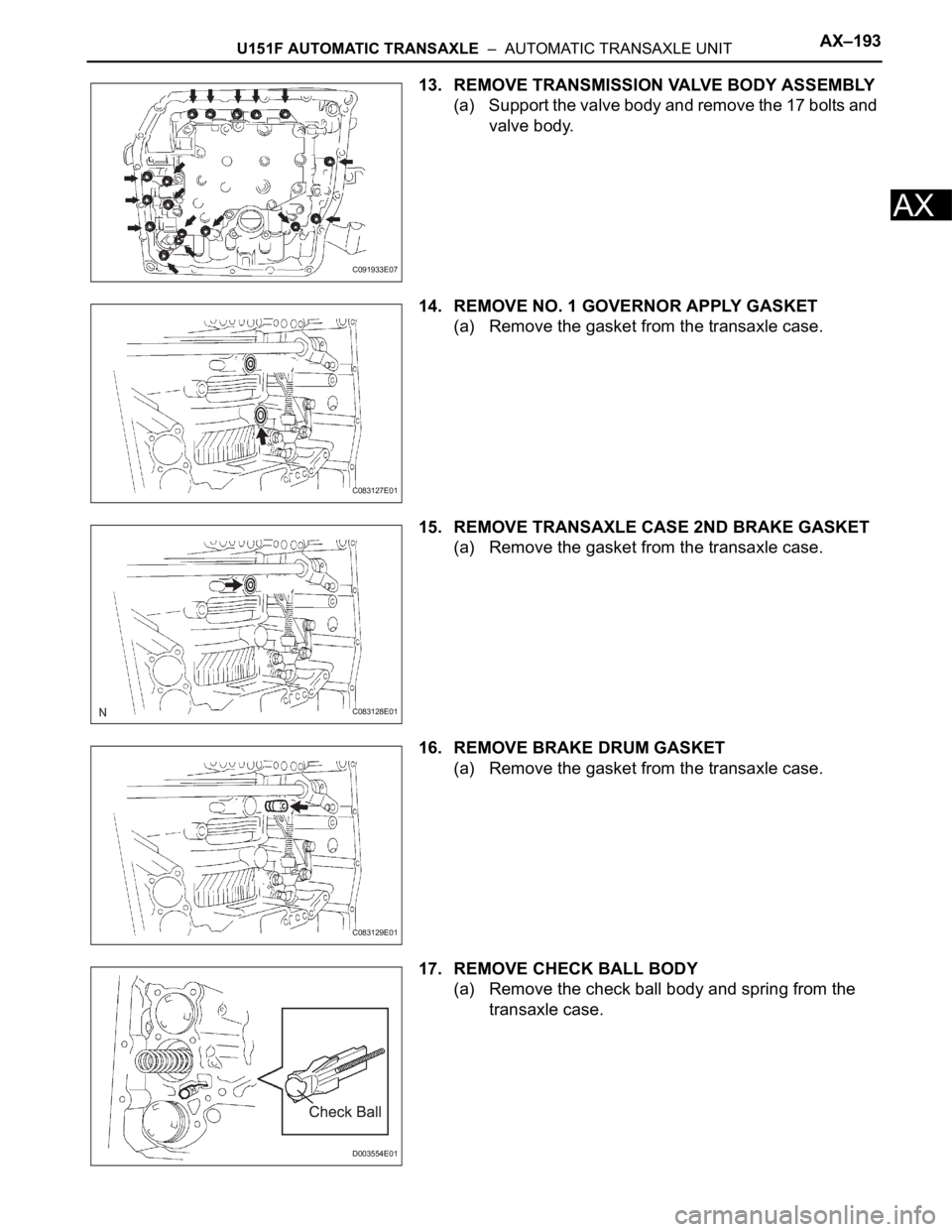
U151F AUTOMATIC TRANSAXLE – AUTOMATIC TRANSAXLE UNITAX–193
AX
13. REMOVE TRANSMISSION VALVE BODY ASSEMBLY
(a) Support the valve body and remove the 17 bolts and
valve body.
14. REMOVE NO. 1 GOVERNOR APPLY GASKET
(a) Remove the gasket from the transaxle case.
15. REMOVE TRANSAXLE CASE 2ND BRAKE GASKET
(a) Remove the gasket from the transaxle case.
16. REMOVE BRAKE DRUM GASKET
(a) Remove the gasket from the transaxle case.
17. REMOVE CHECK BALL BODY
(a) Remove the check ball body and spring from the
transaxle case.
C091933E07
C083127E01
C083128E01
C083129E01
D003554E01
Page 1218 of 2000
AX–240U151F AUTOMATIC TRANSAXLE – AUTOMATIC TRANSAXLE UNIT
AX
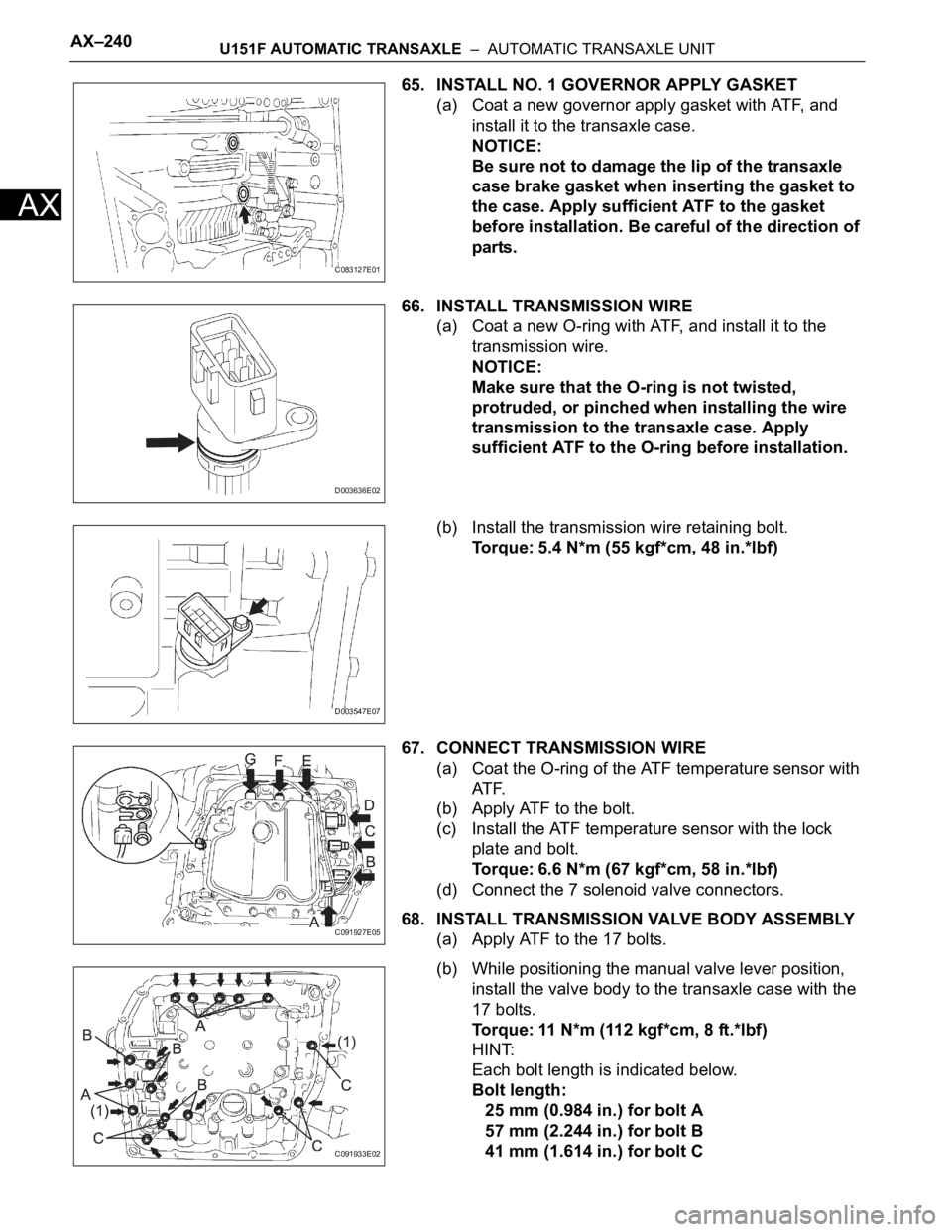
65. INSTALL NO. 1 GOVERNOR APPLY GASKET
(a) Coat a new governor apply gasket with ATF, and
install it to the transaxle case.
NOTICE:
Be sure not to damage the lip of the transaxle
case brake gasket when inserting the gasket to
the case. Apply sufficient ATF to the gasket
before installation. Be careful of the direction of
parts.
66. INSTALL TRANSMISSION WIRE
(a) Coat a new O-ring with ATF, and install it to the
transmission wire.
NOTICE:
Make sure that the O-ring is not twisted,
protruded, or pinched when installing the wire
transmission to the transaxle case. Apply
sufficient ATF to the O-ring before installation.
(b) Install the transmission wire retaining bolt.
Torque: 5.4 N*m (55 kgf*cm, 48 in.*lbf)
67. CONNECT TRANSMISSION WIRE
(a) Coat the O-ring of the ATF temperature sensor with
AT F.
(b) Apply ATF to the bolt.
(c) Install the ATF temperature sensor with the lock
plate and bolt.
Torque: 6.6 N*m (67 kgf*cm, 58 in.*lbf)
(d) Connect the 7 solenoid valve connectors.
68. INSTALL TRANSMISSION VALVE BODY ASSEMBLY
(a) Apply ATF to the 17 bolts.
(b) While positioning the manual valve lever position,
install the valve body to the transaxle case with the
17 bolts.
Torque: 11 N*m (112 kgf*cm, 8 ft.*lbf)
HINT:
Each bolt length is indicated below.
Bolt length:
25 mm (0.984 in.) for bolt A
57 mm (2.244 in.) for bolt B
41 mm (1.614 in.) for bolt C
C083127E01
D003636E02
D003547E07
C091927E05
C091933E02