heater TOYOTA RAV4 2006 Service Workshop Manual
[x] Cancel search | Manufacturer: TOYOTA, Model Year: 2006, Model line: RAV4, Model: TOYOTA RAV4 2006Pages: 2000, PDF Size: 45.84 MB
Page 1949 of 2000

2AZ-FE ENGINE CONTROL SYSTEM – SFI SYSTEMES–61
ES
P0171 System Too Lean
(Bank 1)- Air induction system
- Injector blockage
- MAF meter
- ECT sensor
- Fuel pressure
- Gas leakage from
exhaust system
- Open or short in A/F
sensor (sensor 1)
circuit
- A/F sensor (sensor
1)
- A/F sensor heater
(sensor 1)
- Integration relay
(EFI MAIN relay)
- A/F sensor heater
and EFI MAIN relay
circuits
- PCV hose
connections
- PCV valve and hose
- ECMComes on DTC storedES-147
P0172 System Too Rich
(Bank 1)- Injector leakage or
blockage
- MAF meter
- ECT sensor
- Ignition system
- Fuel pressure
- Gas leakage from
exhaust system
- Open or short in A/F
sensor (sensor 1)
circuit
- A/F sensor (sensor
1)
- A/F sensor heater
(sensor 1)
- Integration relay
(EFI MAIN relay)
- A/F sensor heater
and EFI MAIN relay
circuits
- ECMComes on DTC storedES-147
P0220 Throttle / Pedal
Position Sensor /
Switch "B" Circuit- TP sensor (built into
throttle body)
- ECMComes on DTC storedES-114
P0222 Throttle / Pedal
Position Sensor /
Switch "B" Circuit
Low Input- TP sensor (built into
throttle body)
- Short in VTA2 circuit
- Open in VC circuit
- ECMComes on DTC storedES-114
P0223 Throttle / Pedal
Position Sensor /
Switch "B" Circuit
High Input- TP sensor (built into
throttle body)
- Open in VTA2 circuit
- Open in E2 circuit
- Short between VC
and VTA2 circuits
- ECMComes on DTC storedES-114 DTC No. Detection Item Trouble Areas MIL Memory See page
Page 1955 of 2000

2AZ-FE ENGINE CONTROL SYSTEM – SFI SYSTEMES–67
ES
P2128 Throttle / Pedal
Position Sensor /
Switch "E" Circuit
High Input- APP sensor
- Open in EPA2
circuit
- ECMComes on DTC storedES-282
P2135 Throttle / Pedal
Position Sensor /
Switch "A" / "B"
Voltage Correlation- Short between
VTA1 and VTA2
circuits
- TP sensor (built into
throttle body)
- ECMComes on DTC storedES-114
P2138 Throttle / Pedal
Position Sensor /
Switch "D" / "E"
Voltage Correlation- Short between VPA
and VPA2 circuits
- APP sensor
- ECMComes on DTC storedES-282
P2195 Oxygen (A/F) Sensor
Signal Stuck Lean
(Bank 1 Sensor 1)- Open or short in A/F
sensor (sensor 1)
circuit
- A/F sensor (sensor
1)
- A/F sensor heater
(sensor 1)
- Integration relay
(EFI MAIN relay)
- A/F sensor heater
and EFI MAIN relay
circuits
- ECMComes on DTC storedES-292
P2196 Oxygen (A/F) Sensor
Signal Stuck Rich
(Bank 1 Sensor 1)- Same as DTC
P2195Comes on DTC storedES-292
P2238 Oxygen (A/F) Sensor
Pumping Current
Circuit Low (Bank 1
Sensor 1)- Open or short in A/F
sensor (sensor 1)
circuit
- A/F sensor (sensor
1)
- A/F sensor heater
(sensor 1)
- Integration relay
(EFI MAIN relay)
- A/F sensor heater
and EFI MAIN relay
circuits
- ECMComes on DTC storedES-306
P2239 Oxygen (A/F) Sensor
Pumping Current
Circuit High (Bank 1
Sensor 1)- Same as DTC
P2238Comes on DTC storedES-306
P2252 Oxygen (A/F) Sensor
Reference Ground
Circuit Low (Bank 1
Sensor 1)- Same as DTC
P2238Comes on DTC storedES-306
P2253 Oxygen (A/F) Sensor
Reference Ground
Circuit High (Bank 1
Sensor 1)- Same as DTC
P2238Comes on DTC storedES-306 DTC No. Detection Item Trouble Areas MIL Memory See page
Page 1969 of 2000
2AZ-FE ENGINE CONTROL SYSTEM – SFI SYSTEMES–81
ES
HINT:
• Although the DTC titles say oxygen sensor, these DTCs relate to the Air-Fuel Ratio (A/F) sensor.
• Sensor 1 refers to the sensor mounted in front of the Three-Way Catalytic Converter (TWC) and
located near the engine assembly.
DESCRIPTION
Refer to DTC P2195 (see page ES-292).
HINT:
• When either of these DTCs is set, the ECM enters fail-safe mode. The ECM turns off the A/F sensor
heater in fail-safe mode. Fail-safe mode continues until the ignition switch is turned OFF.
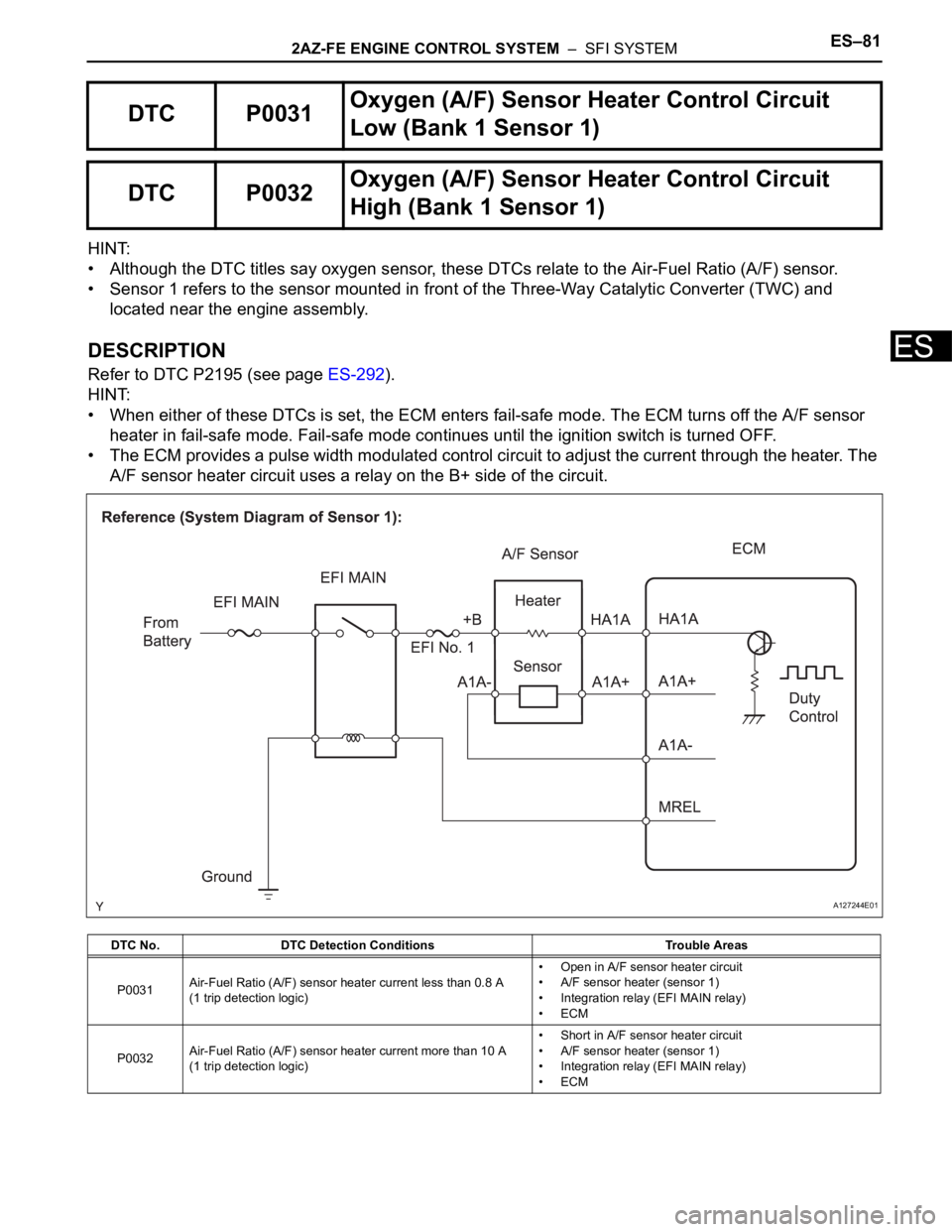
• The ECM provides a pulse width modulated control circuit to adjust the current through the heater. The
A/F sensor heater circuit uses a relay on the B+ side of the circuit.
DTC P0031Oxygen (A/F) Sensor Heater Control Circuit
Low (Bank 1 Sensor 1)
DTC P0032Oxygen (A/F) Sensor Heater Control Circuit
High (Bank 1 Sensor 1)
DTC No. DTC Detection Conditions Trouble Areas
P0031Air-Fuel Ratio (A/F) sensor heater current less than 0.8 A
(1 trip detection logic)• Open in A/F sensor heater circuit
• A/F sensor heater (sensor 1)
• Integration relay (EFI MAIN relay)
•ECM
P0032Air-Fuel Ratio (A/F) sensor heater current more than 10 A
(1 trip detection logic)• Short in A/F sensor heater circuit
• A/F sensor heater (sensor 1)
• Integration relay (EFI MAIN relay)
•ECM
A127244E01
Page 1970 of 2000

ES–822AZ-FE ENGINE CONTROL SYSTEM – SFI SYSTEM
ES
MONITOR DESCRIPTION
The ECM uses information from the Air-Fuel Ratio (A/F) sensor to regulate the air-fuel ratio and keep it
close to the stoichiometric level. This maximizes the ability of the Three-Way Catalytic Converter (TWC) to
purify the exhaust gases.
The A/F sensor detects oxygen levels in the exhaust gas and transmits the information to the ECM. The
inner surface of the sensor element is exposed to the outside air. The outer surface of the sensor element
is exposed to the exhaust gas. The sensor element is made of platinum coated zirconia and includes an
integrated heating element.
The zirconia element generates a small voltage when there is a large difference in the oxygen
concentrations between the exhaust gas and outside air. The platinum coating amplifies this voltage
generation.
The A/F sensor is more efficient when heated. When the exhaust gas temperature is low, the sensor
cannot generate useful voltage signals without supplementary heating. The ECM regulates the
supplementary heating using a duty-cycle approach to adjust the average current in the sensor heater
element. If the heater current is outside the normal range, the signal transmitted by the A/F sensor
becomes inaccurate, as a result, the ECM is unable to regulate air-fuel ratio properly.
When the current in the A/F sensor heater is outside the normal operating range, the ECM interprets this
as a malfunction in the sensor heater and sets a DTC.
Example:
The ECM sets DTC P0032 when the current in the A/F sensor heater is more than 10 A. Conversely,
when the heater current is less than 0.8 A, DTC P0031 is set.
MONITOR STRATEGY
TYPICAL ENABLING CONDITIONS
All:
P0031:
P0032:
TYPICAL MALFUNCTION THRESHOLDS
P0031:
P0032:
Related DTCsP0031: A/F sensor heater open/short (Low electrical current)
P0032: A/F sensor heater open/short (High electrical current)
Required Sensors/Components (Main) A/F sensor heater
Required Sensors/Components (Related) -
Frequency of Operation Continuous
Duration 10 seconds
MIL Operation Immediate
Sequence of Operation None
Monitor runs whenever following DTCs not present None
Battery voltage 10.5 V or more
A/F sensor heater duty-cycle ratio 50 % or more
Time after engine start 10 seconds or more
Time after engine start 10 seconds or more
A/F sensor heater current Less than 0.8 A
A/F sensor heater current More than 10 A
Page 1971 of 2000
2AZ-FE ENGINE CONTROL SYSTEM – SFI SYSTEMES–83
ES
COMPONENT OPERATING RANGE
WIRING DIAGRAM
Refer to DTC P2195 (see page ES-296).
INSPECTION PROCEDURE
HINT:
Read freeze frame data using the intelligent tester. Freeze frame data records the engine condition when
malfunctions are detected. When troubleshooting, freeze frame data can help determine if the vehicle was
moving or stationary, if the engine was warmed up or not, if the air-fuel ratio was lean or rich, and other
data from the time the malfunction occurred.
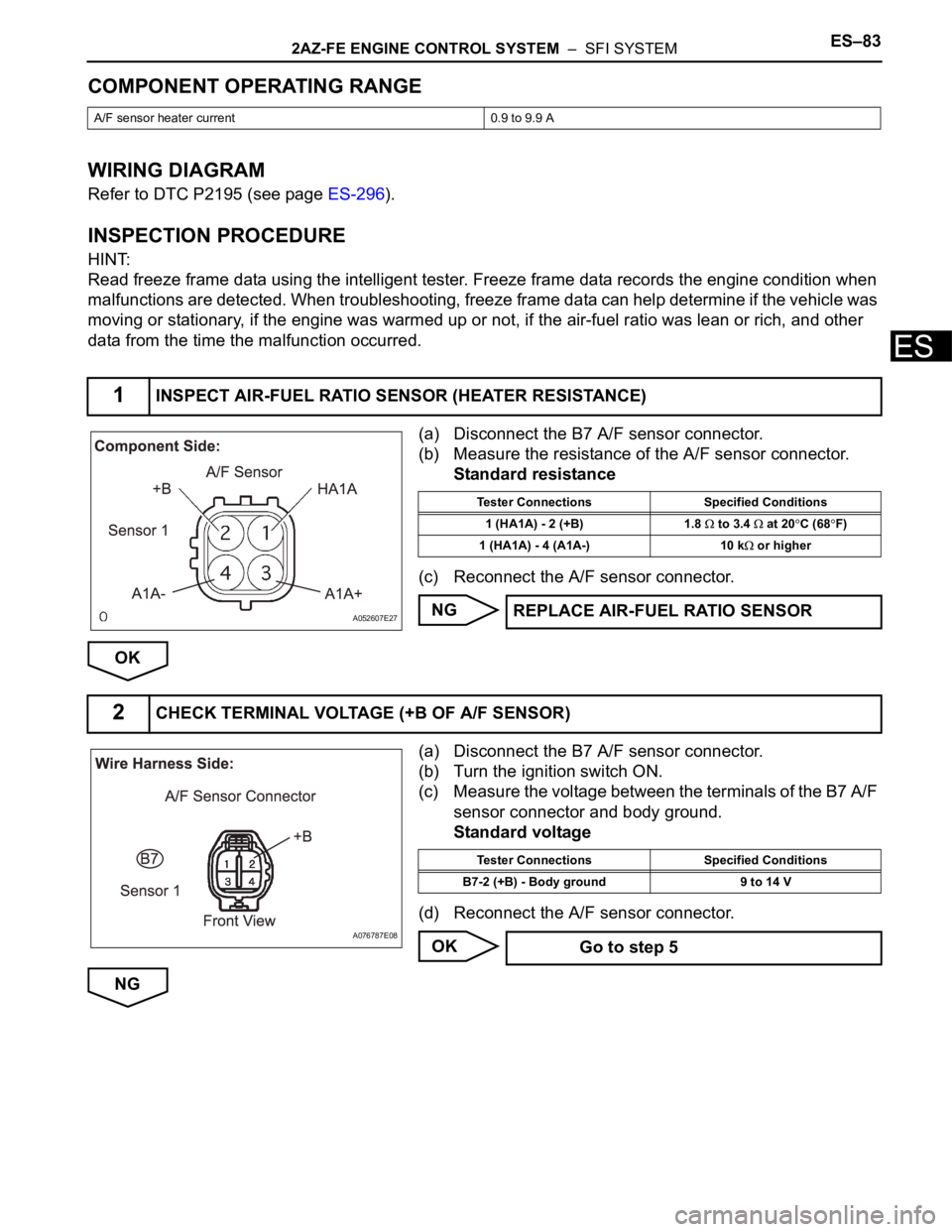
(a) Disconnect the B7 A/F sensor connector.
(b) Measure the resistance of the A/F sensor connector.
Standard resistance
(c) Reconnect the A/F sensor connector.
NG
OK
(a) Disconnect the B7 A/F sensor connector.
(b) Turn the ignition switch ON.
(c) Measure the voltage between the terminals of the B7 A/F
sensor connector and body ground.
Standard voltage
(d) Reconnect the A/F sensor connector.
OK
NG
A/F sensor heater current 0.9 to 9.9 A
1INSPECT AIR-FUEL RATIO SENSOR (HEATER RESISTANCE)
A052607E27
Tester Connections Specified Conditions
1 (HA1A) - 2 (+B) 1.8
to 3.4 at 20C (68F)
1 (HA1A) - 4 (A1A-) 10 k
or higher
REPLACE AIR-FUEL RATIO SENSOR
2CHECK TERMINAL VOLTAGE (+B OF A/F SENSOR)
A076787E08
Tester Connections Specified Conditions
B7-2 (+B) - Body ground 9 to 14 V
Go to step 5
Page 1975 of 2000
2AZ-FE ENGINE CONTROL SYSTEM – SFI SYSTEMES–87
ES
DESCRIPTION
Refer to DTC P0136 (see page ES-129).
HINT:
• When any of these DTCs are set, the ECM enters fail-safe mode. The ECM turns off the Heated
Oxygen (HO2) Sensor heater in fail-safe mode. Fail-safe mode continues until the ignition switch is
turned OFF.
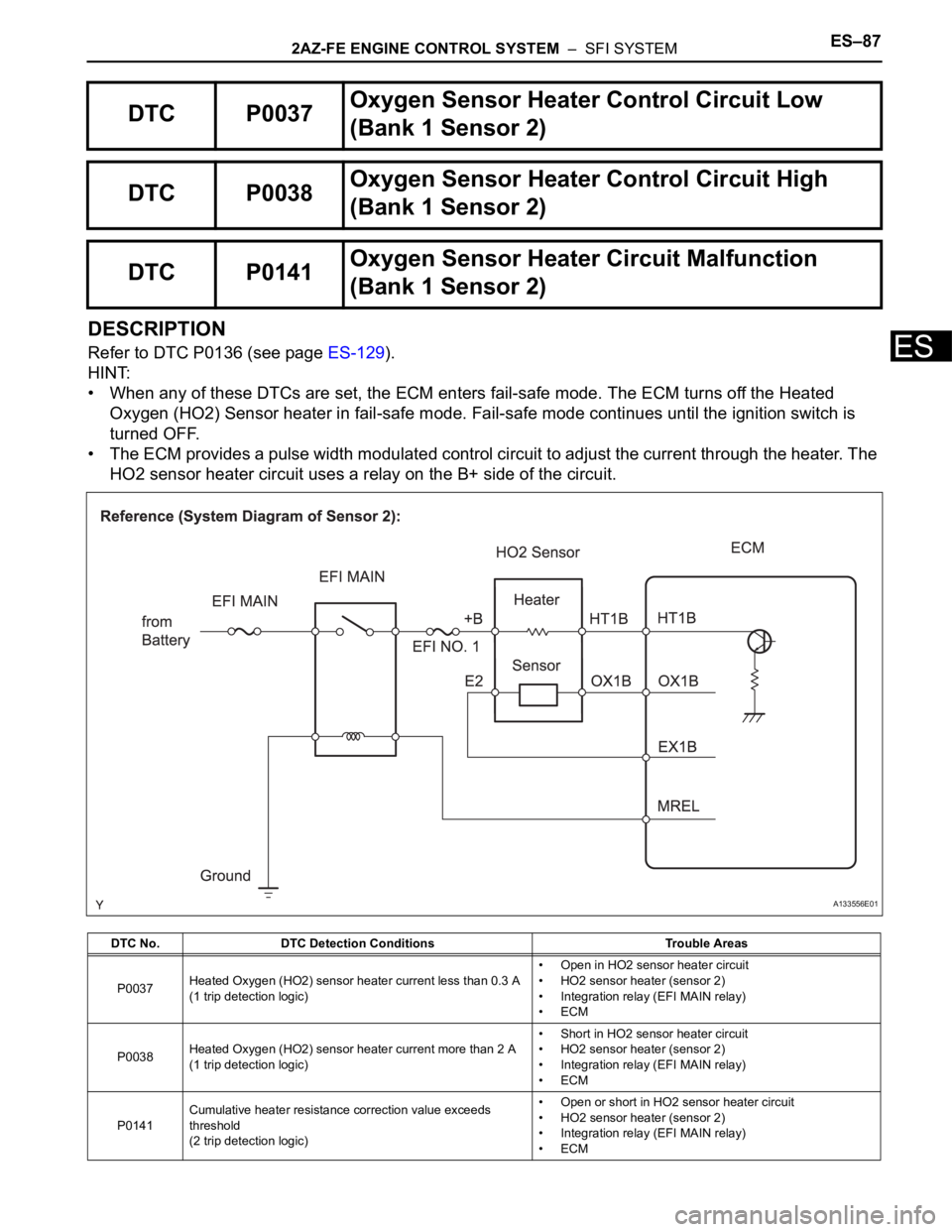
• The ECM provides a pulse width modulated control circuit to adjust the current through the heater. The
HO2 sensor heater circuit uses a relay on the B+ side of the circuit.
DTC P0037Oxygen Sensor Heater Control Circuit Low
(Bank 1 Sensor 2)
DTC P0038Oxygen Sensor Heater Control Circuit High
(Bank 1 Sensor 2)
DTC P0141Oxygen Sensor Heater Circuit Malfunction
(Bank 1 Sensor 2)
DTC No. DTC Detection Conditions Trouble Areas
P0037Heated Oxygen (HO2) sensor heater current less than 0.3 A
(1 trip detection logic)• Open in HO2 sensor heater circuit
• HO2 sensor heater (sensor 2)
• Integration relay (EFI MAIN relay)
•ECM
P0038Heated Oxygen (HO2) sensor heater current more than 2 A
(1 trip detection logic)• Short in HO2 sensor heater circuit
• HO2 sensor heater (sensor 2)
• Integration relay (EFI MAIN relay)
•ECM
P0141Cumulative heater resistance correction value exceeds
threshold
(2 trip detection logic)• Open or short in HO2 sensor heater circuit
• HO2 sensor heater (sensor 2)
• Integration relay (EFI MAIN relay)
•ECM
A133556E01
Page 1976 of 2000

ES–882AZ-FE ENGINE CONTROL SYSTEM – SFI SYSTEM
ES
MONITOR DESCRIPTION
The sensing position of the Heated Oxygen (HO2) sensor has a zirconia element which is used to detect
the oxygen concentration in the exhaust gas. If the zirconia element is at the appropriate temperature,
and the difference between the oxygen concentrations surrounding the inside and outside surfaces of the
sensor is large, the zirconia element generates voltage signals. In order to increase the oxygen
concentration detecting capacity of the zirconia element, the ECM supplements the heat from the exhaust
with heat from a heating element inside the sensor.
Heated oxygen sensor heater range check (P0037 and P0038):
The ECM monitors the current applied to the O2 sensor heater to check the heater for malfunctions. If the
current is below the threshold value, the ECM determines that there is an open circuit in the heater. If the
current is above the threshold value, the ECM determines that there is a short circuit in the heater.
The ECM constantly monitors the current applied to the heater. If the ECM detects an open or short
circuit, the ECM turns the MIL on and sets a DTC.
If a malfunction is detected, the ECM cuts off the current applied to the heater.
Example:
The ECM sets DTC P0038 when the current in the HO2 sensor heater is more than 2 A. Conversely,
when the heater current is less than 0.3 A, DTC P0037 is set.
Heated oxygen sensor heater performance (P0141):
After the accumulated heater ON time exceeds 100 seconds, the ECM calculates the heater resistance
using the battery voltage and the current applied to the heater.
If the resistance is above the threshold value, the ECM determines that there is a malfunction in the HO2
sensor heater and set DTC P0141.
MONITOR STRATEGY
TYPICAL ENABLING CONDITIONS
All:
P0037:
P0038:
P0141 (Heater performance monitor check):
Related DTCsP0037: Heated oxygen sensor heater range check (Low electrical
current)
P0038: Heated oxygen sensor heater range check (High electrical
current)
P0141: Heated oxygen sensor heater performance
Required Sensors/Components (Main) Heated oxygen sensor heater
Required Sensors/Components (Related) -
Frequency of OperationContinuous: P0037 and P0038
Once per driving cycle: P0141
Duration1 second: P0037 and P0038
10 seconds: P0141
MIL OperationImmediate: P0037 and P0038
2 driving cycles: P0141
Sequence of Operation None
Monitor runs whenever following DTCs not present None
Battery voltage 10.5 to 20 V
Battery voltage 10.5 to 20 V
All of following conditions met: -
Battery voltage 10.5 V or more
Fuel cut OFF
Time after fuel cut ON to OFF 30 seconds or more
Page 1977 of 2000
2AZ-FE ENGINE CONTROL SYSTEM – SFI SYSTEMES–89
ES
TYPICAL MALFUNCTION THRESHOLDS
P0037:
P0038:
P0141 (Heater performance monitor check):
COMPONENT OPERATING RANGE
WIRING DIAGRAM
Refer to DTC P0136 (see page ES-136).
CONFIRMATION DRIVING PATTERN
These DTCs are detected when the engine idles for 110 seconds or more.
INSPECTION PROCEDURE
HINT:
Sensor 2 refers to the sensor mounted behind the Three-Way Catalytic Converter (TWC) and located far
from the engine assembly.
Read freeze frame data using the intelligent tester. Freeze frame data records the engine condition when
malfunctions are detected. When troubleshooting, freeze frame data can help determine if the vehicle was
moving or stationary, if the engine was warmed up or not, if the air-fuel ratio was lean or rich, and other
data from the time the malfunction occurred.
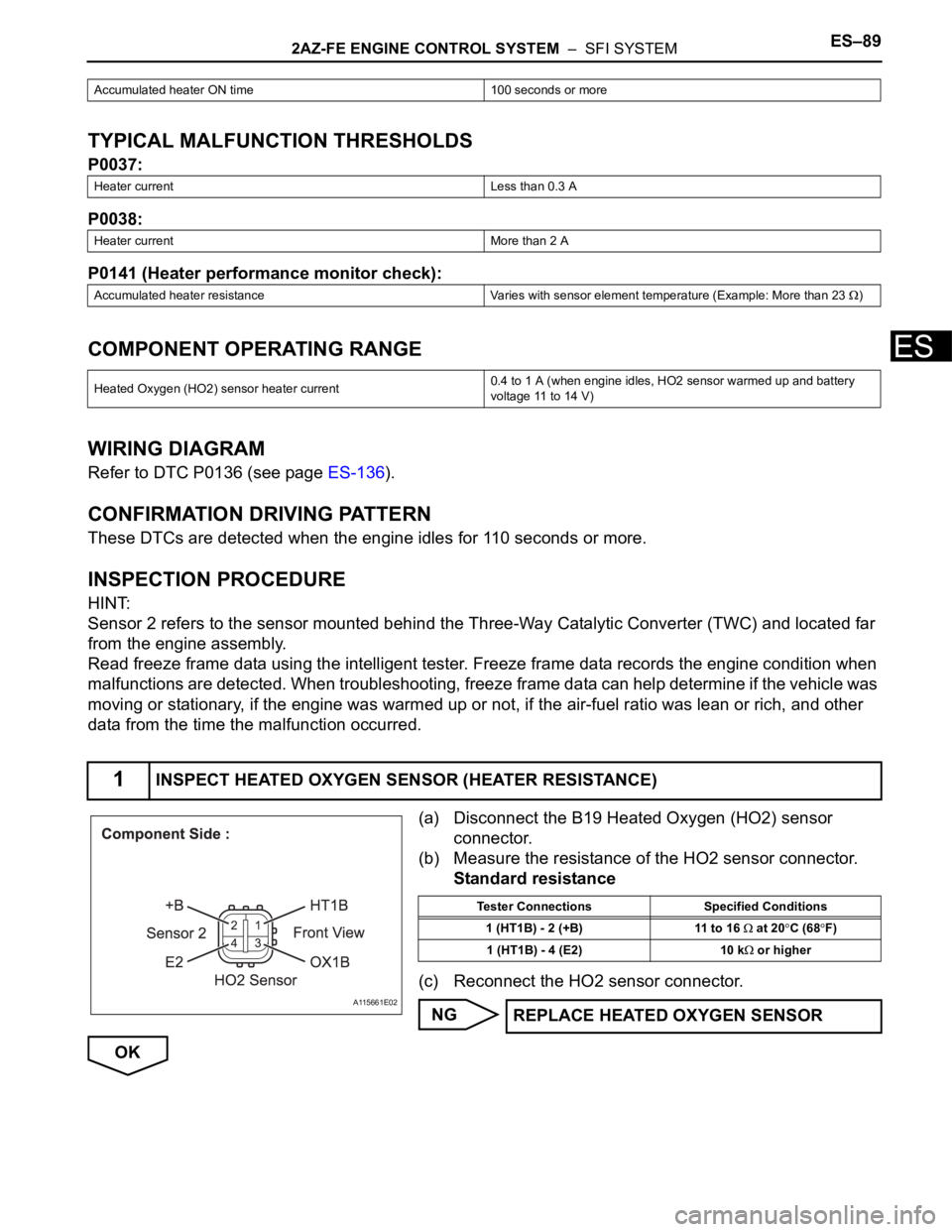
(a) Disconnect the B19 Heated Oxygen (HO2) sensor
connector.
(b) Measure the resistance of the HO2 sensor connector.
Standard resistance
(c) Reconnect the HO2 sensor connector.
NG
OK
Accumulated heater ON time 100 seconds or more
Heater current Less than 0.3 A
Heater current More than 2 A
Accumulated heater resistance Varies with sensor element temperature (Example: More than 23
)
Heated Oxygen (HO2) sensor heater current0.4 to 1 A (when engine idles, HO2 sensor warmed up and battery
voltage 11 to 14 V)
1INSPECT HEATED OXYGEN SENSOR (HEATER RESISTANCE)
A115661E02
Tester Connections Specified Conditions
1 (HT1B) - 2 (+B) 11 to 16
at 20C (68F)
1 (HT1B) - 4 (E2) 10 k
or higher
REPLACE HEATED OXYGEN SENSOR